Club-Face Impact Tape vs Washable Marking Products: What to Check
A clear imprint is useful only when the product suits the surface and you can remove it by the approved method.
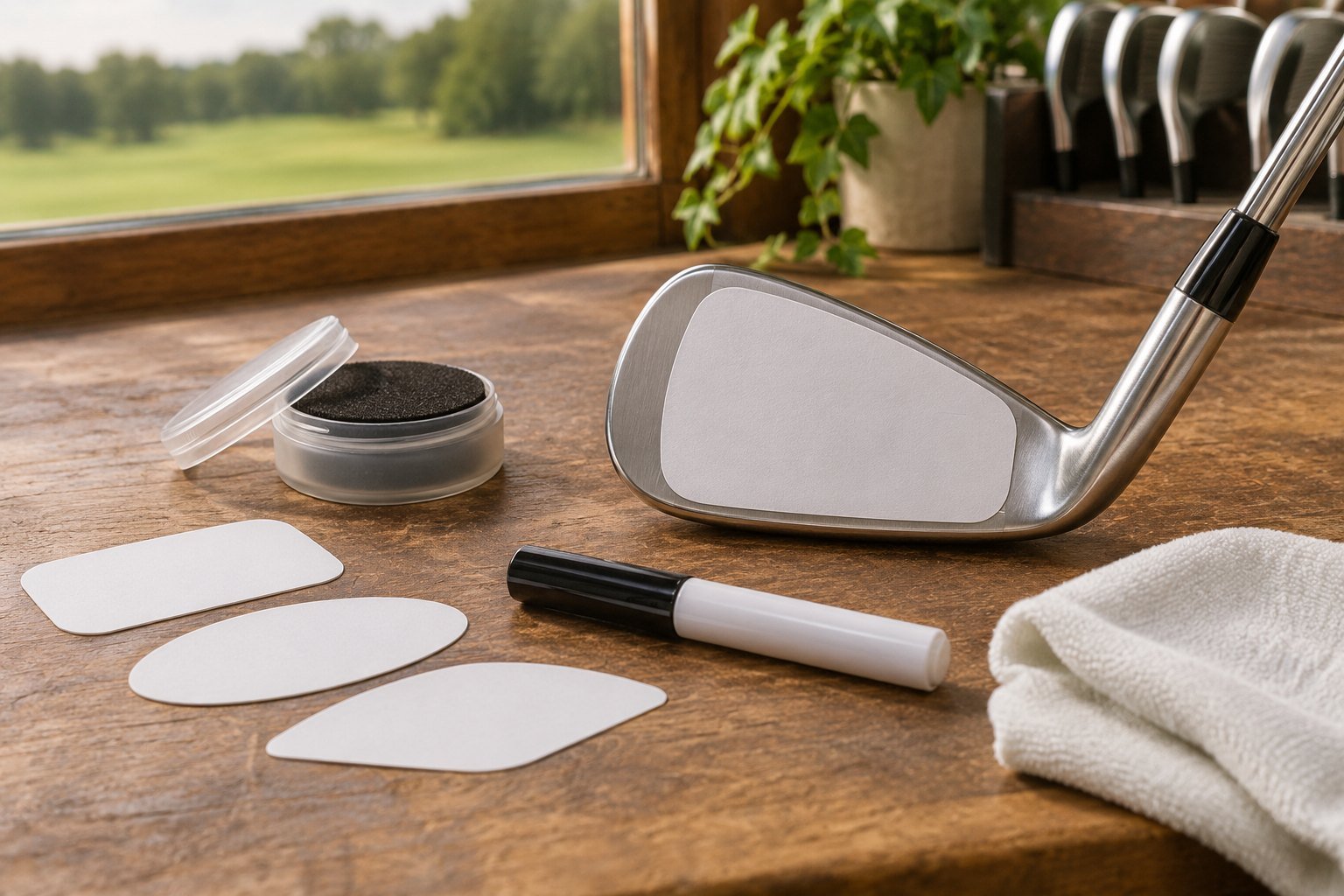
AI illustration of feedback formats; no named product or compatibility test is pictured.
Impact tape and washable face-marking products can leave a visible record of ball contact. Choosing between them involves more than the sharpness of the imprint: the label must fit, the product must suit the actual surface, and the removal method must fit your club’s care instructions.
This research-led guide uses named manufacturer examples to explain those checks. It does not claim a hands-on adhesive, finish-safety or cleaning test.
Identify the club model and face finish, then confirm that the marking product is intended and suitable for it.
Choose the right label shape or coverage and keep new impacts distinguishable from earlier marks.
Know the specified removal method before applying anything. Easy-to-clean marketing is not a complete care instruction.
Compare the intended surface and the removal method
Start with products made for face-contact feedback. A ball-identification pen, grip tape or household washable marker has a different intended job. A familiar description such as “water-based” does not establish that it belongs on a particular club face.
Scroll within the table to see every column.
| Format and manufacturer example | What the maker specifies | What you still need to check |
|---|---|---|
| Impact labels: SWVL Sports | Separate driver and iron shapes, designed for right-handed golfers; low-tack adhesive intended to remove without residue. [1] | Shape, handedness, face finish and any restrictions on adhesive use. |
| Golf face spray: Impact Detect | A light clubface coating, drying time and towel removal. [2] | Exact can instructions, handling requirements, venue permission and club compatibility. |
| Golf marking pen: ImpactPen | Colour applied to the clubface; its FAQ specifies removal with a damp cloth. [3] | Instructions for your finish, priming and storage; UK supply and delivery before ordering. |
These are examples of product formats, not a tested ranking or a promise that every product in a category behaves alike. The pen example establishes the intended surface and cleaning claim; it is not a verified UK delivery offer.
Reject a listing that leaves you guessing whether “impact tape” means a face label or a different fitting label. Likewise, a promise that ink washes from a whiteboard or fabric does not answer whether it can be removed from your club by its permitted cleaning method.
Back to the top ↑Match the product to the actual club face
Write down the model, approximate generation and face finish before asking about compatibility. “An iron” or “a driver” may not identify the surface on which the product will sit. Note any insert, coating or painted edge close to the area you intend to mark.
Ask two separate questions: does the feedback-product maker support that use, and does the club maker’s care guidance permit the application and removal method? Neither a generic “safe on clubs” claim nor your usual cleaning routine answers both.
- Check that you have the exact product and formulation covered by the instructions.
- Confirm the intended area: club face, rather than crown, shaft, grip or ball.
- Read application, removal and storage instructions before purchase.
- Resolve any conflict with the club’s care instructions with the manufacturer or an authorised service contact.
A photograph of the clean face before the session helps distinguish an existing mark from a new one. It does not prove compatibility. Do not use an inconspicuous patch test as a substitute for missing approval on an expensive or uncertain finish.

Treat impact labels as removable records
Choose a label intended for the club and handedness. SWVL’s examples are explicitly shaped for right-handed driver and iron faces. A mixed pack can therefore contain labels that do not suit the club you intend to practise with. [1]
Prepare the face by the club maker’s permitted method and follow the label instructions for fitting it. Check that the adhesive area lies properly on the intended surface, without a fold, loose edge or unintended overlap onto another finish. Do not assume that trimming an unsuitable label produces a manufacturer-approved fit.
Keep the reference consistent. A target printed on a label is an aid to reading that label; its position does not independently locate the optimum impact point of your club. If the label moved, lifted or wrinkled, record the attempt as uncertain rather than using the mark to change your swing.
Take a photograph before removal if you want a record. Multiple hits may be useful while their impressions remain distinguishable, but a crowded patch no longer identifies each individual strike.
A claim of residue-free removal does not establish compatibility with an unlisted finish. Remove the label as instructed after practice. If it leaves adhesive or begins lifting a finish, stop and seek the appropriate care advice; do not escalate to scraping or an unapproved solvent.

Follow the exact spray or pen instructions
For Impact Detect specifically, the maker’s FAQ says to shake the can, apply a light coating from about 10cm, allow roughly 10 seconds for it to dry and whiten, then inspect the ball-contact mark and remove residue with a towel. Do not transfer those timings or distances to a different product. [2]
A thick layer is not automatically a better record. Use the prescribed application rather than repeatedly adding material because the first attempt was unclear. Check the product, surface preparation and allowed ball type before deciding that more coating is the answer.
For a purpose-made pen, follow its own priming, coverage, drying and closure instructions. ImpactPen’s published cleaning advice is a damp cloth; that does not make an ordinary permanent or whiteboard marker equivalent. [3]
Read the can label before choosing where to apply it
For an aerosol, obtain the current label and, if the handling information is unclear, the matching Safety Data Sheet. Check ventilation requirements, ignition-source restrictions and storage conditions for the exact product. Confirm that the venue permits its use. “Easy to clean” does not answer any of those questions.
If you cannot obtain or meet the handling instructions, leave that aerosol out of the setup. A compatible non-aerosol product may be more practical, but it still needs its own surface and removal checks. Do not substitute a cosmetic or household spray because it happens to leave a visible powder.
Back to the top ↑Check the record before interpreting the strike
The first question after a shot is whether the visible mark belongs to that shot. A fresh application or label makes this easier to establish. When marks overlap, reset or replace the recording surface before the question becomes impossible to answer.
Scroll within the table to see every column.
| What you see | What to check first | Reasonable next action |
|---|---|---|
| A clear new imprint | Correct label position or coverage; no earlier mark in the same area. | Record its location on this club. |
| One broad dark patch | Several overlapping strikes or an uneven application. | Reset and separate the next attempts. |
| A displaced or distorted imprint | Label movement, a fold, incomplete drying or uncertain application. | Correct the recording setup before drawing conclusions. |
| No useful mark | Product instructions, surface preparation and the permitted practice ball. | Record an unreadable attempt; do not invent a strike location. |
Contact location and normal playing performance are different questions. A USGA/R&A technical study included impact tape and found reduced spin under its specified wet iron-test conditions. That result is not a universal correction factor for every label, spray or club. [4]
For distance or spin comparisons, ask the fitter whether the measurement protocol permits the material and confirm results with the required clean-face condition. A sharp imprint is useful evidence of contact; it is not proof that every other impact condition remained unchanged.
Build removal into the practice session
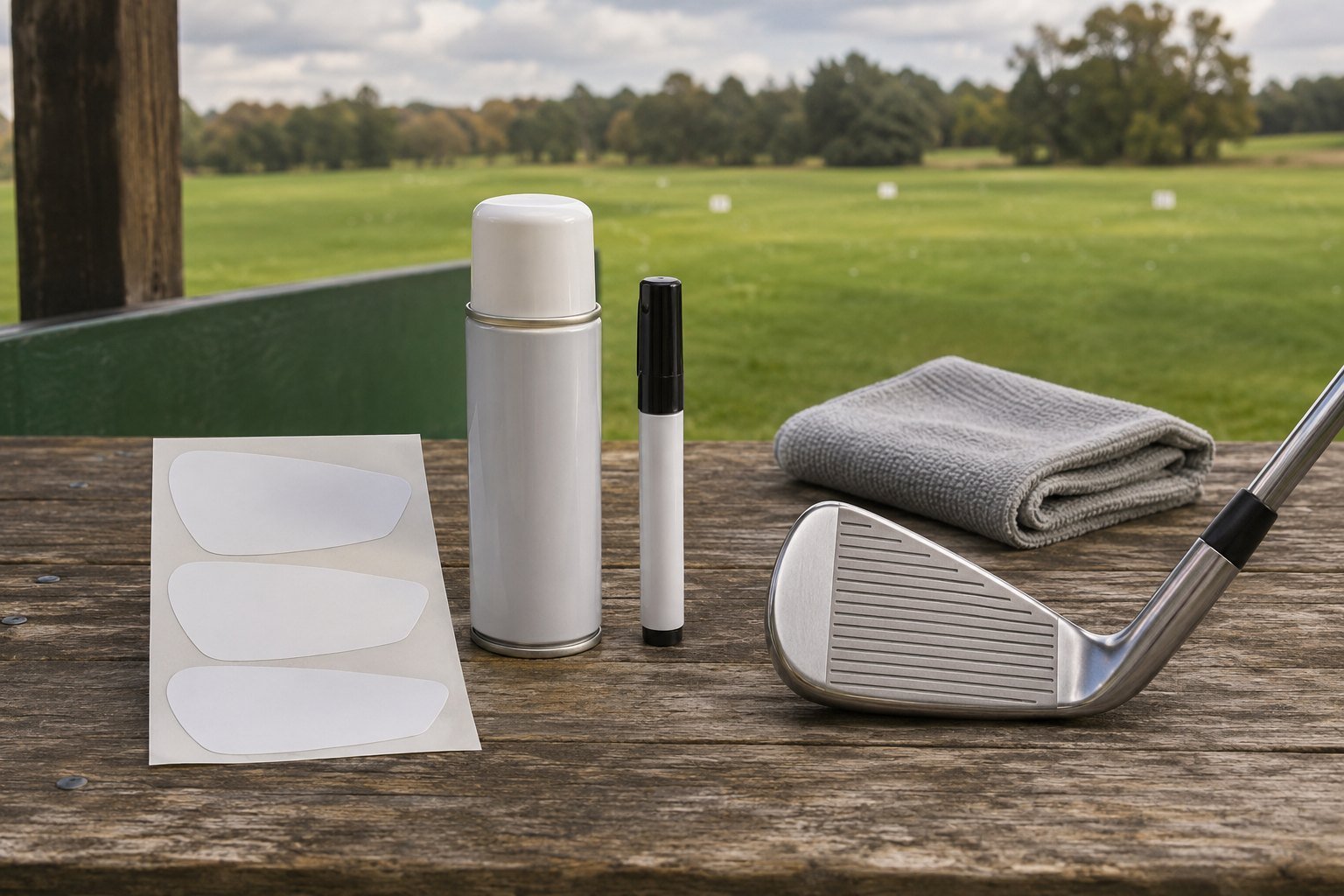
Have the specified cleaning materials ready before applying the product. A soft cloth you already own may be sufficient when it matches both sets of instructions; there is no automatic need for a separate cleaning kit.
- Save the observation. Photograph the face or note the strike location before removing the evidence.
- Use the product’s removal method. Peel labels or wipe coatings as directed. Do not treat one brand’s damp-cloth instruction as the rule for every product.
- Inspect the face and grooves. Look for adhesive, coating or loose label material that remains. Check nearby edges as well as the centre.
- Check anything that contacted the material. If it transferred to a ball, towel or another surface, follow that item’s care instructions too. A clubface cleaning claim does not establish compatibility with a simulator screen.
- Finish according to the club’s care instructions. Keep the face clean and dry as appropriate before storing it or returning to play.
If ordinary instructed removal leaves a persistent mark or residue, pause further applications. Record the exact product and club, photograph the issue and ask the relevant maker what to do next. A stronger chemical or more force is not a sensible default response to an unresolved compatibility question.
A useful care record is short: club and finish → product → application method → removal method → result. Keep it alongside the practice photograph. “Clear imprint, removed by the specified method” is a more complete assessment than “good feedback” alone.
Back to the top ↑Calculate cost from the consumables you can actually use
Count usable labels for your task, rather than dividing by the largest number on the packet. SWVL’s 52-label example contains 26 driver and 26 iron labels. If you only need the iron shape, the other half is not immediately useful to that session. [1]
Illustrative arithmetic, not a current quote: a £12 delivered mixed pack with 26 suitable labels costs about 46p per suitable label, rather than 23p across all 52. If you genuinely use both shapes, the whole-pack calculation becomes relevant. Neither figure predicts how many distinct shots each label will record.
Use the same discipline with liquid products. An illustrative £10 can yielding 40 readable renewed applications costs 25p per application; 20 would make it 50p. Those are chosen examples, not measured yields. Record your actual usage and separate an application from the number of shots made before resetting it.
Include delivery and required cleaning materials, check replacement stock and confirm UK fulfilment before ordering from an overseas brand. For a small practice budget, the putting-focused small-space kit guide is a useful reminder to fund a defined task before collecting accessories.

Finish with a clean club before the playing round
Keep these products for permitted practice. Rule 4.1a requires conforming clubs for strokes; its exception allows a non-permissible face sticker to be removed before the club is used. Rule 4.1a(3) also addresses substances applied to affect performance. Removing material later does not undo a stroke already made in breach. [5]
Remove labels and coatings, check for residue and resolve any uncertainty with the Committee or referee before using the club in play.
Choose the format whose fit, surface compatibility, readable record and removal are all clear. Tape can be convenient when the correct label and adhesive are suitable. A golf-specific pen or spray can suit a different routine when its instructions are workable. If one of those four checks remains unanswered, postpone that product rather than testing the assumption on your club.
Back to the top ↑Sources and research
Research reviewed on 23 November 2026. Manufacturer descriptions, official guidance and retailer information are distinguished from the suggested comparisons and editorial recommendations in this guide.
- SWVL Sports — Golf Impact TapeLabel shapes, handedness, adhesive claims and pack split; checked 23 November 2026.
- Impact Detect — FAQProduct-specific application and removal instructions; checked 23 November 2026.
- ImpactPen — Product Information and FAQIntended clubface use and damp-cloth removal; UK delivery not established.
- USGA and R&A — R22-12: Spin Reduction Modifications to Existing Irons2021 technical report; findings limited to its test conditions.
- The R&A — Rule 4, The Player’s EquipmentCurrent Rule 4.1 wording; checked 23 November 2026.
Find more equipment guidance in Home Practice.
Illustrations in this article were created for Taylor’s Trailblazing Golf. Third-party photographs, where used, are credited beside the image or in the source list.