Swing Mirrors vs Video Tripods: Choosing Simple Visual Feedback
Choose an immediate reference or a saved recording by the question you need to answer.
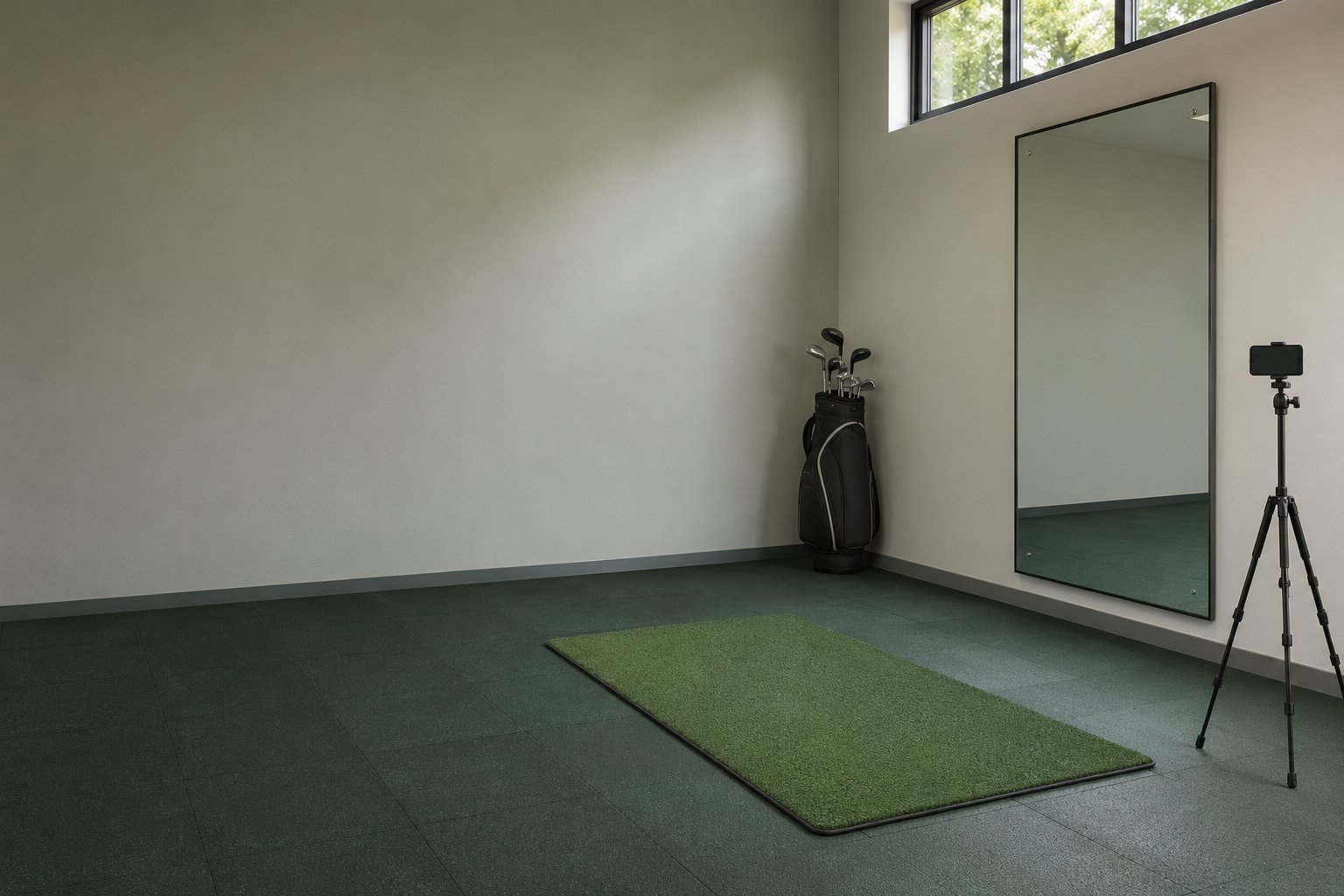
A mirror offers an immediate view; a fixed camera provides a recording to review afterwards. AI-created illustration of a generic practice space.
A full-length mirror can make a small change at address easy to see. A phone on a tripod can show what happened after you stopped thinking about it. Both are useful forms of visual feedback, but they ask different things of your practice space and your attention.
The best choice starts with a question you can answer from an image. “Can I recognise the setup my coach showed me?” is a useful brief. “Can this make my swing better?” is too broad to guide a purchase. Decide whether you need an immediate reference, a saved sequence or help interpreting either one.
Name the question
Choose one visible reference or movement to review.
Choose when to look
Use an immediate reflection or save the movement for later.
Make the view repeatable
Agree the camera protocol before comparing clips.
Buy the missing function
Keep suitable equipment you already own.
Match the feedback to the job
The important difference is when you look. With a mirror, you see a position while holding it. With a recording, you can give the movement your attention and look later. That makes the following a better starting point than comparing mirror size with a tripod’s advertised maximum height.
Swipe or scroll the table to see all columns.
| What you need | Useful starting choice | What still needs care |
|---|---|---|
| Recognise a coach-agreed position at address | Mirror, using a still check | The reflection must show the relevant body area without making you twist to find it. |
| Review the order of a movement | Phone and tripod | The relevant movement must stay in frame, from a repeatable view. |
| Send a question to a coach | Recorded video | Ask for the required camera view before filming a collection of unusable clips. |
| Practise in a room with no safe club clearance | Club-free, still mirror checks | A room suitable for standing practice may be unsuitable for any club movement. |
| Understand why a shot curved or lost distance | Coaching informed by the shot and suitable evidence | Neither a reflection nor one ordinary video automatically identifies the cause. |
You may eventually use both. For example, a mirror can help you recognise a setup reference and a separate recording can show whether you reproduce it without looking. There is no need to purchase both before establishing that the first tool answers a useful question.
Where a full-body mirror earns its place
Titleist instructor Justin Parsons uses a mirror in an indoor posture drill. That is a good example of the tool’s practical role: making a position visible while the golfer is still enough to inspect it. It is not evidence that every golfer should copy an identical silhouette. [1]
Choose one reference from a lesson, such as recognising the address posture you have agreed with your coach. Stand comfortably, make the still check, then step away and set up again. If you must crane your neck, rotate your torso or move your feet simply to see the relevant area, change the viewing arrangement. Otherwise you may end up practising the position needed to inspect the mirror.
For a home comparison, keep this club-free. A wall mirror is not a ball barrier, and a clear reflection says nothing about the clearance available to a moving club. Do not lean an unsecured mirror against furniture or balance it on a chair. Use a product installed or supported according to its maker’s instructions, with a clear floor and no route for someone to walk into the activity.
Check the view before choosing the size
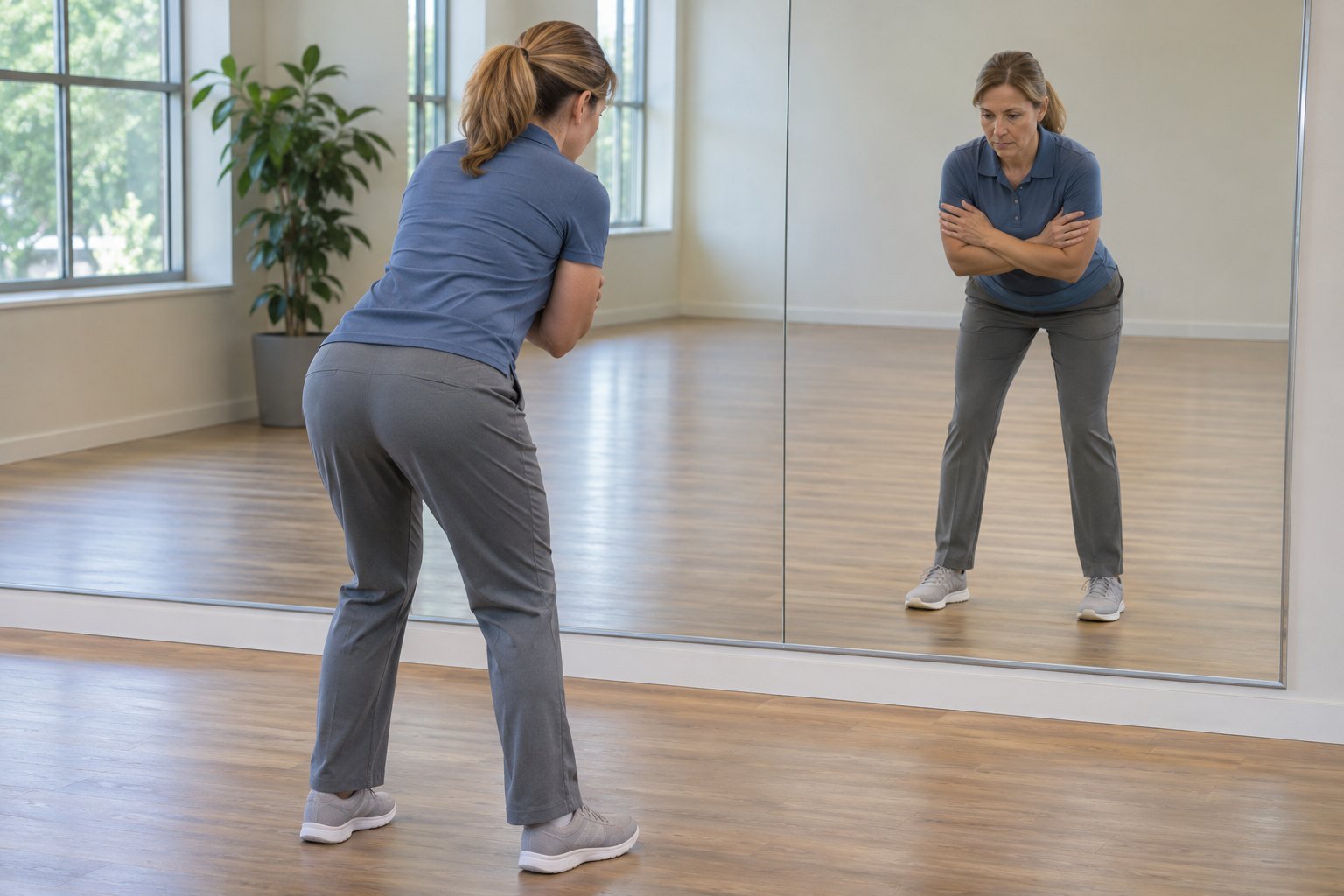
“Full-length” is a shopping description, not a guarantee that a mirror will show the required view from your available position. Mark out where you would stand and check what you can see in an existing, securely installed mirror. Include the body areas relevant to the task; do not choose a narrow panel only to discover that a shoulder or foot disappears when you set up.
Also check lighting and the surrounding room. Strong glare can obscure the feature you want to inspect. A busy reflected background can make a simple reference harder to follow. Moving the practice position may solve either problem without buying a larger mirror.
A mirror is a poor choice when you keep watching yourself through a full-speed movement, chasing a professional player’s shape or changing several positions at once. Use it for a defined still reference, then ask whether that reference survives without the reflection.
A tripod fixes the camera; it does not fix the viewpoint
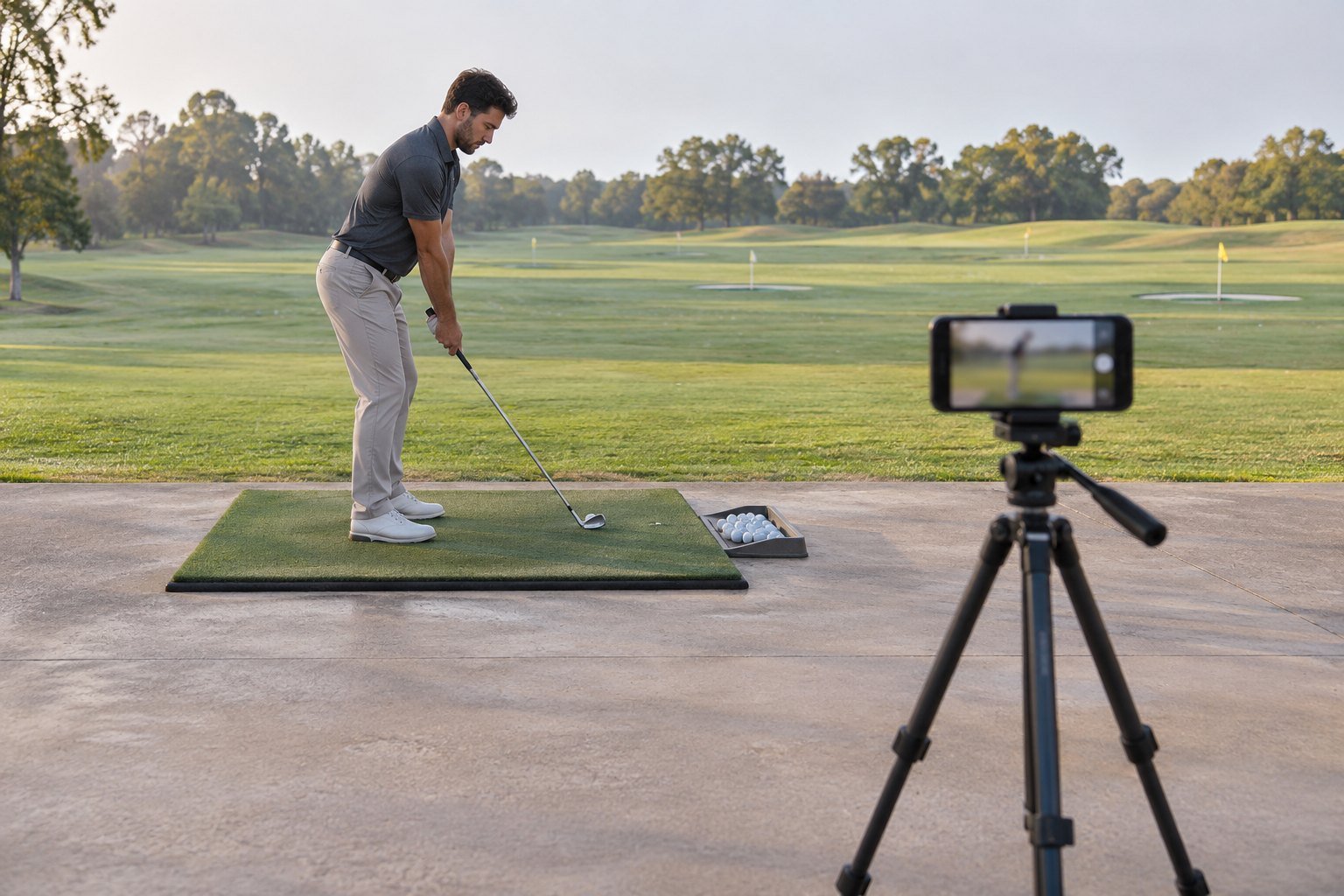
A stable recording is useful only when the camera can see the question you want answered. A face-on view looks across the target line towards the golfer; down-the-line looks from behind towards the target. Label your clips so later comparisons use the same view.
Published filming protocols differ. Titleist’s staff guide puts the lens at hand height at address; V1 Sports uses belt height. Follow your coach’s requested protocol and repeat it consistently. [2] [3]
Align the lens, not the phone’s centre. Titleist warns that shifting the camera sideways changes the apparent club path in a down-the-line view. A different picture is not necessarily a different swing. [2]
Make a short camera record
Write down enough to recreate the filming arrangement: view, lens used, orientation, lens height and a simple description of the camera’s position. Keep these consistent when comparing sessions. If a coach changes the protocol, label that change so a later comparison does not mix camera adjustments with movement adjustments.
Record a short test and review it after the movement. Can you see the hands, feet and the complete part of the club’s travel needed for the question? Is the subject clear? Is the phone level and still? Reframe before collecting more footage if the answer is no. Titleist recommends checking a test clip and allowing room around the full swing arc. [2]
At a practice facility, position the tripod within the permitted area, outside the club’s reach, ball-strike area and other people’s route. Do not move into an adjacent bay to obtain a preferred angle without permission. If the safe space cannot accommodate the requested view, tell your coach and choose another location.
Review the screen after recording, rather than trying to watch it during the movement. A slow-motion setting may be convenient for replay, but a blurred or badly placed recording still leaves questions unanswered. Avoid assigning precise impact or club-path measurements to an ordinary clip simply because an app lets you draw a line over it.
What to check before buying a mirror or tripod
Buy the missing function. If a securely mounted mirror already gives you the right view, its lack of golf branding is not a reason to replace it. If an existing camera support securely holds your phone at the required position, start there.
Swipe or scroll the table to see all columns.
| Check | Mirror | Phone tripod |
|---|---|---|
| Fit for the task | Enough visible area from the actual standing position | A usable lens height and view for the chosen filming protocol |
| Secure installation | Suitable fixings or a manufacturer-approved support; protected edges | A compatible phone clamp, secure head and legs that remain stable on the intended surface |
| Space required | Clear standing space and a location away from club or ball impact | Room for the leg footprint and camera position without creating a trip hazard |
| Compatibility detail | Mounting requirements and suitability for the room | Clamp fit with your actual phone and case, access to the lens, and the required portrait or landscape position |
| Storage and reuse | A permanent safe position, or a safe way to store and reinstall it | Packed size, repeatable adjustments and secure transport |
| Reason to wait | You cannot yet name the still reference you want to see | You do not yet know which view your coach needs |
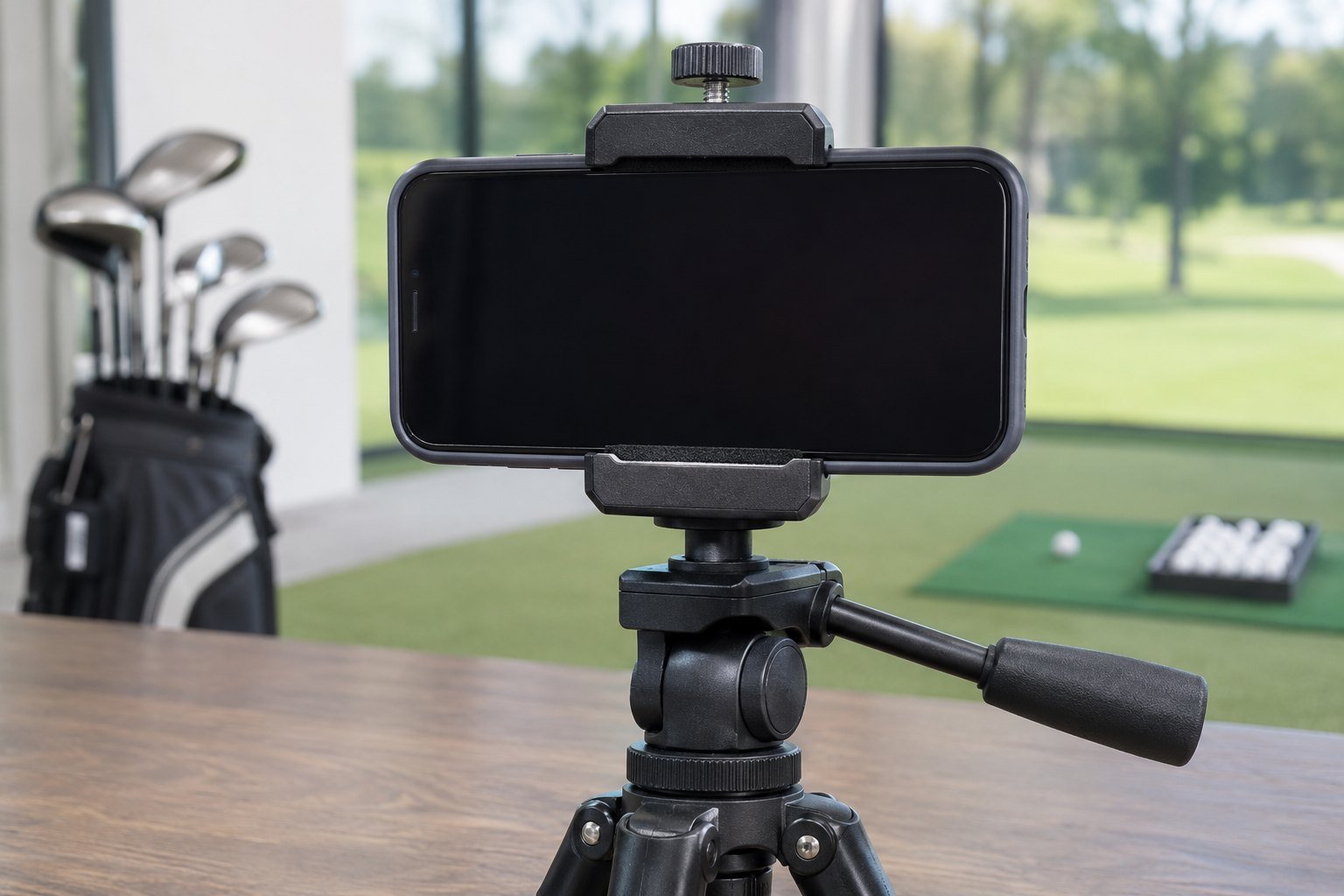
Check whether a tripod listing actually includes a phone holder. A camera screw mount alone is not a phone clamp. Equally, a compact tabletop support may be useful for other tasks while failing to reach your filming position. Measure the required lens height first and read the supplied-parts list, rather than assuming a tall-looking product photograph answers either question.
For a mirror, the installation cost and suitable location can matter more than the frame’s appearance. If the only available position puts it near a ball-strike area, choose a different practice arrangement.
Try one question before committing
This short comparison separates useful feedback from equipment you enjoy looking at. Use a coach-agreed, club-free setup reference so the initial choice can be made without a full swing or a ball.
- Name one observable question. For example: “Can I reproduce the address position agreed in my lesson?” Write down what you are looking for; avoid a list of unrelated faults.
- Try the mirror. Make three separate, comfortable setups. Use the reflection to check each one, stepping away between attempts. Note whether you could see the reference without changing position to inspect it.
- Try a recording. From an agreed, fixed view, record three separate setups without watching the screen. Review afterwards. Note whether the same reference is visible and whether the saved record adds anything useful.
- Choose the easier useful method. Consider the clarity of the answer, effort to set up, need to reposition equipment and value of showing the result to a coach.
- Repeat without live feedback. If the question concerns a remembered setup, check whether you can reproduce it without staring at a reflection. Use a later recording or your coach’s observation to review it.
Three attempts keep the comparison manageable; they are not a measured performance test. This trial chooses a way to observe practice. It does not establish that a position is correct for you or that a change will improve ball flight.
Swipe or scroll the table to see all columns.
| What happened? | Useful next step |
|---|---|
| The mirror made the agreed reference easy to recognise, with little setup effort | Keep the mirror routine short and focused; buy nothing further unless a new question requires it. |
| You needed to look afterwards or show the sequence to someone else | A stable recording arrangement has a clear purpose. |
| Both showed the body clearly, but you could not interpret what you saw | Ask for coaching guidance before adding hardware or more lines to the screen. |
| Neither worked safely in the available space | Move the activity or choose a different form of home practice. |

Keep the evidence—and the practice—in context
A clear picture can help a conversation with a coach. It cannot tell you whether a new movement is comfortable, sustainable or effective from appearance alone. Keep the original question beside your clips so the session does not become a search for every visible difference from a tour player.
Keep this feedback routine for practice. During a round, Rule 4.3a(4) restricts watching competition video that helps with club choice, making a stroke or deciding how to play; it includes a narrow exception for broadcasts to spectators at the course. Local Rules may add restrictions. [4]
If your home cannot safely accommodate the activity, the small-space golf practice guide offers a putting-led alternative. For more ways to match equipment to the room, explore Home Practice.
Choose the mirror when a still, immediate reference is the useful part. Choose the tripod when saving and reviewing movement is the useful part. If you cannot yet explain what you want to see, agree the question with your coach before buying either.
Sources
- Titleist: Indoor Training—Posture, with Justin Parsons — primary coaching example of a mirror used for a posture check; published 4 March 2021.
- Team Titleist: Online Golf Instruction—How to Film Your Swing — staff guidance on lens position, consistent views, framing and test recordings; published 29 September 2021.
- V1 Sports: How to Film Your Golf Swing — the coaching-video provider’s filming protocol, updated 6 October 2026.
- The R&A: Rule 4, The Player’s Equipment — Rule 4.3a(4), audio and video during a round.
Sources checked 23 November 2026. This is a researched equipment-choice guide; it does not report hands-on product testing.
Illustrations in this article were created for Taylor’s Trailblazing Golf. Third-party photographs, where used, are credited beside the image or in the source list.