Golf Groove Tools: When Does Cleaning Become Alteration?
Clearing soil from a groove and changing its edges are different jobs. Check what a tool is designed to remove before putting it against the face.
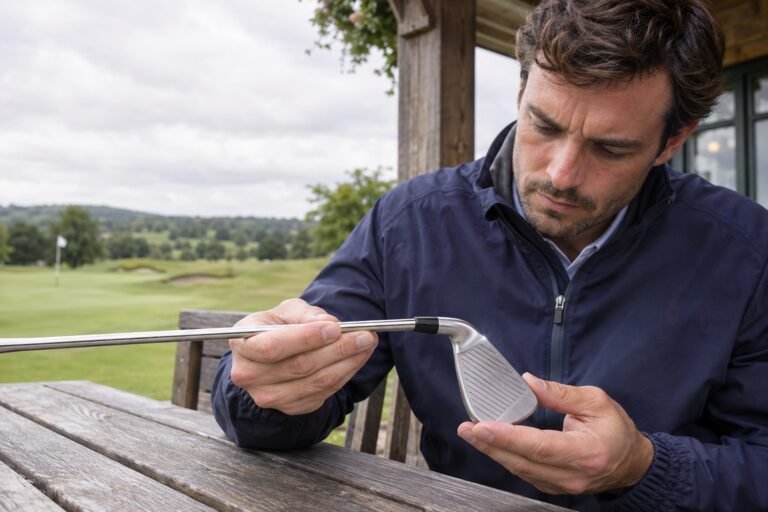
Identify the cleaning task before choosing a tool. Generic AI illustration; not a product photograph or conformance test.
Golf groove tools are sold under overlapping names: cleaners, picks, sharpeners and restorers. The name is a poor starting point for deciding whether the job belongs in your normal care routine. Start with the action: are you removing something lodged in the groove, or changing the surface that was manufactured into the club?
This research-led guide explains that boundary for irons and wedges. It does not certify a particular club or tool, and the illustrated scenes are generic. The useful outcome is a clear next step: gentle cleaning, a question to the manufacturer, or an assessment of work already carried out.
This is a research-led guide. How we assess golf equipment explains the evidence behind our recommendations.
This guide contains affiliate links. If you buy through them, Taylor’s Trailblazing Golf may earn a commission at no extra cost to you.
Use the exact club’s approved care method; stop when the problem no longer appears to be dirt.
Its model identity, alteration history and applicable competition conditions all matter.
A promise to restore groove edges needs a conformance assessment, not an assumption that it is ordinary cleaning.
Golf groove tools: identify what the tip will remove
Cleaning has a limited objective: clear unwanted material so that the existing face can be seen and used. It is not a project to make an edge feel sharper or to reproduce the appearance of a new wedge. Once the proposed job involves cutting the groove’s walls or edges, treat it as modification.
The Equipment Rules control groove width, depth, spacing, cross-section and edge condition; they prohibit sharp edges and raised lips. Surface roughness is also regulated. A groove looking tidy does not establish that those requirements are met.[1]
Normal wear does not invalidate an originally conforming club under Rule 4.1a(1). Deliberate alteration is not automatically non-conformance: the resulting club must meet the applicable requirements. Damage during a round has separate provisions.[2]
That distinction matters when a worn face disappoints you. Removing trapped soil may expose the existing condition more clearly. It does not replace material that has worn away, and an intentional attempt to recreate an edge is not simply more thorough cleaning.
Back to top ↑Use the purpose of the tool as the first filter
The matrix below is a purchasing and inspection aid. It does not give an entire product category a legal verdict. Read the instructions for both the accessory and the exact club, including any special face coating or insert.
| Tool or proposed action | What to establish | Useful next step |
|---|---|---|
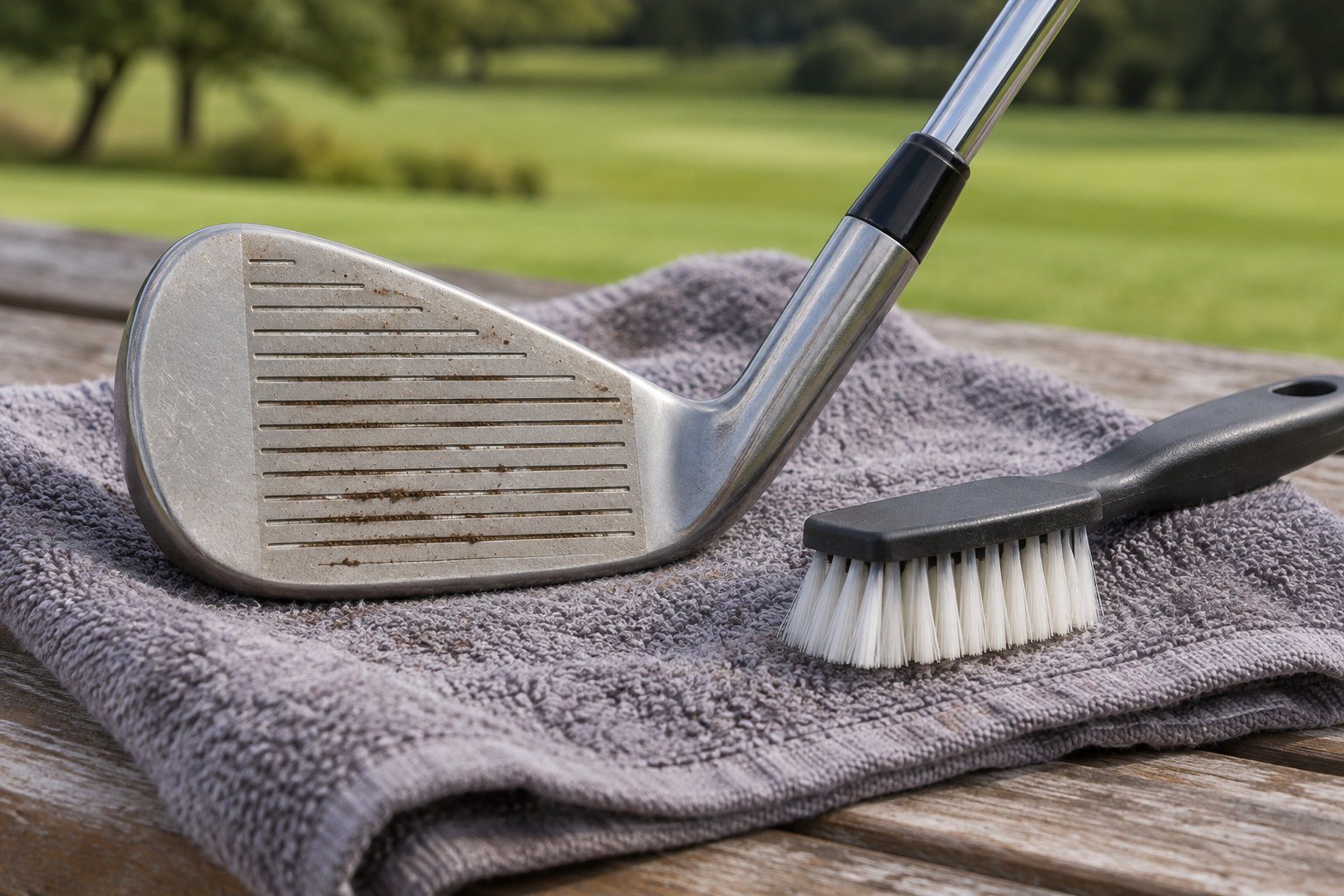
| Cloth or suitable soft brush | The intended job is lifting soil, grass or other debris. | Follow the clubmaker’s care instructions and inspect the existing face afterwards. |
| Pointed groove pick or scraper | What the tip is made from, whether it cuts, and whether the clubmaker permits that contact. | Do not infer suitability from a narrow tip or a “cleaner” label. Ask before using an uncertain point. |
| Wire brush or abrasive pad | Whether that exact surface and finish allow the proposed method. | Keep finish compatibility separate from the question of competition conformance. |
| Cutter, file or tool intended to re-profile edges | The purpose is changing the face markings. | Treat it as alteration; deliberately re-grooved markings must meet the post-2010 specifications.[1] |
| Refinishing or surface restoration | Exactly what material, coating or texture the service will change. | Ask the manufacturer or specialist to explain the finished condition and conformance implications. |
A useful question to a seller is: “Does this remove only debris, or is it designed to remove clubface material?” If the answer is unclear, a sharper tool is not a sensible experiment. Choose an approved cleaning method or ask for advice before proceeding.
Likewise, the presence of a metal component does not by itself settle a Rules question. What it does to this club matters. Avoid replacing one sweeping claim—“all groove tools are legal”—with another that declares every pick or brush prohibited.
Check the club’s age, identity and alteration history
Older clubs create a common misunderstanding. The R&A’s current player guidance permits clubs available before 1 January 2010 that met the 2009 Rules to continue in use, except where the Committee has introduced the newer groove requirement. It states that any future universal change would require at least four years’ notice.[3]
Model Local Rule G-2 requires the post-2010 groove and punch-mark specifications when adopted. It is recommended for professional and elite amateur events. Check the actual event’s Local Rules; a general description of your standard of play is not a substitute.[4]
Keep the older-club provision separate from intentional groove work. The Equipment Rules expressly apply the newer specifications to purposely altered face markings. They also distinguish refurbishment back to the original state from re-grooving.[1]
Use this order when checking a club:
- Record the exact model, club number or loft, finish and identifying markings.
- Establish what is known about its history, including any re-grooving or advertised “restoration”.
- Read the relevant event’s equipment conditions.
- Use the governing bodies’ information for that exact club, then resolve any remaining uncertainty before play.
The R&A’s Club Groove Informational Database guidance explains why identification markings matter. Absence from the database does not itself prove non-conformance; an eligible club may never have been submitted.[5]
A matching original model is not the end of the check after modification. The USGA says the usual presumption based on a database listing does not apply when grooves or punch marks have been purposely modified, including sharpening or re-grooving.[6]
For a used purchase, ask the seller what “refurbished” means in practical terms. Cleaning, a cosmetic treatment and cutting new groove edges are different histories to disclose. Keep the answer with the sale record; a reassuring adjective is less useful than a description of the work.

Keep routine cleaning separate from changes during a round
Rule 4.1a(3) prohibits making a stroke after deliberately changing a club’s playing characteristics during the round, including a suspension of play. Its substance restriction excludes cleaning. The penalty for a stroke in breach of Rule 4.1a is disqualification. The Rules contain specific exceptions; they do not provide a general permission to sharpen grooves between shots.[2]
There are therefore two questions to keep separate: does the club conform, and was a prohibited change made during this round? A claim that a tool leaves a conforming groove would not, on its own, answer the second question.
Prepare the cleaning kit before you start. If ordinary care reveals a concern, put the questionable tool away and ask the referee or Committee what to do about the actual circumstances. Describe the action and when it happened. Do not try another stroke to demonstrate that the work has made no difference.
For routine debris removal, keep the process modest and appropriate to the club. A towel or permitted brush should not become an invitation to experiment with edge shape while play is under way.

If the grooves have already been worked on, preserve the facts
Stop further attempts to improve or disguise the result. The next useful step is to make the history understandable to the person assessing the club. A phone photograph can record what you have, but cannot measure all the relevant properties or certify conformity.
| Record | Why it helps |
|---|---|
| Model, identifying marks and club number or loft | Avoids assessing a different generation or another club from the set. |
| Exact tool or service description | Explains whether the work was intended to clean, cut, refinish or reshape. |
| What was actually done and when | Separates work before the round from an action during it. |
| Photographs and any original service record | Give context without pretending to replace examination or measurement. |
| The event and its equipment conditions | Lets the rules adviser address the competition you intend to enter. |
A qualified repairer can help identify what has been changed and whether a manufacturer service is appropriate. Ask the Committee or the R&A/USGA equipment team to resolve a conformance doubt. Do not treat a repair receipt, a product review or an informal photograph-based opinion as a blanket competition clearance.
A club that has been worked on does not automatically need to go in the bin. Equally, “it still looks normal” is not an adequate conclusion. Get the particular club assessed before deciding whether to retain it, seek suitable work or replace it.
If replacement becomes the practical option, the guide to iron wear, repairs and replacement helps separate an individual-club problem from a reason to change the whole set.

Buy a cleaning accessory for the job you actually have
If your existing permitted brush and cloth remove the debris, a new groove accessory has no necessary job to do. If something is missing, compare access to the face, bristle material, ease of carrying and the clubmaker’s care instructions before considering extra functions.
One clearly identified brush option is the Pride Sports Pro Precision Club Brush, code SASSAPB. UK distributor JS Golf Brands specifies nylon bristles and a magnetic attachment.[7] You can check the black Pride Sports Pro Precision brush at Clubhouse Golf; the retailer identifies the same SASSAPB item.[8]
Consider it only where its bristles suit your club’s care instructions. The recommendation is about an ordinary cleaning function, not a guarantee for every finish or a certification of the resulting clubface. It is also not evidence that a worn wedge will regain new-club spin.
Read beyond marketing words such as “restore”. Ask what physical action the product performs. For this task, a cutting function is a reason to pause and investigate, rather than an extra feature to collect.
Back to top ↑Choose the next step from the evidence you have
- Only debris to remove? Use the exact club’s permitted cleaning method and inspect the result.
- The product proposes cutting or reshaping? Treat it as modification and seek advice before using it.
- The face has already been altered? Retain the history and have the actual club’s status assessed.
- An event has extra equipment conditions? Check those conditions against the identified club before playing.
- The issue is ordinary wear? Consider the club’s useful condition and replacement options without assuming sharpening is required.
The stopping point for home cleaning is a clear existing face. When the objective changes to rebuilding an edge or changing a texture, the decision belongs with an informed assessment of the finished club.
Back to top ↑Frequently asked questions
Does a U-groove or V-groove label prove that a tool is suitable?
No. A shape label does not establish the groove’s dimensions, edge condition or what a tool will leave behind. The Equipment Rules assess more than the broad profile name.[1]
Does carrying an unused groove tool itself settle the Rules question?
No. Rule 4.3 concerns how equipment is used and does not limit what equipment a player may carry. That does not authorise altering a clubface or making a stroke with a club in breach of Rule 4.1.[2]
Sources and checks
Sources consulted on 24 November 2026. Manufacturer and retailer descriptions are attributed claims; illustrations do not show tested products. Recheck current care instructions, model and finish compatibility, rules and retailer details before use or purchase.
- The R&A — Equipment Rules, Part 2: Conformance of Clubs, section 5
- The R&A — Rule 4: The Player’s Equipment
- The R&A — Equipment Information for Players: Groove and Punch Mark Specifications
- The R&A — Model Local Rule G-2: Groove and Punch Mark Specifications
- The R&A — Club Groove Informational Database guidance
- USGA — Conforming Club and Ball Lists: Equipment Database guidance
- JS Golf Brands — Pride Sports Pro Precision Club Brush, SASSAPB
- Clubhouse Golf — Pride Sports Pro Precision Golf Club Brush, Black
Illustrations in this article were created for Taylor’s Trailblazing Golf. Third-party photographs, where used, are credited beside the image or in the source list.