Taylor’s Trailblazing Golf · Equipment guides
Tech & Upkeep · Buying, Care & RepairsBuilding a Half Set of Golf Clubs: Cover Useful Distances
Choose fewer clubs by the shots they cover, with a seven-club planner and practical gap checks.
AI illustration: start with a smaller bag that still covers the shots you need.
Building a half set of golf clubs starts with the shots you want available, not a rule that every second iron must stay at home. A smaller bag can make sense for a short course, a carry round or a golfer who rarely uses several clubs. The useful question is whether each remaining club does a distinct job. This research-led guide gives you a way to check that using your own shots, with a worked example to make the decisions clear.
Ad – includes affiliate links. If you buy through the links in this guide, Taylor’s Trailblazing Golf may receive a commission at no extra cost to you.
Choose roles first
A club earns its place by offering a useful shot, not by filling a numbered slot.
Check the overlap
Compare repeatable carry and misses; the longest single shot is a poor basis for the bag.
Protect the short game
A bunker option or a familiar pitch may matter more than a second long club.
Allow an eighth
A smaller set is successful when it suits the course and the player.
Build a half set around seven useful jobs
The Rules of Golf set a maximum of 14 clubs; they do not require you to carry 14. A half set is a practical description, not a separate equipment category in the Rules. You can choose fewer clubs, subject to the usual requirements for conforming equipment and your event’s conditions. [1]
Begin with this seven-place plan. The club names are examples to try, not a fitting prescription. A club can cover more than one job, while two clubs with different numbers may cover almost the same distance for you.
Swipe within the table to see all columns.
| Place | Job to cover | Possible starting choice | Question before keeping it |
|---|---|---|---|
| 1 | A useful tee shot | Driver or a fairway wood | Does it earn enough extra distance without a miss you cannot manage? |
| 2 | A longer shot from the turf | Hybrid or higher-lofted fairway wood | Can you launch it from the lies you actually face? |
| 3 | Longer approach or lay-up | A familiar mid iron, perhaps a 6-iron | Is its usual carry clearly different from the next club? |
| 4 | Shorter approach | A shorter iron, perhaps an 8-iron | Does it cover a common approach without a forced swing? |
| 5 | Pitching distance and running chips | Your pitching wedge or another familiar pitching club | What is its actual loft and your useful carry? |
| 6 | Short pitches and bunker shots | A wedge that suits your technique and usual conditions | Have you checked the shot you need, rather than the name on the sole? |
| 7 | Putting | Your usual putter | Can it stay familiar while other parts of the bag change? |
If one fairway wood covers both the tee and turf jobs well enough, you have a spare place. Use it for a distance you often face, an additional wedge or nothing at all. Equally, if your normal driver is your most useful tee club, there is no reason to remove it simply because some half-set lists do.
Find the overlap in the clubs you already own
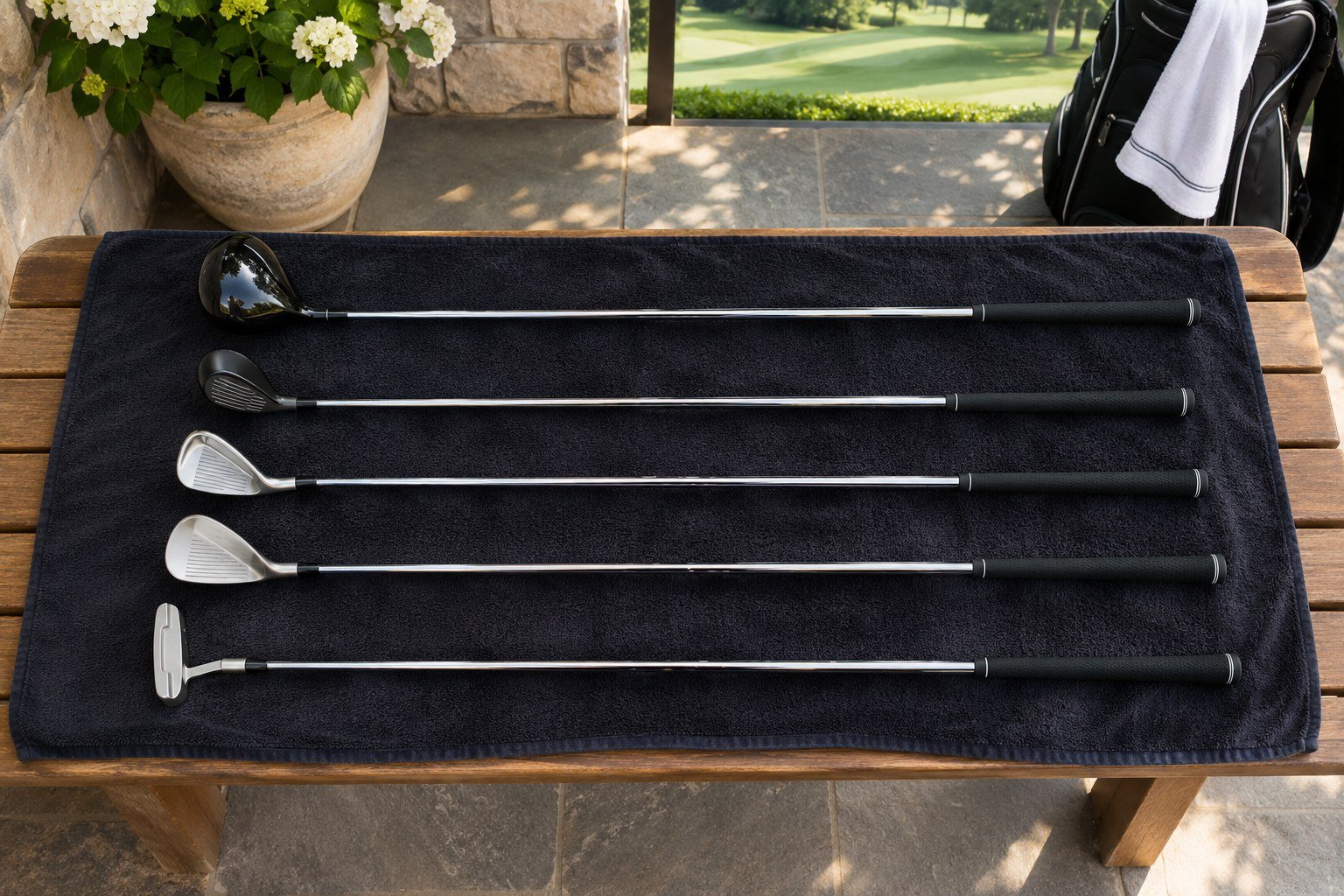
Lay out your current clubs and write down which ones you actually use. Separate three reasons for leaving one out: it repeats another club’s distance; you cannot produce a useful shot with it; or the course rarely asks for its particular job. Those are different problems and may lead to different choices.
Callaway’s published hybrid-fitting process begins its gapping assessment with the longest iron the golfer is comfortable hitting and their 7-iron carry. That is a useful reminder to build the transition around a player’s usable shots. It is not a reason to copy the document’s model-specific recommendations into every bag. [2]
Check exact lofts when mixing models. For example, PING lists the G430 7-iron at 29° in its standard specification, 27.5° in Power Spec and 31° in Retro Spec. The same number on the sole can therefore represent different builds even within one model. Those published design values do not tell you the measured loft of a used club or how far you will hit it. [3]
Keep a simple equipment record: model, club number, known loft specification, shaft and any alterations you know about. If a club’s identity or condition is uncertain, have a suitable professional check it. Do not bend, cut or otherwise alter a club to make an example table work.
When combining clubs from different iron families, our guide to choosing the crossover in a mixed iron set explains the separate build questions. Here, the aim is simply to decide which useful shots remain in a smaller bag.
Back to top ↑Read a carry table without chasing perfect spacing
This invented example starts with eight clubs, including the putter. The numbers illustrate the reasoning; they are not average distances, targets or measured results from an author’s test. “Typical band” means the central group of hypothetical ordinary shots, not a confidence interval or a guarantee that the next ball will finish inside it.
Swipe within the table to see all columns.
| Club | Central carry | Typical band | What this example suggests |
|---|---|---|---|
| Driver | 195 | 180–206 | A distinct tee option, if its sideways misses remain acceptable. |
| Fairway wood | 163 | 153–171 | Very similar distance to the hybrid; compare the actual shot and lie. |
| Hybrid | 160 | 151–168 | Potentially keeps the turf role while the overlapping wood stays home. |
| 6-iron | 138 | 128–148 | A separate approach option; check contact as well as the central number. |
| 8-iron | 117 | 109–125 | Creates a deliberate wider gap in the reduced bag. |
| Pitching wedge | 96 | 88–103 | Retains a familiar pitching distance and running-chip option. |
| Sand wedge | 70 | 62–78 | The 26-yard central gap deserves a check of shorter swings and course needs. |
| Putter | Not compared | Not compared | Retained for its separate job. |
The fairway wood and hybrid differ by only three yards at the centre and their bands overlap heavily. That makes them the first pair to compare, rather than immediately dropping a wedge. If the wood is much more useful from a tee and the hybrid is essential from the rough, both might still earn a place. Distance alone cannot settle that choice.
Removing the wood leaves driver, hybrid, 6-iron, 8-iron, pitching wedge, sand wedge and putter: seven clubs. The gaps are not evenly spaced, and that is acceptable only if the remaining shots suit this golfer. A frequent 82-yard approach might expose a short-game gap; a frequent 150-yard carry might expose a different problem. There is no reason to pretend either disappears because the bag contains the right number of clubs.
The sensible next step is a trial, not a purchase. Keep the removed club at home for a suitable casual round, note where it would have helped and compare that with the convenience of carrying less.
Make your own distance check useful
Use a driving range or fitting facility that allows the shots you need. Warm up first, then compare a few neighbouring clubs in short alternating groups. Record enough ordinary attempts to see a pattern; stop or take a break when fatigue starts changing the exercise. There is no magic shot count that makes a poor session reliable.
- Choose one unit, yards or metres, and keep it throughout the record.
- Write down the ball type, surface and conditions. Compare like with like.
- Record carry, the pattern of short and long results, and the sideways misses that would affect your choice.
- Keep a note of poor contact. A club that works once but fails repeatedly has not proved a dependable role.
- Repeat an uncertain pair on another occasion before buying a replacement.
Carry and total distance answer different questions. Trackman defines its standard carry measure using a landing point at the same elevation; its total value estimates the eventual resting position. A large total number can therefore hide a shorter flight followed by more run. Use carry when assessing whether a shot can clear a hazard, while allowing a sensible margin for your variation and the conditions. [4] [5]
Ask what the screen is displaying. Trackman Range, for example, distinguishes actual range-ball carry from converted flat carry; the converted flight is simulated and excludes wind and temperature. A converted number and a visible ball landing on a sloping range are not necessarily the same measurement. [6]
Without reliable distance data, use clearly marked targets and modest conclusions: one club consistently reaches farther, two appear similar, or contact is too variable to judge. Book a focused gapping session if the answer will affect several purchases. Our fitting-fee checklist helps you ask what the appointment and written results include.
Back to top ↑Keep the short-game shots the course will ask for
A half set inevitably offers fewer stock full-swing distances. The hardest compromise is often between the pitching club and the highest-lofted wedge, because that part of the bag may also need to handle chips, pitches and bunkers.
Vokey’s wedge selector recommends starting with the pitching-wedge loft and choosing wedge lofts roughly 4°–6° apart for its conventional gapping approach. That is manufacturer fitting guidance, not a law that requires a half set to contain several specialist wedges. It does show why a large leap from a strong pitching wedge to a sand wedge needs examination. [7]
For a small bag, test the actual compromise. Can your familiar pitching club cover a controlled shorter approach? Do you have a wedge you can use from the bunkers you expect? Is a running shot available, or does the green’s entrance require flight? A smaller set is easier to justify when you can explain those answers without imagining a shot you have never practised.
Use a permitted practice area and safe spacing to explore comfortable shorter swings. Do not assume that moving your hands down the grip or changing swing length produces a fixed percentage reduction in distance. Record what happens for you and ask a PGA professional for help where the technique is unfamiliar.
Keep the extra wedge when it has a clear job
If a second wedge covers a frequent approach and your bunker club does something different, carrying eight clubs may be the better choice. The purpose is a manageable bag, not a test of how few tools you can tolerate.

Change the selection when the course changes
Prepare a default small set, then look at the course and the tees you intend to play. You do not need an elaborate hole-by-hole strategy to spot a repeated distance or a shot you would otherwise struggle to cover.
Swipe within the table to see all columns.
| Your situation | The question to prioritise | A sensible adjustment to consider |
|---|---|---|
| Short par-three course | Which approach distances appear repeatedly? | Trade a rarely needed long club for the missing approach club. |
| Regular carry round | Which clubs are actually used, and what does the loaded bag feel like? | Remove overlapping jobs before buying a new lightweight bag. |
| Several forced carries | Which carry is dependable enough with a margin? | Retain the useful club or choose appropriate tees; do not plan around a best-ever strike. |
| Firm or windy conditions | Which familiar shots can you control in those conditions? | Keep a proven option; avoid adding an unfamiliar low-flight shot on the day. |
| Course with demanding bunkers | Does the short-game selection cover the actual recovery task? | Protect the suitable wedge before another long club. |
Judge weight using the complete loaded bag. Spare balls, clothing, water and accessories still have to fit. Try the strap adjustment and normal load before deciding that the number of clubs alone solves a carrying problem. A trolley, a different bag or a shorter round may suit you better than removing a club you regularly need.
Back to top ↑Buy one missing job, not a second collection
If you already own a safe, suitable set, your first half-set experiment can cost nothing. Choose the clubs, record the missing shots and only then decide whether to spend. A convenient gap in an online catalogue is not evidence of a gap in your golf.
When a purchase becomes justified, compare the complete club: handedness, usable loft, length, shaft and grip, as well as condition and price. For used clubs, request clear photographs and the exact specification, allow for any professional checks or grip replacement, and read the seller’s return terms. A matching badge is less valuable than a club that performs the intended job.
You can compare the Callaway UK club categories when a particular long-club or wedge role is missing. For a wider retailer comparison, browse golf equipment at Clubhouse Golf. Both links are places to research a suitable build; neither establishes that an off-the-shelf choice fits you.
Ask whether individual irons can be supplied before buying a complete set simply to use three of them. Availability differs by model and build. If ordering odd-numbered or even-numbered irons separately, confirm the quoted club list and the total cost, including any fitting or delivery. A package’s advertised piece count is not a substitute for reading its contents.
Do not sell the discarded clubs after one good round. Give the smaller bag a fair trial in the conditions you actually play. Keep a note of useful shots you lacked, rather than recording only occasions when you enjoyed the lighter load.

Use a clear rule for adding a club back
Add a club when you can name the shot, show that it comes up often enough to matter, and explain why your existing options do not cover it reliably. That might be an approach between two widely spaced irons or a wedge with a separate short-game role. It does not have to be the longest gap on a chart.
Keep the smaller set when the remaining clubs cover the shots you face and the trade-off feels worthwhile. Revisit it when you change courses, tees or equipment, or when a club stops doing its expected job. If a troublesome club may be worn or damaged, our keep, repair or replace guide covers that different decision.
For the first outing, choose seven familiar clubs from what you already have, keep the short game usable and record just three things afterwards: the club you missed, the club you never needed and the shot you would like to check. That gives your next change a reason.
Back to top ↑Questions golfers ask
Can I use a half set in a normal competition?
Carrying fewer than 14 clubs is permitted by Rule 4.1b. The clubs must still conform, and any competition-specific equipment conditions still apply. Check an unusual event format with the organiser. [1]
Can two golfers share one half set?
Do not assume so. The Rules normally prohibit using a club being used by another player on the course. There are limited exceptions in partner formats, with a combined 14-club limit. Confirm the format and Rule 4.1b before sharing. [1]
Should a half set contain odd-numbered or even-numbered irons?
Either can be a starting experiment if you already own those clubs. Choose from the distances and shots you can produce, then check the transition to your long club and pitching wedge. A tidy numbering pattern has no special value if it leaves the wrong gaps.
Sources and checks
Official rules, manufacturer guidance and retailer terms checked on 24 November 2026. Prices, services and policies can change; check the relevant details before buying or playing.
- The R&A — Rule 4: The Player’s EquipmentChecked 24 November 2026
- Callaway — Hybrid Fitting ProtocolChecked 24 November 2026
- PING — G430 iron specificationsChecked 24 November 2026
- Trackman — Carry (Tee to Green)Checked 24 November 2026
- Trackman — Total (Tee to Green)Checked 24 November 2026
- Trackman Range — Understanding Flat Carry vs Actual CarryChecked 24 November 2026
- Titleist Vokey — UK Wedge SelectorChecked 24 November 2026
Illustrations in this article were created for Taylor’s Trailblazing Golf. Third-party photographs, where used, are credited beside the image or in the source list.