Golf Hitting Mats for Small Gardens: Drainage and Storage
Choose a mat that fits the garden, the weather and the job of putting it away.
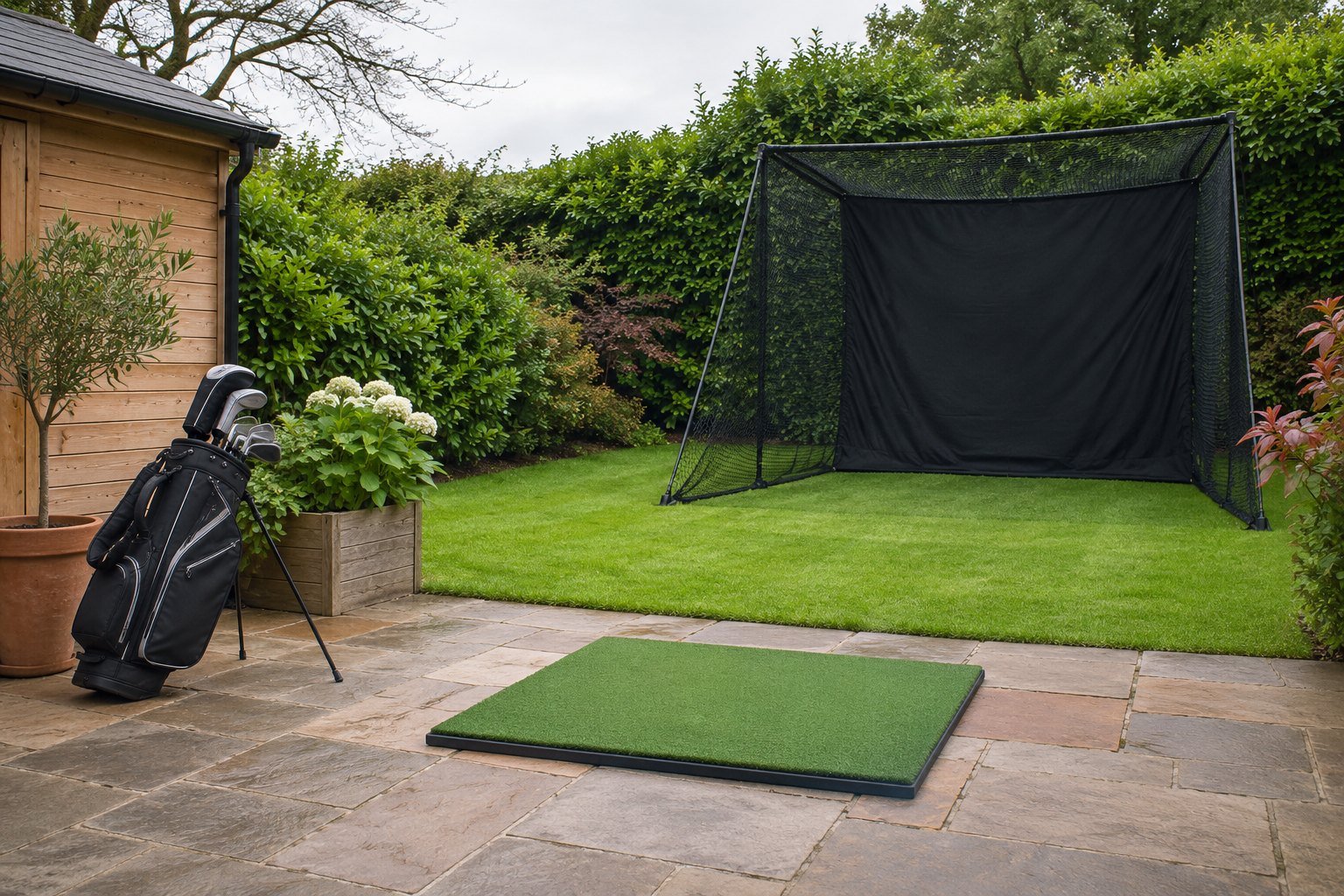
AI illustration of a garden setting; the pictured layout is not a safety or clearance specification.
A compact hitting mat can fit neatly on a patio yet be awkward to lift, dry or put away after rain. When choosing golf hitting mats for small gardens, include those ordinary jobs in the purchase decision. The useful size is the one you can set up properly and look after between sessions.
This research-led guide focuses on temporary outdoor placement, drainage and storage. Manufacturer examples show why instructions differ between products; they are not reports of mats we have weather-tested or gardens we have assessed for safe hitting.
This guide contains affiliate links. If you buy through them, Taylor’s Trailblazing Golf may receive a commission at no extra cost to you.
The mat and the golfer both need a suitable, stable position.
Check the backing, base and the surface beneath them.
Measure the route and consider the complete item you must carry.
Allow space for the shape and orientation the maker permits.
Golf hitting mats for small gardens: plan three places
Start with a short sketch of the garden and the space where the equipment will live. Mark the proposed practice position, a place where you can inspect and dry the mat, and the final storage location. Add the route between them, including gates, steps and doors.
Scroll within the table to see every column.
| Place | Record before buying | Reason to rethink |
|---|---|---|
| In use | Approved supporting surface, mat footprint, stance, club clearance and the complete containment setup. | The mat fits only by blocking a route or compromising the practice area. |
| After use or rain | A permitted cleaning/drying arrangement, with room to inspect the underside. | The only option is immediately sealing a wet mat into its storage space. |
| Between sessions | Stored dimensions, permitted orientation, access and any separate components. | The product must be bent, crushed or stored in an unsupported position to fit. |
Assess the hitting activity separately from the product’s rectangle. Spornia’s own guidance requires inspection of its net and target before use and adequate clearance from people, structures and surrounding property. [1] Follow the instructions for the actual net, balls and mat you choose; no single garden dimension in this guide certifies a safe setup.
If the area cannot support the intended shots, use an appropriate practice facility. A putting-only small-space practice kit is a separate option when suitable space is available. It does not turn a cramped garden into a full-swing bay.
Back to the top ↑Choose the supporting surface before the mat
Inspect the actual position rather than relying on a photograph of the garden. Check for rocking paving slabs, soft ground, debris, surface water and changes in level where your feet would stand. A small hitting patch also leaves a separate stance area to assess.
Fiberbuilt recommends a firm, flat outdoor support such as paving or firmly packed crushed stone, and advises against grass for its installations because the support can be unstable and the grass can die beneath it. Its concrete guidance includes a drainage fall. These are instructions for its systems, not a universal specification for every portable mat. [2]
For the product you are considering, ask which supporting surfaces are allowed and whether an additional base is required. “Garden use” may describe a possible setting without specifying the preparation that setting needs. Obtain an answer before assuming the mat can sit on an uneven lawn or bridge a gap between slabs.
Make a simple placement check without hitting balls: confirm that the approved assembly sits flat and that the intended standing area is stable. Resolve movement, lifting edges or a mismatch between the stance and strike positions before practice. Do not pack a low corner with a loose towel or improvised stack of soft material.
If the proposed spot needs permanent groundwork, treat that as a separate installation decision. A removable mat may still be the wrong purchase when the supporting area has not been made suitable.
Follow the water through the complete assembly
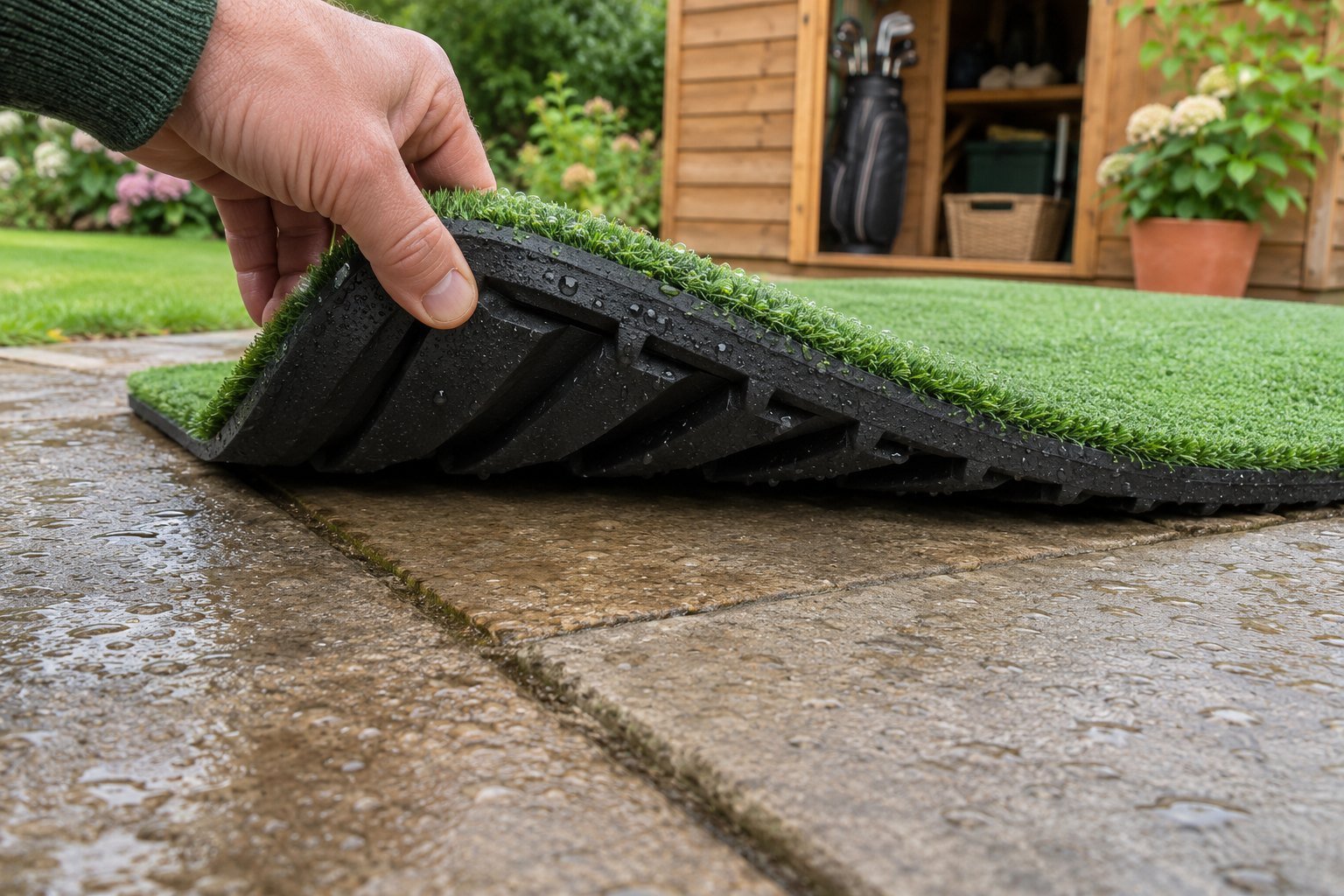
Ask three drainage questions: can water pass through or off the hitting surface, where does it go at the backing or base, and how does it leave the ground beneath? A hole in one component cannot tell you whether the complete arrangement will drain at your chosen position.
Net World Sports describes drainage holes in its rubber golf-mat bases and lists different base sizes and compatibility limits; its standard base is restricted to FORB and FORZA mats. This is an example of a designed component, not permission to add any rubber tray beneath any mat. [3]
Scroll within the table to see every column.
| Part of the setup | Ask or inspect | Do not assume |
|---|---|---|
| Hitting surface and backing | Does the maker describe permeability, drainage or an approved wet-weather routine? | A grassy appearance means that water passes through the backing. |
| Separate base or frame | Is it compatible, and are its intended exits unobstructed? | Another brand’s base will fit or preserve the drainage route. |
| Supporting ground | Where does water collect after ordinary rainfall, and where can it leave? | The mat will cure an existing puddle or a low spot. |
| After rain | Can you inspect the underside and restore the setup as its instructions require? | A dry-looking top proves the whole assembly is ready. |
Use observations after normal rain to identify a problem; they are not a measured drainage-rate test. If water remains trapped, take the setup out of use while you clarify the cause. Avoid drilling, cutting channels or adding an unapproved underlay as a first response. Ask the manufacturer about the complete arrangement.
Back to the top ↑Read outdoor-use wording alongside the care instructions
A description such as indoor/outdoor or weather resistant is a starting point for questions about exposure. Look for the exact storage conditions, any temperature or sunlight limits, and instructions for a wet mat. Also check whether the guidance applies to the whole mat or only its hitting insert.
TrueStrike says its mats can be used outdoors in all weather, while also advising storage away from direct sunlight because intense sunlight can temporarily curl the range panels. The qualification belongs with the outdoor claim. [4]
Ask the seller what happens between sessions: may this model remain in position, should it be covered, or should it be taken inside? If a cover is suggested, check that it is the specified type and that the required drying process can still happen. A cover is not an answer to every unanswered storage question.
Include the rest of the equipment in the plan. A mat, net and frame can have different care requirements. Spornia’s warranty, for example, excludes several forms of weather damage; its outdoor setting does not amount to a promise of unlimited exposure. [1]
Where the documentation is unclear, ask before committing to a setup that depends on leaving everything outside. For a temporary arrangement, the practical question is whether you can remove and store each part in the manner its maker permits, even when the weather changes unexpectedly.
Back to the top ↑Measure the stored shape and the route to it
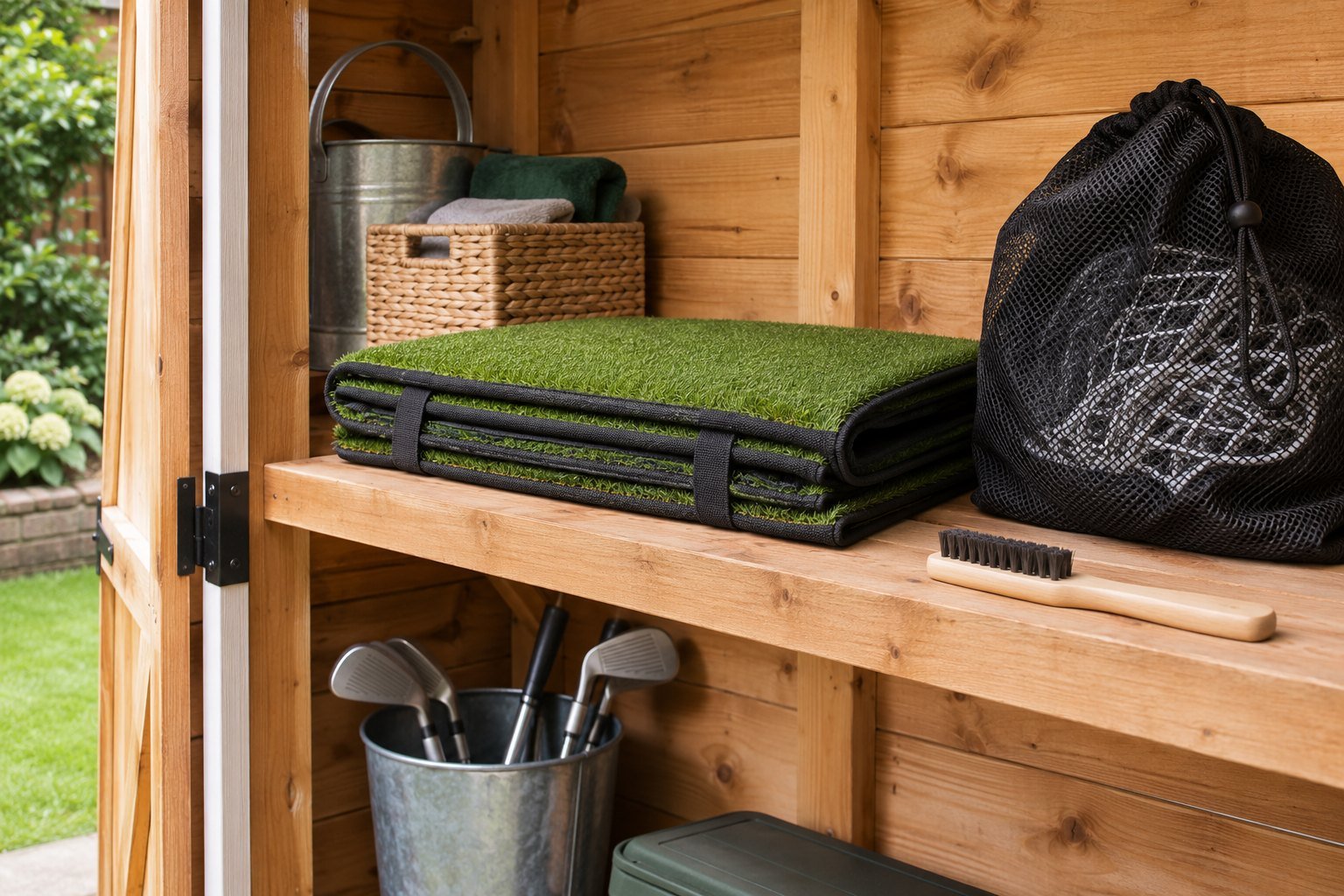
Measure the narrowest door or gate, turns in the route, shelf depth and overhead clearance. Check the weight of the complete item you will move, whether parts can be separated, and how the maker says to carry them. “Portable” does not tell you what will be manageable in your garden.
The Longridge 3 Turf Practice Mat at Clubhouse Golf provides a concrete folding example. Its listing gives an open size of 41 × 64 × 3.5 cm and a folded size of 21 × 40 × 10.5 cm. It is listed for indoor and outdoor use, but those dimensions alone do not establish a drainage specification or permission for permanent outdoor storage. [5]
For an illustrative fit check, a clear shelf measuring 45 cm wide, 30 cm deep and 12 cm high would accommodate that listed folded rectangle on paper when the 40 cm side runs across the width. You would still need room to handle the item, account for any bag or protruding parts, and follow its actual storage instructions. The example is a dimensional comparison, not a verified storage installation.
Compare three options before paying: a naturally folding model, a mat the manufacturer allows you to roll, and a modular system whose components can be handled separately. Do not turn a rigid product into a folding one to make a tempting specification fit the shed.
Rehearse the route with a harmless outline of the stored dimensions if that helps. Keep access clear; a mat that fits the shelf but cannot comfortably reach it has not solved the storage problem.

Build cleanup and drying into the session
Keep the care instructions with the equipment record. Identify which parts can be removed, which cleaning tools or products are permitted, and how each part should be supported while drying. Use that information to prepare a practical routine rather than borrowing a method from a different mat.
Fiberbuilt’s care page calls for keeping foundation drainage holes clear. Its off-season instructions also distinguish vertically stored hitting panels from stance mats and rubber foundations that may be stacked horizontally. Component-specific instructions matter even within one manufacturer’s system. [6]
- Clear the practice area. Gather balls and separate items so the mat can be handled without stepping around loose equipment.
- Inspect before cleaning. Note trapped debris, loose edges, visible damage and anything that has changed since the previous setup.
- Use the permitted method. Remove loose material and clean only as the maker allows; do not assume a pressure washer, detergent or solvent is suitable.
- Check every relevant surface. Include the backing and separate base, not just the visible pile.
- Complete the specified drying process. Use an appropriate supported position and keep the route clear.
- Store in the permitted shape. Avoid forcing the mat into a smaller space or crushing components beneath unrelated items.
Allow time for this after the hitting has finished. If a short practice session would regularly end with a wet mat left in an unsuitable corner, choose a different storage arrangement or a different product before buying. The routine needs to work on an ordinary weekday, not only when you have a free afternoon.

Choose how the mat will live in the garden
The right routine depends on the product’s instructions and the garden you have. Decide which of these arrangements you can support before comparing a larger or heavier mat.
Scroll within the table to see every column.
| Arrangement | When to consider it | What must work |
|---|---|---|
| Set out and remove each session | You share the space or want the patio clear afterwards. | Manageable carrying, a clear route and a real drying/storage place. |
| Leave an approved system in position | The exact product permits that exposure and the location is properly prepared. | Drainage, required care, inspection and the separate net/frame instructions. |
| Assemble seasonally | You have a defined period of use and space for the stored components. | Manufacturer-approved disassembly, labelled parts and the correct storage orientation. |
There is no reason to prefer the most permanent arrangement automatically. A smaller removable setup can be easier to keep clear of household traffic. A larger system may make sense when its support and storage requirements have already been resolved.
Include the effort in the comparison as well as the price. Write down what must be moved, cleaned, dried and put away. If an extra base or storage container is necessary, include its cost and space before deciding that the mat alone is affordable.
Put the unresolved questions into the order brief
Before ordering, save the exact model and ask the supplier to confirm the intended supporting surface, whether a separate base is required, drainage arrangements, allowed exposure, cleaning method, stored shape, dimensions and weight. Keep the answers with the receipt so that the next setup can follow the same instructions.
Resolve a missing answer when it affects the way you will use the product. An unknown folded size is material if the mat must fit a small cupboard; unclear exposure instructions matter if you cannot bring it indoors. A cheaper listing does not remove either problem.
Choose the mat whose complete routine fits: a suitable practice position, an understood route for water, a practical cleanup and a storage place that can accommodate it properly. If one of those is missing, change the plan before expanding the purchase.
Back to the top ↑Sources and research
Research reviewed on 23 November 2026. Manufacturer descriptions, official guidance and retailer information are distinguished from the suggested comparisons and editorial recommendations in this guide.
- Spornia — Warranty and Product-Care ConditionsNet/target inspection, clearance and weather exclusions; checked 23 November 2026. Apply the instructions for the actual equipment.
- Fiberbuilt — Installation RecommendationsSupporting surfaces and outdoor ground preparation for Fiberbuilt systems; checked 23 November 2026.
- Net World Sports — Rubber Golf Mat BasesDrainage holes, base sizes and standard-base compatibility; checked 23 November 2026. No universal fit or drainage performance inferred.
- TrueStrike — Frequently Asked QuestionsOutdoor-use statement and direct-sunlight storage qualification; checked 23 November 2026.
- Clubhouse Golf — Longridge 3 Turf Practice MatListed open/folded dimensions and indoor/outdoor description; checked 23 November 2026. No current price or weather-test claim.
- Fiberbuilt — Product CareFoundation drainage and component-specific storage guidance; checked 23 November 2026.
Find more equipment guidance in Home Practice.
Illustrations in this article were created for Taylor’s Trailblazing Golf. Third-party photographs, where used, are credited beside the image or in the source list.