When to Replace a Fairway Wood: Check Shot Gaps Before Upgrading
Find the shot your bag needs, then decide whether to keep, maintain, refit or replace the club you already own.
AI illustration: a familiar club can be a useful benchmark for an upgrade decision.
Knowing when to replace a fairway wood starts with a more useful question than its age: what job is it failing to do? Perhaps it carries no further than your hybrid, struggles with the approach you bought it for or no longer feels dependable. Perhaps it still does everything you need, but a new release has caught your eye.
Start by describing the missing shot, checking the current club’s condition and comparing it with the clubs either side. This research-led guide gives you a practical way to make that decision, including examples you can replace with your own distances and quotes.
This guide contains affiliate links. If you buy through them, Taylor’s Trailblazing Golf may receive a commission at no extra cost to you.
Write down the carry, flight, direction and lie that the current club struggles to cover.
A replacement trial needs a current-club baseline under comparable conditions.
The longest ball can make a club look better while concealing an unhelpful spread.
Include fitting, labour, grips and any confirmed trade-in before deciding what represents value.
Start with the gap in your shots, not the gap between model years
Give the club one main job and, if needed, one secondary job. Useful descriptions include “a dependable fairway approach beyond my hybrid”, “a shorter tee option when driver brings trouble into play” or “a higher flight into a green that my long iron struggles to hold”. “More distance” is too vague until you say where that distance helps.
Callaway’s 2023 fairway fitting protocol includes gapping and the longest iron a player feels comfortable hitting. [1] The useful principle is to assess the surrounding bag, not treat the wood as an isolated purchase. Bring those neighbouring clubs to a fitting.
Swipe within the table to see all columns.
| Your concern | What to establish | Reason to consider a change |
|---|---|---|
| “It goes the same distance as my hybrid.” | Whether carry, flight, direction and suitable lies really overlap. | Both occupy the same role and another option would cover a shot you need. |
| “I only hit it well from a tee.” | Whether a tee club is its actual job or a compromise you have accepted. | You need a reliable turf option and the current build cannot provide it. |
| “The new one went much further.” | Carry rather than just total, plus the ordinary misses in the same session. | The extra useful distance repeats without an unacceptable trade-off. |
| “It feels less secure than it used to.” | Condition, grip and build before blaming the head. | A qualified assessment identifies a problem that maintenance cannot reasonably solve. |
If tee use is the main purpose, our mini driver versus fairway wood guide helps define that choice before you spend.

Record carry and the type of shot separately
Carry describes the ball’s flight distance; Trackman reports it at the same elevation as the launch point. [2] It is a useful starting point for comparing clubs intended to clear a feature or reach a landing area. Keep uphill and downhill course experiences in context when comparing them with level-ground fitting numbers.
Total distance answers a different question. Trackman’s total is calculated to the ball’s resting position using assumptions about the surface. [3] A shot that runs further can be useful from a tee, but that same extra roll may not solve an approach-shot problem.
Landing behaviour also matters. Trackman identifies landing angle as an influence on bounce and roll, with a flatter arrival producing more run when other factors are equal. [4] Ask a fitter to look at the flight needed for your role, rather than chase one longer distance figure.
A baseline worth keeping
- Record the current wood’s exact loft setting, shaft, playing length and grip, plus the ball used.
- Keep tee and turf shots in separate groups, with the lie and conditions noted.
- Record several ordinary shots with the wood and the adjacent club. Retain the misses you routinely make.
- Note carry, direction, flight and strike quality, then repeat enough to see whether the pattern persists on another occasion.
- Distinguish actual readings from estimates. Do not turn a guessed range landing point into precise yardage.
You are looking for a useful pattern, not building a personal distance record from your best strike. If the club’s results change dramatically between sessions, investigate that variation before deciding the head needs replacing.
Back to top ↑Read the spread, not just the extra yards
Here is an invented six-shot example in yards. It shows how to read a comparison; these are not tests of real clubs or suggested target distances.
Swipe within the table to see all columns.
| Club | Six carry distances (yd) | Median (yd) | Observed span (yd) |
|---|---|---|---|
| Existing hybrid | 173, 176, 175, 178, 172, 176 | 175.5 | 172–178 |
| Current fairway wood | 176, 180, 178, 175, 182, 177 | 177.5 | 175–182 |
| Replacement candidate | 182, 192, 184, 168, 190, 176 | 183 | 168–192 |
The current wood’s median is only 2 yards beyond the hybrid’s, and their observed spans overlap. That prompts a role check: do they offer different useful flights or perform from different lies? Overlap alone does not prove that one should go.
The candidate’s longest shot is 10 yards beyond the current wood’s longest, but its median gain is 5.5 yards and this small sample spans 24 yards. That is a reason to investigate the variation, not declare an upgrade from the 192-yard shot.
The median is the middle value after ordering the shots; for six shots it is the average of the third and fourth values. The span here is simply the shortest to longest recorded carry. Neither is a prediction of future shots, and six results are not enough to establish long-term consistency.
There is no fixed gap being prescribed. Decide whether the separation is useful for your courses, usual shots and level of variation. A fitter may find that a different loft or a different type of club serves the missing role better than a new version of the same wood.

Choose the next step: keep, maintain, refit or replace
Work down this table in order. A possible safety problem takes priority over performance or value.
Swipe within the table to see all columns.
| If this describes the club | Do this next | When replacement becomes reasonable |
|---|---|---|
| Suspected structural damage, looseness or shaft abnormality | Stop use and arrange a qualified assessment. | The manufacturer or technician advises against continued use or an appropriate repair is not worthwhile. |
| Sound club, useful role, dependable results | Keep it and maintain it. | A tested alternative offers a material benefit you actually want. |
| The grip is worn but the club otherwise suits you | Arrange suitable grip replacement, then reassess. | The underlying role or performance issue remains afterwards. |
| The club is sound but its setup no longer suits the job | Ask a fitter about appropriate, manufacturer-supported adjustments or a different build. | A sensible refit cannot provide the needed result at an acceptable cost. |
| No useful role remains, or a repeatably better option fills the gap | Compare complete alternatives and their full costs. | The new club earns its place on more than appearance or one excellent shot. |
Mitsubishi Chemical’s shaft instructions require abnormalities or damage to be assessed before continued use and warn against forceful bending or twisting as a stiffness check. [6] Do not hit a questionable club to find out whether the damage matters, and do not attempt structural shaft or head repairs at home.
A club can also be redundant without needing a replacement. If your bag already covers its job, removing that overlap may be enough. The purpose of the exercise is a more useful set, not a compulsory purchase.
Back to top ↑Give inexpensive maintenance a fair chance
Golf Pride identifies a slick, glossy feel, deteriorating material and visible wear as signs that a grip needs attention. [5] A worn grip is a reason to assess the grip; it does not by itself establish that the fairway wood head has reached the end of its useful life.
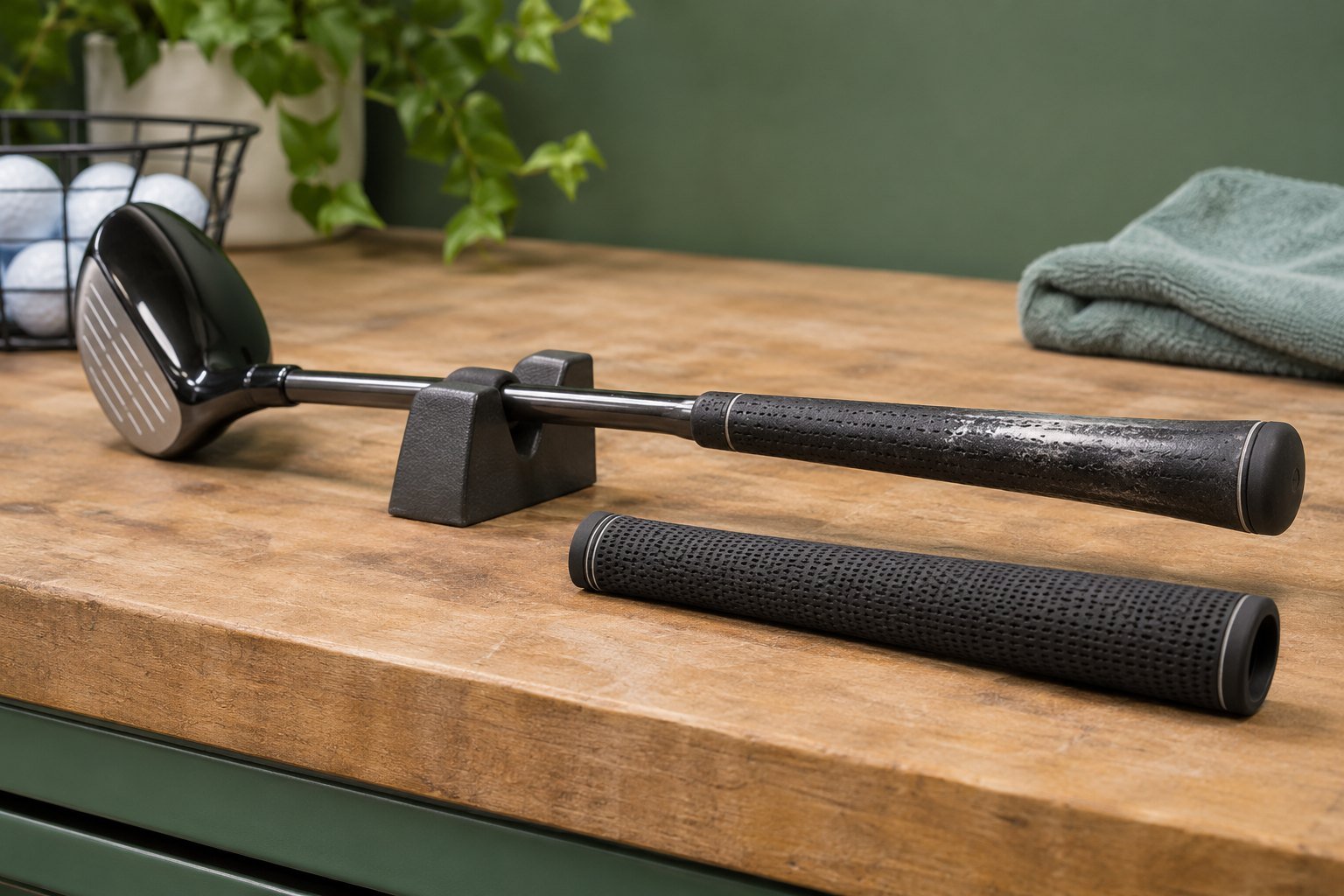
Ask for a replacement that preserves the size and feel you want, or discuss any deliberate change with the fitter. If you plan to compare clubs, record the grip difference so it does not become an overlooked part of the result.
If a standard Golf Pride Tour Velvet is the agreed replacement, you can view that grip at Clubhouse Golf. Check the exact size and the complete fitted cost before ordering. This is one maintenance option, not a claim that everyone should use the same grip.
For loft, length or component changes, ask what the proposed work can realistically address and what it will cost. Avoid paying for an expensive reshaft on the assumption that every distance or contact problem must come from the shaft. The fairway wood shaft-length guide explains why a build decision needs more than a simple height label.
If condition and build are satisfactory but contact remains unreliable, a lesson or fitting assessment may be the more useful next booking. There is no obligation to diagnose the fault yourself before asking for help.
Back to top ↑Compare the cost of solving the problem
Get quotes for the options that could actually work. A cheap adjustment has little value if it cannot solve the missing-shot problem; a replacement is poor value if maintenance would restore a club you already trust.
Swipe within the table to see all columns.
| Option | Assumed complete cost | Question before spending |
|---|---|---|
| New grip, fitted | £15 | Is grip condition the issue, with the rest of the club suitable? |
| Assessment and a supported minor adjustment | £40 | Can the existing club be made suitable without major work? |
| Professional reshaft | £140, including the chosen shaft, grip and labour | Has a comparable build been trialled, and is the head still right? |
| Replacement club | £240 + £35 fitting − £60 confirmed trade-in = £215 | Does the observed benefit justify the net outlay? |
These figures are only examples. Under these assumptions, replacement costs £75 more than the reshaft, or £200 more than a new grip. Those differences matter only if the cheaper option can genuinely do the required job.
Do not include an optimistic resale value until you have a realistic offer. Check whether a fitting fee is separate or credited, what any work includes, and the return terms for a custom build. If you keep the old club, remove the assumed trade-in credit from the calculation.
Once a fitting gives you a useful specification, you can compare the fairway wood range at Callaway UK or investigate a suitable alternative brand. Match loft, shaft, length and handedness before comparing prices. A previous-generation or used club can still be a candidate if its actual build and condition meet the brief.
Make the replacement earn its place against the current club
Bring the current wood, the adjacent hybrid or long iron and your intended ball to the session. Tell the fitter which shot is missing and which existing strengths you want to retain.
Swipe within the table to see all columns.
| Decision point | Evidence to retain |
|---|---|
| Does it cover the missing role? | Separate carry and direction records for the relevant tee or turf shot. |
| Does the benefit repeat? | Several ordinary shots and a return to the current club during the session. |
| What gets worse? | Any loss of useful flight, directional control, lie versatility or comfortable setup. |
| Is it a fair comparison? | Ball, lie, settings, complete build and any conditions that changed. |
| Is the cost justified? | The final specification and full quote alongside maintenance or refit alternatives. |
Alternate clubs in manageable blocks and take breaks. Do not discard every poor shot to make the new model’s averages attractive. If one unusual swing or questionable reading changes the conclusion, take more time before buying.
Agree any trial arrangement before purchase and understand what condition the club must remain in for a return. A promise to “try it” is useful only when you know where, for how long and under which terms.
When to replace a fairway wood
My recommendation is to keep a sound fairway wood that fills a distinct role and gives you dependable results. Maintain it when the problem is a serviceable component. Refit it when a suitable adjustment or build change has a credible route to the required shot. Replace it when the current club cannot reasonably do that job and a tested alternative can.
That decision can happen with a fairly recent club or after years of good use. The date on the model name does not tell you which applies. Condition, your current needs and a fair comparison provide the useful evidence.
What if I do not have a launch monitor?
Start by recording the situations where the club helps or lets you down, using honest estimates rather than invented precise carry figures. A range with reliable landing references can help you compare patterns. If the purchase depends on a narrow carry difference, a supervised fitting session is a more useful expense than guessing—or buying a launch monitor solely for this decision.
What if a new club is better from the tee but worse from grass?
Return to the job you wrote down. It may be a good tee option, but it has not automatically replaced an approach club. Keep both roles visible when deciding which club should occupy the space.
Our Woods & Hybrids guides cover the related equipment choices. The most satisfying outcome may be a new club, a modest service bill or a clear reason to carry on with the one you already know.
Back to top ↑Sources and further reading
Sources checked on 22 November 2026. Product descriptions are attributed to their makers; the comparison methods and buying judgements are editorial guidance.
Illustrations in this article were created for Taylor’s Trailblazing Golf. Third-party photographs, where used, are credited beside the image or in the source list.