Golf Glove Holders and Drying Clips: Avoiding Crumpled Gloves
Give a removed glove a practical home without confusing holding with drying.
Original conceptual illustration; not a product-test photograph.
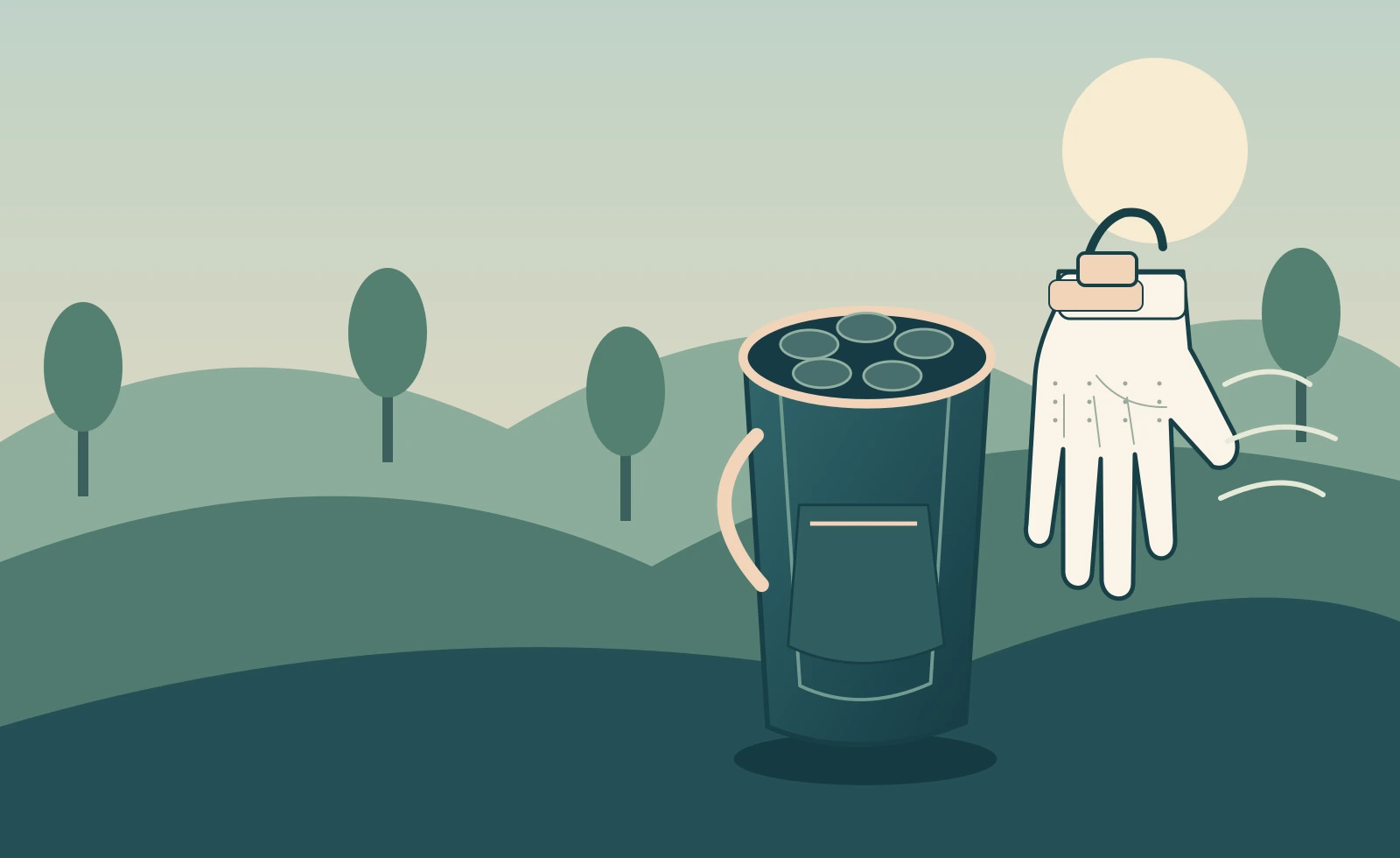
Golf glove holders and drying clips are small accessories with a specific job: giving a removed glove somewhere better to go than the bottom of a pocket. They are not miniature drying machines, a remedy for the wrong glove size or proof that the leather will last a certain number of rounds. Their usefulness depends on how they hold the glove and where you put them.
A glove can be secure but still folded tightly against a wet towel. It can be nicely spread out but hanging where rain reaches it. It can also be positioned perfectly on the bag and forgotten there when the entire bag goes into the car. Choosing the accessory is only part of building a routine that avoids those outcomes.
This research-led guide compares holder designs by practical function rather than ranking products we have not tested. It uses manufacturer care advice and published accessory descriptions, then sets out proposed checks for your own glove and bag. The goal is a repeatable remove, air, inspect and store routine, with no promises about drying time, hygiene or glove lifespan.
Gentle contact
Check the closure or clip surface before attaching the glove.
Clear and accessible
Avoid rain exposure, dirty wheels and snagging points.
A complete routine
An accessory is not a substitute for appropriate care.
Inspect the bag
An existing suitable glove tab may already do the job.
Golf glove holders and drying clips: choose the job first
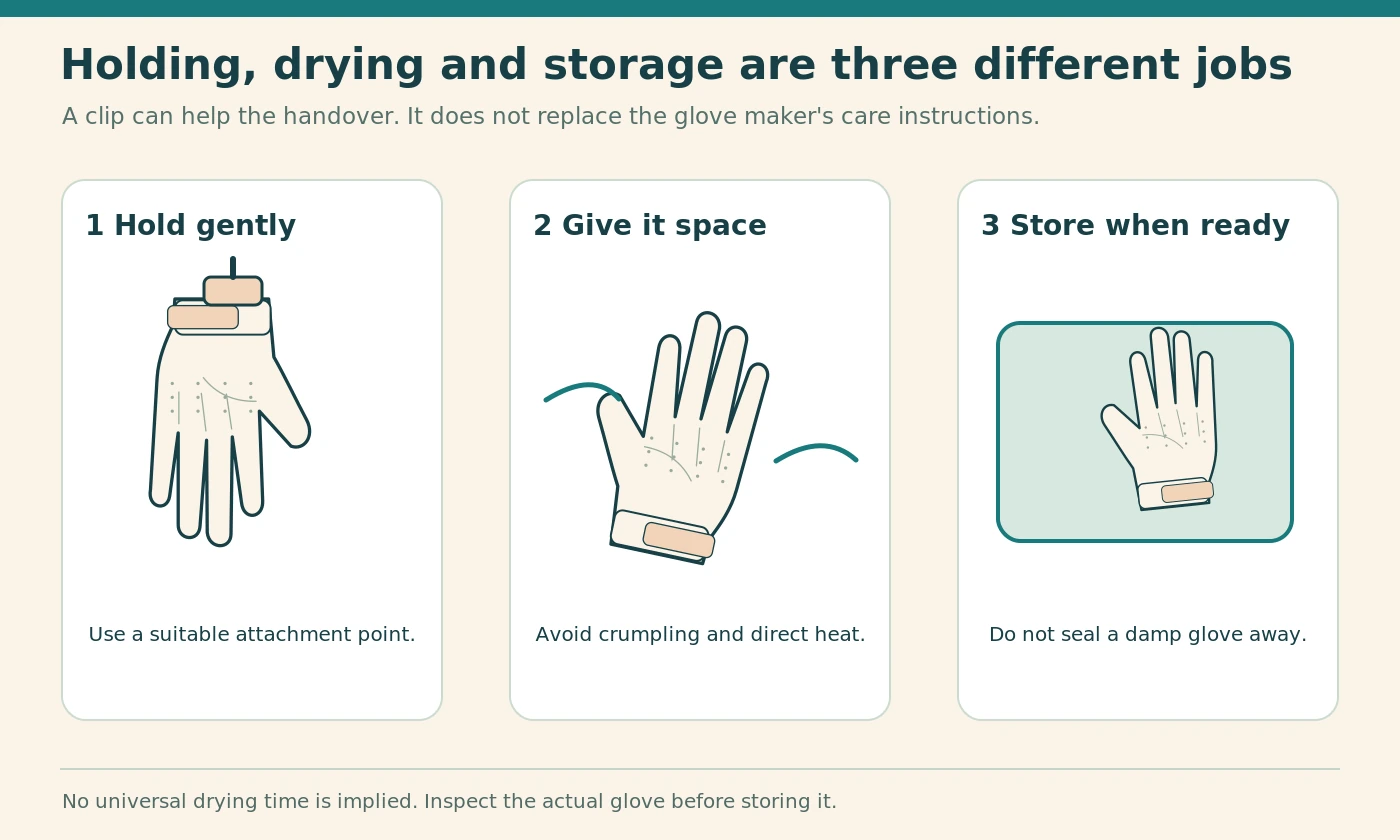
Separate holding, drying and storage
A holder keeps the glove in a chosen position. A drying arrangement exposes suitable parts of it to moving air. Storage protects it between uses once the required drying and care have been completed. One accessory may contribute to all three, but the tasks are not interchangeable.
Start by identifying the failure in your current routine. Do you lose the glove when putting, stuff it into a sweaty pocket, or leave it folded in the bag overnight? A quick-release attachment may help the first problem, an accessible airing point the second, and a habit of unpacking the bag the third. Buying the same clip for every problem can miss the actual cause.
Keep the claim proportionate
A passive clip has no way to guarantee that every glove will be ready by a fixed time. Material, initial wetness, how the glove is opened and the surrounding conditions all change the situation. Treat a universal "dries in minutes" claim as something requiring evidence for a stated setup, not as a dependable schedule for your next round.
Your first acceptance criterion can be simpler: does the accessory let you remove and place the glove without folding it into a tight bundle? Then ask whether the position remains suitable once the bag is moved, covered or stored.
Compare the main holder designs
Hook-and-loop tabs and hanging clips
A hook-and-loop holder usually connects to the glove's existing closure. It can be convenient when the attachment surfaces match and the glove hangs without twisting. Some bags already provide a glove tab, so inspect your current bag before buying another accessory. Ram lists a glove tab among the features of its Deluxe Trolley Bag. [1]
A clip grips an edge or reinforced area instead. The important details are the contact surfaces, pressure, release action and the position of the suspended glove. An accessory described as a glove clip is not automatically gentle enough for every thin leather panel.
Shapers and protective organisers
An open hand-shaped support aims to hold the glove less crumpled. A case or organiser primarily protects it from being crushed or lost. These designs solve different problems, so judge each by the task it actually performs. A protective shell without suitable ventilation is not automatically a drying solution.
You may not need a dedicated product at all. A clean, suitable place to lay the glove out at home can be more useful than an elaborate support that remains inside a closed bag. Choose an accessory only when it removes a practical obstacle in the routine you will actually follow.
Editorial comparison by function. These are selection questions, not measured drying results.
| Design | Useful role | What to check |
|---|---|---|
| Hook-and-loop tab | A repeatable place to attach a removed glove | Closure compatibility, orientation and exposed rough hooks. |
| Hanging clip | Quick attachment at a suitable reinforced point | Gentle jaws, release action and pressure marks. |
| Open shaper | Support a less-crumpled shape | No forced stretching; follow exact care guidance. |
| Case or organiser | Protection from loss or crushing | Do not assume a closed container dries a damp glove. |
Read the glove's care instructions before choosing a system
Leather, synthetic and mixed construction differ
Check the exact glove rather than relying on a broad material label. A leather palm with stretch panels is not the same construction as an all-synthetic glove, and a special treatment can change the manufacturer's cleaning instructions. The holder must support the care routine, not become a reason to substitute instructions from an unrelated product.
FootJoy advises checking care instructions and says full-leather golf gloves should not be submerged, recommending a damp wipe instead. Bionic explains that some specially treated gloves are washable, but its general care article and RelaxGrip 2.0 product page give conflicting advice about that named model. Follow the supplied care label and ask Bionic to resolve an unclear instruction before washing. Do not generalise either statement across all gloves. [2] [3] [6]
Use an accessory gently
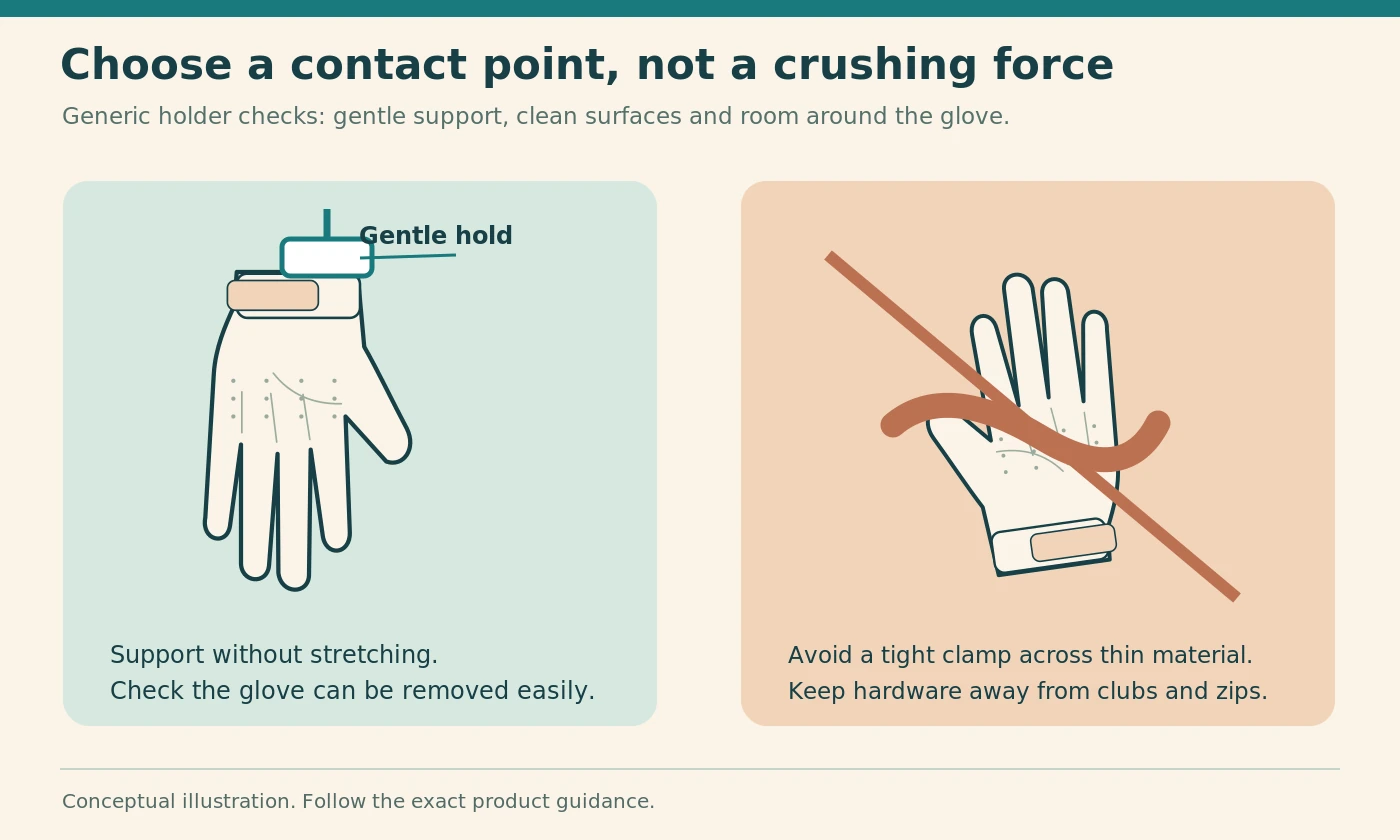
Before attaching a damp glove, consider where the load will be carried. A strong cuff or closure may be more suitable than a delicate finger panel, but follow the glove and accessory instructions rather than treating that as universal permission to clamp anywhere.
Do not force a glove onto a support that stretches the palm or pulls the fingers apart. A holder should make appropriate handling easier. When it changes the fit or creates visible stress, it is no longer solving the original storage problem.
Inspect the part that touches the glove
Look at jaws, edges and contact area
Open a clip and inspect the surfaces that will touch the glove. Look for sharp edges, exposed burrs or teeth that could mark a thin panel. Check whether the opening accommodates the intended attachment point without needing an awkward sideways pull.
Try the release action with the clip away from the glove first. A powerful spring may be secure, but it should not require you to yank the glove free. Test cautiously on a suitable reinforced area only when the instructions permit, then inspect for a pressure mark or snag.
Match the closure rather than assuming compatibility
With a hook-and-loop holder, check that the glove's tab attaches in a useful orientation. A secure connection that folds the glove palm-to-palm may be less helpful for airing than a different position. Conversely, a broad holder may expose rough hooks that catch nearby clothing.
Make sure the attachment can be released without pulling on a fingertip. The easiest way to lose the benefit of a tidy system is to make removal irritating. A holder that you stop using after two holes has failed your practical requirement, regardless of its advertised strength.
Find a suitable position on your golf bag
Choose an accessible, sheltered location
Look for a position you can reach without moving several headcovers or opening a crowded pocket. Keep the glove clear of dirty wheels, the base of the bag and places where a wet towel normally hangs. Accessibility matters because the holder is intended to support a small action repeated through the round.
Check the bag in its actual working position. A point that is high and clear when upright may become low or trapped when the bag tilts on its stand. On a trolley, make sure the glove does not hang against a moving part or get caught when the handle is folded.
Test the bag's normal movements
Lift and set down the bag carefully, then move it through the route you normally use to the car or locker. Watch for the glove swinging into clubs, buckles or rough surfaces. You do not need to shake the bag violently to test a lightweight accessory.
Avoid attaching the holder to a zip pull, thin loop or other point unless the bag maker intends it to carry that load. An accessory should not make a convenient pocket harder to open or introduce a snagging point into the straps. Reposition it before deciding that the glove itself is the problem.
Plan for rain rather than exposing the glove automatically
Airing outside is not always the right move
Hanging the glove on the outside of a bag can be convenient in suitable conditions. During rain, the same position may expose it to more water. Treat the weather as part of the placement decision rather than assuming that "outside" always means "drying".
Look at what happens when the rain hood is fitted. Does it cover the glove, press it against another wet surface or prevent access to the attachment? A sheltered location needs to be checked in the complete rain arrangement, not imagined while the hood is folded away.
Keep the spare genuinely separate
A spare glove is useful only if it is kept in the condition you need when you reach for it. Store a dry spare separately from the damp glove being aired, using the protection appropriate to the glove and conditions. Do not put both into one small pouch simply because the pouch has a mesh panel.
Rain gloves and ordinary leather gloves may have different intended uses and care requirements. Follow the exact product guidance rather than applying a single drying or grip assumption to everything labelled a golf glove. This article concerns handling and storage; it does not prescribe a glove material for every weather condition.
Build an easy between-shot routine
Give the glove one predictable home
Choose a repeatable point at which you remove the glove, place it on the holder and retrieve it. The routine should fit your own play without delaying others. Some golfers remove a glove for putting; others use different habits. The accessory should support your preference rather than dictate it.
Practise the movement before the round with clean hands and an empty practice area. Check whether you can reach the holder comfortably and whether the glove remains visible enough to remember. A complicated sequence involving several clips is unlikely to survive an ordinary busy round.
Release the glove before pulling it away
Open the closure or clip fully, then remove the glove without dragging it through the fastening. Likewise, when taking the glove off your hand, avoid pulling hard on one fingertip. Gentle handling is a practical precaution, not a claim that one particular technique guarantees a longer life.
If the holder requires you to use your teeth, twist the wrist awkwardly or tug the bag towards you, choose a different position or design. Convenience should be assessed as part of care: the system must remain usable when you are wearing a jacket or carrying a towel.
Use a deliberate end-of-round handover
Do not leave the last glove in the car
The final removal of the glove is the point at which a course accessory needs to hand over to your home routine. Before closing the bag or car boot, check that you know whether the glove is dry, damp or still visibly wet. That observation determines what needs doing next.
A useful personal rule is to unpack the glove with the shoes or other equipment you already remove after golf. Link the new habit to something established rather than relying on a separate reminder you may ignore. The clip itself cannot solve a forgotten glove inside a stored bag.
Separate the dirty and clean items
Keep the glove away from muddy shoes, used cleaning towels and loose debris during the journey home. A temporary transport arrangement should prevent crushing without being mistaken for completed drying. Once home, remove it from that arrangement and follow the relevant care instructions.
Inspect the holder as well. If it is wet or dirty, putting a clean glove straight back onto it defeats the purpose of the reset. Give the accessory its own suitable cleaning and drying step before the next use, particularly where contact surfaces collect grit.
Set up a suitable drying place at home
Choose conditions, not a deadline
Use the glove manufacturer's recommended drying method. Bionic's care guidance specifies air drying rather than a drying machine. Do not substitute a radiator, hot hairdryer or other unapproved heat source simply because you need the glove soon; an accessory marketed for drying is not permission to add heat. [3]
Choose a clean place where the glove can sit in an appropriate, uncrumpled shape without being pressed under other equipment. Keep it away from household traffic, pets and dirty surfaces. A reliable location makes the routine easier to repeat than moving the glove between whatever spaces happen to be free.
Check both shape and remaining dampness
Do not judge readiness solely from the outside of the palm. Inspect accessible finger areas, the cuff and places where material remains folded together. The check is a practical observation, not a calibrated moisture test, so allow uncertainty rather than declaring a fixed drying time.
When the glove still feels damp or looks unevenly dried, give it more appropriate airing rather than sealing it away. If it has become damaged, stiff or uncomfortable, ask the manufacturer about care options or replace it. A shaper cannot certify that a compromised glove is suitable to keep using.
Decide whether an open shaper adds value
Fit the support to the glove, not the reverse
An open support can help maintain an uncrumpled position, but only when its shape and size suit the glove. Check the intended hand, finger arrangement and dimensions where provided. A support that needs force to enter is not a neutral storage surface.
Try placing the glove without stretching the fingertips taut or pulling the closure beyond its normal position. If the glove catches on a join or edge, stop and inspect the support. You are looking for gentle support, not an excuse to reshape the glove into a different size.
Keep the evidence modest
A manufacturer may claim faster drying or longer glove life for a particular design. Unless the test method and conditions are available, those claims should not become your expected result. Your useful observations are whether the glove sits more open, whether the support is easy to clean and whether the routine is easier to maintain.
Compare the shaper with simply laying the glove out appropriately at home. The dedicated product earns its place when it solves a real space, handling or organisation problem. It does not need to be presented as essential equipment for every golfer.
Rotate gloves without inventing a timetable
Label condition rather than age alone
FootJoy recommends rotating gloves so each has more opportunity to dry. That supports the general idea of allowing recovery between uses, not a promise that alternating two gloves will produce a particular lifespan. Keep any rotation routine responsive to the actual condition of each glove. [4]
You might identify gloves as ready, drying and awaiting inspection. Use separate locations or a simple written note rather than marking a playing surface with an unsuitable pen. The aim is to avoid reaching for the damp glove again because it happens to be on top.
Keep a ready spare for genuine uncertainty
Before a second round, check the glove rather than assuming the elapsed time was enough. If it is not ready, use an appropriate spare. Do not make a drying accessory responsible for meeting a schedule it cannot control.
A rotation system also makes it easier to notice a recurring problem. If one glove repeatedly becomes awkward while another of the same model remains comfortable, inspect the individual item and fit rather than treating every difference as proof that the holder works or fails. Several variables can change at once during ordinary use.
Store a dry glove without compressing it
Give it room to retain its ordinary shape
Once care and drying are complete, place the glove where it will not be tightly folded under balls, batteries or other heavy items. A protective organiser may be useful for that task, particularly if your bag pockets are crowded. Check its dimensions with the glove laid in the intended position.
Do not assume that more rigid protection is always better. A bulky case may be inconvenient enough that it stays at home, while a simpler organiser fits your routine. The relevant question is whether the glove is protected and easy to retrieve, not how elaborate the accessory looks.
Distinguish transport storage from long-term storage
A holder on the outside of a bag may work between holes but be vulnerable during transport. Conversely, a protective pocket that is useful in the car may not be the place to leave a damp glove. Move the glove between arrangements deliberately rather than expecting one position to serve every situation.
Follow the glove maker's storage advice where provided, and recheck condition before the next round. Avoid using fragrance, powders or chemical treatments to conceal an unresolved care problem. Those products need their own material compatibility evidence and are not a substitute for inspection.
Keep the holder clean and mechanically sound
Contact surfaces deserve attention
Inspect the part touching the glove for grit, roughness or damage. A clip that was smooth when new may acquire contamination in the bag. Clean it only by a method appropriate to its material and the manufacturer's instructions, then let it dry before attaching the glove again.
Hook-and-loop surfaces can collect loose fibres. Remove accessible debris gently without cutting or picking aggressively at the fastening. Check whether the connection still holds reliably in the intended orientation rather than compensating for poor engagement by pressing harder against the glove.
Check the attachment as a separate component
A sound clip can still be lost if its ring, cord or bag attachment is worn. Inspect those connections before relying on the holder, especially after it has snagged during transport. Replace a damaged accessory rather than improvising a sharp wire loop or an insecure repair.
Keep small detachable parts away from children and pets. For a junior golfer, an adult should assess both the fastening and the bag location. The simplest suitable holder is often easier to manage than a collection of loose clips and decorative attachments.
Read accessory descriptions critically
Features are more useful than sweeping benefits
Hippo describes its glove holder as a hook-and-loop design with a detachable clip arrangement. Those are features you can compare with your bag and glove. Broader claims about freshness, traction or lifespan require evidence beyond the existence of the fastening. [5]
When reading any listing, separate construction, intended use and claimed outcome. "Clips to a bag" is different from "dries twice as fast". The first may be checked directly; the second needs a meaningful comparison under described conditions before it can guide expectations.
Ask what a demonstration actually shows
A video of a glove hanging neatly can show how the attachment works. It does not establish that the glove has dried internally, retained its dimensions or lasted longer than a comparison glove. Likewise, a customer's positive comment can describe satisfaction without proving a general performance claim.
You do not need laboratory evidence to buy a modest convenience accessory. You do need to keep the reason for buying honest. Choose it because the fastening and placement suit your routine, not because an unverified claim has been converted into a guaranteed saving on future gloves.
Run a practical acceptance check
Try the complete remove-and-replace sequence
Before relying on a new holder, attach it to the intended bag point and use the actual glove. Remove the glove, fasten it, move the bag normally, release it and put it back on. Repeat only enough to identify an obvious inconvenience, keeping the glove clean if the item may be returned.
Look for folding, twisting, snagging and awkward reach. Check the arrangement with your usual jacket and towel in place. These are proposed usability checks, not a standardised product test or a durability assessment.
Decide what would make you reject it
A sensible rejection point is a contact surface that appears likely to damage the glove, an unreliable attachment or a position that repeatedly puts the glove against dirty or wet equipment. Another is simply that the release is too awkward for you to use comfortably.
Do not keep an unsuitable accessory because it was inexpensive or looks tidy in a photograph. The alternative may be a different attachment point, an existing bag tab or no extra product at all. A small purchase should reduce friction in the routine, not add another problem to manage.
Adapt the routine for different golfers
The walker and the trolley user
For a walker, check the glove while lifting and shouldering the bag as well as while it stands. Keep it away from strap movements and the area pressed against clothing. A useful location at rest may be poor during carrying, so consider both phases.
For a trolley user, inspect the position with the bag secured and the trolley unfolded. Keep the glove clear of wheels, frame hinges and folding mechanisms. Remove it before packing equipment when necessary rather than hoping it will remain protected through every movement.
The occasional player and the junior
An occasional player benefits from a simple ready-to-play check before leaving home. The glove may have been stored for some time, so inspect its condition and fit rather than assuming a neat organiser proves it is ready. Keep the routine short enough that it actually happens.
For a junior, prioritise a fastening they can operate without pulling at the glove or losing small parts. Demonstrate where the glove belongs after play and involve an adult in the care check. Avoid treating a holder as a way to make an outgrown or uncomfortable glove last longer.
Troubleshoot the problem that remains
The glove still comes out crumpled
Look at where folding occurs. The attachment may be secure while the glove is pressed against the bag or doubled over inside a case. Change the position or storage arrangement rather than automatically buying a stronger clip. Security and shape support are separate requirements.
If an open support is involved, check whether it actually fits the glove. A support that is too large may create strain, while an unsuitable shape may leave the palm folded. Stop using it when it appears to change the glove's fit or produces visible stress.
The glove is still damp or uncomfortable
Review the entire route from the last shot to storage. Perhaps the glove was placed in a closed pocket for the journey and never removed, or the holder sat against a wet towel. Correct the routine before crediting or blaming the accessory for a result it did not control.
Persistent discomfort, damaged seams or a glove that no longer fits should not be disguised with a storage gadget. Follow the maker's care advice, replace an unsuitable glove and seek appropriate help for persistent hand symptoms. A holder is an organisational tool, not a treatment or a fitting correction.
Make the handover work in a shared household
Choose a temporary drying place before you need it
A holder is easier to use consistently when the next destination is already decided. Choose a clean, suitable area where a glove can rest or hang in accordance with its care instructions, away from direct heat and where it will not be crushed by other belongings. Do not select a place solely because it is near the front door.
Keep wet golf kit separate from paperwork, electronics and clothing that must stay dry. The holder should make that separation easier, not transfer a dripping item onto another vulnerable surface. If the only available hook leaves the glove pressed against a wall, consider a different arrangement that gives the glove room without stretching it.
Make ownership and readiness obvious
Where several people use similar gloves, store them in clearly separate positions. A small label on the storage location is preferable to applying an unapproved adhesive or ink to the glove. Record the wearer and hand if that helps avoid confusion.
Do not use a numbered drying schedule as a guarantee that every glove is ready after a fixed interval. Check the actual item before moving it into longer-term storage. The practical aim is a repeatable handover from bag to drying place to storage, rather than leaving the decision to whoever unpacks the car.
Check whether a new holder actually changes the problem
Observe the routine, not a promised percentage
For a proposed home comparison, note what currently happens to the glove after a round: it is folded in a pocket, hangs against a wet towel, or is removed and laid out promptly. Then change the holder arrangement while keeping the care instructions and storage destination the same.
Look for observable differences such as easier removal, less accidental folding or fewer times the glove is forgotten in the bag. These observations do not establish a laboratory drying rate or prove a longer product life. They tell you whether the accessory makes your own care routine easier to follow.
Stop when the accessory introduces a worse trade-off
A holder that keeps the glove visible but repeatedly catches on the car boot opening may not suit that position. A shaper that makes storage tidy but is awkward to insert without force may not suit that glove. Change the location or accessory rather than continuing merely because it was sold for golf.
Keep the acceptance question narrow: does it hold the glove securely and gently, allow the intended care routine and fit the way you handle the bag? You do not need to attach a numerical score to answer those questions. A simpler existing tab can remain the better solution when an additional purchase adds complexity without solving the problem.
Pros and cons of adding a holder
The useful advantages
A suitable holder gives the glove a predictable place, can make removal and retrieval easier, and may reduce the temptation to crush it into a pocket. It also makes a deliberate end-of-round check more visible. These are practical advantages you can assess without claiming a measured improvement in playing performance.
The best benefit may be behavioural rather than technical: the accessory reminds you to deal with the glove before putting the bag away. That is worthwhile when the reminder works reliably and the attachment itself is gentle and convenient.
The limitations to accept
A holder does not control the weather, certify dryness or repair worn material. External placement can expose the glove to rain or dirt, and an unsuitable clip can introduce pressure or snagging. A protective case can also conceal a glove that still needs attention.
Treat the purchase as an optional part of a complete routine. Existing bag features or an appropriate place at home may already do the job. Spend only when a particular design solves a problem you have identified, and judge success by better handling rather than an unverified promise of longer life.
Common mistakes to avoid
Buying a drying claim instead of a usable fastening
Do not choose purely on advertised drying speed, then discover that the clip is difficult to release or incompatible with the glove tab. Inspect the mechanical details first. A simple holder that you use consistently is more valuable than an elaborate claim attached to an awkward product.
Avoid using a tight shaper to stretch a glove into comfort. Similarly, do not assume that a secure clip can be attached to any thin panel. The accessory should work with the glove's existing construction, not require it to tolerate an improvised stress test.
Stopping the care routine at the bag
Hanging the glove neatly after the last hole is not the end of the process if the whole bag then goes into closed storage. Build the handover to home into the routine. Check the glove, the holder and the chosen storage place separately.
Finally, do not copy another manufacturer's washing advice because the gloves look similar. Keep model-specific care instructions available and use the holder to support them. An organised system is useful only when the underlying handling remains appropriate for the actual glove.
Frequently asked questions
Do I need a separate clip if my bag has a glove tab?
Not necessarily. Try the existing tab with your glove, bag position and normal movements. If it is accessible, secure and keeps the glove in a suitable position, another accessory may add little. Buy a separate holder only when it resolves a specific limitation such as awkward reach or unsuitable attachment orientation.
Will a holder dry a wet glove during the round?
Do not rely on that outcome. A passive holder may support airing, but it cannot guarantee readiness in particular weather or after a particular amount of wetting. Keep an appropriate spare and judge the actual glove's condition. A published universal drying time should not become your personal schedule without relevant evidence.
Is a hand-shaped support better than a clip?
It performs a different job. A support may help the glove sit less crumpled, while a clip mainly attaches it somewhere. The support must fit without stretching, and the whole arrangement still needs a suitable location. Compare the actual handling benefit rather than assuming that a more complex shape is automatically better.
Can I attach the holder to my belt instead?
Only where the accessory is intended for that use and the position works safely for you. Check whether the glove contacts clothing, catches during movement or becomes awkward when sitting. A bag-mounted system and a belt-mounted system need separate usability checks. Detach it when the arrangement no longer suits the activity.
Should I put a damp glove into a protective case?
Protection from crushing is not the same as drying. Follow the glove's care instructions and complete the necessary drying before normal storage. A case may be useful for a dry glove, but its presence does not establish that moisture has been dealt with. Reopen a temporary transport arrangement promptly when you get home.
Can a clip make a worn glove last another season?
There is no responsible guarantee of that kind. A clip cannot restore damaged stitching, lost fit or unsuitable material condition. Improve the handling routine, but replace a glove that is no longer appropriate to use. Judge the accessory by convenience and care support, not a promised number of extra rounds.
Final recommendation: a simple holder, a complete routine
Start with the fastening and location you already have. If the glove can be removed, supported and retrieved gently without getting crushed or exposed unnecessarily, there may be no need for another purchase. Where an accessory helps, choose a design you can operate easily with the actual glove and bag.
Then make the end-of-round handover deliberate. Bring the glove out of the bag, follow its care instructions, allow appropriate drying and store it without compression. Check the holder itself for dirt or damage before using it again.
That complete routine is more useful than a bold drying claim. A good holder gives the glove a sensible place; it does not replace judgement about weather, material care, condition or fit.
Sources and fact-checking notes
Editorial review: 4 October 2026. Named product and service details come from the official sources below. The practical checking routines and hypothetical examples are editorial guidance, not reported hands-on tests. Specifications, availability and terms can change; confirm the exact model or booking before acting.
- Ram Golf – Deluxe Trolley BagExample of a bag with an integrated glove tab.
- FootJoy – golf gloves and care guidanceFull-leather cleaning caution and model-specific care guidance.
- Bionic – How to Clean Golf GlovesThe general care article names a RelaxGrip 2.0 exception that conflicts with the model page below. Do not infer a universal washing method.
- FootJoy – glove fitting and careGlove rotation and allowing time to dry; no quantified lifespan claim is adopted.
- Hippo – glove holderPublished attachment design only; no independent drying or durability result.
- Bionic – RelaxGrip 2.0 product explanationOfficial model-page washing advice conflicts with the general care page. Seek exact-model confirmation.
Illustrations in this article were created for Taylor’s Trailblazing Golf Gear. Third-party photographs, where used, are credited beside the image or in the source list.