

Golf Bags with Full-Length Dividers: How to Check the Claim
Look below the top count, then test the bag with the clubs you actually carry.
Original conceptual illustration; not a product-test photograph.
Golf bags with full-length dividers promise a more orderly home for your clubs, but the wording on the label needs unpacking. The number of openings you can see at the top is not necessarily the number of separate channels running through the bag. More importantly, even a clearly specified individual-divider system still needs to work with your grips, putter and trolley.
The best buying check starts with a simple question: what problem are you trying to remove? Perhaps grips catch when you replace an iron, your putter needs two hands to extract, or the clubs become awkward only after the bag is strapped onto a trolley. Those are different problems, and paying for more top openings does not automatically solve all of them.
This guide combines current manufacturer descriptions with a practical inspection routine you can use before committing to a bag. The checks are proposed shopping and ownership checks, not results from a laboratory comparison or a claim that we have used the named bags. Product examples illustrate how manufacturers describe construction; they are not a ranking. Start with the internal layout, then assess the complete loaded bag.
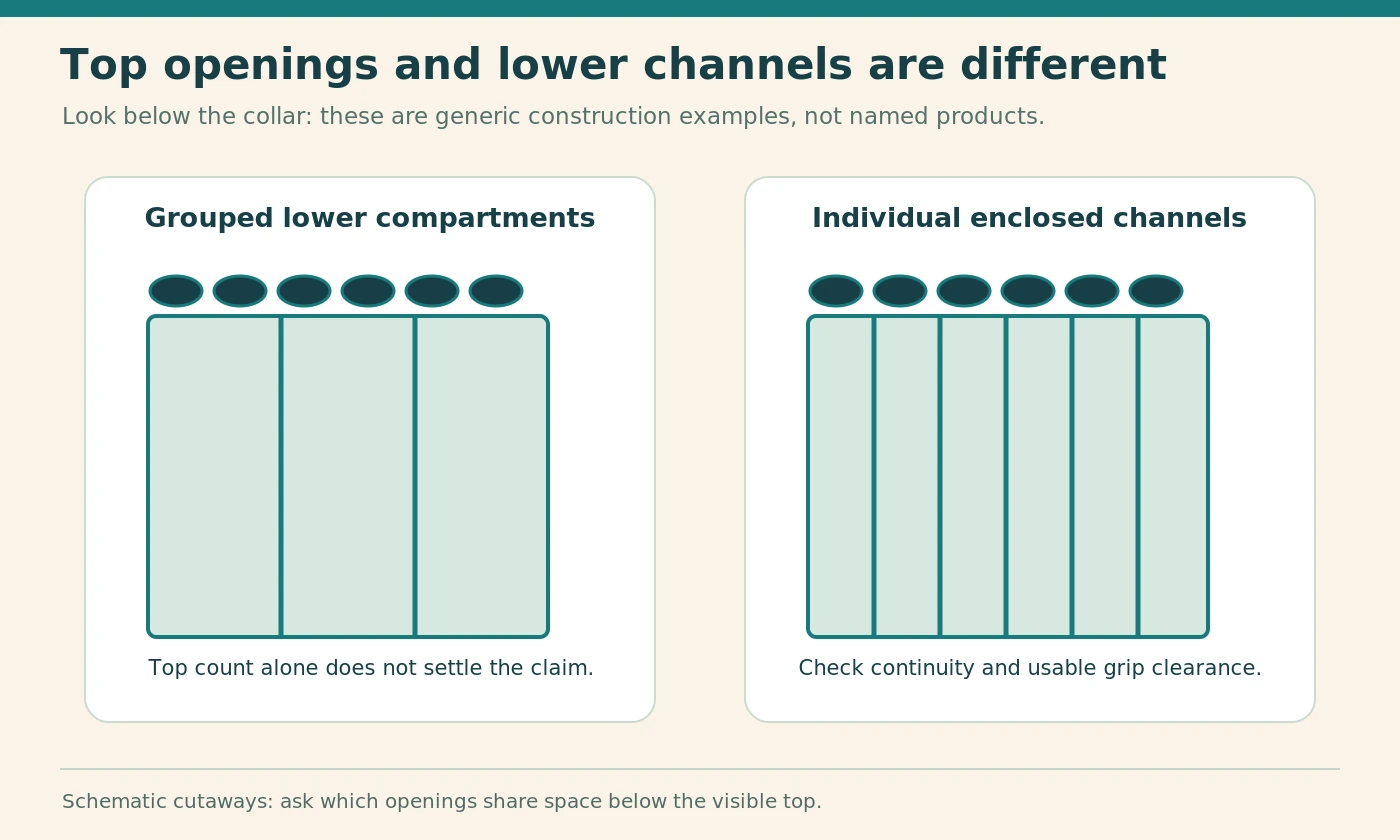
Below the collar
A divided top is not proof of individual full-length channels.
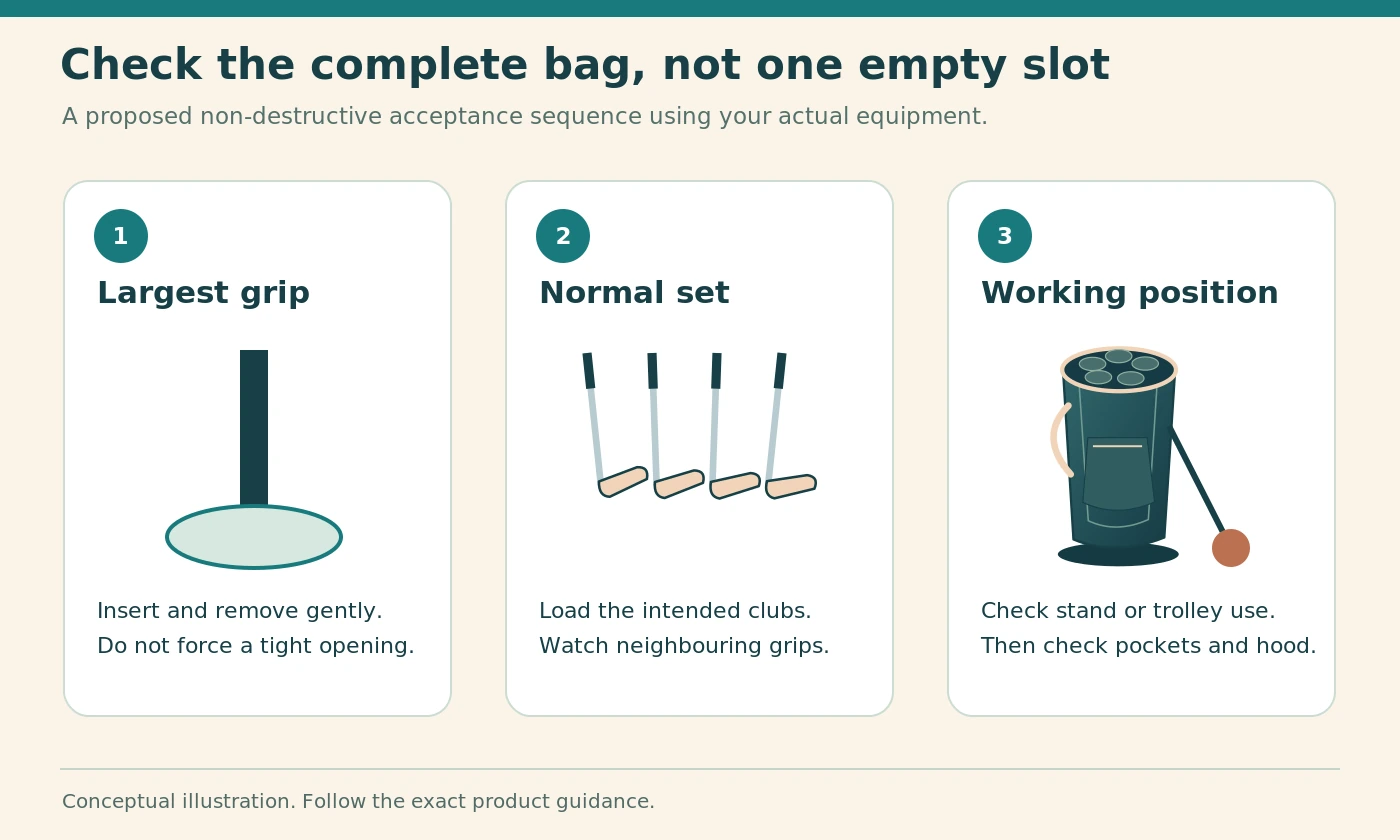
Your largest grip
Check the entry and the route below it without forcing anything.
A complete set
Neighbouring clubs and headcovers change practical access.
The whole bag
Carry, storage and trolley fit still matter.
Golf bags with full-length dividers: what the claim should tell you
Count openings and internal channels separately
A top divider is the structure around the openings at the mouth of a bag. A full-length divider continues substantially down the interior to separate clubs or groups of clubs. An individual full-length system describes a different arrangement from a few long partitions beneath several top openings. These distinctions matter because clubs can share space lower down even when their shafts enter different openings above.
VESSEL makes the distinction explicit on its Player V Stand page: the six-way version has three full-length, fully enclosed dividers, while the fourteen-way version has fourteen. The manufacturer also says the fourteen-way version best accommodates standard iron grips. Those statements belong to that exact model and option; they should not be transferred to every VESSEL bag. [1]
Ask for a construction description, not reassurance
When a listing says only "14-way top", treat the internal arrangement as unconfirmed. Ask how many full-length compartments there are, whether each opening has its own channel, and whether the putter opening is included in that count. A seller answering "yes, it has dividers" has not yet answered your question.
Write the answer against the exact product code and top option. That small record is more useful than remembering a broad brand reputation, especially when a retailer sells several generations under similar names. You are establishing what is being offered, not accusing the seller of making a false claim.
Understand grouped, individual and putter-well layouts
Grouped channels are a legitimate design choice
A grouped layout gives several clubs a shared compartment. That can be convenient when you carry a reduced set or want flexibility over where each club goes. Individual channels instead give clubs defined positions. Neither arrangement is automatically the better purchase: the relevant question is whether it supports your set without awkward access.
Sketch a simple plan of your current clubs before comparing bags. Mark the longest wood, shortest wedge, putter and any unusually large grips. Then imagine replacing each club while the neighbouring slots are occupied. An attractive empty top can conceal a less convenient arrangement once headcovers and a full set are present.
Treat the putter position as its own check
A dedicated putter well may have a different shape or opening size from the iron positions. Ram's Deluxe Trolley Bag description uses a fourteen-plus-one layout, with an additional oversized opening intended for larger putter grips or other items. That is a useful example of why the putter position needs explicit identification rather than being assumed from the headline number. [2]
An extra opening is storage provision, not permission to carry extra clubs in a round. Keep the bag-layout decision separate from playing-equipment rules. For shopping purposes, concentrate on whether the putter enters and leaves cleanly without dragging against a neighbouring headcover or forcing your hand into a crowded corner.
Read manufacturer examples without turning them into a league table
Compare the specificity of the wording
Some descriptions are more informative than others. Bag Boy describes the HB-100 Hybrid's fourteen-way top and later specifies full-length individual dividers. Sun Mountain describes fourteen full-length dividers for the Matchplay Ballistic stand bag. Both are examples of a stated construction feature, not independent confirmation of how smoothly your own grips will move. [3] [4]
Read the specification and explanatory text together. An abbreviated retailer heading may leave out a qualification present on the brand page. Conversely, a detailed review of an older version may describe a structure that has changed. Match the name, version and top option before comparing claims.
Keep three evidence levels distinct
First comes the published specification. Second comes an answer from the brand or retailer about the exact bag you intend to buy. Third comes your own careful loaded inspection. Each level answers something different: a specification describes the design, a clarification resolves missing detail, and an inspection shows whether the particular arrangement suits your equipment.
A successful shop check does not establish long-term durability. Equally, a single snag does not prove the specification is false. Record where and when the snag occurred, then investigate possible causes. Keeping evidence separate lets you make a proportionate decision rather than treating every favourable impression as a verified performance result.
Examples of manufacturer wording checked 4 October 2026. These illustrate claims to verify, not a product ranking.
| Named example | Published distinction | Question that remains |
|---|---|---|
| VESSEL Player V, 6-way [1] | Three full-length enclosed dividers | Which openings share the lower space? |
| VESSEL Player V, 14-way [1] | Fourteen full-length enclosed dividers | Do your actual grips fit the selected configuration? |
| Ram Deluxe [2] | 14 + 1 positions and an oversized putter slot | Does your putter pass through the complete route? |
| Bag Boy HB-100 [3] | 14-way top with individual full-length dividers | Is access convenient with your normal set loaded? |
Check the listing before travelling or ordering
Save the details that identify the bag
Record the full model name, year where stated, colour code, top configuration and retailer stock reference. A screenshot of the relevant specification can be useful, but include the surrounding context so you do not accidentally save a claim for a different option. Do not assume that selecting a different top leaves every other specification unchanged.
Look for an illustration of the interior, a manufacturer explanation or a precise written answer. A top-down photograph is useful for counting openings but cannot establish what happens beneath them. Likewise, a picture showing clubs arranged neatly is not evidence that the channels are fully separate.
Ask a question the seller can answer
A practical message is: "For this exact model and fourteen-way option, does each top opening have an individually enclosed channel running down to the base? Is the putter well included, and are there any stated grip-size limitations?" Add your putter-grip model when it is unusually large.
A seller may not have internal drawings. That is not automatically a reason to reject the bag, but uncertainty should remain uncertainty. Ask whether you can inspect the bag with clean clubs before making a decision, and check the applicable return conditions rather than assuming that outdoor use is permitted during a trial.
Start with an empty, non-destructive inspection
Use light, not force
With the bag empty and supported safely, look through the top openings using ordinary room light or a torch. Check the visible lining for loose fabric, exposed rough edges or a partition that appears folded over. Your aim is to spot an obvious issue, not to certify the entire internal construction from above.
Do not insert sharp tools, dismantle the top or pull hard on fabric partitions. These actions can damage a new bag and complicate a later discussion with the retailer. If the interior is difficult to see, a written manufacturer explanation is preferable to an improvised destructive inspection.
Check the route around the opening
Run a clean hand gently around accessible edges, avoiding any area that looks damaged. Consider whether a bulky grip will pass through the narrowest part of the entry, including padded lips and the angle created by an adjacent handle. The headline top dimension describes the overall opening, not necessarily every usable passage.
Also inspect the base from outside. A bag should sit in its intended position without an obvious twist or deformation. Do not infer a hidden divider fault solely because the empty bag looks slightly soft; flexible construction needs assessing as part of the loaded system, not against an expectation that every bag behaves like a rigid box.
Test the grip that is hardest to accommodate
Choose representative clubs
Bring a clean iron with your largest ordinary grip, the putter, a short wedge and a longer club. When possible, use your normal set rather than the shop's small demonstration grips. A check with a slim stock grip may tell you little about the equipment you actually own.
Begin with one club and lower it slowly into the intended position. Note whether resistance appears immediately at the top, partway down, or near the base. Keep the shaft aligned with the channel rather than levering it sideways. If the grip stops, lift it out and investigate; forcing it down converts an inspection into a damage risk.
Separate entry clearance from internal clearance
A grip can pass the padded top comfortably and still meet resistance lower down. Conversely, a tight entry may be the only restriction while the channel itself is spacious. That distinction helps you ask a useful follow-up question instead of saying the whole bag is "too small".
Repeat with the putter in its intended well. Look at the shape of the grip rather than just a generic size label. A broad, flat-sided putter grip and a round oversize iron grip can interact differently with the same opening. There is no reliable universal clearance figure that replaces trying the actual combination.
Load the complete set before judging access
An empty bag is only the first stage
Once the initial checks look promising, place the normal set into the bag with permission and without dropping clubs. Include the headcovers you actually use. Move through the positions systematically so you can tell whether a problem follows a particular club or a particular channel.
Try removing a middle iron while both adjacent positions are filled. Then replace it without moving the neighbours. Repeat with the putter and a short wedge. These are proposed convenience checks, not a timed test: the useful observation is whether an ordinary action needs avoidable rearranging.
Pay attention above the divider line
Full-length partitions do not prevent clubheads or headcovers touching above the top. A snag near the mouth may come from a headcover cuff, a shaft leaning across another opening or a clubhead sitting over a short neighbour. Inspect that visible area before blaming the lower compartments.
Try one sensible rearrangement, keeping similar clubs in a clear order. If access becomes straightforward, the issue may have been layout rather than construction. However, avoid solving every awkward movement by inventing a complicated sequence you will not want to repeat on the course. The best arrangement should remain understandable when you are tired, wearing layers or dealing with rain.
Repeat the check in the position you will use
Stand mode changes the approach angle
A stand bag is normally accessed while tilted on its legs, not only while held upright. On a suitable level surface, deploy the stand according to the bag's instructions and repeat a few club movements. Keep the area clear and do not lean on the bag as though it were furniture.
Watch how the shafts settle when the bag tilts. A layout that feels spacious upright may bring heads closer together in stand mode. The point is not that one angle is wrong, but that you should assess the intended working position before accepting the upright showroom impression.
Trolley use adds another variable
For a trolley bag or hybrid bag, test the intended trolley cradle and approved strap route where possible. Secure the bag normally, not excessively, then check access again. If a previously easy channel becomes awkward only after fastening, note the strap location and how the bag is supported.
Do not keep tightening a strap to cure rotation without consulting the trolley and bag instructions. A compatibility issue may be about the cradle, base or attachment system rather than the dividers. This guide does not certify a particular trolley combination; it gives you a way to notice that the combination changes the result.
Include pockets, clothing and the rain hood
Compare normal load, not maximum stuffing
Repeat the access check with the clothing and accessories you realistically carry. Overfilling every pocket is not a fair representation of a light summer round, but leaving them all empty may miss an issue during your usual winter use. Use a consistent, ordinary load when comparing two candidates.
Pay particular attention to large side pockets. Note whether club access changes when a jacket is placed inside, without assuming that any change proves a manufacturing defect. The useful question is whether the bag remains convenient with the equipment and layers it must carry for you.
The hood needs its own practical check
Fit the supplied rain hood as instructed and see whether you can reach the clubs you use frequently. Consider zip direction, clearance over headcovers and where a wet cover will be stored afterwards. Do this gently indoors rather than staging a water test on a bag you may return.
The hood and the internal dividers perform different jobs. A bag can have excellent internal separation yet an inconvenient hood opening, or a good hood with a top layout that does not suit your putter. Assess both before deciding that a single headline feature makes the whole bag right for you.
Diagnose a snag before replacing a bag
Use a simple location record
Describe the problem in plain terms: "The putter catches at the top", "two iron grips rise together", or "the wedge stops halfway down only on the trolley". That is more useful than a broad complaint about tangling. Empty the neighbouring positions and repeat carefully to establish whether crowding changes the behaviour.
Inspect the affected grip for a loose end cap or other damage without altering it. A damaged club component should be assessed by an appropriate repairer, not repeatedly forced through the bag. Similarly, visible torn lining deserves retailer or manufacturer advice before further use makes it worse.
Change one thing at a time
Try the same club in a different suitable position, then another club in the original position. Compare upright and intended-use positions. These small checks can help distinguish a club-specific fit issue from an awkward channel or loading arrangement.
Stop when resistance becomes substantial or the fabric appears to move abnormally. You do not need dozens of repetitions to establish that something needs attention. Photograph the visible issue and explain the sequence to the retailer. A calm, specific record is more helpful than trying to prove the fault by pulling harder until something tears.
Balance organisation against the rest of the bag
More separation is not the only purchase criterion
Decide how much you value individual club positions relative to carry comfort, pocket access, overall size and trolley compatibility. A golfer using a compact half set may reasonably prefer fewer shared compartments. Someone who wants an obvious empty space for each missing club may prefer individual positions.
Do not treat this as a contest between serious and casual golfers. It is a choice about your routine. A bag that looks highly organised but is cumbersome to lift into your car can be the wrong purchase even when the divider claim is clear and accurate.
Compare the finished system
When considering weight, use the manufacturer's stated basis and check what is included. Then think about the bag with your clubs, balls, water and clothing. This is not a substitute for a measured carry assessment, but it keeps an empty-bag specification from dominating a decision about a loaded object.
Try the available handles with the loaded bag supported safely. Check whether your normal storage space accommodates the top, base and protruding headcovers. Divider construction should survive this broader review as a useful feature, not become the excuse for overlooking every other ownership compromise.
Buying online, in a shop or second-hand
Online purchases need a clear question trail
Before ordering, identify the seller, exact option and relevant product description. Save the answer to any construction question alongside the order details. Check current delivery and return terms directly with that seller; a brand's terms on another country's website may not apply to your purchase.
On arrival, inspect the unused bag on a clean indoor surface. Keep packaging until you have completed the checks that the seller permits. Do not take it into wet grass first and assume you can later treat it as an untouched item if the putter fit disappoints.
Used bags require condition evidence
For a second-hand bag, ask for current photographs of the top, lining that is visible from above, base, handles and stand mechanism where relevant. Request a description of any catching, tearing or repairs. A stock product picture establishes the model's appearance, not the condition of the actual bag.
An older specification can still help identify the original layout, but it cannot confirm that the internal fabric remains intact. Arrange an inspection with your clubs when practical. Decline an uncertain purchase when the potential saving depends on a divider repair whose scope, cost and feasibility nobody has established.
A repeatable ten-minute shop check
Keep the sequence short enough to use
As a suggested shopping routine, allow roughly ten minutes after you have identified a promising bag. Spend the opening part confirming the exact model and internal-divider description, then inspect the empty openings. Next try your most demanding grip and putter before loading the remaining clubs.
Use the final part to repeat ordinary removal and replacement in stand or trolley position. The timing is only an organisational suggestion, not a standardised test duration. A helpful retailer may need longer to answer a construction question, and it is better to pause than rush a decision around an unverified detail.
Record a decision, not a score out of ten
Write three outcomes: the construction is clear or unclear; your normal clubs pass the access check or need rearrangement; and the bag suits or fails your intended carry or trolley use. Add the specific unresolved question rather than inventing a numerical rating.
For two candidates, use the same clubs, headcovers and pocket load. Otherwise, you may compare one bag under easy conditions with another under difficult ones. A consistent sequence makes the result more useful while still acknowledging that a brief shop inspection cannot predict years of wear, every weather condition or future grip changes.
Three practical buying situations
The oversize-grip trolley user
Suppose your current bag works until the trolley strap is fastened, and your new grips are larger than the previous set. Prioritise the loaded trolley check rather than buying whichever bag advertises the most compartments. Ask about grip compatibility, then verify the actual putter and iron passage with the strap routed correctly.
A clearly described individual system may be suitable, but a wider grouped arrangement could also solve your practical problem. Choose on observed access with your equipment. Do not pay for a construction label that you have not connected to the reason your current setup is awkward.
The walker and the reduced-set player
A regular walker should give the divider layout a place alongside loaded carry comfort and stable stand access. Organisation is valuable only if the complete bag remains manageable. Keep that assessment separate from assumptions that premium materials or a high compartment count necessarily produce a comfortable carry.
For a player carrying fewer clubs, shared channels may provide enough separation without a prescribed position for every club. Plan where the putter and short clubs will sit, then check that the remaining openings do not encourage you to pack unrelated equipment where it obstructs access. The right answer can differ even when all three golfers shop from the same product range.
Measure the space around the bag as well as inside it
Check loading height and storage access
A bag can accommodate every grip while still being awkward in a low car boot or a narrow cupboard. Measure the space with the clubs and headcovers in place, not only the empty shell. Think about the route through the opening as well as the final resting position: a bag may fit once inside but be difficult to lift through the available gap.
Practise the movement with a supported demonstration bag where the retailer permits it. Keep clubs secure and avoid lifting beyond what feels manageable. The purpose is to notice a practical mismatch before purchase, not to perform a strength test or prove that an inconvenient bag can be forced into the space.
Look at handle placement
Consider which handle you naturally reach for when removing the bag from storage. A crowded top may leave little room around that handle once woods and headcovers are loaded. Check the ordinary grip you would use, including whether a large putter head blocks it.
These details are not evidence for or against the full-length-divider claim. They are reasons to retain the wider ownership check after the claim has been verified. A bag's internal organisation is useful only when getting the complete bag to and from the course remains straightforward.
Care for the interior without creating a new problem
Empty and inspect after a messy round
As a proposed housekeeping routine, remove the clubs somewhere clean and check accessible areas for loose debris before putting everything away. Follow the bag manufacturer's care instructions, particularly where linings, coated fabrics or structural panels are involved. Do not assume that advice for a different material or an older model applies.
Keep cleaning tools gentle and accessible. Pushing a brush or improvised rod deep into a fabric channel can snag something you cannot see. When an object is trapped out of reach, ask the manufacturer how the interior is designed to be accessed rather than opening seams or removing structural parts yourself.
Keep the diagnosis separate from cleaning
If club access changes suddenly, record the symptom before cleaning or rearranging everything. A photograph of visible lining and a note of the affected position may help the seller understand the issue. Stop using a channel that appears torn or catches a damaged grip until appropriate advice is available.
After permitted cleaning and drying, reload the same clubs and repeat only the relevant access check. That provides a clearer comparison than adding new tubes, changing grips and moving every club at once. Routine care should preserve the intended arrangement, not gradually turn the interior into an undocumented modification project.
Decide whether the current bag actually needs replacing
Separate inconvenience from failure
Before spending money, make a short record of what the present bag does badly. If a single headcover catches above the top, a sensible layout change may be enough. If several channels show torn lining or the bag no longer sits securely in its intended support, the issue deserves a different response.
Avoid assuming that age alone explains every problem. A recent grip change, different trolley or unusually full clothing pocket may coincide with the new difficulty. Identifying that change helps you choose a replacement intelligently, and may prevent buying another bag with the same practical limitation.
Set a replacement threshold
Your threshold might be persistent resistance with normal loading, an unresolved putter mismatch or damage that the manufacturer cannot economically address. These are personal purchasing criteria, not universal rules. Ask for a repair assessment where appropriate before treating a new bag as the only possible answer.
For a future grip change, repeat the clearance check before committing to the entire set. Keep a record of which grip and bag combination worked rather than relying on an old memory that "midsize fitted". Product labels can be broad, while the physical passage through a particular bag is specific.
Turn the listing into a precise question
Ask about the route below each opening
A useful retailer question is: "Does every opening have its own enclosed channel to the bottom, or do some openings share a lower compartment?" Add the exact model, year or product code and the top configuration. This avoids receiving an answer about a different version in the same range.
Then explain your largest grip and ask whether you may check it with the intended club set loaded. A written confirmation of divider construction and a physical grip test answer different questions. Keep both when possible rather than treating either as complete proof of the whole bag's suitability.
Make a decision from the answer
If the seller confirms grouped channels, decide whether that actually fails your requirement. Grouped construction is not automatically defective; it simply differs from individual separation. If the answer remains vague and individual channels are essential to you, postpone the purchase instead of interpreting silence as confirmation.
For an online order, keep the listing description and the seller's reply together. Inspect the delivered model before outdoor use and raise any discrepancy promptly through the seller's process. Do not cut a lining or modify a divider to make the item match what you hoped the description meant.
Pros and cons of full-length separation
Where it can be useful
A clearly specified layout helps you understand where clubs share space and where they do not. Individual positions can support an orderly routine and make it easier to notice an unfilled position. For buyers who dislike rearranging neighbouring clubs, that organisation is a legitimate convenience to assess.
The benefit should be demonstrated with your actual set rather than inferred from marketing language. A well-designed grouped layout may already be sufficient. Paying for individual compartments makes most sense when the arrangement resolves a problem you can describe and still fits the rest of your ownership needs.
Where expectations can become unrealistic
Full-length separation does not guarantee friction-free access, silence between clubheads, unlimited grip clearance or compatibility with every trolley. It also does not establish the durability of stitching, the quality of handles or the convenience of pockets. Those remain separate questions.
Think of dividers as one part of a bag rather than a universal quality grade. A practical compromise is acceptable when you understand it before buying: perhaps the putter needs a particular position, or a lighter grouped bag suits you better. An unexplained snag, by contrast, is an unresolved issue rather than a compromise you should quietly accept.
Common mistakes that make the decision harder
Judging the photograph instead of the construction
The most common reasoning error is to count top holes and stop there. Another is to read a detailed review without checking whether it covers the same top option. Keep your comparison attached to exact versions, and distinguish a visible opening from a confirmed internal channel.
Avoid testing with only one slim club in an otherwise empty bag. That tells you whether the club can enter, not whether everyday access works with the full set. Likewise, do not omit the headcovers and then blame the dividers when the upper area becomes crowded after purchase.
Trying to repair a new purchase during inspection
Do not cut lining, add improvised tubes or force partitions aside to make a new bag usable. Such changes can create new restrictions and leave you unsure whether the original product would have worked. Ask the seller about the issue while the bag remains in the condition in which you received it.
Finally, do not confuse an uncertain claim with a proven bad product. Some listings are simply incomplete. Give the seller a precise opportunity to clarify, then choose a better-documented alternative when a key question remains unanswered. That is a measured buying decision, not a verdict on every bag made by the brand.
Frequently asked questions
Does a fourteen-way top always mean fourteen full-length dividers?
No. The top count alone describes the visible openings, so look for a separate statement about the internal channels. VESSEL's Player V specifications are a useful illustration of why top layout and full-length-divider count need reading together. Ask about the exact option rather than relying on the brand name or a retailer's abbreviated headline. [1]
Are individual dividers automatically better than grouped compartments?
Not for every golfer. Individual positions may suit someone who wants a fixed place for each club, while grouped compartments may be convenient for a reduced set. Test the normal loaded arrangement, including headcovers and putter, and choose the layout that makes access straightforward without compromising the bag's other practical requirements.
Why do clubs still catch in a full-length-divider bag?
The cause may be at the top opening, around headcovers, in the grip clearance, in loading position or within damaged lining. The claim alone cannot diagnose it. Note where the resistance occurs, compare one variable at a time and stop forcing the club. Ask the retailer or manufacturer to assess a persistent or visibly damaged area.
Will a large putter grip fit an oversized putter well?
The word "oversized" is not a universal dimensional guarantee. Bring the actual putter or give the seller its exact grip model, then check both the entry and the route down the well. A wide flat-sided grip may behave differently from a round one, so a generic statement about larger grips is only a starting point.
Can I add plastic tubes to create individual channels?
Do not assume that aftermarket tubes will improve the bag. They can change clearance, loading and the way clubs sit, and their compatibility needs checking with the relevant manufacturers. For a new purchase, choose a layout that works as supplied rather than planning an unverified modification to correct a basic mismatch.
Should I reject a bag when the internal construction is not visible?
Not necessarily. Many interiors are difficult to inspect completely without dismantling them. Ask for an exact written construction description and combine it with a non-destructive loaded check. Reject the uncertainty when it concerns a feature essential to your purchase and the seller cannot clarify it, rather than treating visibility alone as the measure of quality.
Final recommendation: verify the channel, then the complete bag
Choose a bag by following the club from its opening to its resting position, not by counting the top holes and assuming the rest. Confirm the number and type of internal compartments, identify the putter arrangement, and keep the evidence attached to the precise model and option.
Next, use your real clubs to check the complete loaded setup in the position in which you will access it. Include headcovers, normal pocket contents and the intended trolley or stand arrangement. When a snag appears, describe its location and change one variable rather than pulling harder.
The strongest purchase is not necessarily the bag with the most dividers. It is the one whose construction is clear, whose access works with your set, and whose overall size, carrying or trolley behaviour fits your routine. Leave unresolved construction or compatibility questions with the seller before buying, not with yourself after the first round.
Sources and fact-checking notes
Editorial review: 4 October 2026. Named product and service details come from the official sources below. The practical checking routines and hypothetical examples are editorial guidance, not reported hands-on tests. Specifications, availability and terms can change; confirm the exact model or booking before acting.
- VESSEL – Player V StandConfiguration-specific divider counts and standard-iron-grip qualification; no independent product test.
- Ram Golf – Deluxe Trolley Bag14 + 1 layout, full-length divider description and separate oversized putter slot.
- Bag Boy – HB-100 Hybrid14-way Individual Divider System and full-length individual-divider wording in the detailed page.
- Sun Mountain – Matchplay Ballistic 14-wayNamed model full-length-divider specification; availability is not assumed.
Illustrations in this article were created for Taylor’s Trailblazing Golf Gear. Third-party photographs, where used, are credited beside the image or in the source list.