Golf Glove Size and Hand Measurement: Check Finger Length and Palm Fit
Use the chart to make a shortlist, then check the complete glove on your hand.
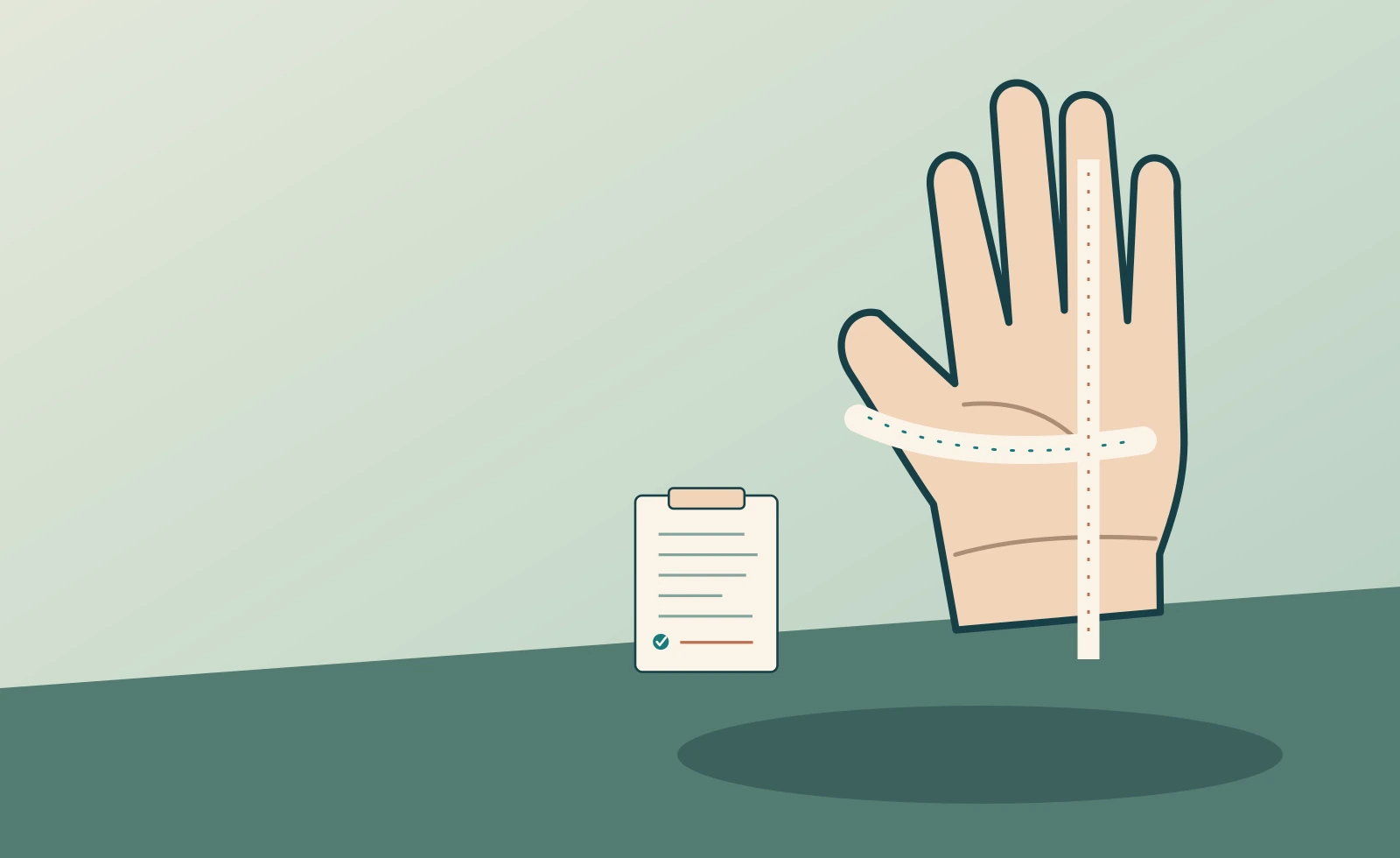
Original conceptual illustration; not a product-test photograph.
Golf glove size and hand measurement belong together, but a tape measure cannot finish the fitting on its own. Two hands can have a similar circumference and different finger proportions. Equally, two gloves carrying the same size label can use different cuts, materials and measurement systems. The label is a starting point, not a verdict on how the glove should feel.
The most useful check considers finger length, palm fit and comfortable movement separately. If the fingertips are empty but the palm already feels tight, simply buying a smaller size may exchange one problem for another. If the closure has to do all the work of taking up loose material, the glove may look secure while the rest of the fit remains poor.
This guide uses current manufacturer fitting information and a proposed home-and-shop assessment routine. It does not diagnose hand conditions or claim that a particular glove improves your swing. You will learn which measurements to record, how to compare neighbouring options and when to change the cut rather than keep moving up or down a size.
The wearing hand
Confirm the glove side before reading the size.
The exact tape path
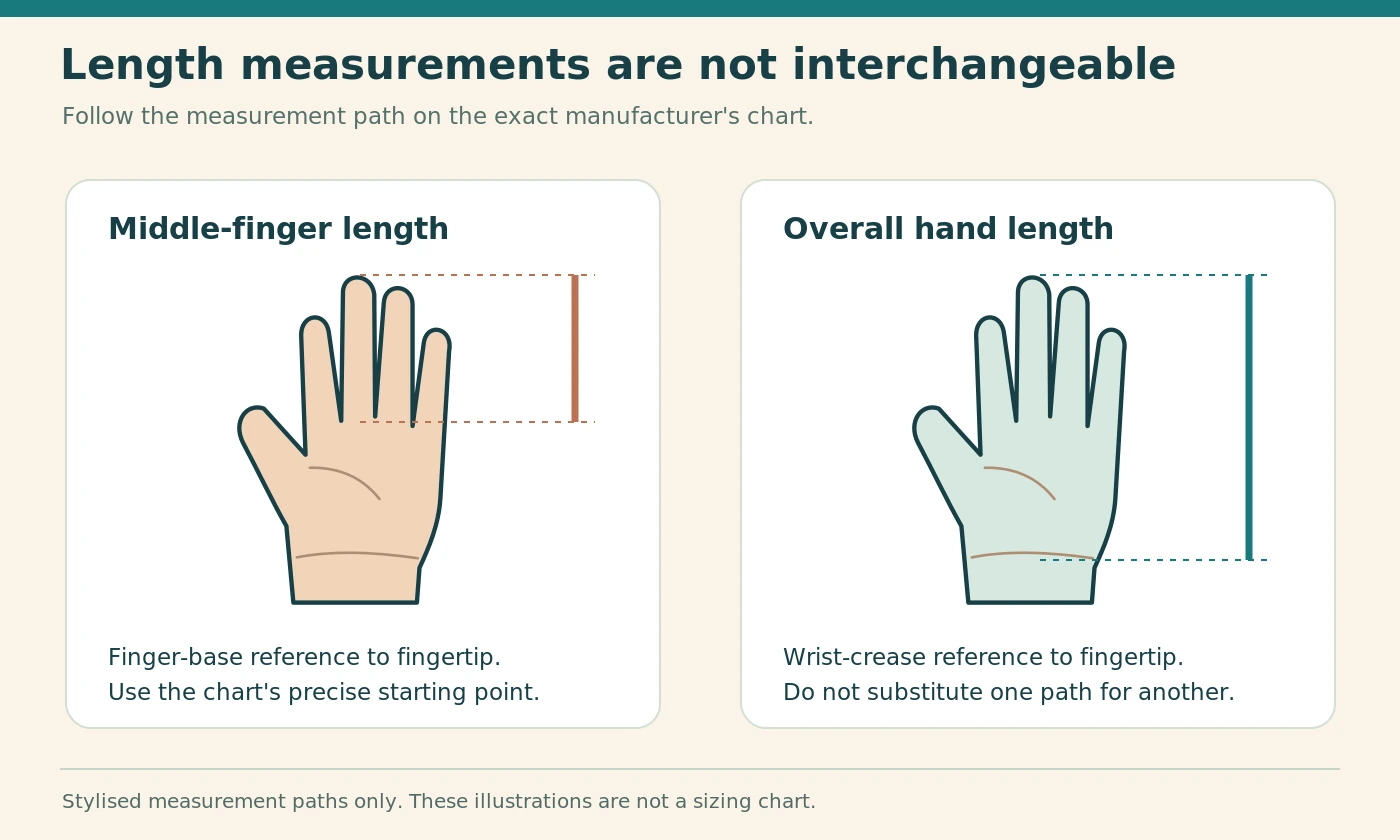
Finger length and overall hand length are not interchangeable.
Proportion as well as size
A different cut may solve what a smaller label cannot.
An unforced try-on
Check the palm and closure in a normal stationary hold.
Golf glove size and hand measurement: use two stages
Measure to create a shortlist
The first stage is matching your measurements to the exact manufacturer's chart. The second is trying the shortlisted glove and checking its behaviour on your hand. Keep those stages separate so that a chart recommendation does not persuade you to ignore an obvious fit problem.
FootJoy's guide uses middle-finger length and hand circumference, excluding the thumb. Bionic's guide instead includes hand length from the wrist crease to the middle-finger tip alongside circumference. These are not interchangeable length measurements, so copy the method as carefully as the number. [1] [2]
Fit is a pattern, not one sensation
A glove should not be accepted because one part feels good. Examine the fingers, web spaces, palm, thumb, closure and cuff. Then close your hand naturally and hold a clean club in a safe, stationary position. Look for a consistent, comfortable relationship between the glove and your hand.
The purpose is not to find the tightest glove you can tolerate. Nor is it to buy spare space for imagined stretching or future growth. Choose a size and cut that meet the maker's fitting guidance while allowing comfortable ordinary movement now. Pain or persistent symptoms need a different conversation, not a more aggressive fitting experiment.
Confirm which hand the product is for
Read the hand selector literally
Most right-handed golfers use a glove on the left hand, and most left-handed golfers use one on the right. PING makes that distinction explicitly in its Sport Tech product guidance. A retailer's "left" selector normally refers to the hand wearing the glove, not the direction in which you play. [3]
Check the product page before ordering, especially when the photograph shows only one glove and the selection controls use abbreviated labels. Write "worn on left hand" or "worn on right hand" in your comparison notes. That wording is less ambiguous than remembering that you clicked a particular letter.
Pairs need two individual checks
For gloves sold as a pair, assess both hands rather than assuming they have identical dimensions or comfort needs. The same printed size may fit one hand more convincingly than the other. Do not solve the mismatch by overtightening the closure on the looser hand.
When the product is intended for rain or cold-weather use, check its own instructions and sizing guidance. Do not carry over the fit expectation from a different single leather glove automatically. The construction and intended use are part of the comparison, alongside the measurements.
Prepare a measurement record you can actually reuse
Gather simple tools
Use a flexible tape measure, a ruler where the chart calls for one, and a place to write the results. Record the hand measured, unit, date and measurement method. These details make the numbers useful later when a different brand asks for a different type of length.
Remove anything that interferes with the tape path. Keep the hand in the position shown by the relevant guide rather than clenching it or stretching the fingers as far apart as possible. A helper can make the reading easier, but the method still needs to match the chart.
Measure twice without chasing false precision
Repeat the measurement once after repositioning the tape. If the readings differ noticeably, check the placement before averaging them. A carefully repeated ordinary reading is more useful than reporting several decimal places from an inconsistently positioned tape.
Keep the original units beside the result. When a chart uses inches, convert deliberately rather than treating a centimetre reading as an inch figure or mixing both in the same row. The precision of a converted number does not make the original measurement more exact.
Measure hand circumference using the chart's route
Do not include the thumb by accident
Read the maker's diagram or description before wrapping the tape. The route around the hand matters, and an extra loop around the thumb can produce a misleading result. Keep the tape flat rather than allowing it to twist into a narrow cord against the skin.
Aim for contact without deliberately compressing the hand. If you pull the tape tighter to reach the size label you usually buy, the measurement stops being useful. Record what you observe, then let the fitting stage decide which option is comfortable.
Record the method beside the number
A note such as "left hand, circumference around the indicated knuckle line, thumb excluded" is better than "glove size 9". The former describes a measurement; the latter may be mistaken for a manufacturer's size designation. Keep raw measurements and recommended labels in separate columns.
When a chart uses an unfamiliar term such as palm width, do not assume it means the same thing as circumference. Check the diagram and units. If the page is unclear, ask the brand or retailer before using the number to choose a size.
Measure finger length and hand length separately
Identify the starting point
Middle-finger length starts at a different place from total hand length. A chart requesting one cannot be satisfied by the other. Mark the intended start and finish in your notes, then measure without bending the finger to shorten the distance or pulling it straight under tension.
For total hand length, follow the maker's specified wrist crease rather than guessing where the hand ends. If more than one crease is visible, the diagram or written instruction matters. A small method difference can be enough to move a borderline result into another row.
Do not merge different brands' systems
It is tempting to take a circumference from one chart and a length from another, then choose whichever label sounds familiar. That creates a hybrid system that neither manufacturer supplied. Instead, keep a separate line for each brand's measurement method and resulting shortlist.
You can still use the same raw measurements when the methods genuinely match. The key is to verify that match rather than assume it. A consistent record makes it easier to see whether an awkward fit comes from a method error, a proportion mismatch or the glove's actual cut.
Use printed and online charts carefully
Check scale before trusting a printout
Some guides provide a printable measuring tool. Follow the specified paper size and print scaling, and use any calibration mark supplied. A page shrunk to fit margins can look perfectly readable while giving an inaccurate measurement. Do not treat a screen screenshot as a full-size ruler.
If you cannot confirm the scale, use a physical ruler or tape according to the maker's instructions instead. The chart is supposed to reduce uncertainty, not introduce an invisible printing error that you then compensate for by buying the wrong glove.
Keep charts attached to the exact product family
A brand may have different guidance for men's, women's, junior or specialist gloves. Check the category and the current product page. Do not assume that a size converter for clothing or winter gloves applies to a thin golf glove from the same company.
Save the chart title and date with your notes. Product ranges can change, and an old screenshot may be useful only as a historical reference. When reordering after a long gap, verify the current model and fitting information before relying on a previous purchase.
Interpret the measurement label before choosing a size. No universal centimetre-to-size conversion is implied.
| Measurement or label | What it describes | Avoid this substitution |
|---|---|---|
| Middle-finger length [1] | The finger path specified by the relevant guide | Do not replace it with wrist-to-fingertip length. |
| Overall hand length [2] | The maker's wrist-crease-to-fingertip path | Do not apply it to a different maker's finger-only chart. |
| Hand circumference [1] [2] | A complete measurement around the specified part of the hand | A flat palm width is not a circumference. |
| Regular or cadet [1] | Different proportions within a product range | Cadet does not simply mean the next smaller size. |
Understand regular and cadet proportions
Change shape when length and width disagree
Cadet is a proportion option, not a synonym for junior or a guarantee of a smaller glove overall. FootJoy describes its cadet cut as having shorter fingers and a wider palm than its regular cut. That can be worth trying when regular fingers are too long but reducing the whole size makes the palm unsuitable. [1]
Use that description to create a comparison, not to self-diagnose your hand from one measurement. Try the relevant regular and cadet options with the same assessment sequence. The better fit is the one that resolves the conflicting areas without creating a new restriction elsewhere.
Availability is model-specific
Do not assume every size, hand or model is available in a cadet cut. Bionic's guide, for example, gives specific limitations on its cadet golf-glove availability. Check the product actually being sold rather than choosing a size from a chart and assuming that exact combination exists. [2]
When the preferred cut is unavailable, consider another suitable model instead of forcing the nearest available size to work. A fitting problem is not solved by choosing the option that happens to be in stock if its proportions remain wrong.
Put the glove on without distorting the assessment
Start with clean, dry hands
Try a new glove with clean hands and according to the retailer's handling conditions. Open the closure properly and ease the fingers into place rather than pulling hard on the cuff or fingertips. The aim is to assess the supplied fit without stretching the glove during the test.
Let the material settle around the hand, then fasten the closure normally. If you need to force the glove into position, pause and consider whether the size or cut is appropriate. Difficulty getting it on is useful information; it is not an invitation to stretch it until it becomes acceptable.
Compare in a consistent order
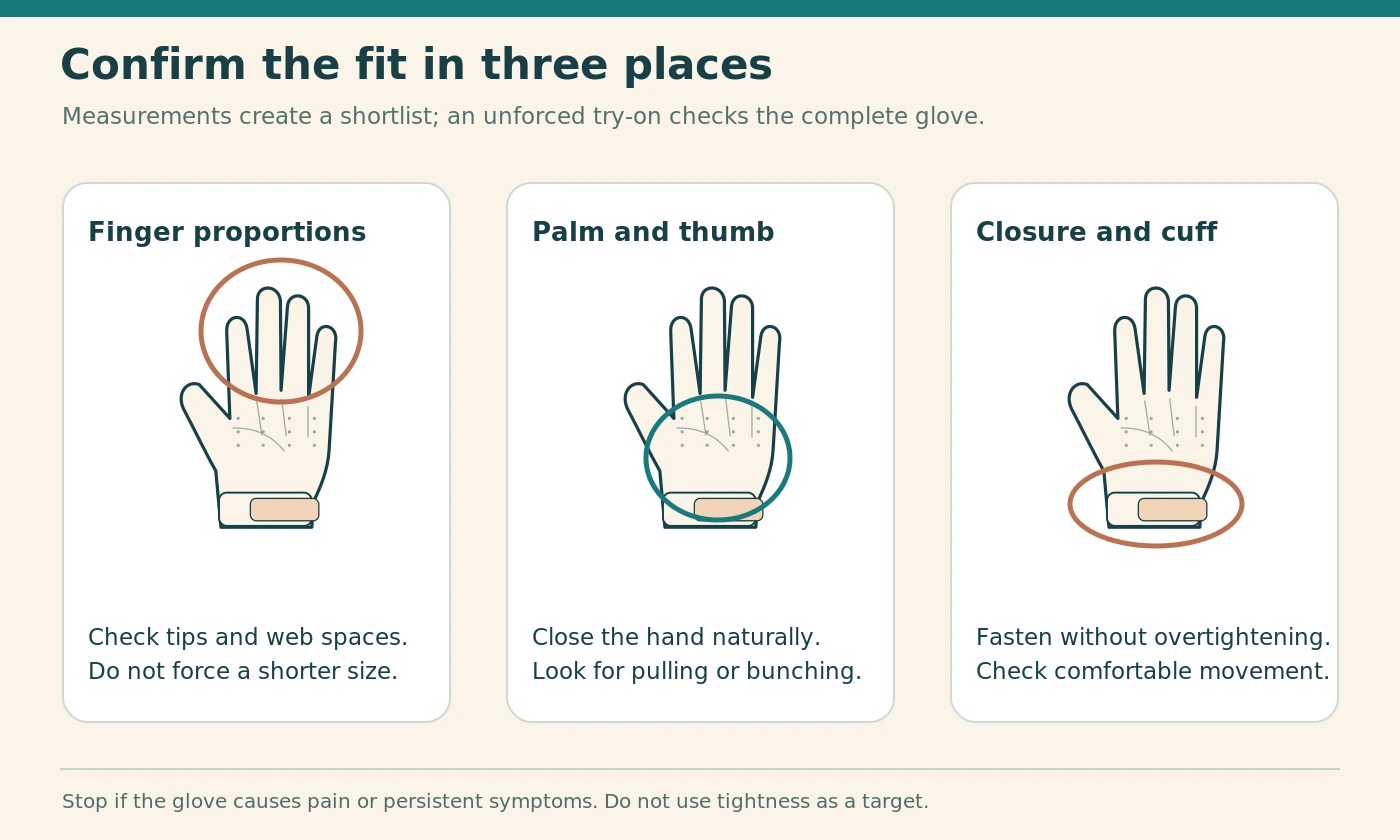
Use the same sequence for each candidate: fingers, palm, thumb, closure, relaxed fist and stationary club hold. That prevents one unusually soft material from distracting you from an unresolved length problem. Take short notes immediately, while the differences are clear.
Do not compare a heavily worn glove with a new one as though both represent their original size. The old glove can show what you liked or disliked, but it is not a reliable dimensional template. Your current hand measurements and a careful new-glove assessment should lead the decision.
Check every fingertip, not only the middle finger
Look for unused space and pulling
A middle-finger measurement helps with the shortlist, but the other fingers still need checking. Look for excess material at the tips and for seams being pulled tightly into position. A glove may fit the longest finger while leaving another finger awkwardly loose or restricted.
Close and open the hand gently. Observe whether the material follows the movement without forcing a particular finger position. Do not judge the glove only while the hand is held flat for a photograph; the useful fit needs to survive ordinary gripping movement.
Treat web-space tension as a separate observation
Check the material between the fingers. If it appears to bridge above the natural web spaces or pulls when you close the hand, note that specifically. Avoid assuming the solution is always a larger size, because the palm or other fingers may already be loose.
A different cut or model may be more appropriate than moving the whole glove up a size. Bring the observation to a knowledgeable retailer: "the palm is comfortable, but the finger webbing pulls" is more useful than "it feels strange". Specific language helps them suggest a meaningful comparison.
Assess palm fit without overtightening the closure
Look at the palm in more than one position
With the hand relaxed, inspect whether the palm material sits smoothly or gathers into a loose fold. Then close the hand naturally and check whether the same area becomes uncomfortably taut. You are looking for a workable balance, not demanding that every crease disappear during movement.
Do not press or stretch the material flat to make the glove look better. Normal construction includes seams and panels, and a visual crease is not automatically a fault. The question is whether loose material or restriction interferes with a comfortable, stable hold.
Keep the closure in its proper role
The closure secures the glove; it should not be used to compensate for a fundamentally oversized palm. If you pull it unusually far to take up slack, compare a different size or cut. Likewise, a closure that barely reaches is a reason to reassess rather than force the fastening.
FootJoy gives a specific closure-position guide for its gloves. Treat that as its fitting reference, not a universal percentage rule for every closure design. Different products may use different tabs, shapes or adjustment ranges, so the exact manufacturer's instructions remain relevant. [1]
Check thumb, cuff and back-of-hand comfort
The thumb can reveal a mismatch
Move the thumb through the ordinary position it takes when holding a club. Look for a seam that twists, a pocket of unused material or tension that pulls the palm out of place. A glove that feels satisfactory with an open hand may show a different problem once the thumb moves.
Do not try to solve a thumb-length issue by cutting, stretching or modifying a new glove. Record it and compare another pattern. The purpose of fitting is to find an appropriate construction, not to convert an unsuitable one into a homemade experiment.
Assess the cuff independently
Check whether the cuff and closure remain comfortable when the wrist moves naturally. Make sure a watch, jacket cuff or other item is not creating the sensation you are attributing to the glove. Remove the competing item briefly to isolate the cause, then assess the normal combination again.
Stop if the glove causes pain, numbness or an obvious restriction. Persistent hand symptoms deserve appropriate professional advice. A golf-glove size guide cannot diagnose the reason, and no size label should persuade you to continue a painful test.
Hold a club before accepting the fit
Use a safe, stationary check
With the retailer's permission, hold a clean club in a clear area without making a swing. Use your ordinary grip and notice whether the glove bunches or pulls differently from the open-hand check. You do not need to hit balls to identify a basic comfort or proportion problem.
Use the same club grip for each candidate. Changing glove and club-grip size together makes the comparison harder to interpret. If the purpose is to choose a glove, keep the club constant until that question is resolved.
Separate glove fit from swing advice
A glove assessment is not a diagnosis of grip technique. An unusual wear pattern or a feeling of instability may have several causes, including the glove, the club grip and how the club is held. Do not turn a shop comparison into a promise that one glove will correct a swing fault.
For persistent uncertainty, ask a suitable golf professional to look at the broader setup. The useful outcome may be a better explanation of the problem rather than a purchase. Equipment advice is strongest when it acknowledges what a glove can and cannot change.
Compare materials and specialist constructions fairly
Softness is not the same as correct sizing
A soft leather glove may feel appealing immediately, while a synthetic or mixed construction may feel different. That first impression should not override the finger, palm and movement checks. Compare each glove according to its intended fit and care instructions rather than expecting identical sensations from different materials.
Callaway's Weather Spann description combines synthetic material with leather in the palm and thumb. It is a useful reminder that "synthetic glove" can conceal a mixed construction. Read the exact product details before making assumptions about feel, stretching or washing. [4]
Rain and winter models need their own assessment
FootJoy's RainGrip is described around a specific autosuede knit palm and wet-weather use. That purpose should not be generalised to ordinary leather gloves or every product using the word "all-weather". Assess the actual model and follow its usage guidance. [5]
For a pair or a bulkier construction, check both hands and the club hold. Do not automatically size up for warmth or down for a tighter sensation. A specialist glove still needs a workable fit, and the correct comparison may be between models designed for the same conditions.
Treat universal-fit claims as a shortlist, not a guarantee for you
Read the range behind the headline
A stretch-based glove can use a broader size concept than a conventional small-to-extra-large range. Zero Friction's universal-fit page still distinguishes men's, ladies', varsity, larger-hand and junior options. The existence of those categories is a reason to read beyond the phrase "one size". [6]
Choose the intended category and try the glove using the same finger, palm and movement sequence. A broad claimed range does not remove your need to assess the actual fit. Nor should a compression-style description be treated as a reason to accept discomfort.
Avoid comparing labels from different systems directly
A universal-fit glove and a conventional medium glove are not equivalent labels. Compare how each sits and functions on your hand, not whether the packaging appears to describe the same size. Keep the product name and category in your notes so a later reorder is unambiguous.
If one construction accommodates your proportions better, that is a useful personal observation. It does not establish that the system fits every golfer, lasts longer or improves performance. Separate your fitting decision from the broader marketing claims.
Work through borderline measurements logically
Start with neighbouring options in the same model
When the chart puts you near a boundary, try adjacent sizes if available. Keep the cut and model unchanged at first so the comparison isolates size. Note which area improves and which becomes worse rather than selecting the option that merely feels looser.
For example, a smaller glove might remove empty fingertip space but make the palm restrictive. That is evidence to investigate proportions, not proof that you must tolerate the restriction. A cadet or different model may be the next useful comparison.
Do not invent a universal compromise rule
There is no responsible single instruction to "always size down" or "always size up" across all brands, materials and hand shapes. A manufacturer's own borderline guidance can help, but the try-on still matters. Record the reason for your eventual choice so you can reassess it later.
When several options remain unsatisfactory, stop ordering random labels. Ask the retailer for help using your measurement record and specific observations. A short, well-described fit problem is more productive than accumulating gloves that each solve one area while failing another.
Recheck fit when circumstances change
A familiar model is not a permanent measurement
Reassess rather than automatically reordering when your old glove no longer feels comfortable or when the model changes. Keep the current hand measurements and product details together. A long-standing size preference can be useful context, but it should not overrule present fit.
If hand size or comfort varies noticeably, record when the problem occurs and avoid drawing a medical conclusion from the glove alone. A retailer can help with product comparisons; persistent swelling, pain or other symptoms need appropriate healthcare advice.
Juniors need a current fit check
Do not buy a glove with deliberately excessive finger space simply to allow for growth. Assess the current fit and recheck it as needed. PING's junior product information includes measurements of the glove itself, which must not be confused with a hand-measurement chart. [7]
An adult should help distinguish discomfort from a fastening that is simply unfamiliar. Keep the process brief and calm, and avoid turning the size label into a judgement about age or ability. The purpose is suitable equipment for the hand that will use it.
Order online with a useful comparison record
Save more than the size label
Record the brand, model, hand, cut, size, material description and date. Add the measurements used and a sentence about the fit: for example, "palm comfortable, no unused fingertip pocket, thumb seam stays in place during stationary grip". These observations make a later replacement easier to assess.
Check the seller's current return and exchange conditions before ordering. Do not assume that a different country's brand policy applies to a UK retailer. Keep the glove clean and packaging intact while completing any permitted indoor inspection.
Ask for clarification before guessing
If a listing has no clear distinction between regular and cadet, ask the seller to identify the exact option. The same applies to ambiguous hand selectors or size abbreviations. An answer before purchase is more useful than discovering the mismatch after opening a multipack.
Avoid ordering a large quantity until one example of the current model has passed your fitting check. A previous season's comfortable glove is not proof that every new version or material will feel identical. Confirm the individual item first, then decide whether a repeat order makes sense.
Use a simple fit log rather than a numerical score
Record observations by area
Create headings for fingertips, web spaces, palm, thumb, closure, cuff and club hold. Under each, write a short description rather than a score out of ten. "Palm folds under ring finger" tells you more than "comfort six", especially when comparing a different cut later.
Keep the log brief enough to use in a shop. You do not need an elaborate spreadsheet or photographs of every angle. The goal is to preserve the reason one glove worked better so that soft material, packaging or a familiar brand does not dominate your memory.
Change one variable deliberately
Compare size first within one model, then cut where proportions conflict, then another model if necessary. That order is a proposed decision routine, not a mandatory professional fitting protocol. It simply makes the result easier to interpret than changing size, brand and material simultaneously.
When you eventually choose, keep both the successful specification and the rejected observations. Knowing that a regular medium left excess finger space while a smaller regular restricted the palm can be more useful than remembering only the final label. It explains why the cut mattered.
Work through a proportion mismatch without guessing a size
A fictional example with two different problems
Imagine a golfer whose circumference falls within a maker's medium range, but whose finger measurement points towards a shorter proportion than that regular glove provides. This is an invented example, not a set of numbers copied from a branded chart. Trying a smaller regular glove may remove some empty fingertip space while making the palm uncomfortable.
The next useful question is whether the maker offers a different proportion, such as an appropriate cadet cut, and how that exact model is charted. Do not skip directly to the assumption that every cadet glove will fit. The alternative still needs its own palm, thumb, finger and closure checks.
Compare the observation rather than the letter
Set the two candidates beside one another and write down what changed. One might remove fingertip slack but bunch at the thumb; another might feel comfortable across the palm but leave an unhelpful fold when holding a club. These are different observations and should not be averaged into a vague overall score.
Keep the conditions consistent: the same hand, clean dry skin, the same stationary grip hold and an unforced closure. Then decide whether one candidate works or whether neither solves the combination. A clear rejection of both is more informative than choosing the less uncomfortable one because a chart seemed to promise a match.
Resolve conflicting measurement advice before ordering
Check whether the definitions actually disagree
Two pages may appear to give different advice because one uses middle-finger length and another uses overall hand length. Return to the measurement diagrams before deciding that either chart is wrong. Write out each starting point and finishing point in words.
Similarly, a figure printed beside a glove diagram may describe the garment rather than the hand. Do not compare it with a body measurement unless the manufacturer explicitly says to do so. A catalogue drawing is not automatically a personal sizing instruction.
Send a focused support question
Provide the exact model, the hand on which it will be worn, your measurements and the method used. Ask which chart applies to that model and whether a regular or alternative cut should be shortlisted. Include the specific conflict rather than a general request for the best glove.
A support reply can narrow the options, but it does not cancel the need for a try-on. Keep any uncertainty visible, particularly when two sizes are suggested. Check the seller's current return conditions before opening packaging or testing a glove in a way that could affect its condition.
Compare a replacement with a worn glove cautiously
Separate original fit from the shape produced by use
A glove that has been worn repeatedly can still tell you where you liked or disliked the fit. However, its present shape is not a precise template for a new glove. Note stretching, compressed areas, damaged seams and any alterations to the closure separately from the original label.
Do not choose a new size solely by laying it against the old item. Try the replacement on your hand using the relevant current guide. A changed product generation or material can make an old label an incomplete reference even when the brand and familiar model name look similar.
Do not diagnose a swing from wear alone
A worn patch may prompt you to inspect fit, condition and the way the glove is used, but this article does not identify the cause of your swing or grip from a photograph of wear. Keep equipment observations separate from coaching conclusions. Ask an appropriate professional when the question concerns technique.
If the glove has damage that affects its secure, comfortable use, replace or assess it rather than tightening the closure to compensate. Buying another identical size without reviewing the original fit can repeat a problem, but changing sizes randomly is not a diagnosis either.
Make the final decision under ordinary conditions
Give the shortlist a consistent second look
After an initial try-on, remove and refit the preferred candidate without rushing. Check that it can be put on normally without pulling hard at fingertips or forcing the cuff. A glove that only feels acceptable after a complicated stretching ritual deserves another look.
Use the same clean club grip for each candidate and hold it in a safe stationary position. Notice whether the glove stays comfortably arranged as the hand closes, rather than judging it only with fingers spread for a photograph. Avoid practising full swings in a crowded shop or indoor room.
Record why you accepted it
Write one useful sentence, such as "fingertips filled without pressure, palm smooth in the normal hold, closure settles without pulling". That description will help with a future purchase more than remembering only a size letter. Add the full model, cut, material family and the hand worn.
This is an acceptance record, not a measured performance result. It does not promise better grip pressure, extra distance or symptom relief. It simply explains why that particular glove was a sensible fit choice for you at the time of purchase.
Pros and cons of measurement-led glove shopping
What measurements improve
A measurement record gives you a repeatable starting point and helps identify whether a chart uses finger length, total hand length or circumference. It can reduce random ordering and make a retailer conversation more specific. It also encourages you to consider proportions rather than treating every problem as a simple size error.
The strongest benefit is clarity. You can explain which method you used and which part of the glove fails the try-on. That does not guarantee a perfect first purchase, but it makes the next comparison more purposeful.
What measurements cannot decide
Numbers do not fully describe seam placement, thumb shape, material feel or comfortable movement. They also cannot diagnose hand symptoms or establish that a glove will improve your golf. Those are separate questions requiring different evidence or professional input.
Use the chart to narrow the field, then let the physical assessment complete the decision. A glove that matches a chart but feels clearly unsuitable should not be accepted out of loyalty to the number. Equally, an initially soft glove still needs the proportion checks before you commit.
Common mistakes when choosing a glove size
Mixing measurements and labels
Do not substitute total hand length for finger length, include the thumb in a circumference that excludes it, or read a garment dimension as a body measurement. Keep the unit and method visible in your notes. These small errors can make a chart look unreliable when the underlying comparison is wrong.
Avoid assuming that men's, women's and junior labels form a universal progression across brands. Compare the relevant product's actual guidance and fit. A category name is not a complete description of hand proportions.
Accepting discomfort as a break-in plan
Do not buy a painfully tight glove on the assumption that use will fix it. Likewise, avoid a loose glove merely because the closure can be pulled far enough to hold it on. Both approaches skip the central question of whether the size and cut are appropriate now.
Finally, keep glove fit separate from club-grip sizing and swing technique. They interact in use, but a glove label is not a club-fitting prescription. Resolve one question at a time and seek a suitable professional when the broader setup remains unclear.
Frequently asked questions
Should I measure my fingers or my whole hand?
Use the measurement requested by the exact manufacturer's chart. Some systems use middle-finger length, while others use total hand length from a specified wrist crease. Keep both measurements separately when comparing brands, and never substitute one for the other because the resulting size label seems familiar.
What should I try when the fingers are long but the palm is tight?
Consider a different proportion or model rather than simply reducing the whole size. A cadet option may be worth comparing where the manufacturer offers one. Assess the palm, fingertips and movement together; solving empty fingertip space is not useful if the new glove becomes restrictive elsewhere.
Does cadet mean a children's glove?
No. Cadet describes a cut within relevant product ranges, not a universal age category. Read the maker's definition and availability for the specific model. Junior gloves are a separate product category and may use different sizing information, so the terms should not be treated as interchangeable.
Is a glove supposed to feel painfully tight when new?
No fitting chart is a reason to accept pain. Stop the assessment and compare a more appropriate size, cut or model. Persistent hand symptoms deserve appropriate professional advice. Do not rely on stretching, heat or repeated use to turn a clearly uncomfortable new glove into a suitable one.
Can I use the same size in every brand?
Not reliably. Measurement systems, cuts, materials and model details can differ. Keep your raw measurements and fitting observations, then consult the new product's chart. A successful size in one glove is useful background, but it is not a guaranteed conversion to another manufacturer's label.
Can a glove size tell me which club-grip size I need?
It can be contextual information, but it is not a complete grip-fitting method. Club-grip selection needs its own assessment of dimensions, construction and comfortable use. Keep the glove constant while evaluating a club grip, and involve a suitable fitter when the combined setup remains uncertain.
What should I record after finding a good fit?
Save the exact model, hand, cut, size and date, plus the measurement method and a few observations about fingers, palm and club hold. Recheck the information when the product changes or comfort differs. A precise record is more useful than a note saying only "medium fits".
Final recommendation: match proportions, then confirm movement
Use the manufacturer's chart to build a shortlist, not to silence your own fitting observations. Record circumference and the requested length correctly, confirm the hand and cut, then assess fingers, palm, thumb and closure as separate areas.
Complete the check with comfortable hand movement and a safe stationary club hold. When finger and palm requirements conflict, change the proportion or model rather than forcing the nearest size to work. Stop painful tests and keep persistent hand concerns outside the scope of a shopping guide.
The right outcome is a clearly identified glove that fits comfortably now, with a record that makes the next purchase easier. It is not the tightest glove, the most familiar label or a promise that one accessory will change your game.
Sources and fact-checking notes
Editorial review: 4 October 2026. Named product and service details come from the official sources below. The practical checking routines and hypothetical examples are editorial guidance, not reported hands-on tests. Specifications, availability and terms can change; confirm the exact model or booking before acting.
- FootJoy – glove fitting guideFinger-length and circumference approach, regular/cadet proportions and closure checks.
- Bionic – sizing helpOverall hand-length and circumference method; model and cadet availability limitations.
- PING – Sport Tech gloveClarifies golfer handedness versus the hand on which a single glove is worn.
- Callaway – Weather SpannExample of mixed synthetic and leather construction; not a general size conversion.
- FootJoy – RainGripSpecialist wet-weather glove design and intended use.
- Zero Friction – Universal FitDifferent product groups still require appropriate selection and a real fit check.
- PING – Prodi G junior gloveGarment dimensions on the named page should not be substituted for a personal body chart.
Illustrations in this article were created for Taylor’s Trailblazing Golf Gear. Third-party photographs, where used, are credited beside the image or in the source list.