3-Wood vs 5-Wood: Gapping and Course-Use Decisions
Give each wood a useful distance and a clear job on the holes you play.
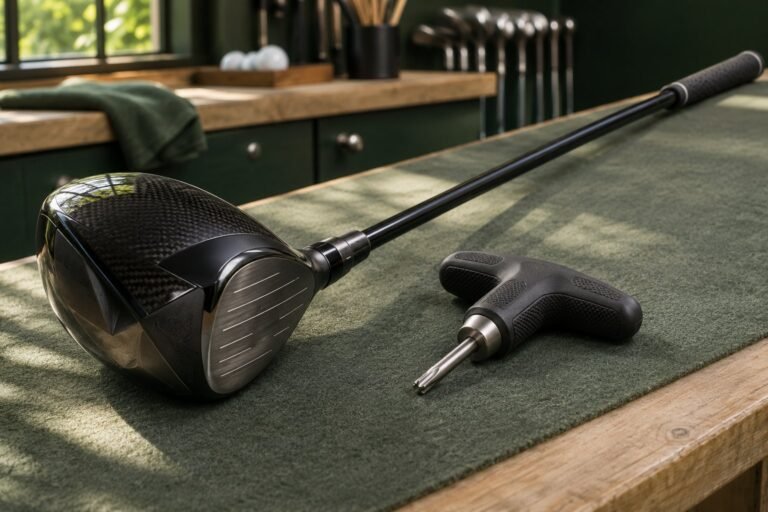
AI illustration: a bag choice starts with the shots each club needs to cover.
The useful answer to 3-wood vs 5-wood starts with your next shot. One golfer needs a longer option from the tee; another needs a club that regularly carries a hazard from the fairway. Those are different purchases, even when both golfers are looking at the same two woods.
Ad – includes affiliate links. If you buy through these links, Taylor’s Trailblazing Golf may earn a commission at no extra cost to you. Recommendations consider fit, drawbacks and alternatives.
A tee alternative and a long approach are different buying decisions.
One outstanding strike should not hide the ordinary short result.
Each wood should add a useful shot without losing one you already rely on.
3-wood vs 5-wood: choose the shots that need covering
Write down two or three situations in which your next fairway wood would come out of the bag. A tee shot that must finish before a bunker is a different job from an approach that must fly over one. A long second shot with room to run is different again. The club should have to satisfy the job you actually face.
Scroll within the table on a small screen.
| Your main need | Case for testing the 3-wood | Case for testing the 5-wood |
|---|---|---|
| A longer alternative from the tee | It reaches a useful landing area that your other options cannot reach as consistently. | It stays within the desired landing area and leaves an acceptable next shot. |
| Long approaches from short grass | It adds useful carry while keeping the ordinary miss manageable. | It produces the flight and carry you need more regularly than the lower-lofted option. |
| One wood for both tee and turf | Its turf performance remains useful after the tee-shot comparison. | Its tee distance is sufficient while the grass shots are more dependable. |
| A gap above a hybrid or long iron | The larger gap is genuinely required on your course. | It fills the immediate missing distance without repeating the club below. |
These are questions for a trial, rather than promises about either club. TaylorMade’s manufacturer guidance also separates a tee alternative from an easier-launching long-approach option, with distance gapping part of the choice.[1]
Decide which job matters most before looking at a distance leaderboard. If eight of your likely uses are from grass and two are from a tee, a wonderful tee result should not excuse an unreliable fairway result. Equally, a golfer buying a dedicated tee option can reasonably give that role more weight.
Back to top ↑Look beyond the number on the sole
A 3-wood and a 5-wood differ in more than their names. As one documented example, Callaway lists the standard men’s Quantum Max 3-wood at 15° and 43.25 inches, compared with 18° and 42.75 inches for the 5-wood. Those figures also appear on the Clubhouse Golf UK listing.[2][3]
Scroll within the table on a small screen.
| Callaway Quantum Max | Stated loft | Standard playing length |
|---|---|---|
| 3-wood | 15° | 43.25 in |
| 5-wood | 18° | 42.75 in |
Specifications checked on 22 November 2026. They describe this model and standard build; a used or custom-built club needs its own details confirmed. The numbers do not establish how far either club will carry for you.
The practical point is to compare complete clubs. If the 5-wood produces better contact, do not immediately credit loft alone: its playing length and other build differences may also matter. Likewise, a different shaft in the trial 3-wood makes this a comparison between two setups, not a clean experiment in clubhead loft.
That is perfectly useful when buying. You need a club that works as a whole. Just keep an accurate record of the head, loft setting, shaft, playing length and grip so that the club you order matches the one you liked. If playing length is the sticking point, our guide to fairway wood length and individual fitting explains what to ask before authorising changes.

Draw a carry map around the clubs you already trust
Start with the longest club you use confidently from the turf. Then record the carry of each candidate above it. Keep the driver and any dedicated tee club in a separate tee-shot column. Otherwise, you can accidentally compare a teed-up distance with a fairway distance and call the difference a gap.
Carry concerns the airborne portion; Trackman’s level-ground definition ends at launch elevation. Its total distance includes the calculated resting point.[4] Use the same type of number throughout your comparison.
Scroll within the table on a small screen.
| Club and exact build | Usual turf carry | Ordinary short and long outcomes | Tee role, if needed |
|---|---|---|---|
| Trusted hybrid or longest iron | Record your own yardage | Note the spread, including common misses | Describe when you select it |
| 5-wood candidate | Record separately from tee shots | Keep the regular short miss visible | Record tee carry and where it finishes |
| 3-wood candidate | Record separately from tee shots | Keep the regular short miss visible | Record tee carry and where it finishes |
Here is a fictional example to show how the decision changes. Suppose a golfer’s usual turf carry is 178 yards with a hybrid, 192 with a 5-wood and 197 with a 3-wood. The first gap is 14 yards; the second is only five. If the 3-wood also produces more very short shots, those extra five yards are a weak reason to carry it for approaches. It could still justify a place through a useful tee role, which must be checked separately.
Now change the 3-wood figure to 212 yards, with a manageable spread. The 20-yard step above the 5-wood may cover a real longer shot. That makes carrying both easier to justify. These are illustrative numbers, not target distances, test results or a recommendation that every golfer needs those gaps.
Give the course a vote. A gap that looks untidy on paper may be harmless if it never leaves you without a sensible shot. A smaller gap may be valuable when it covers a frequent approach with a distinct flight. The purpose is usable coverage, not perfectly equal spacing at any cost.
Back to top ↑Run a comparison that includes the shots you usually hit
Take your existing club as the baseline. Use the same ball type and comparable conditions, and tell the fitter whether the priority is tee distance, a turf approach or both. Titleist’s fitting guidance asks golfers to bring their current clubs so the fitter can establish baseline performance.[5]
This short comparison helps identify a promising club while keeping ordinary shots in the decision. Repeat it before committing if the result is close.
- Warm up, choose a clear target and agree which readings are reliable enough to retain. Record obvious device errors separately.
- Hit five turf shots with each candidate, then repeat the blocks in the opposite order. Include normal poor strikes in the record; they are part of what you are buying.
- For each club, note the middle carry result, the short and long spread, and the direction of the costly misses. Also count shots that failed the intended job.
- If tee use matters, add a separate block with each club from your normal tee setup. Keep those results separate from turf shots.
- Return to the existing club and the preferred candidate near the end. If the apparent advantage disappears, arrange another comparison before paying.
A median helps stop one exceptional strike defining the club. Put the distances in order and take the middle result; with an even number of shots, average the two middle results. It still needs the rest of the record beside it. A club can have an attractive median while producing several misses that would be expensive on your course.
Ask whether the screen is showing actual or normalised flight. Trackman Range’s Conversion estimates results in standard conditions with a premium ball, removing the effects of wind, temperature and altitude.[6] Do not mix those figures with an unconverted session and treat the difference as a club improvement.
A mat session is a useful first comparison. Before committing to a club for grass, seek a trial from representative turf where that is available and permitted. The question is whether the result carries over to the shot you are buying it for.
Check three course situations before choosing
The tee shot with trouble beyond the landing area
Start with where the ball is allowed to finish. If a 3-wood brings a crossing hazard into play on ordinary good shots, greater distance may remove its value on that hole. Compare the spread of finishing positions, not simply the average carry. A 5-wood may leave a longer approach but still create the more usable tee option.
Also check your existing driver. Buying a 3-wood because you assume it must be straighter skips the very comparison that could save you money. Keep it only if your own result gives a useful reason to select it. For a club intended almost entirely for tee shots, the mini driver and fairway wood role comparison explores that separate decision.
The approach with a forced carry
Write down the minimum carry that matters and look at the short side of your results. A best shot beyond the hazard does not make that club dependable for the carry. Nor does a long total distance help when much of it happens after landing. If neither candidate provides enough dependable margin, plan a different route to the green.
The long second shot with room short
Here you may value steady forward progress more than a particular landing angle. Compare where ordinary shots leave the next stroke, including the mishits. A club that advances the ball consistently into a straightforward position can be useful even if it does not produce the longest shot in the session.
Repeat the judgement for the conditions you commonly play. A choice built around generous summer run needs reconsidering when the ground offers little help. Do not add a fixed allowance to a screen number and treat that as a reliable winter or summer result.

When to carry one, both or neither
Scroll within the table on a small screen.
| What the evidence from your trial shows | Sensible next step | Compromise to accept |
|---|---|---|
| 3-wood adds a useful longer shot; 5-wood covers a different approach | Keep both if each earns regular use | Another club may have to make way; check what it contributes |
| 5-wood covers the needed turf shot and an adequate tee shot | Use the 5-wood as the single fairway wood | You may give up a longer tee option that you rarely need |
| 3-wood works well; a hybrid already covers the next useful distance | Keep the 3-wood and existing hybrid | Do not buy a 5-wood simply to complete a numbered sequence |
| Both woods produce similar carry and similar misses | Keep the better existing option and investigate the cause | A new head alone may not solve the problem |
| Neither wood gives a dependable result from the intended lie | Trial a more suitable build or another club category with a fitter | The longest theoretical distance may remain unavailable |
Overlap is not automatically waste. Two clubs that carry similar distances may offer meaningfully different flights or lie options for a particular golfer. But name that difference and show that you actually use it. “One says 3 and the other says 5” is not enough.
Before removing a club, write down the shots it currently covers. The new wood should improve the bag overall. Trading a frequently used approach option for an occasional ambitious second shot can leave you with a less useful setup despite the impressive headline distance.
There is also no urgency to replace a serviceable older wood. If your current club covers the role, use it as the reference and set a clear improvement that a replacement must demonstrate.
Buy the setup that earned its place
Once the trial points to a decision, compare the exact specification offered by the shop. A model name without loft, handedness, shaft and playing length is an incomplete buying description. An adjustable head should arrive with the agreed setting understood and the correct adjustment instructions available.
Callaway’s Quantum Max is one verified family with both options, with a UK manufacturer page and a Clubhouse Golf listing available to inspect.[3][7] It is a specification example in this guide, not a winner from personal testing. Check the exact variant, current price and availability when ordering.
A used club can be a sensible comparison, provided the seller can identify its build and condition. Ask whether it has been shortened, extended or reshafted; inspect the head, shaft and connection, and have uncertain damage assessed by a competent professional. Do not assume an aftermarket build has the standard dimensions in a manufacturer’s table.
Before paying, confirm what happens if the delivered club differs from the agreed specification and whether trying it affects the seller’s return terms. Include any fitting, build or repair charges in the amount you are comparing. A cheaper club is poor value if it requires work to become the club you thought you were buying.
Back to top ↑Choose the wood you can give a clear job
For a golfer whose main difficulty is getting useful long shots from grass, a 5-wood is a sensible first comparison against the current club. For a golfer who needs a longer tee option or has already demonstrated a useful extra turf carry, the 3-wood deserves its place in the trial. Neither is an automatic choice based on handicap, age or what a playing partner carries.
Carry both when the evidence shows two worthwhile jobs. Carry one when it covers the actual need and the other repeats it. Keep what you already own when the proposed change has not made the next shot easier to plan.
Before your next fitting, take three things: the clubs either side of the intended gap, a note of the holes where the new wood would be used, and a simple record of the miss you most want to avoid. That is a much better brief than asking for whichever wood produces the longest single ball.
This is a research-led decision guide. The practical worksheets and fictional yardages are editorial aids; no personal club testing is claimed. Our review methodology explains how specifications, manufacturer statements and direct testing are distinguished.
Back to top ↑Sources and method
This guide brings together manufacturer information and the sources below. The comparison methods and decision aids are editorial suggestions for your own fitting or trial. No personal product test or measured performance result is claimed. Read how we review golf gear for the site’s evidence standards.
- TaylorMade — 3-wood vs 5-wood (manufacturer guidance, 2021)
Checked 22 November 2026. - Callaway — Quantum Max fairway wood specifications
Checked 22 November 2026. - Clubhouse Golf — Callaway Quantum Max UK listing
Checked 22 November 2026. - Trackman — Data parameter definitions
Checked 22 November 2026. - Titleist UK — Golf club fitting
Checked 22 November 2026. - Trackman Range — Normalised data and Conversion
Checked 22 November 2026. - Callaway UK — Quantum Max fairway woods
Checked 22 November 2026.
Illustrations in this article were created for Taylor’s Trailblazing Golf. Third-party photographs, where used, are credited beside the image or in the source list.