Driver Playing Length: What Changes With a Shorter Build?
Measure the complete club, try a reversible change and decide whether the improvement survives a proper comparison.
- Measure the complete club
- Trial before altering
- Record the full build
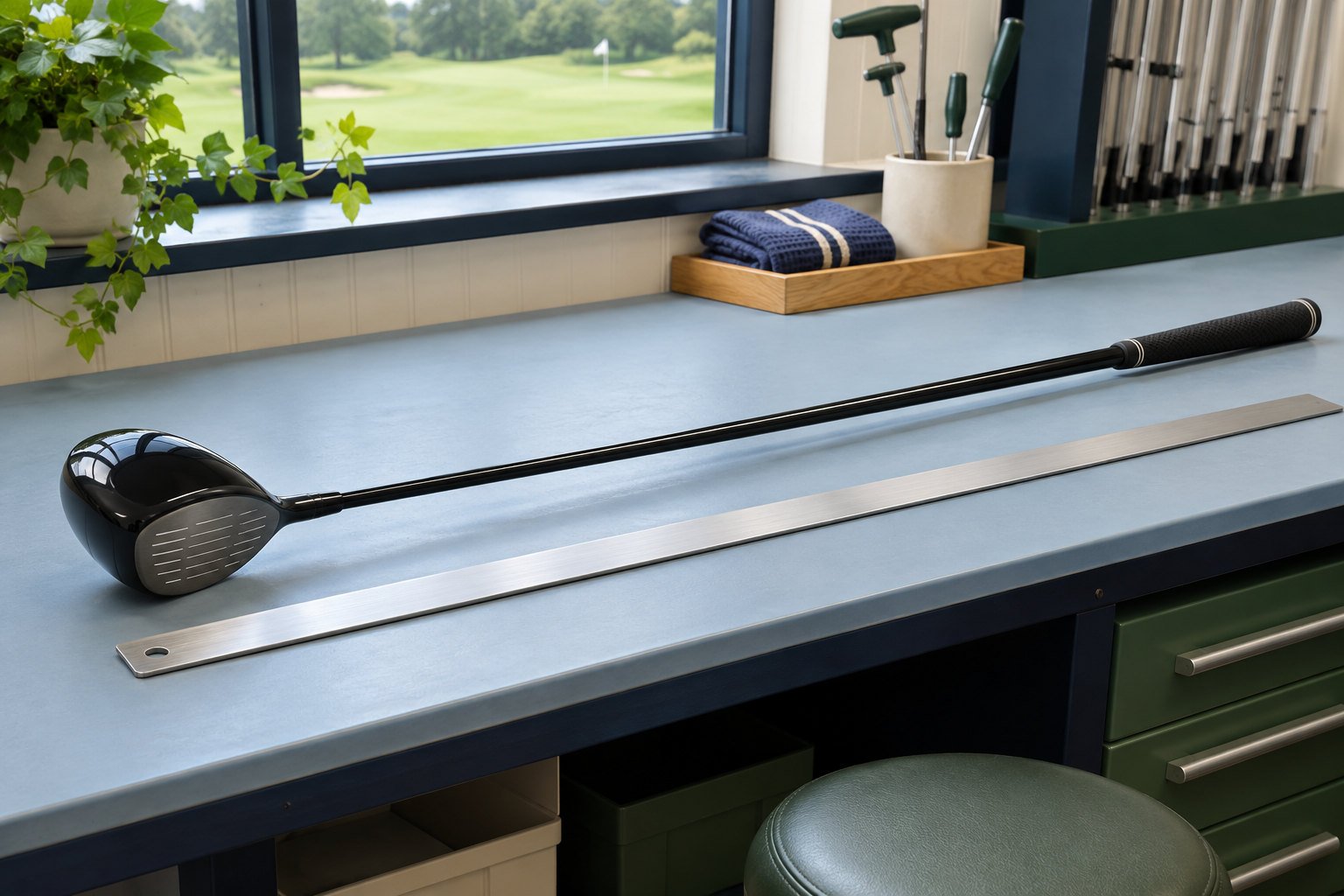
AI-generated illustrations show generic golf equipment and settings. They are not photographs of the named products or records of product testing.
A driver can look manageable in the shop and still feel difficult to deliver consistently on the course. Playing length is one variable worth investigating, particularly when you find yourself moving your hands down the grip or struggling to make repeatable contact. It is also easy to change prematurely: cutting a shaft commits you before you know whether the finished club will suit you.
The useful question is what a shorter driver playing length does to your ordinary shots, comfort and complete build. This guide sets out a reversible first observation, a separate trial of a properly assembled shorter option, and a before-and-after sheet to keep those two stages honest. The named products illustrate published specifications; they are not clubs tested by this website.
Check the actual length
Record the assembled driver, including its grip, using the same measurement method for both builds.
Keep the first trial reversible
Use a comfortable grip-down observation to decide whether a fitted shorter option deserves a test.
Keep the whole result
A tidy strike pattern needs to deliver useful flight and acceptable misses, not just a nicer feeling.
Measure the complete driver before comparing lengths
Playing length refers to the assembled club. A loose shaft measurement, an uncut shaft specification and a finished driver measurement answer different questions. Under the R&A equipment method for woods and irons, the club is placed on a horizontal plane with its sole against a 60° plane; length runs from their intersection to the top of the grip. [1]
Ask the fitter to measure your existing driver rather than relying on its original catalogue entry. A replacement grip, shaft or previous alteration makes the actual club the useful starting point. Have the proposed build measured in the same way, and write down whether the quoted length includes the fitted grip. This prevents two apparently precise numbers from referring to different things.
Do not start with a height-based cutting rule. Your height may help a fitter understand your setup, but the question here is whether this driver gives you a comfortable address position and repeatable results. The separate fairway-wood length guide for shorter golfers explores why stature alone should not determine a build.
Before hitting, state the problem in a sentence: “I want fewer severe heel strikes”, for example, or “I want a less awkward setup without losing the carry I need”. A specific aim gives the length trial something meaningful to resolve.
What changes when the complete build gets shorter?
Longer shafts can offer club-speed potential, while a shorter club may make contact easier to repeat for some golfers. Neither outcome is guaranteed. The useful result depends on how you deliver that particular club, so a shorter build can be worth testing even if your best shot with the longer one is impressive. Titleist treats the head, shaft and grip as a connected system and identifies shaft length, head weight and grip weight as contributors to swingweight. [2]
That connection matters after an alteration. Ask the builder to record overall weight and swingweight separately. Overall weight is the mass of the complete club; swingweight describes its balance on a club-building scale. Two drivers can share one of those measurements and differ in the other, so “it feels lighter” is not a complete specification. [3]
Head-weight options may be part of the fitting. Titleist’s SureFit guidance, for instance, links different club lengths with head-weight choices and notes that preferences for head weight vary. That supports testing the finished balance; it does not establish a universal requirement to restore the original swingweight or add a fixed amount of weight to every shortened driver. [4]
Keep three questions separate: can you move the club comfortably, can you strike it repeatedly, and does the resulting flight do the job? A build that answers only one of them may still be the wrong purchase.
Use gripping down as a reversible first observation
This is an editorial comparison plan for deciding whether to investigate further. It is not a prescription for how much length to remove.
- Start with a correctly assembled driver and a normal warm-up. Choose a target and landing area that give the session a purpose.
- Hit a short group with your usual hold. Keep the ball type, tee setup and target consistent, and record contact, flight and comfort.
- Move both hands a modest, comfortable distance down the usable grip. Keep both hands securely on the grip; do not force a position that crowds your hands or feels insecure.
- Hit a comparable group with your normal swing intention. Note the hand position so you can repeat it, without treating that distance as a cutting instruction.
- Return to your usual hold, then repeat if you remain fresh. Switching back helps reveal whether the apparent improvement belonged to the hand position or simply to warming up.
Retain ordinary poor strikes. If the purpose is to reduce them, they belong in the comparison. A confirmed monitor misread can be excluded with a reason; an inconvenient result should stay visible.
Gripping down leaves the same shaft, grip and head in place. Material remains above your hands, your hands may contact a different part of the grip, and the club’s measured physical length has not changed. A rebuilt club can have different components and balance. A promising grip-down result earns a proper shorter-build trial; it does not prove exactly how a cut club will behave.
If the altered hold gives no clear benefit, keep the current club intact. That is useful information too.

Then compare a properly assembled shorter option
Take the first observations to a fitter or club builder. Ask for a shorter trial club close enough to your current specification to make the comparison useful. Record the head, loft setting, shaft model and flex, grip and any changed head weights. If several variables change, you are comparing two complete builds; do not credit every difference to length alone.
There are two sensible questions. “Does length help when the other variables are closely matched?” isolates the length decision as far as practical. “Which complete build works better for me?” allows the fitter to refine balance and other components. Both can inform a purchase, provided you know which question the session answers.
A shorter finished driver is not a reason to assume a particular new shaft flex. Tip trimming and alterations at the grip end are different operations. Fujikura’s own guidance generally advises against driver tip trimming as its starting recommendation and directs golfers towards a fitter or builder. The instructions for the exact shaft and intended assembly matter; a generic shortening rule is inadequate. [5]
Leave cutting, bonding and uncertain component work to a qualified builder. For an interchangeable trial, our driver head and shaft adapter guide covers the separate compatibility checks. A sleeve that appears to fit is not enough information to approve an assembly.
Ask to test the intended finished specification before ordering. If an exact trial build is unavailable, have the fitter explain what differs and what remains uncertain.
Keep a before-and-after measurement sheet
Copy this sheet into your fitting notes. The two record columns are prompts for your own measurements, not example specifications to copy. Ask the builder to supply the technical entries you cannot establish reliably.
| Record | Before: current driver | After: shorter trial |
|---|---|---|
| Finished playing length | Measured length, units and method | Measured length using the same method |
| Head and settings | Exact model, handedness, loft marking and settings | Exact model and every setting change |
| Shaft specification | Full model, weight category, flex and known trim history | Full specification and builder-confirmed alterations |
| Grip | Model, size and known build-up | Model, size and any changed build-up |
| Complete-club weight | Measured mass with units | Measured mass with units |
| Swingweight and head weights | Measured swingweight and installed weight configuration | Measured swingweight and new configuration |
| Comparison conditions | Ball, tee setup, target, monitor mode and session date | Confirm what matched; record any differences |
| Shot record | All retained shots, exclusions and reasons | The same record for the shorter build |
| Comfort and strike | Usual feel and contact pattern | Repeated changes, including any new difficulty |
| Carry and landing spread | Typical carry, short shots and both sides of the pattern | The same measures, with the costly miss highlighted |
Scroll within the table to see all columns.
Finish with three written answers: what improved, what became worse, and what remains unproven. If you cannot complete those sentences, another comparison is more useful than selecting a cutting length from memory.
Keep the grip-down observations on a separate line from the measured shorter build. That distinction will matter if you later ask another fitter to reproduce the club.
Decide whether the benefit is useful on the course
Review the whole set of ordinary swings. A more central contact pattern is encouraging, but the purchase decision also needs carry, direction and comfort. Look at the short end of the carry spread and both left and right misses, not simply the longest ball or the average landing point.
Decide which trade-off matters on your course before declaring a winner. If a shorter build repeatedly keeps more shots within a playable corridor, a modest reduction in the best-shot distance may be acceptable. If it leaves ordinary drives short of the carry you need, a tighter-looking pattern alone does not settle the decision. These are conditional examples, not predictions of what shortening will do.
Watch for a new problem as well as relief from the old one. You may prefer the first few swings but find the altered setup tiring, or make better contact while introducing a troublesome miss on the other side. Record those outcomes rather than averaging them away.
Repeat a close comparison, ideally when fresh on another occasion. A small session cannot establish your long-term scoring benefit. If the apparent advantage disappears when you return to the original build, keep investigating before paying for a permanent change.
Length is one part of the wider purchase. The driver selection guide brings loft, shaft and forgiveness back into the decision once you understand the length question.

Read the offered length before buying
“Standard length” belongs to a particular build. These manufacturer specifications show why the head name alone does not tell you what you will receive.
| Manufacturer example | Published specification | What to check |
|---|---|---|
| PING G440 MAX | 46 inches with ALTA CB Blue 50; 45½ inches with the listed PING Tour 2.0 Chrome/Black, Mitsubishi Tensei 1K or Project X Denali Red shafts. [6] | The exact shaft option and finished build on the order |
| Callaway Quantum Max | The UK men’s standard specification lists 45.75 inches. [7] | Whether the selected configuration changes that standard length |
Scroll within the table to see all columns.
The PING options also change the shaft, so they are not a controlled experiment showing what half an inch does by itself. Nor does either manufacturer’s standard establish your ideal length.
If a G440 MAX build is on your shortlist, view the PING G440 MAX at Clubhouse Golf. That destination is the men’s right-handed listing; obtain the correct handed version and confirm the fitted specification. [8] For the other published example, check the Quantum Max at Callaway UK. [7]
Before ordering or authorising an alteration, get the complete specification and total work cost in writing. Confirm the grip, head-weight arrangement, finished length and any relevant custom-order or alteration terms. The club you receive should reproduce the build that justified the change.

The permitted maximum is not a fitting target
The general equipment limit for clubs other than putters is 48 inches. Model Local Rule G-10 lets a committee impose a 46-inch maximum for those clubs; it is an optional local rule, recommended for professional and elite amateur competitions, rather than a universal replacement for the 48-inch equipment limit. Check the local rules of the competition you intend to enter. [1][9]
Neither figure tells you which length will produce your best usable driver. Compliance is one boundary; a comfortable build and a convincing shot pattern answer the fitting question.
Choose a complete build you can reproduce
A shorter driver earns its place when the improvement is repeatable and the remaining trade-offs suit your course. Measure your current club, make the first observation reversible, then compare a properly assembled alternative. Keep the complete specification and the ordinary misses in the record. If the case remains unclear, preserving the existing club leaves you with more options.
Sources
Sources checked on 22 November 2026. Product names refer to the exact models described.
- The R&A — Equipment Rules, Part 2: Conformance of ClubsOverall club-length limits and the 60° measurement reference.
- Titleist Learning Lab — The Complete Guide to Golf DriversThe head, shaft and grip as a complete build; length and swingweight considerations.
- The GolfWorks — Clubmaking Glossary: SwingweightSwingweight as weight distribution around a fixed fulcrum, distinct from total club weight.
- Titleist UK — SureFit Performance GuideManufacturer guidance on club length, head-weight options and individual weight preferences.
- Fujikura Golf — Tip TrimmingManufacturer guidance distinguishing shaft trimming decisions from a general length recommendation.
- PING UK — G440 MAX DriverOfficial standard-length specifications and the shaft-dependent length notes.
- Callaway UK — Quantum Max DriverOfficial UK standard-length table and club configuration.
- Clubhouse Golf — PING G440 MAX Golf DriverThe retailer destination for the named men’s right-handed driver.
- The R&A — Committee Procedures, Model Local Rules: G-10Optional maximum club length of 46 inches when Model Local Rule G-10 is adopted.
Illustrations in this article were created for Taylor’s Trailblazing Golf. Third-party photographs, where used, are credited beside the image or in the source list.