White vs Yellow Golf Balls: Finding Your Ball in Different Conditions
Choose the colour you can follow and find in the places you actually play.
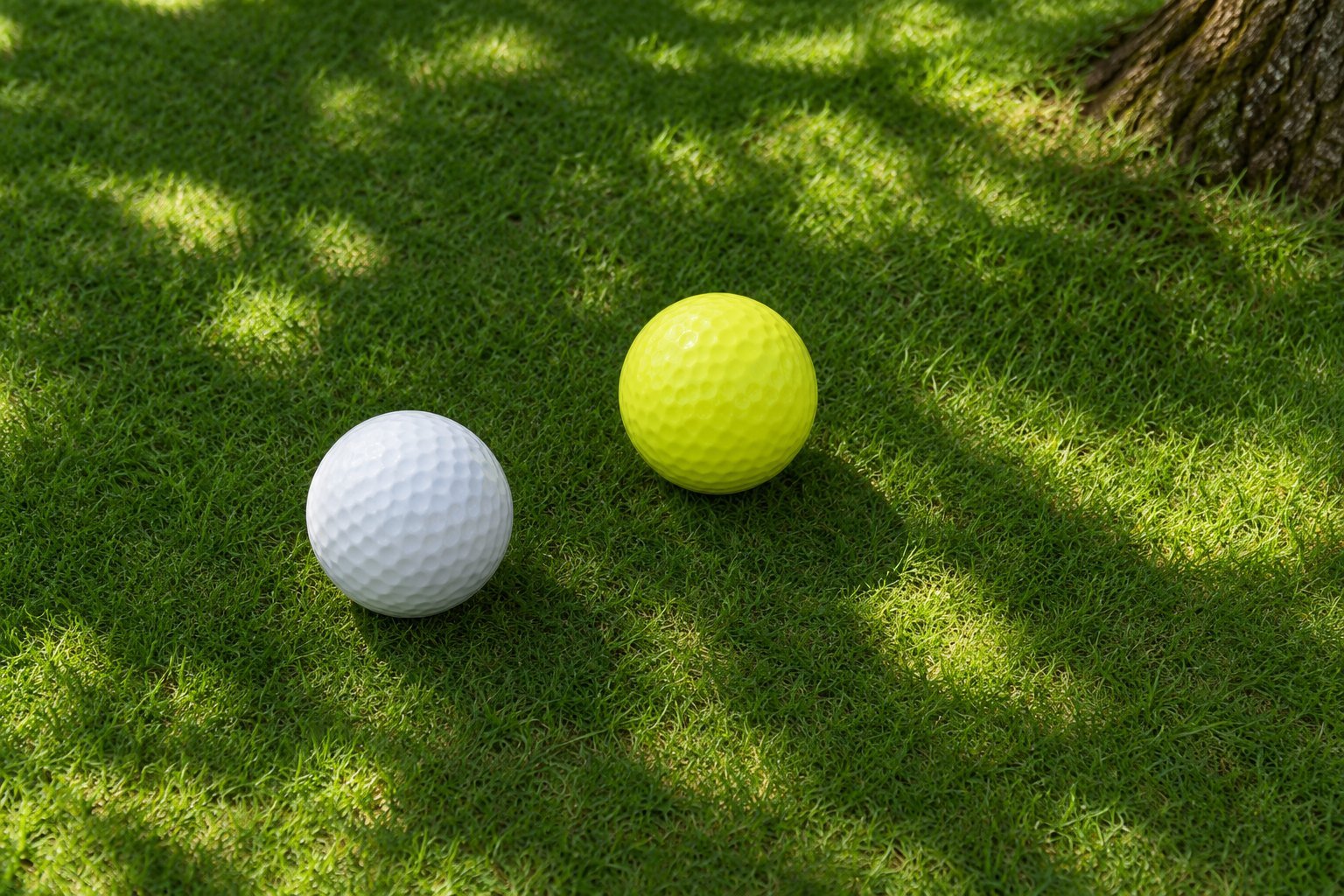
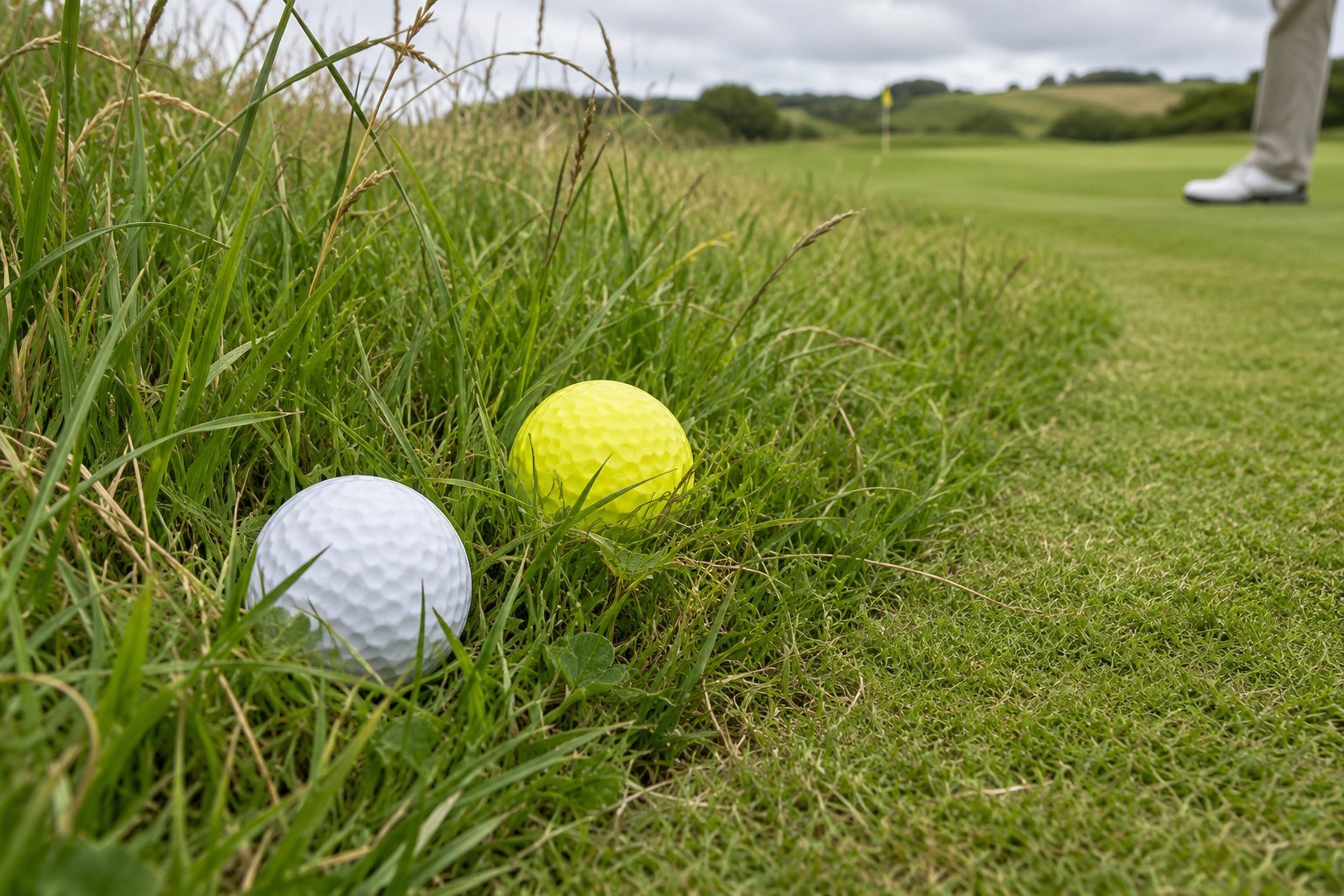
AI illustration of a colour comparison; this image is not a visibility test.
When comparing white vs yellow golf balls, start with a practical question: where are you losing sight of the ball? Following a shot against the sky, spotting it beside the fairway and recognising your own ball among several others are separate jobs. The colour that catches your eye in the shop has not yet answered them.
This research-led guide focuses on that white-or-yellow purchase decision. The background grid and recording method are suggested ways to organise your observations, rather than measured visibility rankings. The aim is a clear choice for your normal golf, with the model and cost kept in view.
This guide contains affiliate links. If you buy through them, Taylor’s Trailblazing Golf may receive a commission at no extra cost to you.
Notice where you lose the ball in flight and which background is behind it.
Compare white and yellow against your usual grass and clutter.
Colour helps recognition; a clear personal mark adds useful identification.
White vs yellow golf balls: decide which problem matters
Think about your last few rounds. Did you lose the flight early, reach the right area but struggle to spot the ball, or find several similar balls and need a closer look? Choose the recurring inconvenience before choosing a colour.
If the flight is the problem, a ball placed on a shop carpet tells you very little. If the ground search is the problem, a dramatic photograph of a ball against a blue sky is equally incomplete. Your comparison should reproduce the task you want to make easier.
Also ask what you already like about your present ball. A comfortable putting view and a familiar short-game response are useful reasons to keep the model while exploring its other colour. Changing colour, construction and price bracket at once makes it harder to explain a preference.
Write one useful buying question
“Can I locate the yellow version more readily in my usual semi-rough without making it harder to follow against the sky?” gives you something to check. “Which colour is best?” leaves too much undefined.
Use the background grid before choosing a winner
Use the table to plan a comparison, then enter your own result. It deliberately does not declare white or yellow the winner in a particular weather forecast. Your viewpoint, the exact shade of the ball, the background and the amount of cover all belong in the observation.
Scroll within the table to see every column.
| Situation | Compare white and yellow for… | A useful note |
|---|---|---|
| Short green grass | How readily you pick out each ball from the same viewing position. | Which remains easy to locate when you look away and back? |
| Longer green rough | The visible part of each ball, with similar grass cover. | Separate the colour from how much grass hides it. |
| Pale or dry grass | Whether either colour blends with the actual surface. | Record the result here rather than carrying over a green-grass preference. |
| Sunlit and shaded patches | Both colours in each patch, then after changing your viewing position. | Does the preference survive the change of light? |
| Sky or distant trees behind a shot | The part of flight you can follow during permitted practice. | Where did you lose sight of it, and what was behind it? |
| Fallen leaves or other visual clutter | The particular leaf colours and the amount of exposed ball. | “Easier in this patch” is more useful than “best for autumn”. |
| Putting green | The view at address and your comfort with the ball’s markings. | Would you happily use this appearance for the whole round? |
Mark each situation as usual or occasional for your golf. A clear advantage in a setting you encounter throughout a round deserves more attention than a preference in a condition you rarely face. Keep a serious drawback visible rather than hiding it inside a combined score.
If the main difference involves shine, surface wear or cleaning, the separate matte-versus-gloss guide deals with that question. Here, keep the decision centred on the two colours.
Match the model before attributing a difference to colour
A yellow two-piece ball and a white premium multilayer ball can both be sensible products, but comparing them changes more than colour. Look for the same manufacturer, complete model name, generation where identified, finish and condition. A familiar family name alone is not enough when one listing is old stock or a different version.
For a model-specific example, Titleist describes Pro V1 Yellow as providing the Pro V1 performance benefits with its High Optic Yellow finish. That is the manufacturer’s description of those versions; it does not establish that every white and yellow ball from every brand performs identically. [1]
Likewise, Clubhouse Golf’s current AD333 listings identify separate white and yellow dozens, both described as two-piece balls. They are useful starting points for a colour comparison; confirm the precise current version before ordering, especially when a sale listing adds an older year to the name. [2] [3]
For a casual visual check, take clean examples in similar condition. If you compare a stained white ball with a new yellow one, record that difference rather than crediting everything you notice to colour. There is no reason to buy a large mixed bag to answer a question about two identified versions.
If you also need to change the playing characteristics of the ball, use the structured golf-ball fitting guide to organise that separate decision. Then compare the colours available in the model you want to use.

Run a small comparison you can repeat
Start on a safe area where the facility permits your comparison. Ask before using a practice area for a different purpose, and keep well clear of anyone playing shots. Use your usual golf eyewear and ordinary viewing position so the observation relates to the way you play.
- Choose a matched pair. Note the complete ball model, generation if known, colour and condition.
- Compare stationary balls first. Place them with similar exposure on one relevant background. Swap their positions so a patch of brighter grass does not always favour the same colour.
- Look naturally. Step back to a sensible viewing position, look elsewhere briefly, then return your attention to the area. Record which you find easier, or write “no clear difference”.
- Repeat on another usual background. Keep shade, rough and short grass as separate observations. Do not hide either ball to manufacture a difficult result.
- Observe flight only where normal practice is permitted. Note whether you could follow each shot and the background involved. Keep helpers safely behind the hitting area.
- Revisit the promising colour on another day. Check whether the useful difference remains when the light or your level of familiarity changes.
This is a personal shopping exercise, not a validated vision test. You do not need a stopwatch, a visibility percentage or a pass mark. A short plain-language record is enough to stop the most memorable moment from deciding the whole purchase.
Scroll within the table to see every column.
| Record | Example entry |
|---|---|
| Priority | Finding a ball in the semi-rough I regularly reach. |
| Pair | Exact model and generation; one clean white and one clean yellow example. |
| Conditions | Cloudy afternoon; green grass; usual sunglasses. |
| Observation | Your own result, including “no clear difference”. |
| Trade-off | Any problem following flight or discomfort over putts. |
| Next step | Keep current colour, repeat the comparison or buy a small quantity. |
Photographs can remind you where you compared the balls, but judge them with your own eyes in the setting. The illustrative images in this guide provide context; they are not measured comparisons or a reliable way to choose a shade from a screen.
Make sense of a mixed result
Suppose your notes show that yellow is easier for you to find on the semi-rough you regularly play, while flight tracking is similar and you are comfortable putting with either. A small purchase of the yellow version is a reasonable next step. The conclusion is about your recurring task, not a promise that everyone will lose fewer balls.
Now suppose white is clearer to you against one important background, but yellow is more striking in your hand. The hand-held impression is less useful than the observation that relates to your round. Keep white unless another practical reason justifies changing.
A third possible result is a trade-off: you prefer yellow on the ground and white in flight. Choose which inconvenience matters more, then repeat that comparison. You can also ask a playing partner what they observed from a safe position, while recognising that their preference may differ from yours.
These are illustrative decisions, not results from golfers tested for this article. They show why the record should keep the tasks separate. If a difference is inconsistent or too small to matter, the current colour remains a perfectly useful choice.
Buy the version you compared, at a sensible quantity
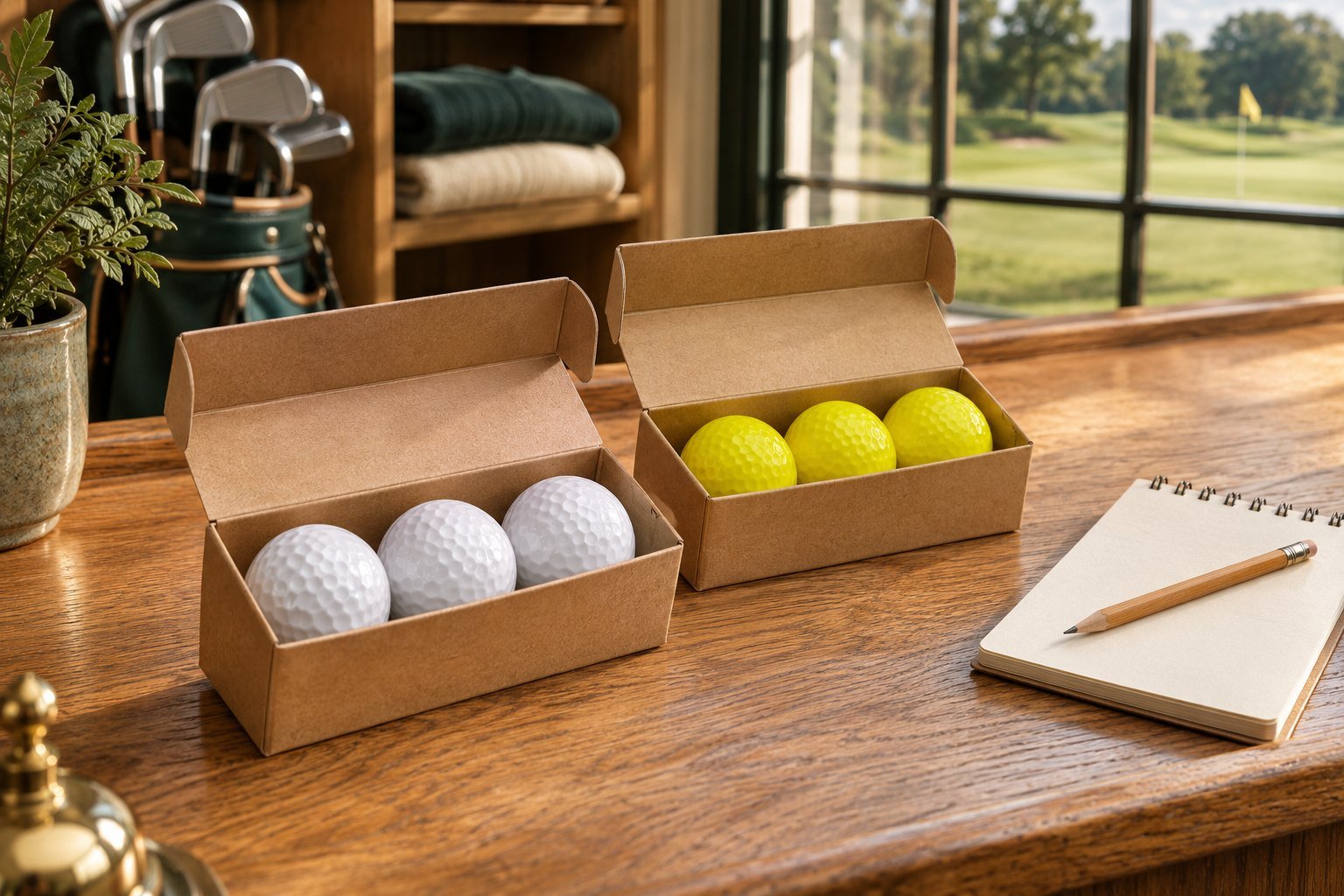
Check the pack size, exact model, colour and generation on the order itself. Compare the delivered total, including any minimum order or multibuy condition. A cheap listing for a different generation is a new choice, even if the large word on the box looks familiar.
If AD333 is already a suitable model for your game, you can compare the white AD333 dozen at Clubhouse Golf with the yellow AD333 dozen. Both destinations identify the colour and dozen format. They are comparison options, not a recommendation to change ball model solely to try yellow. [2] [3]
There need not be a colour premium, but check rather than assume. For a planning example, delivered prices of £24 and £27 per dozen would mean £2 and £2.25 per ball: a difference of 25p each. Those figures are illustrative, not current quotes. Do not justify the extra cost by promising yourself a saving from fewer lost balls before you have observed any useful difference.
Start with the smallest practical quantity that lets you make the comparison. A low unit price is less attractive if it leaves you with several dozen balls in a colour you dislike over putts. Once the choice is comfortable, compare larger packs on the same basis.
Back to the top ↑Keep identification and competition rules in the decision
Colour alone may not identify your ball. Rule 7.2 limits identification by a mark when an identical ball with that mark is found nearby. Add a distinctive mark; keep model details readable. [6]
Under Rule 6.3, you may change balls between holes. During a hole, substitution depends on the applicable Rule; lifting a ball does not by itself let you swap to another colour. [4]
Check any One Ball Rule before a competition. Model Local Rule G-4 treats different colours as different balls even when their markings match, and requires the same listed brand and model during the round when adopted. It is recommended for professional and elite amateur events, rather than being automatically in force for every competition. [5]
The practical preparation is simple: know the competition conditions, carry enough of the required version and resolve uncertainty with the committee before play. Do the deliberate white-and-yellow comparisons in suitable practice, then arrive with a decision you can explain.
Back to the top ↑Choose for ordinary rounds, not a universal colour ranking
If your preferred colour is unavailable in the model you want, decide whether the inconvenience justifies trying another model. Check that alternative for playing suitability before ordering in quantity.
Otherwise, act on the comparison already recorded: buy a small quantity of the useful colour, or keep your current version when the difference is inconclusive.
Back to the top ↑Sources and research
Research reviewed on 23 November 2026. Manufacturer descriptions, official guidance and retailer information are distinguished from the suggested comparisons and editorial recommendations in this guide.
- Titleist UK — Pro V1 YellowManufacturer description of the yellow version and its relationship to Pro V1; performance language is attributed, not independently tested here.
- Clubhouse Golf — Srixon AD333, white dozenRetailer’s exact white product listing and two-piece specification; checked 23 November 2026.
- Clubhouse Golf — Srixon AD333, yellow dozenRetailer’s exact yellow product listing and two-piece specification; checked 23 November 2026.
- The R&A — Rule 6, Playing a HoleRule 6.3 covers changing balls between holes and substitution during a hole.
- The R&A — Model Local Rules, G-4 One Ball RuleThe adopted condition distinguishes separate list entries and different colours; check the actual competition conditions.
- The R&A — Rule 7, Finding and Identifying BallRule 7.2 identification; checked 23 November 2026.
Find more equipment guidance in Golf Balls.
Illustrations in this article were created for Taylor’s Trailblazing Golf. Third-party photographs, where used, are credited beside the image or in the source list.