

Golf Ball Fitting Without a Launch Monitor: A Structured Short-Game Test
Compare ordinary outcomes, not one perfect chip or an invented spin number.
Original conceptual illustration; not a product or test photograph.
Golf ball fitting without a launch monitor is possible as a structured comparison, but it cannot tell you everything a measured fitting can. You can observe how a ball behaves on your usual chips, pitches and putts, whether you like its feel and whether the results are repeatable. You cannot reliably infer spin rate, launch angle or a precise distance gain by watching a handful of shots.
The useful approach is to compare a small shortlist under consistent conditions, record ordinary outcomes as well as good ones, and keep your conclusions narrower than the evidence. This guide supplies a practical short-game protocol you can use at an authorised practice area. The suggested sample sizes and recording method are original editorial proposals, not manufacturer test results, and no ball has been physically tested for this article.
Two known models
Keep generation and condition identifiable.
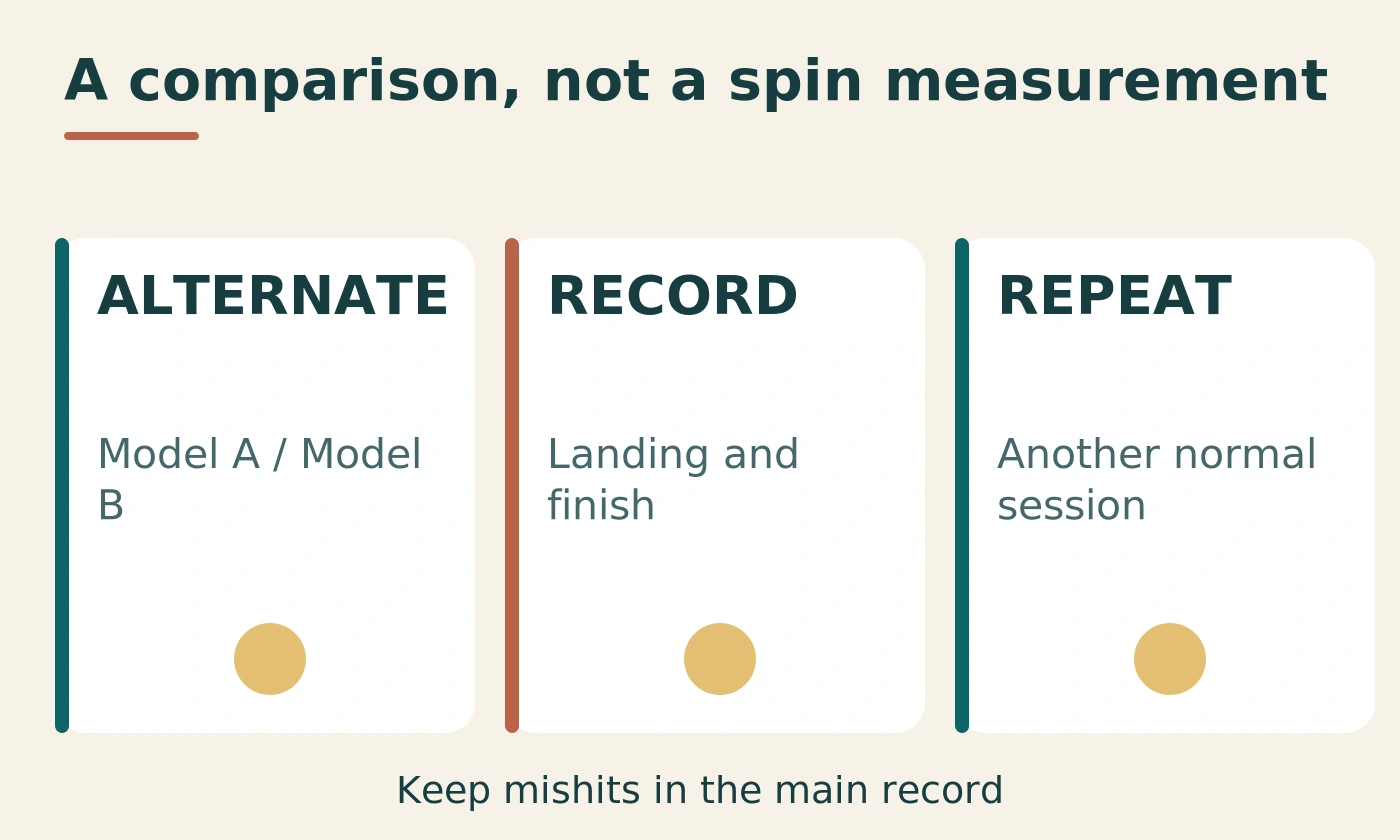
Alternate small blocks
Record the same task for both balls.
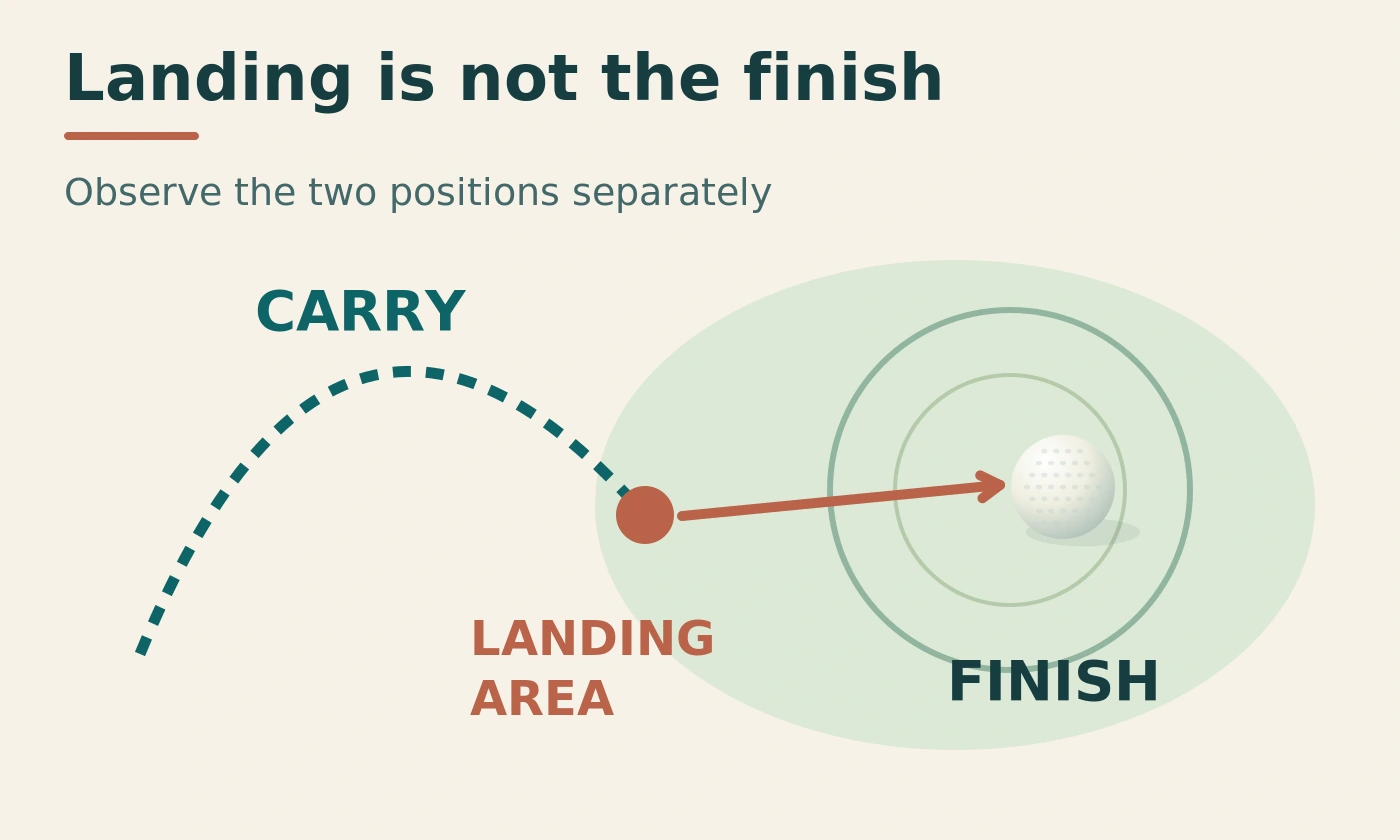
Landing is not finish
A shorter carry is not proof of more spin.
Confirm the longer game
A short-game winner remains a candidate.
Golf ball fitting without a launch monitor: define the decision
Start with the problem you actually want to solve
Write one sentence about your current ball before choosing alternatives. Perhaps you struggle to predict release on a stock chip, dislike the sound off your putter or cannot easily see the colour you use. A focused question makes the test useful. "Find the best ball" is too broad because it does not say which result would matter most to your game or budget.
Keep the question separate from the hoped-for answer. For example, "Does model B give me a more predictable stopping area on my usual chip?" is a fair comparison. "Prove that a premium ball spins more for me" already assumes the result. The first wording allows the current ball to remain the sensible choice when the alternative offers no clear benefit.
Set limits before collecting results
Decide which two models you will compare, which shots you will use and what would count as a meaningful practical difference. That might be a noticeably tighter stopping area across two sessions, or a strong feel preference without a disadvantage on longer shots. Avoid choosing a winner from tiny differences that are smaller than your normal variation.
This is a screening exercise, not a complete laboratory fitting. A launch monitor can provide measurements that observation cannot, while a course session reveals aspects of use that a short indoor fitting may not reproduce. The two approaches can complement each other. Your notes should make that distinction explicit rather than presenting a home-designed test as a replacement for every other form of fitting.
Understand why short-game testing is useful but not universal
Manufacturers do not all start in the same place
Titleist's published fitting advice recommends comparing suggested models on the course, paying particular attention to shots around and onto the green. That supports a short-game comparison as one useful approach. However, its own strong performance language should not be converted into a guarantee that the winner of your small test will lower your scores. [1]
Bridgestone describes a different in-person approach that begins with driver shots and launch-monitor data. Its stated emphasis is tee-to-green fitting. These are different starting frameworks, which is a good reason not to claim that all manufacturers agree the short game must decide every ball choice. This article focuses on the information you can gather without measured launch data. [2]
Use the short game to narrow the shortlist
Around the green, you can choose a landing area, repeat a familiar shot and observe how the ball finishes. That gives you a practical comparison of the outcome you are trying to use on the course. Nevertheless, a ball that suits one chip still needs checking for putting, approach play and the longer game before you commit to a season's supply.
The aim is to remove obviously unsuitable options and identify a promising all-round candidate. A shortlist of two models is usually easier to compare carefully than a large pile of assorted sleeves. More products create more combinations, more fatigue and more chances to confuse a changing lie or green condition with a property of the ball.
Choose two models and keep their identity clear
Compare known, consistent examples
Use balls whose model and generation you can identify. Keep each model's examples in similar condition, and avoid mixing a new ball with one that is visibly damaged or has an unknown history. A test of two worn balls against three new ones is partly a condition comparison, even when the brand names look clear.
Do not rely on a colour or a single number to distinguish the models if those markings are shared. Use a simple identification mark that does not obscure the model information. Record the precise version on your sheet. If you later buy a different generation, treat it as a new comparison rather than assuming that a familiar name proves identical performance.
Limit expectation without pretending the test is blind
A helper can alternate balls while you concentrate on the shot, and simple A/B labels can keep your notes tidy. However, logos, sound and appearance may still reveal the model. Describe the test as a structured comparison, not as a fully blinded experiment. That honesty matters when a strong brand preference could influence the way you interpret a small difference.
Keep the original model key and the test sheet together. A neat set of numbers becomes useless if you cannot remember whether A meant the current ball or the alternative. The organisation should reduce mental effort during practice, leaving you free to make normal shots rather than repeatedly checking packaging or trying to remember which ball was which.
Select shots that reflect the golf you play
Begin with a stock chip, not a highlight-reel shot
Choose a chip you regularly face and can attempt with a familiar technique. A simple landing area and a clear stopping zone are more useful than a difficult flop shot that you rarely use. Keep the club, lie and intended trajectory the same for both models. If you change clubs halfway through, label that as another test rather than combining the results.
Next, choose a modest pitch where the facility permits it. The distance should be comfortable for you and safe for the available area, not dictated by an internet number. You are comparing normal outcomes, so there is little value in selecting a shot that produces mostly accidental contact. A test can be demanding enough to reveal differences without being unrealistic.
Add the situations that genuinely matter
A golfer who usually plays firm running shots may care about predictable release, while another may prioritise a pitch that stops in a smaller area. Neither preference is automatically superior. Write down the intended shot and the result you would choose on the course, then evaluate each model against that purpose.
Do not test every imaginable lie in the first session. Begin with a clean, reasonably uniform lie and add another common situation only after the basic comparison is organised. This reduces the risk of drawing a conclusion from a mixture of fairway, rough and wet grass shots that were never comparable in the first place.
Check permission, space and conditions first
Use an authorised area and keep others safe
Confirm that chipping and pitching are permitted where you intend to practise. Some greens are putting-only, and shared practice areas may restrict particular shots or directions. Keep people outside the shot and retrieval area, collect balls carefully and stop when another golfer enters the space. Do not use a public park or garden as an assumed substitute for a suitable golf facility.
Avoid laying hard markers where a ball could strike them unpredictably. Flat, permitted references or existing features can define a landing area without creating a hazard. The test should be easy to pause and clear away. A busy green may be suitable for a short putting comparison but not for a full sequence of pitches and measurements.
Record conditions in ordinary language
Note whether the surface is wet or dry, firm or soft, and whether a noticeable slope or wind could affect the result. You do not need to invent a precise green-speed value. A useful record might say "damp practice green, gentle uphill finish, light breeze". That description helps explain why a later session may produce different rollout.
Keep both models in the same conditions during each block. If rain begins, the green is watered or the lie changes substantially, stop and start a new labelled block. Do not quietly merge the results and attribute the change to the ball. The environment is part of the test, and noting it is more valuable than pretending it remained perfectly controlled.
Build a simple recording sheet
Separate the observations you can actually make
For each shot, record the model, task, landing zone, final position and any obvious mishit. Landing position matters because a ball that stops nearer the target may simply have landed nearer it. Rollout is the movement after landing, not the total distance from your feet. Keep those descriptions separate even when your measurements are only approximate.
Use broad, consistently defined zones when exact measurement would slow the session or imply false precision. For example, mark whether the ball landed short of, inside or beyond a chosen area, then record whether it finished short, within or beyond the intended stopping zone. The same definitions should apply to both models throughout the comparison.
Keep a note of the strike without editing the result
Record an obvious thin, heavy or otherwise unintended contact as such. Do not remove it simply because it makes a preferred model look worse. Instead, keep two views: all intended attempts, and a clearly labelled subset of reasonably comparable strikes. That preserves the practical difficulty you experienced while allowing a cautious look at the ball's behaviour on similar shots.
| Field | What to write | Why it helps |
|---|---|---|
| Model and task | A, stock chip | Prevents mixed comparisons |
| Landing area | Short / chosen area / long | Separates carry from release |
| Finish | Short / target zone / long | Records the usable outcome |
| Strike note | Ordinary / obvious mishit | Keeps exclusions transparent |
| Conditions | Same block / changed | Avoids blaming the ball for the weather |
On smaller screens, scroll this table sideways.
Run the stock-chip comparison
Use alternating small blocks
After warming up, play three balls from model A and three from model B using the same club and intended landing area. Then repeat in the reverse order. Twelve attempts across the two models is a manageable first block for this suggested protocol, not proof of a statistically reliable difference. Add another block only while you can maintain ordinary attention and safe use of the area.
Retrieve the balls and reset the lie between blocks. Do not let one model repeatedly receive the best patch of grass or the first attempt after a long break. Small practical details can bias a comparison more than the equipment difference you are trying to observe. The purpose of alternating is to reduce those avoidable imbalances, not to claim perfect experimental control.
Compare similar landing outcomes
First look at all the results, including mishits. Then examine the shots that landed in broadly similar places. If model B finished shorter only because it consistently landed shorter, the test has not isolated a release difference. Write that plainly. A result can be useful for your actual shot without proving the particular technical explanation you expected.
Avoid calling a visible check-up "more spin" as though you measured it. Describe what happened: a shorter observed release, a different first bounce or a tighter finishing area under those conditions. Spin rate, launch and landing angle would require information this protocol does not provide. Careful wording keeps the conclusion useful without adding unsupported precision.
Add a pitch comparison without changing the question
Keep the intended shot familiar
Choose a pitch from a distance and lie that you can attempt consistently at the permitted facility. Use one club and one intended trajectory for the comparison. If you need to change the shot because of the wind, a busy green or another practical issue, label a new block. Do not combine unlike pitches merely to reach a larger total count.
As with the chip, alternate small groups and record landing and finishing areas separately. A pitch may introduce more variation in contact and carry than a short chip. That is not a reason to hide poor attempts; it is information about how confidently this particular test can distinguish the balls for you.
Look for a useful pattern rather than a dramatic winner
A practical difference might be that one model repeatedly finishes in a more predictable area after broadly comparable landings. However, a single ball stopping quickly while the others release does not establish a general advantage. Consider whether the pattern appears across blocks and whether it is large enough to affect the shot choice you would make on the course.
If the results are scattered for both models, the honest conclusion may be that your current pitch variation is larger than the observed ball difference. You can still choose on price, feel or visibility while seeking more consistent shot execution or a measured fitting. The test has done its job by showing where the available evidence is weak.
Compare putting feel and pace separately
Sound and feel are preferences, not performance measurements
Use the same putter and a consistent area of the practice green. Begin with short putts to become familiar with each model's sound and feel, then include longer putts where space allows. Record a preference without converting it into a claim about speed, quality or scoring. A firmer sound can be a personal preference rather than a defect.
Titleist describes the Pro V1's cast urethane cover and its own intended performance profile on the product page. That is a manufacturer specification and positioning statement, not a result from this website's test. More generally, a construction description can help build a shortlist, but it cannot replace your comparison of the actual models you are considering. [3]
Observe pace without over-interpreting a few putts
For a longer putting block, record whether the ball finishes short, in a chosen stopping zone or long. Alternate models and avoid consciously changing the stroke to force equal results. However, recognise that a golfer naturally adapts during practice. The session therefore reflects the interaction between you and the ball, not an isolated mechanical measurement of ball speed.
A strong sound preference with similar practical pace results can be a valid reason to choose one model. Conversely, liking the feel of a ball does not require declaring it objectively better. Keep the language personal and specific: "I preferred the feedback off this putter" is more defensible than "this ball gives everyone better distance control".
Include rough or damp conditions only as a separate session
Change one setting deliberately
After the basic comparison, choose one additional condition you often encounter, such as a modest chip from light rough at an authorised area. Keep that block separate from the clean-lie test. The lie is part of the shot, and changing it can alter the observed outcome. A ball that behaved differently in rough has not contradicted the clean-lie result; it has been tested in another situation.
Do not manufacture extreme wetness or damage a practice surface to create a test. Work with permitted, naturally available conditions and record them honestly. A seasonal follow-up is often more useful than trying to simulate every weather pattern in one afternoon. Your conclusions should remain attached to the conditions you actually observed.
Let mixed results remain mixed
One model may suit your stock chip on a dry surface while showing no clear advantage in a damp session. That is a legitimate outcome. Decide which situation matters more to your normal golf and whether the difference is meaningful enough to influence the purchase. Avoid averaging unlike tasks into a single score without explaining the weighting.
When the results conflict, a smaller shortlist and another normal session are more useful than adding several new models. More products do not resolve an unclear comparison. They usually create more variables and make it harder to remember what was actually observed under each condition.
Interpret a small sample honestly
Use a median or a clear zone count
For measured finishing distances, a median can describe the middle result without being dominated by one extreme attempt. To find it, sort the values and take the middle one, or the average of the two middle values for an even count. This is simple arithmetic, not proof that the difference between two small samples is statistically significant.
For an illustrative example, finishes of 1, 2, 2, 3 and 12 units have a median of 2 and a mean of 4. The large final value matters, but it affects those summaries differently. Label examples as examples and do not publish invented numbers as actual testing. Your own sheet should retain the individual results alongside any summary.
Ask whether the difference changes a decision
A tiny advantage that reverses in the next block is not a dependable reason to pay more or abandon a familiar ball. Look for a repeated practical pattern that relates to your original question. A clear visibility preference or a noticeably more predictable stock-chip finish may be more useful than an uncertain numerical edge.
Do not convert a result such as seven successes out of ten into a claimed future success probability. The sample is small, the conditions are specific and you are not a mechanical hitting device. A zone count is a description of that session. Its main value is helping you compare another session conducted in a similar way.
Repeat the comparison on another day
Keep the core protocol recognisable
Use the same models, clubs and principal shots, while recording the new conditions. You do not need an identical green speed or weather forecast to learn something, but you do need to know what changed. Repeat the alternating order and the same zone definitions so the results can be compared without translating a new scoring system.
Begin with the model that went second in the previous session. This is a simple way to reduce the chance that the first model always benefits from freshness or the second always benefits from adaptation. Again, it does not create a blinded scientific trial; it is a practical safeguard for an ordinary golfer making a purchasing decision.
Keep the decision open until the pattern is clear
Before looking back at the first sheet, write your impression of the new session. Then compare the records. This can expose a preference that exists mainly in memory rather than in the observations. If one model remains clearly preferable for the same reasons, you have a stronger practical basis for choosing it than after a single attractive shot.
If the sessions disagree, retain the uncertainty. You might continue with the current model, arrange a measured fitting or compare only the task that remains unresolved. There is no obligation to declare a winner because you spent time testing. A careful "no clear difference for me" is a useful result and can prevent unnecessary spending.
Check the longer game before buying in quantity
A short-game winner is still a candidate
Take the preferred model into ordinary permitted practice or a non-competitive familiarisation round, following the facility's rules. Observe whether it gives you a usable flight and predictable outcomes with the longer clubs. Do not estimate a precise distance gain from where two drives happen to finish on different lies or in changing wind.
If the long-game behaviour raises a concern, a measured fitting can help separate ball, strike and delivery effects. Bridgestone's driver-led fitting framework is a reminder that this part of the game can matter to selection too. The purpose of the short-game protocol is to narrow the field, not to declare the rest of the bag irrelevant. [2]
Avoid turning a round into an uncontrolled experiment
Playing several balls on every hole can disrupt pace and may breach the conditions of the round or facility. Use an appropriate practice setting and ask permission where needed. A few ordinary rounds with one model can reveal practical preferences without making every shot a side-by-side trial. Keep notes afterwards rather than distracting yourself or other players during play.
Before competition, check that the ball and its use meet the applicable rules and any relevant local conditions. The R&A requires a conforming ball and restricts deliberately altered performance characteristics. This article does not certify an unidentified ball or authorise changing models in circumstances where a competition condition restricts it. Ask the committee about the actual event. [4]
Put price, losses and visibility into the decision
Use your own cost arithmetic
A ball you can afford to replace consistently may be a more practical choice than one you ration or frequently substitute with random finds. Use the current delivered price of the exact model, not a remembered sale or a different pack size. Divide the total by the number of balls, then consider your own typical loss rate without pretending it is an industry average.
For illustration only, using budget figures prepared on 4 October 2026 rather than live retail quotes, £24 per dozen is £2 per ball and £48 per dozen is £4 per ball. Losing two balls would make that portion of the round's cost £4 or £8. This arithmetic informs a personal budget; it does not decide which ball performs better.
Consider the practical experience of using it
Visibility, alignment markings, availability and your willingness to use the same model all matter. A colour preference is legitimate when it helps you identify the ball comfortably, but do not claim that a particular colour is universally easiest to see in every background. Compare it in the surroundings where you play and note any limitations.
Availability also has a practical consequence. A discontinued version that performs well in a test may be difficult to replace consistently. Before buying a large quantity, confirm the exact model and generation, delivery cost and seller. A ball fitting decision should lead to an identifiable, repeatable purchase rather than a vague plan to buy whichever similar-looking box is on offer.
Decide when a measured fitting is the better next step
Recognise the questions this test cannot answer
Seek measured help when your principal concern is launch, spin, height or a long-game trade-off that you cannot judge reliably. A short-game sheet cannot provide those missing measurements by becoming longer or more detailed. Nor can a smartphone estimate replace calibrated launch data simply because the result is displayed as a number.
Take your current ball and the shortlisted alternatives, together with the practical observations that led you there. A useful fitting question might be: "Model B suits my chip and putting preferences, but I am unsure about its driver flight." That links the measured session to a real decision rather than starting from a marketing category such as soft, tour or distance.
Keep preference and measurement in the same conversation
A technically interesting result is not automatically the best choice when cost, feel or availability makes the ball impractical for you. Equally, a preferred sound should not hide a clear long-game problem. Discuss both. A good final decision can acknowledge a trade-off rather than insisting that one model wins every possible category.
Ask for the exact model recommendation and the reason it suits the intended use. Retain any measured results separately from your home observations so the evidence types remain clear. Manufacturer specifications, personal preferences and launch-monitor measurements should not be presented as though they are the same kind of information.
Turn the observations into a defensible choice
Work through an illustrative mixed result
Imagine that model A and model B finish in similar areas on your stock chip. On the pitch, B appears more predictable in one session but not in the repeat. You prefer A's putting sound and can buy it consistently within your budget. Those are hypothetical observations, not results from a product test. They support retaining A more clearly than they support a claim that B has superior short-game performance.
Now change the example: B repeatedly gives the finishing pattern you want on comparable chips and pitches, while putting and longer-game checks reveal no practical drawback. That creates a stronger reason to choose B, provided the price and availability suit you. The important difference is not a dramatic score. It is that several relevant observations point in the same direction and survive repetition.
Keep the weighting personal and visible
Write the factors in the order that matters to your golf. A frequent running-chip player may place more weight on predictable release, while another golfer may prioritise a familiar putting response. State that preference instead of presenting your personal weighting as a universal ranking of balls. Two golfers can reasonably choose different models from similar observations.
A simple decision note might say: "Preferred for my stock chip and putting feel; no measured spin claim; longer-game check acceptable; price manageable." That is specific enough to guide the purchase and modest enough to remain honest. It also gives you a reason to revisit the choice when your course conditions, shot preferences or available model change.
Know when to stop collecting more data
Additional sessions are worthwhile when they answer a particular unresolved question. Repeating the entire test indefinitely because you dislike an uncertain result is less useful. Decide whether the remaining uncertainty would actually change the purchase. If not, choose the practical option and move on to ordinary golf rather than making ball selection a permanent project.
For example, a tiny finishing difference that changes direction between sessions may not justify further expense or effort. You can reasonably choose on feel and cost while acknowledging that the performance comparison was inconclusive. A measured fitting remains available when the unresolved issue is important, particularly in the longer game. The right stopping point depends on the decision, not on reaching an impressive number of shots.
Retain the identity of the final choice
Keep the exact model and generation on the decision note, along with the date and conditions of the comparison. When purchasing later, check that the box matches that record. A familiar family name or similar packaging does not automatically mean you are buying the same version that informed the choice.
If the model becomes unavailable, use the record to select a sensible alternative to compare. You will know which characteristics mattered and which observations were uncertain. That is a more useful legacy from the test than a statement that one brand was best, because it can guide a future decision without pretending products never change.
Pros and cons of a structured short-game test
The useful strengths
The method is accessible, uses shots that matter to your own golf and does not require buying a launch monitor. It can reveal a strong feel or visibility preference and help you compare practical finishing patterns. Because the protocol is written down, you can repeat it instead of relying on a memory of one good shot.
It also encourages a smaller, more purposeful shortlist. Rather than trying every new release, you compare alternatives against a stated need. A result that favours the current ball can be just as valuable as finding a replacement, especially when the apparent difference between models is smaller than your normal shot variation.
The important limitations
Human strike variation, changing conditions and small samples limit the strength of the conclusions. Visual observation cannot supply spin-rate data, and a short-game result cannot certify long-game suitability. These are not defects to conceal; they define what the test is capable of answering.
The method also takes attention and suitable practice space. If organising it makes your shots increasingly unnatural, simplify the tasks or seek a fitting. More detailed recording is only helpful while it supports an ordinary comparison. A complicated spreadsheet cannot rescue a session in which the lies, targets and intended shots were inconsistent.
Common mistakes that create a false winner
Comparing unlike shots
Do not compare a well-struck ball from a clean lie with a mishit from rough and attribute the entire difference to the model. Keep the complete record, then examine comparable attempts cautiously. Landing position and rollout must remain separate, because a shorter finish can result from a shorter carry rather than a different release.
Avoid using one favourite ball repeatedly while the alternative gets only occasional attempts. Familiarity and order can influence the experience. Alternate small blocks and record when the conditions change. These simple controls are more useful than adding technical labels that the test cannot actually measure.
Hiding uncertainty behind a score
A combined score can look authoritative while concealing arbitrary weights. If putting feel matters more to you than one pitch result, say so instead of pretending a universal formula made the decision. Keep categories visible and explain the trade-off in ordinary language.
Finally, do not publish illustrative numbers as real results or claim a handicap improvement from this exercise. The defensible outcome is a better-informed ball choice for the conditions and shots tested. Any wider benefit remains something to observe over time, not something established by a short afternoon comparison.
Frequently asked questions
Can I fit a golf ball without knowing my swing speed?
You can compare short-game outcomes, putting preferences, visibility and cost without a swing-speed number. However, that does not answer every long-game fitting question. Use the comparison to narrow the shortlist, then seek measured help when flight or spin remains uncertain. Do not invent a swing-speed estimate to make the process appear complete.
Should I test two balls or several models at once?
Two models make it easier to keep the shots, conditions and records consistent. A larger shortlist can be reduced in stages, with the current ball acting as a reference. The goal is a clear comparison, not the largest possible collection of products. Add another model only when it addresses a question the first comparison leaves open.
Does less rollout prove that a ball spun more?
No. Landing position, trajectory, slope, surface and strike can influence the finish. Describe the observed release under the test conditions rather than assigning a spin-rate explanation. A measured fitting may help investigate the cause, but the visual result alone does not establish it.
Should I remove mishits from the results?
Keep every intended attempt in the main record and flag obvious mishits. You may also examine a clearly labelled comparable-strike subset, provided you apply the same rule to both models. Silently deleting poor shots creates a misleading picture, especially when a small number of attempts determines the apparent winner.
Can used balls be included?
Only with clear limits on what you are comparing. Unknown history, mixed generations or visible damage make it harder to attribute differences to the model. For a cleaner comparison, use identifiable examples in similar condition. A used-ball test can describe those particular balls, but it should not be presented as a definitive judgement on a new model.
Is the more expensive ball automatically the better fit?
No. Price is one part of the purchase, while practical outcomes, preferences and longer-game suitability are separate. A more expensive option needs a benefit that matters to you, not merely a prestigious category label. When the difference is unclear, retaining an affordable familiar model can be a reasonable decision.
What should I do when the results are almost identical?
Keep the uncertainty and choose using the factors you can distinguish, such as feel, visibility, availability and your own budget. Repeat the comparison later only when there is a specific unresolved question. Similar results do not mean the test failed; they may show that changing balls is not your most useful equipment priority.
Final recommendation: choose a repeatable fit, not a headline claim
Begin with two identifiable models, a stock chip, a familiar pitch and a putting comparison. Keep the order balanced, record the landing and finish separately, and repeat the session before committing to a large purchase. The strongest result is a practical pattern that persists, not one spectacular shot or an invented spin number.
Use the preferred ball in the longer game before making it your default. When the evidence remains mixed, a measured fitting or staying with the current model is a sensible next step. Golf ball fitting without a launch monitor works best when it helps you make a narrower, more honest decision about the golf you actually play.
Sources and fact-checking notes
Official material was checked on 4 October 2026. Manufacturer specifications and instructions are distinguished from the suggested practical checks in this guide. Illustrative examples are not original product-test results. Check the exact current model instructions before acting on a consequential specification.
- Titleist – How to choose a golf ballPublished on-course comparison approach; its performance promises are not adopted as guarantees.
- Bridgestone – In-person ball fitting FAQA driver-led, tee-to-green fitting approach, distinguished from this short-game protocol.
- Titleist – Pro V1 product informationManufacturer construction and positioning example, not original test evidence.
- R&A – Rule 4, The Player's EquipmentBall conformity and equipment-use context; consult competition conditions separately.
Illustrations in this article were created for Taylor’s Trailblazing Golf Gear. Third-party photographs, where used, are credited beside the image or in the source list.