Golf Hitting Net Size: How to Compare Containment and Space
Separate the advertised frame size from the space needed for the golfer, containment and everyday access.
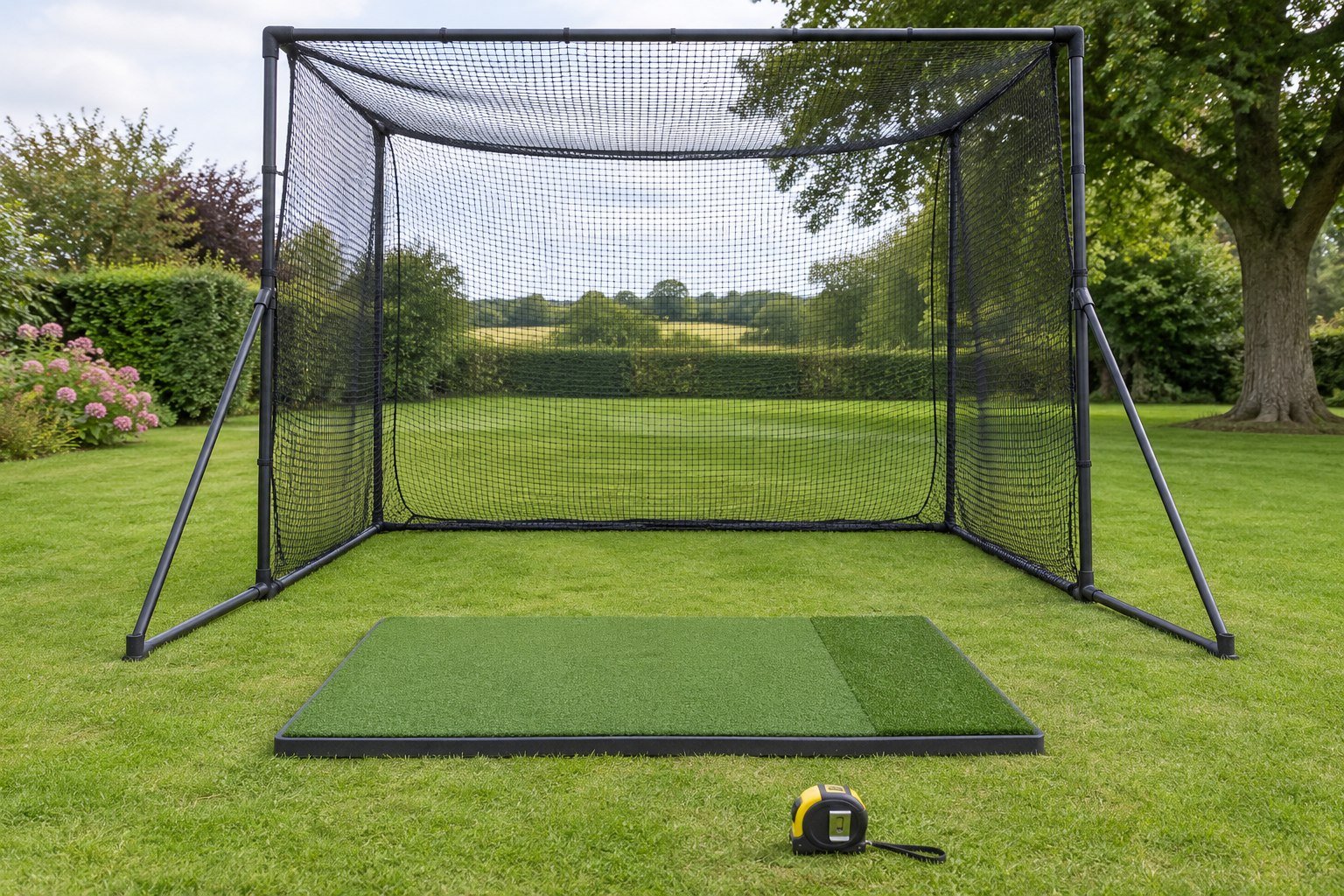
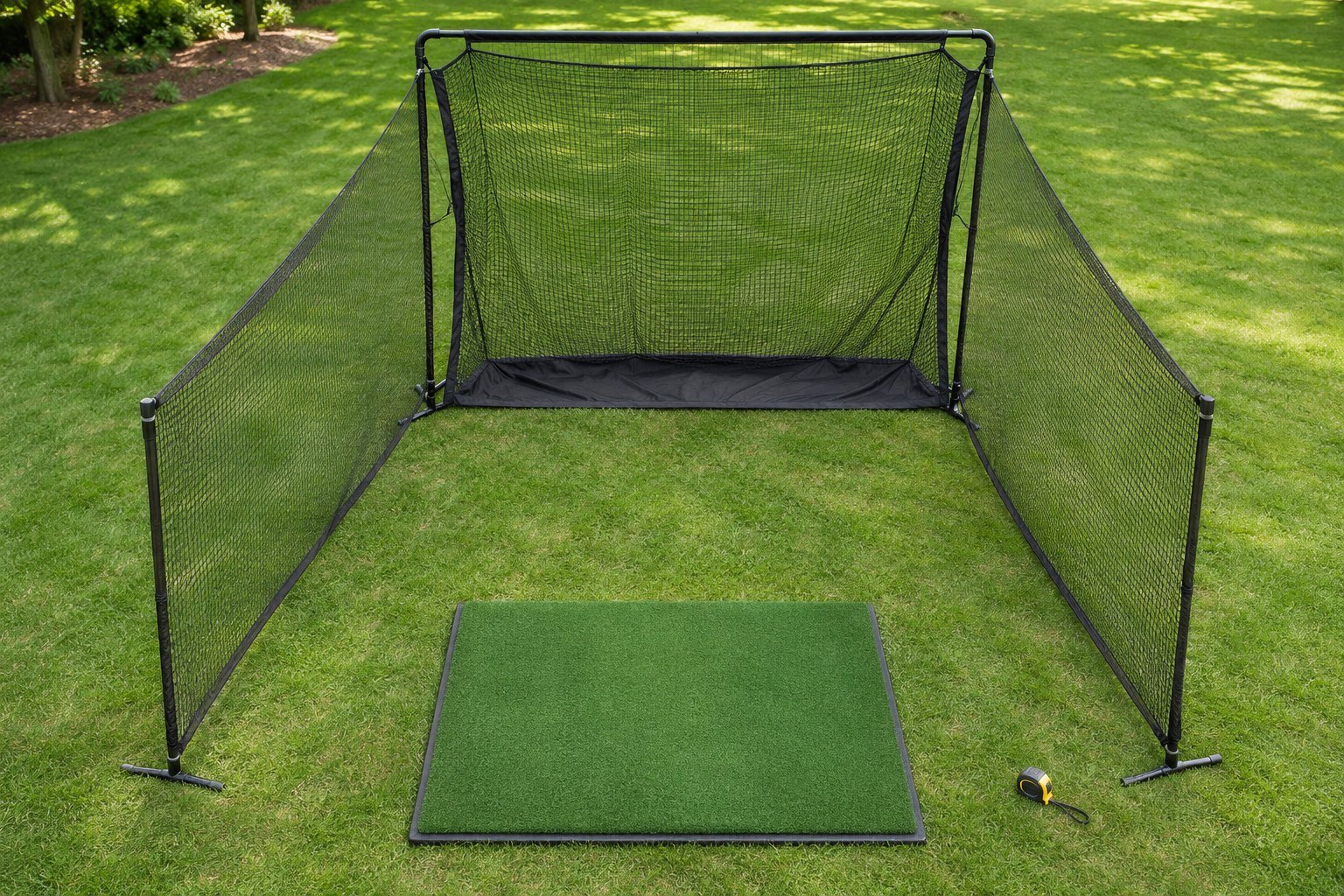
The frame’s size is only one part of the space decision. AI-generated illustration of a generic setup, not a safety assessment.
The tempting question is whether a net will fit between two walls. The more useful question is whether the complete activity fits there: the player, club, ball path, net, attachments and people who use the surrounding space.
This guide compares published specifications and manufacturer instructions, then turns them into a measurement record. It is research-led guidance, not a site survey or a claim that the illustrated setups have been tested. The worked space example is explicitly fictional.
Record width, height and depth with their exact measurement references.
Check the sides, top and lower edges from the intended hitting position.
Include the golfer, mat, net movement, approved fixings and surrounding access.
A smaller frame is useful only when the intended activity and complete layout also fit.
Read the listed size before ranking nets
The UK Net World Sports page for the FORZA ProFlex Pop-Up Golf Net lists an 8ft × 8ft option as 2.4m × 2.4m and a 10ft × 7ft option as 3m × 2.1m. The specification does not explicitly label the axes, so obtain a dimensioned drawing before assigning those figures to width and height. [1]
On a small screen, scroll sideways inside this table.
| Listed option | Published size | What still needs checking |
|---|---|---|
| FORZA ProFlex 8ft × 8ft | 2.4m × 2.4m. | Labelled width, height and depth; clear opening and complete installation requirements. |
| FORZA ProFlex 10ft × 7ft | 3m × 2.1m. | The same labelled dimensions and installation details; do not infer the axes from the size name. |
These are product labels, not certified clear openings or recommended room dimensions. Check the drawing and the selected variant rather than assuming every number refers to the part you intend to measure.
A cage listing may include a third dimension. For example, the FORB Freestanding Golf Cage & Net is listed at 3m long, wide and high. That still does not make a room of those dimensions a complete practice bay. [2] The product’s footprint and the working area answer different questions.
Measure the product, the golfer and the surrounding area
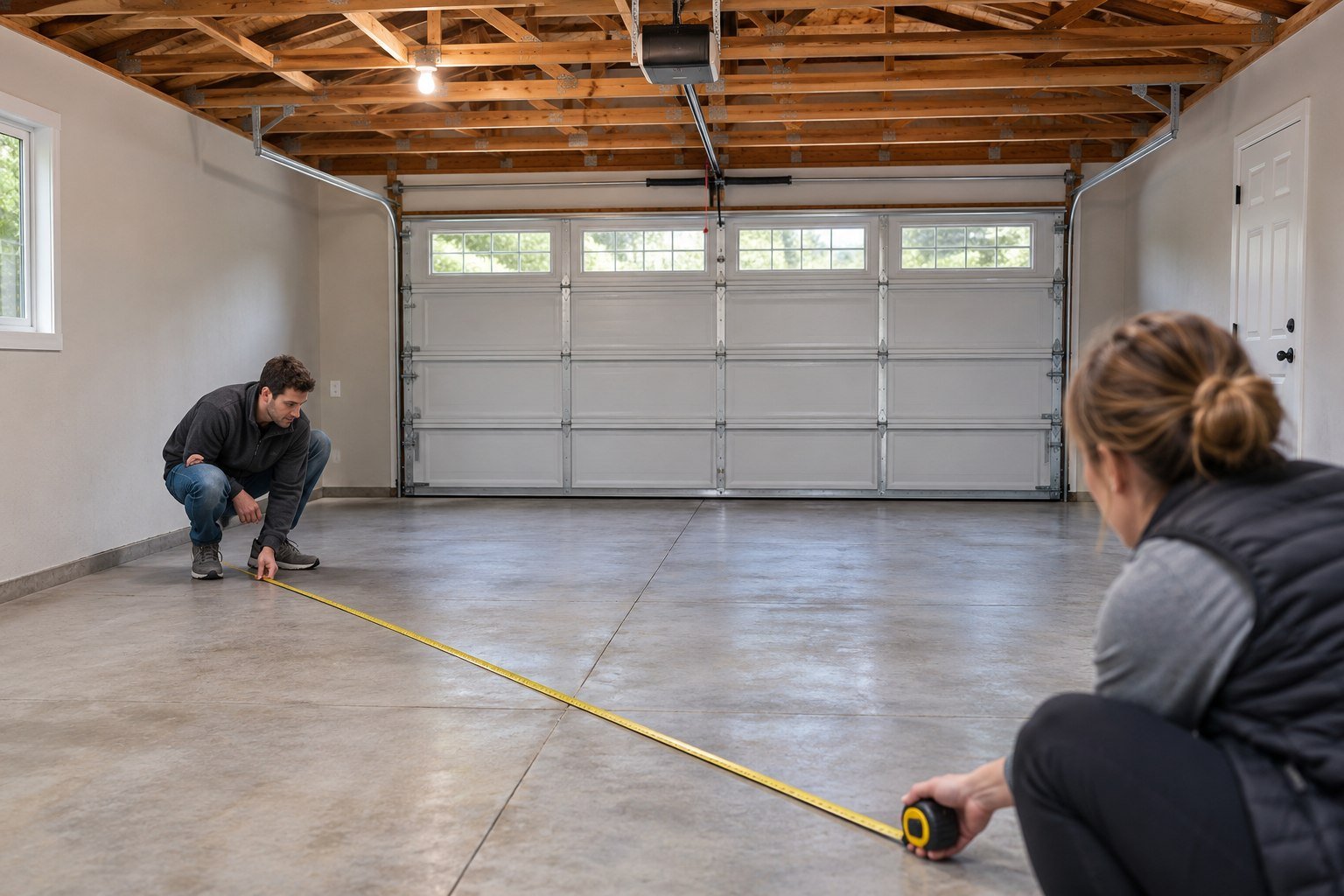
Start with the proposed location empty. Measure its actual usable width, length and lowest overhead obstruction. Record doors, beams, lights, shelves, branches and changes in level. A room’s highest ceiling point is not helpful if a lower beam crosses the intended swing area.
Next, separate the measurements into three groups:
- The installation: frame, hanging net, side extensions, roof section, feet and any required fixing positions.
- The golfer’s working area: ball position, stance, mat height and the club movement of each intended user.
- The surroundings: space beyond the net, household access, neighbouring areas and objects that cannot be exposed to an escaped ball or equipment contact.
The Net Return’s currently linked Home assembly manual calls for clearance around and above the net and consideration of the surrounding area. It does not turn the frame dimensions into a universal room-size allowance. [3]
Record swing clearance as a separate requirement. Do not discover whether a driver clears a beam by swinging close to it. If the space is uncertain, have the proposed layout assessed by a suitable golf-bay installer or practise at an established facility instead. Include both handednesses if the area will be shared.
Examine the opening from the intended ball position
A front photograph can make two nets look equally substantial while concealing different depths, roof coverage and side arrangements. Ask where the ball is meant to be struck from, then examine how the complete approved setup relates to that position.
Use the following questions when reviewing the manufacturer’s drawings or discussing the installation:
- What covers shots travelling towards either side, including a poorly struck ball?
- What covers a high launch above the main target area?
- How are the lower edge and gaps around the frame handled?
- Which attachments are required, and which are merely optional targets?
- What lies beyond every part of the assembly?
Side protection must be identified as part of the particular system. The Net Return publishes a separate side-barrier manual with its own attachments and weighted positions. That is evidence of an additional installation task, not a reason to assume that any loose side net will fit any frame. [4]
Do not treat a strong-mesh claim as proof that the layout contains every miss. Likewise, hitting a few balls into the middle would only show what happened on those attempts. It would not establish the protection available at the edges. If the proposed layout leaves an unresolved escape route towards people, property or a neighbouring area, stop the purchase assessment there.
Use one measurement record for each candidate
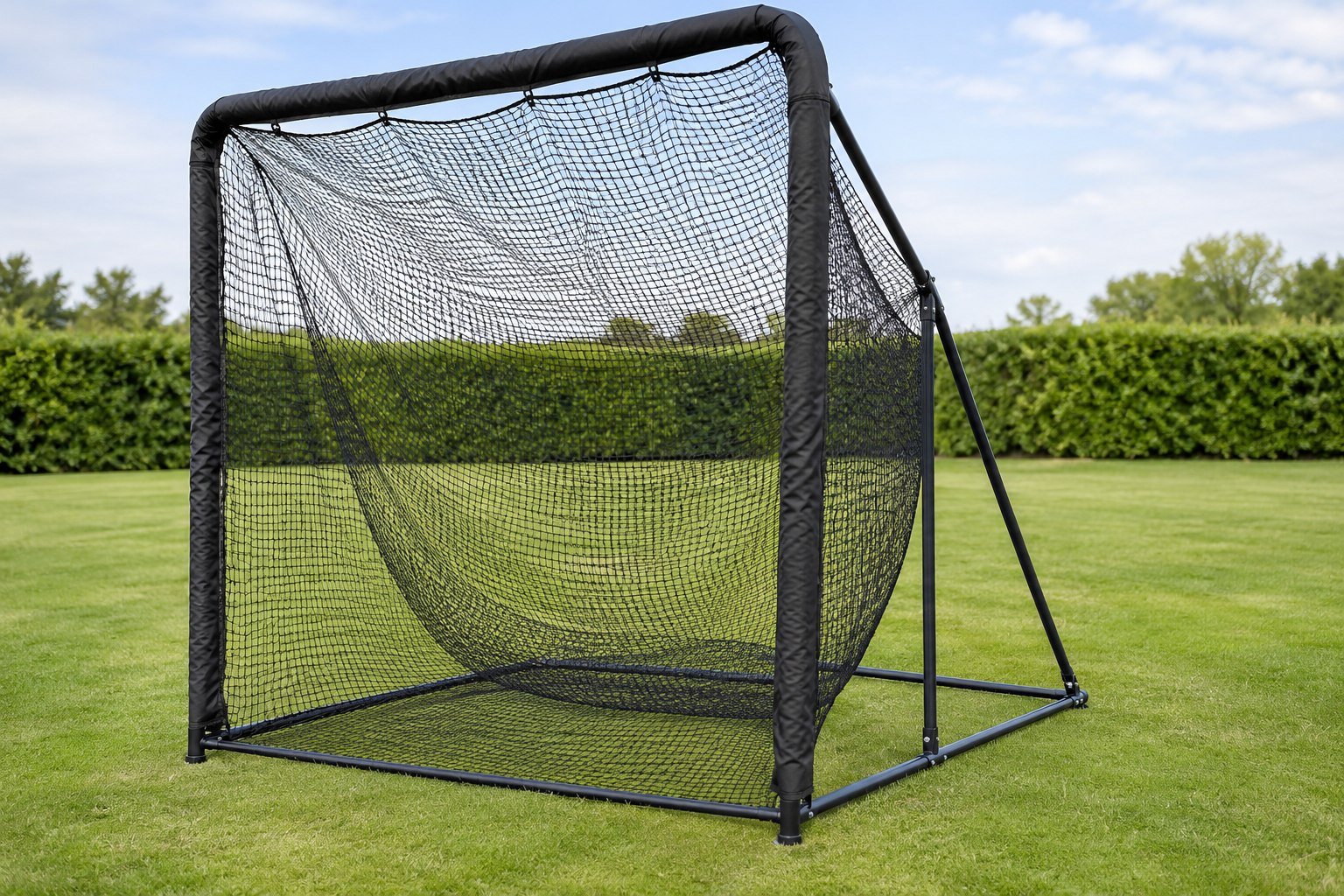
Keep your measurements and the manufacturer’s requirements in different columns. “Not supplied” is a useful finding; it is not a zero. Save the model name, selected variant, manual version and date with the record so a later product change does not silently alter the comparison.
On a small screen, scroll sideways inside this table.
| Entry | Record at your location | Obtain for the exact model |
|---|---|---|
| Assembled size | Available width, depth and height, with obstructions marked. | Overall dimensions; distinguish the frame from the clear opening. |
| Hitting position | Proposed ball position and mat dimensions. | Permitted position and distance, including the point measured from. |
| Golfer and club | Intended users, handedness and clubs; mat height. | Any setup restrictions, plus a separate assessment of swing clearance. |
| Rear and side space | Objects, boundaries and available separation. | Required clearance for the net and its movement under impact. |
| Containment additions | Space available for side and upper coverage. | Compatible parts and their installed positions. |
| Fixing footprint | Actual surface and space around the base. | Approved anchoring or weighting arrangement for that surface. |
| Access | Doors, walkways and who could enter the area. | How the whole practice area will remain clear during use. |
| Decision | Fits, conflicts or unresolved, with the reason. | Written clarification for any unanswered requirement. |
Draw a simple plan for yourself and label where each measurement begins and ends. A distance from the ball to the front frame is not automatically the distance to a hanging impact panel. Avoid adding measurements that overlap, or forgetting a component because it was included in a different-looking product photograph.
A fictional example: reject the obvious mismatch first
Suppose Ruth measures a proposed indoor area as 2.85m wide, 5.6m long and 2.3m high at its lowest obstruction. These room measurements are invented solely to demonstrate the worksheet. The product figures below are the published labels discussed earlier; no installation or swing has been assessed.
On a small screen, scroll sideways inside this table.
| Candidate | Known finding | Decision at this stage |
|---|---|---|
| FORB Freestanding Golf Cage & Net | Its listed 3m width and 3m height exceed the fictional 2.85m width and 2.3m height. [2] | Reject this location/model combination. |
| FORZA ProFlex 10ft × 7ft option | The 3m × 2.1m label does not explicitly identify the axes or provide complete assembled dimensions. [1] | Hold: obtain a labelled drawing before making the fit decision. |
The longer room does not cancel the cage’s width or height conflict. Ruth also has no basis to decide swing clearance or containment from these numbers. She should not squeeze the frame, omit parts or move the hitting position outside the instructions to make a purchase fit.
This first pass can save time: an explicit dimensional conflict can eliminate a candidate before a detailed assessment. Missing information needs a different response. Neither an unresolved label nor a frame that fits on paper establishes that the activity fits.
Ask the supplier questions that a size label cannot answer
Send the exact model and variant with your measured plan. A useful enquiry identifies the proposed clubs, ball type, users, surface and surroundings. A photograph without dimensions can hide the very obstacle the supplier needs to understand.
Ask for the current manual and an installation drawing covering these points:
- Which assembled dimensions include the feet, roof and supplied side panels?
- Where is the permitted hitting position measured from?
- What clear space must remain behind, beside and above the assembly?
- Which approved containment additions are needed for the intended use?
- How must this exact model be secured on the proposed surface?
- What conditions make the location unsuitable or require dismantling?
Request clarification when the product page and manual differ. Do not choose whichever number is easier to fit. Keep the answer with the order details, especially if a bundle supplies different sides, target material or frame components.
The FORB freestanding-cage instructions, for example, distinguish the outer cage net from a separately positioned impact panel. [5] That construction detail matters when identifying the impact surface and its position. It should not be copied as a spacing rule for another net.
Include the mat, accessories and everyday access
Mark the ball’s proposed location, not just the outline of a mat. The mat’s stance area, tee position and height are relevant to the golfer’s working space. If several people use the setup, check the complete arrangement for each person rather than assuming the first player’s position serves everyone.
A launch monitor or other device introduces another set of instructions. Check its required location separately; do not move the player or net outside their own requirements to accommodate it. Leave the accessory out of the buying plan until the complete arrangement can be reconciled.
Consider the space at the time you would actually practise. A clear garage in a photograph may contain a parked car each evening. A garden corner may also be the route to a shed. Decide how access will be controlled during use and restored afterwards; a plan that depends on other people never appearing is incomplete.
Our small-space golf practice guide provides a putting-led alternative when a full-swing area cannot be established. Its budget is for that smaller task; it does not include or certify a hitting-net bay.
Buy only after the complete arrangement is resolved
Use three outcomes. Reject a candidate with a known dimensional or containment conflict. Hold a candidate with unanswered requirements. Shortlist a candidate only when the exact product, intended activity and complete location have been assessed together.
The manufacturer pages for the FORZA ProFlex size options and FORB freestanding cage are starting points for that enquiry, not endorsements of either model for an unseen space. No current price, availability or personal test result is assumed here.
Before first use, follow the delivered product’s inspection and assembly instructions. The FORB cage manual requires checking for defects and says not to use faulty parts. [5] A suitable layout cannot compensate for a damaged or incorrectly assembled product.
Choose the arrangement whose requirements you can meet without changing its intended use. If the information or space is insufficient, postpone the net and use a suitable established practice facility or a properly planned putting setup. The useful purchase is a complete workable system, not simply the largest rectangle the room can hold.
Explore more Home Practice guides
Sources and checks
Sources were checked on 23 November 2026. Product ranges and buying terms can change. The practical worksheets are editorial suggestions for your own comparison.
- FORZA ProFlex Pop-Up Golf Net: two listed size optionsNet World Sports UK · Checked 23 November 2026
- FORB Freestanding Golf Cage & Net: Home Driving RangeNet World Sports UK · Checked 23 November 2026
- Home / Home Series V2 assembly manual, currently linked PDF (©2021)The Net Return · Checked 23 November 2026
- Side Barrier assembly manual, currently linked PDF (©2021)The Net Return · Checked 23 November 2026
- 10ft freestanding golf cage and net: assembly and safety instructionsNet World Sports / FORB Golf · Checked 23 November 2026
Illustrations in this article were created for Taylor’s Trailblazing Golf. Third-party photographs, where used, are credited beside the image or in the source list.