
Flat vs Ramped Putting Mats: Which Feedback Is Actually Useful?
Choose a practice task you can observe, not just a target that returns the ball.
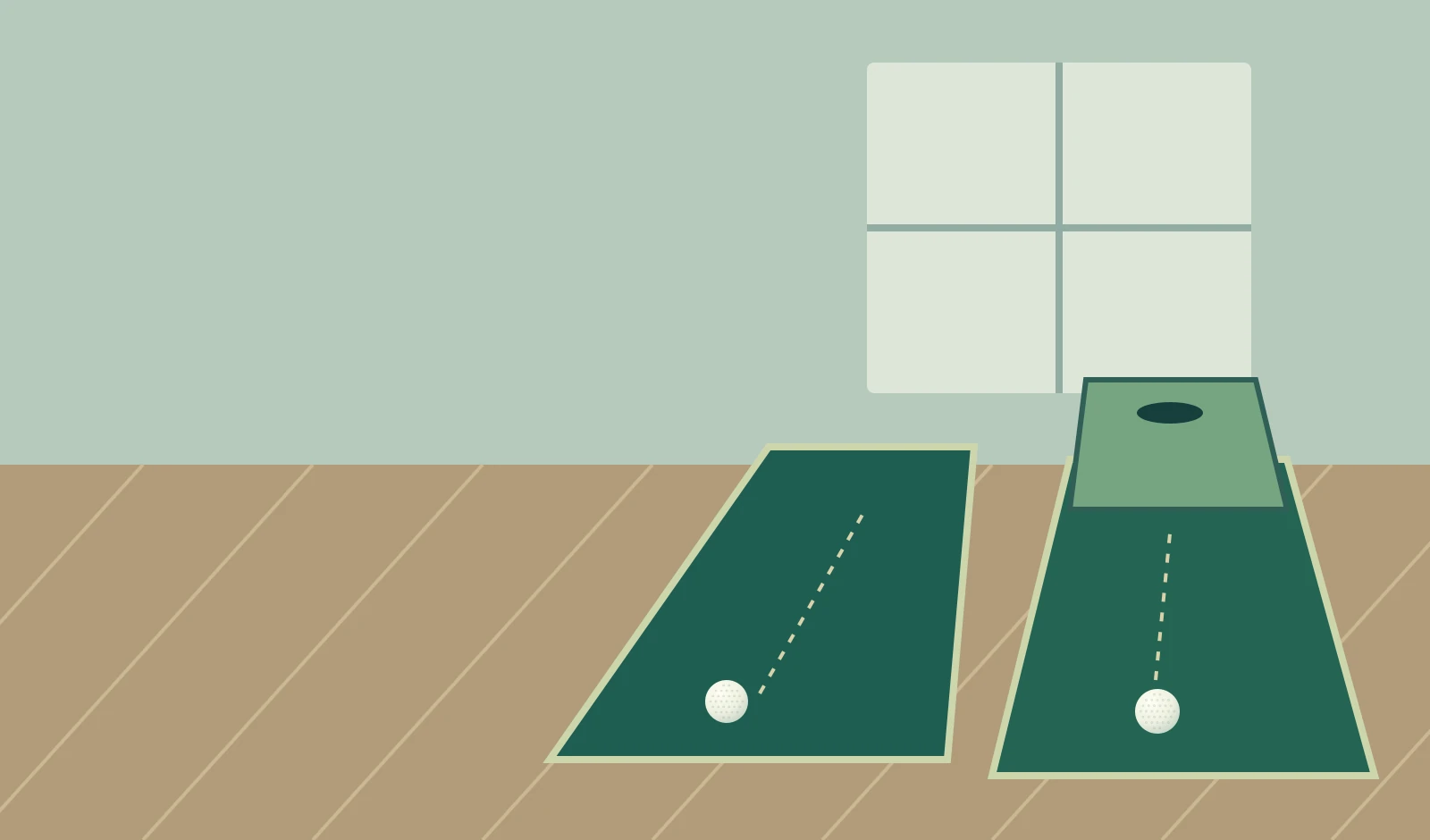
Original conceptual illustration; not a product or test photograph.
Flat vs ramped putting mats is not a contest between a serious practice surface and a gimmick. The two layouts can give different feedback, and that difference matters more than which one looks most like a miniature green. A flat stopping area can show where the ball finishes, while a raised target may make retrieval convenient and provide a clear target task. Neither automatically measures every part of a putting stroke.
The useful buying question is what you want to learn from each attempt. Are you checking the starting direction, practising a repeatable setup, comparing stopping distances or simply making a short practice session easy to begin? A mat should support that task and fit your room without encouraging you to mistake a convenient return system for a complete simulation of outdoor putting.
This research-led guide uses published product dimensions and explains the feedback each layout can reasonably provide. The practice routines are suggestions, not tested coaching programmes or promises of lower scores. No mat has been independently speed-tested for this article. Manufacturer speed descriptions remain manufacturer descriptions, and the floor beneath the mat is part of the setup you need to assess.
Visible stopping points
Keep the finish of each attempt available to inspect.
Target and retrieval
Understand what the raised target result actually shows.
Usable room space
Include stance, stroke and safe household access.
One task per group
Separate direction, target success and pace.
Flat vs ramped putting mats: choose the feedback first
Name the observation you want
A useful practice task produces an observation you can understand. For direction, you might observe the ball's initial path against an appropriate reference. Pace work instead asks where it stops relative to a target area. For routine, you might focus on setting up consistently and completing a small number of deliberate attempts.
Do not begin by deciding that a mat needs the greatest number of printed lines, holes or accessories. Those features are helpful only when they serve the chosen task. A simpler surface can be more useful than a crowded one if it lets you see the result clearly and repeat the exercise without confusion.
Separate convenience from measurement
An automatic or gravity return can make it easier to practise without walking after every ball. That is a real ownership benefit, but it is not the same as measuring direction or pace accurately. Likewise, a dramatic target that catches a ball may make success obvious while concealing how far the ball would have rolled on an uninterrupted flat surface.
Keep both questions in the buying checklist: does the mat provide useful feedback, and will its practical arrangement make you use it? You do not have to reject convenience to practise thoughtfully. You simply need to understand what the convenient feature does and does not tell you.
Recognise three different target arrangements
Flat mats and raised-hole mats
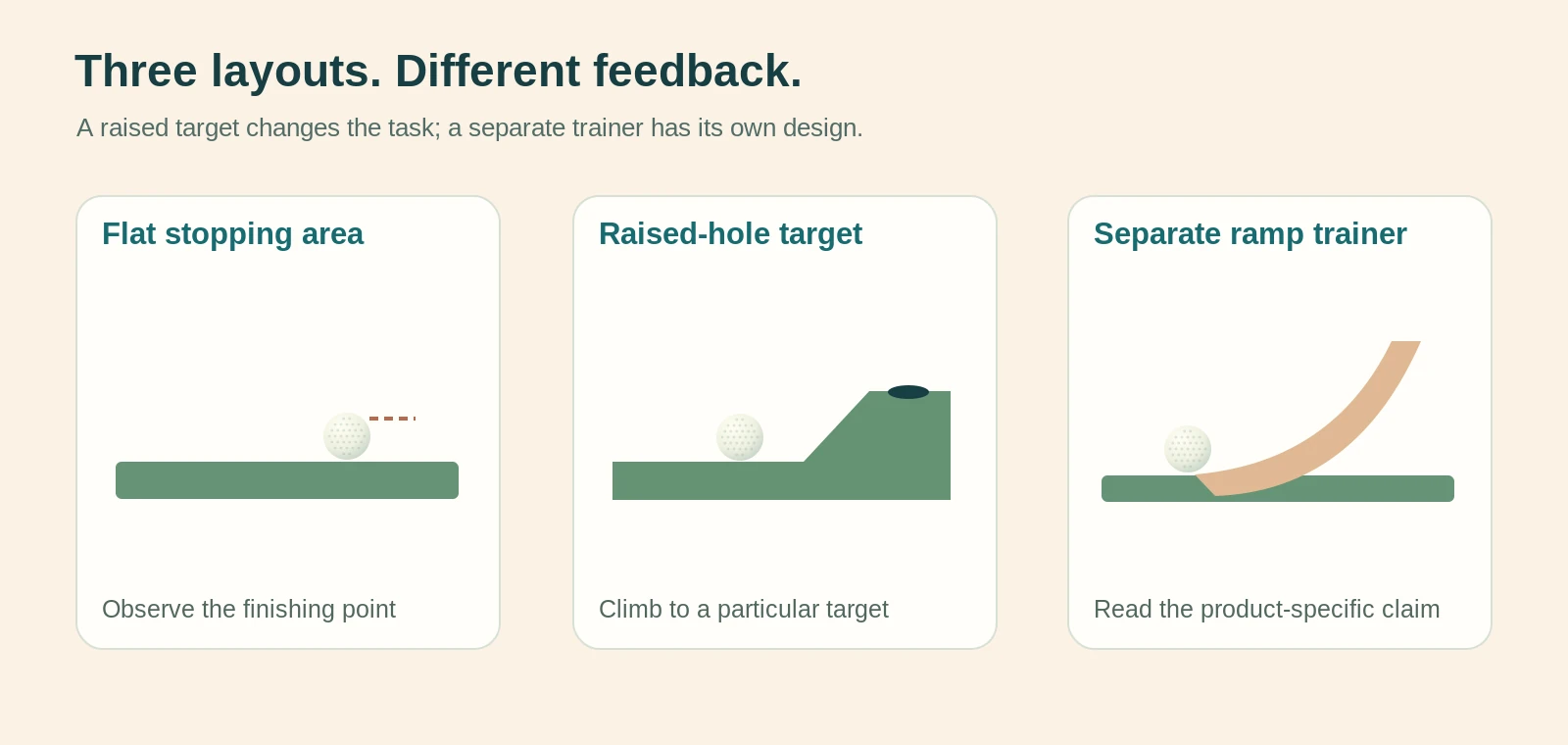
A flat mat may provide printed targets, lines or a stopping area without asking the ball to climb to a raised hole. A raised-hole mat adds an uphill section at the target, often with a return route. The raised section changes the task because the ball needs enough energy to climb it; that is basic mechanics, not evidence that the design is inherently bad.
Check how much of the advertised mat remains flat and usable for your intended exercise. A product's overall length can include the ramp, return structure or space beyond the target. Do not assume that the full box dimension equals the distance from your ball position to the hole.
A separate ramp trainer is another category
A portable ramp-style target placed on a flat mat is not necessarily equivalent to a raised-hole mat. Its shape and stated purpose may be different. PuttOUT's pressure trainer, for example, is marketed around a parabolic ramp and a particular feedback concept. That claim belongs to the named product, not to every ramp on every putting mat. [3]
Before comparing reviews or recommendations, identify which arrangement is being discussed. Otherwise, a criticism of one uphill hole can be mistakenly applied to a separate training target, or a manufacturer's specific feedback claim can be repeated as though it describes all ramps.
What a flat surface can show well
Stopping position remains visible
With a suitable flat stopping area, you can observe where the ball comes to rest relative to a chosen target. That supports simple distance-control comparisons on that surface. You can see a short result, a long result and the spread between attempts without every ball disappearing into a raised hole or return channel.
The observation still belongs to the particular mat and floor. It does not establish the stroke length required on every outdoor green. Use the surface for a clearly defined indoor task, then allow for the different conditions when practising outside. A useful indoor observation does not need to pretend it is a universal green-speed calibration.
Flexible targets can keep the task varied
Where the product instructions and surface allow, you can select different stopping areas or use its printed references for short tasks. Keep any markers safe, non-damaging and out of the putter's path. There is no need to add rigid obstacles or improvised equipment that could damage the mat, ball or surroundings.
A flat arrangement can be especially practical when you want to compare several distances within the available space. However, very short usable length still limits the range of tasks. Buy according to the space and exercise you actually have, rather than assuming the word flat automatically makes a compact mat suitable for every form of pace practice.
What a raised target can show well
It can create a clear repeatable target task
A raised target may provide an obvious aim point and a convenient way to collect or return balls. That can make a brief session straightforward to organise. You can use the flat approach portion to observe starting direction, provided the references are appropriate and the setup is consistent.
However, reaching or entering the raised target does not by itself describe the ball's hypothetical stopping distance on a level continuation. The uphill section removes energy from the rolling ball. Interpret success as success at that particular target task rather than treating every holed ball as evidence of identical pace on a flat green.
A return system can support more deliberate practice
Convenient retrieval can reduce the interruption between attempts, but it can also encourage rapid, thoughtless repetition. Decide whether you will pause to observe the result before playing the next ball. The feature is useful when it supports the routine, not when it hides every miss quickly enough that you stop noticing what happened.
Check whether the return works only after certain outcomes or whether missed balls require manual collection. That affects the real ownership experience more than a broad promise of automatic practice. Read the exact product description and inspect the arrangement where possible rather than assuming every return mat behaves the same way.
Understand why the ramp changes pace feedback
The ball is doing work against the rise
A ball that climbs a raised section needs enough remaining motion to gain height. Therefore, a stroke that reaches a raised hole is not directly interchangeable with a stroke aimed at an otherwise identical flat target at the same horizontal distance. The amount of difference depends on the actual geometry and surface, so this guide does not offer a universal extra-hit percentage.
That does not mean the mat teaches an automatically harmful stroke. It means the user needs to label the task correctly. Practising a consistent start line or a specific raised-target challenge can still be purposeful, while claiming precise flat-green stopping feedback from that same result would require more evidence.
Avoid a universal beyond-the-hole rule
Some training products describe a particular intended pace reference. PuttOUT's pressure-trainer marketing relates its perfect-putt concept to a stated roll-past distance. Treat that as the manufacturer's product-specific design claim, not an independent validation or a rule that every putt should finish the same distance beyond every hole. [3]
Different slopes, surfaces and tasks require different interpretation. For your indoor practice, state the actual objective: enter this target under the product's intended conditions, start through this reference or stop in this flat area. Clear task labels prevent one convenient product feature from becoming an oversimplified theory of all putting.
Measure usable space before buying
Include the player and the stroke
Measure the room area needed for the mat, your stance, the putter's movement and safe access around the setup. A narrow strip that fits between furniture may not leave a comfortable stance position. Similarly, an advertised length can fit the room while leaving too little space behind the ball for your normal stroke.
Check both the mat's footprint and the intended ball-to-target distance. Perfect Practice's published standard-mat specification gives an overall length of 9 feet 6 inches, with an 8-foot putting distance. The difference illustrates why overall product length should not be treated as usable putt length. [2]
Consider storage and shared space
Decide whether the mat will remain in place or be stored after each session. A design that needs frequent assembly or a large fixed target structure may suit one home and frustrate another. Check the manufacturer's storage instructions rather than assuming the surface can be folded into any available cupboard.
Keep doorways, stairs and household walking routes clear. A mat or return track should not create a trip hazard, particularly in a shared room. It is better to choose a smaller usable practice area with safe access than to squeeze in a longer product that makes ordinary movement around the home awkward.
Read product dimensions with the right questions
Two named examples, not a best-buy ranking
PuttOUT lists its Medium Mat at 240 by 50 centimetres and provides distance markings through 6 feet. Perfect Practice's standard specification distinguishes its 2.9-metre overall length from a 2.4-metre putting distance and lists target holes of 6.5 and 8.5 centimetres. These are published product examples checked on 4 October 2026, not measurements made for this article. [1] [2]
The examples show that footprint, marked distances and target size are separate specifications. They do not establish which mat will suit your room or practice goal. Use the numbers to ask better questions, then compare the actual layout and the space required for your stance and stroke.
Published examples checked 4 October 2026. Footprint, marked distances and target geometry are separate details.
| Example | Published space detail | Interpretation |
|---|---|---|
| PuttOUT Medium Mat | 240 x 50 cm; markings through 6 feet | Footprint is not a promise of every usable stroke distance. |
| Perfect Practice standard | 2.9 m overall; 2.4 m putting distance | Allow for the target and room behind the ball. |
| Perfect Practice targets | 6.5 cm and 8.5 cm target holes | Target geometry changes the task. |
| Separate ramp trainer | Product-specific shape and claim | Not interchangeable with every raised-hole design. |
Confirm what the selected version includes
Product families can contain several sizes or generations. Read the exact variant's dimensions and included accessories, especially when a photograph shows equipment that may be sold separately. A compatible target or return accessory is not automatically included with the mat itself.
Keep a copy of the selected product description so you can check the delivered item against the order. If a listing mixes dimensions or leaves the usable putting distance unclear, ask the retailer before purchasing. A familiar brand name does not remove the need to verify the particular version that will arrive.
Check the floor before blaming the mat
Flat-looking is not necessarily level
A mat can follow the support beneath it. If the floor slopes or the surface underneath is uneven, the ball may behave differently from what the printed lines suggest. Check the intended location before treating every sideways movement as a stroke fault or a defective mat.
The USGA's explanation of green-speed measurement distinguishes flatness from level and stresses the importance of an appropriate test area. Its process is not a home-mat certification method, but the underlying caution is useful: the supporting surface matters when interpreting a roll. [4] Avoid assuming that a straight-looking hallway automatically provides a neutral reference.
Use simple comparisons without overstating them
Where the product and room allow, try the mat in another suitable location or rotate it to investigate whether a recurring behaviour follows the mat or the room. Keep the setup safe and avoid creasing or stressing the surface. This can help identify a question to ask the manufacturer, but it is not a calibrated test proving the cause.
Also inspect for debris, curled edges or an incorrectly assembled target. Correct ordinary setup issues according to the instructions before drawing conclusions about your putting. A useful practice surface starts with a sensible installation; it should not require you to compensate for an avoidable bump on every attempt.
Keep stance height and access in the comparison
The surface under your feet also matters
If the ball sits on a raised mat while you stand on a lower floor, the setup differs from standing and putting on one continuous surface. The practical significance depends on the arrangement, but it deserves a check. Notice whether you adopt an awkward posture to reach the ball rather than assuming the mat's thickness is irrelevant.
Use only a safe, stable arrangement consistent with the product's intended use. Do not build an improvised stack of loose materials under your feet to imitate a green. If the setup feels unsuitable, consider another location or product rather than forcing a stance that distracts from the intended practice task.
Check handedness and household layout
A return track or fixed target structure may interact with where you can stand. Check the complete arrangement for your handedness and for anyone else who will use it. A product that appears symmetrical in a photograph can still be inconvenient in a room where furniture blocks one side.
Test the available space with your normal putter before ordering, without striking balls towards fragile objects. Include a clear route for collecting misses and storing the club. Good room fit is not merely whether the mat lies flat; it includes comfortable use and safe movement around the whole practice area.
Interpret speed labels cautiously
A published Stimp figure is not your own measurement
PuttOUT describes its Medium Mat with a stated Stimp speed. That is a manufacturer description, not a reading measured in your room or verified for this article. [1] The floor, surface condition and setup can affect what you observe. Do not assume that matching a printed speed number means the mat reproduces every aspect of a particular outdoor green.
A proper green-speed measurement involves a defined procedure and suitable conditions. The USGA describes repeated rolls in opposing directions and attention to the test location. [4] Rolling a ball down an improvised object once is not an equivalent measurement, and this guide does not recommend presenting such a result as a certified Stimp value.
Use consistency before chasing a number
For ordinary home practice, first ask whether the surface behaves consistently enough for the task you have chosen. A stable directional reference or repeatable stopping area can be useful without an independently measured speed claim. Note changes after storage, cleaning or moving the mat, and check the manufacturer's instructions where the behaviour is unexpected.
Do not repeatedly modify the surface to force it towards an advertised number. Follow the product's care and setup directions, then contact support if a genuine problem remains. Your practice should be based on an understood surface, not an endless attempt to reproduce an outdoor condition with unverified home adjustments.
Build a direction task that does not depend on the ramp
Observe the early part of the roll
On either layout, you may be able to use the flat approach area to observe initial direction against suitable printed references. Keep the ball position and target consistent. The point is to notice a repeatable pattern, not to declare a technical stroke diagnosis from a handful of attempts.
If you use an additional training aid, follow its instructions and ensure it is appropriate for the mat and setting. Avoid rigid improvised gates that could damage equipment or create a hazard. A coach can help choose a task that produces interpretable feedback without turning the living room into a collection of obstacles.
Separate direction from whether the target accepts the ball
A ball can begin along the intended line yet fail to reach a raised target, or reach the target area after starting off line. Record those observations separately. A simple holed-or-missed total may hide the distinction and make it difficult to know what the session actually practised.
Keep the task small enough to observe carefully. Rather than racing through many balls, pause and note whether the starting path was the intended one. The mat becomes useful when its layout helps you see that result clearly, not merely when it produces a satisfying sound at the far end.
Build a pace task suited to the layout
Flat stopping zones make a clear indoor comparison
On a suitable flat mat, choose a stopping area using the product's markings or another safe, non-damaging reference. Play a few attempts from one position and observe the distribution of finishing points. Then use another available distance without changing the mat location. Label this as an indoor task on that surface rather than a prediction for every course green.
The stopping area should be realistic for the space. There is little value in defining a target so close to the mat's end that most long attempts fall onto another surface and cannot be compared. Keep the full result visible where possible and retrieve balls safely.
Ramped targets need a different label
With a raised-hole design, use the target as intended but recognise that climbing and entering it is a particular challenge. You can observe whether attempts reach, fall short or pass through the intended target route. Do not translate those outcomes automatically into flat-green roll-past distances unless the exact product has a relevant, supported feedback system.
A separate flat area may still let you practise stopping-distance tasks before the ramp, provided there is sufficient usable length. Check that the task remains clear and safe. You do not have to use every part of the mat on every attempt; choose the part that gives the feedback you need.
Use a short session structure instead of endless repetition
Give each group one purpose
A proposed session could begin with a few setup repetitions, continue with a small direction task and finish with a stopping or target task appropriate to the layout. The exact number of attempts is less important than being able to observe them. This is a suggested structure, not a tested training prescription or a guarantee of improvement.
Keep notes brief: what task, what setup and what you noticed. If the surface or room arrangement changes, record that before comparing results with another day. A small, consistent record can reveal whether the mat is supporting your intended practice or whether you mostly spend the session adjusting equipment.
End with a question you can take outside
Choose one observation to explore on a proper practice green, such as whether a more consistent setup feels comfortable without the mat's printed lines. Do not expect an indoor success rate to transfer numerically to a different surface and task. Outdoor putting introduces conditions the home mat does not fully reproduce.
This is not a reason to dismiss indoor practice. It is a reason to keep its role specific. A convenient home task can support deliberate repetition, while outdoor practice supplies additional context. The mat is one tool in that process rather than a complete replacement for reading and adapting to real greens.
Check whether the markings help or become a dependency
Printed lines can make a task clear
Distance and alignment markings can simplify setup and make a result easier to describe. They are especially useful when you want to repeat the same starting position. However, consider whether the layout lets you practise without relying on every printed cue, particularly if your intended outdoor routine does not contain those references.
You do not need to cover or alter the mat to investigate this. Use an unmarked part where available and suitable, or compare the routine on an outdoor practice green. Keep the exercise appropriate to the product and avoid adhesives or treatments that could damage the surface.
Too many features can obscure the result
A mat with several holes, tracks and graphics may offer useful choices, but it can also tempt you to change tasks after every miss. Decide the purpose of the current group before starting. If you cannot explain what a particular feature helps you observe, it does not need to be part of every session.
The best layout for you may therefore be simpler than the most elaborate option. That is not a judgement about seriousness or skill. It is a practical choice to make feedback understandable and practice convenient enough to repeat.
Run a small comparison with two clearly different outcomes
Use direction and target success as separate columns
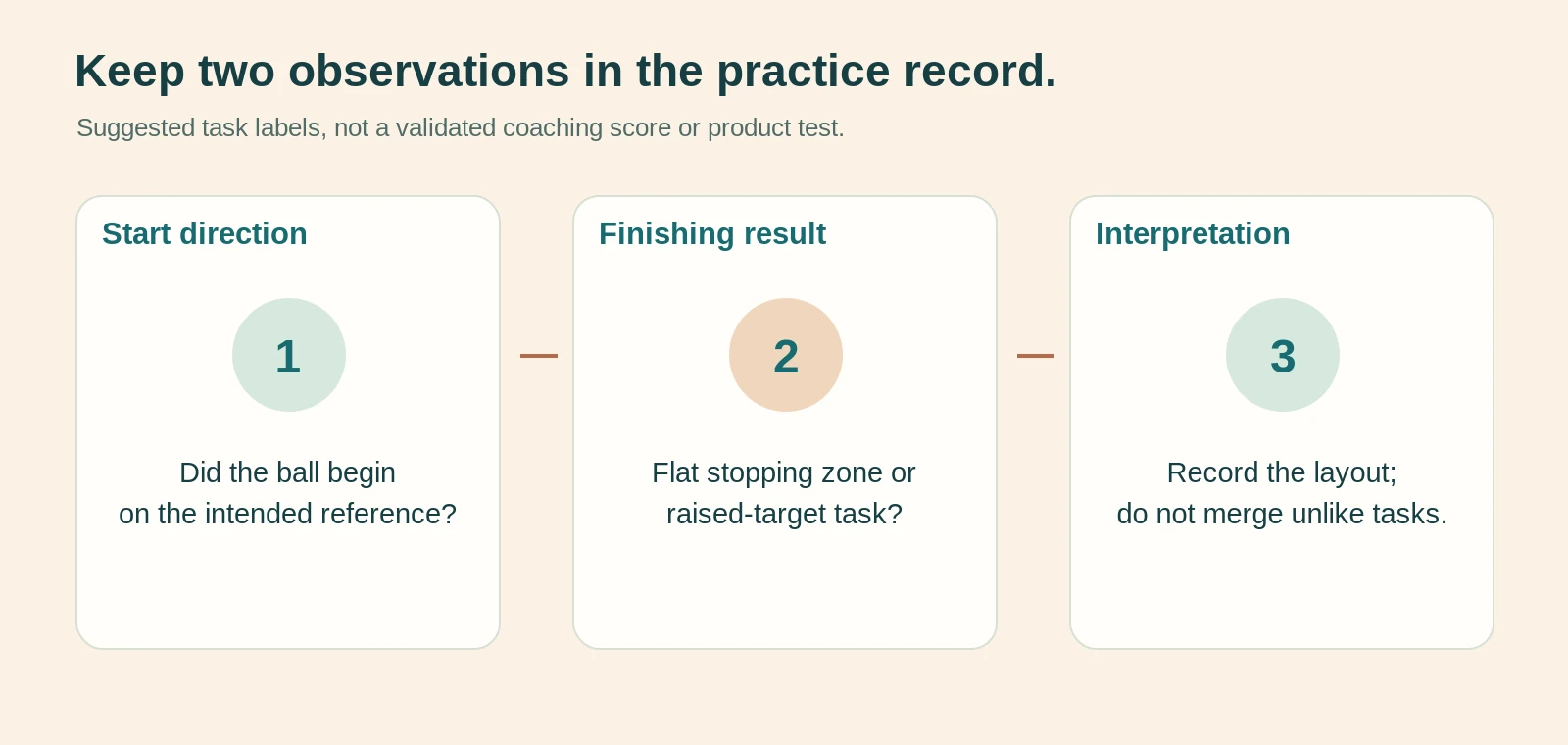
For a proposed twelve-attempt session, divide the attempts into three groups of four. Keep one starting position and one target during each group. After every attempt, note whether the ball began along the intended reference and whether it achieved the target task. The numbers are an organisational suggestion, not a validated coaching prescription or a standard that every golfer should follow.
This two-column record helps reveal why a simple success total can be incomplete. You might complete the target task after an uncertain start, or start correctly but fail to supply the motion needed for a raised target. Those outcomes suggest different questions. A coach can help interpret a persistent pattern without assuming the mat alone identifies the technical cause.
Change only the task that needs another look
After the first group, decide whether the next group should repeat the same task or investigate a specific observation. Do not change target, starting distance and stroke intention automatically after every miss. Keeping a few attempts comparable makes the feedback more intelligible than a sequence of unrelated putts.
On a flat mat, a separate finishing-area note can describe short, within the intended zone or long. On a ramped target, use labels that match the actual outcome, such as reached the target route or stopped before the rise. Avoid translating those labels into outdoor stopping distances. The record should describe what happened on the product, not a hypothetical green it was never shown to reproduce.
Inspect a new mat before committing to permanent changes
Check the delivered version and components
When the mat arrives, confirm its model, size and included parts against the order. Read the setup and return conditions before trimming packaging, adding adhesive markers or using it outside the intended environment. Keep photographs of any apparent damage and contact the retailer about uncertainty instead of trying to repair a new item immediately.
Assemble only according to the instructions and check the supporting floor. A return track fitted incorrectly can create an impression of poor performance that has little to do with the putting surface. Similarly, a mat that needs to settle after storage should be assessed according to the manufacturer's guidance rather than judged from the first minute out of the box.
Separate a product fault from an unsuitable room
If the ball repeatedly moves unexpectedly, inspect ordinary setup factors and, where safe and permitted, compare another suitable location. Record the direction of the behaviour and whether it remains after the move. Do not describe that small check as proof of a fault, but use the observations to ask the manufacturer a clearer question.
The result may be that the room is unsuitable even though the product appears sound. That is still useful information for the purchase decision. Check the retailer's actual options rather than assuming use or modification leaves every return right unchanged. A careful initial assessment is more valuable than forcing the product into a location that requires constant compensating adjustments.
Share the practice area without forcing one routine on everyone
Set up for the person currently using it
Where several household members use the mat, confirm that each has comfortable stance and stroke space. A return track or furniture arrangement that works for a right-handed user may need a different safe layout for another person. Keep clubs and loose balls away from anyone not participating, including children and pets.
Do not leave a practice arrangement across a route simply because it is convenient for the next session. Store the equipment safely when the space returns to ordinary household use. The ownership decision should include this setup-and-clear routine; a mat that creates a daily obstacle may be less useful than a more compact option that everyone can accommodate.
Keep individual observations separate
Two users may practise different tasks or prefer different markings. Record the setup relevant to each rather than comparing unexplained success totals. A smaller target or longer starting position changes the task, so one person's result should not be treated as directly comparable with another's without those details.
Shared use can still be simple. Agree a clear space, one active player at a time and a safe collection routine, then let each person choose a modest task. The mat does not need to become a household leaderboard to be useful. Its value is providing an accessible setting for deliberate practice without creating unnecessary hazards or misleading comparisons.
Think about storage, cleaning and repeat setup
Follow the surface's care instructions
Check how the mat should be rolled, stored and cleaned. Do not assume it can be folded sharply, ironed or treated with household chemicals to remove every mark. Follow the exact manufacturer's directions, particularly where a surface, backing and fixed target structure need different handling.
After storage, allow the mat to settle as directed and inspect it before practising. A curled end or trapped object can alter the roll and create a trip hazard. Correct the setup first rather than interpreting an unusual ball path as evidence that your stroke has changed overnight.
Make repeated setup easy to reproduce
If the mat is put away after each session, note the location and orientation that work well in the room. Check that furniture or floor coverings have not changed the support beneath it. A repeatable setup makes your observations more comparable and reduces time spent investigating avoidable differences.
For a return system, inspect the track and target connection according to the product instructions. Do not force a misaligned component into place or use damage as a reason to improvise a new ramp shape. Contact the supplier about a faulty part rather than creating a layout that no longer behaves as intended.
Three household scenarios and a sensible choice
The narrow hallway with limited stance space
Imagine a golfer with enough floor length for a long mat but little room to stand beside it. The first decision is not flat versus ramped; it is whether the complete setup is usable and safe. A shorter mat in a wider area may support better practice than a longer product squeezed into an awkward route through the home.
Measure stance and stroke space before comparing features. Include the route used to collect misses and the position of any return track. A product that technically fits the floor can still fail the practical test of comfortable, repeatable use.
The player who wants visible stopping feedback
Another golfer mainly wants to compare finishing distances during short indoor tasks. A flat stopping area is a logical priority, while an automatic return is secondary. The decision should favour clear observation rather than a raised target whose success outcome does not directly show the desired flat stopping point.
A third golfer values a compact, convenient target routine and dislikes retrieving every ball. A raised-hole mat may be a sensible choice, provided its feedback is understood and the room fit works. These hypothetical cases show why neither layout deserves an automatic winner label. The useful choice follows the task and setting.
Read a practice record without claiming a scoring improvement
A hypothetical twelve-attempt example
Imagine a player recording twelve attempts on a raised-hole mat. Eight start along the intended reference and seven finish in the target. Those two totals do not reveal whether the seven target successes were among the eight intended starts. Keep the attempt-by-attempt notes if that relationship matters, rather than treating both totals as one overall measure of putting quality.
Now imagine the next session produces nine intended starts but only six target successes. It would be premature to say the player became better or worse overall. The task, surface, setup and particular outcomes need context. The record may suggest that direction deserves less immediate attention than reaching the raised target, but even that is a question to investigate, not a diagnosis of the stroke.
These numbers are invented solely to explain how to read a record. They are not results from a mat test, a coaching study or a user trial. The example shows why apparently precise percentages can conceal the observation you actually need. Retain the underlying task and outcome instead of turning a small session into an impressive-looking performance claim.
Compare like tasks before changing the equipment
For a useful follow-up, repeat the same starting position and target arrangement under similar conditions. Check that the floor support and mat setup have not changed. If you deliberately move to a flat stopping-zone task, give it a new label rather than adding the result to the old raised-target total. The tasks answer different questions even when the ball travels a similar horizontal distance.
Use the record to decide what to observe next, not to justify an immediate product replacement after an ordinary disappointing session. A recurring setup problem, inconsistent return assembly or insufficient usable space is a more concrete reason to reconsider the equipment than a small change in a short run of putts. Equally, do not keep practising around an obvious product or room-fit issue because the target-success total occasionally looks good.
The practical outcome is a clearer conversation with a coach or a better choice of exercise. You can explain where the ball started, what the target required and how the session was arranged. That is more informative than saying a particular mat improved putting by a percentage that the limited comparison never established. Good feedback should make the next decision clearer without exaggerating what the practice record proves.
Pros and cons of flat and ramped layouts
Flat mats
A flat surface can make stopping points visible and allow flexible target tasks within its usable length. It can also be relatively simple to understand. However, it still depends on suitable floor support, adequate stance space and a clear practice purpose. A flat mat is not automatically level, accurately speed-rated in your room or equivalent to an outdoor green.
Retrieval may require more movement unless a compatible target or return system is added. That can be acceptable, or it may make the product less convenient for your habits. Consider the actual session you intend to run rather than assuming a purer-looking surface is always the better purchase.
Ramped mats
A raised target can provide an obvious task and convenient retrieval, which may make short sessions easier to start. The limitation is that the uphill section changes the pace requirement and can conceal the flat stopping distance you might otherwise observe. Interpret the target result according to the layout rather than treating it as a universal pace measurement.
The fixed structure and return track can also affect storage and room fit. Check the complete footprint and handed access. A ramped mat can be useful when those practical details work and the feedback matches your goal; it does not need to imitate every feature of outdoor putting to justify its place.
Common mistakes when buying or practising
Buying overall length instead of usable practice space
Do not assume the advertised length equals the ball-to-target distance. Check the ramp, target structure, return track and room needed for your stroke. Also verify the exact variant and included accessories. A long product is not useful if you cannot stand comfortably beside it or keep the household route safe.
Another mistake is trusting a printed speed figure as though it were measured on your floor. Use the manufacturer's description appropriately, then focus on consistent setup and interpretable tasks. A mat can provide useful practice without an independently certified speed match to your course.
Counting every target success as perfect pace
A ball entering a raised hole has completed that target task; it has not necessarily demonstrated an ideal stopping distance on a flat continuation. Keep direction, reach and stopping feedback separate. Similarly, do not blame the stroke for every sideways movement before checking the floor, debris and assembly.
Finally, avoid rapid repetition without a defined observation. A return system is convenient, but the next ball should not erase the lesson from the previous one. Choose a small task, observe the result and stop or change the exercise deliberately rather than treating volume alone as evidence of useful practice.
Frequently asked questions
Are flat putting mats better than ramped ones?
They are better suited to some tasks, particularly when you want to observe stopping positions on an uninterrupted area. A ramped target may be more convenient for a repeatable target routine and retrieval. Neither is universally better. Choose according to the feedback you want, the available room and the exact product layout, while recognising that both depend on a suitable supporting floor.
Will a ramp teach me to hit every putt too hard?
That is not a conclusion established by this article. A ramp changes the task because the ball must climb, but the practical effect depends on how you use and interpret it. Label the exercise accurately and do not transfer a raised-target result directly into a universal flat-green pace rule. Use outdoor practice to explore the routine in a different setting rather than assuming automatic positive or negative transfer.
Can I trust the advertised Stimp speed?
Treat it as the manufacturer's stated description, not an independent measurement of your own installation. Floor support, setup and surface condition need attention. The USGA describes a defined procedure for green-speed measurement, so an improvised home roll is not equivalent. Focus first on whether the mat behaves consistently enough for your chosen task and follow the maker's instructions if something seems wrong. [4]
How much room do I need around the mat?
Measure the complete footprint plus space for your stance, putter movement, retrieval and safe access. Overall length alone is not enough, and a return track may make one side less convenient. Check the arrangement for your handedness and anyone else using it. A shorter safe setup can be more useful than a longer mat squeezed into a narrow household passage.
Is a separate ramp trainer the same as a raised-hole mat?
Not necessarily. A portable trainer may have a specific geometry and feedback concept, while a raised-hole mat may primarily provide a target and return route. Read the exact product's intended use. Do not generalise one manufacturer's roll-return or pace claim to every ramp, and do not assume a compatible accessory is included with the mat unless the selected listing says so.
Can home practice replace a real putting green?
A home mat can support defined repetition and useful observations, but it does not reproduce every outdoor slope, surface condition or visual task. Use it for the feedback it provides clearly, then explore the routine on a proper practice green. Avoid expecting an indoor success percentage to transfer directly to different distances and conditions. The mat is a practical tool, not a complete substitute for all putting practice.
Final recommendation: buy a clear task, not a miniature promise
Choose a flat mat when visible stopping positions and flexible short-distance tasks are the priority. Choose a ramped layout when its target and retrieval system make a useful routine easier, provided you understand how the rise changes pace feedback. Inspect the floor, usable distance, stance space and storage requirements before deciding.
Then give each practice group one purpose and interpret the result honestly. Flat vs ramped putting mats becomes a straightforward decision when the feedback is matched to the task. The best option is the one that fits safely, behaves consistently and helps you observe something useful without pretending to recreate every challenge of an outdoor green.
Sources and fact-checking notes
Official pages were checked on 4 October 2026. Specifications refer to the named model or document, not every product in its category. The practical checks and examples in this guide are research-led suggestions, not reported results from hands-on product testing.
- PuttOUT – Medium Mat240 x 50 cm dimensions, markings and manufacturer speed description; not independently measured here.
- Perfect Practice – specificationsStandard model overall length, usable putting distance and target dimensions.
- PuttOUT – Premium Pressure Putt TrainerProduct-specific parabolic-ramp feedback claim; not generalised to every ramp.
- USGA – choosing locations to measure green speedFlat versus level, suitable testing locations and defined speed-measurement procedures.
Product pages, model options and rule guidance can change. Recheck the exact item and applicable document before relying on a technical or competition decision. No product price, availability or performance outcome is guaranteed by inclusion here.
Illustrations in this article were created for Taylor’s Trailblazing Golf Gear. Third-party photographs, where used, are credited beside the image or in the source list.