Putting Mirrors: Size, Position and Setup Feedback
Choose a useful view, position it carefully and know what the reflection can establish.
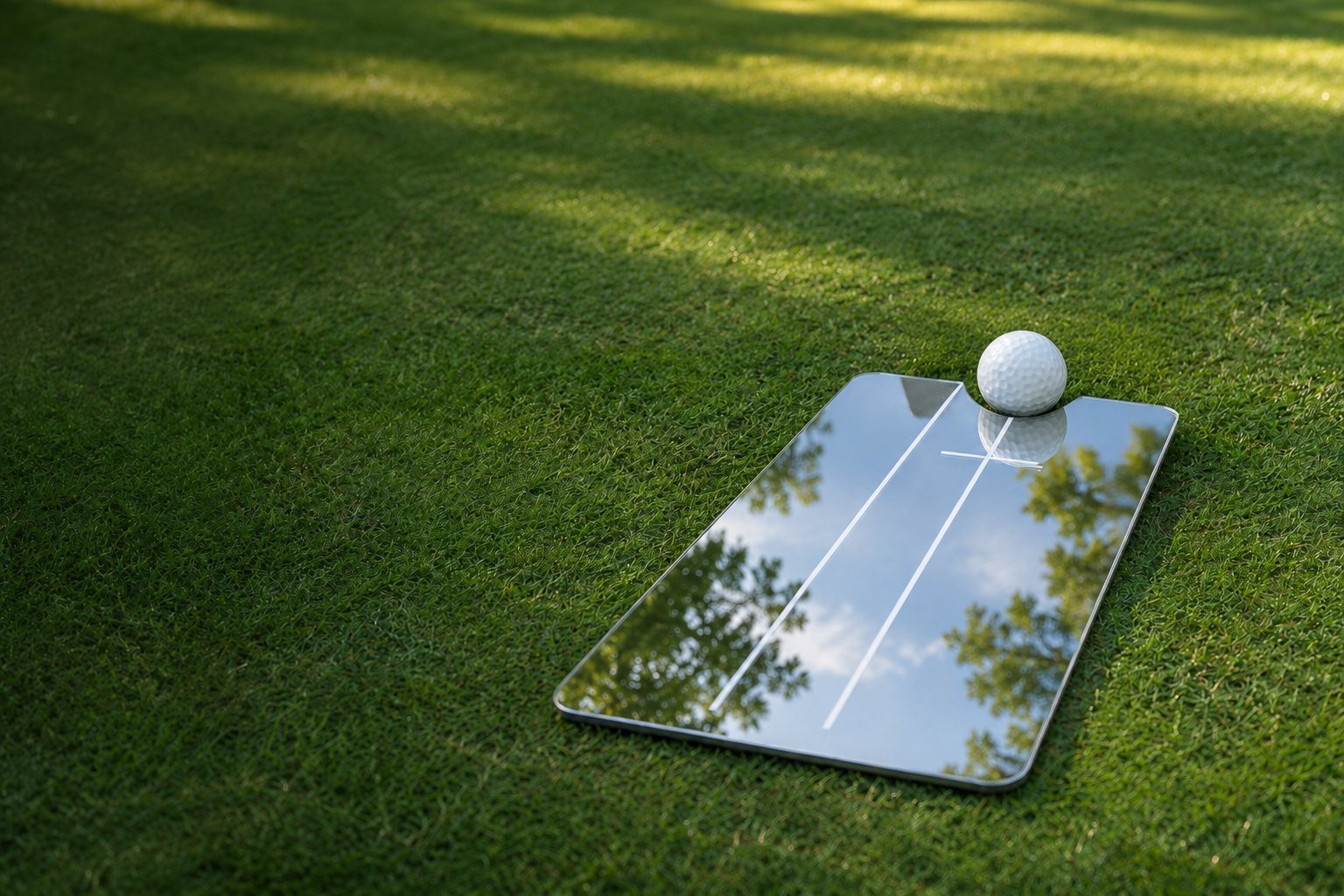
A mirror provides a visible reference for a chosen setup. Its presence does not establish that the setup suits every golfer. Generic illustration. AI-generated illustration of generic golf equipment.
A putting mirror is useful when it answers a specific question: can you see the address position you want to repeat? Its size, ball opening and position on the ground determine whether that check is comfortable and meaningful.
Ad – includes affiliate links. Taylor’s Trailblazing Golf may earn a commission from qualifying purchases. Our recommendations follow the reader’s needs and the available evidence. Read our disclosure.
Name the visible reference
Choose eyes, putter face at address or shoulders before comparing sizes.
Check your actual view
Keep your comfortable setup while judging what the plate reveals.
Record the arrangement
Note the surface, orientation, ball opening and attachments.
Check transfer
Remove the aid and see which setup cue you can repeat.
Choose the view before choosing the size
“Large” and “small” are incomplete buying descriptions. Ask which parts of your setup remain visible when you stand comfortably over the ball. Moving your head or stretching towards the plate to find your reflection changes the position you meant to inspect.
EyeLine’s FAQ makes a useful distinction within its range: the compact Putting Alignment Mirror does not show the shoulders; it suggests a separate shoulder mirror or a larger Classic or Groove PLUS model for that task. That is a model-specific visibility distinction, rather than evidence that all compact mirrors provide the same view. [1]
Swipe or scroll the table to see all columns.
| Your question | Feature to inspect | Reason to reject the fit |
|---|---|---|
| Where are my eyes relative to the ball? | A clear reflection and reference lines visible from your normal head position. | You have to move into an unfamiliar posture to find the reflection. |
| How does my putter face sit at address? | A usable perpendicular reference, suitable ball opening and room for your putter head. | The frame or attachment prevents the putter from sitting as intended. |
| Can I repeat a chosen shoulder alignment? | Sufficient reflective area towards your body, or a compatible shoulder attachment. | The shoulders are cropped or obscured by glare. |
| Can the head pass between guides? | Appropriate adjustable putter guides with generous initial clearance. | The guides restrict the movement you intend to observe or risk a hard collision. |
A larger mirror earns its extra space when it reveals a reference you otherwise cannot see. A smaller one earns its place when it answers the same chosen question and is easier to carry, position and store. Neither size is a skill level.
Read dimensions as a starting point
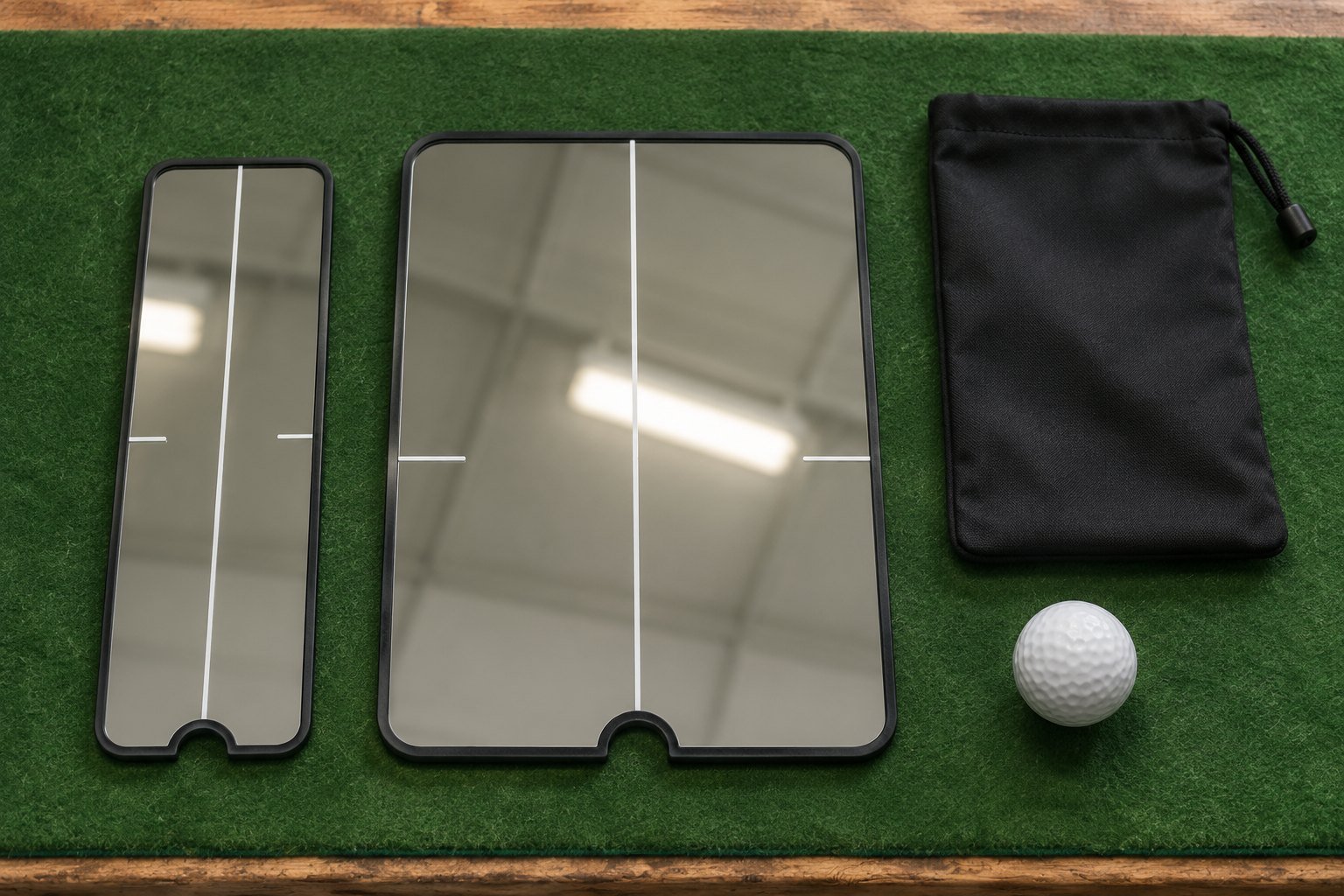
Check the exact model and supplied configuration. Outside dimensions tell you whether an aid fits a bag pocket or practice area; they do not tell you exactly what your reflection will include.
Swipe or scroll the table to see all columns.
| Identified model | Published detail | Question to settle before buying |
|---|---|---|
| PuttOUT Compact Putting Mirror | The maker lists an 8.5-inch length, 97 g weight and travel pouch. [2] | Will the actual reflective area show your chosen reference? The checked description does not give a width. |
| Masters Putting Mirror, PE175 | Masters lists 12 × 6 inches: approximately 30.5 × 15.2 cm after conversion. [3] | Does that footprint fit your practice space and provide a useful view from your stance? |
| PuttOUT Mirror & Adjustable Gate Set | The removable bare mirror is listed as 1 mm thick; the set includes a protective casing, magnetic guides and a separate adjustable gate. [4] | Which configuration will you use, and do you need the additional parts? Confirm the overall footprint if space is tight. |
The conversions above describe the listed footprint, not a measured viewing window. Likewise, a 1 mm bare plate is not a claim that the complete mirror and casing are 1 mm thick.
For UK purchase comparisons, the Masters Putting Mirror at Clubhouse Golf provides a straightforward single-mirror option, while the PuttOUT Mirror & Adjustable Gate Set combines several practice functions. Check the current total price and contents against the manufacturer’s listing; these are identified examples, not a ranking from hands-on testing. [7] [8]
Pay for the functions you will use. If you already have suitable ball gates, another set may add little. If shoulder visibility is the priority, a bundle with more accessories still needs to pass that visibility check.
Position the mirror before interpreting it
A neatly centred reflection can be misleading when the entire plate points somewhere unintended. Establish the reference first, then use the mirror to inspect your relationship to it.
- Choose one practice line. Start with a short, reasonably straight putt or an independently checked straight reference on a suitable mat. The line printed on the mirror cannot tell you whether the surface slopes.
- Orient the guide lines. Position the mirror’s intended lengthwise reference along that chosen starting direction. On a breaking putt, the intended starting direction need not point directly at the hole.
- Use the maker’s ball position. Follow the design of the notch, opening or marked area. Check that the ball can leave along the intended route without crossing an unintended frame edge.
- Check the club and base. Set your putter down gently. Confirm that the head, shaft and any guides clear one another, and that the plate does not rock. Do not press spikes through a home mat or floor covering.
- Take your normal setup. Look at the selected reference without moving solely to improve the reflection. If glare prevents a useful view, change the lighting or practice location and recheck the line.
Thickness matters because the club may sit on a raised surface while the ball rests in an opening. Check the arrangement actually supplied, including its casing. An edge that catches the sole is a setup problem to resolve before making strokes; it is not feedback about your putting technique.
If your indoor surface itself is the uncertain part, our flat versus ramped putting mats guide covers that separate choice. A mirror cannot make an unsuitable base level.
Use eye position as an individual reference
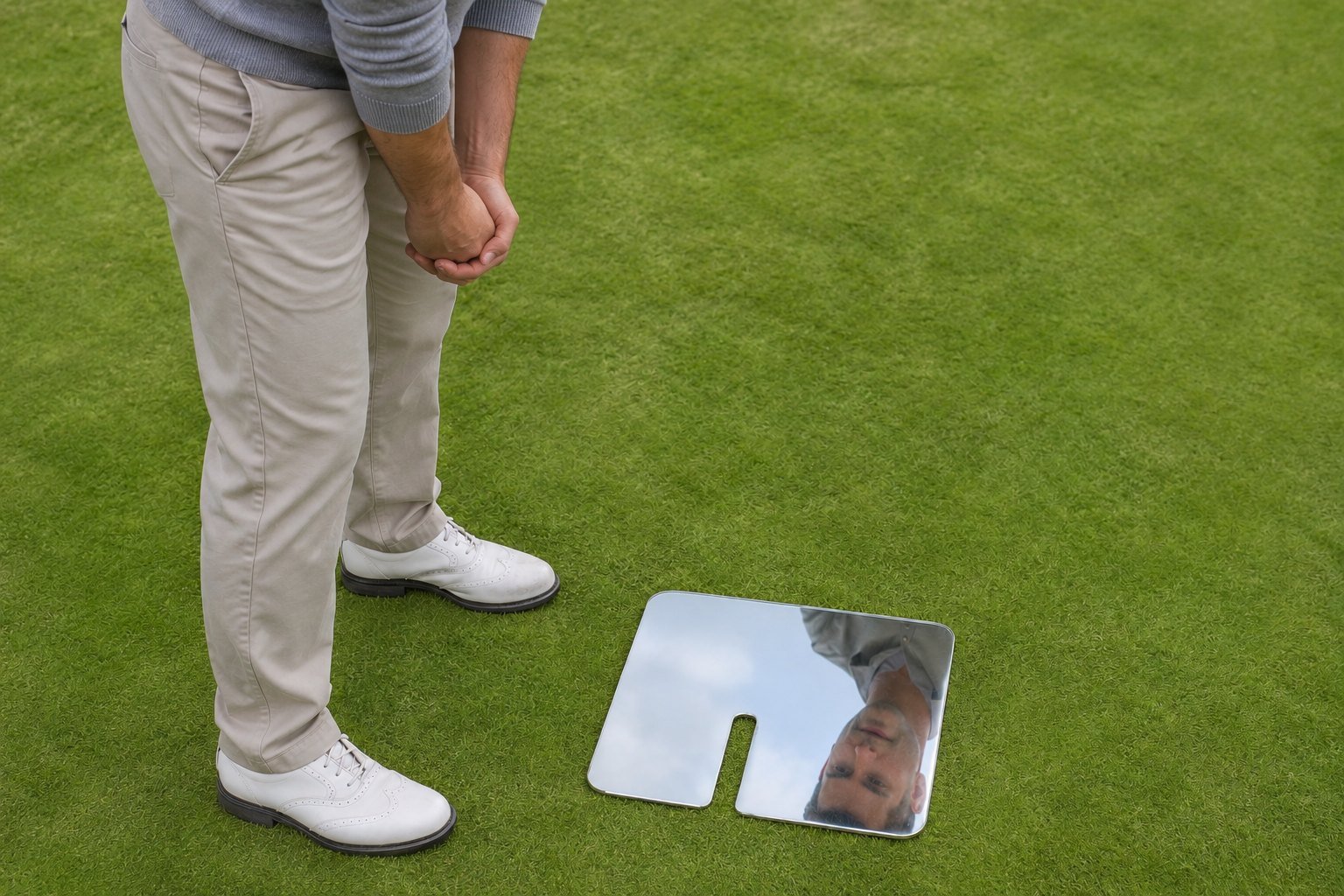
A line on a mirror is a reference mark, not a fitting verdict. “Eyes exactly over the ball” is too rigid as a universal buying or setup rule.
In his coaching article Matching Perception with Reality, Dr Paul Hurrion describes first establishing an objectively straight line, then finding a setup from which the golfer perceives it as straight. The mirror records that golfer’s eye position. His explanation explicitly recognises individual differences rather than coaching everyone into one identical position. [5]
The practical lesson is to connect what you see with a reference you have checked. If a straight practice line looks curved or differently aimed at address, ask a qualified putting coach to help examine the relationship between perception, posture and equipment. Continually moving your head until it matches a printed line may conceal the original question.
Once you have a suitable baseline, describe it plainly: where the ball appears relative to the eyes, whether both eyes are visible, and which guide line you use. Use the same putter and footwear when comparing sessions so that a changed setup is easier to recognise.
Separate a visible setup from a measured stroke
Swipe or scroll the table to see all columns.
| Observation | Useful interpretation | What remains unmeasured |
|---|---|---|
| Your reflected eyes occupy a similar position | You have repeated a visible address reference. | Whether that position gives you suitable aim or a comfortable stroke. |
| The putter face matches a mirror line at address | The face appears aligned to that reference before movement. | The delivered face angle at impact. |
| The putter clears two guides | The head passed through that particular opening. | The complete path, strike location and face behaviour throughout the stroke. |
| The setup looks tidy but the putt misses | The visible setup alone has not explained the result. | The contribution of start direction, pace, surface and read. |
This boundary prevents an expensive mistake: buying a larger mirror to answer a question a reflection cannot resolve. If you need to understand impact or motion, suitable coaching observation, video or measurement may be the next step. More printed lines do not turn a static mirror into an impact instrument.
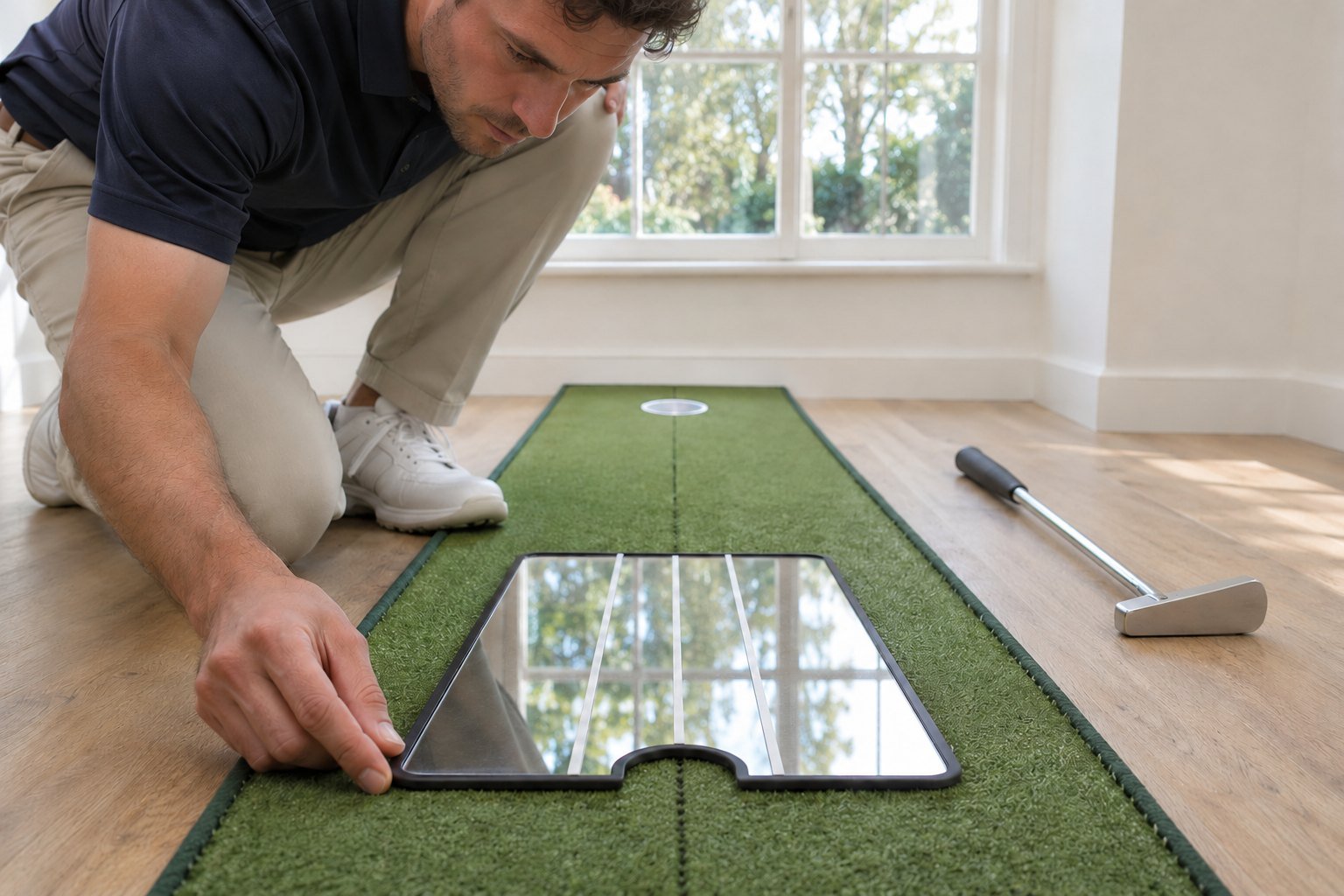
Build a mirror specification and placement record
Use this original worksheet to compare a candidate mirror or repeat a setup you already use. Leave unknown dimensions blank until the seller supplies them; a product photograph is not a scale drawing.
Swipe or scroll the table to see all columns.
| Record | Your entry | Decision it informs |
|---|---|---|
| One feedback task | Eye position, putter face at address, shoulder reference or putter-guide clearance. | Which features are necessary? |
| Exact model and configuration | Dimensions supplied, casing fitted or removed, attachments included. | Are you comparing the same version? |
| Actual visible area | What you can see from your comfortable setup; any cropped reference. | Is the mirror large enough in the useful direction? |
| Ground and orientation | Surface, chosen starting reference, ball position and frame clearance. | Can you recreate the arrangement? |
| Baseline and transfer | Your chosen reference with the mirror, then the setup after removing it. | Can you repeat the cue without watching the plate? |
| Purchase consequence | Keep existing mirror, try a larger view, add a compatible part or seek coaching. | What specific problem would spending solve? |
A worked buying example
Suppose your compact mirror shows both eyes clearly but excludes your shoulders. If the agreed task is repeating eye position, that missing view may not matter. If the task changes to observing shoulder alignment, the same mirror now lacks a required function. A larger plate or suitable attachment becomes worth investigating; a tighter putter gate does not solve the visibility problem.
After a brief check, remove the mirror and recreate the setup towards the same practice reference. Notice what you can repeat without looking down for confirmation. This is a transfer check, not a promised number of holed putts or a validated coaching protocol.
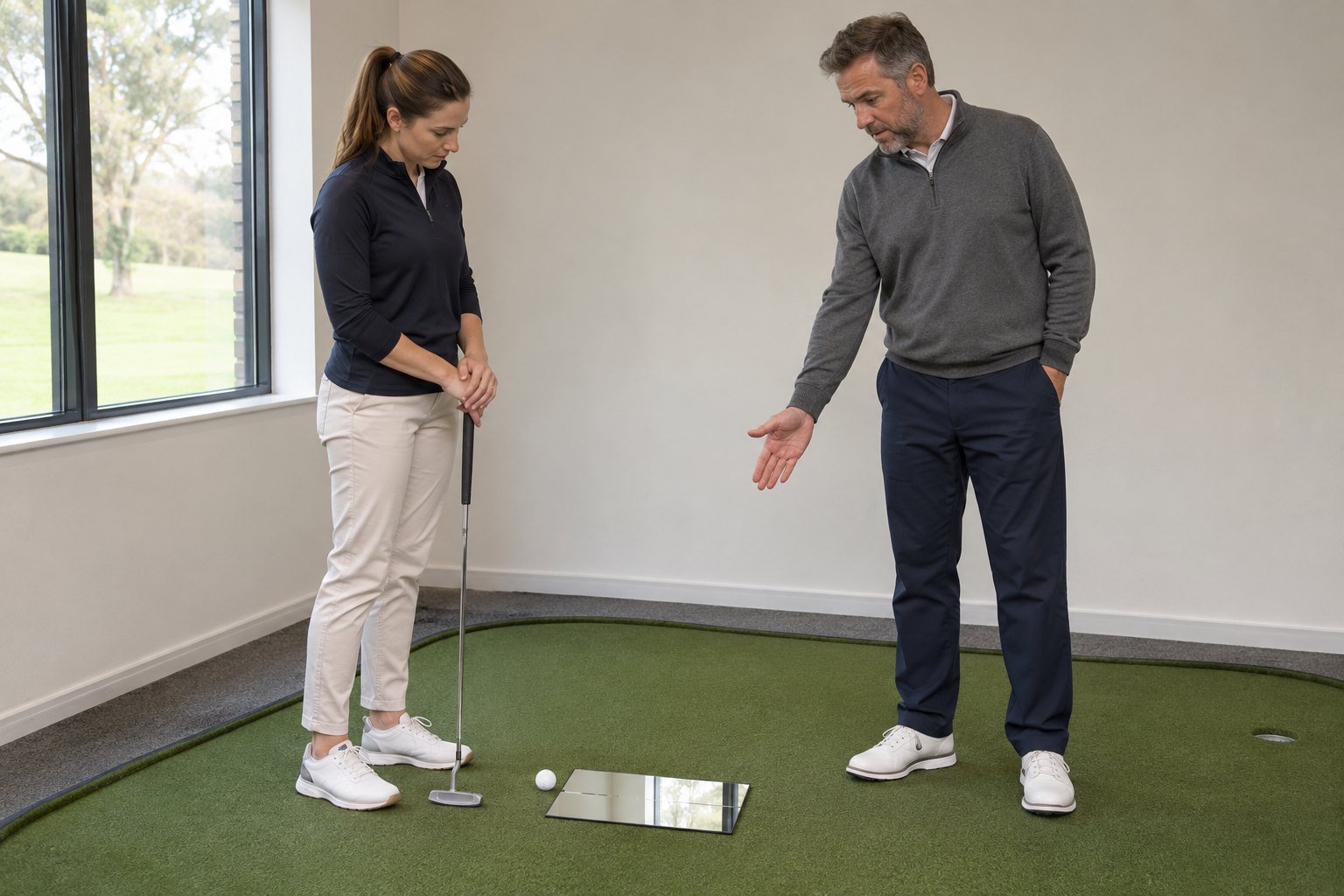
Keep the aid useful, portable and appropriate
Inspect a mirror before use for a damaged edge, loose attachment or a reflection too distorted to interpret. Protect the surface in its supplied pouch or case, and follow its own care instructions. A generic household glass mirror is a poor substitute for equipment designed to sit safely beside a putter and ball.
Use putting mirrors for appropriate practice. During a round, Rule 4.3a(6) prohibits using a training aid in a way that creates a potential advantage when preparing for or making a stroke, including help with alignment, ball position or posture. Rule 4.3 concerns use, rather than merely having equipment with you. [6]
For a broader indoor kit, the small-space golf practice guide helps place this purchase alongside other needs. Choose a mirror when a visible setup reference is the missing function. Keep an existing one when it already provides that view comfortably and repeatably.
This is a research-led selection and setup guide, not a hands-on product test. Read how we review golf gear or explore the Home Practice guides for related equipment decisions.
Sources
Manufacturer, coaching and Rules sources checked on 23 November 2026. Product details are attributed specifications; the worksheet and buying examples are editorial tools, not reported test results.
- EyeLine Golf: Putting Alignment Mirror, FAQ — compact-mirror shoulder visibility and larger or additional mirror options.
- PuttOUT: Compact Putting Mirror — published length, weight and pouch.
- Masters: Putting Mirror, PE175 — the listed 12 × 6-inch dimensions.
- PuttOUT: Mirror & Adjustable Gate Set — removable bare plate and identified set contents.
- Dr Paul Hurrion: Matching Perception with Reality, coaching PDF — individual perception and recording an eye-position reference; published in Asian Golf Monthly, August 2009.
- The R&A: Rule 4, The Player’s Equipment — Rule 4.3 and training-aid use under 4.3a(6).
- Clubhouse Golf: Masters Putting Mirror — identified UK retail listing.
- Clubhouse Golf: PuttOUT Putting Mirror & Adjustable Gate Set — matching UK set listing.
Illustrations in this article were created for Taylor’s Trailblazing Golf. Third-party photographs, where used, are credited beside the image or in the source list.