Two-Wheel vs Three-Wheel Push Trolleys: Handling and Stability
Choose the way your bag moves, parks and folds—not just the number of wheels.
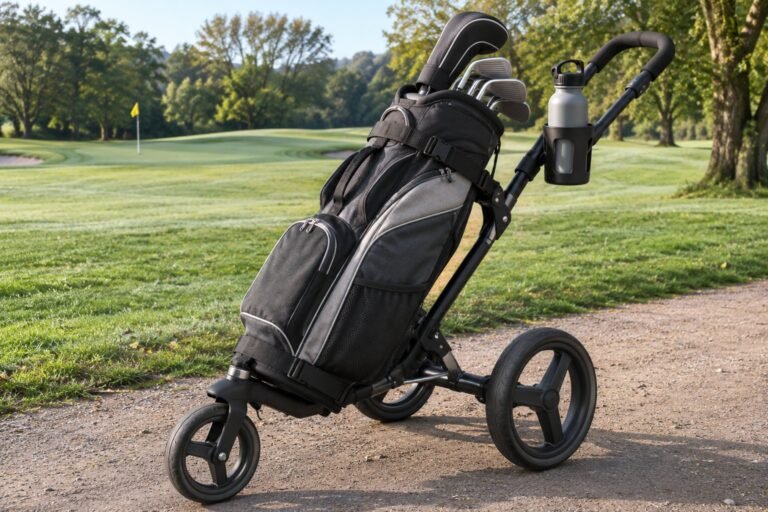
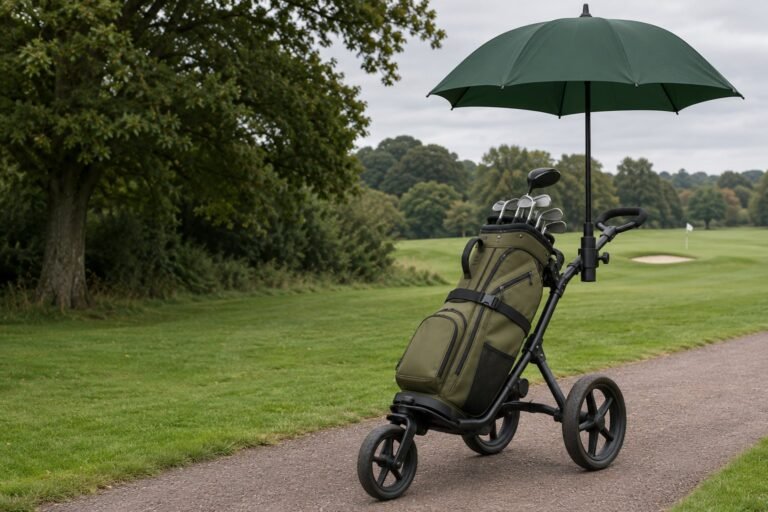
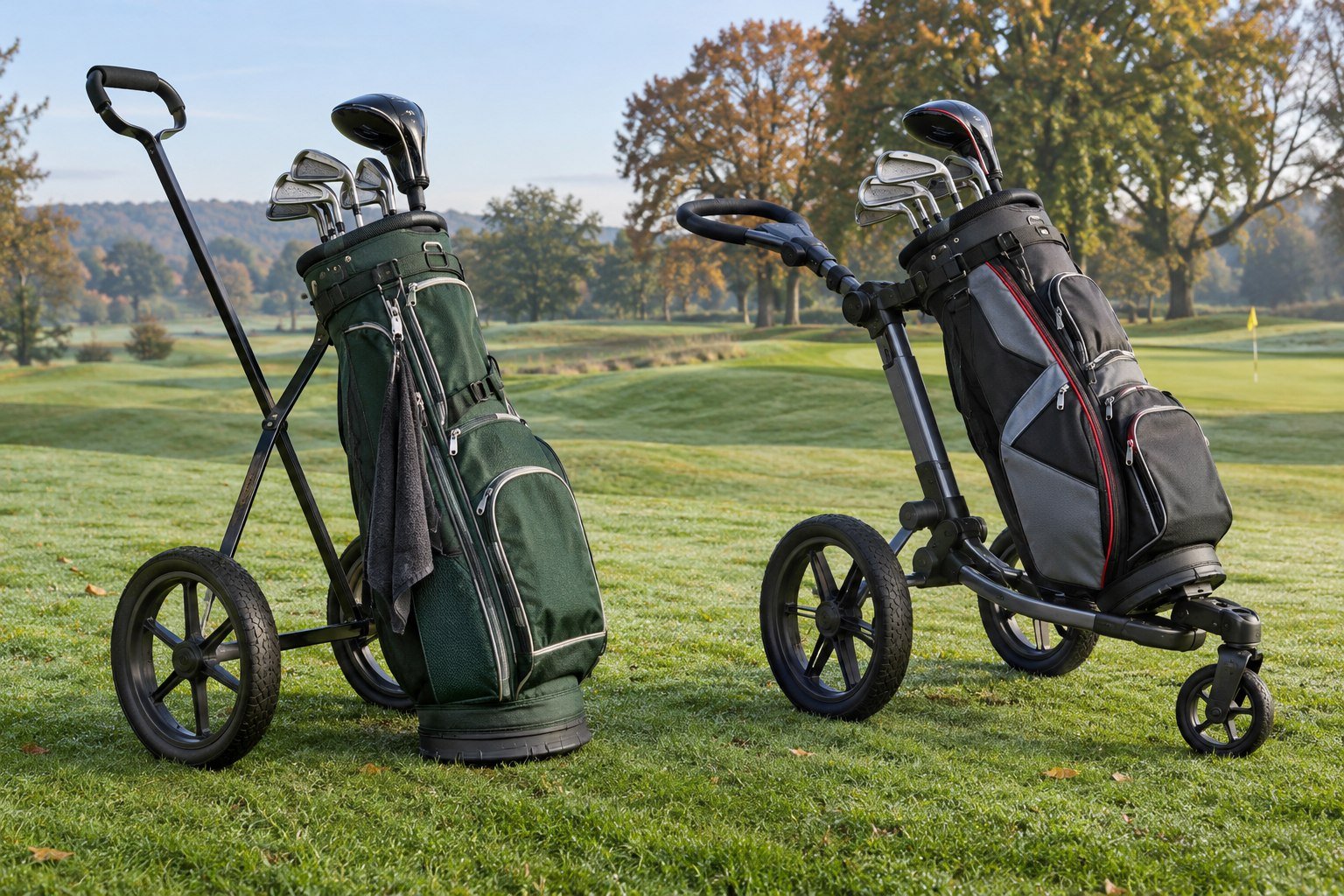
Two wheels usually mean supporting the handle while moving; three wheels support the load on the ground. AI-created category illustrations show generic equipment, not the named products or a product test.
In a comparison of two-wheel vs three-wheel push trolleys, one important distinction is easy to miss: two-wheel golf trolleys are commonly designed to be pulled, while three-wheel designs are commonly pushed. Decathlon uses that distinction in its buying guide. Follow the intended use of the exact model; the two layouts are not simply the same push trolley with one wheel removed. [1]
For a full bag and regular walking rounds, start by trying a suitable three-wheel push trolley. A lightweight two-wheel model can still make sense for an appropriate smaller load and simple transport. The decision turns on what your hand has to do, how the bag is supported and whether the folded frame suits your car.
This guide contains affiliate links. If you buy through them, Taylor’s Trailblazing Golf may receive a commission at no extra cost to you.
A two-wheel pull trolley should be judged by how it is intended to be used.
Some small two-wheel models are intended for a half set, not a fully loaded bag.
A fixed front wheel and a swivelling front wheel behave differently within the three-wheel category.
A parking brake is a specific feature; more wheels do not replace one.
Two-wheel vs three-wheel push trolleys: what changes?
In a typical two-wheel pull design, you tilt the trolley to roll it and keep the load balanced through the handle. A conventional three-wheel push frame gives the bag a third rolling support at the front. These are basic mechanical differences, not measured effort or stability results.
Scroll the table horizontally on a small screen to see every column.
| Task | Typical two-wheel pull design | Typical three-wheel push design |
|---|---|---|
| Starting and stopping | Lift/tilt into the rolling position, then return it to its intended resting position. | Push from its supported position; check how the parking brake works. |
| Keeping the bag balanced | Notice the force at your hand with your normal load. | Check that the bag sits securely between the supports without rotating. |
| Making a turn | Steer the tilted frame while keeping control of the load. | Try the actual front-wheel design; fixed and swivelling designs differ. |
| Passing a narrow opening | Check the widest part of the wheels and bag. | Do the same: three wheels do not tell you the actual width. |
| Putting it in the car | Compare folded length, removable wheels and carrying points. | A folding front wheel can help, but the complete folded shape decides fit. |
| Choosing for uneven ground | Do not assume a light frame suits every load or surface. | Do not assume a third wheel prevents tipping or sliding. |
A trolley that suits your walking pace on a shop floor may feel different with your full bag and on the paths you use. Ask for a permitted, controlled demonstration rather than trying to discover its tipping point on a slope.
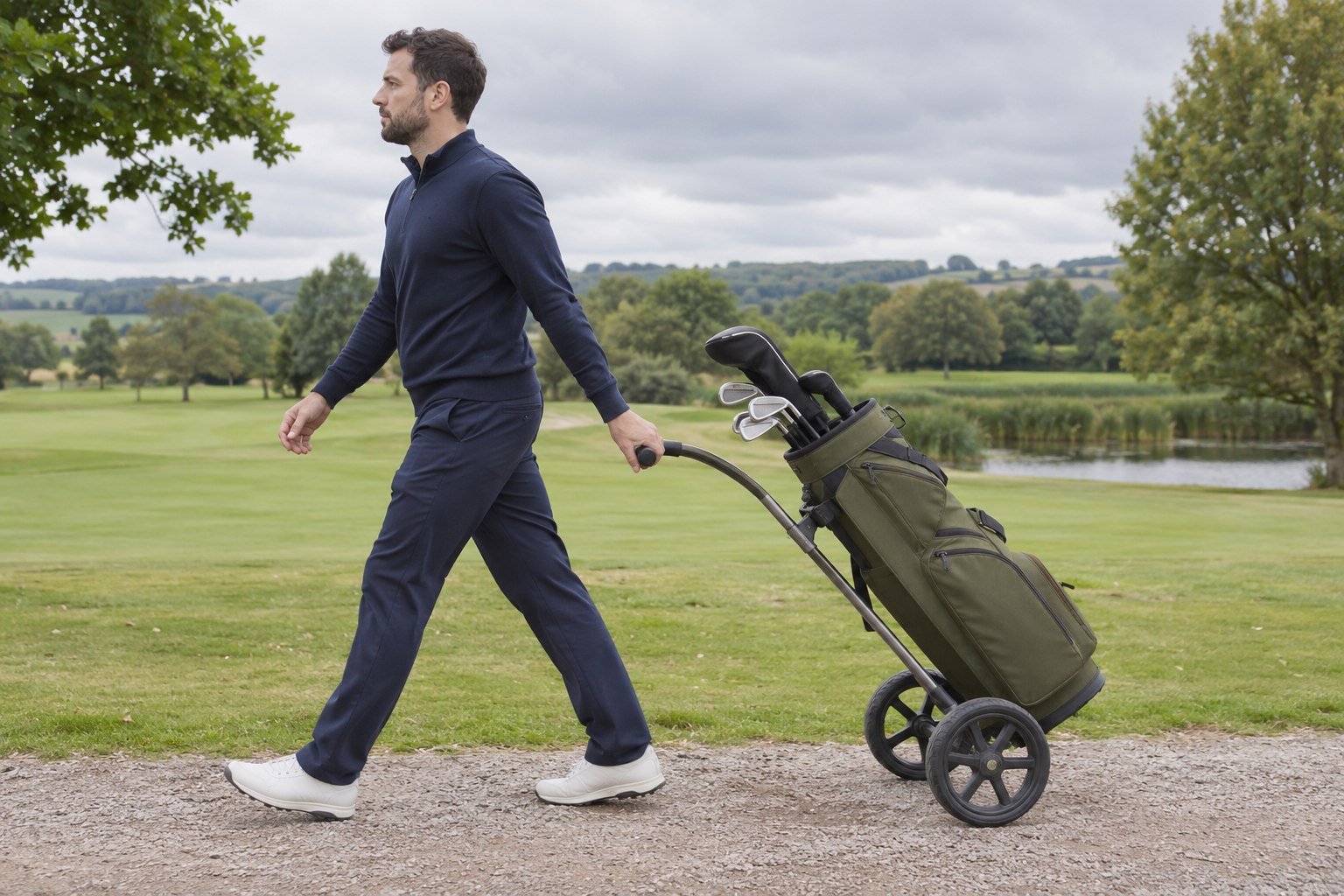
Read the model limits before judging the layout
These three documented examples show why “two wheels or three?” is only the first filter. They are illustrative reference models, not a ranked product test. Prices shown were observed on 23 November 2026 and can change.
Scroll the table horizontally on a small screen to see every column.
| Exact example | Documented detail | Buying implication |
|---|---|---|
| Inesis 100 two-wheel, product 8920549 | About 2.6 kg; £49.99. The listing specifies a half set and says it is not suitable for a full set. [2] | Do not choose it as a cheap substitute for a trolley intended to carry your full load. |
| Inesis 500 three-wheel, product 8920550 | 6.7 kg; £84.99. The listing identifies adult-bag compatibility and a foot brake. [3] | Try your actual bag, handle position and boot fit instead of assuming “adult bag” settles every fit question. |
| Motocaddy QB2 three-wheel, Graphite/Charcoal | Adjustable handle and foot parking brake; Clubhouse Golf displayed £179. [4] [5] | Worth comparing when adjustable handle position and the folding routine matter to you. |
The lighter two-wheel example and heavier three-wheel examples are not proof that every two-wheel trolley is lighter than every three-wheel trolley. They also carry different design limitations. Compare models you can actually use with the same intended bag, not whichever two product cards produce the neatest price gap.
If a seller gives a load limit or a restriction on bag type, treat that as a condition of the shortlist. Do not compensate by tightening straps harder or removing a structural support.
Back to guide contents ↑A third wheel does not settle the turning question
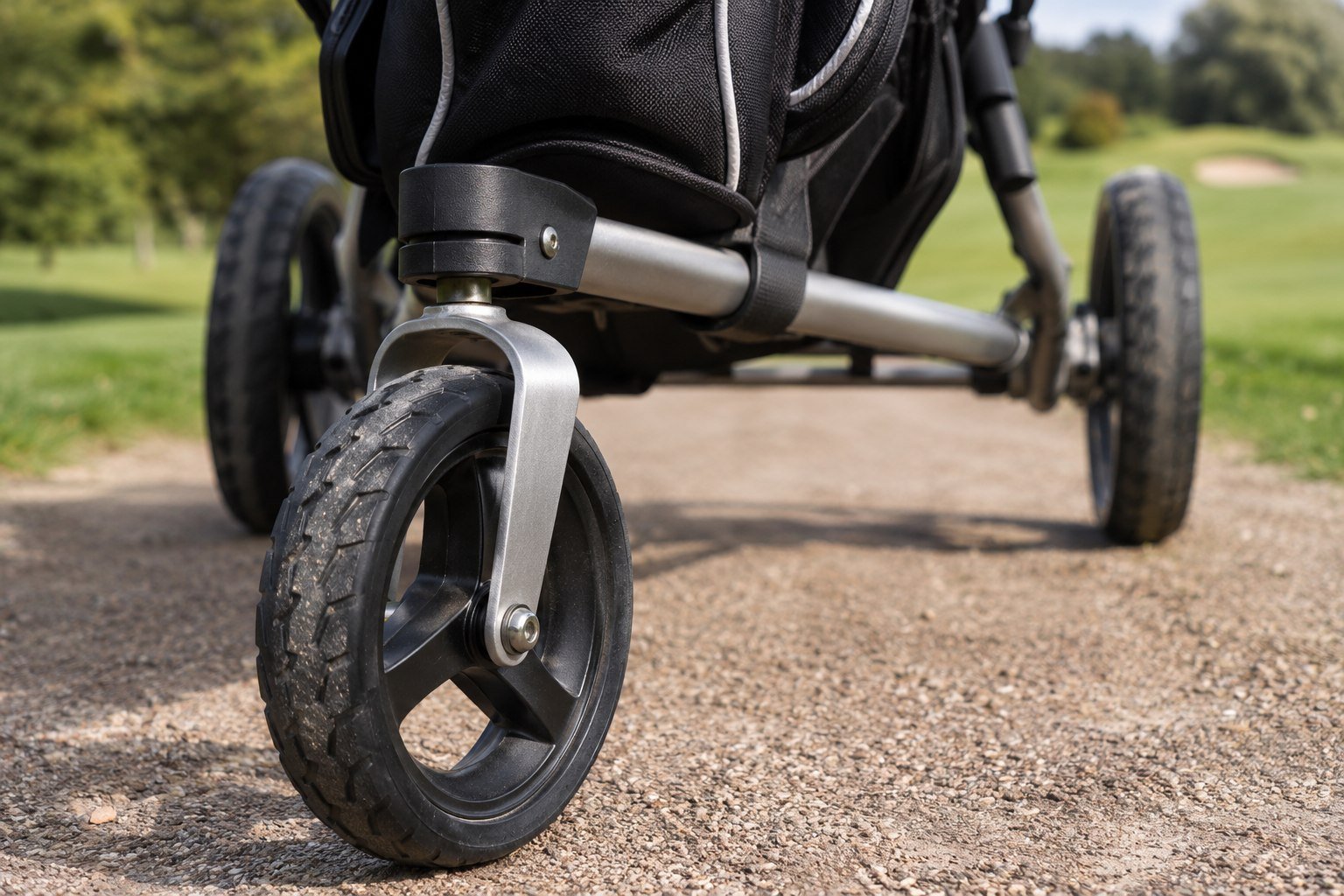
Watch the front wheel during a demonstration. A fixed wheel points ahead with the frame; a swivelling wheel can change direction around its own mounting. Which feels more useful depends on the particular trolley, your load and how often you turn tightly.
For a concrete example, Decathlon’s Inesis 900 360° listing specifies a swivelling front wheel. That is a different feature from simply having three wheels. Do not assume it is present on every three-wheel option, or that a swivel automatically includes a lock. [6]
Ask the demonstrator to show ordinary left and right turns on level ground and the manufacturer’s method for tighter changes of direction. Notice whether you are forcing the handle sideways, the bag shifts, or your feet catch the frame. If the trolley has a wheel lock or tracking adjustment, have its purpose explained before operating it.
A tracking adjustment corrects a trolley’s tendency to run off line; it is not a substitute for a steering mechanism. Avoid buying a frame that needs constant correction during a straightforward loaded demonstration, and do not improvise adjustments beyond its instructions.
Back to guide contents ↑Judge parking separately from rolling stability
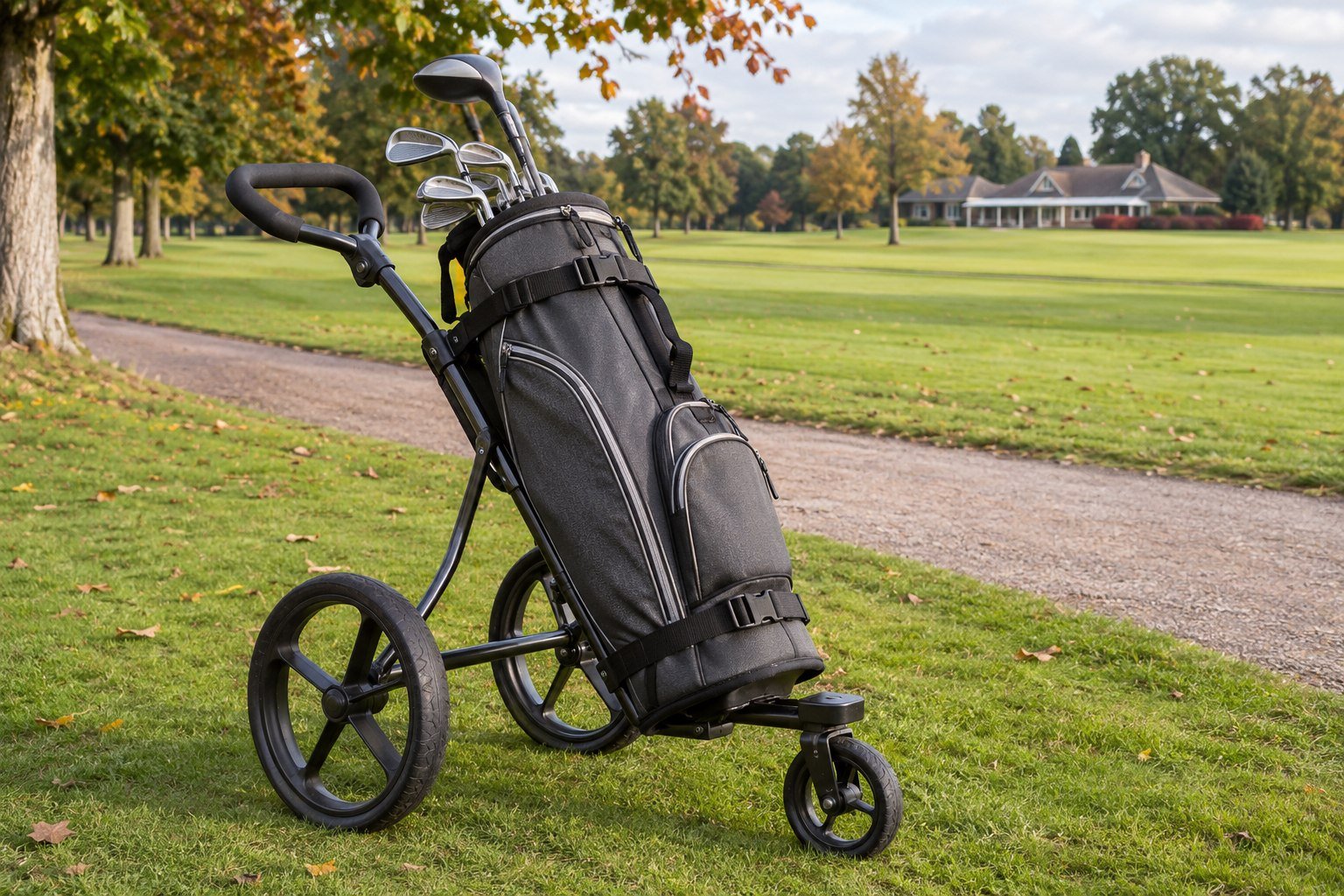
There are three different questions: does the bag remain secure, does the frame remain supported and does the trolley stay where you park it? A third wheel answers none of them automatically.
With permission, inspect the fully assembled trolley on a flat, suitable surface. Confirm that the bag base is seated, the supports and straps follow the instructions, and the wheels are properly fitted. Ask the seller to show the parking procedure. You should be able to operate it without struggling to reach a pedal or lever.
The QB2 manual specifically warns owners to stop the trolley before applying its foot parking brake. Treat that as a parking device, not a way to slow the moving trolley. The correct operation of other models must come from their own instructions. [7]
Avoid the slope-test trap
Do not release a loaded trolley on a slope to see whether it holds, and do not deliberately lean it until a wheel lifts. Those experiments can damage equipment or let it roll away. A controlled demonstration and the manufacturer’s limits are more useful than a dramatic tipping-angle claim.
Bag layout matters as well. Loose heavy items that shift, a poorly seated base or an umbrella catching the wind can change how the complete system behaves. Pack sensibly and follow the trolley’s accessory instructions; an extra wheel does not excuse an unstable load.
Back to guide contents ↑Compare the folded shape, not the unfolded photograph

Before leaving home, note the usable boot opening, the space beside your golf bag and the route to where you store the trolley. A long slender fold and a shorter block-shaped fold can create very different problems even when both are described as compact.
- Check the complete folded dimensions, including whichever wheels and accessories remain fitted.
- Ask whether a folded lock prevents the frame opening during the lift.
- Try the approved carrying point at your real loading height.
- Allow somewhere for wet wheels without enclosing damp equipment indefinitely.
- Decide whether removing wheels after every round is an acceptable task.
Bring the bag and, if possible, the car to the demonstration. A small paper rectangle can help you compare floor space, but it cannot establish that the trolley clears the boot opening or can be lifted comfortably.
Make cleaning and parts support part of the same conversation. Can you obtain the correct wheel, strap or brake component for the exact model? An inexpensive purchase is less attractive if a small, serviceable part becomes impossible to replace.
Back to guide contents ↑Use a simple pass-or-fail shortlist
Do not turn a failed essential requirement into a few lost points on a scorecard. Use this order to eliminate unsuitable trolleys before comparing nice-to-have features.
Scroll the table horizontally on a small screen to see every column.
| Check | Pass looks like | Reason to pause |
|---|---|---|
| Approved load and bag fit | The exact model is intended for your load, with the base and straps fitted correctly. | A half-set restriction, unsupported bag base or interference with stand legs. |
| Loaded handling | Normal starts, stops and turns are manageable during a permitted demonstration. | Uncomfortable balancing, repeated steering corrections or a shifting bag. |
| Parking method | You understand and can operate the intended parking arrangement. | A brake that does not work correctly or instructions the seller cannot explain. |
| Transport and storage | The folded trolley fits and can be lifted at the places you use. | Only just fitting an empty boot, awkward carrying points or inaccessible storage. |
Then compare price, pockets, holders and appearance. If two options pass the essentials, choose the one that is easier to live with rather than paying for a wheel-count label.
If an adjustable three-wheel option makes your shortlist, view the Motocaddy QB2 at Clubhouse Golf. The verified listing is useful for checking the exact version and included items; settle the folded fit in person because the manufacturer and retailer dimensions differed during research. [4] [5]
Back to guide contents ↑When each design makes sense
A suitable two-wheel pull trolley makes sense when your approved load is modest, the balancing action feels manageable and simple transport is a priority. Keep a working one if it already meets those needs; buying a third wheel for its own sake adds little.
A suitable three-wheel push trolley is the more natural starting point for someone who wants the bag supported throughout normal pushing, carries a full adult setup and values a clearly usable parking brake. Compare the front-wheel behaviour and fold between models, because the differences within this group can be substantial.
The final choice should survive all four checks: intended load, loaded handling, parking and transport. If either option fails one of those, try another model before deciding that its entire wheel category is wrong for you.
Browse the Trolleys & Course Accessories section for other parts of the bag-and-trolley decision.
Back to guide contents ↑Sources
- Decathlon UK — Golf trolley comparison guide
Used for the common pull-versus-push distinction only; its generalised handling claims are not treated as independent testing. Checked 23 November 2026. - Decathlon UK — Inesis 100 half-set two-wheel trolley
Product 8920549; approximately 2.6 kg, £49.99 and explicit half-set-only restriction. Checked 23 November 2026. - Decathlon UK — Inesis 500 three-wheel trolley
Product 8920550; 6.7 kg, £84.99, adult-bag compatibility and foot brake. No adjustable-handle claim is inferred. Checked 23 November 2026. - Motocaddy UK — QB2 Push Trolley
Adjustable handle and foot parking brake; folded dimensions conflict with the retailer listing and are not quoted as settled. Checked 23 November 2026. - Clubhouse Golf — Motocaddy QB2, Graphite/Charcoal
Verified UK product listing and observed £179 price. Product fit and future stock are not guaranteed. Checked 23 November 2026. - Decathlon UK — Inesis 900 360° three-wheel trolley
Example of an explicitly specified swivelling front wheel; no unverified locking feature is claimed. Checked 23 November 2026. - Motocaddy — QB2 Push Cart instruction manual
Parking brake must be applied only after the trolley stops. Checked 23 November 2026.
Illustrations in this article were created for Taylor’s Trailblazing Golf. Third-party photographs, where used, are credited beside the image or in the source list.