Push Golf Trolley vs Electric Trolley: Costs, Storage and Walking
Weigh the easier walk against the full bill, the car-boot lift and the routine at home.
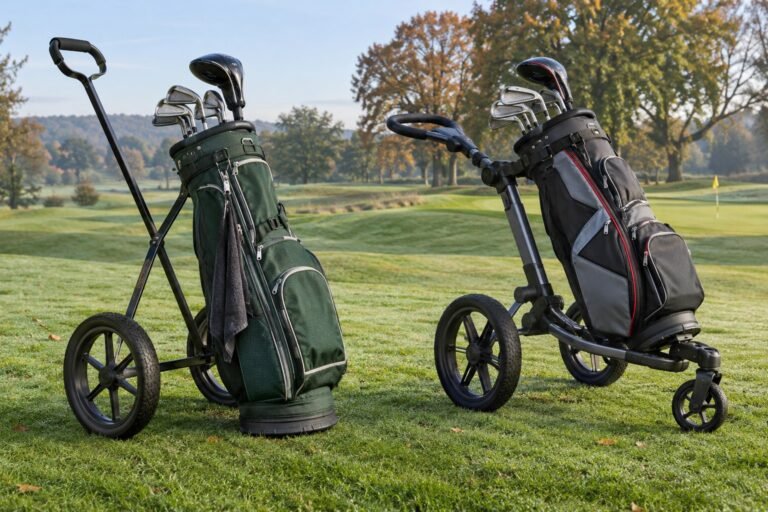
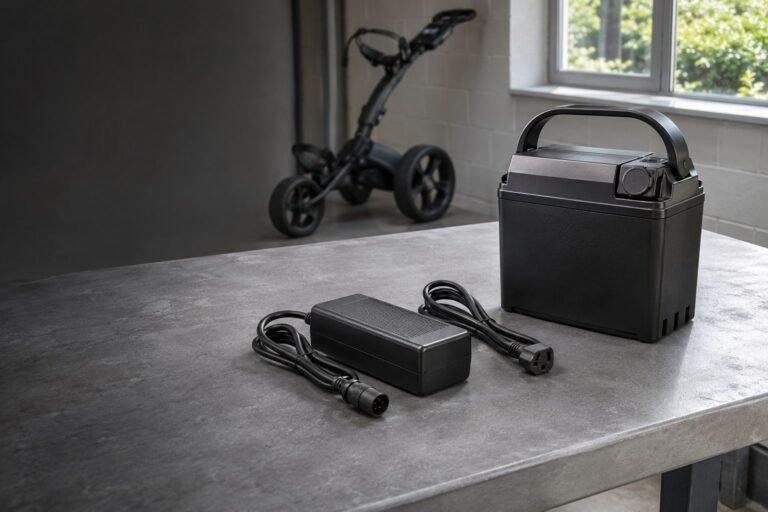
A powered trolley changes propulsion; bag fit, loading and storage still matter. AI-created category illustrations show generic equipment, not the named products or a product test.
A motor can move the bag for you, but you still have to get the trolley out of the house, lift it into the car and organise its battery. That makes the right choice surprisingly personal: the easiest option on the fairway may be the most awkward one on your stairs.
This push golf trolley vs electric trolley comparison starts with the whole routine. It uses documented features and dated UK price examples, followed by a cost worksheet you can adapt. It is a research-led guide; no on-course effort, endurance or durability testing is claimed.
This guide contains affiliate links. If you buy through them, Taylor’s Trailblazing Golf may receive a commission at no extra cost to you.
Purchase, useful accessories, upkeep and a battery contingency belong in the same comparison.
Try the folded frame at your actual boot height; a headline weight cannot show how it handles.
Speed control, downhill control and a parking brake are separate features.
If your present push trolley does the job well, electric is an optional convenience upgrade.
Push golf trolley vs electric trolley: the everyday differences
A manual push trolley relies on you to move it. A conventional electric trolley supplies propulsion while you remain responsible for direction, speed changes and safe use. Remote steering and follow functions are further choices, not standard features of every powered model.
Scroll the table horizontally on a small screen to see every column.
| Decision | Push trolley | Conventional electric trolley |
|---|---|---|
| Moving the loaded bag | You supply the pushing effort and control its movement. | The motor supplies propulsion; you still supervise and steer. |
| Going downhill | You need to keep the trolley under control; do not assume its parking brake is a moving brake. | Check the exact downhill-control specification. A powered model may lack this function. |
| Getting ready | Inspect the frame, wheels, brake and bag attachment. | The same checks, plus the approved battery, charge level and connections. |
| Car and home storage | Compare the folded shape and approved carrying points. | Allow for the frame, battery and safe charging/storage arrangements. |
| Running costs | Wear parts and repairs remain possible. | Allow for mechanical and electrical support as well as eventual battery replacement. |
| A fault during the round | A damaged wheel or brake can still end the trolley’s usefulness. | Check the manual’s procedure if power fails; pushing without power is not automatically straightforward. |
The braking distinction matters. Motocaddy’s QB2 manual says its parking brake should be applied only once the trolley has stopped. Its 2026 M1/M1 DHC manual identifies automatic downhill speed control and an electronic parking brake specifically for the DHC version. These examples establish features of those models, not universal rules for every brand. [1] [2]
Back to guide contents ↑Put a price on three years of ownership
For two concrete reference points, the Clubhouse Golf pages checked on 23 November 2026 displayed £179 for the Motocaddy QB2 in Graphite/Charcoal and £749 for the Motocaddy M1 with an 18-hole lithium battery. That is a £570 purchase-price difference. These are dated listing prices, not a promise of continued price or stock; confirm the exact battery, charger, delivery and other inclusions before paying. [3] [4]
The worksheet below uses those two observed prices, then adds clearly stated planning allowances. It assumes 40 rounds a year for three years: 120 rounds altogether. The allowances are our illustrative inputs, not retailer quotations or predictions of when components will fail.
Scroll the table horizontally on a small screen to see every column.
| Cost item | Push example | Electric example |
|---|---|---|
| Observed purchase price | £179 | £749 |
| Useful accessories — assumed | £40 | £50 |
| Maintenance/repair reserve — assumed | £45 | £150 |
| Charging electricity — assumed total | £0 | £18 |
| Three-year planning budget | £264 | £967 |
| Budget divided by 120 rounds | £2.20 per round | £8.06 per round |
On these inputs, electric costs £703 more over three years, or about £5.86 more per round. This calculation excludes finance, insurance and resale proceeds; it also assumes no replacement battery is purchased during that period. Add your actual costs if any apply. Any unused reserve remains yours; actual spending could be lower or higher.
Keep the battery contingency separate
If you set aside an extra £250 as an illustrative battery contingency, the electric total becomes £1,217. That is £10.14 per round over 120 rounds. The £250 is not a quote or an expected three-year replacement schedule: obtain the price of the battery approved for the exact trolley, then decide what reserve suits your circumstances.
Playing frequency changes the value of the initial premium. Spread the £570 purchase difference across 60 rounds and it is £9.50 per round; across 120 rounds, £4.75; across 240 rounds, about £2.38. Those figures deliberately exclude running costs and show only how often you would use the extra purchase spend.
Compare with hiring, too. Ask your club what an electric hire trolley actually costs, whether availability is guaranteed and what happens when the course restricts trolley use. Occasional hire can be a useful way to test the benefit before committing.
Back to guide contents ↑Check the boot, the lift and the route into the house
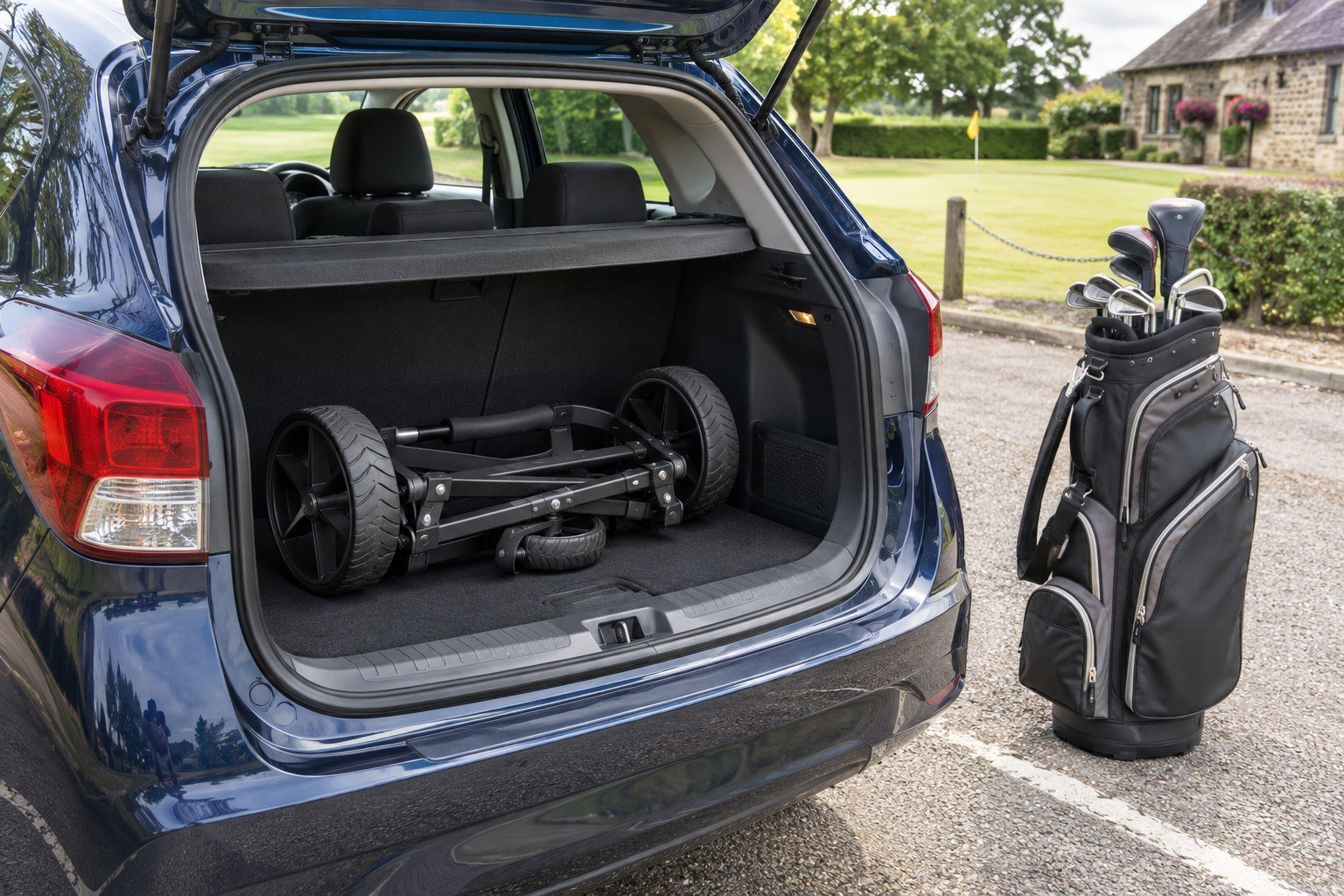
A trolley that technically fits in the boot may leave no sensible place for your golf bag, shoes or another passenger’s clubs. Make the comparison with your normal golf-day load, not an empty vehicle.
- Measure the opening as well as the boot floor. Wheel housings, the parcel shelf and a raised boot lip can matter more than the widest internal dimension.
- Ask what the quoted folded dimensions include: wheels, handles, accessories and battery can change the answer.
- Try the lift using the manufacturer’s intended carrying points. Notice where the weight sits and whether a folded joint can move.
- Repeat the practical check for the cupboard, garage doorway or stairs at home. Include somewhere appropriate for the battery, rather than assuming it can remain wherever the frame is stored.
Do not buy from a single “compact” claim. Ask the retailer to demonstrate the fold on the exact version you intend to order. If you must remove muddy wheels every time, decide whether that is an acceptable part of your routine.
For example, Motocaddy’s QB2 instructions tell owners to remove fitted accessories before folding and identify the handle or upper bag support as carrying points when folded. That is useful model-specific information; it is not permission to lift a different trolley by any convenient tube. [1]
Back to guide contents ↑Think about the walk you actually play
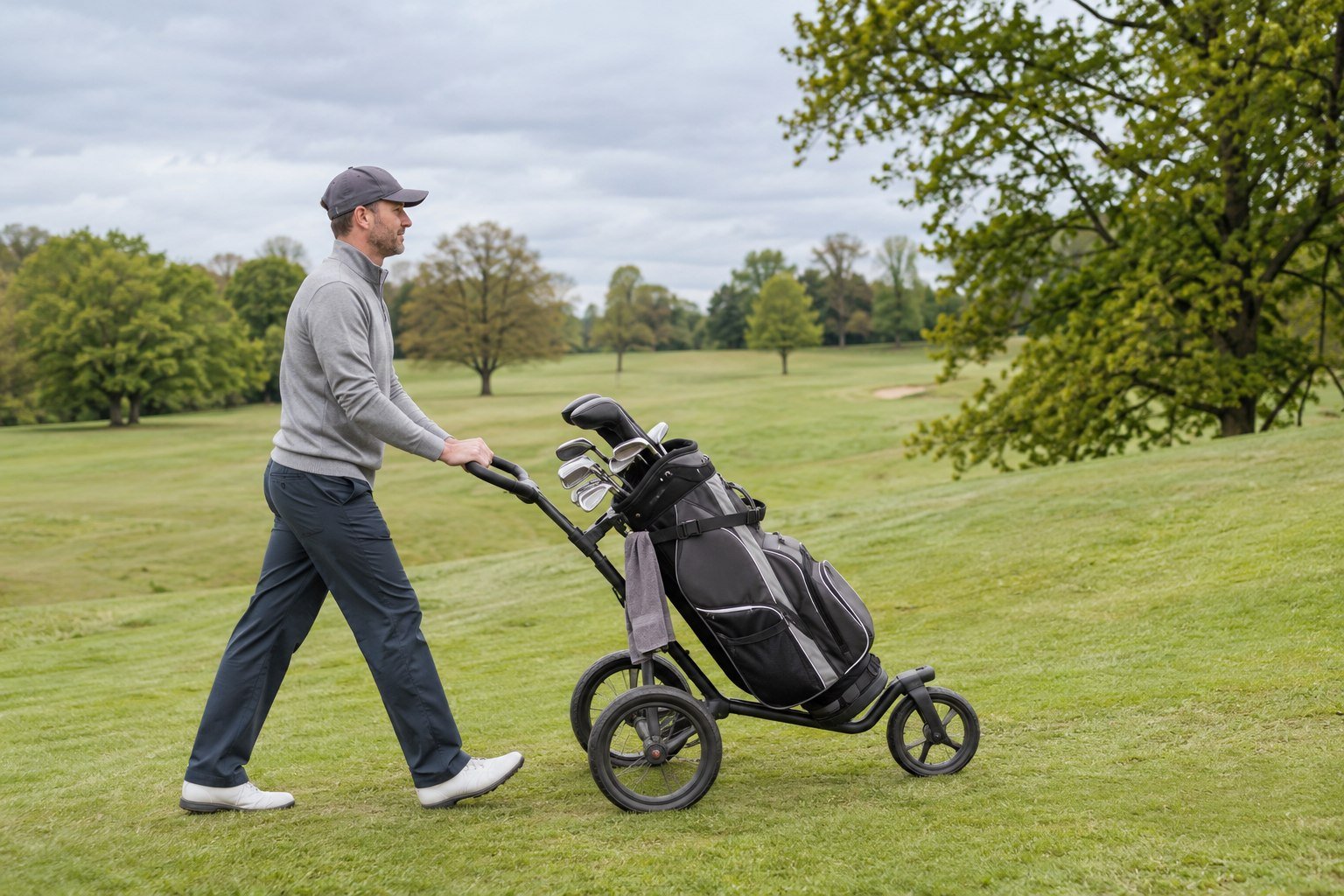
Ask what you want to change. Is it pushing uphill, keeping the bag moving through soft ground, steering around a narrow course, or simply avoiding a tiring push late in the round? “I want an electric trolley” is less useful than naming the part of the day that feels awkward.
Arrange a demonstration with a realistic bag load and permission to use a suitable area. Start on level ground, learn the controls and stop before trying anything more demanding. You should be able to reach the handle comfortably, make ordinary turns and stop where you intend without the bag rotating in its supports.
For a course with descents, ask the seller to demonstrate the exact downhill-control and parking functions according to the manual. Do not infer these from a motor rating, a speed dial or the word “electric”. Follow the course’s paths and restrictions; no extra feature makes an unsuitable slope or a hazard edge safe.
A powered trolley is still equipment you need to control. It does not establish a health benefit, guarantee that a round will feel easier overall or make a particular model suitable for every golfer. If the loading and control tasks are difficult, resolve those before spending more on features.
Back to guide contents ↑Decide whether the charging routine fits your home
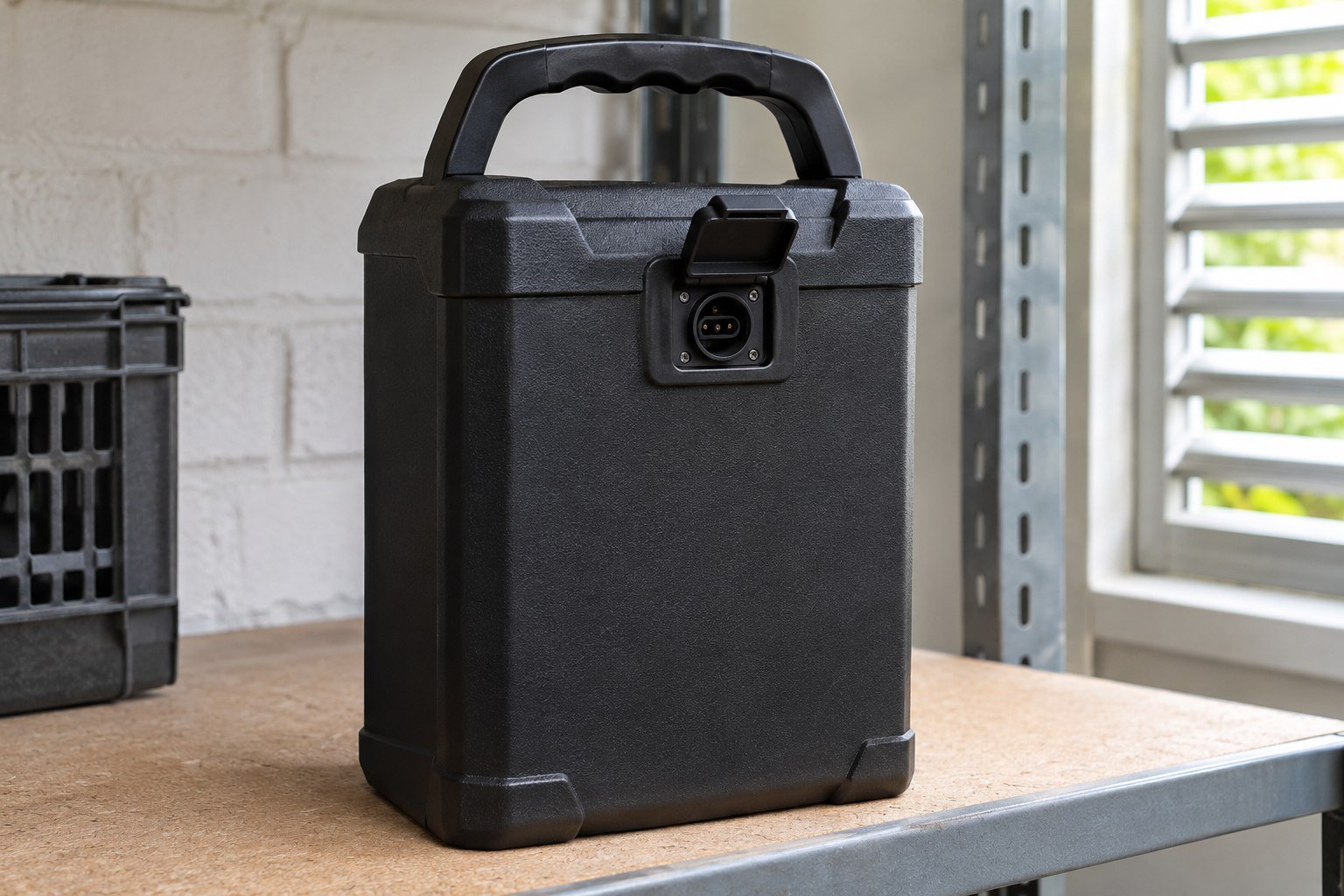
A push trolley is ready without a charged battery. Electric ownership adds a small but important household routine: bring the right components home, check their condition, charge as instructed and store them correctly between rounds.
For the 2026 M1/M1 DHC, Motocaddy specifies an appropriate matched battery and charger, a dry non-carpeted charging/storage surface and a 10–30°C temperature range. It warns against overnight or prolonged unsupervised charging and says suspected battery damage needs support advice before charging or use. Those are instructions for that system; follow your own model’s current manual, including its long-storage procedure. [2]
- Identify the model and battery before buying a replacement or spare charger.
- Choose a suitable charging position you can realistically use after golf.
- Check the routine for weeks when you do not play.
- Keep the manufacturer’s support details and purchase information accessible.
Capacity claims need the same care. If you regularly play two rounds, read our guide to the conditions behind 36-hole trolley battery claims before choosing a battery option.
Back to guide contents ↑Keep your existing bag if it fits properly
Put the bag you already own on the candidate trolley before assuming you need a new one. Fill it as you normally would, close the supports correctly and check that the base sits securely, the straps avoid crushing pockets and the stand mechanism does not interfere with the frame.
Reach for your putter, water bottle and waterproofs while the bag is secured. A technically compatible setup can still be irritating if you have to unstrap it for a frequently used pocket. Remove unnecessary load before treating a larger trolley as the answer.
The QB2 lists adjustable bag supports and Motocaddy’s EASILOCK connection. Treat an attachment system as a specific compatibility feature: check its instructions with your bag rather than assuming the brand name means every bag fits identically. [5]
Only price the accessories you will use. An umbrella holder, cover or drinks holder can change the total, but an included accessory is not a saving if you would not otherwise buy it. Ask which mounts or adaptors the exact trolley requires.
Back to guide contents ↑Use two reference options to ask better buying questions
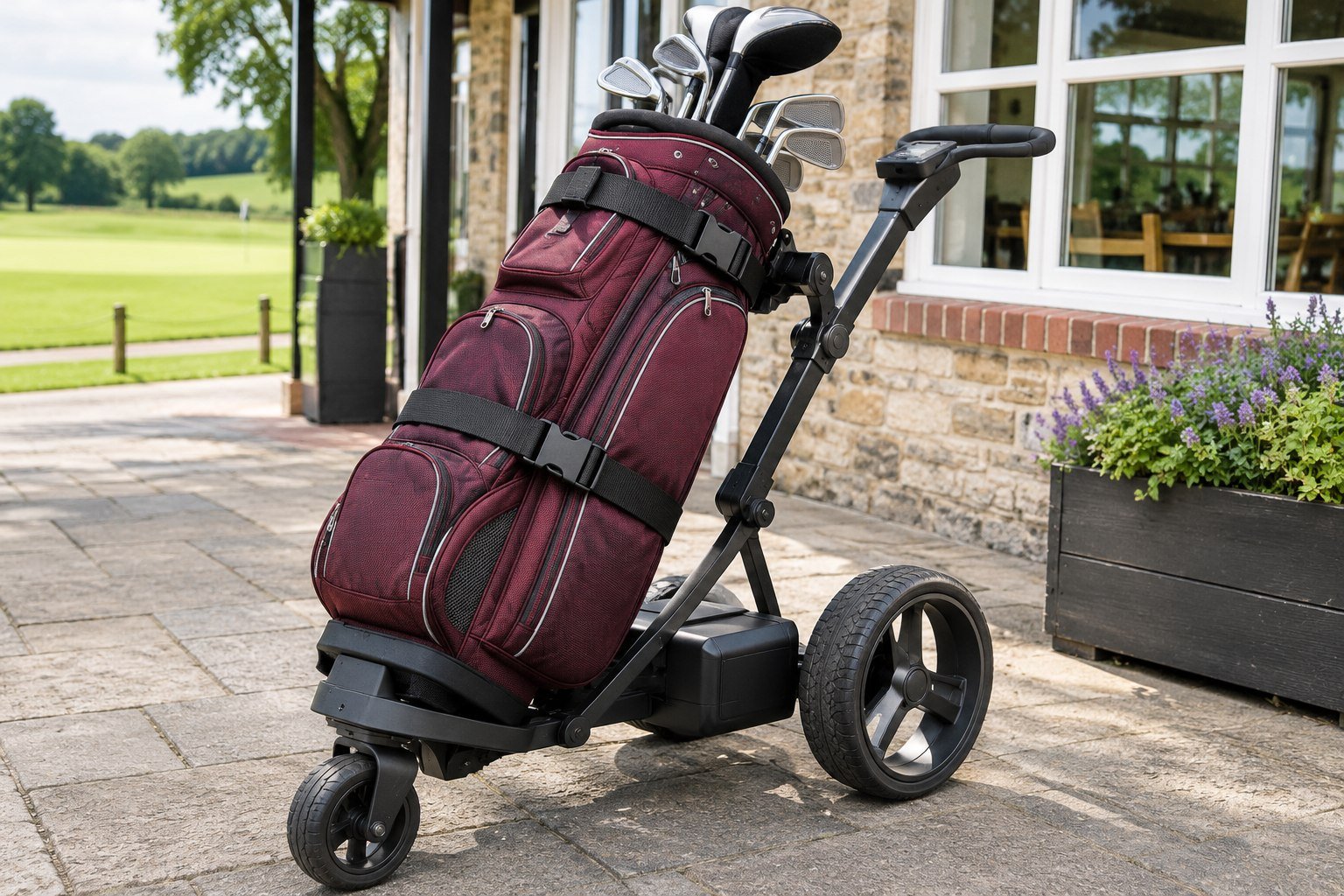
These examples illustrate the buying decision. They are not a ranked test, and no claim is made that either is the best trolley for your course.
Motocaddy QB2: a manual starting point
Consider this three-wheel push option if you want to compare an adjustable handle, a foot parking brake and a compact folding routine without taking on battery care. Check the actual folded size: the manufacturer and retailer dimensions displayed during research differed, so a physical demonstration is the sensible way to settle fit. [3] [5]
View the QB2 at Clubhouse Golf
Motocaddy M1 with 18-hole lithium battery: a powered starting point
Consider the listed M1 package if propulsion is the feature you need. Confirm the model generation, battery and charger supplied, and whether you need the separate DHC version. Do not treat the standard M1 listing as if it includes DHC braking. [2] [4]
Check the M1 battery package at Clubhouse Golf
Back to guide contents ↑Choose the option that removes your real difficulty
For occasional golf, straightforward storage and a loaded bag you are happy to push, manual is the sensible place to start. Spend on a secure fit, a usable brake and a fold you can manage before adding elaborate accessories.
Electric becomes more persuasive when you play often and propulsion solves a repeated problem. The case is strongest when you have also confirmed manageable lifting, suitable storage and charging, the right downhill behaviour and support for the exact battery and trolley.
If you already have a serviceable push trolley, keep it while you arrange an electric demonstration or hire. The useful question is whether the change improves your complete golf day enough to justify the full cost. A more expensive trolley that leaves the awkward parts untouched is easy to postpone.
For related equipment decisions, browse our trolleys and course accessories guides.
Back to guide contents ↑Sources
- Motocaddy — QB2 Push Cart instruction manual
Parking-brake use, folding and approved carrying points; manufacturer instructions. Checked 23 November 2026. - Motocaddy — 2026 M1 / M1 DHC instruction manual
Battery-care requirements and DHC-only downhill control/parking brake, especially pages 6–7 and 23. Checked 23 November 2026. - Clubhouse Golf — Motocaddy QB2, Graphite/Charcoal
Exact UK product listing and displayed £179 price; listed dimensions differ from the manufacturer page. Checked 23 November 2026. - Clubhouse Golf — Motocaddy M1, 18-hole lithium battery
Exact UK battery-package listing and displayed £749 price. Future price, stock and model-generation confirmation remain purchase-time checks. Checked 23 November 2026. - Motocaddy UK — QB2 Push Trolley
Adjustable supports, handle, brake and folding features. Conflicting folded dimensions are not treated as resolved. Checked 23 November 2026.
Illustrations in this article were created for Taylor’s Trailblazing Golf. Third-party photographs, where used, are credited beside the image or in the source list.