Full Golf Bag Rain Covers: Whole-Bag Protection vs Rain Hood
The useful upgrade is the cover that protects the exposed part of your bag while still letting you play. Start with coverage, then check the loaded bag on your own trolley.
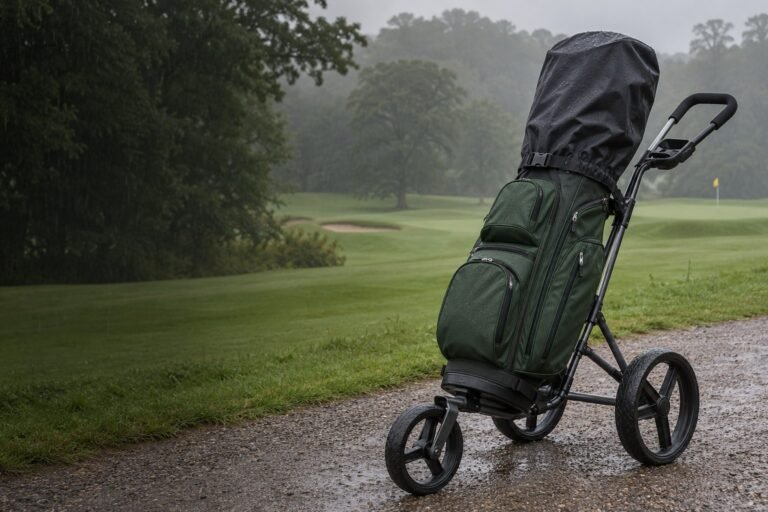
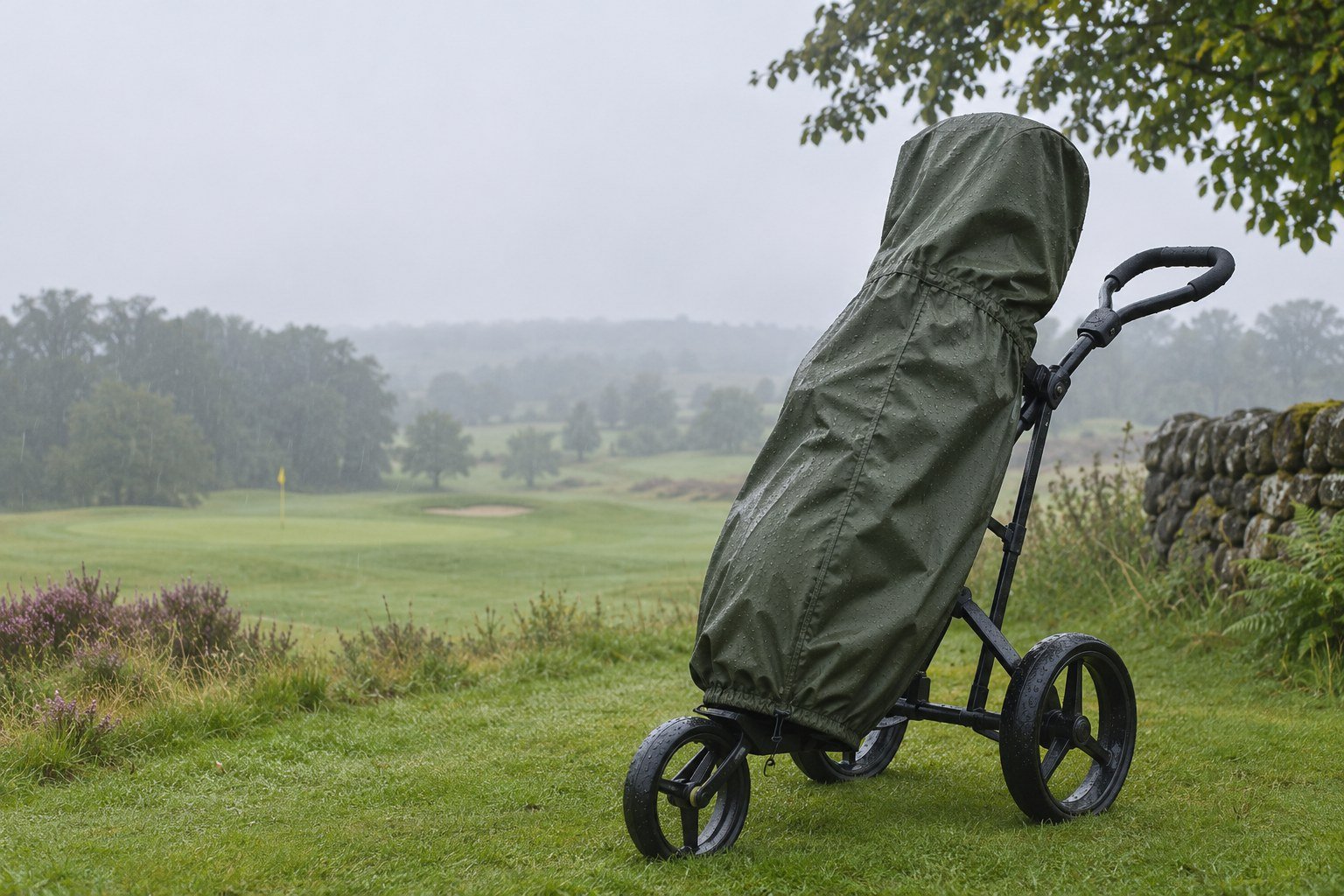
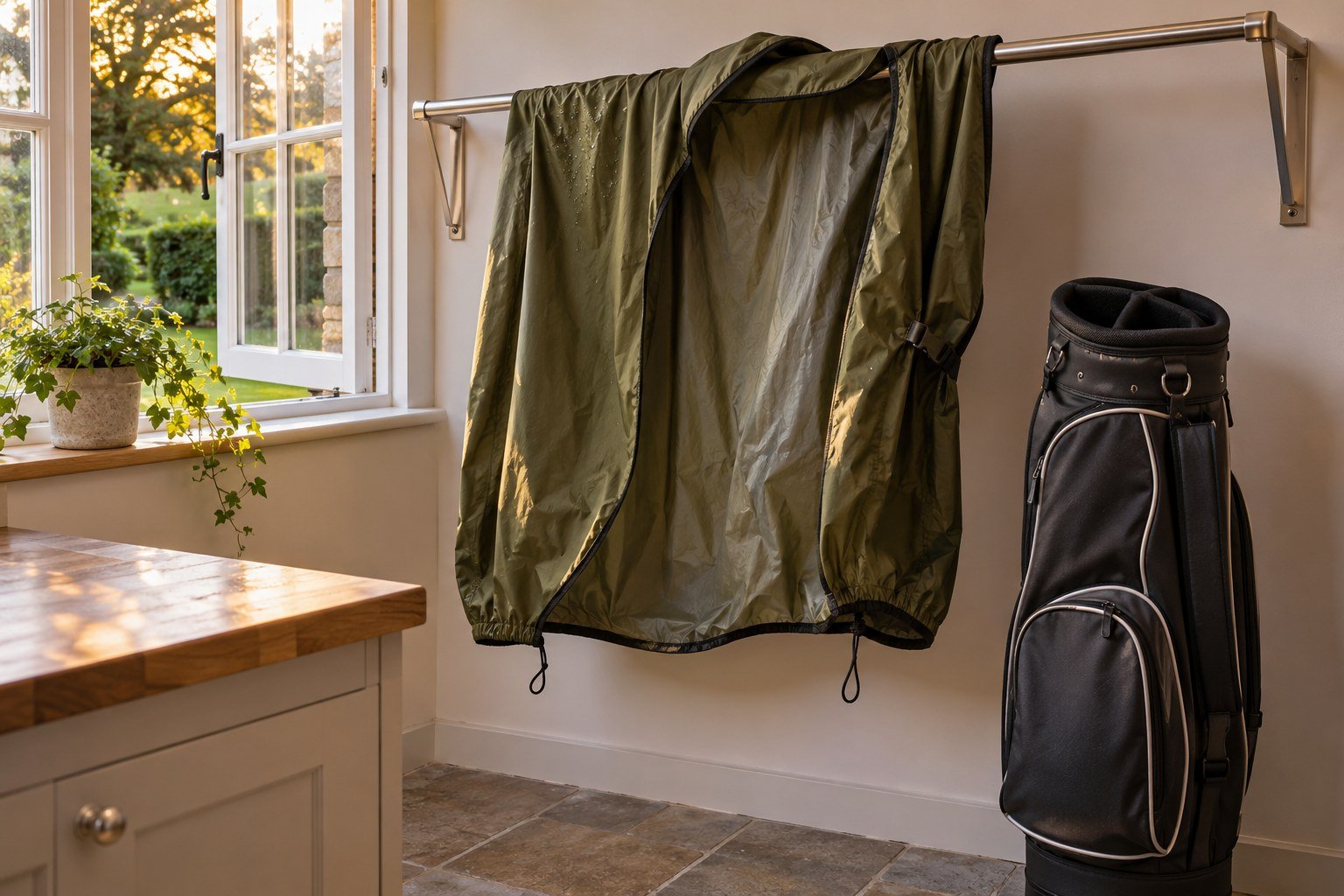
AI illustration of a generic full-cover setup, not a tested product or a named course.
A hood and a full cover can look similar in a small product photograph. Their useful difference is where they finish. A hood sits over the club opening; a full cover extends down around the bag. If the water problem is a side pocket, another hood may leave the problem exactly where it was.
This research-led guide compares those jobs, then gives you a dry fitting routine to use before a wet round. Product features below are attributed to their makers or retailers. The fit checks and decision tables are editorial guidance, not results from a rain test.
This is a research-led guide. How we assess golf equipment explains the evidence behind our recommendations.
This guide contains affiliate links. If you buy through them, Taylor’s Trailblazing Golf may earn a commission at no extra cost to you.
A hood protects the opening; a full cover reaches down around the bag.
The driver headcover, putter and full pockets all affect fit.
A covered pocket is useful only if you can reach and close it properly.
Loose fabric must stay away from trolley wheels, brakes and stand legs.
Full golf bag rain covers and hoods do different jobs
Sun Mountain describes its Dry Hood as an accordion-style cover for the top of the bag, with access to the clubs. Callaway’s Performance Dry Waterproof Bag Cover instead has openings for both clubs and side pockets, plus an elasticated lower closure. These are useful examples of the two approaches, rather than evidence that one is always better.[1][2]
| Option | Practical advantage | Compromise to check | Most useful starting point |
|---|---|---|---|
| Bag’s fitted rain hood | Covers the club opening using the bag’s own attachment arrangement. | Does not enclose the lower body or exposed side pockets; access depends on the hood design. | You already own it and your bag body handles the conditions you play in. |
| Separate universal hood | An alternative opening or shape may make club access easier. | Attachment and height still need checking; it remains a top cover. | The original hood is missing, awkward or too cramped around your clubs. |
| Full external rain cover | Adds a sheltering layer around the bag body and club opening. | More closures, possible pocket obstruction, storage bulk and trolley-clearance checks. | The sides and pockets need protection as well as the top. |
| Bag with documented waterproof construction, plus its hood | Weather protection is built into the bag rather than added around it. | A new bag is a larger change; openings, care requirements and exact model claims still matter. | You also need to replace an unsuitable or worn bag. |
Start by identifying what actually gets wet. A soaked scorecard in a side pocket suggests a different weakness from water entering the club dividers. Damp grips can also arrive in the bag on wet clubs. A new outer layer cannot undo water that you have already brought inside.
If your current hood and bag work well, there is no automatic reason to buy a full cover. Conversely, adding a full cover can be a proportionate way to keep using a comfortable bag whose exposed pockets are the weak point. Make that decision before comparing brand names.

Check the loaded shape, not just the empty bag
A cover must fit the equipment as you use it. Fill the usual pockets, put the headcovers on, and place the bag on its normal trolley or stand. Measuring an empty bag leaves out the protrusions most likely to make a cover tight or misalign an opening.
“Universal” is a useful invitation to check compatibility, not a measured clearance. Stewart Golf says its Deluxe Universal Rain Cover is intended for typical club sets, warns that unusually long putters may not suit it, and does not guarantee fit on very large bags.[3] The same questions are sensible for any cover, even when a listing sounds broader.
| Record | How to check it | Why it matters |
|---|---|---|
| Loaded height | Measure from the bag base to the highest club or headcover in its normal position. | The cover must close without pulling down on the clubs. |
| Maximum width and depth | Include filled pockets, handles and any external putter position. | A nominal bag-top size does not describe the whole loaded shape. |
| Pocket opening positions | Note which side holds balls, clothing and valuables, then compare the cover’s openings. | A side zip in the wrong place may still require lifting the cover. |
| Trolley mounting points | Look at the upper support, lower cradle and strap route with the bag secured. | The cover must not compromise the bag’s proper attachment. |
| Lower hem and moving parts | Check clearance from wheels, brake controls and any stand-leg mechanism. | A draped flap must not enter a moving part or prevent normal operation. |
| Packed cover space | Find a reachable place for the cover and its pouch in the normally loaded bag. | A cover buried beneath clothing is harder to fit when rain starts. |
Ask the seller for usable internal dimensions if the listing gives only a folded size or no dimensions. Allow for the actual headcovers and pockets rather than applying an invented universal clearance. Where the cover has a shaped opening, ask whether its position is adjustable.
For a carry bag, verify how the cover works with both straps and deployed legs. A cover that sits neatly over a trolley-mounted bag has not thereby demonstrated that it can be carried safely. Do not cut holes or alter a fitted cover to overcome an uncertain design.
Back to top ↑Rehearse the five actions you need during a round
The practical cost of extra protection is often access. A full cover may require opening one zip to reach another. If that process is awkward, you may leave it partly open and lose much of the benefit you bought it for.
Do this rehearsal indoors or under cover, with the trolley stationary and the bag attached correctly:
- Remove and replace the longest club without dragging its headcover against the cover or lifting the bag out of position.
- Take a ball and tee from their usual pocket, then close both the pocket and outer opening fully.
- Retrieve the rain jacket without emptying other compartments into the rain.
- Reach the valuables pocket without putting a wet outer flap across its open mouth.
- Return everything to its normal position and confirm the cover is secure and clear of the trolley.
Use the same hand and position you would use during play. You are looking for understandable closures and a repeatable sequence, not trying to prove a manufacturer’s fitting-time claim. If you need to remove the cover for a routine item, either move that item to a suitable accessible pocket or choose a different access arrangement.
For an electric trolley, keep the controller, handle and manufacturer-required access clear. A golf bag cover is not automatically an approved weather cover for the trolley, battery or electrical connections.
Read the weather claim at the level of the finished cover
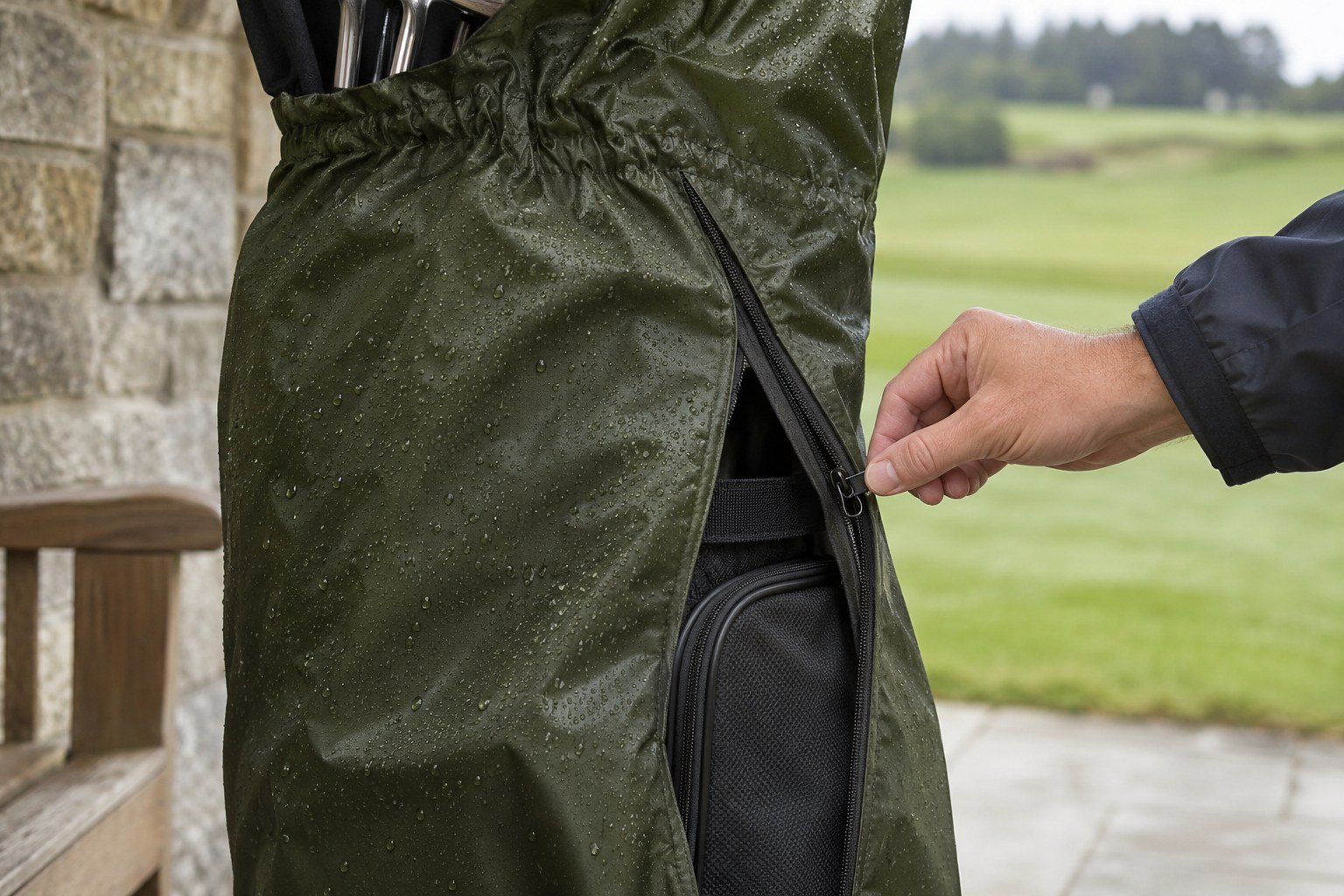
Material, seams, closures and openings form the useful system. A waterproof-fabric description tells you something about the material; it does not tell you whether a particular zip is closed, whether the hem fits your setup or whether water enters while you select a club.
Callaway lists 3k ripstop waterproof fabric, waterproof zips and an elasticated base on the Performance Dry cover. Stewart lists a full-length waterproof zip and two side-pocket openings on its Deluxe Universal model.[2][3] Treat these as documented product features. They do not supply a shared laboratory result that lets this guide rank the covers by hours of rain protection.
Look for an explanation of the complete cover’s intended use, not just a large waterproof number in isolation. Ask about seam construction, the way the main zip finishes, and the position of any access opening. Check whether a maker’s claim depends on a particular fitting method or matching bag.
A cover also has limits after it is fitted. Lifting an opening towards the rain can expose the contents, while putting a wet towel inside adds moisture without any leak at all. Organise wet equipment separately and keep dry essentials in a place you can reach without opening the whole bag.
There is no need to pressure-wash, immerse or deliberately soak a newly purchased cover to investigate those questions. Check the instructions and use an ordinary dry fit first. Unclear claims are a reason to ask the supplier, not to assume a stronger rating.
Back to top ↑Researched examples: compare the access design
These examples illustrate different arrangements. They are not a performance ranking, and no model has been rain-tested for this article. Features were checked on 23 November 2026; confirm the exact version and current buying terms before ordering.
| Model | Documented feature | Decision to make |
|---|---|---|
| Sun Mountain Dry Hood | Accordion-style cover over the bag top with club access.[1] | Does top-only protection solve your problem, and does the attachment suit your bag? |
| Callaway Performance Dry Waterproof Bag Cover | Separate zipped access for clubs and side pockets; elasticated base; carry pouch.[2] | Do its openings line up with the pockets you use on your cart bag? |
| Stewart Golf Deluxe Universal Rain Cover | Main full-length zip and two side-pocket zips; published cautions for very long clubs and very large bags.[3] | Will your loaded setup fit without tension or awkward lifting of the cover? |
| PowaKaddy Rain Cover | External storage pocket and a pouch for storing the cover.[4] | Would accessible external storage reduce repeated opening, and what fit does your bag require? |
| Masters Clear Rain Cape | Wrap-around bag-and-trolley design, hook-and-loop fasteners and a zip at the top, as listed by Clubhouse Golf.[5] | Can you reach lower pockets without disturbing the fit, and where will loose material sit? |
For a cart bag where side-pocket access matters, view the Performance Dry cover at Callaway UK and compare the openings with photographs of your loaded bag. Callaway describes it as fitting all cart bags; still confirm unusual proportions or external accessories before relying on that description.
If a wrap-around cape suits your setup, view the Masters Clear Rain Cape at Clubhouse Golf. The visible difference to assess is its fastening and top-access arrangement, rather than assuming that a clear material means the pockets remain accessible.
For a missing original hood, ask the bag manufacturer about the exact replacement first. A replacement with the right attachments may be the most straightforward solution; buying a whole new bag solely to obtain a hood is rarely the first question to resolve.
Back to top ↑Choose around the round you actually play
Your carrying method and frequency of wet play change the value of an extra layer. Use the following as a decision guide, not a weather forecast or a promise of protection.
| Your situation | Sensible starting choice | Reason to reconsider |
|---|---|---|
| You mostly carry and can choose dry days | Try the existing fitted hood and keep essentials separately protected. | Upgrade only if a recurring exposure problem justifies the extra bulk and strap/leg complications. |
| You use a trolley and regularly play through rain | Compare full covers using the loaded-fit and pocket-access checks. | A cover that blocks essential access or moving parts is an unsuitable fit, regardless of its fabric claim. |
| Your bag body and pockets already meet your needs | Keep the current system and check the hood’s condition. | Add a cover only for a specific gap you can identify. |
| The bag is worn, poorly fitting or awkward even in dry weather | Compare replacement bags as well as accessories. | A cover cannot repair broken closures or make an unsuitable carrying system comfortable. |
Consider the total routine. A cover that fits, packs into a reachable pocket and dries easily at home is more useful than one with an impressive label but an awkward place in your setup. If you borrow or share a trolley, repeat the fit check on that trolley rather than assuming the previous arrangement carries over.
The best no-purchase option is often simply better organisation: move the rain jacket somewhere accessible, keep a dry cloth separately, and learn the hood fastening before the first shower. Those changes remain useful even if you later add a cover.
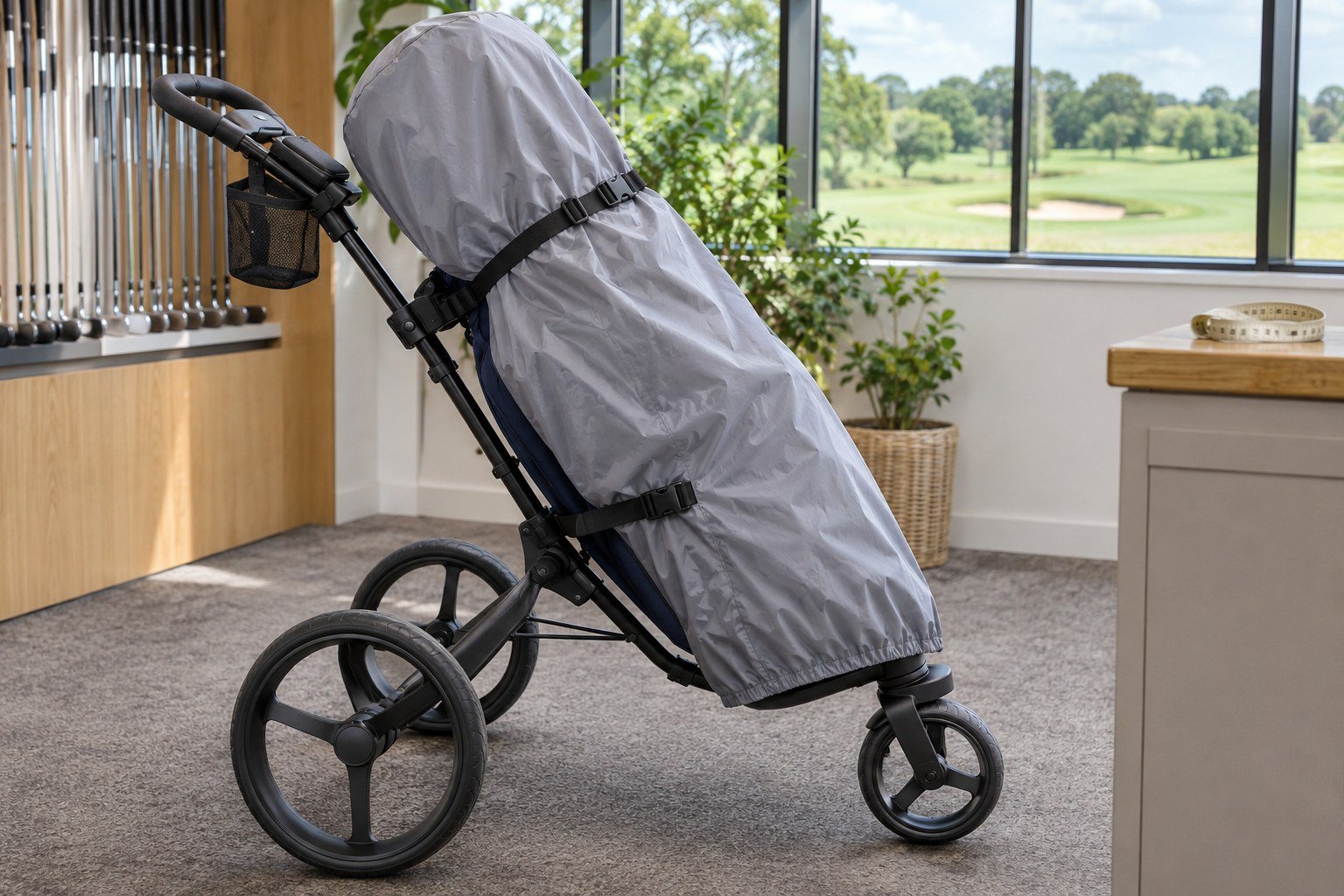
Fit it before the bag is wet, then dry the complete setup
Have the cover ready before rain arrives when practical. Trying to fit it after the pockets and towel are already soaked makes it harder to distinguish water entering from moisture you have enclosed.
During play, close each opening properly after access. Put used wet items in a separate suitable compartment or bag rather than beside the dry valuables. If water has collected on an outer flap, avoid tipping it across an open pocket. A full cover should help a sensible routine, not require you to stop checking what is happening beneath it.
After the round, remove the cover and check the bag, hood, pockets and stored items separately. Follow their individual care instructions. Let wet components dry before folding the cover into its pouch or closing the bag for storage. Do not assume the bag is dry because its outside looks protected.
Use this moment to inspect attachments, seams and closures. A torn fastening, damaged zip or stretched area deserves attention before the next wet round. Ask the maker about an appropriate repair or replacement rather than applying an unverified spray, adhesive or lubricant.
The buying decision
Buy a full cover to solve a bag-body or pocket-exposure problem, provided it passes the fit and access checks. Keep or replace a hood when the club opening is the only part that needs help. If neither arrangement works with your normal loaded bag and trolley, change the candidate cover rather than accepting an awkward fit.
Frequently asked questions
Can a golf travel cover double as an on-course rain cover?
A travel cover is designed around transporting the bag. Do not assume it permits normal club access, secure trolley mounting or moving-part clearance during play. Choose a product whose maker expressly supports the intended on-course use.
Does a bag rain cover protect an electric trolley battery?
Not by itself. Check the trolley manufacturer’s own wet-weather and battery instructions. A cover sold for the golf bag does not establish protection or approval for the trolley’s electrical components.
Will another brand’s snap-on hood fit my bag?
Not necessarily. Attachment spacing, fastening type, top shape and club height all matter. Confirm the exact bag model and replacement part with the manufacturer or seller before ordering.
Sources and checks
Sources consulted on 23 November 2026. Manufacturer and retailer descriptions are attributed claims; illustrations do not show tested products. Recheck current specifications and compatibility before purchase.
Illustrations in this article were created for Taylor’s Trailblazing Golf. Third-party photographs, where used, are credited beside the image or in the source list.