Golf Bag Rain Hoods: Fit, Closure and Weather Protection
A rain hood earns its place by fitting your bag, closing easily and letting you reach a club without a struggle. Start with those checks before buying another cover.
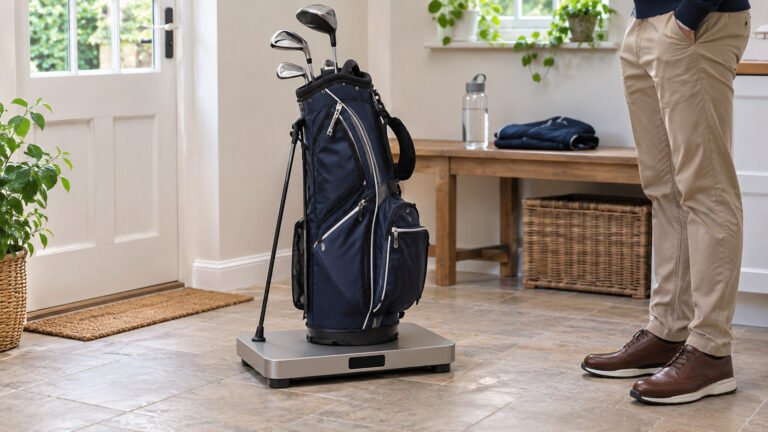
AI illustration of generic equipment. A fitted top cover is one part of the complete wet-weather setup. No named product or physical test is pictured.
The right hood is the one that fits the bag you already own and opens without a struggle. Before ordering, separate three questions: how it attaches, whether it clears your loaded clubs, and which part of the bag actually needs protection.
Research-led guidance for UK golfers. Read how we assess golf equipment for the distinction between documented features and hands-on testing.
A top hood and a full bag cover protect different areas.
Headcovers, handle clearance and opening direction all matter.
Replace it to solve a real fit or closure problem.
Golf bag rain hoods: first decide what needs covering
A rain hood covers the club opening. That is a different job from covering the pockets, seams and lower part of a bag. If your clubheads get wet through an uncovered top, a well-matched hood addresses the obvious gap. If water enters an apparel pocket, replacing only the hood may leave the actual problem untouched.
Use the table as a first decision, then check your own bag’s instructions. These are coverage categories, not waterproof ratings or a ranking of products.
On a small screen, swipe inside the table to read every column.
| What you notice | First thing to assess | What a hood cannot establish |
|---|---|---|
| Open club top exposed to rain | A correctly attached hood with room for the normal clubs and headcovers | Whether the bag’s pockets and seams resist water |
| Wet contents in a side pocket | Pocket closure, fabric condition and the bag’s stated protection | That a different top cover will repair a leak |
| Rain reaches several sides of a trolley bag | A suitable whole-bag cover as well as top access | That the cover clears every strap, wheel or control |
| Clubs were already wet when put away | Drying and storage routine | That sealing the top will dry the contents |
A water-resistant bag with a hood does not acquire a different construction merely because its top is covered. Read the exact model’s wording, including any conditions about closed pockets or the supplied hood. A broad waterproof claim also tells you little about how conveniently you can retrieve a wedge when the bag is loaded.
Back to the start ↑Identify the bag before ordering a replacement
Start with the model label, purchase record and approximate model year. Photograph the top cuff, each attachment point and the bag from the side. An old hood is useful evidence even if its zip has failed: keep it until the replacement has been confirmed.
Before buying anything, check the storage arrangements. For example, PING’s current Hoofer description lists a dedicated zipped rain-hood pocket. That is a reason to inspect the bag carefully, not proof that every older Hoofer stores its hood in the same place. [2]
Ask the manufacturer or supplying retailer to confirm a replacement against those details. Titleist UK’s own FAQ directs rain-hood enquiries to its support team and also provides a route for bag-part questions. It does not promise that every historic hood is available. [1]
- Record the exact bag name and any visible product code.
- Describe whether the hood attaches with press studs, a zip, hook-and-loop tabs, elastic or straps.
- Count and photograph the attachment points in their actual positions.
- Say whether you carry the bag or use it on a trolley.
- Include the tallest club and the headcover that needs the most space.
Two bags with similar top diameters can still have different cuff shapes, handles and attachment positions. The brand name alone is not a fit check. For a second-hand hood, request photographs of the underside and fasteners rather than relying on a picture of its logo.

Run a dry fit with your normal clubs
This is a proposed shopping and ownership check. It helps reveal obvious mismatches without claiming a laboratory waterproof test. Work indoors or under shelter, keep the bag supported and follow the hood’s fitting instructions. For a new purchase, agree what inspection the seller permits before marking or using it outdoors.
Match the attachment first
Fit each supplied fastener in its intended place. The fabric should not need stretching hard across the cuff to make the final stud reach. Do not move studs, cut slots or add improvised screws to make an incompatible hood fit. A damaged fastening on the bag itself needs advice about that bag.
Check the loaded envelope
Put in the clubs and headcovers you normally take. Close the hood without pulling it tightly against the tallest club. Look around the cuff for unintended gaps and check that the closure reaches its normal finishing position. There is no single clearance measurement that proves fit across every design.
Repeat the access you actually need
Open the intended access point and remove the driver, a middle iron, a wedge and the putter, one at a time. Replace each normally. If one club repeatedly catches the fabric or zip, decide whether the hood opening or the bag layout is responsible. Our guide to checking full-length dividers helps separate internal snagging from a hood-access problem.
Use the normal carrying position
For a trolley bag, repeat with the bag properly secured to your actual trolley, parked on level ground. Check access from the side you usually stand on. For a carry bag, confirm the hood does not obstruct handles, harness attachments or normal stand movement; avoid adding a loose strap near the mechanism.
Make a clear decision
Keep the hood if it attaches without force, closes over your usual set and permits ordinary club access. Ask for a different size or model if it needs a workaround. Being able to get the hood onto the bag once is weaker evidence than being able to open, close and use it consistently.
Back to the start ↑Choose a closure you can operate in the rain
The most useful closure is one you will actually close between shots. Compare the action with a glove on, using only normal hand pressure. Different fastening systems solve different problems; none removes the need to inspect the complete fit.
On a small screen, swipe inside the table to read every column.
| Design feature | Useful observation | Reason to pause |
|---|---|---|
| Press-stud attachment | Each matching stud engages without distorting the cuff | A final stud reaches only when the hood is stretched |
| Zipped access | The opening allows a club through and the zip closes smoothly | Fabric catches repeatedly or the zip needs a hard pull |
| Elasticated or drawcord neck | The intended fixing remains secure around the bag’s actual shape | The hood rides up or a cord obstructs moving parts |
| Hook-and-loop tabs | The required surfaces meet fully and stay clear of club grips | Tabs are damaged, obstructed or only partly engaged |
| Lift-up or accordion access | The cover can open and return to its covering position | The opening catches nearby accessories or will not stay in its intended position |
A large opening may be convenient yet leave more of the top exposed while open. A smaller zipped opening may suit someone who prioritises compact storage but become awkward with bulky headcovers. Treat that as a practical trade-off to try, not a universal verdict.
If a closure is stiff, first check whether fabric or a headcover is trapped. Do not force a jam or apply a household spray without the manufacturer’s approval. Changing the closure is not a sensible first repair when the real problem is the wrong hood.
Compare original, universal and lift-up hoods
An exact replacement confirmed for your bag is the clearest starting point when the original worked well. It preserves the intended fastening arrangement, although you still need to check the received item and its condition.
A universal hood can be useful when an original replacement is unavailable, but read beyond the name. BIG MAX’s Universal Rainhood page, for example, offers separate stand-bag size choices and a cart-bag option. A product called universal can still require a variant decision. [3]
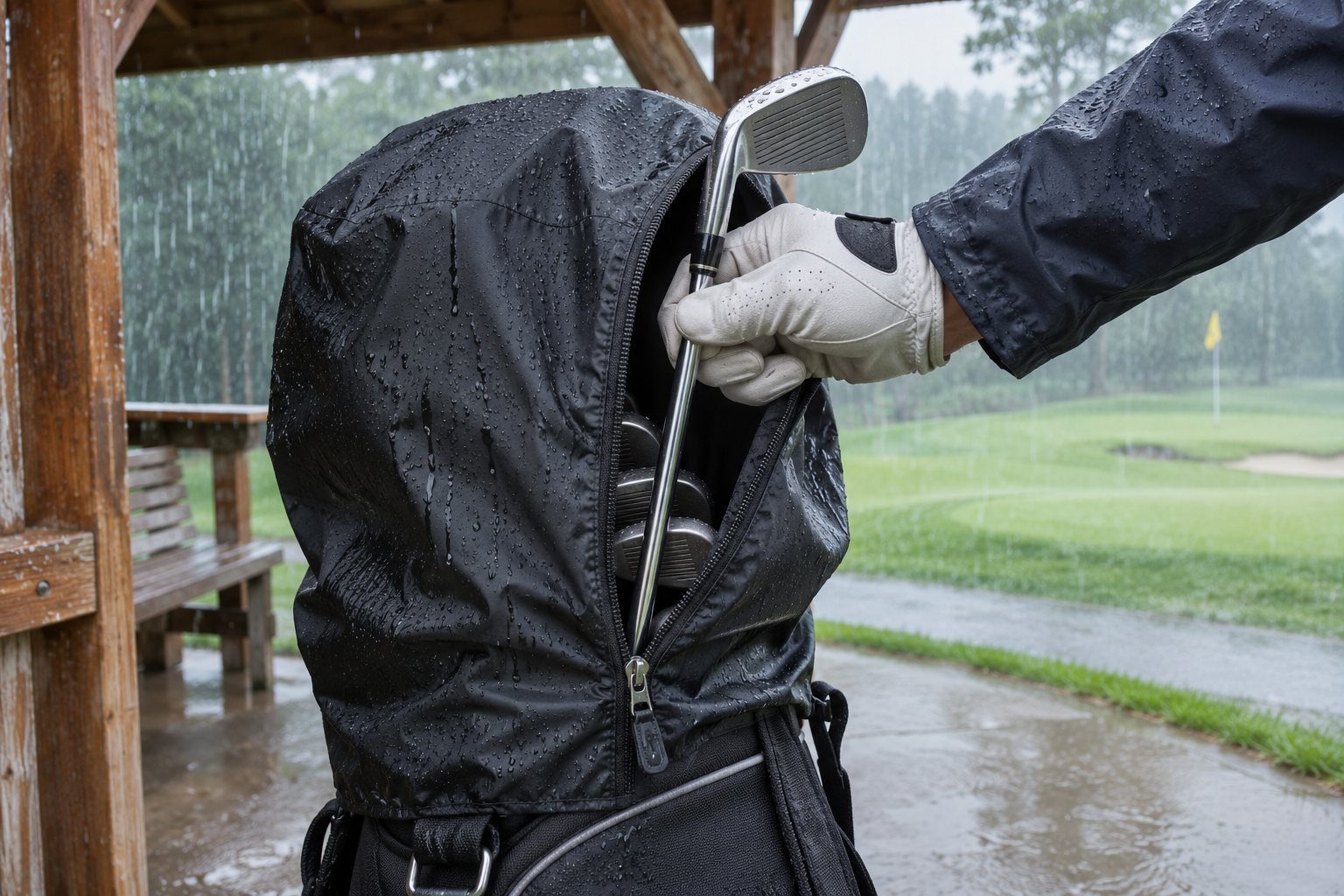
Sun Mountain describes its Dry Hood as an accordion-style cover for the top of a bag, designed to allow club access. That supplies a useful alternative to consider if repeatedly opening a conventional zip is your main frustration; it does not establish how it fits your particular bag or performs in your local weather. [4]
Choose by the problem you need to solve:
- Replace like for like when only a lost or worn hood is at fault.
- Consider a correctly sized universal design when model-specific supply has ended.
- Try a lift-up design if access is the weakness, checking attachment and stowed size.
- Consider whole-bag protection when the uncovered body and pockets are also exposed.
Keep the comparison to fit, access, coverage and storage. A more expensive cover cannot compensate for the wrong attachment or a bag that is already damaged.
Back to the start ↑Keep protection practical while you play
Set the hood up before rain reaches the open bag. Keep the access side where you can use it without twisting the bag or loosening its trolley strap. Store frequently needed small items in pockets that remain accessible with the cover fitted.
A hood is most useful when reopening it is a short, familiar movement. Open only as far as necessary for the club, return the club carefully and close the access point again. Check that a headcover has not been caught in the zip. If your usual sequence repeatedly requires removing the entire hood, the design may be a poor match for your layout.
Whole-bag covers deserve a separate check. With the trolley stationary, follow the cover instructions and inspect the lower edge, access flaps and any straps. Keep fabric and cords clear of wheels, brake parts, controls and folding joints. A cover hanging neatly in a shop can sit differently once the bag is tilted and its pockets are full.
For a carrying setup, do not assume a trolley cover can be adapted safely around the harness or legs. If the intended use is not clear, ask the supplier. The goal is protection that works with the bag’s normal operation, rather than an arrangement that must be held together throughout a round.

Find the source of wet kit before buying again
Notice where dampness first appears instead of assuming the hood has failed. A single observation is not proof of the route, but it gives you a better question for the supplier.
- Wetness around the club opening: check whether the access point was closed and the hood remained attached.
- Dampness directly under a fastening: inspect for an unintended gap or damaged surrounding material.
- A wet pocket away from the top: examine that pocket’s closure and the bag’s own protection claim.
- Moisture after storage: consider whether wet clubs, towels or a damp hood were put away together.
Avoid using a pressure washer or hose as a home certification test. It does not reproduce every playing condition and may expose equipment to water in ways the maker never intended. If you suspect a defect, photograph it, record the circumstances and ask the retailer what evidence it needs before attempting a repair.
There is also a cost decision. If the bag is otherwise sound, a compatible replacement hood may be all that is needed. If several pockets, seams and closures have deteriorated, compare the cost of proper repair or replacement of the bag. Do not spend money on progressively larger hoods to conceal a wider failure.
Back to the start ↑Dry it properly, then keep the solution simple
After a wet round, remove damp contents and open the hood so it can dry before being packed away. Follow its own care label. Sun Mountain’s general bag-care advice favours gentle cleaning and thorough air-drying, while cautioning against harsh chemicals, abrasive tools and direct heat. A different material may need different care. [5]
Once dry, check the fasteners and closure before folding it into the intended storage pocket. Keep any label or order confirmation that identifies the hood; finding the correct replacement is easier when the model information has not been lost.
Our recommendation is to keep a working original hood, replace a failed one with a confirmed match, and choose a different design only when it solves a specific access or coverage problem. Make the decision with your normal clubs and carrying setup in place. A hood that fits comfortably and is easy to close is more useful than a promising waterproof label on a cover you struggle to use.
For wider decisions about layout, carrying or replacement, browse the Golf Bags guides. The comparisons here follow our research-led review approach; no named hood has been personally tested for this article.

Questions before you decide
Can I carry the bag by its rain hood?
Use the bag’s designated lifting handles. A rain hood is a cover; do not treat its fabric, zip or attachment studs as a carrying handle unless the manufacturer explicitly identifies a lifting function.
Should I choose a transparent hood?
Visibility can make it easier to see the club you want, but it does not resolve fit, fastening or coverage. Check the material’s care instructions and try the opening with your own headcovers before choosing by appearance.
Will a spare hood from the same brand fit?
Possibly, but the brand name is insufficient. Compare the exact bag version, cuff shape, attachment pattern and loaded clearance, then ask the maker or retailer to confirm the match.
Sources and editorial checks
Manufacturer specifications and instructions inform this guide. The comparison and checklists are editorial decision aids, not results of hands-on product testing.
- Titleist UK — FAQs: bag parts and replacement rain hoodsOfficial UK support route for identifying replacement bag parts; consulted 23 November 2026.
- PING — Hoofer carry bagOfficial current Hoofer page lists a zippered rain-hood pocket; not a compatibility promise for older versions. Consulted 23 November 2026.
- BIG MAX — Universal RainhoodOfficial product page shows separate stand-bag size options and a cart-bag option. Consulted 23 November 2026; no UK price or availability claim.
- Sun Mountain — Dry HoodOfficial description of accordion-style top cover and club access. Consulted 23 November 2026; no independent weather test asserted.
- Sun Mountain — How to clean a golf bagManufacturer care guidance on gentle cleaning and complete air-drying away from direct heat. Consulted 23 November 2026.
Illustrations in this article were created for Taylor’s Trailblazing Golf. Third-party photographs, where used, are credited beside the image or in the source list.