Golf Trolley Seat Attachments: Stability and Approval Checks
Confirm the exact seat and trolley pairing before judging comfort or convenience.
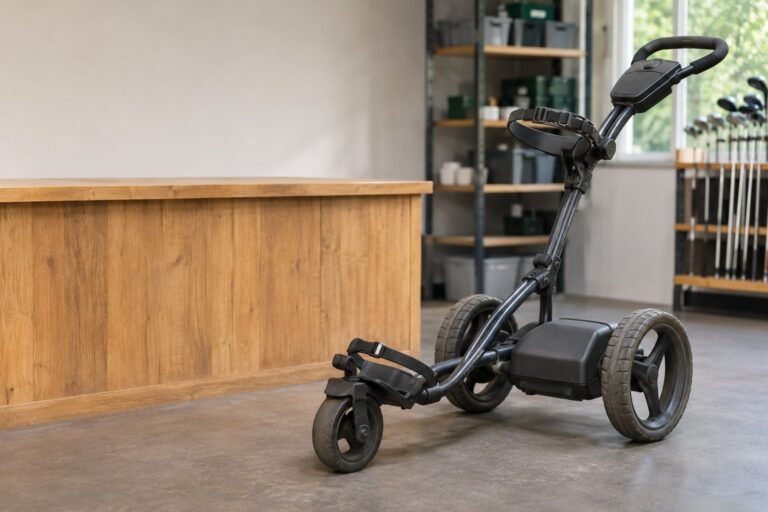
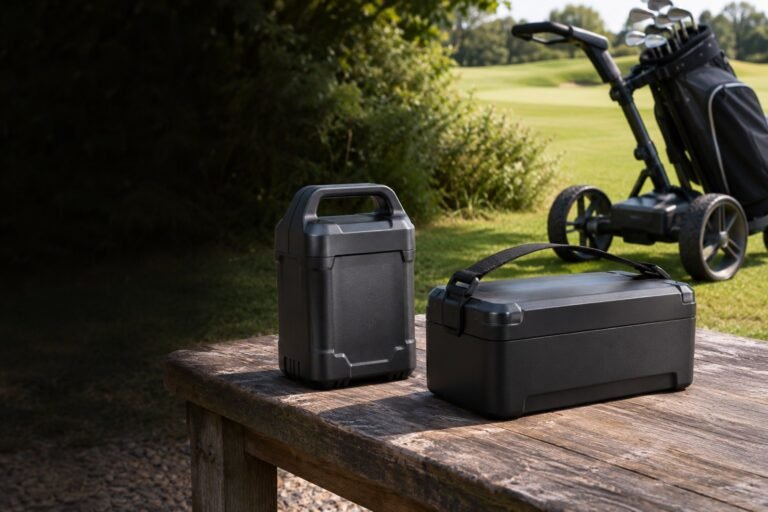
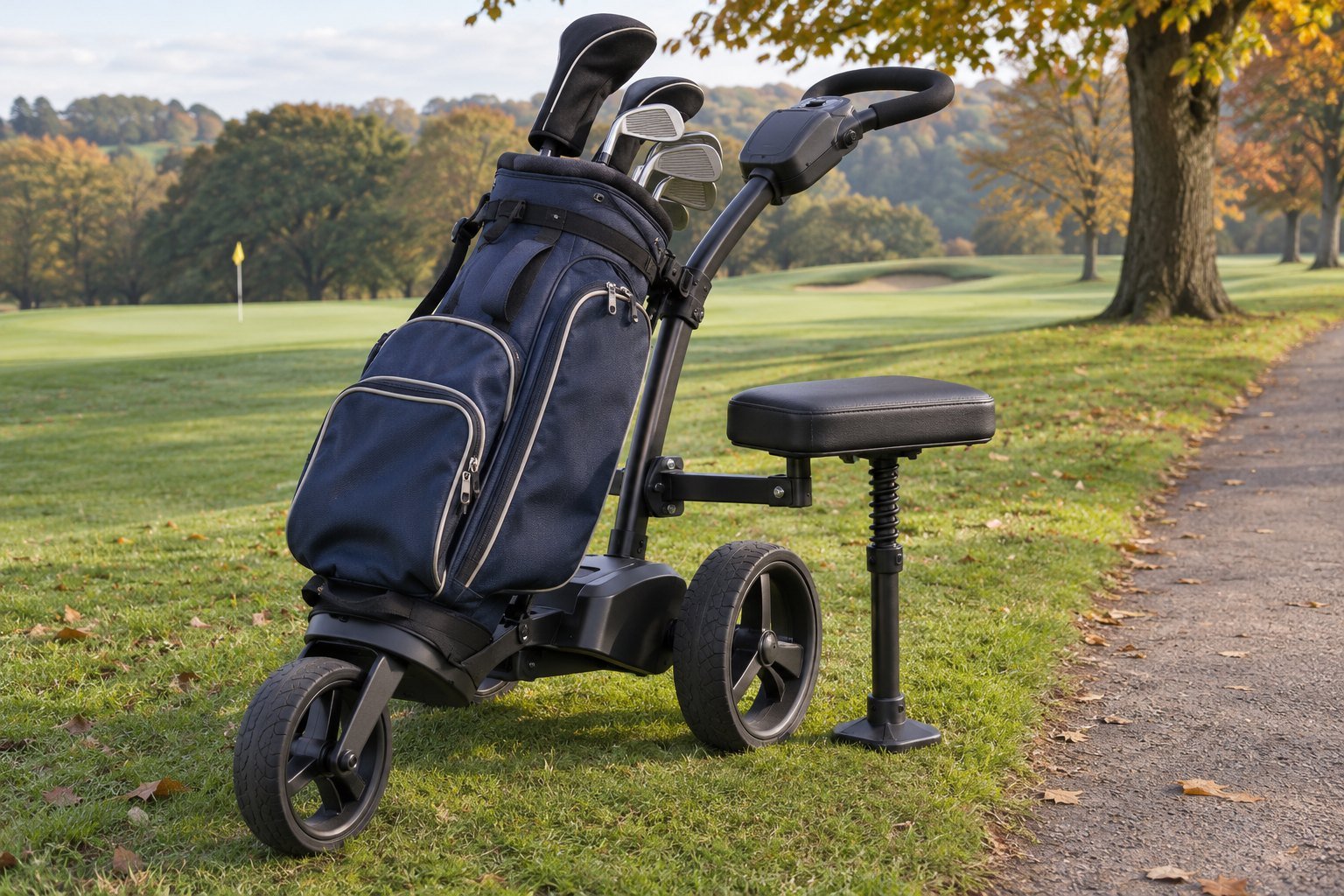
Check the exact seat, trolley and support arrangement before use. AI-generated illustration of generic equipment.
Golf trolley seat attachments can provide a useful pause during a slow round, but a bracket that slides into place is not enough evidence of compatibility. The exact trolley generation, seat assembly, mounting parts and published user limit all matter.
This guide compares specific manufacturer information and turns it into a practical approval and use checklist. It is research-led, with no claimed load testing. The images are generic illustrations, not proof that a pictured assembly is approved for your trolley.
Ad – includes affiliate links. If you buy through these links, Taylor’s Trailblazing Golf may earn a commission. Recommendations are based on the equipment decision and the available evidence.
A familiar brand or series name can cover different mounts. Record the exact trolley and seat version.
Use the limit for that seat. A trolley’s bag-load rating or another model’s capacity is not a substitute.
Where the design uses feet that lower to the ground, confirm they reach and settle as the maker specifies.
An unverified bracket, missing fixing, rocking seat or sinking foot is a reason to stop using the attachment.
Golf trolley seat attachments: check the exact combination
These examples show the level of detail to look for. They are not a ranking, and the limits belong to the named products. Check the current instructions supplied with the item before purchase and use.
On a phone, swipe within the table to see all columns.
| Named product | What the maker states | What to take from it |
|---|---|---|
| Motocaddy 28V Deluxe Seat, titled “2024 Onwards” | The current page lists all 28V M-Series and 28V S-Series trolleys and a maximum capacity of 100 kg/220 lb. [1] | Match the actual seat version and mounting instructions, not the title’s year alone. |
| Motocaddy M-Series Seat, 2018–2023 | The page lists 28V M-Series models from 2018–2023 and 28V S-Series from 2022–2023, and excludes CLICK ‘N’ CONNECT cable-free battery trolleys. Its feature list specifically names S1 for 2022–2023. [2] | Resolve any uncertainty about the exact S-Series model with Motocaddy. Do not transfer the newer seat’s capacity to this one. |
| Clicgear 3-Wheel Cart Seat | Listed for Models 1.0, 2.0, 3.0, 3.5+, 4.0 and 4.5, with a 220 lb limit. Other brands/models and Clicgear Model 8 are excluded. [3] | A separate Model 8 seat exists; “Clicgear seat” alone is insufficient identification. |
| MGI Zip Series seat | The manufacturer’s seat page gives Zip fitting instructions and a recommended weight limit of 100 kg. It tells buyers to choose the correct seat for their buggy. [5] | Confirm the selected variant and its instructions; do not assume every MGI bracket is the same. |
| PowaKaddy Deluxe seat | The official page lists FX, CT and RX ranges. It does not state a user weight limit on that page. [6] | Ask for the current seat’s capacity and exact-model approval before buying or using it. |
A matching brand badge does not settle these questions. Nor does the trolley’s permitted golf-bag load: that describes a different use from a person sitting on a separately mounted accessory.
Back to top ↑Confirm the complete mounting arrangement
Start with the trolley label, its model year or generation where known, and the seat’s part reference. Ask the manufacturer or an authorised dealer to confirm the combination if the product description is ambiguous. A written reply tied to those details is more useful than “it should fit”.
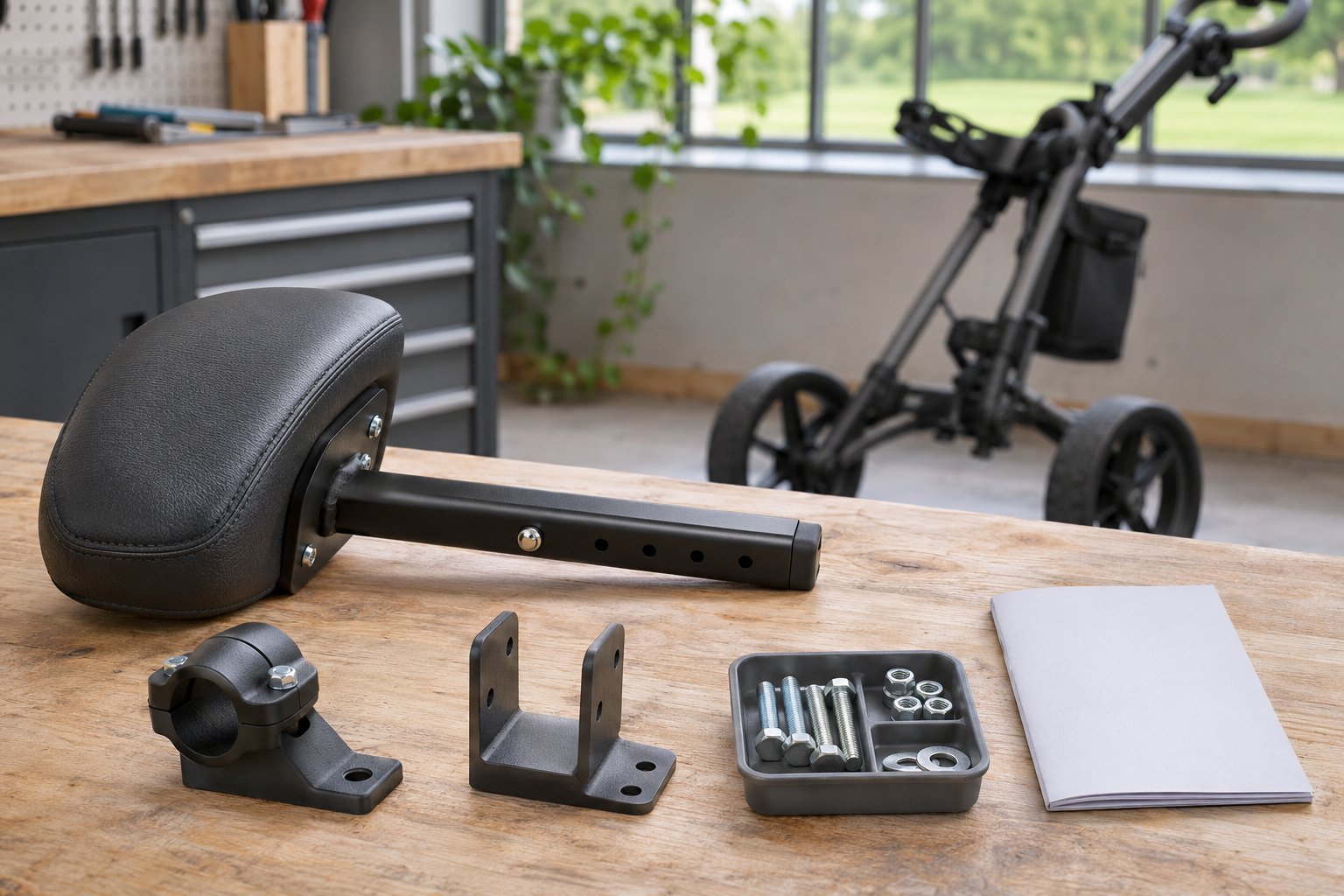
Check what comes in the box. A seat, a mounting bar and a bracket are not interchangeable descriptions of a complete kit. MGI’s page, for example, says the Quad seat bracket is sold separately. That is a contents check for that version, not a rule for the Zip model. [5]
Use the assembly instructions for the actual seat. The current Motocaddy 28V Deluxe instructions specify a right-hand mounting position from the operator’s viewpoint and securing its bar with two bolts supplied with the trolley. Do not replace that procedure with an older model’s instructions or a photograph of a similar seat. [1]
- Confirm that every required fixing and locking component is present.
- Check that the mounting point and seat parts are undamaged.
- Use only the installation method and tools specified for that assembly.
- Have a dealer resolve an unclear fit instead of modifying the bracket, frame or fasteners.
If you are considering a used seat, ask for its identification and complete fitting parts before travelling to collect it. An attractive price loses its value if the matching mount cannot be identified or supplied.
Back to top ↑Ground contact is part of the seat check
Some trolley seats use a spring-loaded arrangement whose feet settle onto the ground when the seat is pressed down. The ground-support instructions for that design are part of correct use, not an optional extra.
MGI’s Zip Series assembly guide gives a useful, specific example. It says to check that the seat depresses correctly by hand before sitting and that the feet sit flush on the ground. It also explains that an upside-down crossbar prevents the seat reaching the ground, and directs owners to keep the legs clear of dirt and debris. [4]
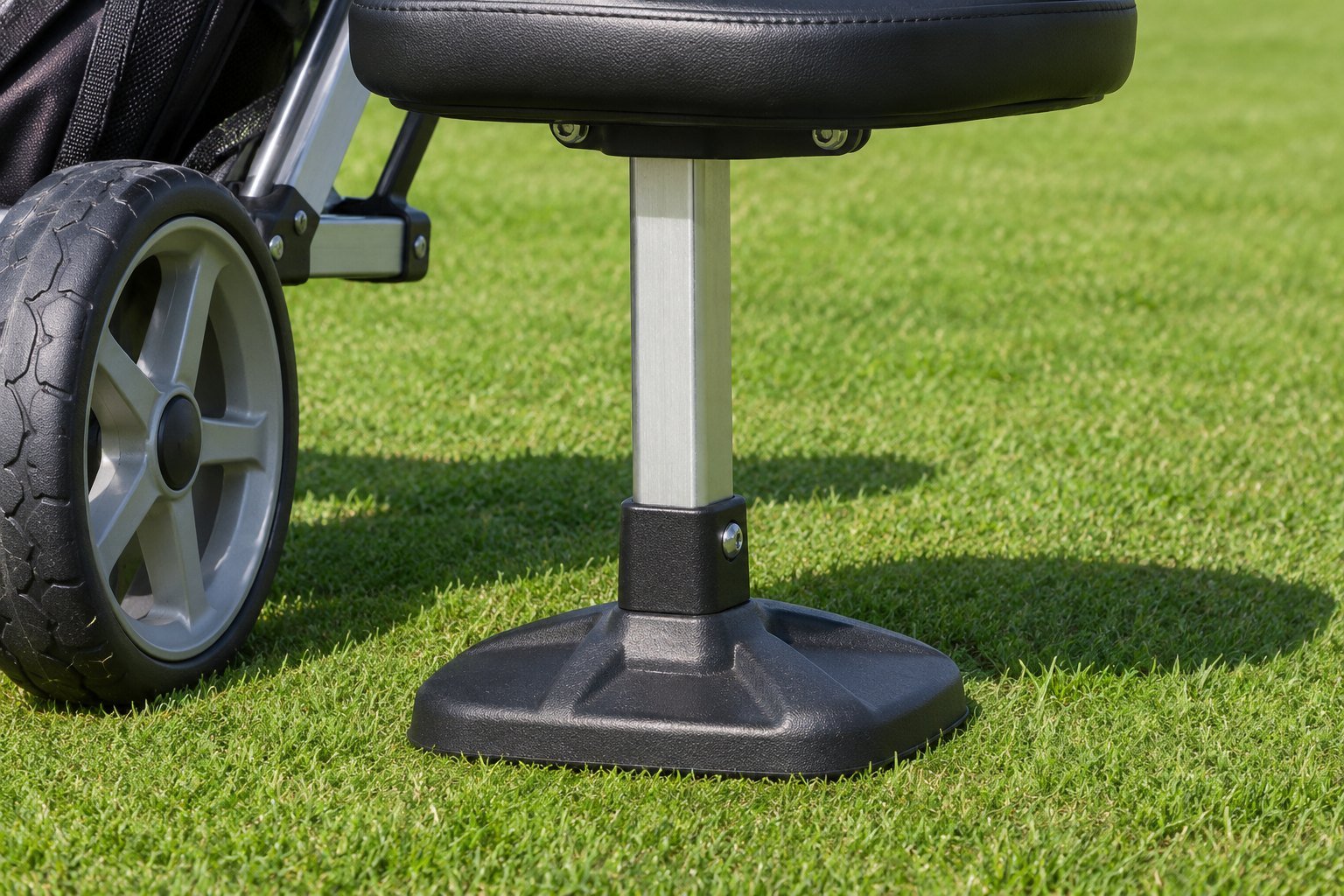
For that type of design, a seat suspended above the ground when it should be supported by its feet is a stop signal. Do not sit down to force the assembly into position or pack stones, blocks or other objects under a foot. Recheck the correct installation with the equipment unoccupied, and get help if it still does not behave as instructed.
Choose firm, level ground with enough room for the trolley and the whole deployed seat. Look for soft turf, a hidden hollow, loose gravel or an edge where a support could sink or lose contact. These are practical site checks; they do not establish a universal safe slope angle or turn an unsuitable surface into an approved one.
A hand check is not a load test. It can help reveal incorrect deployment when the maker requires it. Passing it does not establish the weight capacity of an unidentified seat or approve a substitute bracket.
Use a short stop-and-check routine
Use the manufacturer’s directions first. The following editorial routine brings the separate decisions together before a rest:
- Park deliberately. Stop the trolley and follow its specified parking and control procedure, using a parking brake if one is fitted and required. Do not assume that a stopped motor provides a parking brake.
- Choose the resting place. Check the surface and leave the trolley clear of traffic, slopes and nearby edges. Keep the bag in the normal retained arrangement described by the trolley maker.
- Inspect the attachment. Look for a loose or missing fixing, bent part, cracked support or unusual movement. Keep the seat unoccupied while checking.
- Deploy as instructed. Complete the model’s ground-contact and operating checks. If a foot will not settle or anything rocks or sinks, move to a suitable place or leave the seat unused.
- Use it as intended. Sit and rise without bouncing, standing on the seat or treating the trolley handle as a grab rail. Get fully off before moving the trolley.
MGI explicitly warns against using its seat while the buggy is moving. Treat a trolley seat as a stationary resting accessory, not permission to ride on the trolley. [4]
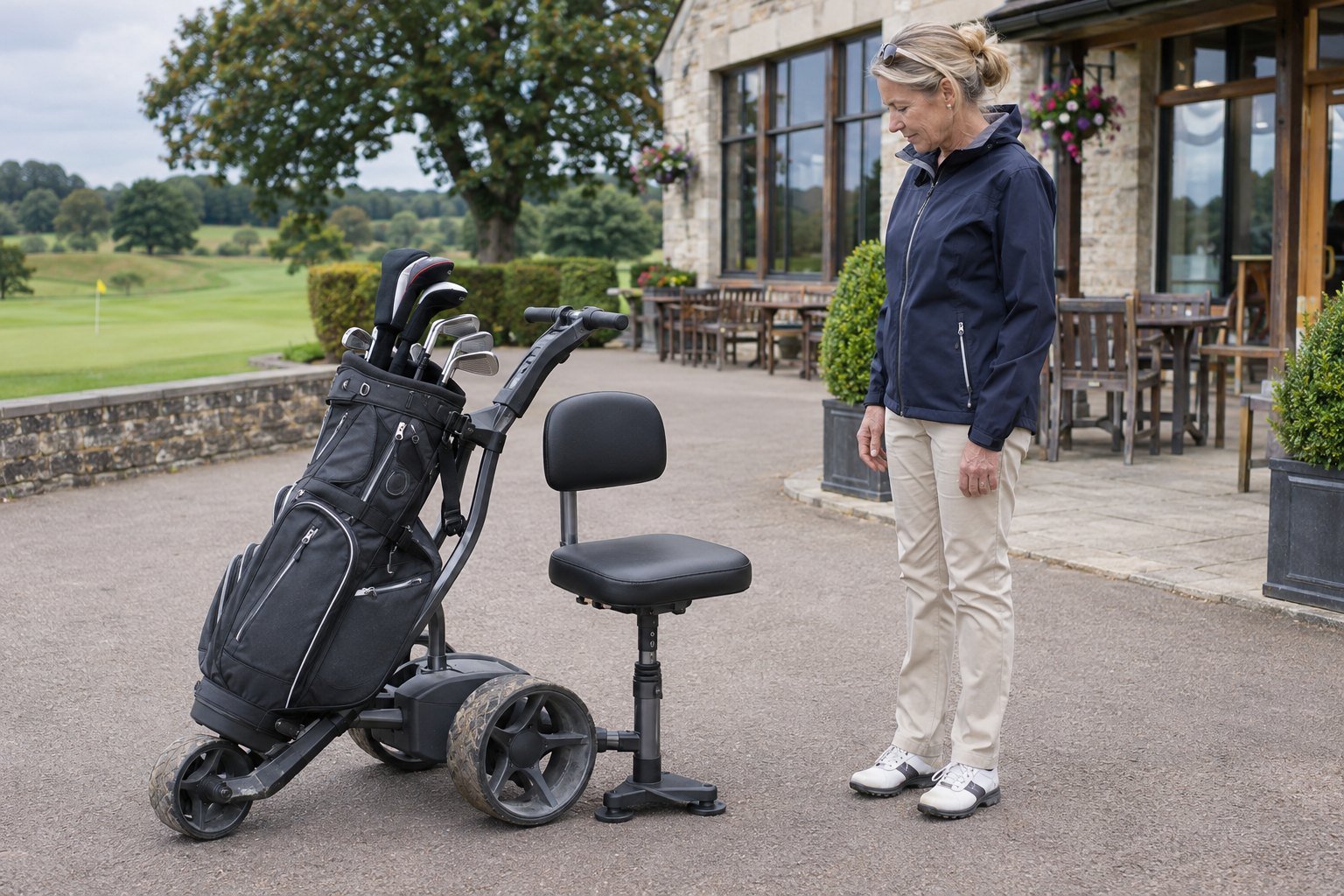
Before buying, also consider the person using it. Can they approach, sit and stand comfortably within the maker’s intended use, without needing to pull on the handle or bracket? A seat attachment does not establish that the trolley is suitable as a walking or transfer support. If a different form of assistance is needed, arrange an appropriate course option rather than relying on the attachment to provide it.
You do not need to prove that a questionable setup will fail. If it feels wrong or the required checks cannot be completed, use an available suitable resting place and resolve the equipment issue later.
Back to top ↑Buy only after the approval gaps are closed
Compare the complete cost and practicality: seat, correct mount, any required fitting work and the space it will occupy in the car. Decide whether you will use it often enough to justify carrying and cleaning another accessory. Existing convenient resting places may already meet your needs.
For a current UK example, Clubhouse Golf lists the PowaKaddy Deluxe 2.0 Trolley Seat, article 03011-01-01, for FX, CT and RX ranges. Its listing does not supply a user weight limit, matching the information gap on the official Deluxe seat page checked for this guide. Do not fill that gap with another brand’s 100 kg figure. [6] [7]
If PowaKaddy or an authorised dealer confirms your exact trolley, seat version, mounting parts and user limit, you can check the PowaKaddy Deluxe 2.0 Seat listing at Clubhouse Golf. Confirm the supplied version and current details before ordering; the link itself is not compatibility approval.
If you are close to a stated limit or unsure what the maker includes in it, ask the maker directly. Do not round a limit upwards or rely on a brief trial sit to decide whether it applies.
Back to top ↑Check removal, folding and storage before leaving home
An attachment that works on the course also needs a practical journey there and back. Establish whether the seat must be removed before folding, which parts may remain fitted, and where the removed assembly will travel.
Clicgear’s named 3-Wheel Cart Seat is designed so the mounting bracket can remain attached when the trolley is folded while the seat is removed. That permission belongs to that product; check other seats individually. [3]
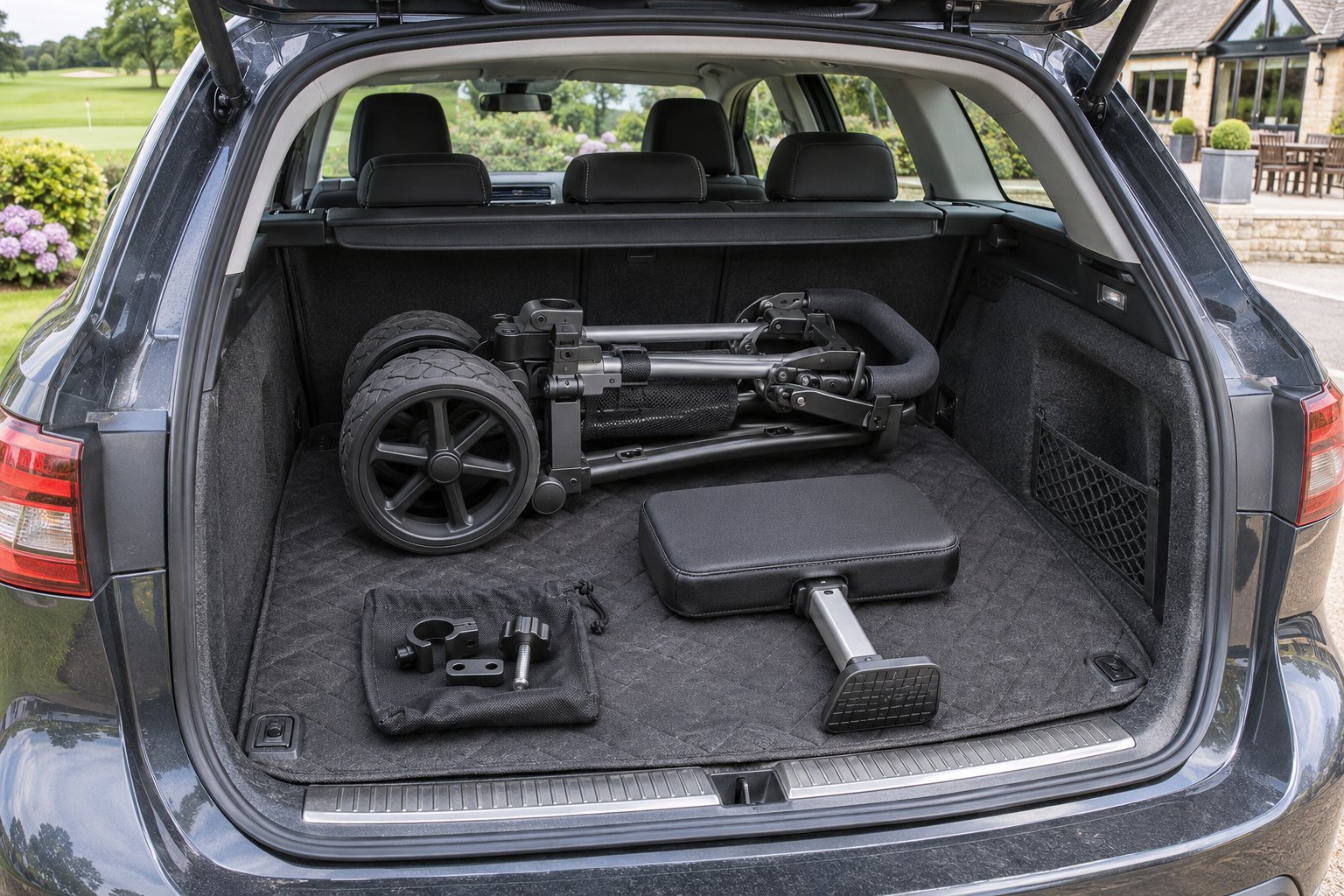
Practise the specified removal and folding sequence with the seat unoccupied. Stop if a part obstructs the fold or requires force. Store removed components so they cannot slide around the boot or press against other equipment, and keep small required fittings together.
After use, clean and dry the assembly as its maker directs. Before the next outing, check its mount and supports for damage, missing parts or a change in operation. If a component has bent or an attachment has been knocked loose, have the fault assessed instead of assuming that tightening the nearest bolt restores the original condition.
Back to top ↑Keep a seat approval and use record
Save the following details with your receipt and instructions. This is a practical record for you and the retailer, not a certification issued by this guide.
On a phone, swipe within the table to see all columns.
| Question | What to record |
|---|---|
| Which trolley? | Brand, exact model, generation/year and identifying label. |
| Which seat and mount? | Seat part reference, bracket or bar reference, and included fixing parts. |
| Who confirms compatibility? | Exact manual/product page, or a maker/dealer reply naming this combination. |
| What is the user limit? | Published limit for this seat and any clarification received from the maker. |
| How is it deployed and parked? | Required mounting side, locks, ground-contact checks and trolley parking procedure. |
| How does it travel? | Removal/folding instructions, parts retained on the trolley and storage arrangement. |
Recheck the record if either the trolley or the seat changes. Reusing a familiar accessory on a new trolley is a fresh compatibility decision.
Back to top ↑Sources and checks
Research and specifications checked on 23 November 2026. Manufacturer descriptions are identified in the text; practical checklists and worked examples are editorial guidance, not product testing.
- Motocaddy — 28V Deluxe Seat (2024 Onwards), compatibility, fitting and capacity — checked 23 November 2026
- Motocaddy — M-Series Seat (2018–2023), model years and exclusions — checked 23 November 2026
- Clicgear — 3-Wheel Cart Seat, supported models, weight limit and storage — checked 23 November 2026
- MGI — Zip Series seat assembly instruction guide — checked 23 November 2026
- MGI — Seat variants and Zip Series setup information — checked 23 November 2026
- PowaKaddy — Deluxe Golf Trolley Seat — checked 23 November 2026
- Clubhouse Golf — PowaKaddy Deluxe 2.0 Trolley Seat, article 03011-01-01 — checked 23 November 2026
Illustrations in this article were created for Taylor’s Trailblazing Golf. Third-party photographs, where used, are credited beside the image or in the source list.