Lithium vs Lead-Acid Electric Trolley Batteries: What Differs?
A lighter pack can make the journey from the car easier. A longer warranty can sound reassuring. Neither tells you, on its own, whether changing your trolley’s battery system is worthwhile.
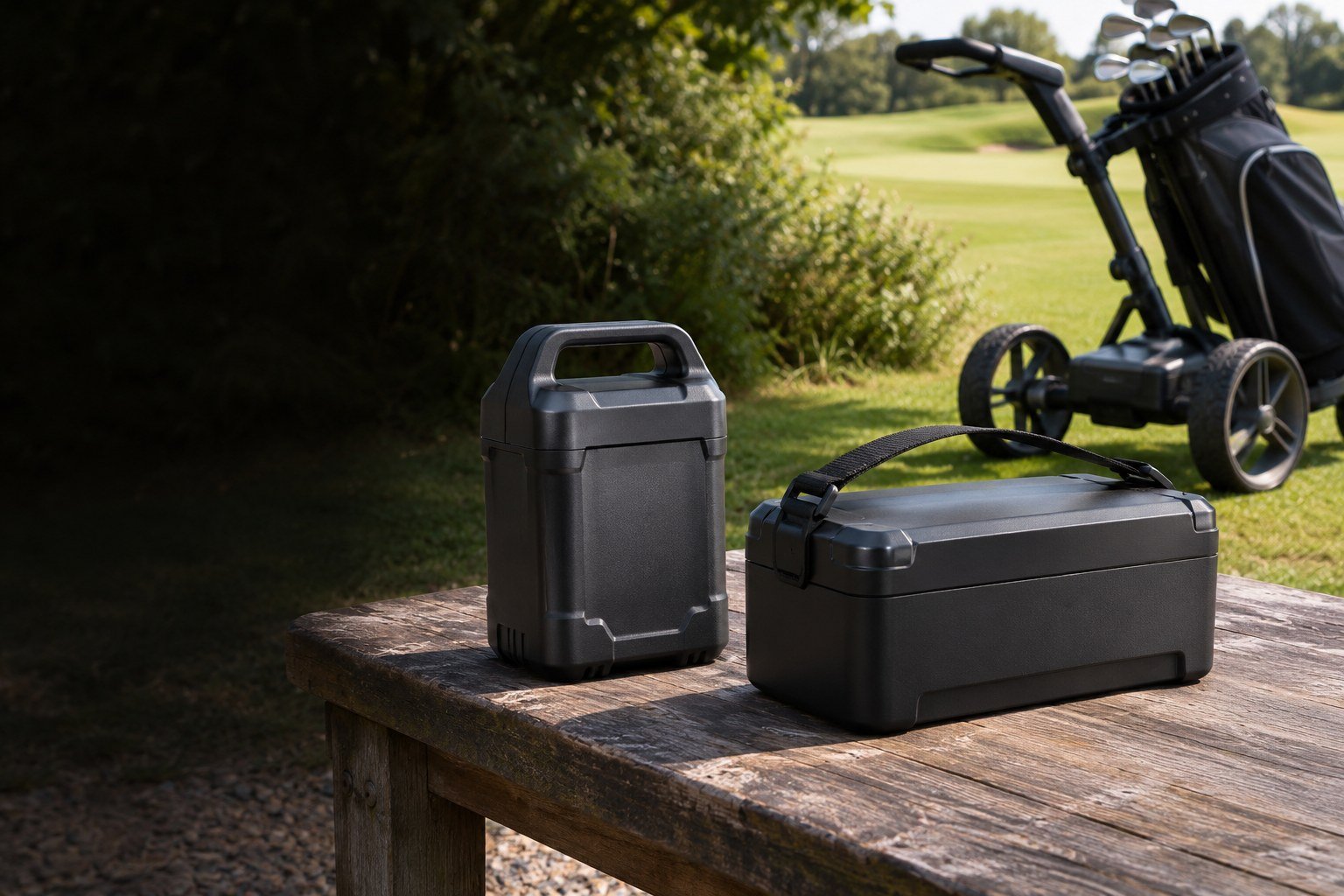
Compare approved complete systems, including what you carry. Generic AI illustration; size does not identify a battery’s chemistry.
When comparing lithium vs lead-acid electric trolley batteries, start with the problem you want to solve. A difficult lift, inadequate playing range and an ageing charger are different problems. Each calls for different evidence before you spend.
This is a research-led comparison with an original ownership worksheet. The manufacturer examples explain differences in real systems; they are not a head-to-head endurance test or a claim that the featured batteries fit the same trolley.
This is a research-led guide. How we assess golf equipment explains the evidence behind our recommendations.
This guide contains affiliate links. If you buy through them, Taylor’s Trailblazing Golf may earn a commission at no extra cost to you.
A working approved battery does not need replacing simply because another chemistry is available.
Compare the battery and the complete item you actually load into the car.
Include the approved charger, required fittings and any service work.
Use the exact battery’s charging and storage instructions, including during winter.
First establish whether there is a real choice
A chemistry comparison only becomes a buying choice when the trolley manufacturer permits both options. In the 2024 Motocaddy SE manual, the named options include S-ULTRA 274Wh lithium and 12V 21Ah lead-acid. That specific permission does not extend to other generations or batteries.[1]
Record your trolley version and installed battery before comparing alternatives. If a maker lists only an approved lithium system for your model, a cheap lead-acid pack is not an equivalent option. Equally, an older trolley that accepts a particular lithium conversion has not thereby gained approval for every pack with a similar connector.
“Lithium” also covers different constructions. PowaKaddy describes its 30V Standard Plug ’n’ Play battery as nickel cobalt manganese, or NCM; Motocaddy’s NEW M-Series Standard page uses a lithium-phosphate description.[3][4]
Keep the exact part number, chemistry and approved charger together in your enquiry. Do not choose a charging routine from the word lithium alone, or infer the chemistry from a broad voltage family. Any change needs confirmation for the complete battery, charger and trolley combination.
Back to top ↑Lithium vs lead-acid electric trolley batteries at a glance
Use this matrix to decide what to investigate. It deliberately leaves the final answer with your approved products and your routine, rather than awarding a universal winner.
| Decision | Keeping lead-acid | Choosing approved lithium | Evidence to collect |
|---|---|---|---|
| Handling | Your existing pack provides a known lifting task. | A lighter pack may make carrying easier. | Complete pack weight and the actual car-loading arrangement. |
| Purchase cost | Account for any needed charger or service work. | Include the approved charger and any required fitting costs. | Written quotes for complete usable systems. |
| Charging | Follow the lead-acid charger’s stages and completion instructions. | Use the lithium pack’s matched charger and sequence. | Exact manuals, including first-use requirements. |
| Winter care | Storage still requires attention. | Storage still requires attention. | Required charge state, temperature and recharge interval. |
| Playing range | Judge the approved pack against your normal round. | Choose the appropriate approved capacity, not simply the chemistry. | Manufacturer conditions and your route/load. |
| Long-term value | Consider the serviceable equipment you already own. | Check warranty scope and realistic use. | Terms, repair support and complete cost over a stated period. |
The charging distinctions are explicit in Motocaddy’s lead-acid instructions and PowaKaddy’s CT10 lithium manual. Neither supports treating chargers as interchangeable.[5][6]
Give each row one of three answers: meets my needs, needs improvement or not yet verified. An unresolved compatibility question stops the purchase. A small handling benefit is a preference to weigh against cost, not a fault in equipment that works.
Compare the weight you actually lift
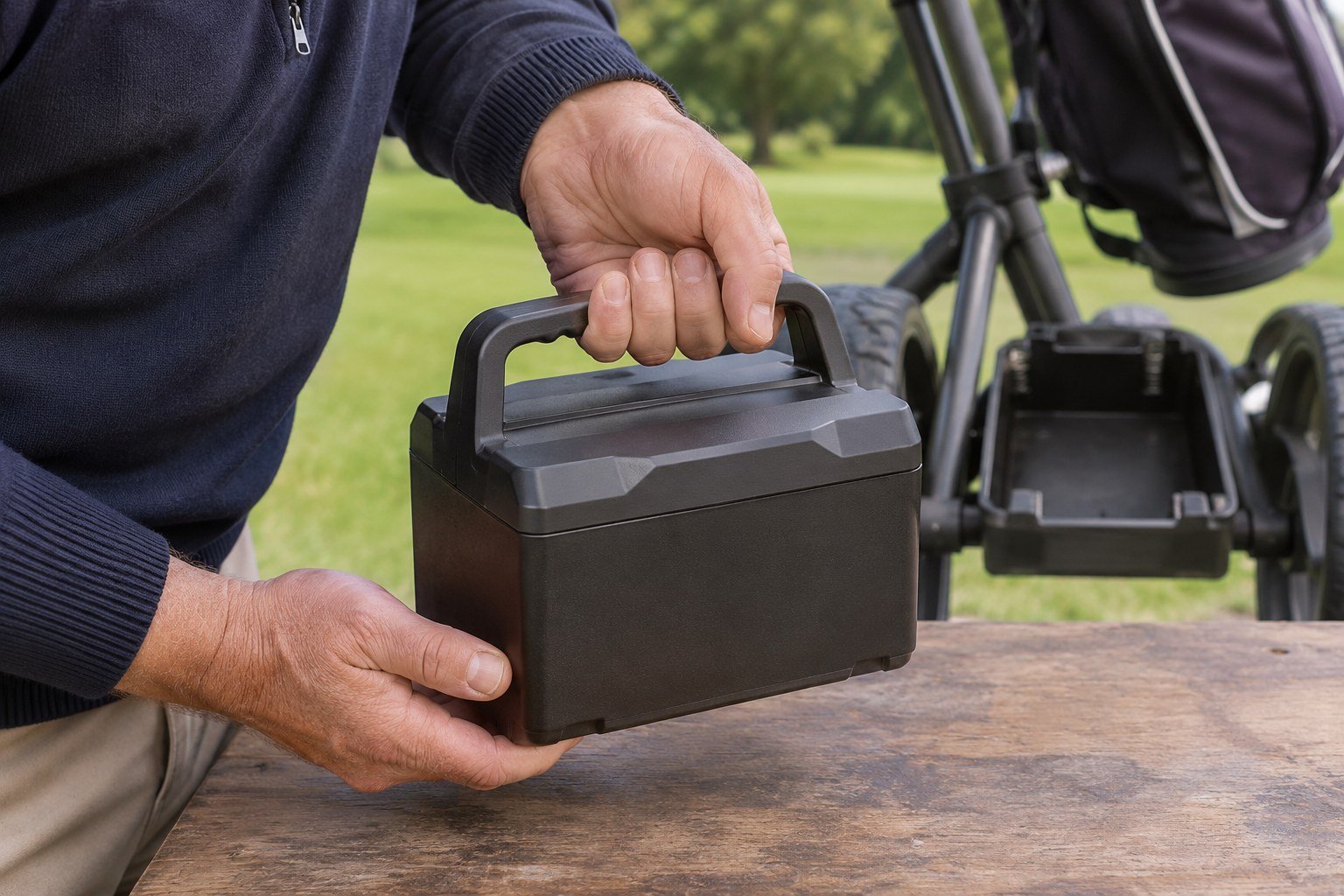
Manufacturers offer compact lithium packs with a substantial handling advantage over traditional lead-acid equivalents. As one specific example, Motocaddy lists the LitePower 12V Standard lithium battery at 2.1kg. That is an individual product specification, not the weight of every lithium battery or approval for your trolley.[2]
A battery that stays on the frame can save a separate carrying trip while increasing the weight of the assembled item you lift. Compare both arrangements, following the trolley’s removal and lifting instructions. Decide which fits your car, storage space and comfortable handling.
| Your handling worksheet | Record for each approved option |
|---|---|
| Separate battery lift | Weight including the case, handle and cable you carry with it. |
| Trolley lift | Weight in its normal loading arrangement: battery fitted or removed as permitted. |
| Grasp and reach | Where the intended handle sits and whether you must reach deep into the boot. |
| Number of transfers | Car to trolley, trolley to charging place, then back again. |
| Storage access | Whether the approved charging/storage location is readily accessible. |
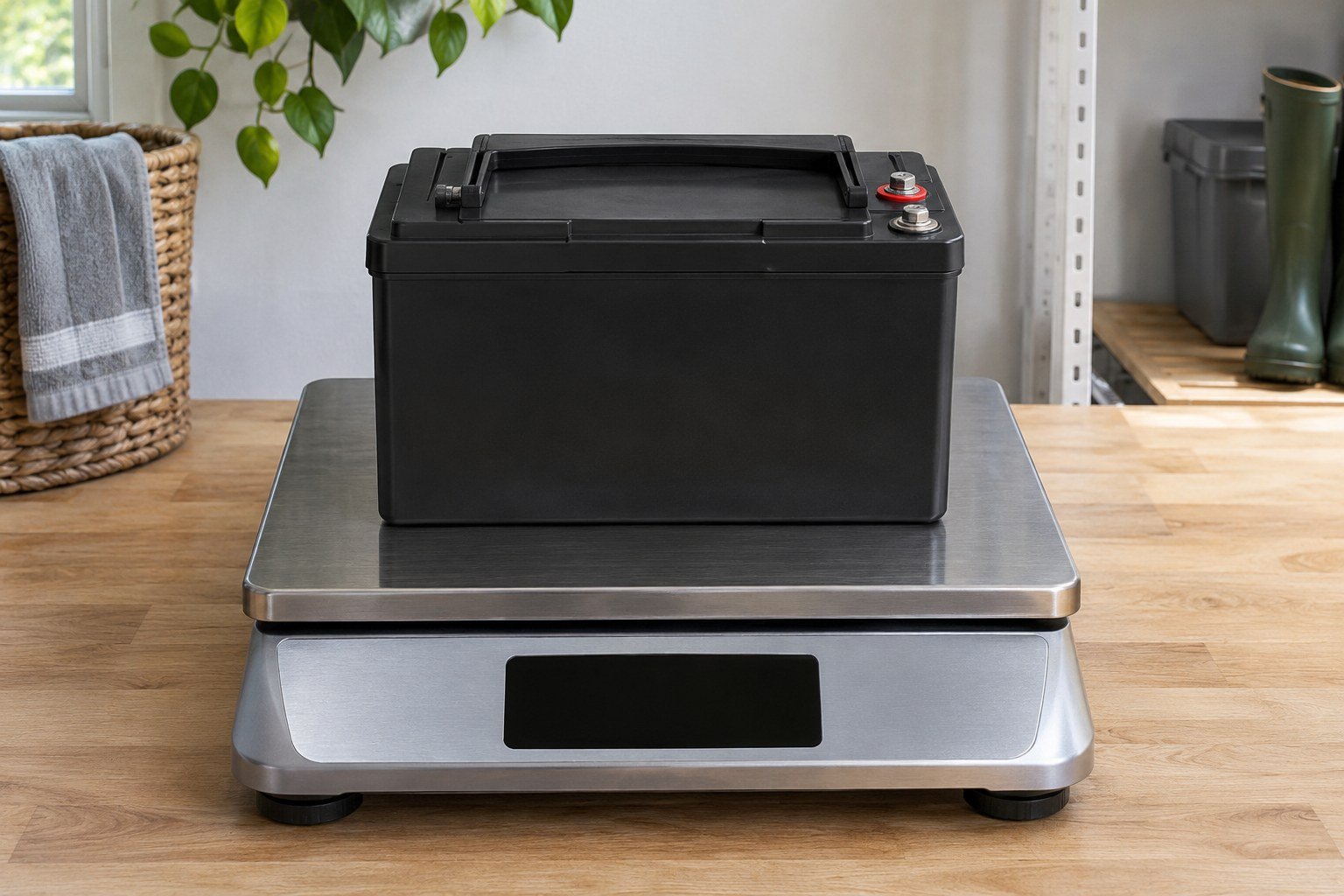
Use a suitable platform scale only if the disconnected, undamaged pack can sit securely on it. Otherwise ask the supplier for the complete carried weight. Do not improvise a hanging arrangement around cables or connections.
A showroom demonstration can be more useful than a percentage saving. Ask to see the permitted battery removal and loading routine with the intended handles. Your aim is a comfortable real task, not the smallest isolated number in a specification table.
Charging and winter care belong to the exact battery
Both systems need a deliberate charging routine. Motocaddy’s lead-acid instructions say to recharge promptly after use; PowaKaddy’s 2023 FW3 lithium manual specifies recharging within 24 hours. A newer chemistry does not remove the need to look after the pack.[5][7]
Charging times are also product-specific. When timing matters, compare the quoted charging procedure for your two actual options, including their capacities, starting charge level and first-use instructions. Do not budget your evening around a generic claim that all lithium batteries charge in a particular number of hours.
Why there is no single winter interval
The following are examples from identified documents. Use the instructions applicable to the battery you own and ask the maker to resolve any conflict.
| Document | Specified storage charging instruction |
|---|---|
| Motocaddy lead-acid instructions, 2019 | Recharge every six weeks during prolonged non-use; disconnect the charger.[5] |
| Motocaddy SE lithium manual, 2026 | Store fully charged; do not exceed two months without charging.[8] |
| PowaKaddy FW3 lithium manual, 2023 | Fully charge before storage, then recharge monthly.[7] |
| PowaKaddy CT10 GPS manual, 2026 REV2 | Fully charge before storage, then recharge every three months.[6] |
The different intervals are why “lithium” is not a storage instruction. If your supplied manual and current manufacturer advice conflict, ask the maker to identify the correct routine for your pack.[6][7]
For lithium charging, Scottish Fire and Rescue Service advises using the manufacturer-approved charger, following the instructions, disconnecting after completion and avoiding charging while asleep or away. Keep charging equipment clear of escape routes.[12]
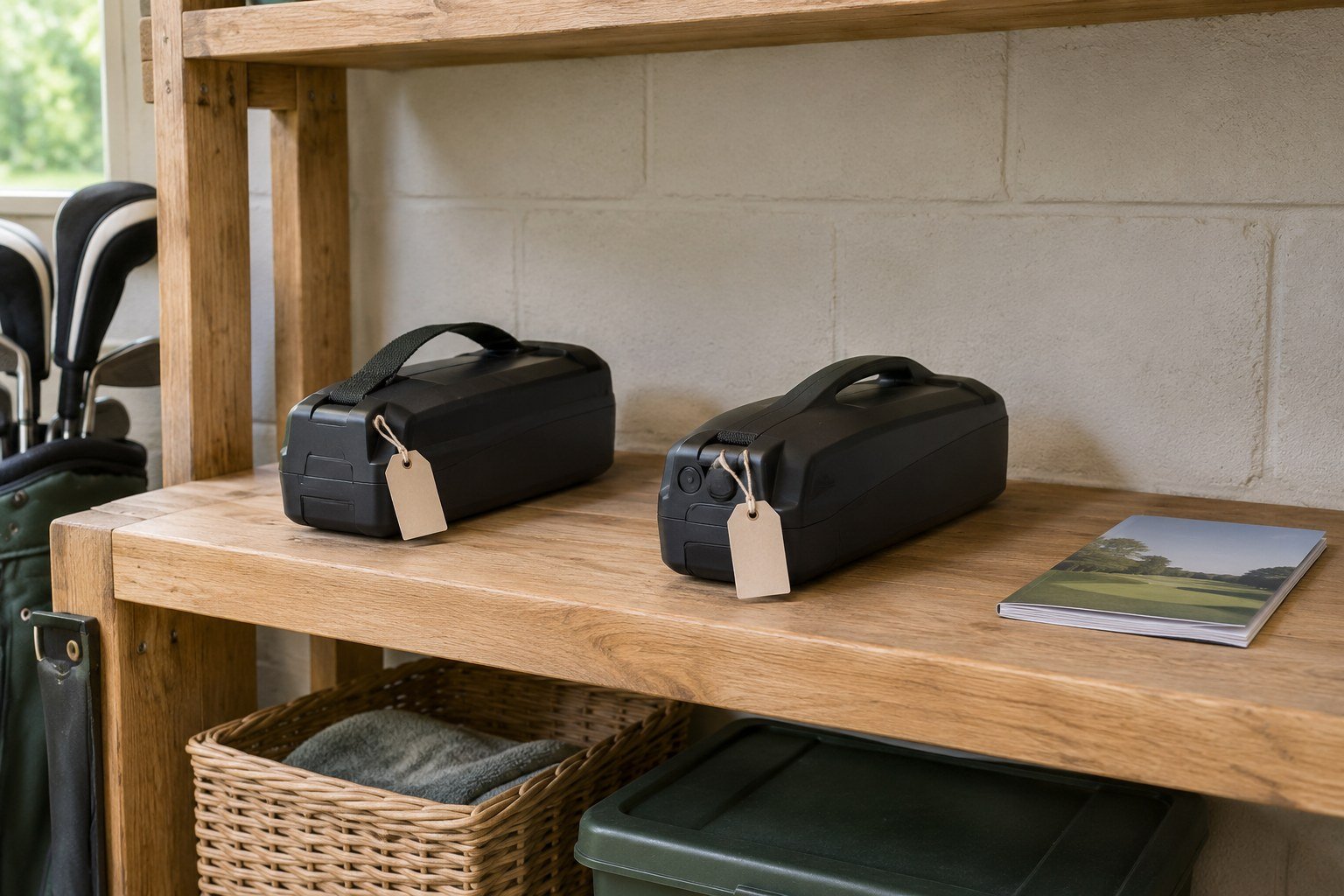
Turn the confirmed routine into a dated note: preparation before storage, location, next recharge and return-to-play check. Avoid borrowing a partial-charge storage percentage from a different type of consumer device.
Separate playing range, service life and warranty
Range is the usable golf between charges. PowaKaddy’s CT10 manual describes its Standard 30V battery for 18 holes and its XL Extended battery for 36 in normal conditions, with route, load, ground and temperature qualifications.[6]
That example makes the practical point: lithium does not automatically mean two rounds. For the capacity question, use our guide to battery capacity and the conditions behind 36-hole claims. Keep this decision focused on an approved pack that covers your normal use.
Service life is how long a battery remains useful. PowaKaddy identifies use, lack of use, charging practice, trolley condition and bag weight as relevant factors. There is no single replacement birthday that follows from the chemistry name.[9]
Warranty is the stated support if a qualifying problem occurs. PowaKaddy’s 2026 UK and Ireland terms list one year for Plug ’n’ Play lead-acid batteries and a five-year pro-rata lithium arrangement: three years of standard cover followed by specified discounted-replacement terms.[10]
A long headline warranty is therefore not the same thing as a free replacement throughout that period, or proof of how many seasons your battery will last. Read the terms for the exact purchase and keep the receipt and any required registration.
Ignore arithmetic that treats a manufacturer’s lifespan multiplier as your guaranteed replacement schedule. If the pack already struggles with your usual round, arrange a battery, charger and trolley assessment before deciding that a different chemistry is the answer.
Back to top ↑Price the complete change, then test the assumptions
Compare what you would actually pay from today. Money already spent on a serviceable system is not another charge in the replacement quote, but any immediate repair needed to keep it working belongs in the comparison.
| Cost line | Keep or replace with approved lead-acid | Change to approved lithium |
|---|---|---|
| Battery | Actual quote, or zero if keeping a sound pack. | Exact approved battery quote. |
| Charger | Zero only if the existing unit remains approved and serviceable. | Included in the pack price, or a separately quoted approved unit. |
| Fittings/service | Necessary work only. | Only manufacturer-approved requirements and installation. |
| Other purchase costs | Delivery and any agreed diagnostic charge. | Delivery and any agreed diagnostic charge. |
| Future replacement | Scenario assumption, clearly identified. | Scenario assumption, clearly identified. |
Planning cost per round = total cost assumed over your chosen period ÷ rounds you expect to play in that period. Use this as a comparison tool, not a prediction. Run one scenario with no further replacement and another with a replacement at a time you choose. Label that time as an assumption.
If lithium only appears cheaper when you assume exceptionally long life, the result is fragile. If the two choices cost much the same under reasonable scenarios, the easier lift or simpler handling may settle it. Keep energy cost separate unless you have actual electricity-use evidence; battery capacity alone is not a measurement of charging consumption.

When keeping, changing or replacing the trolley makes sense
Keep the approved system when it already works for you
A sound lead-acid pack that covers your normal round, has a suitable serviceable charger and is comfortable to handle has a clear argument in its favour: it already meets the need. Review its condition and routine before buying for a marketing claim alone.
Consider approved lithium when it solves an identified problem
Lower carried weight may justify an additional cost even if no financial saving is promised. Make that decision after confirming the actual pack, charger, handling arrangement and storage requirements. Do not use improvised connections or an unapproved charger to make a conversion seem cheaper.
Compare a complete trolley only when the existing machine also needs replacing
If the frame or drive system is nearing replacement, compare its total repair-and-battery quote with a complete supported system. One current retail reference is the 2026 Motocaddy SE with Standard lithium battery at Clubhouse Golf. Its listing includes a charger; this is a whole-trolley option, not a replacement battery for an older SE.[13]
Ask the retailer to confirm the exact supplied generation, battery and current terms. Choose the machine for its suitability as a whole, rather than allowing a battery decision to obscure folding, loading and course requirements.
Back to top ↑Plan a proper end to the battery’s working life
Neither chemistry belongs in household rubbish. UK product-safety guidance directs waste batteries to appropriate collection points. Ask the manufacturer or local recycling centre which route accepts your trolley pack, especially if it is damaged.[11]
Do not use or charge a suspect lithium pack. Scottish Fire and Rescue Service highlights damage, swelling, leakage and unusual heat among warning signs; contact the maker about safe handling and disposal.[12]
Do not open a pack or improvise a discharge method to prepare it for recycling. Keep its identification available so the receiving service can advise on the correct procedure. A new battery purchase is complete only when you also know what to do with the old one.
Back to top ↑Frequently asked questions
Is lithium always the better trolley battery?
No. It may offer a worthwhile handling advantage, but suitability depends on an approved system, actual weight, cost and your routine. Keeping a sound lead-acid system is reasonable when it meets those needs.[2]
Can I replace lead-acid with lithium in any trolley?
Only where the trolley and battery manufacturers approve the complete combination, including the charger. The specific dual-chemistry options in the 2024 Motocaddy SE manual are not permission for other models.[1]
Does lithium automatically provide 36 holes?
No. PowaKaddy’s CT10 manual distinguishes Standard and XL Extended capacities, and qualifies range by conditions. Choose the approved capacity for your actual use.[6]
Do lithium batteries need winter charging?
Follow the exact manual. PowaKaddy’s 2023 FW3 instructions call for full charging before storage and monthly recharging; other documented systems use different intervals.[7]
How many years will a trolley battery last?
There is no reliable universal figure. Use, charging and trolley condition affect service life; warranty terms are conditional support.[9][10]
Sources and checks
Sources consulted on 23 November 2026. Manufacturer and retailer descriptions are attributed claims; illustrations do not show tested products. Recheck current model-specific instructions and compatibility before use or purchase.
- Motocaddy — 2024 SE Instruction Manual, named battery options
- Motocaddy — LitePower 12V Lithium Battery & Charger, Standard
- PowaKaddy — Plug ’n’ Play Standard Lithium Battery
- Motocaddy — NEW M-Series 28V Standard Lithium Battery & Charger
- Motocaddy — Lead-Acid Battery Instructions, 2019
- PowaKaddy — CT10 GPS Owners Manual, 2026 REV2
- PowaKaddy — FW3 Lithium Owners Manual, 2023
- Motocaddy — 2026 SE Instruction Manual, lithium storage
- PowaKaddy — FAQs and Technical
- PowaKaddy — UK and Ireland Warranty Information, 2026 terms
- Office for Product Safety and Standards — Recycling batteries and electrical waste
- Scottish Fire and Rescue Service — Lithium-ion batteries
- Clubhouse Golf — 2026 Motocaddy SE with Standard lithium battery
Illustrations in this article were created for Taylor’s Trailblazing Golf. Third-party photographs, where used, are credited beside the image or in the source list.