Golf Waterproof Ratings Explained: Hydrostatic Head and Seams
A large number on a jacket label can be useful. It becomes much more useful when you know what was tested, how the garment is built and which questions the number leaves unanswered.
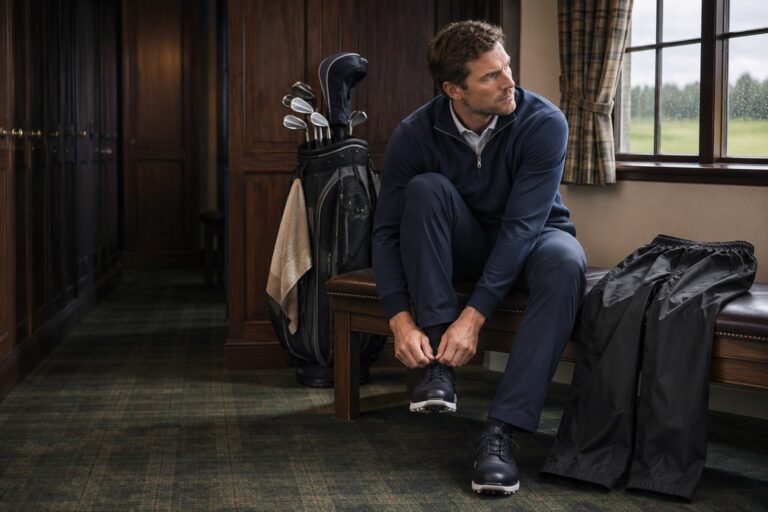
AI illustration. A fabric rating is one part of the evidence for choosing a complete rain garment.
This guide contains affiliate links. If you buy through them, Taylor’s Trailblazing Golf may receive a commission at no extra cost to you.
Golf waterproof ratings are useful when you know what was measured. Read the fabric result alongside the test method, seam construction and complete garment details before treating a larger number as a better choice.
Research-led guidance for UK golfers. Read how we assess golf equipment for the distinction between documented features and hands-on testing.
Match the test method, specimen and condition before treating one number as better.
Check seams, closures and coverage over your intended layers as separate decisions.
Record where moisture appeared and seek care or repair advice before assuming the original rating was wrong.
What hydrostatic head actually measures
Hydrostatic head expresses water pressure as the equivalent height of a column of water, usually in millimetres. A 10,000 mm claim therefore refers to a pressure equivalent to a 10-metre water column. It does not mean 10 metres of rainfall, immersion to that depth, or 10,000 minutes of protection.
The laboratory applies pressure to a specimen and records a defined water-penetration endpoint. For example, SATRA TM259 progressively increases pressure on one face and records the pressure at the third point of penetration. It can assess materials or seams. That is a controlled measurement, not a simulation of every part of a golf round.[2]
ISO 811:2018 is a recognised hydrostatic-pressure method for fabrics and remains current following confirmation in 2025. A label must actually identify its method before you can assume ISO 811 was used.[1]
When methods and specimen conditions match, a higher result means greater resistance in that comparison. Keep the conclusion that narrow. Doubling the number does not establish twice the useful life or twice as long in rain. Nor does an unreported number automatically mean the garment is unsuitable: it means that particular comparison is unavailable.
Use the rating to ask a better question: “What evidence supports this jacket for the wet-weather use I have in mind?” Avoid translating a pressure result into a timetable for continuing a round.
Back to the start ↑Ask what was tested before comparing figures
A sales page may quote a fabric supplier’s figure without showing the full report. That can still be useful information, provided you keep track of its scope. Ask the retailer or manufacturer for the missing details that could change your decision.
On a small screen, swipe inside the table to read every column.
| What you find | What to record | How to use it |
|---|---|---|
| A number with “mm” | Exact value and the property named beside it | Record it as a water-pressure claim; do not assign hours of rain. |
| A named method | Standard, edition and any stated procedure | Compare against results obtained on the same basis. |
| “Fabric tested” | Which fabric or assembled layers were assessed | Keep seams and garment openings on the separate checklist. |
| A result after treatment | Any stated washing, wear or other preparation | Do not silently equate it with an untreated specimen. |
| A garment test | What the manufacturer says was assessed | Read its scope; do not assume every garment follows the same protocol. |
| A warranty | Terms, exclusions, claim route and care requirements | Treat it as aftercare information, separate from the pressure result. |
The distinction between fabric and garment testing is real. GORE-TEX, for example, describes a separate rain-room assessment of garment design, alongside its material testing. That illustrates why a fabric number alone cannot describe the complete jacket.[3]
You do not need to demand a laboratory report for every purchase. Prioritise the gaps: a missing procedure matters most when you are paying more specifically because one rating looks higher. A clear written explanation may be enough to decide whether that price comparison has a sound basis.
Back to the start ↑Read seams and closures as part of the specification
Stitching, panel joins and fastenings need their own attention. GORE-TEX explains that its waterproof garments combine laminates with seam tapes, construction requirements and assessment of other components, including zips. This is a useful example of garment-level design, rather than a claim that every rain jacket uses the same construction.[4]
Look for explicit wording such as “fully seam sealed”. If a listing mentions only selected or critical seams, ask which joins are covered. A photograph of tidy stitching does not answer that question, and a lining may hide the sealing completely.

For a jacket you can handle, open it normally and look at accessible joins without pulling, peeling or removing anything. Record visible lifting tape, a split, a damaged closure or an unexplained gap for the retailer to assess. A neat-looking seam is reassuring as an observation; it is not a certified waterproof test.
Read the main zip and pocket descriptions separately. A water-resistant zip, a covered zip and a waterproof pocket claim are different pieces of information. Ask whether pocket protection is stated, particularly if you intend to carry a phone or paper scorecard there. Do not assume the jacket’s headline rating applies unchanged to each pocket.
Operate the closures with the layers you expect to wear. Check that the front zip reaches its intended closed position, storm flaps sit as designed and cuffs can be adjusted without strain. If the instructions are unclear, ask before buying rather than improvising a different fastening arrangement.
Back to the start ↑Check coverage while making ordinary golf movements
A specification cannot tell you whether this size will cover you properly. Try the garment over the shirt and midlayer you would actually use. If you need measurement help first, the golf clothing size-chart guide explains how to approach the brand’s sizing information.
Fasten the jacket as intended, then make a comfortable address position and a slow practice turn in a clear space. Reach forward as if pushing a trolley, and bend normally as if reaching into a bag pocket. You are checking fit, not testing waterproofness.
- Does the hem retain useful overlap with the trousers, or rise enough to expose the layer underneath?
- Do the sleeves and cuffs remain in a comfortable position when you reach?
- Can the collar close without pressing uncomfortably or forcing you to leave it open?
- Can you use the pockets and adjusters without repeatedly pulling the jacket out of position?
- If you carry your bag, does your normal strap arrangement interfere with a closure or bunch the garment?
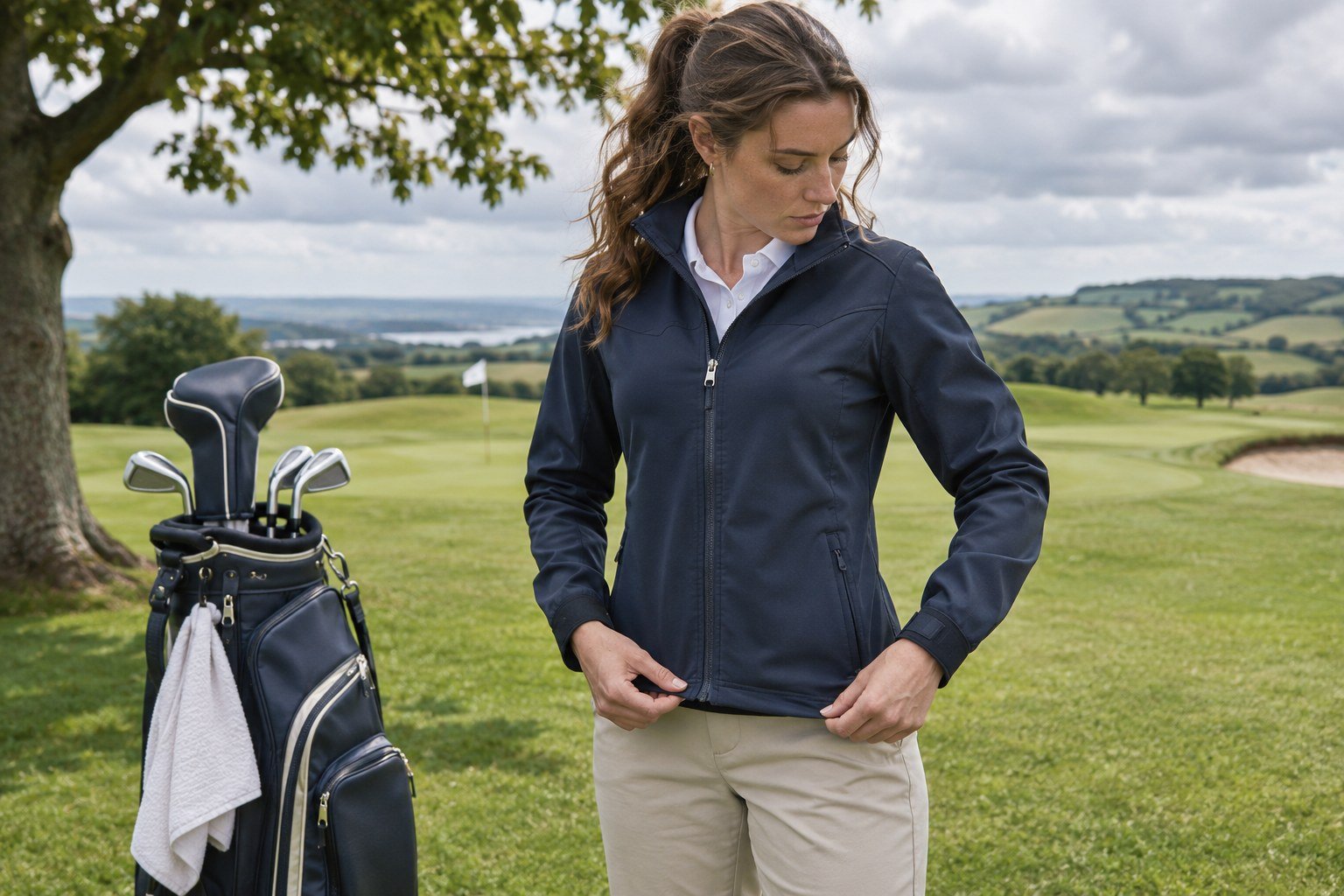
Write down the movement that caused a problem. “Hem rose when reaching forward” is more useful during a size comparison than “felt a bit small”. Repeat with another suitable size or cut, rather than assuming a larger hydrostatic-head figure will compensate for poor coverage.
Back to the start ↑Separate surface beading from suspected leakage
DWR, or durable water repellent treatment, acts at the outer surface. GORE-TEX explains that diminished beading can allow the face fabric to saturate while the membrane remains waterproof. Consequently, a wet-looking exterior is not by itself proof of a failed barrier; attractive droplets are not proof of complete garment protection either.[5]

When investigating an existing jacket, begin with what you observed during ordinary use. Note the location of dampness, whether it was inside or outside, which closures were open, what you wore underneath and whether the issue recurred. These notes help a manufacturer assess the problem without your needing to diagnose its cause.
Then read the care label and the instructions for that exact garment. Follow its permitted cleaning and drying process; do not borrow a heat setting, treatment or ironing instruction from a different waterproof. Keep the product name and receipt with your notes if you may need support.
A visibly damaged seam or closure, or repeated unexplained internal wetness, deserves an assessment before you rely on the garment for another wet round. GORE-TEX directs damage and repair enquiries to the relevant manufacturer or authorised repair route. Use the corresponding route for the brand you own.[4]
A shower, hose or weighted water test at home will not reproduce the published laboratory method. It may also confuse the question by introducing unusual pressure or entry through openings. An observation log and photographs give the retailer a clearer starting point.
Back to the start ↑A real label example: PING Taran 3L
The PING Taran 3L in Blue 24 is useful for practising this approach. PING’s manufacturer description identifies three-layer stretch fabric, fully sealed seams, adjustable cuffs and hem, and a two-way front zip. Clubhouse Golf’s exact Blue 24 listing, article P03696-BL24, publishes a 20,000 mm waterproof claim.[6][7]
That gives you both a number and construction details to examine. The retrieved descriptions do not supply a complete hydrostatic-test report, so they do not establish the method, specimen preparation and endpoint needed for a rigorous comparison with another brand’s figure. Ask for clarification if that comparison is what would justify the purchase.
For a fitting shortlist, check whether the adjustment range and coverage work over your usual layers. The useful buying question is whether the complete garment meets your needs, with enough evidence to support the price you are considering. This is a specification example, not a hands-on endorsement or a ranking.
If those features suit your shortlist, check the PING Taran 3L jacket in Blue 24 at Clubhouse Golf. Confirm the selected size and current return terms before ordering.
Back to the start ↑Compare two labels without inventing a winner
Consider this hypothetical example. Jacket A is advertised at 20,000 mm, with no method or specimen condition shown. Jacket B is advertised at 15,000 mm, with a named method and a result stated after a specified washing programme. Both say their seams are sealed.
You can accurately say that A publishes the larger number. You cannot yet conclude that it will outperform B in use. The descriptions are incomplete in different ways, and the specimen histories do not match. Ask A’s manufacturer for its test basis and B’s manufacturer which parts of the finished garment were covered by the claim.
Now suppose the manufacturers confirm matching methods and conditions. A’s higher result becomes a meaningful fabric comparison. You still need the coverage and closure checks, and neither result establishes a number of rain-soaked holes.

If B fits well, has clear aftercare and satisfies your intended use, a larger figure on A is not by itself a reason to replace it. Conversely, if your current jacket has an unresolved construction fault, shopping by an old rating does not resolve that fault. Decide which question you are actually trying to answer before comparing numbers.
Back to the start ↑Use this label-check worksheet before buying
Copy the following prompts into a note for each candidate. Use three answers: documented, needs asking or needs a fitting check. This keeps missing information visible without turning the exercise into an artificial points score.
- Identity: exact model, colour, product code and source page. Have you mixed a current listing with an older version?
- Pressure claim: the full value and unit. Does the source identify the test method and edition?
- Test scope: fabric, assembled material, seam or finished garment? What preparation or ageing is reported?
- Construction: which seams are sealed, how the front closes and what is stated about pockets.
- Coverage: the size tried, layers worn and any movement that exposed an overlap or strained a closure.
- Ownership: the exact care instructions, support contact and warranty terms you would need to keep.
- Decision: the one unresolved question that would change your choice.
A useful enquiry is specific: “For this product code, is the published figure for the fabric as supplied or after treatment, and which method was used?” Follow with the seam or closure question that matters to you. You are more likely to receive a useful answer than by asking whether a jacket is “really waterproof”.
Shortlist the garment when its documented construction and fit meet your needs. Pause when the missing answer is central to your purchase. Seek support when an existing garment shows a fault. You can browse the wider Clothing & Wet-Weather Gear guides for the other parts of a wet-weather outfit.
Back to the start ↑Questions before you decide
Does 20,000 mm mean a golf jacket will keep me dry for a full day?
No duration follows from that number. It is a water-pressure claim under a test method, while a round involves the finished garment, its condition, its fit and the way its openings are used.
Is 10,000 mm automatically enough for golf?
A universal pass mark would hide the information that matters. Read the manufacturer’s intended use, test evidence and seam construction, then check coverage. A number alone cannot certify a particular round or wearer.
Are sealed seams more important than a high rating?
They answer different questions. A fabric result cannot establish how panel joins are protected. Check both, including whether the manufacturer describes full sealing or only selected seams.
Should I replace a jacket when water stops beading?
Start with the exact garment’s care instructions and the symptoms you observed. Loss of beading alone does not establish a failed waterproof barrier. Visible damage or repeated internal wetness calls for manufacturer or retailer advice.
Sources and editorial checks
Manufacturer documentation and published technical evidence inform this guide. The comparisons and checklists are editorial decision aids, not results of hands-on product testing.
- ISO 811:2018 — resistance to water penetrationPublic abstract; fabric-test scope. Current edition, confirmed in 2025. Checked 24 November 2026.
- SATRA TM259 — hydrostatic pressure testPublic method summary explains increasing pressure, the penetration endpoint and application to seams. Checked 24 November 2026.
- GORE-TEX — garment testingDescribes separate rain-room assessment of garment design. Checked 24 November 2026.
- GORE-TEX UK — frequently asked questionsSeam tapes, garment construction and manufacturer or authorised repair assessment. Checked 24 November 2026.
- GORE-TEX — durable water repellent treatmentSeparates surface water repellency from the waterproof membrane. Checked 24 November 2026.
- PING — Taran 3L jacket, Blue 24Manufacturer description of three-layer construction, sealed seams and adjustment features. Retrieved 24 November 2026.
- Clubhouse Golf — PING Taran 3 Layer jacket, Blue 24Exact P03696-BL24 listing and published 20,000 mm claim. Checked 24 November 2026.
Illustrations in this article were created for Taylor’s Trailblazing Golf. Third-party photographs, where used, are credited beside the image or in the source list.