What to Wear for Autumn Golf in the UK: A Practical Layering System
Build an outfit for the whole round, including the moment the weather changes.
Plan for the whole playing period, including walking and waiting. The golfers and clothing are illustrative.
Deciding what to wear for autumn golf in the UK is easier when you plan the round rather than dress for the first tee alone. Start with a comfortable shirt or base layer, add removable warmth where you need it and carry suitable rain protection when the forecast calls for it.
The useful system is one you can change without emptying the bag or fighting a tight jacket. This guide combines official weather and garment information with an editorial planner. The worked round is fictional, and the clothing examples have not been wear-tested for this article.
Ad – includes affiliate links. If you buy through these links, Taylor’s Trailblazing Golf may earn a commission. Recommendations are based on the equipment decision and the available evidence.
Use removable warmth so a comfortable first tee does not dictate the whole round.
Keep appropriate waterproofs accessible, with room for the clothing underneath.
Plan for both your moving pace and the periods when you will stand still.
Identify the missing function before adding another similar layer.
What to wear for autumn golf in the UK: plan the whole round
Check the forecast at the course location for your tee time, the middle of the round and the likely finish. The Met Office explains that “feels like” temperature includes wind and humidity; it also distinguishes average wind from stronger gusts. These details can be more useful for an exposed course than the day’s headline temperature alone. [1]
Write down the main change you are preparing for: a cool start becoming mild, an increasingly windy afternoon or showers arriving before you finish. Check current warnings and course notices as part of that plan.
Then add your own circumstances. Will you walk briskly, ride in a buggy, carry a bag or wait between shots? Do you normally feel warm or cool in the clothing you already own? There is no universal temperature at which every golfer needs another jumper.
Before leaving home, finish this sentence: “I will start in these clothes, carry this extra item, and change when this happens.” If a packed layer has no clear job, reconsider it.
Give each layer a different job
A layering system is a way to assign jobs, not a requirement to wear three technical garments all day. Galvin Green’s own combinations distinguish rainy and warm conditions from rainy and cold ones: the first uses a breathable shirt with rainwear, while the second adds thermal layers. That supports adapting the combination rather than buying a fixed autumn uniform. [2]
On a phone, swipe within the table to see all columns.
| Role | Useful starting choice | Check before adding more |
|---|---|---|
| First layer | A comfortable polo, shirt or base layer that suits your usual playing conditions. | Will its sleeves and collar sit comfortably beneath the next layer? A dedicated thermal top is optional, not automatic. |
| Removable warmth | One jumper, light fleece, zip-neck top or insulating vest that you already find comfortable. | Can it come off easily, and does it still fit beneath the outer layer? A vest leaves the arms with less coverage. |
| Outer protection | A windproof or waterproof garment with the protection stated for that exact model. | Does the forecast need rain protection, wind protection or both? Do not infer waterproofness from a smooth fabric or a shower-resistant description. |
Brand families can help identify these jobs, but the names need checking. Galvin Green separates DRYVR waterproof materials, INTERFACE-1 windproof and water-repellent materials, INSULA insulation and SKINTIGHT base layers. Those are different functions; they are not interchangeable promises or a shared temperature scale across brands. [3]

Start with your existing clothes. If a familiar mid layer already works under your shell, a second similar one may add little. If you have warmth but no suitable rain protection, another thick jumper does not fill that gap.
Back to top ↑Try the full combination before the first tee
Put on the largest combination you expect to wear, including the outer layer. A jacket that feels generous over a polo may feel different over a fleece. Use the size chart for the exact garment, then check the combination rather than automatically going up a size.
Our golf clothing size-chart guide explains body measurements and garment allowance. For this autumn outfit, concentrate on the places where layers meet:
- Raise and bring your arms forward without a club. Check for pulling across the shoulders and bunched material under the arms.
- Fasten the shell as you would in rain. Check whether the collar remains comfortable over the mid layer.
- Reach towards a pocket and take an address-like stance in a clear space. Look for a rising hem or clothing that catches at the waist.
- Check that cuffs do not obstruct the glove or cover your hand, and that trouser or overtrouser hems clear the ground in your playing shoes.
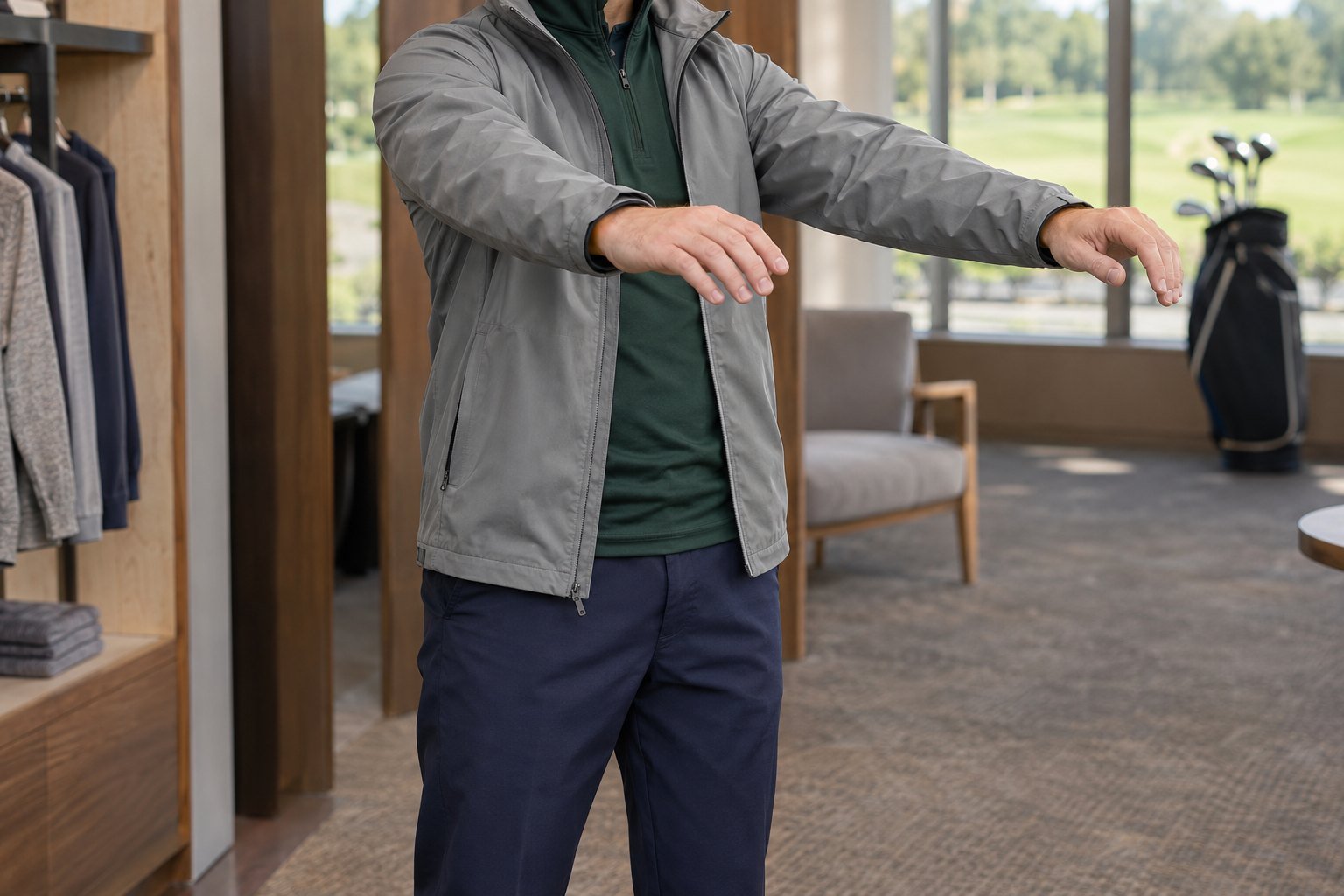
These are practical checks, not a fitting certificate. If one combination binds, change the garment cut or the thickness underneath and repeat it. A stretch claim cannot tell you whether your particular combination will feel comfortable.
Back to top ↑Use simple triggers for adding and removing clothing
Choose your change points before you need them. If you are becoming uncomfortably warm while walking, adjust an opening or remove the warming layer at a sensible stopping point. If a pause or exposed stretch feels cooler, put it back on before settling into a long wait.
For approaching rain, keep the shell where you can reach it and put it on before the clothing beneath gets wet. Use a convenient sheltered place for changing when available. If your outer layer is also providing wind protection, you may prefer to remove the mid layer beneath it rather than remove the shell itself.

Those are editorial comfort decisions, not instructions to finish in deteriorating conditions. Course notices and decisions about whether play should continue come first. Clothing choice does not settle whether the course is safe to use.
Once you change something, notice the result over the next part of the round. “Removed the fleece on the uphill walk; needed it again during the wait” is more useful for next time than simply recording “cold day”.
Back to top ↑A compact planner, with a worked autumn round
The following is a hypothetical example, not a current forecast or a tested temperature recommendation. Sam expects to walk from 10am to 2pm. The invented forecast shows 8°C at the start, 12°C around midday, increasing wind and showers after noon. Sam normally warms up while walking but dislikes standing in a damp jumper.
On a phone, swipe within the table to see all columns.
| Decision | Sam’s plan | Trigger or check |
|---|---|---|
| Wear at the start | Familiar polo, one light zip-neck mid layer, comfortable golf trousers and usual suitable golf shoes. | Try the shell over this outfit before leaving. Check trouser hems with those shoes. |
| Carry for rain | Existing waterproof jacket and overtrousers in the easiest-to-reach clothing space. | Put them on before the forecast showers arrive or rain begins to develop locally. |
| Adjust for warmth | Remove the mid layer when walking becomes uncomfortably warm; keep it protected in the bag. | If a cooler wait follows, add it again. The forecast temperature is not a compulsory switching point. |
| Small extras | A familiar hat, spare suitable glove and dry socks kept separately from wet kit. | Use only if needed; the socks may be most useful after the round. |
| Leave at home | A second bulky jumper that duplicates the existing mid layer’s job. | Reconsider if the forecast, playing plan or Sam’s usual comfort needs change. |
For a calm, mild and dry round, Sam might start without the mid layer. For a colder round with more waiting, the starting combination could need more warmth. Change those choices using your own experience rather than copying the example’s numbers.
Use the same three columns for your next round: decision, actual item and the reason to change it. Afterwards, record one useful observation and alter the next plan accordingly. There is no need to build a complicated wardrobe log.
Back to top ↑Finish the outfit below the waist and inside the bag
Choose trousers that are comfortable for walking and bending, then decide whether overtrousers need to be carried. Try them over the actual trousers and shoes you will use. Check the waistband, lower-leg opening and hem; extra length can bunch even when the waist size seems right. The shorter-leg golf trousers guide covers that fit problem in more detail.
Use shoes and socks that already fit together, and check the footwear’s stated weather protection and the course’s footwear requirements. A second thick sock is not an automatic solution if it makes the shoe cramped. Keep a spare pair available for a comfortable change if you need one, without treating it as a way to make unsuitable footwear waterproof.
A hat and a spare appropriate glove can be small additions with a clear purpose. You do not need a new matching accessory set to use the planner. Check that any neckwear or cuffs sit comfortably and do not interfere with movement.

Pack dry spare clothing in a suitable protective compartment or inner bag you already own. Keep the next likely item near the opening, and leave space for the mid layer you may remove. A tightly stuffed pocket that cannot accept it defeats the point of removable warmth.
Back to top ↑Buy for a missing role, with the exact model in view
These are two UK-listed examples of different functions, not a ranked autumn outfit or a requirement to buy both. Their specifications are manufacturer descriptions rather than our test results. Check current sizes, the delivered model and how it works with the clothing you own.
- For an adjustable mid layer, FootJoy’s navy Chill-Out Pullover, style 90147, uses a stretch double-layer knit and is described as a breathable, moisture-wicking mid layer. Treat it as warmth to combine with other clothing, not as your rain shell. [4] You can view the navy 90147 Chill-Out at Clubhouse Golf, whose listing identifies the same article number. [6]
- For a packable rain shell, FootJoy’s HydroLite X Jacket, style 37814, is described as seam-sealed waterproof outerwear with 2.5-layer construction. FootJoy positions this model for warmer playing conditions; that is a reason to assess the warmth underneath for your autumn round, not assume the jacket supplies it. [5] You can check the 37814 HydroLite X at Clubhouse Golf. The retailer calls the colour Flint; FootJoy calls it Flint / Niagara, with the same style number. [7]
If your current outfit already covers those jobs and passes the full-combination check, use it. Make the next purchase solve a recorded problem: an outer layer that binds, missing rain protection or warmth that is too awkward to remove.
Browse Clothing & Wet-Weather Gear for further clothing decisions. The review method explains how sourced specifications and practical editorial judgement are distinguished.
Back to top ↑Sources and checks
Research and specifications checked on 24 November 2026. Manufacturer descriptions are identified in the text; practical checklists and worked examples are editorial guidance, not product testing.
- Met Office — What does this forecast mean? — checked 24 November 2026
- Galvin Green — Men’s Comfort Combinations — checked 24 November 2026
- Galvin Green — Our materials — checked 24 November 2026
- FootJoy — Navy Chill-Out Pullover, style 90147 — checked 24 November 2026
- FootJoy — HydroLite X Jacket, Flint / Niagara, style 37814 — checked 24 November 2026
- Clubhouse Golf — Navy FootJoy Chill-Out, article 90147 — checked 24 November 2026
- Clubhouse Golf — Flint FootJoy HydroLite X, article 37814 — checked 24 November 2026
Illustrations in this article were created for Taylor’s Trailblazing Golf. Third-party photographs, where used, are credited beside the image or in the source list.