Golf Club Storage in a Garage: Damp and Temperature Risks
Golf club storage in a garage depends on what happens around the bag between rounds. Assess the space, put equipment away in suitable condition and keep a routine that lets you notice changes before the next round.
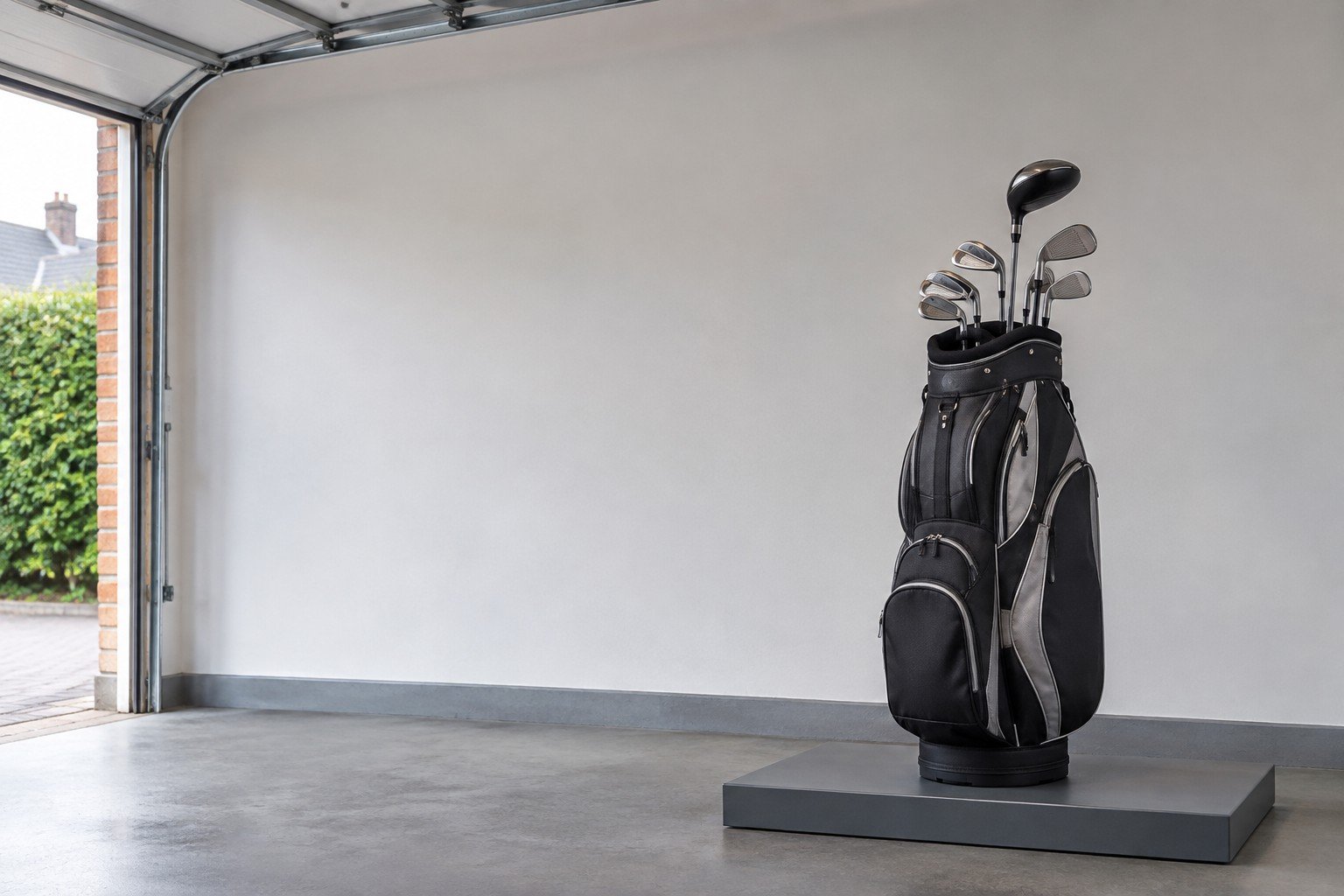
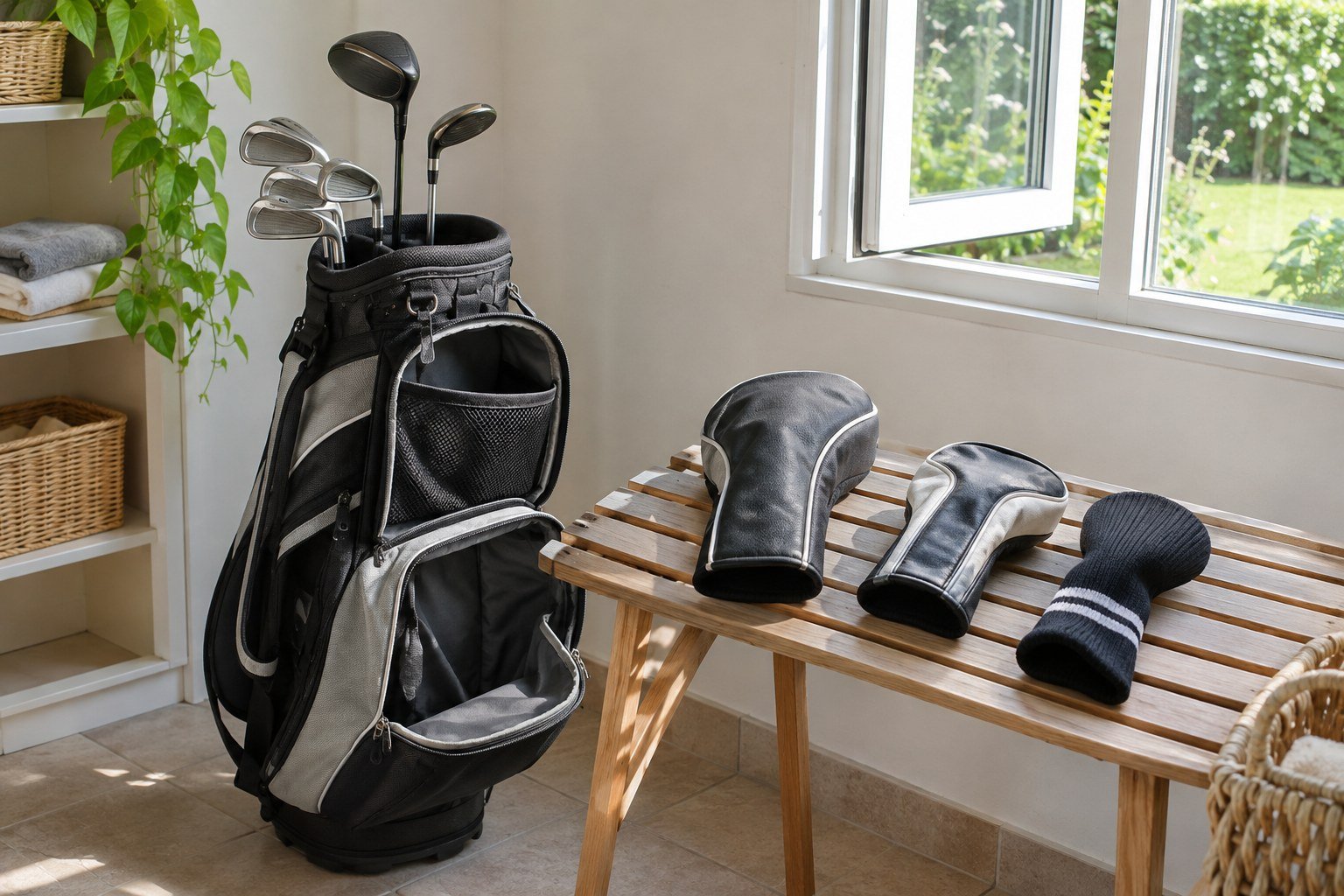
AI illustration. Assess the conditions around the bag, including damp surfaces, air movement and nearby hazards.
Golf club storage in a garage depends on the conditions around the equipment. Check for damp, temperature exposure and physical hazards, and establish a drying routine before deciding that a particular space is suitable.
Research-led guidance for UK golfers. Read how we assess golf equipment for the distinction between documented features and hands-on testing.
A dry-looking garage on one visit may not represent its conditions after rain or through another season.
A wet bag needs a drying routine before it returns to its normal place.
Use a suitable indoor location if recurring damp or the maker’s storage requirements remain unresolved.
Assess conditions rather than the room’s name
“In the garage” can mean a stable interior storage bay, a corner beside a rain-wet car, or a space that becomes very warm in direct sun. Those arrangements deserve different decisions. The useful question is whether the chosen spot remains suitable between visits, including the periods when you are not playing.
Golf Pride advises a cool, dry location away from sunlight and names a climate-controlled garage among its storage examples.[1] That is a qualified example, not approval for every garage.
Begin with the instructions for your own clubs, grips, bag and covers. A mixed set may include several materials and finishes. If one item has a more restrictive storage requirement, follow that requirement for the item or give it a separate suitable home.
Inspect the proposed place at different useful moments: after a wet return, after heavy rain outside and when the garage has warmed or cooled. These observations will not certify the building, but they can reveal why a convenient corner is a poor choice. You do not need to wait for visible club damage before changing location.
Also consider access. If reaching the bag requires moving boxes and bicycles, routine checks are likely to become awkward. A slightly less convenient storage location that you can inspect and use comfortably may work better over a whole season.
Back to the start ↑Deal with moisture brought home from the course
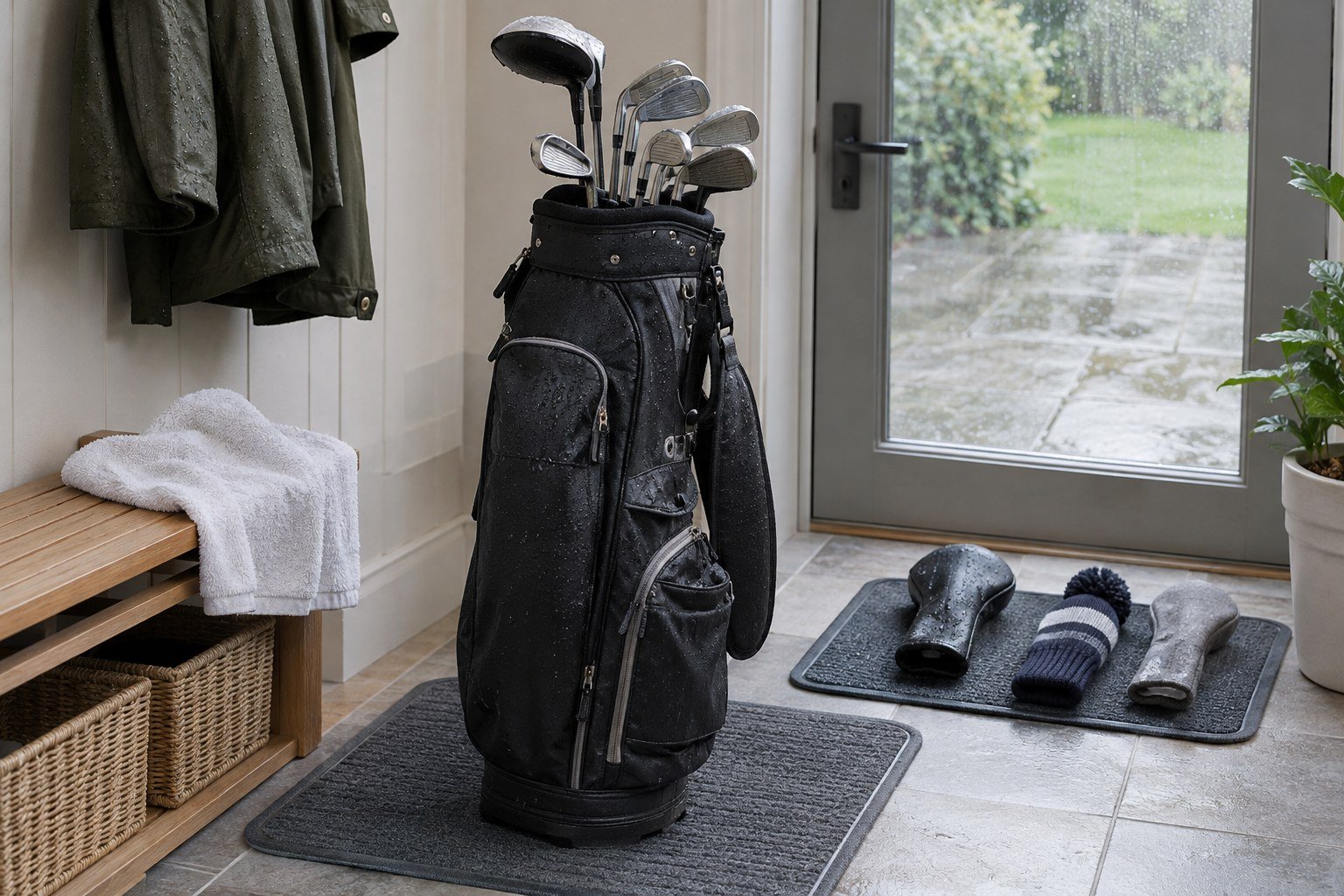
A suitable room does not make a wet cover or closed pocket dry on arrival. Check what has come home with the clubs: damp headcovers, a saturated towel, wet clothing, water in a pocket or a bag base that has been standing on wet ground.
Titleist’s separate advice for carbon-steel Scotty Cameron putters cautions against damp or cold storage.[2] Keep that model/material scope in mind; it is not a general failure temperature for every golf club.
Remove the wet items and deal with each according to its care instructions. For its bags, VESSEL advises thorough drying before storage and recommends a climate-controlled dry area, while warning against a humid garage.[3]
Give removed covers and clothing their own drying space. Check the bag pockets, base and areas hidden by straps rather than relying on the visible outer panel. If the usual garage spot cannot support that routine, use a suitable indoor drying location first. Returning the bag to storage is a later step.
Treat condensation and temperature changes as separate checks
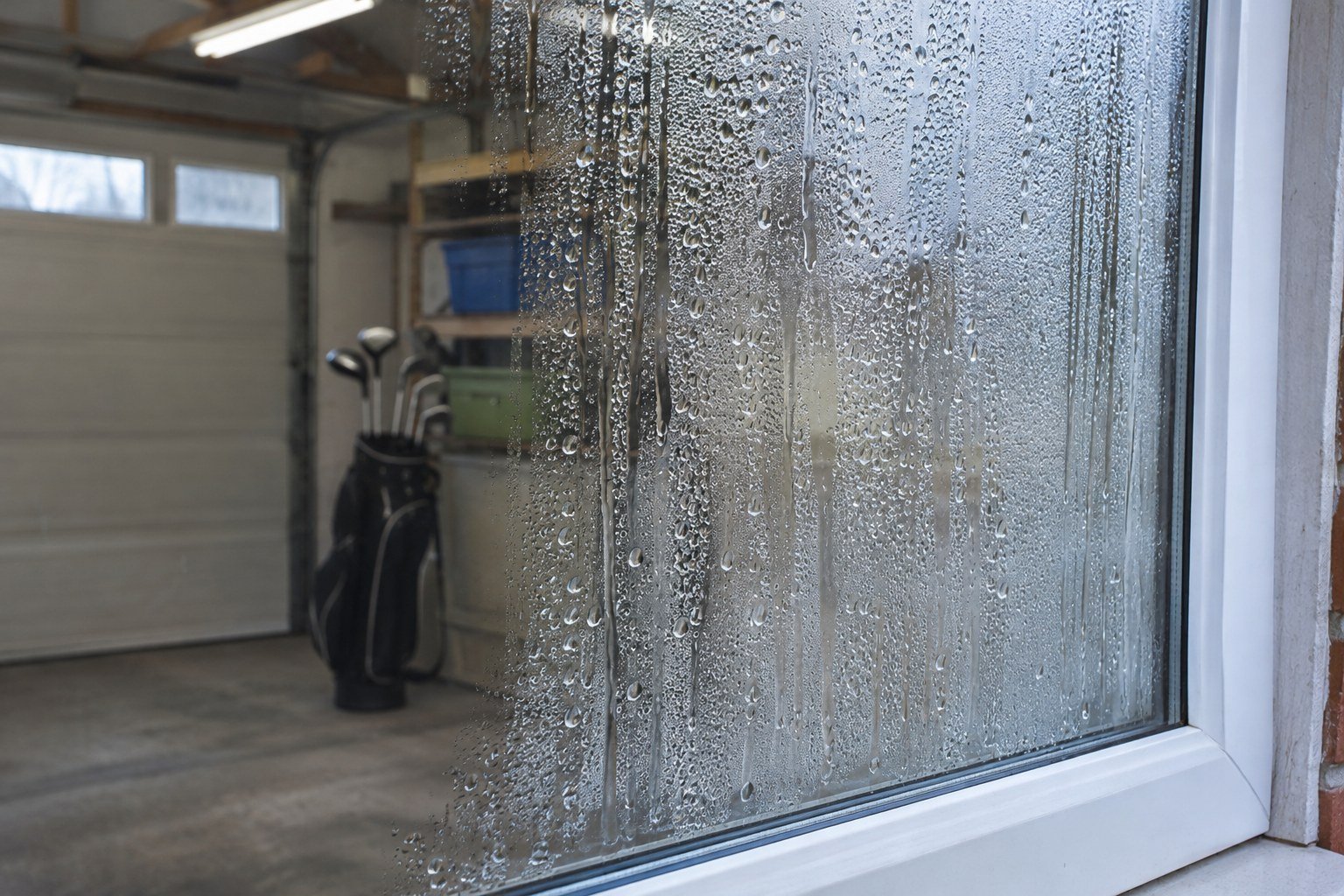
Moisture can arrive with the equipment, through a leak or from condensation. The Met Office explains that water vapour can condense on a surface when that surface reaches the relevant dew point.[4] The practical implication is that a room having a roof does not establish that every surface stays dry.
Look for beads of water on the window, damp surfaces near the bag, recurring wet marks or a musty enclosed storage area. These are reasons to investigate and relocate the equipment while the cause is unresolved. A wet window does not diagnose corrosion inside a shaft, and a dry window does not establish the condition of a closed bag pocket.
Consider heat separately. Golf Pride warns against prolonged sun exposure and heat when caring for grips.[1] Avoid making the bag’s permanent home in a sun-heated position or beside a heat source simply because the space feels dry.
The sources used here do not set a single safe temperature range for every head, shaft, grip, adhesive and bag material. They also do not establish an epoxy failure temperature or a predictable time to corrosion. Do not turn an internet rule of thumb into permission to ignore your particular equipment’s instructions.
If you use a temperature or humidity monitor, treat it as a record of conditions at its location. A reassuring reading at one moment does not answer what happened overnight or inside a damp cover. Persistent condensation or unclear manufacturer requirements is enough reason to choose a more suitable storage place without waiting for a numerical verdict.
Use a conditions chart to choose the storage spot
Walk through the space with the bag in its intended position. Include ordinary household use: doors opening, a car parking, wet outdoor items arriving and stored objects being lifted past the clubs. This chart turns those observations into a practical action.
On a small screen, swipe inside the table to read every column.
| What you observe | Decision | What to resolve |
|---|---|---|
| Dry equipment, an accessible stable position and no recurring damp or heat concern | Consider this position, subject to the makers’ instructions. | Keep the condition checks part of the normal routine. |
| Wet covers, clothing or pockets after a round | Use a separate drying stage before storage. | Find a practical place for each item to finish drying. |
| Water on the floor, leakage or repeated condensation near the equipment | Move the clubs to a suitable location while the cause is addressed. | Changing the rack alone does not settle the moisture problem. |
| Direct sun or a nearby heat source | Choose a different position or room. | Check the actual conditions through the day and the relevant care instructions. |
| Passing bikes, heavy boxes or tools can contact the bag | Rearrange the storage space. | Leave clearance for access and for the full length of the clubs. |
| The spot cannot be checked during a long absence | Prefer a known suitable indoor location. | Plan a pre-storage check and another before returning to play. |
Raising a bag on a suitable stable support may separate it from a wet floor, but it does not resolve damp air or a leaking roof. Equally, a closed cupboard is only useful if its internal conditions suit the equipment. Check the place where the bag will actually sit, rather than the appearance of the room around it.
Use storage equipment only as its maker intends. Assess the bag’s size, stability and access before buying a rack, and follow any installation requirements. This guide does not prescribe a wall fixing or load rating for an unknown garage.
Back to the start ↑Make the return-to-storage routine easy to repeat
A short routine is easier to maintain than an elaborate occasional clean. Choose an order that keeps wet items from disappearing back into closed pockets and gives you a clear point at which the bag is ready to put away.
- Unload the wet items. Separate covers, towels and clothing that need attention. Empty drinks and anything liable to spill.
- Check each club. Follow its own cleaning and drying instructions, including any special finish requirements. Do not apply one chemical or soaking method to an entire mixed set by assumption.
- Attend to the bag. Inspect its base, pockets and divider area. Leave permitted openings accessible while it dries in a suitable place.
- Recheck before closing. Look at the parts that were damp rather than guessing from elapsed time. No universal drying time applies to every cover or bag.
- Put everything back deliberately. Refit appropriate dry covers and return the bag to a stable, clear position.
- Look at the storage spot. A changed floor, wall or nearby item may make yesterday’s arrangement unsuitable today.
Do not try to compensate for an unsuitable place by wrapping a damp bag tightly and forgetting it. Nor should a room heater be treated as permission to ignore the item’s drying instructions. The aim is a routine that leaves you confident about the equipment’s observed condition before it is closed away.
For a long break from golf, leave a brief note of the date, the chosen location and any item needing a professional check. That prevents an unresolved issue from being forgotten when the season starts again.
Keep a simple inspection record
Inspect again before play, especially after a long gap or a change in garage conditions. The purpose is to notice changes and act on uncertainty. An external visual check cannot certify hidden construction or adhesive integrity.
On a small screen, swipe inside the table to read every column.
| Area | Useful observation | Response to a concern |
|---|---|---|
| Club heads and shafts | New marks, corrosion, dents, cracks or an unexpected change near a joint | Set aside a suspect club and seek assessment from its maker or an appropriate repair professional. |
| Grips | A changed surface, cracking, unusual looseness or a feel you no longer trust | Ask a golf professional or grip specialist to assess it before relying on it. |
| Covers and pockets | Residual damp, debris, damaged lining or a closure that no longer works normally | Resolve drying or material care; replace or repair only the affected item where appropriate. |
| Bag and storage support | Unstable position, damaged contact points or new pressure from surrounding objects | Change the arrangement before returning the equipment. |
Use a dated photograph if it helps you remember an existing mark. Record what you can actually see, rather than labelling every surface change as harmless or structural. Some finishes have their own appearance and care requirements; ask the maker when you cannot identify what has changed.
If the problem is catching while clubs enter or leave the bag, the full-length divider guide explains how to assess its internal layout and loaded access. That is a separate question from whether the garage conditions are suitable.
Do not flex a questionable shaft, tighten an unknown joint or polish away a mark merely to see whether the club seems usable. The appropriate next step is an assessment, not an improvised garage repair.
Choose inspection moments linked to events: a wet round, heavy rain affecting the space, a seasonal change or the first outing after storage. That is more useful than treating an arbitrary interval as a guarantee that nothing can happen between checks.
Decide whether the garage still earns its place
A garage remains a practical option when the relevant care requirements are met, the equipment can be put away in suitable condition and the arrangement is easy to inspect. Moving the bag indoors is a sensible response when those conditions are uncertain or repeatedly fail.
Hypothetical example: a golfer returns a damp bag to a rack beside the garage door. The following morning, the cover linings still feel wet and the nearby window has condensation. A taller rack does not resolve those observations. The immediate action is to move the equipment to a suitable drying and storage area, then investigate the garage conditions before using that position again.
Another golfer may have a dry, stable interior bay with clear access and equipment instructions that suit it. There is no need to replace a sound bag or buy another organiser merely because the room is called a garage.
Write down the decision: where the clubs will stay, where wet items will dry and what would make you move them. A workable routine and a suitable location are the useful outcome.
Back to the start ↑Questions before you decide
Can I leave golf clubs in an unheated garage over winter?
Check the actual conditions and the care instructions for your equipment rather than treating “unheated” as a complete answer. Recurring damp, condensation or a product-specific cold-storage restriction is a reason to use a more suitable location. The sources here do not establish a universal winter temperature threshold for every set.
What humidity level is safe for stored golf clubs?
No universal pass mark for a mixed golf set is established by the manufacturer sources used here. A monitor can help record conditions, but one reading cannot confirm that cover linings or closed pockets are dry. Use the applicable product instructions and respond to recurring moisture rather than relying on an invented percentage.
Does a golf-bag rain hood make garage storage safe?
A hood does not control the room’s temperature or humidity, or establish that the equipment underneath is dry. Follow the bag maker’s instructions for any protective cover. Resolve wet equipment and unsuitable storage conditions before closing the bag for an extended period.
Is a garage storage rack necessary?
Only if it solves an actual organisation, stability or access problem and suits the bag and space. A sound existing arrangement may be sufficient. A rack cannot correct damp air, prevent a leak or certify the condition of the clubs. Check its intended use and installation requirements before choosing one.
What if I find rust or a changed grip after storage?
Record the location and extent of the change and check the maker’s guidance for that finish or component. A photograph can help a professional assess what to do next. Set aside a club with suspected structural damage or an insecure component; do not use a general storage guide as a diagnosis or repair instruction.
Sources and editorial checks
Manufacturer guidance, published service information and other primary sources inform this guide. The comparisons and checklists are editorial decision aids, not results of hands-on product testing.
- Golf Pride UK — Grip CareStorage, sunlight and heat guidance. Checked 24 November 2026.
- Titleist UK — Warranty, Care, and RepairCarbon-steel Scotty Cameron storage guidance; material-specific scope. Checked 24 November 2026.
- VESSEL — The Complete Guide to Golf Bag CareBag drying and storage guidance; updated 24 June 2026. Checked 24 November 2026.
- Met Office — DewCondensation and dew-point explanation; no golf-equipment storage threshold. Checked 24 November 2026.
Illustrations in this article were created for Taylor’s Trailblazing Golf. Third-party photographs, where used, are credited beside the image or in the source list.