Buying Recycled Golf Balls: Grade Labels and Seller Checks
Turn “Grade A” into an order you can check, count and accept with confidence.
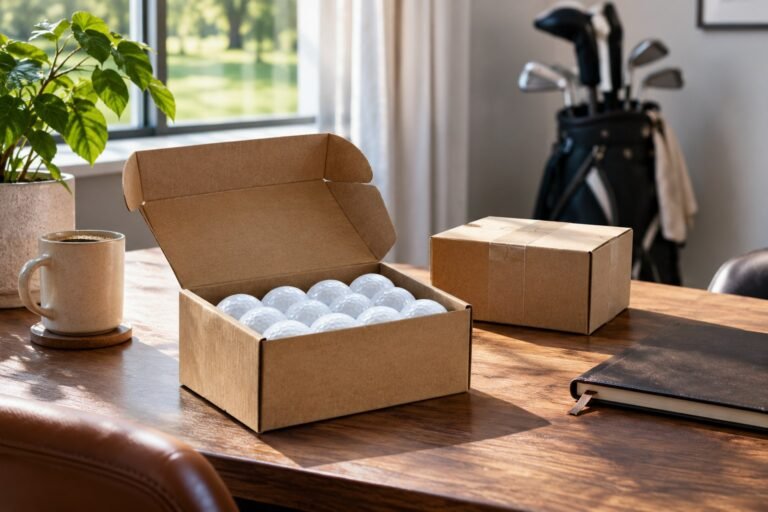
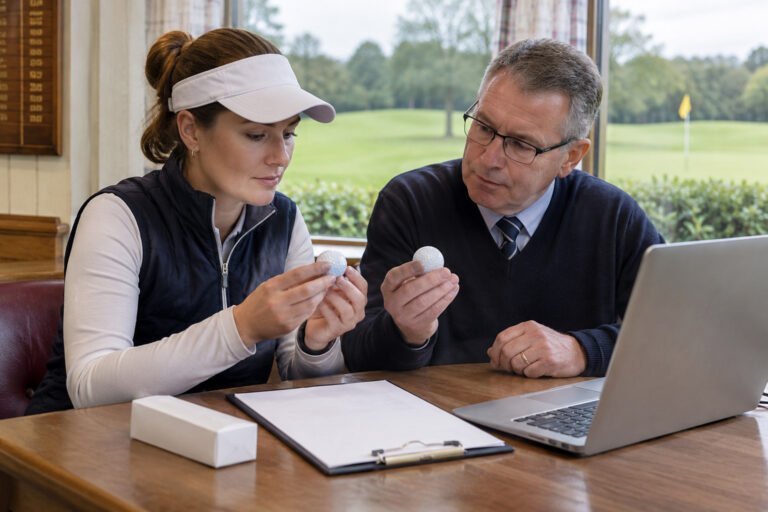
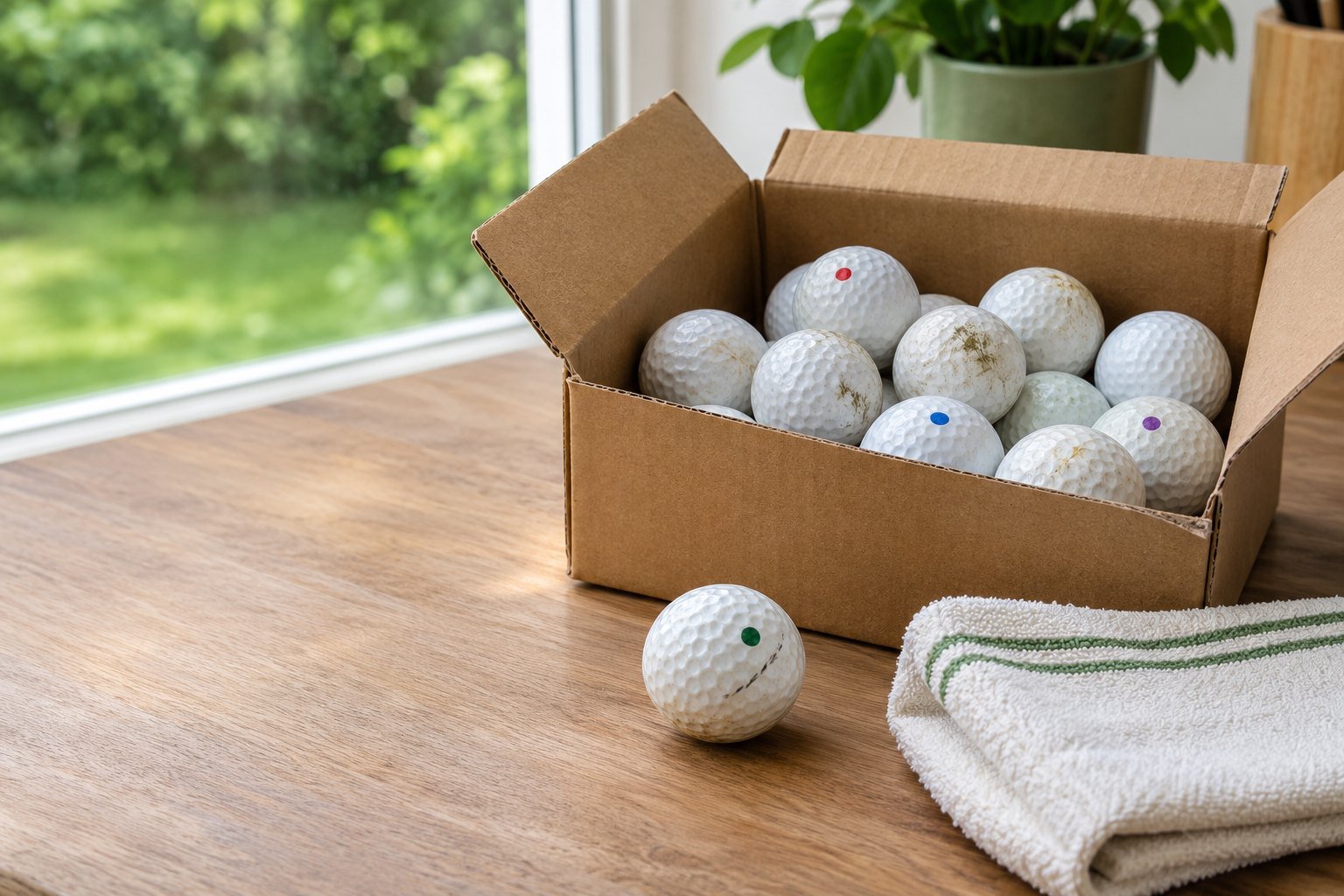
AI illustration of a delivery check; no pictured batch is offered for sale.
The disappointment with a recycled-ball order often begins before the parcel arrives: the buyer imagines one standard while the listing promises another. A good photograph and a reassuring grade name leave plenty of room for different expectations.
Buying recycled golf balls works better when you write down the exact model, acceptable wear and permitted inclusions before ordering. This research-led guide gives you a practical way to check the seller’s promise and assess the delivered batch fairly.
This guide contains affiliate links. If you buy through them, Taylor’s Trailblazing Golf may receive a commission at no extra cost to you.
Record what this seller permits and excludes; a grade name alone is not enough.
Specify an exact model and generation, or consciously accept a disclosed mix.
Compare the whole first order with its description before playing.
Photograph exceptions and agree the next step without assuming a refund.
Buying recycled golf balls: read what the grade includes
Translate each grade into allowed marks, excluded balls and any promised mixture. Do that separately for each seller. The examples below show actual definitions checked on 23 November 2026; they are not equivalent quality levels or a ranking of these businesses.
Scroll within the table to see every column.
| Seller’s own label | What its written guide permits | What to check in your order |
|---|---|---|
| MailOrderGolf — Grade A | Minor marks, discolouration, ink and logos; no cuts or creases, and no Refinished, X-Out or Practice balls. [1] | Whether the listing uses this definition and specifies the model mix you want. |
| Ace Golf Balls — Grade B | Heavier pen marks, larger scuffs and more discolouration; excludes refinished balls but can contain an occasional X-Out or Practice ball. [2] | Whether those inclusions are acceptable for your intended use. |
| Premier Lakeballs — Pearl-A mix | A mixture of near-new appearance and minor marking; its guide states at least 50% Pearl in these packs. [3] | A mixed grade is not an all-Pearl order; confirm the promise for the chosen listing. |
Pay particular attention to the difference between a condition grade and a proportion. “Pearl/A” can describe a mixed pack, while “Pearl” may describe a single grade. A favourable-looking sample photograph does not establish the percentage of each grade in your parcel.
Also separate a seller’s “Practice” grade from a manufacturer’s Practice marking. Ace’s Practice category can include refurbished, refinished, Practice and X-Out marked balls regardless of their cosmetic appearance. A bucket label therefore does not tell you the status of every ball inside. [2]
Save the relevant wording with the order confirmation. It gives both you and the seller a much clearer reference than a later disagreement about whether a ball looks “mint”.
Specify the model, generation and permitted mix
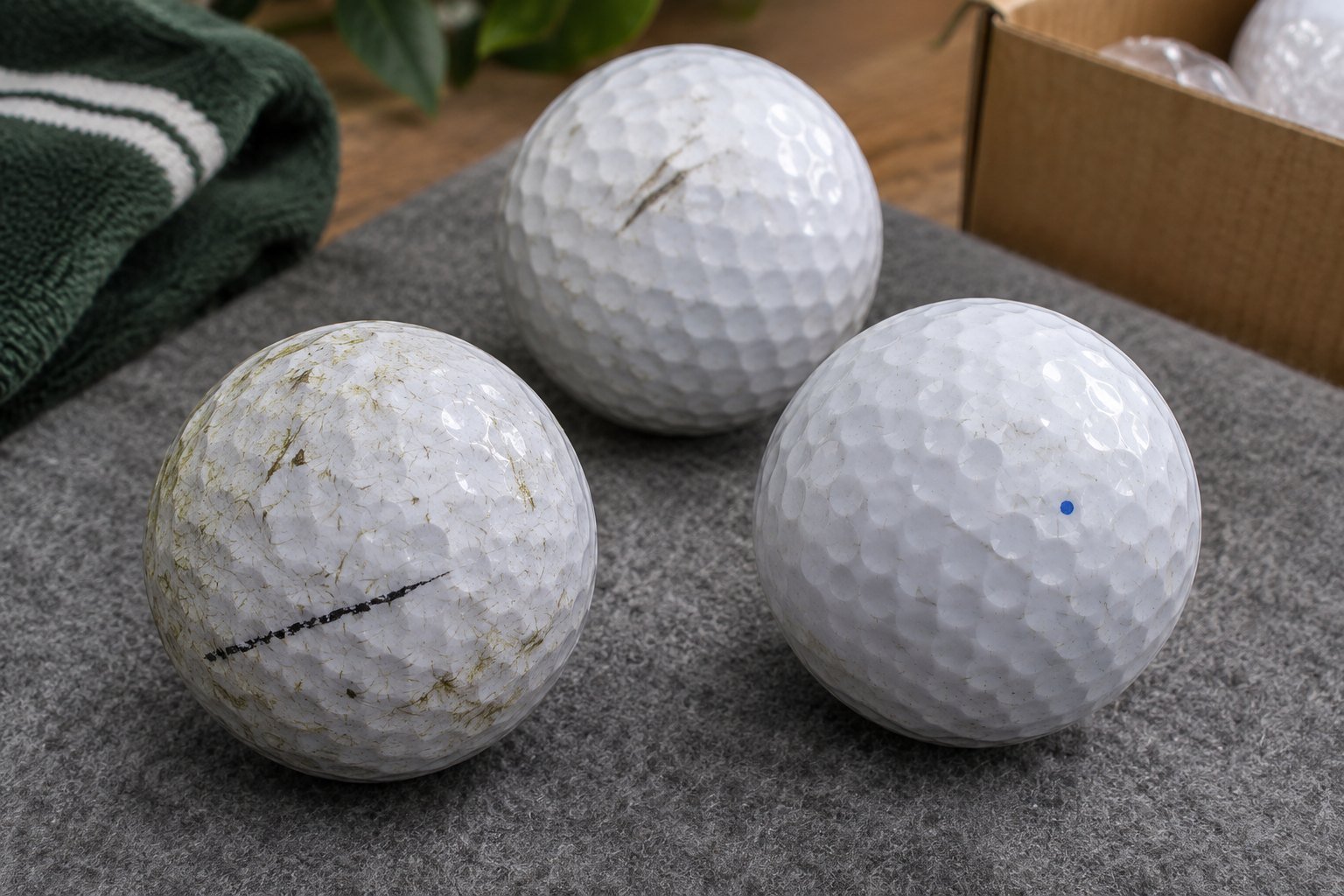
Decide how tightly you need the pack to match. A brand-only selection, a named-model mix and an exact-generation order are different purchases. None is automatically wrong, provided the contents and price suit your purpose.
Write down the full model name, generation if important, colour, surface treatment, ball count and any permitted substitutes. Ask whether every ball must meet the named grade or whether the listing describes a mixture. If the seller cannot guarantee a particular generation, judge it as a mixed-generation offer.
Titleist provides a useful identification example: its official Pro V1/Pro V1x sidestamp guide shows how the side markings distinguish generations. Compare readable photographs with the relevant manufacturer reference; a familiar brand name alone is less specific. This helps identify the claimed version but does not authenticate an altered ball. [4]
Clubhouse Golf’s Challenge-supplied Pro V1 Grade A Rewashed listing illustrates the next question. It identifies a white dozen, allows minor marks and excludes X-Out and Practice balls, but the consulted description does not specify one generation. Ask about that if a particular version matters to you. [5]
View the Pro V1 Grade A Rewashed listing at Clubhouse Golf
That is a listing to compare against your requirements, not a claim that its contents have been independently inspected or perform like new.
Back to the top ↑Ask for evidence that answers your actual questions
First establish what the photographs represent: the exact balls you will receive, a sample of the current stock or a general illustration of the grade. Each can serve a purpose, but only the first identifies that particular selection.
For a small, individually photographed lot, ask for a view of the whole group and readable model markings. Close-ups of the most worn examples are more useful than another photograph of the cleanest ball. For bulk stock, ask which written selection promise applies to your order instead of expecting a photograph to certify every item.
Questions worth sending before payment
- Are these cleaned-only balls with their original finish, and are refinished or repainted balls excluded?
- Which exact models and generations may appear, and are substitutions possible?
- Can the pack contain X-Out, Practice or refurbished markings?
- Are the photographs of my lot or representative stock?
- What happens if the delivered count, model selection or condition does not match the description?
Keep the answers together. A clear response about the actual order is more useful than general reassurance that all customers are happy. If the seller cannot provide information you need, choose whether you can accept that uncertainty before committing money.
A small first order limits the amount at stake and lets you compare that delivery with the description. It does not statistically prove what a future bulk order will contain.
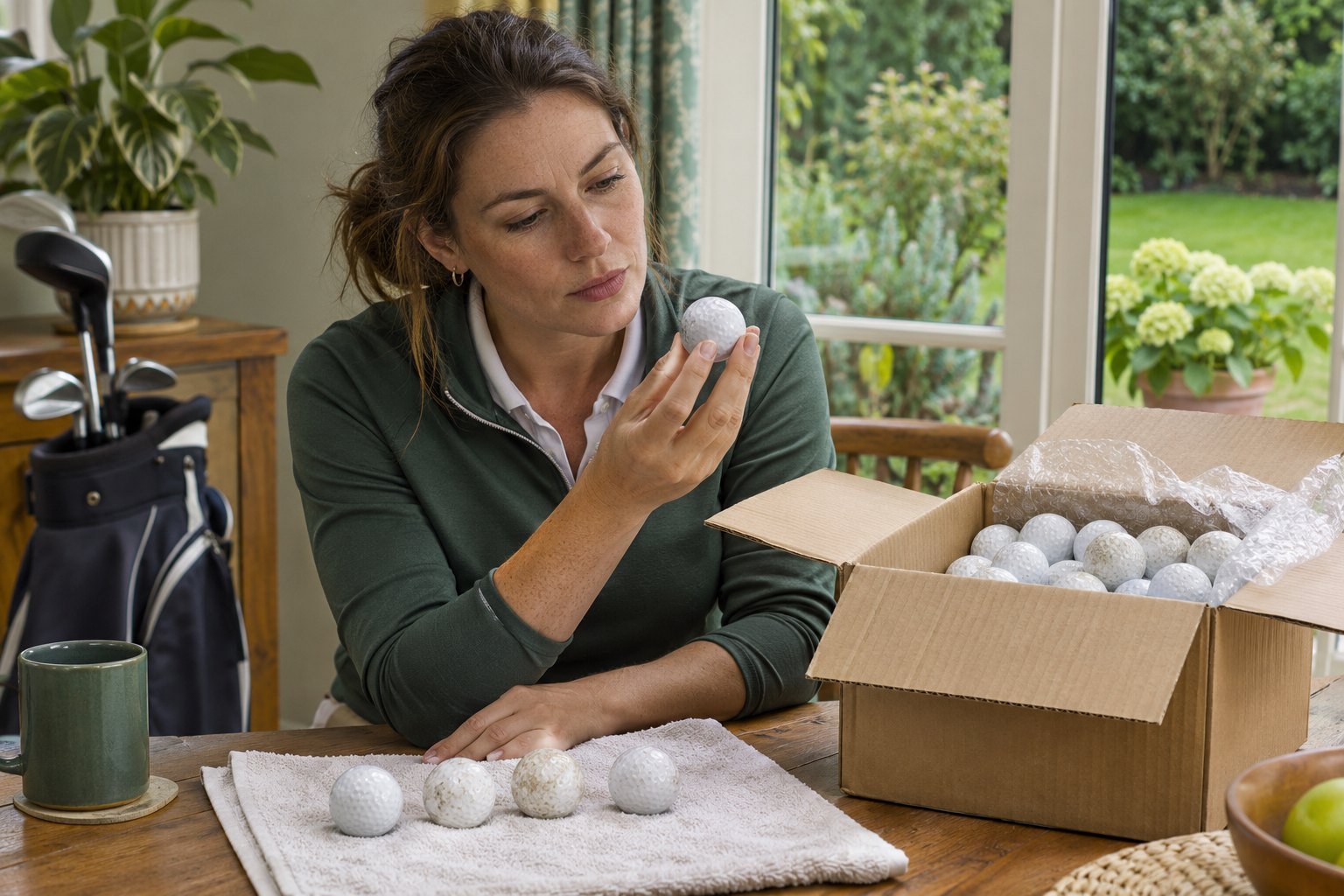
Understand the return process before an on-course trial
Check the policy for the seller you are actually paying. Separate changing your mind about an accurately described order from receiving wrong, missing or apparently faulty goods. Do not assume the same handling instructions, postage arrangements or remedy apply to both.
For example, MailOrderGolf’s policy asks buyers to contact it before returning items. It places return postage on the buyer for change-of-mind returns and requests unused goods in original packaging; for reported wrong, missing or damaged items it asks for order details and supporting photographs. A remedy depends on the circumstances and assessment. [6]
Before ordering, ask how the policy applies to opening a recycled-ball bag for inspection, especially if its wording refers generally to “brand new” condition. Also ask whether an issue with a few balls means returning those balls or the whole pack, who arranges postage and what evidence is needed. Record any stated deadlines.
Retain packaging and the full batch while you check it. Playing several balls can introduce new marks and make an arrival-condition dispute harder to explain. A seller’s return policy is not a promise that you can play a trial round and send back the remainder without conditions.
If something is wrong, report it promptly and clearly: the order number, the specific promise, the count affected and photographs. Follow the agreed process rather than sending an unexplained parcel.
Back to the top ↑Use an arrival worksheet before you play
For a manageable first order, inspect every ball in good light. Keep each ball in one of three groups: accepted against the description, awaiting an answer, or clearly outside the agreed requirements. Photograph the second and third groups and keep their counts separate.
Scroll within the table to see every column.
| Check before playing | Record | Where to place it |
|---|---|---|
| Quantity | Expected count and actual count; retain the pack label. | Record any shortage separately from condition. |
| Model and generation | Full readable markings; compare with the agreed model or permitted mix. | Accept a match; query anything outside the stated selection. |
| Treatment markings | Any refurbished, refinished, X-Out or Practice marking and the seller’s exclusions. | Query an excluded inclusion; do not decide eligibility from grade alone. |
| Visible condition | Cuts, cracks, conspicuous scuffs, discolouration or other features relevant to the promised grade. | Separate apparent departures from normal permitted wear. |
| Ink and additional logos | Whether these were disclosed as acceptable within the grade. | Do not count permitted cosmetics as a seller error. |
Use the seller’s actual wording when recording an exception. “Three balls have cuts although the listing excludes cuts” is clearer than “the grade is poor”. If a disclosed mixed-year pack contains several years, record that mix without treating it as a mistake.
For a closer look at surface appearance, the matte versus gloss guide separates finish, dirt and visible wear. Neither that visual check nor this worksheet certifies a ball’s internal condition, recovery history or rules conformity.
Do not convert uncertainty into a defect count. Put an unclear marking or suspected surface change in the query group until you have an answer. The purpose is a fair comparison with the promise, not to reject every ball that looks used.
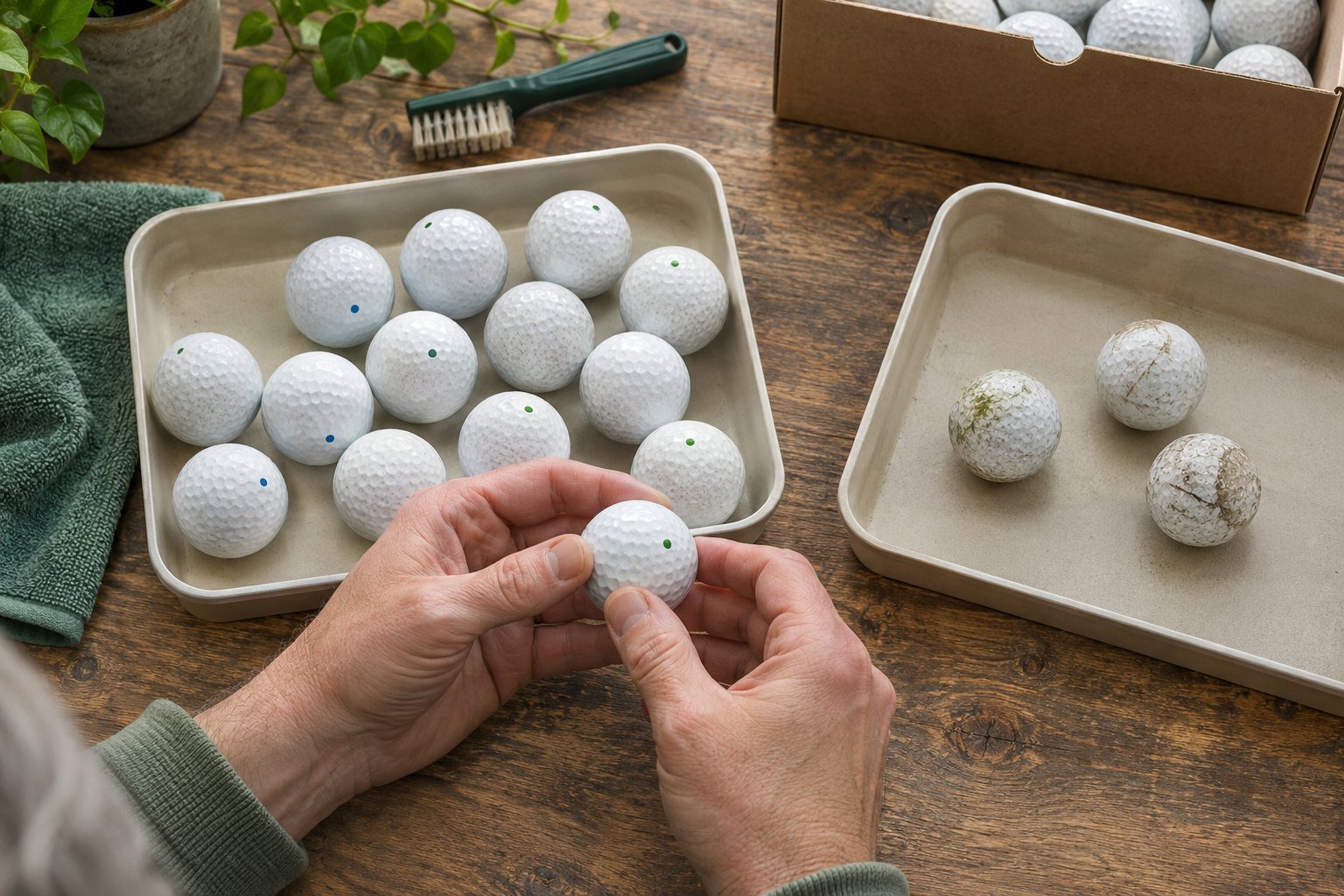
Count the exceptions and recalculate the useful cost
Here is an illustrative order, not a finding about any named seller. Suppose you order 40 balls of one specified generation, with no cuts, for £30 plus £4 delivery. Your agreed grade allows player ink and minor cosmetic marks.
Scroll within the table to see every column.
| Finding in the illustrative 40-ball order | Number | Treatment in the calculation |
|---|---|---|
| Correct generation and acceptable condition | 28 | Accepted |
| Correct generation with expressly permitted ink or cosmetic marks | 4 | Accepted |
| A different generation from the one specifically ordered | 6 | Query and exclude pending resolution |
| Visible cuts, contrary to the listing | 2 | Query and exclude pending resolution |
You have 32 accepted balls and eight outside the stated requirements: 8 ÷ 40 = 20% of this hypothetical order. The headline delivered cost is £34 ÷ 40 = 85p each. Based on the 32 accepted balls, it is £34 ÷ 32 = approximately £1.06 each before any agreed remedy.
The six different-generation balls only count as a mismatch because this example explicitly specified one generation. They would not be a seller error in an accurately described mixed-generation pack. Likewise, the four balls with permitted ink remain in the accepted group.
Recalculate once a replacement or refund is agreed and completed. Do not assume a discount, and do not count a queried ball as suitable just to preserve an attractive headline price.
For a new-pack alternative, Clubhouse Golf lists Srixon Distance in white as a dozen. Check its current delivered price against your accepted-ball cost, provided that model suits the job. This comparison concerns spending; it does not claim equivalent performance to a used premium ball. [7]
Check new Srixon Distance balls at Clubhouse Golf
Back to the top ↑Keep grade labels separate from rules status
A seller’s condition grade does not replace Rule 4.2a’s requirement to use a conforming ball. [8] Check whether the event adopts Model Local Rule G-3, requiring the current List of Conforming Golf Balls. [9]
Under Clarification 4.2a(1)/2, a manufacturer’s Practice stamp does not itself prevent use of an otherwise eligible listed ball. With the List Local Rule in force, the clarification’s X-Out and refurbished balls may not be used, even when their identification markings appear on the list. [10]
This is why the exact inclusions matter more than a broad “suitable for competitions” description. Ask the committee about an uncertain ball and the conditions for your event. Do not let a seller’s Practice grade stand in for identifying the markings and treatment of each ball.
Complete that check before treating an otherwise acceptable batch as your competition supply. A clean appearance and a sensible price cannot resolve an unanswered eligibility question.

Make a fair accept, query or return decision
Scroll within the table to see every column.
| What the check establishes | Decision | Next step |
|---|---|---|
| The order matches the model, grade and agreed exclusions | Accept | Keep the order record and assess it for your intended use. |
| Some balls appear outside the written description | Query before use | Send the count and clear photographs; ask what remedy and return process apply. |
| The description was accurate, but you dislike permitted marks | Reconsider your choice | Check the change-of-mind terms; choose a stricter grade next time. |
| Treatment, model mix or return conditions remain unclear before purchase | Do not place a large order | Obtain a clear answer or choose a more explicit listing. |
Keep preference and misdescription separate. You may decide after inspection that you would rather buy cleaner balls in future, even though the supplied pack met its grade. That is a useful buying lesson, but it is a different issue from receiving the wrong model or excluded damage.
A strong order brief can be short: the count, full model or permitted mix, generation if required, treatment, acceptable wear, exclusions and agreed return process. If those points are clear, you can assess value without relying on the seller’s grade name alone.
Start with a quantity you can afford to inspect and potentially return. Increase the order only when the description is useful, that delivery meets it and the accepted-ball cost remains attractive. Choose a different listing when the seller cannot resolve a requirement that matters to you.
Back to the top ↑Sources and research
Research reviewed on 23 November 2026. Manufacturer descriptions, official guidance and retailer information are distinguished from the suggested comparisons and editorial recommendations in this guide.
- MailOrderGolf — Golf Ball Grading GuideGrade A permissions and exclusions; consulted 23 November 2026.
- Ace Golf Balls — Grading GuideGrade B and Practice definitions; consulted 23 November 2026.
- Premier Lakeballs — GradingSeller’s stated Pearl-A minimum mix; consulted 23 November 2026.
- Titleist — Pro V1 and Pro V1x Sidestamp GuideOfficial generation-identification reference; consulted 23 November 2026.
- Clubhouse Golf — Titleist Pro V1 Grade A Rewashed Golf BallsChallenge-supplied white dozen and its grade description; consulted 23 November 2026. Generation not specified.
- MailOrderGolf — Refund PolicySeller’s policy dated 15 June 2026; consulted 23 November 2026. Policy summary, not a statement of every statutory right.
- Clubhouse Golf — Srixon Distance Golf BallsNew white dozen comparison; consulted 23 November 2026. No live price quoted.
- The R&A — Rule 4: The Player’s EquipmentRule 4.2a; consulted 23 November 2026.
- The R&A — Model Local RulesG-3; consulted 23 November 2026.
- The R&A — Rule 4 ClarificationsClarification 4.2a(1)/2; consulted 23 November 2026.
Find more equipment guidance in Golf Balls.
Illustrations in this article were created for Taylor’s Trailblazing Golf. Third-party photographs, where used, are credited beside the image or in the source list.