
Golf Balls for Autumn Leaves: Colour and Identification Strategies
Prepare for the ground you will play, recognise your own ball and know what the leaves do—and do not—change.
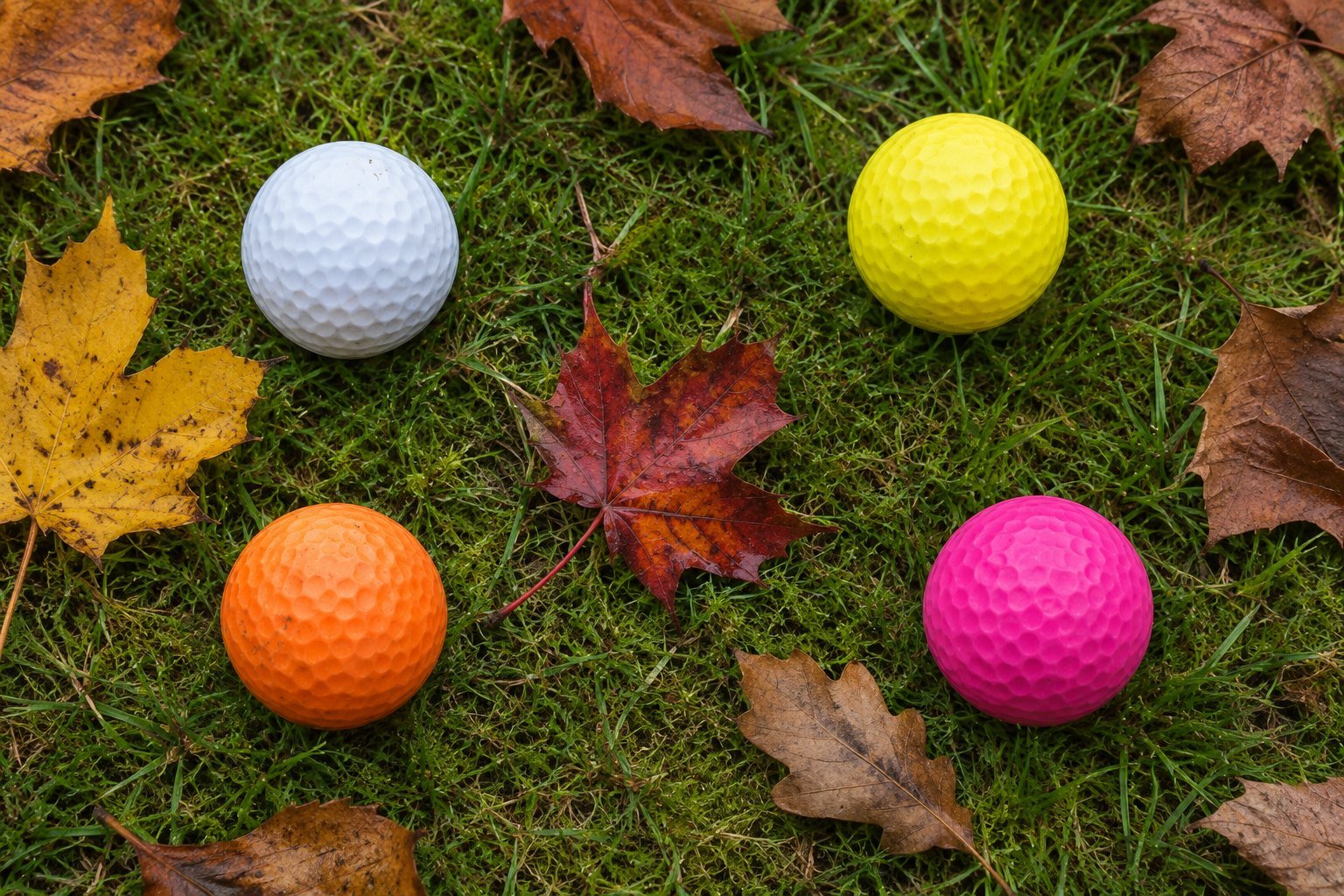
AI illustration of an autumn setting; leaf cover and colour vary between courses.
A ball can disappear in autumn because its colour merges into the background, because leaves cover it, or because you are looking beyond the place it actually finished. Those are different problems. Buying another bright colour addresses only part of the decision.
This research-led guide focuses on leaf-covered play: preparing a recognisable ball, keeping track of the landing area and applying the search and identification rules. It does not claim that one colour guarantees fewer losses or that the illustrated balls have been tested on a course.
This guide contains affiliate links. If you buy through them, Taylor’s Trailblazing Golf may receive a commission at no extra cost to you.
Separate scattered leaves from deep cover and maintenance piles before blaming the ball colour.
Use a mark you can describe, with a different number or pattern for a provisional.
Keep a fixed reference for the last visible point and follow a deliberate search route.
Distinguish searching, identifying, later leaf removal and any applicable relief.
Golf balls for autumn leaves: identify the problem first
Before choosing another ball, ask what happened on the holes where finding it became difficult. Did you see it finish and then struggle to separate it from exposed leaves? Did it run under a layer of leaves? Or did you lose its flight and start searching a large area?
Use that distinction to choose the next action. A colour comparison is relevant when the surface of the ball is visible. It cannot reveal a ball completely covered by leaves, and it does not tell you where an unseen bounce took it.
Scroll within the table to see every column.
| What happened | What to record | Useful next step |
|---|---|---|
| Exposed ball was difficult to distinguish | Leaf colours, shade and the direction from which you approached | Compare another colour against that particular background. |
| Ball was partly or completely covered | Depth of leaf cover and the last visible landing point | Improve tracking and the search plan; check the area’s status. |
| Several similar balls were found | Which details made identification uncertain | Improve your personal mark and distinguish the spare. |
| You could not narrow down the landing area | Where you last saw the flight or bounce | Choose a fixed reference and involve another watcher. |
This is a practical diagnosis of the task, not a test of your eyesight or an explanation for every lost ball. You can have more than one problem on the same hole.
Back to the top ↑Make the colour decision against today’s leaves
Look at the actual landing areas before buying a large supply for the season. Fresh yellow leaves, brown leaf litter, patches of exposed grass and tree shadows are different backgrounds. Your preferred colour on one of them may be less convincing on another.
If you can do so without interfering with play, compare the colours you already own in a permitted practice area with similar leaf cover. Place and retrieve each ball deliberately. Look from the direction in which you would normally approach it, rather than judging only from directly above. You are checking your own impression of an exposed ball, not measuring how quickly a genuinely missing ball would be found.
Keep the conclusion narrow: “white was clearer to me on the exposed yellow leaves beside this practice area” is useful. “White is the best autumn ball” goes beyond that observation. A familiar yellow ball may still suit you better where you play. Other colours deserve the same check rather than an assumption that brighter packaging means better visibility.
Our matte versus gloss golf-ball guide separates finish, colour and surface condition. Here, the important autumn decision is whether a colour change addresses the problem you actually recorded.
Give the ball an identity you can explain
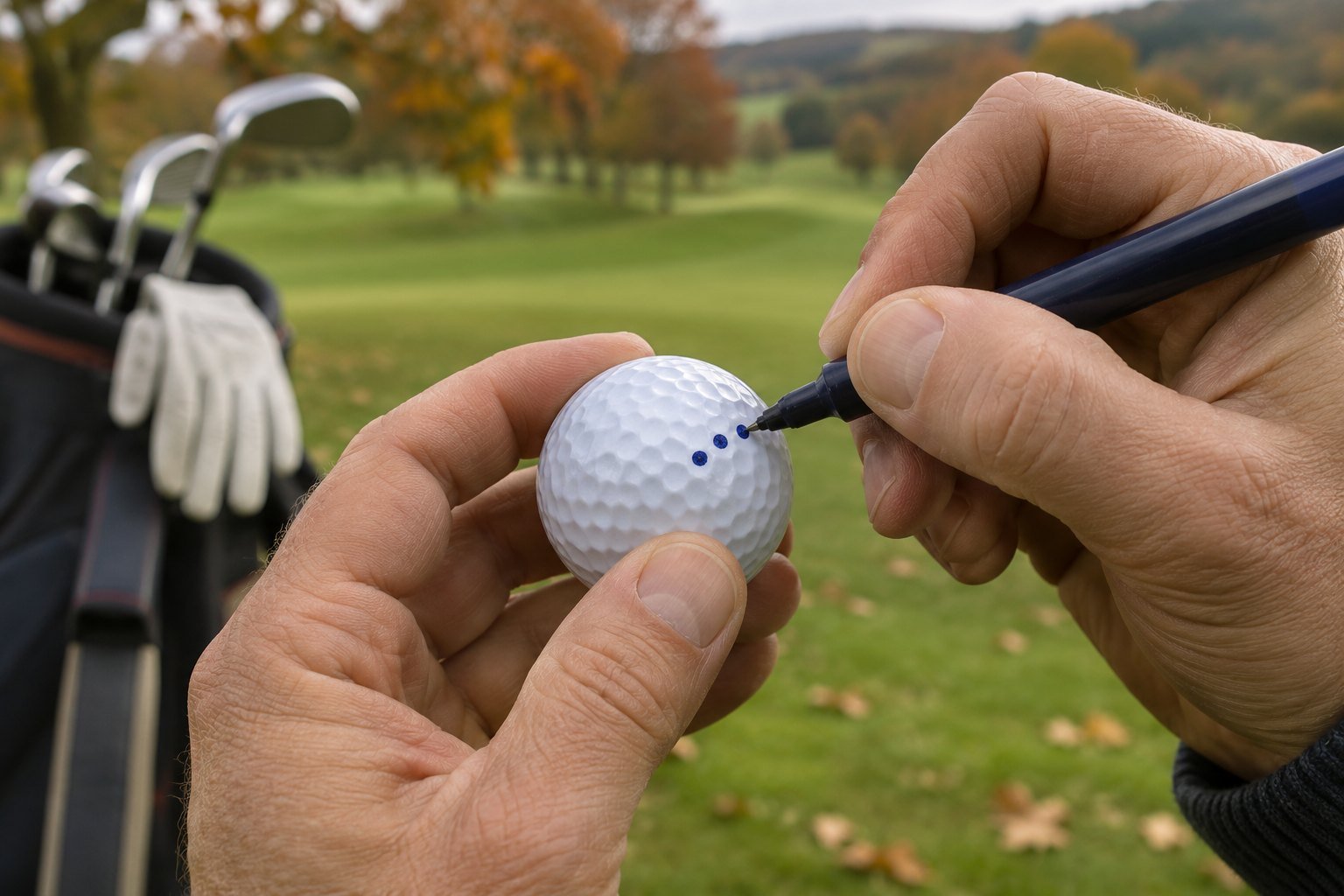
Rule 6.3a says a player should put an identifying mark on the ball they will play. [1] Make yours easy to describe before the round: for example, your initials with two blue dots beside them. Leave the brand, model and playing number readable.
Check whether someone in the group uses the same model and number, then show them your mark. A corporate logo or a popular alignment line may appear on many balls. Your added pattern should give you something more specific to check after a search.
Prepare the spare as well. If the original has two dots, a spare with three dots or a different playing number creates a visible distinction. Record which is which before putting either into play; a second ball with exactly the same appearance can make a difficult search more confusing.
A stencil is optional. The Longridge ball stencil and mini Sharpie set at Clubhouse Golf includes a pen and templates for repeatable markings; the listing says the supplied pen colour may vary. [2]
Use a clean, dry ball and follow the marker’s instructions before packing it. Check that the mark is legible rather than adding a large patch of ink over the manufacturer’s details. Keep the marking kit for preparation, not as a reason to handle a ball in play without permission under the Rules.
Track the finish before the search begins
After a shot towards leaves, keep watching through the bounce and roll for as long as you can see them. Choose a fixed reference such as a particular tree trunk, bunker corner or path edge. “Just right of the narrow trunk, short of the path” gives you a more useful starting point than “somewhere in the leaves”.
Distinguish the last point you saw from the place you think the ball finished. If a slope, bank or tree blocked the view, say so. Ask another player who watched the shot what they actually saw before everyone begins walking towards different guesses.
Where the ball may be lost outside a penalty area or may be out of bounds, consider a provisional under Rule 18.3 before setting off. Announce that it is a provisional before playing it. A distinguishable spare makes the subsequent identification task clearer. [3]
- Keep the fixed reference in view while approaching.
- Start in the most credible finishing area, allowing for the bounce or roll you observed.
- Give helpers separate small areas to check, so everyone is not retracing the same strip.
- Describe the ball and its mark before a helper finds a possible match.
This routine cannot establish where an unseen ball came to rest. Its purpose is to make your observations and the search more organised, rather than letting the first guess become a fact.

Keep searching, identifying and leaf removal separate
Rule 18.2 gives three minutes from when you or your caddie starts searching. If a ball is found within that time, you must promptly try to identify it and are allowed a reasonable time for that, even beyond the three minutes. Keep track of the search time instead of waiting for somebody to ask how long you have been looking. [3]
Rule 7 separates four situations. [4]
Scroll within the table to see every column.
| Situation | What the rule permits or requires |
|---|---|
| Reasonable search | Move leaves reasonably while searching. Do not use the search as an excuse to improve the conditions for the next stroke. |
| Checking an identifying mark | The mark alone cannot settle identity if an identical ball with the same mark is also found in the same area. Other Rule 7.2 identification methods may apply. |
| Ball accidentally moves during finding or identifying | No penalty applies, but replace it where it originally lay, estimating that spot if necessary. |
| Identification reasonably requires lifting or rotating | Mark the spot first. Off the putting green, clean only enough to identify the ball, then replace it. Unnecessary lifting, failing to mark or unauthorised cleaning may cost one penalty stroke. |
Once the search and identification are over, do not assume the same movement exemption continues. Under Rule 15.1b, if your removal of a leaf makes your ball move in the general area, replacement and one penalty stroke normally follow, subject to the rule’s exceptions. [5] Pause before pulling away a leaf that appears to support the ball.
If a ball remains lost, the default under Rule 18.2 is stroke-and-distance relief: add one penalty stroke and play from the previous stroke’s location. A different procedure needs an applicable rule or Local Rule; agreement within the group is not enough. [3]
Back to the top ↑Check what kind of leaf pile you have found
There is no general entitlement to drop a replacement beside the place where you think a ball vanished into leaves. The status of the area matters, and a large pile is not automatically the same thing as scattered autumn litter.
Material piled for removal
The definition of ground under repair includes leaves and other material piled for later removal, even without separate marking. Material left on the course without an intention to remove it does not acquire that status unless the Committee defines it as such. Ask the club if the pile’s purpose is unclear. [6]
A temporary Local Rule
Model Local Rule F-14 lets the Committee designate specified accumulations in the general area or bunkers as ground under repair. It must actually be in force for the relevant location; it cannot apply in penalty areas. Check the notice before assuming relief. [7]
When the ball has not been found
Rule 16.1e requires it to be known or virtually certain that the ball finished in or on the abnormal course condition before its unfound-ball relief procedure can be used. Seeing a ball head towards a pile may not establish that. Ask the Committee or a referee about an uncertain situation and the correct relief procedure. [8]
A familiar winter custom from another club does not establish the rule for this course. Read the current notice, including which holes or areas it covers, before the first tee.
Back to the top ↑Build a short autumn routine you will actually use
A small preparation card is more useful than carrying several colours without a plan. Copy the following headings into your notes and complete them for the course you are playing.
Scroll within the table to see every column.
| Before the round | Your answer |
|---|---|
| Ball chosen | Exact model, colour and playing number |
| Personal mark | The pattern you can describe to a search helper |
| Spare identity | The number or mark that distinguishes it from the original |
| Leaf conditions | Exposed litter, deep cover and any particular troublesome landing areas |
| Course information | Current Local Rules and how to ask about maintenance piles |
| After a wayward shot | Last visible point, fixed reference and the area each helper will check |
Pack a practical supply of your chosen balls based on your own recent rounds, rather than buying to an invented universal “autumn allowance”. Check the marks before setting out. A ball-marker for marking a spot and a pen for drawing an identifying mark have different jobs; have both available.
If you are travelling to an unfamiliar course, ask about leaf conditions before loading up on a colour you have never used. You may find that the most useful preparation is knowing where the maintained piles are and how the club describes them.
Use the next round to make one better decision
Afterwards, record the troublesome hole, the last point you saw, whether the recovered ball was exposed or covered, and whether its identity was clear. Do not record an unfound ball as proof that a particular colour failed: you do not know what concealed it or exactly where it finished.
For example, if you tracked a ball into a known area and later found it lying uncovered against similarly coloured leaves, another colour is worth comparing. If the ball was buried beneath leaf cover, the stronger next step may be a clearer reference point and more organised search. If you found several indistinguishable balls, improve the identifying marks.
Keep the playing characteristics in the decision. The golf-ball fitting guide without a launch monitor helps you choose a suitable model before buying a season’s supply. Autumn is a reason to prepare carefully, not a reason to abandon a ball that suits your game on the strength of one frustrating hole.
Choose the colour that helps you see the exposed ball, the mark that helps you recognise it and the routine that makes the search purposeful. Keep each conclusion within what you actually observed.
Back to the top ↑Sources and research
Research reviewed on 23 November 2026. Manufacturer descriptions, official guidance and retailer information are distinguished from the suggested comparisons and editorial recommendations in this guide.
- The R&A — Rule 6: Playing a HoleRule 6.3a identifying-mark guidance; checked 23 November 2026.
- Clubhouse Golf — Longridge Ball Alignment Tool & Sharpie Golf MarkerVerified UK listing and included pen/stencil; supplied pen colours may vary. Checked 23 November 2026; no durability or performance test claimed.
- The R&A — Rule 18: Stroke-and-Distance, Lost Ball and Provisional BallSearch time, identification time, provisional announcement and default lost-ball procedure; checked 23 November 2026.
- The R&A — Rule 7: Ball Search, Finding and Identifying BallSearch and identification rules; checked 23 November 2026.
- The R&A — Rule 15: Loose Impediments and Movable ObstructionsRule 15.1b movement caused by removing loose impediments; checked 23 November 2026.
- The R&A — Definitions: Ground Under RepairDistinction between material piled for removal and material intended to remain; checked 23 November 2026.
- The R&A — Committee Procedures: Model Local Rule F-14Committee option for specified accumulations of loose impediments; checked 23 November 2026. The course’s actual Local Rules must be checked separately.
- The R&A — Rule 16: Abnormal Course ConditionsRule 16.1e relief for an unfound ball requires knowledge or virtual certainty; checked 23 November 2026.
Find more equipment guidance in Golf Balls.
Illustrations in this article were created for Taylor’s Trailblazing Golf. Third-party photographs, where used, are credited beside the image or in the source list.