
Driver Head and Shaft Adapter Compatibility: What Must Match?
Match the actual components before you buy, adjust or swing a replacement shaft.
Original conceptual illustration; not a product or test photograph.
Driver head and shaft adapter compatibility is not settled by a logo, a shaft colour or the fact that a screw starts to turn. The head must accept the exact adapter system fitted to the shaft. The shaft-to-adapter joint, retaining hardware and completed club build also need to be suitable. Those are separate checks, and passing one does not automatically pass the others.
A replacement shaft can be a sensible way to keep a familiar driver in use. However, a listing described as "fits most drivers" leaves too much unanswered. This guide gives you a purchasing and inspection workflow: identify the head, obtain written compatibility confirmation, check the finished specification and stop when anything does not match. It is a research-led equipment guide, not a claim that these combinations have been physically tested by this website.
Name the exact head
Brand alone is not a compatibility statement.
An official model match
Keep the system and club category explicit.
Finished playing length
A shaft measurement is not the same thing.
Binding or uncertainty
Do not force an unknown assembly together.
Driver head and shaft adapter compatibility: the checks that matter
Separate the three connections
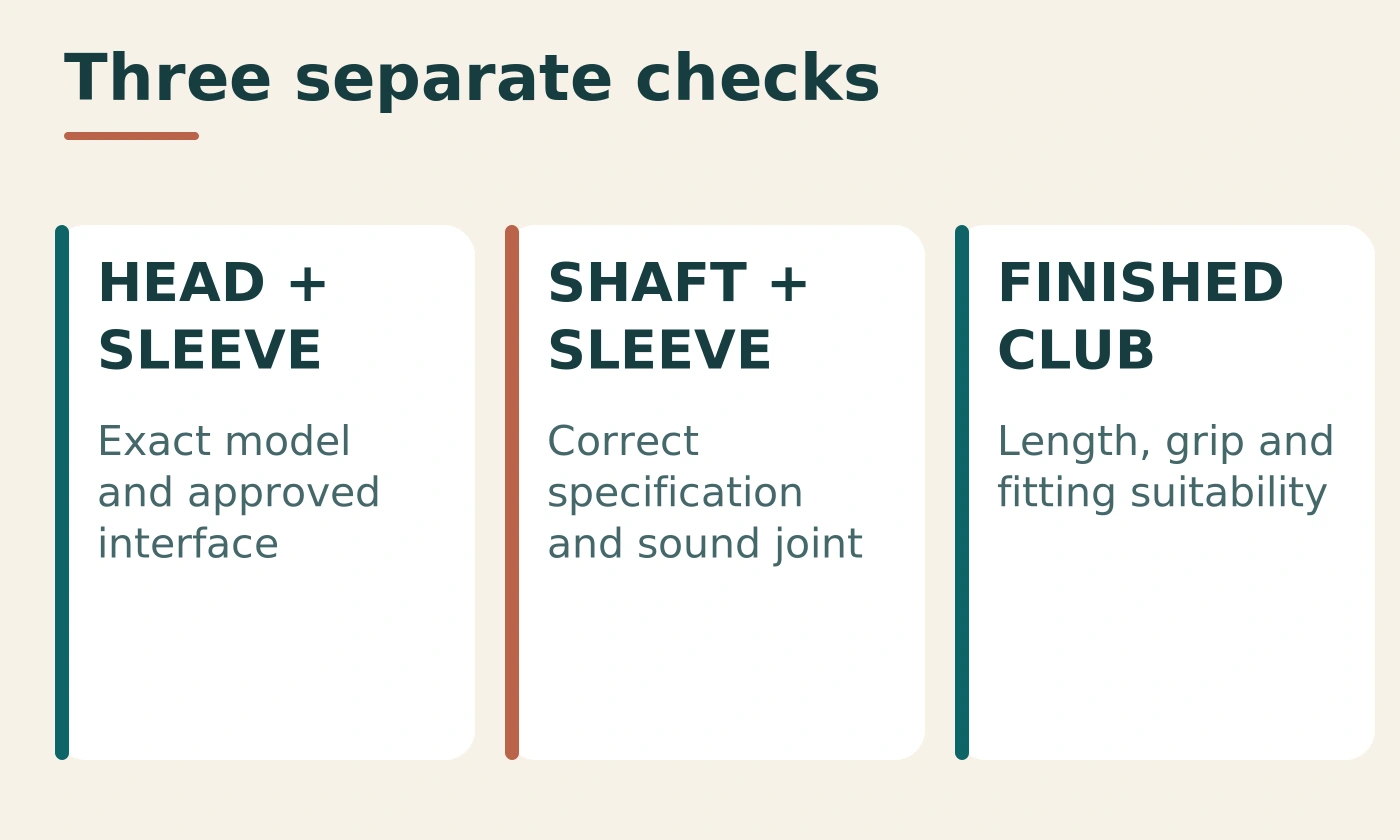
Think of the build as three linked decisions. First, the head connects to an adapter through its own shaped interface and retaining hardware. Second, the shaft is bonded into that adapter. Third, the resulting club must have a usable length, grip and overall specification. A seller may provide convincing information about one connection while saying almost nothing about the others.
For example, a genuine compatible sleeve does not establish that the shaft was prepared and bonded correctly. Likewise, the right shaft model does not establish that its existing sleeve fits your head. Write the three checks on separate lines before comparing listings. That small separation makes vague phrases such as "standard driver fit" much easier to challenge.
Distinguish mechanical fit from playing fit
Mechanical compatibility means the components are approved to work together and are assembled correctly. Playing suitability concerns whether that completed club suits you. Neither shaft flex lettering nor a familiar weight category can settle the second question on its own. Treat an adapter purchase as a compatibility decision first, rather than as a guaranteed performance upgrade.
The table below is a decision checklist, not a universal compatibility chart. It deliberately does not mark every brand combination green or red. Manufacturers revise systems, and a broad chart can encourage a purchase based on a family resemblance instead of an exact model. A clear written answer about your particular head is more useful than a long list of supposedly interchangeable clubs.
| Check | Evidence to obtain | What it does not prove |
|---|---|---|
| Head to sleeve | Exact head model named in current manufacturer guidance or written confirmation | Correct shaft preparation |
| Shaft to sleeve | Matching shaft-tip and adapter-bore specifications, checked by the builder | Suitable finished length |
| Retaining hardware | Correct screw, washers and approved tool for that system | A sound bonded joint |
| Finished club | Playing length, grip, build condition and fitting review | An improvement in distance |
On smaller screens, scroll this table sideways.
Identify the driver before shopping for a shaft
Read the complete model name
Begin with the head you own, not the replacement shaft you would like. Photograph the sole, crown, hosel area and any model or serial markings. Record the manufacturer, full model, loft marking and whether the head is right- or left-handed. A family name alone may omit a sub-model or an older generation with a different connection.
For a used head, compare those details with the manufacturer's archived product information. However, do not assume that a serial number by itself authenticates a club or identifies every component attached to it. A previous owner may have changed the shaft, sleeve, screw or grip. Describe what is actually present rather than copying the original stock specification from a launch article.
Record what you do not know
A useful note might read: "Head identity confirmed; shaft sleeve identity uncertain; no receipt for the previous re-shaft." That is more honest and more actionable than guessing the sleeve from its black finish. Send the same photos and uncertainty note to the retailer or builder so that everyone is answering the same question.
Keep any original wrench and paperwork with the head, but do not let their presence override the component check. Tools and headcovers are easily separated from clubs. If the head itself cannot be identified confidently, pause the purchase. Buying another uncertain part rarely makes an uncertain build easier to resolve, and can leave you paying for two unsuitable components instead of one.
Use brand guidance without inventing a universal chart
What a confirmed family example looks like
Titleist's SureFit guide explicitly lists GT, TSR, TSi, TS, 917, 915, 913 and 910 driver shafts as interchangeable. It lists fairway shafts separately and provides different right- and left-handed starting settings. That is useful evidence for the families actually named; it is not permission to add an unlisted model or treat a fairway assembly as a driver assembly. [1]
At this review, Titleist's US version also names GTS, while the checked UK list begins with GT. That is a difference in the published lists, not evidence that the hardware conflicts. Consult the official guidance that explicitly covers your exact model, and ask for clarification when regional pages differ. [7]
Read the nouns as carefully as the model numbers. "Driver shafts" and "fairway shafts" are not interchangeable phrases. Also distinguish a manufacturer statement from a customer discussion hosted on that manufacturer's website. Forum replies can be helpful leads, but they are not the same as an official compatibility instruction for a purchase.
Settings information is not compatibility evidence
PING describes the G430 LST's Trajectory Tuning 2.0 sleeve as an eight-position system, with its own loft and lie adjustment range. That explains how the specified club adjusts; it does not, by itself, certify every other PING head that a seller might list. Ask for separate model-specific evidence when transferring an assembly. [2]
Cobra's FutureFit33 material similarly identifies the systems used in its named product families and supplies separate fitting charts. The useful lesson is to follow the named system rather than a generic "Cobra adapter" label. Where a retailer's compatibility list extends beyond the official material you can verify, request written confirmation instead of filling the gap with an assumption. [3]
Check the shaft tip, not just the shaft label
Tip diameter and adapter bore are a separate match
A shaft label describes a product family, but the critical bonding interface is at the prepared tip. Ask the builder to verify the exact shaft-tip specification against the adapter's bore specification. Do not infer those dimensions from a photograph or assume that all woods and hybrids use an identical interface. The fitting information needed belongs to the actual shaft and sleeve, not to golf clubs in general.
Keep this as a specification check rather than a home modification job. An adapter that appears nearly right should not be made to accept a shaft through improvised sanding, packing or force. Those actions change the joint you are relying on during a swing. A qualified builder can identify whether an appropriate component exists and whether the shaft remains suitable for reuse.
Ask about previous preparation
Used shafts deserve a question about their history. Was the adapter fitted new? Has the shaft been pulled from another club? Was it tip-trimmed before assembly? If the seller does not know, record that as unknown. A neat ferrule and clean graphics cannot show how much material has been removed beneath the sleeve.
A builder may be able to assess the assembly, but a remote seller should not promise certainty from exterior photos alone. Your buying decision can legitimately be "not enough evidence". There is no requirement to rescue every bargain. Paying for a documented, correctly assembled shaft may be better value than paying less and immediately needing an inspection, replacement adapter or different shaft.
Understand finished playing length before comparing prices
A shaft measurement is not a club measurement
Listings may quote the bare shaft length, the length with a sleeve attached, or the playing length of a completed driver. Those descriptions are not equivalent. Ask exactly where the measurement starts and ends, whether the grip is included and which head was used for any stated playing length. A photograph of the measurement can help clarify the seller's convention.
Avoid applying a single add-on number to every head. Instead, ask for the expected finished playing length in your named head, measured by the builder's stated method. This prevents the common misunderstanding in which two sellers appear to offer identical lengths but are actually describing different parts of the assembly. Record the convention beside the number, not in a separate message you might later lose.
Do not purchase a length correction blindly
A shorter or longer build can alter how the club feels, even when the head and sleeve connect correctly. The sensible question is whether the complete specification remains appropriate, including grip, head weight and any previous shaft trimming. Do not turn a simple adapter question into a promise that shortening a driver will automatically improve accuracy.
For a replacement intended to reproduce an existing club, take the complete club to a builder before ordering. Ask them to record its playing length and relevant build details. For an experimental change, agree what is being changed and what will remain constant. That gives you a meaningful comparison later, rather than a collection of simultaneous changes whose effects cannot be separated.
Handedness and adjustment markings need their own check
Use the chart for the actual combination
Right- and left-handed heads can require different setting interpretations. Titleist's guide, for example, uses different standard starting positions for the two hands. Do not transfer a familiar letter-and-number combination from someone else's club without checking the correct chart. A setting label is an instruction within a specific system, not a universal description of loft. [1]
Ask whether the sleeve itself has a handed version, whether a cross-handed combination is approved and which chart would apply. A seller who only says "it fits both" may be answering the physical-fit question while overlooking the adjustment instructions. Obtain both answers. Where the official guide does not cover your proposed combination, get clarification before using it.
Do not confuse a new chart with a new driver sleeve
Callaway's 2026 OptiFit 4 guide is expressly for fairway woods and hybrids. It includes separate information for a right-handed adapter used with a left-handed head. That makes it a good example of why the document's scope matters: a current Callaway adjustment sheet is not automatically a driver compatibility sheet. [4]
Once the correct setup has been confirmed, keep a photograph of the chosen setting and the relevant official chart. However, avoid marking the club in a way that obscures manufacturer information. A simple note on your phone is enough. The objective is repeatability and clarity, not a homemade alternative to the manufacturer's adjustment system.
Screws, washers and torque tools are not generic extras
Retain the correct hardware
A sleeve and a screw are a system, not two independent items that can be matched by appearance. Ask whether the original head screw and any specified washers remain present and suitable. If a replacement is needed, obtain the exact approved part through the manufacturer, authorised retailer or builder. Do not choose a screw merely because its head accepts the same bit.
An unfamiliar resistance, a screw that will not engage normally or an assembly that will not seat as specified is a stop signal. Do not attempt to pull misaligned parts together by tightening harder. Describe the symptom to the professional checking the club. This is especially important when the head, sleeve and hardware have come from separate sellers with no shared build record.
Follow the exact manufacturer's tightening instruction
Titleist specifies its SureFit wrench and warns that binding requires stopping and realigning the components. Its guide also restricts the system to genuine Titleist components and warns about a head becoming detached if instructions are ignored. Follow the equivalent current instruction for the actual system in front of you. [1]
This guide does not provide a universal torque value or a generic number of clicks. Nor should an adjustable household driver or powered screwdriver be treated as a substitute for an approved golf tool. When the correct instruction or tool is missing, have a retailer assemble and check the club. The small inconvenience is preferable to guessing at a safety-critical connection.
Know the boundary between adjustment and club building
An adjustable connection is not the bonded joint
Changing an approved hosel setting and replacing a bonded adapter are different tasks. The first uses the manufacturer's intended adjustment mechanism. The second involves assessing and preparing a shaft-to-sleeve joint. Buying an adjustable driver does not make every part of that driver a safe home-service item.
A novice should not heat, pull, drill or rebond an adapter on the basis of a general buying article. Take a shaft that needs a different sleeve to a qualified club builder. Ask the builder to decide whether reuse is suitable, explain any unknown history and document the finished specification. That approach also avoids accidentally treating a damaged or over-prepared shaft as a routine conversion.
Decide whether conversion is worthwhile
Request a complete quote rather than a sleeve-only price. It may need to include inspection, removal where appropriate, the correct adapter, assembly, a replacement grip and verification of the final length. These are quote categories, not a statement that every job requires every item. The builder should explain which apply to your particular shaft.
Compare that total with a compatible, documented assembly and with leaving your existing driver unchanged. Also consider the time before your next round. A technically possible conversion may not be the best purchase when the shaft's history is unclear or the timetable is rushed. Compatibility is a threshold question; value is a separate judgement once that threshold has been met.
Evaluate a used-shaft listing like a small build record
Request evidence that answers a specific question
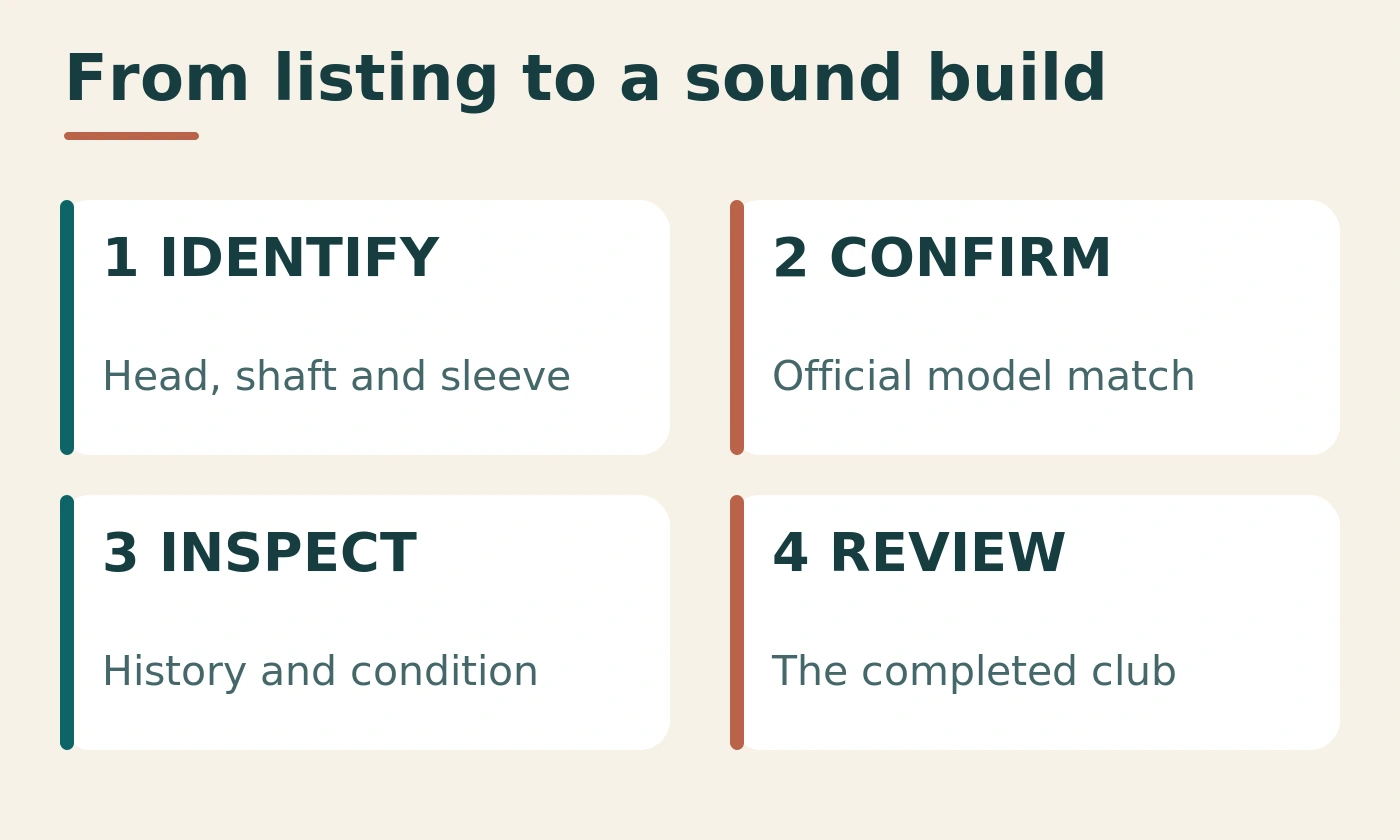
Ask for clear photographs of the entire shaft, grip, adapter markings and the area immediately above the ferrule. Then request the full shaft model and flex, measured length with its method, known trimming history and the exact head models in which compatibility is claimed. Each request should have a purpose. A dozen attractive photographs are less useful than one image of the part that actually needs identifying.
Avoid relying on a seller's statement that the club "worked fine for me". That may be an honest account, but it does not establish that your head uses the same connection or that the assembly was built to the manufacturer's requirements. A previous successful swing is not a substitute for documented compatibility and an appropriate inspection.
Keep return terms separate from technical confidence
Before paying, ask what happens if the manufacturer or your builder finds the assembly unsuitable for the head you named. Save the listing and the written answer. Do not assume that every seller accepts fitted, modified or used returns, and do not alter the shaft while a suitability question is unresolved.
A sensible decision can be conditional: buy only after the seller confirms the exact model match and the return conditions are acceptable. If the listing is missing fundamental details and the seller cannot provide them, move on. Scarcity language and an approaching auction deadline do not reduce the amount of evidence needed for a component that will be swung at speed.
Send a compatibility request that is easy to answer
Include the actual head and the proposed assembly
A useful message is: "I own [full head model, loft and hand]. I am considering [shaft model and flex] fitted with [identified sleeve]. Please confirm whether that complete sleeve assembly is approved for this exact head, which retaining hardware and wrench are required, and the expected finished playing length." Attach the relevant photographs and the seller's length description.
Add the known history of the shaft, especially previous trimming or adapter changes. However, do not bury the main question in a long story about your ball flight. A retailer can answer mechanical compatibility more clearly when the components are identified first. Performance preferences can then be discussed separately with a fitter.
Ask for a distinction between confirmed and inferred
Request that the reply identifies any unresolved points. For instance, the retailer may confirm the head-to-sleeve family but require an in-person inspection of the used shaft. That is a useful answer, not an inconvenience. It tells you what has been established and what still needs checking before the assembly is put into service.
Keep the response with the purchase record. If the item arrives with different markings or a different measurement, refer back to the specific discrepancy. This makes the conversation factual rather than argumentative. It also prevents a broad statement such as "compatible with this brand" being remembered later as a promise about the exact head and shaft combination you intended to buy.
Inspect the delivery before you swing it
Compare the item with the agreed specification
Start with a non-invasive visual check in good light. Confirm the shaft model, grip, adapter markings and overall condition against the listing and written confirmation. Look for obvious cracks, splitting, displaced components or other damage, but remember that a visual check cannot certify a bonded joint. Any concern should go to the retailer or builder before use.
Do not turn the first inspection into a force test. Avoid bending the shaft, twisting the head against resistance or striking balls to see whether the assembly holds. Where a part seems different from the description, photograph it as received. Keeping the item unchanged makes it easier for the supplier to assess the issue and preserves a clear account of what arrived.
Verify assembly through the proper route
Have uncertain or newly converted assemblies checked professionally. For a straightforward manufacturer-approved adjustment, use the exact instructions and correct tool. If anything fails to seat normally, stop rather than inventing a workaround. The aim is not to prove that you can make two pieces connect; it is to establish that the intended connection has been achieved correctly.
After a professional check, record the resulting playing length, setting and any changed hardware. That becomes your new baseline. A future shaft replacement can then start from a documented build rather than repeating the same detective work. Keep the old notes too, but label them clearly so an earlier measurement or sleeve description is not mistaken for the current specification.
Plan a comparison without confusing it with a safety test
Begin only after compatibility has been established
A range session is for evaluating the way a sound club plays, not for validating a doubtful joint. Once the build has been checked, compare it with your existing setup under reasonably similar conditions. Use the same target and ball type where practical, and make notes about strike pattern, directional tendency and your ability to repeat the setup.
Do not let one unusually good shot decide the result. Equally, do not blame the adapter for every poor strike when length, grip or shaft specification also changed. Your notes should say what changed between the two builds. A fitter can then help interpret the observations without needing to reconstruct the equipment differences from memory.
Keep adjustments out of competitive experimentation
The R&A's Rule 4 restricts making a stroke with a club whose playing characteristics have been deliberately changed during a round, subject to the rule's stated exceptions. Plan fitting and adjustment work outside the competition round rather than using a match as an experiment. Ask the committee about an actual rules situation instead of relying on a shortened internet summary. [5]
TaylorMade's own loft-sleeve document also illustrates that a setting change can affect more than one specification. Do not describe a sleeve adjustment as changing only loft unless the relevant system's guidance supports that description. The fitting question is the resulting club configuration, not just the number printed next to a setting. [6]
Compare purchase routes and total value
Existing shaft, replacement assembly or complete fitting
Keeping the current shaft makes sense when it is sound, compatible and doing the job you need. A documented replacement assembly may suit a damaged shaft or a deliberately specified change. A fitting is more useful when the real question is why the driver is difficult to use, because an adapter purchase alone cannot identify the cause.
Make a short comparison using complete costs: item, delivery, necessary inspection, any approved conversion and any grip or length work. Obtain current quotes rather than relying on a generic national price range. A low advertised shaft price can be misleading when the sleeve must be replaced or the final length is unsuitable. Conversely, a higher initial price may include the build verification you actually need.
Give uncertainty a cost
Include the consequence of an unsuccessful purchase. Will you lose return postage, miss a planned round or have a shaft that cannot sensibly be converted? These are practical risks rather than reasons to buy the most expensive option. Their value depends on your situation, but they belong in the decision alongside the headline price.
For an illustrative decision, imagine two offers with similar total prices. One identifies the sleeve, length and build history; the other provides only a shaft model and a promise that it fits. The documented option is the more defensible choice before any performance claims are considered. You are buying a known starting point, not merely a recognisable brand printed on a tube.
Handle head-only purchases and incomplete clubs carefully
A bare head can be missing part of the answer
When buying a head without a shaft, ask exactly which retaining components are included. A seller may show the sole screw in a photograph while omitting information about its condition or the correct associated parts. Request confirmation that the head has not been altered and that the supplied hardware is the approved type. Keep the response tied to the particular item, rather than to a generic product description.
A head-only purchase also leaves the finished length unresolved. The shaft you already own may have been measured in another head, and its grip or preparation may have changed since that measurement. Bring both components to the builder when possible. That allows the proposed club to be considered as an assembly instead of making two separate sellers responsible for assumptions neither has actually checked.
Do not let a headcover stand in for identity
A matching headcover is convenient, but it is not evidence of the head generation or sleeve system. The same applies to a wrench included in a second-hand bundle. Identify the component through its own markings and the relevant manufacturer material. Accessories should support a purchase, not provide the principal reason for believing two parts are compatible.
For a remote purchase, request photographs before committing to a conversion. A builder may be able to identify an obvious mismatch early, saving unnecessary postage or labour. However, a photograph-based opinion should retain its limits: it cannot inspect hidden damage or the bonded joint. Ask which checks still require the physical item and allow for those before your first planned use.
Resolve conflicting advice before choosing a component
Compare the scope of each answer
Conflicting answers often address different questions. One person may mean that a bare shaft can be professionally rebuilt with another sleeve. Another may mean that the existing sleeve directly fits the head. A third may be discussing settings rather than hardware. Rewrite each answer in that more precise language before deciding that the sources disagree.
Next, compare the exact model names, product categories and dates. An old official guide may be accurate for the models it names but silent about later releases. A newer commercial listing may name additional models without showing its evidence. Neither situation gives you permission to invent a connection between the two. Ask the manufacturer or an authorised specialist about the precise gap.
Keep the stopping point clear
Use three status labels in your notes: confirmed, requires inspection and unresolved. Confirmed should mean an explicit statement about the relevant components. Requires inspection covers points that cannot reasonably be established remotely. Unresolved means you do not yet have an adequate answer. Do not convert the final category into confirmed simply because several websites repeat the same claim.
For example, an official family match and a seller's unknown trimming history can coexist. The first supports the head-to-sleeve relationship, while the second still affects the decision to buy that particular assembly. This method avoids both extremes: rejecting useful official evidence because one detail is unknown, or ignoring a real uncertainty because another part of the purchase is well documented.
Pros and cons of reusing a driver shaft
Where reuse can be sensible
A compatible, inspected shaft lets you retain a familiar grip and specification while replacing a head or a damaged component. It can also make a controlled comparison easier because fewer parts change at once. However, those benefits depend on the actual finished build. They should not be assumed from the shaft name alone.
The strongest case for reuse is a documented assembly with known history and a confirmed head match. You can then ask a focused fitting question instead of mixing compatibility, repair and performance into one uncertain purchase. Retaining a sound component can be practical without presenting reuse as an automatic bargain in every case.
Where a fresh assembly is clearer
Unknown preparation, repeated alterations, damage concerns or an unsuitable finished length can make a different assembly the simpler route. A fresh build does not remove the need for correct specifications, but it may remove uncertainty about earlier work. Compare the complete options with the builder rather than deciding that an old shaft must be saved at any cost.
Neither option guarantees better golf. The appropriate outcome is a safe, documented and suitable club, followed by a fair opportunity to evaluate it. That is a more useful standard than expecting an adapter change to deliver extra distance or cure a miss that has not been assessed.
Common mistakes that make this harder than it needs to be
Mistaking resemblance for a match
Similar colours, identical wrench-bit shapes and familiar adjustment lettering can create false confidence. Treat them as identification clues, not approval. The correction is to return to the full head model, exact sleeve family and current manufacturer instruction. If those cannot be connected in writing, the purchase is not ready.
Another mistake is counting a successful thread engagement as a fit test. A retaining screw is not a measuring tool for an unknown interface. Stop when the assembly behaves unexpectedly and have the actual parts examined. Tightening harder only makes the original uncertainty more consequential.
Changing several variables without recording them
A replacement that changes shaft model, grip, length, head setting and head weight is not a clean test of one idea. That may be a deliberate fitting outcome, but it should be documented as such. Otherwise, any improvement or deterioration becomes difficult to interpret and future purchasing decisions are based on an unclear memory.
Finally, do not copy a setting from a different hand or product family. Keep the correct chart with your build record and check it before any permitted adjustment. A minute spent checking the relevant instruction is more useful than trying to translate an unfamiliar system from a photograph of someone else's club.
Frequently asked questions
Can any driver shaft fit any driver head?
Not as a ready-to-use assembly. The head must accept the fitted adapter, the shaft-to-adapter joint must be suitable and the complete build must be correct. A builder may be able to fit an appropriate sleeve to some shafts, but that requires a separate assessment. Do not interpret possible conversion as existing compatibility.
Does the same brand mean the same adapter?
No. Start with the exact models and the named adapter system, then look for an explicit compatibility statement. A manufacturer can use more than one system across product generations and club categories. Brand-level wording in a listing is therefore insufficient when the actual model match has not been confirmed.
Is an aftermarket sleeve automatically unsafe?
This guide has not tested or certified aftermarket sleeves. Compatibility, material quality and the manufacturer's conditions need checking for the exact component. Some official systems specify genuine parts, as Titleist's guidance does. Follow that restriction where it applies rather than assuming that an aftermarket compatibility claim overrides the manufacturer's instruction. [1]
Can I use a fairway shaft in a driver?
The answer cannot be inferred from the shaft's appearance. Check the sleeve family, head compatibility, shaft preparation and completed playing length separately. A fairway assembly may not provide the intended driver build even where individual components are related. Take the actual proposed combination to a builder instead of treating club categories as interchangeable.
Will a new sleeve change the shaft flex?
A sleeve label does not tell you how the completed club will feel. Previous trimming, final length, head and grip are relevant parts of the build history. Ask the builder to document the actual specification rather than seeking a universal flex-change answer. This guide does not predict a flex result from an adapter swap.
Should I buy the shaft before booking a fitting?
Buy first only when you already have a clearly specified, confirmed requirement and acceptable return terms. Otherwise, a fitting or build consultation can prevent purchasing an unsuitable length or assembly. Take details of your current club and the listing you are considering. That gives the fitter a concrete decision to help with.
What should I do if the head feels loose?
Stop using the club. Follow the manufacturer's safety guidance and arrange an inspection where the cause is uncertain. Do not continue hitting balls, add improvised packing or repeatedly tighten an unidentified screw. A loose connection is a reason to resolve the mechanical issue, not a reason to begin a performance comparison.
Final recommendation: buy a confirmed build, not a vague promise
Choose the replacement only when you can identify the head, the sleeve system, the shaft specification and the correct assembly instructions. Ask for finished playing length in your head and retain the written confirmation. For a used or converted shaft, make the inspection history part of the purchase rather than an afterthought.
The most useful question is not "will this shaft go in?" It is "is this exact assembly approved, correctly built and suitable for the club I am trying to create?" When the answer remains uncertain, stop and ask a qualified builder. That is a sensible purchasing decision, not a failure to understand golf equipment.
Sources and fact-checking notes
Official material was checked on 4 October 2026. Manufacturer specifications and instructions are distinguished from the suggested practical checks in this guide. Illustrative examples are not original product-test results. Check the exact current model instructions before acting on a consequential specification.
- Titleist UK – SureFit performance guideNamed driver families, handed settings, approved components and tool instructions.
- PING – G430 LST driverTrajectory Tuning 2.0 is an adjustment-system example, not a universal cross-model approval.
- Cobra – FutureFit33Named product families and system-specific fitting charts.
- Callaway – 2026 OptiFit 4 fairway and hybrid guideExplicitly a fairway/hybrid document; not used to certify driver compatibility.
- R&A – Rule 4, The Player's EquipmentPlaying-characteristic adjustments during a round and the rule's exceptions.
- TaylorMade – Loft sleeve settingsManufacturer illustration of interacting specifications; not a measured performance prediction.
- Titleist US – SureFit performance guideUS list also names GTS; regional list differences are stated explicitly.
Illustrations in this article were created for Taylor’s Trailblazing Golf Gear. Third-party photographs, where used, are credited beside the image or in the source list.