Electric Golf Trolleys: Remote Control vs Follow Modes
Choose controls for the parts of your course where you can use them comfortably and responsibly.
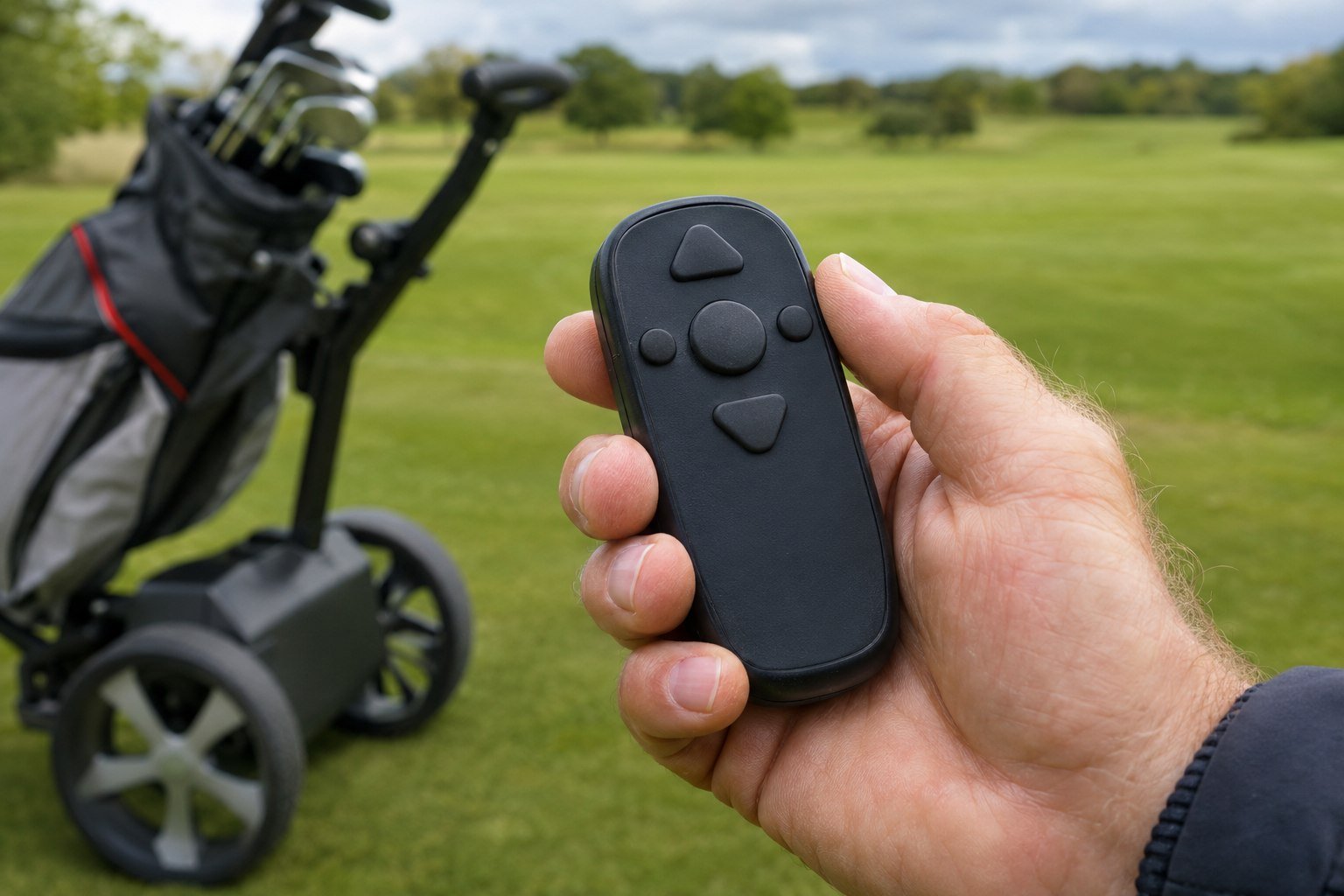
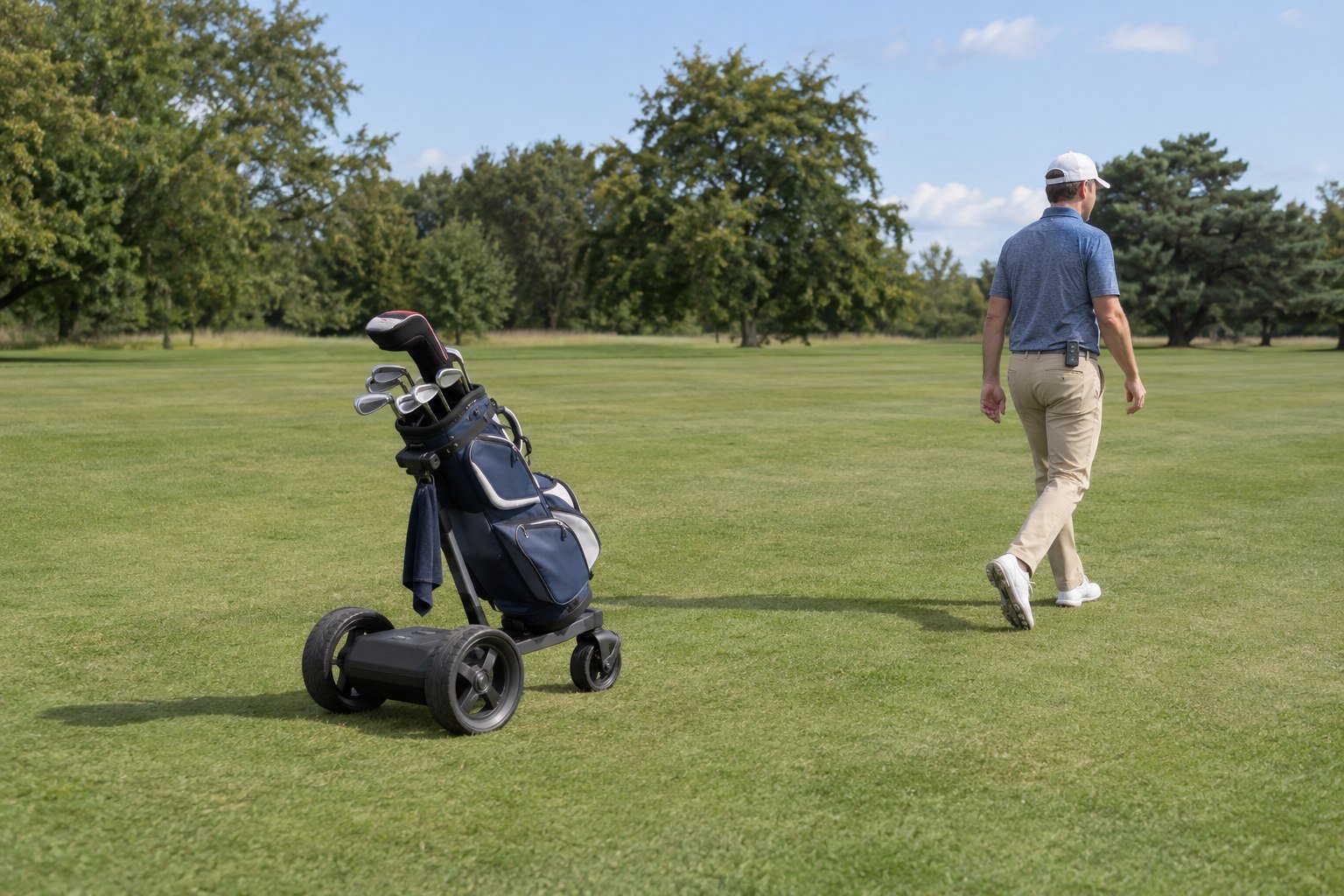
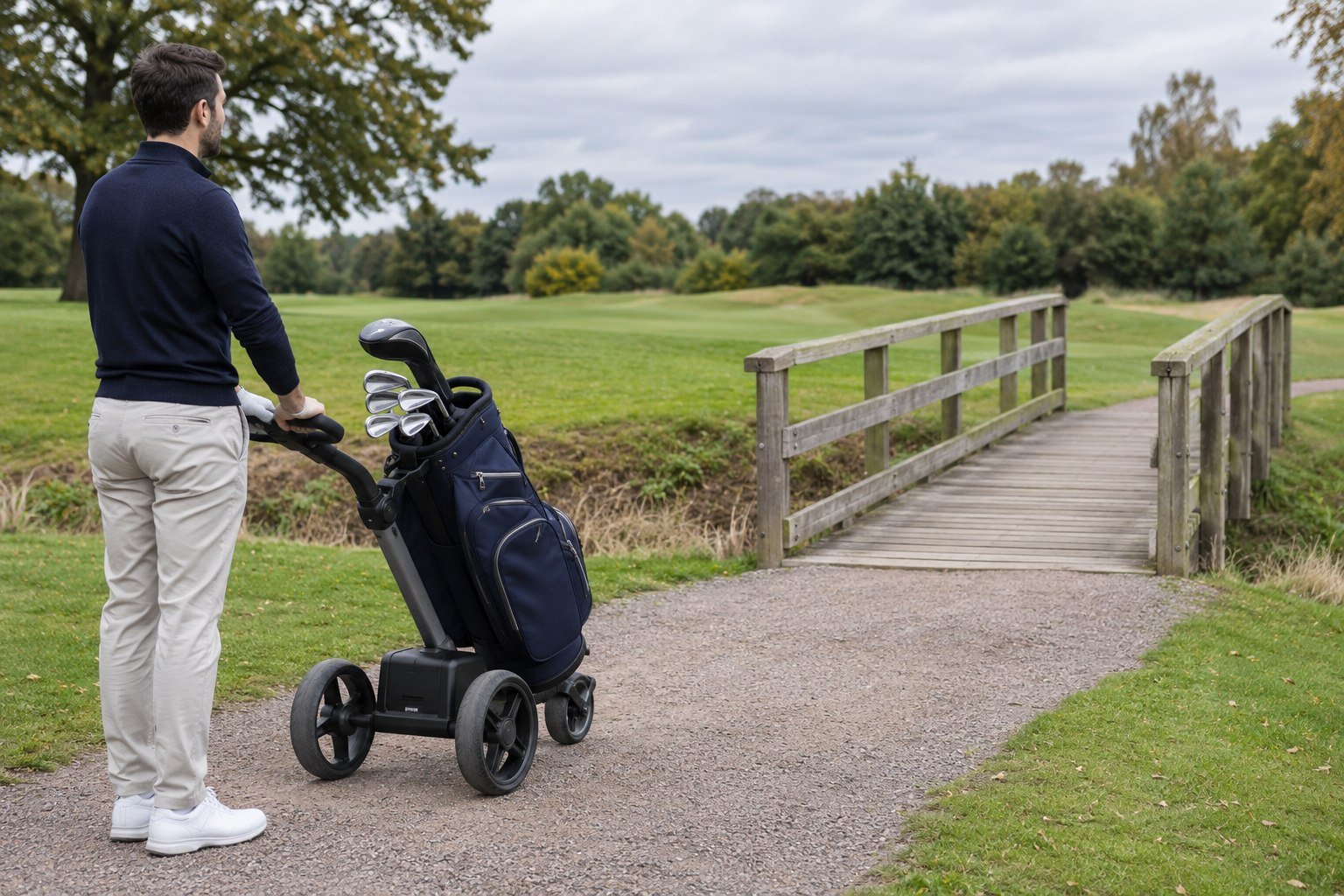
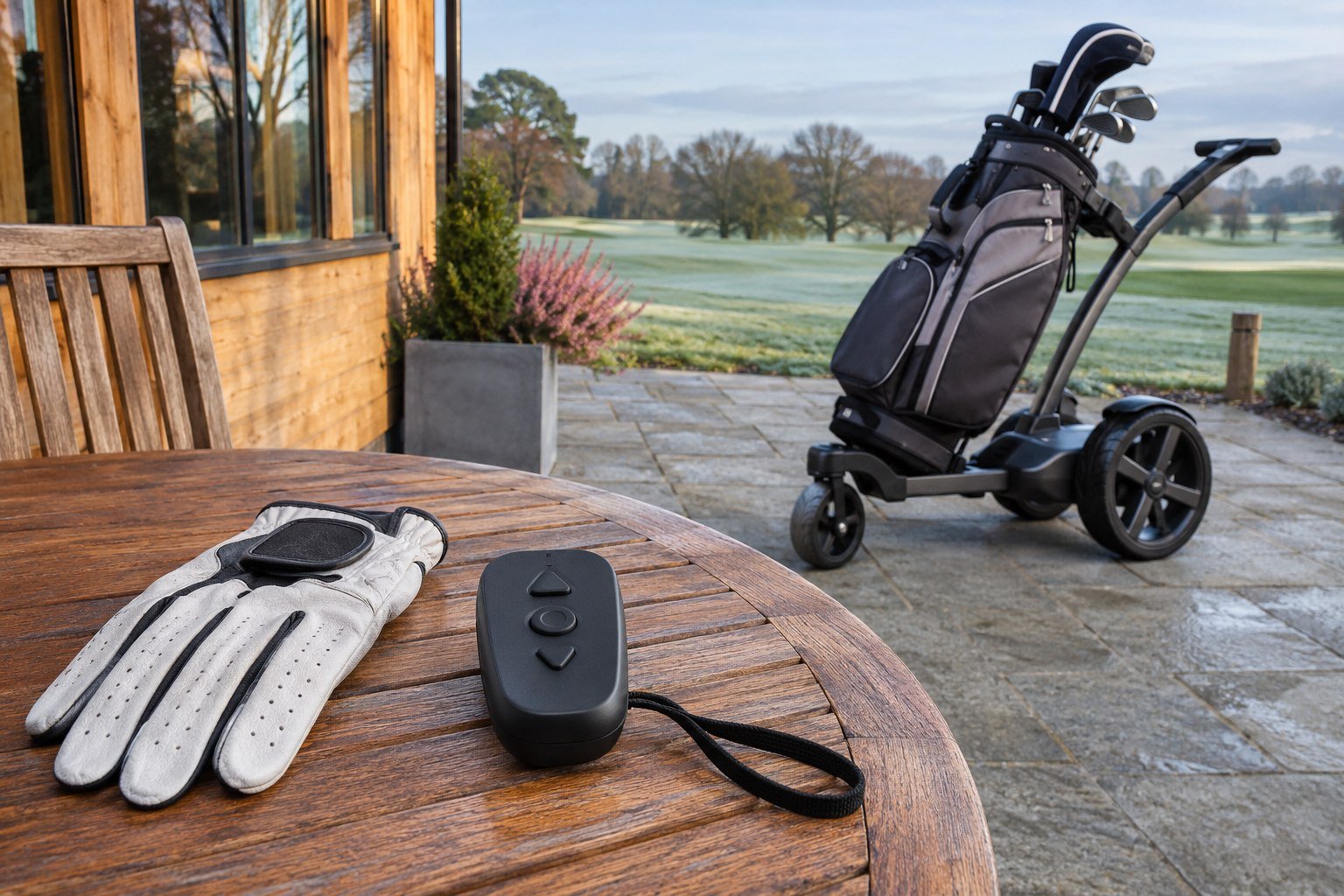
Remote and follow functions still require an attentive golfer and a suitable route. AI-created category illustrations show generic equipment, not the named products or a product test.
Choosing between electric golf trolleys with remote control and follow modes starts with the route you actually walk. Long open fairways, tight paths, bridges and busy areas create very different control tasks. A feature that looks relaxing in a demonstration may be useful for only part of your usual round.
Follow is also often an additional mode, rather than a replacement for remote control. Stewart’s Q Follow provides manual, remote and follow operation, while the 2026 Motocaddy M7 REMOTE lists remote navigation and handle control. [1] [2] This guide compares those jobs and their limits, without claiming either trolley has been personally tested.
This guide contains affiliate links. If you buy through them, Taylor’s Trailblazing Golf may receive a commission at no extra cost to you.
You choose direction and speed using the handset.
The trolley tracks its handset within the system’s operating limits.
Learn the exact transition to the maker’s manual or handle-control mode.
Count useful opportunities to use the feature, not just rounds played.
Electric golf trolleys: what the control modes do
Read the control list for the exact model. “Electric” tells you that a motor moves the trolley; it does not tell you how direction is managed. “Remote” does not by itself promise follow, and “follow” should not be read as a promise of obstacle avoidance.
Scroll the table horizontally on a small screen to see every column.
| Control arrangement | What the golfer does | Useful question before buying |
|---|---|---|
| Handle-controlled electric | Walks with the trolley and manages its direction from the handle, using the model’s speed controls. | Does this already remove the part of pushing that you wanted help with? |
| Remote navigation | Uses handset commands to choose speed and direction while watching the trolley and its route. | Are the buttons easy to operate and is making frequent corrections comfortable? |
| Follow mode | Carries the handset in the maker’s required position so the system can respond to it. | How much of your normal route is suitable, and how easily can you stop or change mode? |
For the Q Follow, Stewart says the system follows the handset, not the person, and specifies carrying it on a back pocket or belt during follow use. [1] That distinction matters if you pass the handset to someone else, move around your bag or leave it somewhere while playing.
The table is a buying framework, not a universal operating procedure. Start and stop commands, braking behaviour and the change between modes must come from the manual supplied with your trolley.
Match each mode to the route
The Q Follow manual identifies open, flat fairways as the intended setting for follow. It excludes paths, bridges, car parks, steep hills and places with collision risks. The same manual directs the user to manual steering in confined areas. [1] Motocaddy likewise recommends manual control in confined spaces or near water and says to keep the trolley in sight. [3]
Scroll the table horizontally on a small screen to see every column.
| Part of your usual round | What to assess | Buying implication |
|---|---|---|
| Long open stretches | How often can you walk a clear route without immediately needing another mode? | Follow may have a useful role if those opportunities are frequent. |
| Frequent changes of direction | Will you prefer choosing the trolley’s line directly, and can you monitor it comfortably? | Remote steering may suit your preference; a demonstration should establish that. |
| Narrow routes and busy crossing points | Can you use the approved handle-control method easily with your normal bag? | Treat that routine as essential even when buying a hands-free feature. |
| Slopes or slippery ground | What does the exact manual permit, and what braking or traction limitations remain? | Ask for appropriate instruction. An extra mode alone does not establish suitability. |
| Courses with seasonal restrictions | Where are trolleys permitted and what routes or wheels are required that day? | Check with the club before assuming a particular feature can be used throughout the round. |
Think about the walks between holes as well as the fairways. If most of your concern is negotiating the clubhouse route or moving through gates, pay close attention to the ordinary handle-control experience. That part of ownership will remain even after buying the more elaborate electronics.
Two current UK examples, with the versions kept separate
These examples illustrate the control distinction. They are not a performance ranking, and their prices do not isolate the cost of a single feature.
Scroll the table horizontally on a small screen to see every column.
| Exact example | Documented controls | Observed UK price |
|---|---|---|
| Motocaddy M7 REMOTE, 2026 generation, ULTRA/Extended lithium listing | Remote navigation and handle control. No follow mode is listed in the 2026 specification. [2] | £1,199 at Clubhouse Golf, product code ETMOT187. [4] |
| Stewart Q Follow, Black/Onyx, Extended lithium listing | 8th-generation follow system, remote control and manual steering. [1] [5] | £1,699 at Clubhouse Golf, product code ETSTE014. [6] |
Check the generation, battery option and finish on the order. Motocaddy also has a separate 2025 M7 REMOTE listing, so a similar model name is not sufficient identification. The figures above are product-price observations, not a guarantee of continuing stock, delivery charges or a future offer.
View the M7 REMOTE listing View the Q Follow Black/Onyx listing
Check the whole bag-and-trolley combination
Stewart’s current Q Follow guidance recommends a cart, staff or tour bag with a total loaded weight of 13–15kg, including clubs and your usual kit. It says lightweight stand bags are not recommended for the intended fit and stability. [1] [5] If your present bag is a light carry setup, resolve that compatibility question before treating the price difference as your entire upgrade budget. Do not improvise ballast to make an unsuitable bag seem acceptable.
Also try the fold and lift. Compare the exact package with and without its removable battery where relevant. A feature you enjoy on the fairway does not compensate for equipment you cannot comfortably load into your car or store at home.
Back to guide contents ↑Give the extra convenience a realistic value
The two observed examples are £500 apart. If you kept the trolley for three years and played 40 rounds each year, that difference would be about £4.17 per round: £500 divided by 120. This is an illustrative way to consider the outlay, not a forecast of lifespan or a claim that follow improves your golf.
Now narrow the question. If only a small part of each round is suitable for follow, would you still choose to spend that money? If you strongly prefer direct remote steering, the extra mode may have little value to you even on an open course.
Compare the complete options, too. Different battery packages, frames, accessories, service arrangements and controls contribute to the purchase price. A £500 gap between two trolleys cannot be described as a £500 charge for follow technology alone.
A useful no-upgrade decision
Keep a satisfactory handle-controlled trolley if your main requirement is simply motor assistance and you are comfortable steering it. Make a list of the specific frustrations an upgrade would remove; if the list is vague, arrange a trial before paying for more controls.
Use a demonstration that includes ordinary tasks
Ask the retailer or manufacturer for a supervised demonstration with an appropriate bag and load. The aim is to learn whether the control routine suits you, not to test the machine’s limits. Use an authorised, clear area and the instructions for that exact model.
Identify the controls before moving
Locate the normal stop command, handset lock and the approved method for changing modes. Make sure you can distinguish the buttons without repeatedly looking away from the route.
Start with the everyday steering mode
Check handle reach, the walking pace you find comfortable and your view around the bag. Practise stopping with generous clear space.
Try remote commands under instruction
Use the demonstrated speed and steering controls. Notice whether button presses and small corrections feel manageable rather than chasing a maximum distance.
Try follow only in an appropriate setting
Use the specified handset position and activation method. Assess a normal walk, a controlled stop and the transition back to another mode.
Finish with packing and loading
Repeat the fold, battery removal if applicable and lifting routine. Include the space needed for the bag as well as the trolley.
Motocaddy warns against trying to steer the M7 manually while it remains in remote-control mode. [3] Learn the actual switching procedure; simply grabbing the handle is not a substitute.
Write down the task that felt awkward. “The handset was difficult to operate with my usual glove” is more useful than “it seemed complicated”. Ask whether instruction, a setting or a different control layout addresses that particular issue.
Back to guide contents ↑Keep safety and upkeep in the decision
A quoted radio range is a specification, not a sensible target for how far away to send a trolley. The 2026 M7 manual describes inactivity and out-of-range cut-offs, but still requires proper care and control. [3] Safety features do not establish that a route is clear or that there is room to stop.
Make the routine easy to remember: know the selected mode, watch the route, stop before dealing with a distraction and use the approved arrangement for parking or leaving the controls. Do not use a trolley as a mobility support; Motocaddy specifically warns against using its trolley to assist you while walking uphill. [3]
Plan for two powered devices
The trolley battery and the handset both need attention. Follow their separate charging instructions, including the specified charger or cable, suitable conditions and storage guidance. Do not assume that a charged trolley means the remote is ready.
Before buying, ask what happens if the handset fails or its battery is empty. Stewart’s Q-Series FAQ says the Q Follow needs its handset for operation except in freewheel mode. [7] That is a practical reason to check the recovery procedure while the retailer can show you.
For the separate question of a long playing day, use our guide to the conditions behind 36-hole trolley-battery claims. Remote and follow control do not remove the need to choose an appropriate battery and realistic route.
Questions worth asking before ordering
Can I compare two models using only the advertised weight?
Ask whether each figure includes its battery and any equipment that must remain fitted. Then compare the actual parts you will lift. A technically lighter trolley can still be awkward if the fold, carry handle or boot opening does not work for you.
What should I ask about service?
Ask who handles faults, how the trolley would be transported, which battery and handset replacements are supported, and what evidence of purchase or registration is needed. Read the terms for the exact package rather than assuming the battery, charger and frame have identical cover.
Back to guide contents ↑Choose the control routine you will actually use
Choose remote control if directly steering the trolley’s route is the experience you want and a trial confirms the handset suits you. Choose a follow-capable model if appropriate open stretches form a worthwhile part of your golf and changing between modes feels straightforward.
Keep handle control in both comparisons. If the bag fit, loading routine, charging arrangements or everyday steering do not suit, look at another model or keep the trolley you already have. The useful upgrade is the one that improves your whole round’s routine, including the unglamorous journey from car boot to first tee.
Back to guide contents ↑Sources
- Stewart Golf — Q Follow Owner’s Manual (2025)
Current manual linked by Stewart; modes and their intended settings, pages 12–15. Match the supplied manual to your model. - Motocaddy — 2026 M7 REMOTE Electric Trolley
2026 control features and model identification; a separate 2025 listing also exists. - Motocaddy — 2026 M7 REMOTE Instruction Manual
Safe use and cut-offs, pages 4–5; specific operating and battery instructions elsewhere in the manual. - Clubhouse Golf — Motocaddy M7 REMOTE, Extended Lithium
ETMOT187; £1,199 observed on 23 November 2026. Price and package may change. - Stewart Golf — Q Follow product details and bag compatibility
8th-generation control system and the maker’s current recommendation for cart/staff/tour bag fit. - Clubhouse Golf — Stewart Q Follow Black/Onyx, Extended Lithium
ETSTE014; £1,699 observed on 23 November 2026. Price and package may change. - Stewart Golf Support — Q-Series FAQ
Handset dependence and freewheel fallback. Follow the exact owner’s manual for operation.
Illustrations in this article were created for Taylor’s Trailblazing Golf. Third-party photographs, where used, are credited beside the image or in the source list.