

Golf Trolley Battery Capacity for 36 Holes: Conditions Behind the Claim
Read the application and conditions before relying on the biggest number on the label.
Original conceptual illustration; not a product or test photograph.
Golf trolley battery capacity for 36 holes is not a single number that can be recommended for every trolley. The claim depends on the exact battery and machine, the route, the load and the conditions. Two packs with similar-looking labels may belong to different electrical systems, while one pack can have a different practical range when used on a different compatible trolley.
The useful buying question is therefore not simply "how many amp-hours do I need?" It is whether the manufacturer approves the battery for your exact trolley and supports the intended two-round use under conditions resembling yours. This research-led guide explains the specifications, the caveats behind the claim and a cautious way to record normal use. It does not report original battery endurance tests or provide instructions for opening, repairing or modifying a battery.
Approved system
Match trolley, battery and charger.
Watt-hours
Useful for energy, not a hole guarantee.
Route, ground and load
Normal conditions may not match your day.
Plan before leaving
A spare must be genuinely compatible.
Golf trolley battery capacity for 36 holes: what the claim means
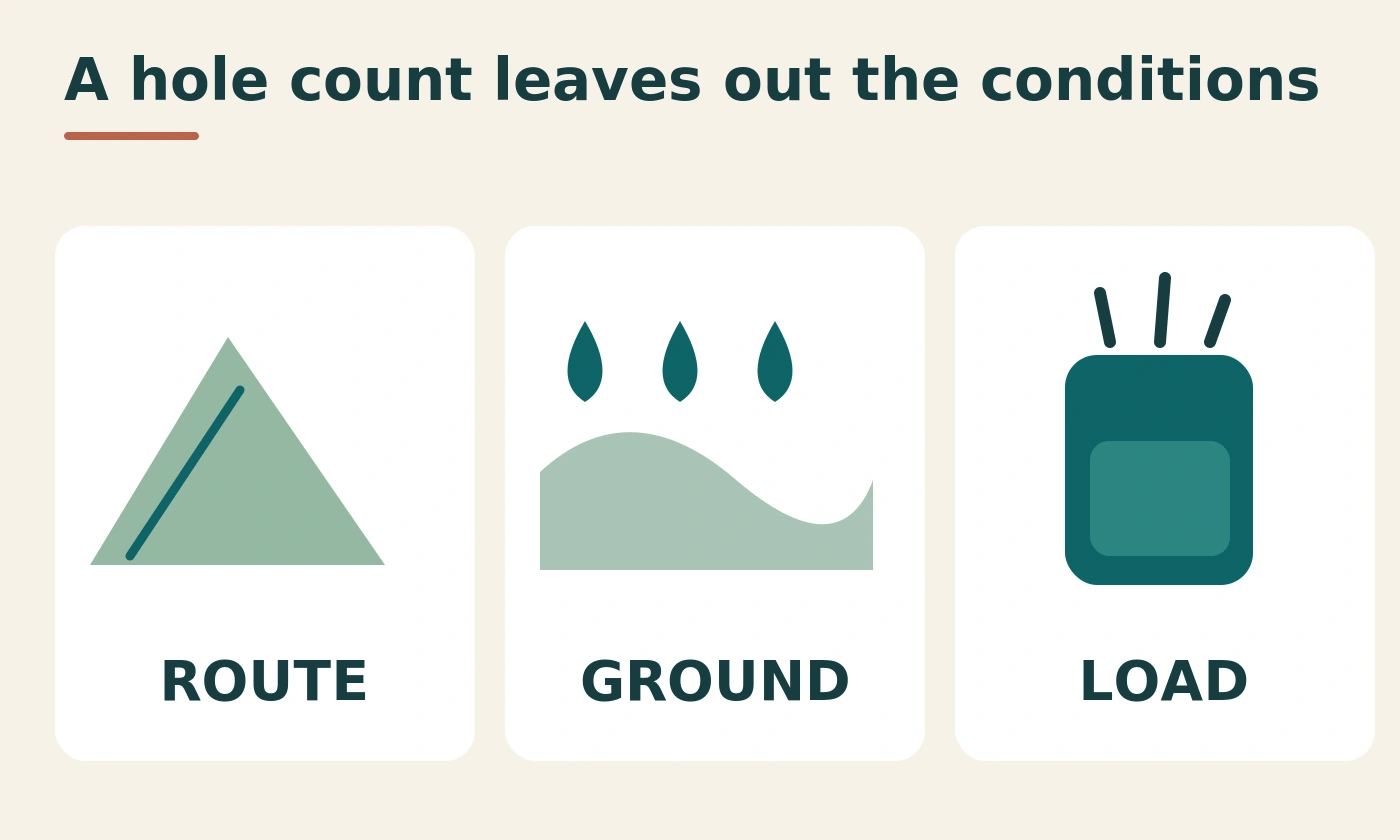
A hole count describes a use case
Thirty-six holes means two rounds of golf, but it does not specify how far the trolley travels or how much work it does. A short, firm, relatively level course and a long, soft, hilly course are different demands. Detours, practice-area travel and the walk from the car park also add movement without adding holes to the scorecard.
Read a 36-hole label as a conditional manufacturer claim for a particular product, not as a universal unit of battery capacity. Ask what trolley it applies to, whether the claim assumes normal conditions and what exclusions or recommendations accompany it. The useful answer includes those qualifications rather than leaving them in small print after a prominent number.
Normal conditions are not a guarantee
PowaKaddy's Extended battery page says that normal-condition 36-hole use can be reduced by a long or exceptionally hilly course, wet or soft ground and an excessively heavy bag. Motocaddy's M-Series extended-battery page similarly qualifies the claim and says completion is not guaranteed. Those caveats belong in the buying decision, not only in the manual after purchase. [1] [2]
The practical response is to describe your own day honestly. If you regularly play a demanding course with a substantial load, do not assume that the largest hole count in a listing removes the need for contingency. A conditional product claim can be useful evidence without becoming a promise that every planned outing will finish on one charge.
Identify the trolley, battery and charger as a system
Record exact model details
Write down the trolley make, full model name, generation or year where known, and any identifying serial information. Then record the existing battery's product code, nominal voltage, stated capacity and connector type. Take photographs of the labels and connectors without dismantling anything. These details give the manufacturer or retailer a specific compatibility question to answer.
Do not rely on a broad family name when electrical systems have changed across generations. A trolley can look similar to another model while requiring a different battery or charger. Nor does a plug that physically fits establish that voltage, charging requirements or battery-management communication are correct. Compatibility must be confirmed for the actual system.
Keep the charger in the conversation
A battery purchase may require its matching approved charger. Ask whether the quoted package includes it and whether any existing charger is explicitly approved for the replacement pack. Do not treat a charger with a similar connector as interchangeable. The label, model and manufacturer's instruction all matter.
Avoid conversion leads, improvised adapters or portable power arrangements unless the trolley and battery manufacturers expressly approve the exact combination. This guide does not provide wiring or modification instructions. A higher-capacity purchase is only useful after it passes the compatibility check; extra energy on paper does not make an unsuitable electrical system acceptable.
Understand volts, amp-hours and watt-hours
Compare like with like
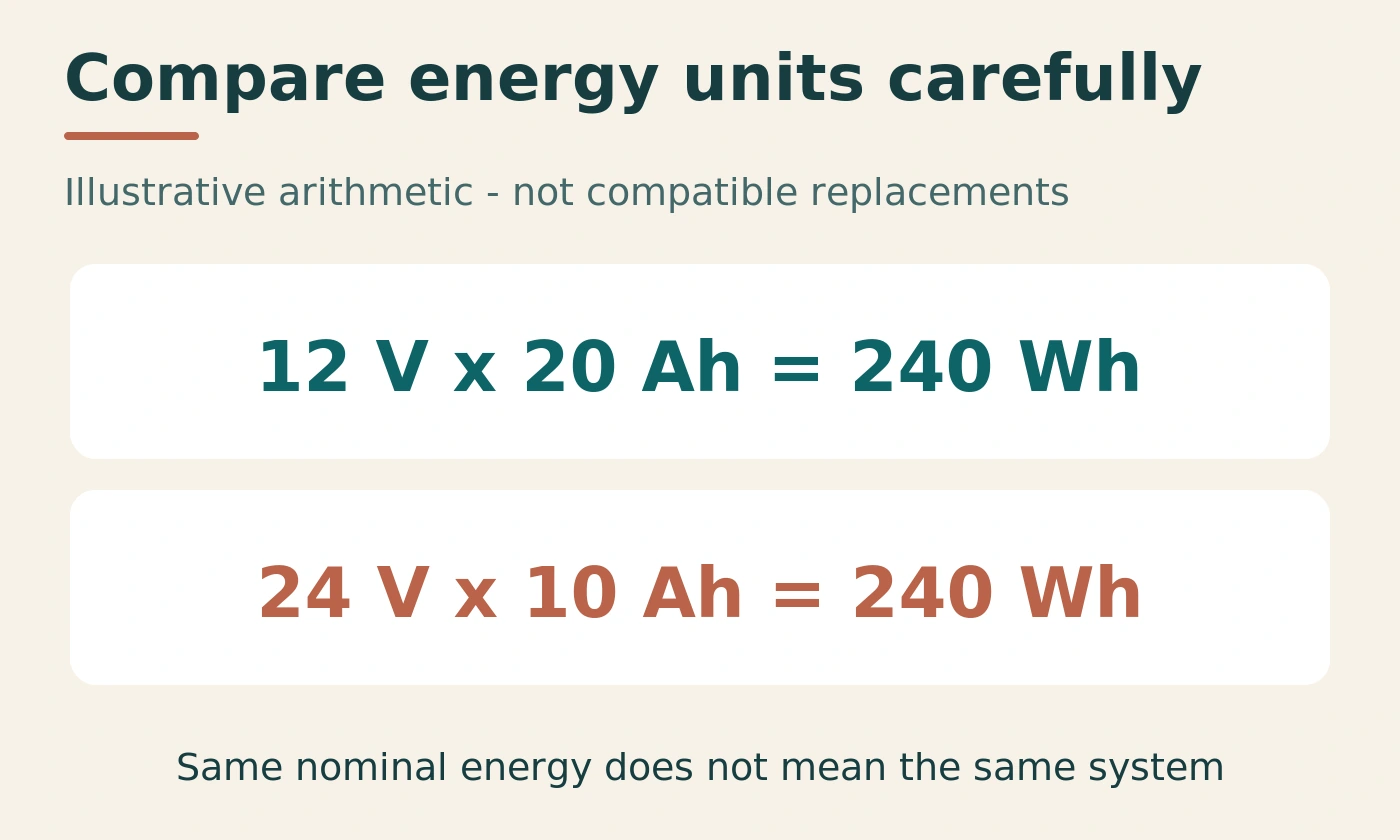
Voltage describes an electrical characteristic of the system, while amp-hours describe charge capacity under the stated rating conditions. Watt-hours express energy and are a more useful starting point for comparing capacity across different nominal voltages. The basic arithmetic is nominal volts multiplied by amp-hours, provided the figures refer to the same battery rating basis.
For a purely illustrative calculation, a 12-volt, 20-amp-hour pack represents 240 watt-hours, and a 24-volt, 10-amp-hour pack also represents 240 watt-hours. That does not make the two packs interchangeable or imply equal trolley range. The example explains units only. Their chemistry, usable energy, current capability, management system and approved application would still need separate assessment.
Rated energy is not guaranteed usable distance
Even a correct watt-hour comparison does not tell you exactly how many holes a trolley will complete. The machine's demand and the usable portion of the battery's stored energy matter. A protective cutoff may stop operation before every theoretical watt-hour has been delivered, and the course determines how much energy each part of the journey requires.
Do not convert a battery label into a precise holes-per-charge forecast without a valid basis. A calculation such as "twice the watt-hours means exactly twice the holes" ignores the rest of the system. Use the rating to understand the product, then use the manufacturer's application guidance and normal-use history to assess the practical range.
Read the checked examples without treating them as universal recommendations
Two product labels illustrate the unit problem
On the pages checked on 4 October 2026, PowaKaddy's named Extended Plug 'n' Play battery lists 29.6 V and 260 Wh. Motocaddy's named M-Series 28 V extended battery lists 28.8 V and 11 Ah, which gives 316.8 Wh by multiplication of those nominal figures. These are examples of differently presented specifications, not a head-to-head endurance test. [1] [2]
The checked Motocaddy example, product code BALI006M11, is explicitly not compatible with ME REMOTE and was listed out of stock. It is included to explain specifications, not as an available recommendation for that trolley. The ME REMOTE manual discussed later is a separate indicator example, not a pairing with this battery. [2]
The larger calculated number does not establish which product is the better purchase for a particular golfer. They belong to specified systems and should not be substituted for each other. A useful comparison must first ask which product is approved for the trolley you own. Only then can capacity, warranty and practical range be considered within the relevant options.
Preserve the product identity beside the number
Keep the exact product name and source beside any specification you copy into a shopping note. Manufacturers can sell several capacities with similar names, and a retailer may use shorthand such as extended, XL or ultra. Without the product code and application, the number can become detached from the battery it actually describes.
| Checked example | Published specification | What the comparison can show |
|---|---|---|
| PowaKaddy Extended Plug 'n' Play example | 29.6 V; 260 Wh | A directly stated nominal energy figure |
| Motocaddy M-Series 28 V Extended example | 28.8 V; 11 Ah | 316.8 Wh from the stated nominal figures |
| Cross-brand use | Not approved by this table | Similar capacity does not establish compatibility |
On smaller screens, scroll this table sideways.
Specifications were checked on 4 October 2026. Confirm the exact current product code and application before purchase; the table is not an approved replacement list.
Count the distance the trolley actually travels
Scorecard length is only part of the route
A trolley travels between greens and tees, around restricted areas and from parking to the course. It may also visit the practice ground before or between rounds. The scorecard's playing yardage does not include all of that movement. A course with long transfers can therefore demand more from the battery than the hole count alone suggests.
For planning, describe the route rather than attempting to calculate an exact energy requirement from yardage. Note long transfers, repeated detours and whether the second round uses another course. A manufacturer or retailer can respond more usefully to that description than to the statement that both courses have eighteen holes.
Compare two-round days with two separate days
Do not assume that a battery advertised for 36 holes is intended to complete eighteen holes on each of two consecutive days without charging. Motocaddy's extended-battery guidance specifically distinguishes that pattern and recommends charging or topping up appropriately. PowaKaddy's warranty guidance also requires charging between uses on consecutive days. Follow the exact instruction for your battery. [2] [3]
This distinction affects weekend planning. Two rounds on one day with a permitted interval top-up are not the same charging pattern as leaving a partly used battery overnight and returning the next morning. Put the manufacturer's charging requirements into the itinerary rather than treating the hole-count label as permission to skip them.
Hills change the demand, not just the walking experience
Describe the course honestly
A long climb requires the trolley to move its own mass and the loaded bag uphill. Repeated climbs can therefore change the demand compared with a flatter route. PowaKaddy explicitly identifies exceptionally hilly courses as a factor that can reduce its stated range. That is a reason to discuss your normal course when buying, not a reason to apply an invented percentage reduction. [1]
Avoid assuming that every descent returns the energy used on the climb. Trolley braking and downhill-control systems differ, and this guide does not claim a universal regenerative benefit. Follow the machine's intended operating method and ask the manufacturer about the actual model instead of borrowing assumptions from an electric car or bicycle.
Terrain also affects the contingency plan
A battery problem near the clubhouse is different from one at a distant low point on a steep course. Think about where you could safely stop, obtain help or change to another permitted option. Do not leave this until the battery warning appears. A useful contingency is practical for the route, not merely a spare item left somewhere inaccessible.
If the trolley can be used in a freewheel or manual mode, learn the exact procedure from its manual before the day. Do not assume every electric trolley can simply be pushed with its drive engaged. This article does not provide a generic wheel-release instruction because the correct method is model-specific.
Wet ground and a heavy bag can reduce the margin
The surface matters
Soft or wet ground can increase the effort required to move the trolley, and PowaKaddy lists those conditions among the factors that reduce its normal-condition range. A battery that comfortably completed a summer day may have less practical margin during a wet winter outing. Record the surface conditions when comparing your own normal-use history. [1]
Do not drive through deep water or unsuitable ground in an attempt to preserve the shortest route. Battery casing claims do not make the complete trolley safe for every water exposure. Follow the trolley and battery instructions, and use the course's permitted routes. Protecting the equipment and observing restrictions takes priority over a speculative range calculation.
Pack deliberately without removing essentials
A heavier load is another stated range factor. Remove unnecessary accumulations and duplicate accessories, but do not leave behind essential water or suitable weather clothing merely to make the battery plan appear viable. Describe the real bag load you intend to use, including the items that are regularly added for a two-round day.
The useful question is whether the approved battery suits that realistic load and course. A test with an unusually light bag followed by a heavily packed event is not a meaningful comparison. Keep load changes visible in the record so a decline in range is not automatically blamed on battery ageing when the trolley is being asked to do more work.
Remote and twin-motor trolleys need their own range evidence
Do not transfer a claim from another machine
Different trolley designs can place different demands on an approved battery. A remote-controlled machine, for example, should be assessed using the manufacturer's guidance for that exact application rather than the range stated for another compatible trolley. The presence of the same battery family name does not settle the intended hole count.
PowaKaddy's UK and Ireland warranty terms effective from January 2026 make this distinction explicit: its XL Plus 30 V battery is treated as an eighteen-hole battery in the RX-series context, while other compatible applications may offer up to 36 holes. This is a particularly clear warning against reading the battery label without the trolley context. [3]
Separate motor power from battery energy
A motor power rating in watts is not the same quantity as battery energy in watt-hours. Do not compare those numbers as though a larger motor figure automatically means a larger battery reserve. They describe different aspects of the system, and the actual duty during a round is not captured by one label alone.
Ask for the exact 36-hole recommendation for your model, including any remote or downhill-control variant. A retailer should not answer solely from a generic battery category. Provide the full trolley identification and ask them to name the approved pack and charger in writing, together with the relevant range caveat.
Keep operating temperature and charging temperature separate
Follow the limits for the actual product
A manufacturer's charging-temperature range is not automatically the same as its permitted operating or storage range. Read the relevant section of the manual rather than taking one number out of context. Motocaddy's battery care material specifies conditions for safe charging, including a dry, non-carpeted surface and its stated temperature range. Those are instructions for that product family, not a universal lithium-battery rule. [4]
Do not invent a cold-weather percentage loss for a battery that has not been tested under those conditions. Instead, ask the manufacturer how the actual product should be used and charged in the weather you expect. A cautious plan includes uncertainty rather than replacing it with a precise-looking but unsupported derating figure.
Plan the charging location before the trip
A cold shed, wet clubhouse corner or hot vehicle may not satisfy the battery's instructions. Identify an appropriate place before relying on a top-up. Confirm that permission, a suitable socket and supervision are available, and that the battery can be handled and connected according to its own manual.
Do not warm a battery with improvised heaters or charge it simply because the connector is available. If the conditions are outside the instructions, seek manufacturer advice and change the plan. Range preparation should not introduce a charging hazard in order to preserve the original schedule.
Account for battery age without inventing a replacement date
Capacity and history matter more than the birthday alone
A battery's useful capacity can change over time, and Motocaddy explicitly notes that use and charging conditions affect capacity. However, age alone does not tell you the remaining range of an individual pack. A relatively new battery with a concerning history deserves attention, while a calendar date cannot certify an older battery as suitable for a demanding day. [2]
Keep a record of normal use, charging behaviour and any changes in warning indications or completed routes. Do not repeatedly run the battery to shutdown to measure its limits. A protective cutoff is not a target for a home endurance test. Ask the manufacturer or an authorised service provider about an appropriate assessment when performance changes unexpectedly.
Compare like-for-like outings
A useful history compares similar routes, bag loads and conditions. If the course has become wetter or you have added equipment, note that before concluding the battery has deteriorated. Conversely, do not dismiss a clear, repeated decline under similar conditions simply because the pack still charges to an apparently normal indication.
The record should help you ask a better question, not provide a self-diagnosis. Tell support staff what changed, when it began and which battery, charger and trolley are involved. They can advise on the appropriate inspection or service route without you opening the pack or attempting to interpret internal electrical behaviour.
Charge according to the exact manual
Use the approved charger and a suitable place
Motocaddy's care guidance calls for the correct charger, suitable charging conditions and disconnection after charging is complete. It also advises against overnight or prolonged unattended charging. Follow the corresponding instructions for your own battery rather than applying a generic routine from another chemistry or brand. [4]
Keep the charging area clear of combustible clutter and do not block an escape route. Inspect the visible battery, cable and charger condition before connecting them. If damage is suspected, do not charge the pack to see whether it still works. Contact the manufacturer for advice and use an alternative plan for the round.
A partial top-up is not a promised number of holes
Where the manufacturer permits a top-up between rounds, treat it as additional margin rather than a precisely predictable extension. A short charging interval does not translate automatically into a fixed number of extra holes. The starting state, charger, battery and subsequent route all matter.
Confirm the available time and charging arrangement with the venue in advance. Do not assume that a lunch break includes access to a suitable supervised location. A plan that depends on an unconfirmed socket is not a reliable contingency. Bring the correct charger only when the transport and venue arrangements allow it to be used properly.
Plan a backup that is genuinely compatible
A spare pack must pass the same checks
A second battery is useful only when it is approved for the trolley, appropriately charged and safely transported. Check the exact model and connector requirements, including any indicator settings specified by the manufacturer. Do not assume that a friend's pack is suitable because it fits into the tray or comes from the same brand.
Keep the spare protected and secure according to its instructions. Avoid loose placement among metal objects or equipment that could damage the casing or connectors. This guide does not recommend generic power banks, conversion cables or improvised external packs as trolley backups. Compatibility and safe handling come before convenience.
A non-battery fallback may be simpler
Depending on the course and your needs, an approved hire trolley, a permitted buggy or another suitable transport arrangement may be more practical than carrying a spare battery. Confirm availability and the relevant conditions before the day. Do not assume that a venue can supply a compatible battery at short notice.
Also consider how you will respond if the trolley itself develops a fault. A spare pack does not solve every problem. Keep the fallback focused on completing the day safely and sensibly, rather than assuming all loss of movement is a battery-capacity issue.
Build a normal-use record rather than a discharge test
Record an ordinary first round
Begin with a fully prepared, approved system used according to the manual. Record the course, conditions, approximate bag load and the battery indication at sensible stopping points. Do not interrupt play or stare at the display while moving. The record can be completed afterwards from a few brief notes.
Stay within the battery's intended use and do not deliberately extend the route until it stops. The aim is to learn whether ordinary use leaves a comfortable practical margin, not to discover the absolute cutoff point. Where the indication or performance becomes concerning, stop and follow the manufacturer's advice instead of pressing on to complete a data point.
Keep the second round conditional
A first-round result can inform the next decision, but it does not guarantee another eighteen holes. Consider the second course, weather, load and available contingency. A favourable gauge reading is only one piece of information. If the day is more demanding than your established use, a permitted top-up or different plan is more defensible than relying on an untested assumption.
| Record field | Example of the kind of note | Why it matters |
|---|---|---|
| Trolley and battery | Exact model and product code | Keeps the system identifiable |
| Route and conditions | Normal course, wet fairways | Explains changed demand |
| Load | Usual bag plus waterproofs | Avoids an unrealistic comparison |
| Indication | Display state at a normal stop | Describes, but does not guarantee, reserve |
| Action | Charged as instructed; no fault | Keeps use and charging history clear |
On smaller screens, scroll this table sideways.
The entries above illustrate a record format. They are not results from an endurance test performed for this article.
Read the battery indicator as the manual intends
Bars and colours are model-specific
A battery display is not a universal fuel gauge with an identical meaning across trolleys. Read the instructions for the actual machine and battery combination. Some systems may require a particular indicator setting for an approved battery type, while others use different warning or cutoff behaviour. Do not copy a setting from another golfer's trolley.
The 2026 Motocaddy ME REMOTE manual, for example, describes a battery indicator calibration associated with specified battery connection types and a protective low-capacity cutoff. That is model-specific information. Its value here is to show why the display must be interpreted through the correct manual, not to provide settings for unrelated machines. [5]
Do not convert a display into a hole guarantee
A green light or several remaining bars cannot promise completion of a route whose demand is unknown. The second round may be wetter, hillier or longer than the first. Treat the display as part of the system's guidance and combine it with normal-use history and the manufacturer's caveats.
If the indication behaves unexpectedly, check the approved configuration through the manual or support service. Do not open the battery, alter wiring or bypass a protection system to make the display look normal. A confusing indication is a reason to seek clarification, not a reason to assume the battery has more usable reserve than it is showing.
Investigate reduced range without opening the battery
Look at the complete system
A change in range may involve the battery, charger, trolley condition, load or route. Begin with the visible and permitted checks in the trolley manual. For example, make sure the machine is being used in its intended configuration and that obvious debris or a mechanical issue has not been ignored. Do not invent a generic tyre-pressure or lubrication instruction for models with different wheel designs.
Record any new noise, resistance, warning message or charging irregularity. These observations help support staff distinguish possible causes. Avoid concluding that the battery must be replaced simply because the trolley stopped sooner once, especially when the course or load changed substantially.
Keep troubleshooting within safe limits
Do not remove battery covers, probe cells, replace internal parts or attempt a homemade reset. This guide does not provide electrical repair instructions. Follow the manufacturer's support route and stop using or charging equipment when damage or a fault is suspected.
When seeking help, supply the exact model details and a concise account of the issue. Include whether the charger indicated completion, whether the battery was used as instructed and whether the problem repeats under similar conditions. That is more useful than a speculative explanation about a particular internal cell or circuit that has not been professionally assessed.
Read the warranty separately from the range claim
Years of cover are not years of full original capacity
A warranty describes specified cover under stated conditions; it is not automatically a promise of unchanged range. Read exclusions, registration requirements, transferability and any capacity or pro-rata provisions that apply to the exact product and purchase date. A headline saying five years can conceal important distinctions in how later-year support works.
PowaKaddy's UK and Ireland terms effective from January 2026 describe a five-year pro-rata battery arrangement rather than five identical years of full replacement cover. They also distinguish particular battery and trolley uses. Read the actual terms for the purchase rather than relying on a retailer's shortened badge or an older summary. [3]
Keep the paperwork useful
Retain the receipt, product identification, registration confirmation where required and the relevant warranty version. If a retailer makes a specific representation about your intended 36-hole use, keep that written answer too. This is practical record-keeping, not a legal opinion about the outcome of a future claim.
Ask the supplier to clarify ambiguous terms before buying. For example, distinguish a manufacturing-defect warranty from an endurance promise and ask what assessment is available if range becomes unsuitable. Clear questions at purchase are more useful than discovering later that the headline and your expectation described different things.
Ask the retailer a complete 36-hole question
Describe the intended day
A useful enquiry identifies the trolley, the proposed battery and the course conditions: "I use [exact model] with [typical load] on a long, hilly course and occasionally play two rounds in one day. Which approved battery and charger do you recommend, what conditions apply to the 36-hole claim, and what backup arrangement is sensible?"
This asks for more than a capacity number. It invites the supplier to state compatibility, application and limitations. Attach label photographs when the generation is uncertain. Do not let a generic response such as "extended battery recommended" stand in for an exact product identification.
Ask what is included and what remains uncertain
Confirm the charger, connector arrangement, required setup and warranty terms in the quote. Ask whether the range recommendation is a manufacturer statement or the retailer's judgement about your description. Both can be useful, but they are different kinds of evidence and should not be confused.
If the supplier cannot support the intended day without a contingency, keep that limitation in the plan. A candid answer is more useful than an unconditional promise unsupported by the manual. You can then compare a compatible spare, a top-up arrangement or a different transport option without pretending that the initial battery choice solved every uncertainty.
Be cautious with used batteries and old stock
Ask about identity and history
For a used pack, obtain the exact product code, purchase date where documented, charger details and known use and storage history. A clean casing and a normal indicator do not establish remaining capacity or internal condition. This guide does not provide a method for certifying a second-hand battery from photographs.
Do not buy a visibly damaged, altered or unidentified pack as a cheap route to 36 holes. Nor should a seller's claim that it "still does two rounds" replace your model-specific compatibility check and the product's actual condition. Consider an authorised assessment where available, and compare the uncertainty with the value of a documented approved purchase.
Old stock still needs a clear sales basis
An unused battery can still have a storage history, an older product revision or terms that differ from a current model. Ask the supplier to identify the product and the warranty that will apply to your purchase. Do not assume that a sealed box answers every question about suitability or condition.
Where the price looks unusually attractive, check whether the correct charger and necessary approved accessories are included. A battery-only offer may not be the lower-cost usable system once those are added. The relevant comparison is the complete, compatible and supportable setup, not the cheapest isolated component.
Transport and store it according to its instructions
Protect the pack and connections
Secure the battery during transport so it cannot move around or be struck by loose equipment. Follow the manufacturer's instructions about disconnecting it from the trolley and protecting the connectors. Do not lift it by a cable or leave it where another item can crush the wiring or casing. Motocaddy's care guidance specifically warns against carrying its battery by the cable. [4]
Keep the pack out of unsuitable heat, moisture or storage conditions identified by its manual. A boot or shed is not automatically appropriate simply because the battery fits there. Plan storage as part of owning the system, particularly when the trolley is not used for several weeks.
Do not apply a generic lithium-storage rule
Different products can have different storage instructions, including the recommended charge state and top-up interval. Follow the actual battery manual rather than a general internet rule for another chemistry or device. If the instructions are unclear or the pack has been left unused for a long time, contact the manufacturer before returning it to service.
Keep charging and storage records simple enough to maintain. The purpose is to avoid neglect and recognise a changed situation, not to create an elaborate monitoring project. A calendar reminder to consult the manual's required interval can be useful, but the interval itself must come from the relevant product instruction.
Stop-use warning signs override the golf plan
Damage and unusual behaviour need attention
Do not use or charge a battery that is visibly damaged, swollen, leaking or behaving unusually. Excessive heat, unusual smells or sounds are reasons to stop and seek manufacturer advice. Do not try to complete the round first or charge the pack as a diagnostic experiment. The range question becomes irrelevant when a possible safety fault is present. [4] [6]
London Fire Brigade's lithium-battery advice is written for e-bikes and e-scooters, not as a golf-trolley endurance standard. Its emergency warning is nevertheless relevant to a smoking lithium-ion battery: get out, raise the alarm, call 999 and do not try to tackle the fire yourself. Do not handle or move a smoking pack in an attempt to save equipment. [6]
Use the appropriate disposal route
Ask the manufacturer or your local authorised waste service how to deal with a damaged or end-of-life pack. Explain its condition before transporting it. Do not place a suspect battery in ordinary household waste or post it using an assumed standard parcel service. The appropriate route depends on the battery and its condition, so obtain specific instructions.
A replacement purchase should follow only after the cause of any system fault has been addressed. Fitting a new battery to an unresolved charger or trolley problem is not a complete solution. Keep the support conversation focused on the full system and follow the authorised repair or replacement process.
Make a two-round day decision before leaving home
Separate the normal day from the demanding exception
For an ordinary two-round day on a familiar course, use the approved battery, follow its charging instructions and review the normal-use history. Confirm the interval charging arrangement or other fallback before setting off. This is a practical plan, not a calculation that promises a particular reserve at the final green.
For an unfamiliar, longer or wetter course, increase the attention given to the contingency rather than inventing a safety percentage. The relevant question is whether a suitable alternative is actually available when needed. A spare left in a distant vehicle or an unconfirmed hire option may not be a workable answer at the point where the trolley must stop.
Decide in advance what will change the plan
Identify the warnings that would make you abandon the second round on that battery: unexpected performance, a fault indication, unsuitable charging conditions or damage. Follow the product instructions and do not negotiate with a safety warning because the event is important. A clear stopping decision is easier to follow when made before the pressure of the day.
Keep the contact details for the venue and the relevant support route available. The aim is to respond calmly if the plan changes, not to perform electrical troubleshooting beside the fairway. A well-prepared day includes the possibility of using another permitted transport option or stopping, as well as the hope of completing all 36 holes on the original setup.
Pros and cons of buying for an occasional two-round day
The useful advantages of an approved extended option
A manufacturer-approved extended-capacity option can offer practical margin for the intended application and reduce dependence on a mid-day charging opportunity. It may suit a golfer who regularly plays two rounds under conditions covered by the product guidance. The benefit is a more suitable energy reserve, not an unconditional promise about every course.
Buying the correct system also simplifies support and charging arrangements. You can follow one set of instructions and identify the product clearly if a problem arises. That clarity is worth considering alongside capacity, especially when the alternative is a collection of unverified adapters or second-hand components.
The trade-offs remain real
An extended option can involve additional cost, weight or bulk, and it may still need a contingency on a demanding day. A golfer who rarely plays 36 holes may prefer an approved hire or top-up arrangement rather than purchasing around an unusual event. The best choice depends on frequency, route and practical support, not just the largest number in the catalogue.
Do not pay for nominal capacity that is incompatible with the trolley or unnecessary for your normal use. Start with the intended application, obtain a complete quote and compare the realistic alternatives. A considered smaller setup with a confirmed occasional fallback can be more sensible than an oversized but poorly understood purchase.
Common mistakes behind disappointing range
Comparing amp-hours across different voltages
A larger amp-hour figure does not automatically mean more energy when the nominal voltages differ. Convert the stated figures only to understand the units, then return to compatibility and application. A watt-hour calculation is not permission to connect the packs to the same trolley.
Another mistake is treating a remote trolley as equivalent to a different compatible machine. Use the range guidance for the exact model, including the battery version and any relevant setup requirements. A product family name is too broad when the manufacturer's terms distinguish the applications.
Treating the gauge or warranty as a guarantee
A healthy-looking display cannot promise the remaining holes, and a multi-year warranty does not promise unchanged capacity for its entire duration. Read each piece of information for what it actually means. Combine the manual, normal-use record and a practical contingency rather than allowing one reassuring label to answer every question.
Finally, never stretch the plan through damaged equipment, unsuitable charging or an improvised electrical connection. A missed round is inconvenient; an unsafe battery arrangement is a different level of problem. Keep the stopping rules clear and let them override the desire to complete an arbitrary hole count.
Frequently asked questions
How many watt-hours do I need for 36 holes?
There is no universal figure in this guide. The exact trolley, approved battery, route, load and conditions determine the relevant recommendation. Ask the manufacturer for the appropriate 36-hole application and its caveats. Use watt-hours to understand a specification, not to replace compatibility or a practical range assessment.
Is a 20 Ah battery better than an 11 Ah battery?
Not enough information is provided. The nominal voltage and other system requirements matter, and the packs may belong to entirely different applications. Compare rated energy only after confirming the actual products, then check which one is approved for your trolley. A larger amp-hour label alone does not answer the buying question.
Can I play eighteen holes on two days without charging?
Do not infer that from a 36-hole label. The checked Motocaddy guidance and PowaKaddy terms distinguish consecutive-day use and require appropriate charging between uses. Follow the exact battery's manual. Two rounds in one day and two separate days are not automatically the same permitted charging pattern. [2] [3]
Does a remote trolley need a different battery recommendation?
It can need a different range assessment even within a compatible battery family. PowaKaddy's current RX-series caveat is an example of a product whose stated application changes the hole-count expectation. Ask about the exact trolley variant rather than borrowing a recommendation from a non-remote model. [3]
Can I use a generic charger with the right-looking plug?
No suitability should be assumed from the connector. Use the charger expressly approved for the battery and follow its instructions. An incorrect charger can create a safety problem. Ask the manufacturer to confirm a replacement rather than testing a visually similar unit on the pack.
Should I run the battery flat to test its range?
No. This guide recommends recording normal use within the manufacturer's instructions, not deliberately reaching protective shutdown. A cutoff is not a target for an endurance experiment. Unexpectedly reduced range or warning behaviour should be discussed with the manufacturer or an authorised service provider.
Will a lunchtime top-up guarantee the second round?
No. Where permitted, it may add useful margin, but the extra range depends on the system, starting state, charging time and subsequent demand. Confirm a suitable supervised charging location and keep a practical fallback. Do not convert a short charging interval into an unsupported number of extra holes.
What should I do if the battery starts smoking?
Leave the area, raise the alarm and call 999. Do not try to tackle the fire or move a smoking battery to protect the trolley. Follow emergency-service instructions. Routine range planning and troubleshooting no longer apply when there is an immediate fire warning. [6]
Final recommendation: buy the application, not the hole-count badge
Identify the exact trolley, battery and charger, then ask for the manufacturer's approved two-round recommendation with its conditions. Read watt-hours correctly, keep the route and load realistic, and use normal-use records to understand your own practical margin. Plan a permitted top-up or compatible alternative when completion matters.
A 36-hole claim is useful only when it is attached to the right system and the right conditions. It should never be stretched into permission for an incompatible pack, skipped charging or unsafe troubleshooting. The dependable choice is a documented, approved setup with a realistic contingency, not simply the biggest number on a battery listing.
Sources and fact-checking notes
Official material was checked on 4 October 2026. Manufacturer specifications and instructions are distinguished from the suggested practical checks in this guide. Illustrative examples are not original product-test results. Check the exact current model instructions before acting on a consequential specification.
- PowaKaddy – Extended Plug n Play battery29.6 V / 260 Wh example and conditional 36-hole statement; not a cross-brand recommendation.
- Motocaddy – M-Series 28 V Extended batteryBALI006M11: 28.8 V / 11 Ah; excludes ME REMOTE; listed out of stock when checked.
- PowaKaddy – UK and Ireland warranty termsTerms effective January 2026; range qualifications, RX application and pro-rata distinction.
- Motocaddy – Lithium battery instructionsModel-family charging, care, storage and stop-use guidance; follow the exact supplied manual.
- Motocaddy – 2026 ME REMOTE manualSeparate example of model-specific indicator calibration and protective cutoff; not paired with BALI006M11.
- London Fire Brigade – Lithium-battery warning signsGeneral lithium-ion warning and emergency advice, written for e-bikes/scooters; not a golf range standard.
Illustrations in this article were created for Taylor’s Trailblazing Golf Gear. Third-party photographs, where used, are credited beside the image or in the source list.