Golf Club Cleaning Kit: Brushes, Cloths and What You Really Need
Choose the tools your clubs permit, then buy only what your current routine is missing.
AI-generated illustrations throughout show generic equipment and care situations, not named products or results from testing. A small kit begins with the tools your clubs permit.
A golf club cleaning kit can be small: clean soft cloths, a suitable brush and a way to use the cleaning method your club maker permits. The important buying question is which surfaces those tools will touch. A grooved iron face, a painted wood and a specialist putter finish do not automatically need the same treatment.
This guide combines manufacturer care advice with an editorial kit checklist. It has not tested brushes, cleaning liquids or improvements in spin. The aim is to help you remove ordinary dirt without turning routine care into unnecessary equipment buying or an improvised restoration project.
Ad – includes affiliate links. If you buy through these links, Taylor’s Trailblazing Golf may earn a commission. Recommendations are based on the equipment decision and the available evidence.
Use suitable clean supplies you own before buying a boxed set.
Identify the model and finish before choosing a brush or treatment.
Pause and ask for the correct method instead of reaching for a sharper tool.
Build a golf club cleaning kit by job
List the jobs first: wiping ordinary dirt, reaching permitted grooves, removing cleaner as directed and drying. Count useful functions rather than the number of pieces in a gift box. A branded towel is optional if a suitable clean cloth already does the job.
On a phone, swipe within the table to see all columns.
| Item | Useful job | Buying check |
|---|---|---|
| Two soft cloths | Keep a cleaning cloth and a dry finishing cloth available. | Choose a soft, clean surface without a stiff edge rubbing the club. Reuse suitable cloths you already own. |
| Small soft brush | Reach grooves where the club maker permits brushing. | Check the actual bristle material and softness. “Golf brush” alone is not a compatibility specification. |
| Clean water and a small bowl | Dampen the cloth and keep the work organised. | The container need not hold a club head. Avoid making immersion the default method. |
| Permitted mild cleaner | Use only when the club or grip instructions call for it. | Check the surface and directions before adding a bottle to the kit. |
| Drying space | Keep cleaned equipment and wet accessories apart. | Reserve a clean towel or suitable surface so drying is part of the job, not an afterthought. |
For a concrete manufacturer example, Titleist’s current care page specifies mild soap and water for its drivers, woods, hybrids, irons and wedges, followed by a soft cotton cloth. That guidance supports a simple kit; it does not make every household chemical or washing method suitable. [1]
Back to top ↑Match the tools to the surface
Record the brand, model and finish of any club that needs different care. Include the grip maker where you can identify it. If the finish is unknown, start by obtaining that information rather than guessing from colour or shine.
On a phone, swipe within the table to see all columns.
| Part of the club | What to establish | Kit implication |
|---|---|---|
| Iron or wedge face | Which brush and cleaner the maker permits, and whether the face has a special finish. | Keep a suitable soft brush available; avoid treating every metal surface as equally scrub-resistant. |
| Wood or hybrid head | Instructions for the crown, sole features, joints and any adjustment openings. | Keep a separate clean cloth ready and leave covers, weights and bonded parts assembled for routine care. |
| Putter | Exact model, face material and finish. | A specialist care cloth may belong in this kit only when the maker identifies it for that finish. |
| Grip | The grip maker’s cleaning and drying instructions. | Select its permitted method separately from the head-cleaning routine. |
| Shaft and joints | Any model-specific restrictions and any damage needing assessment. | Keep cleaning separate from repairs, disassembly and refinishing. |
Titleist’s 2017 staff guide gives a useful construction-specific example: for AP1/AP2 irons it recommends a damp cloth and soft brush, extends that approach to metalwood soles, and advises against running water over clubs or soaking them. Treat this as dated advice for the constructions discussed, not permission for every later model. [2]

The practical lesson is to read the exact instructions. A broad recommendation to use soap and water does not, by itself, specify a bucket soak, pressure spray or permission to dismantle a head.
Back to top ↑Choose a brush you can control
Look for a head small enough to place where you intend, a handle you can hold without gripping the club awkwardly and clearly identified bristles. If using a double-sided brush, check both sides before bringing it near the finish. More attachments do not necessarily add a useful cleaning job.
Titleist’s staff advice also excludes sharp tools around its ARC channel and sole features because they can harm finishes or the bond between components. That is a good reason to keep an unapproved metal pick out of this basic kit. [2]
My kit recommendation is conservative: start with a soft non-metal option authorised for your club. A clean soft toothbrush can be a practical shape where the maker allows it. Keep it for equipment care and check that the bristles remain sound. Do not assume the word “nylon” makes every stiff brush suitable for every painted surface.

If the permitted method leaves a stubborn deposit, describe it to the maker or a qualified club technician. Buying a harder brush, groove sharpener or polishing attachment changes the task. This guide does not recommend any of those as the next step in ordinary cleaning.
Back to top ↑Keep cloths, cleaners and finish care separate
Give each cloth a job. One can handle permitted damp cleaning while another stays ready for drying. Inspect both before use, and keep heavily soiled shoe-cleaning equipment away from the cloth intended for a club crown. A cheap cloth used for the right task can be more useful than a large kit with no clear separation.
A special finish can justify one additional item. Scotty Cameron identifies gun-blue/black-oxide and oil-can carbon-steel finishes as particularly susceptible to moisture-related corrosion. Its care-cloth page prescribes drying with a soft cloth, then using the specified metal care cloth and a dry headcover. Follow the instructions for the actual putter; this is not a direction to oil every club in the bag. [3]
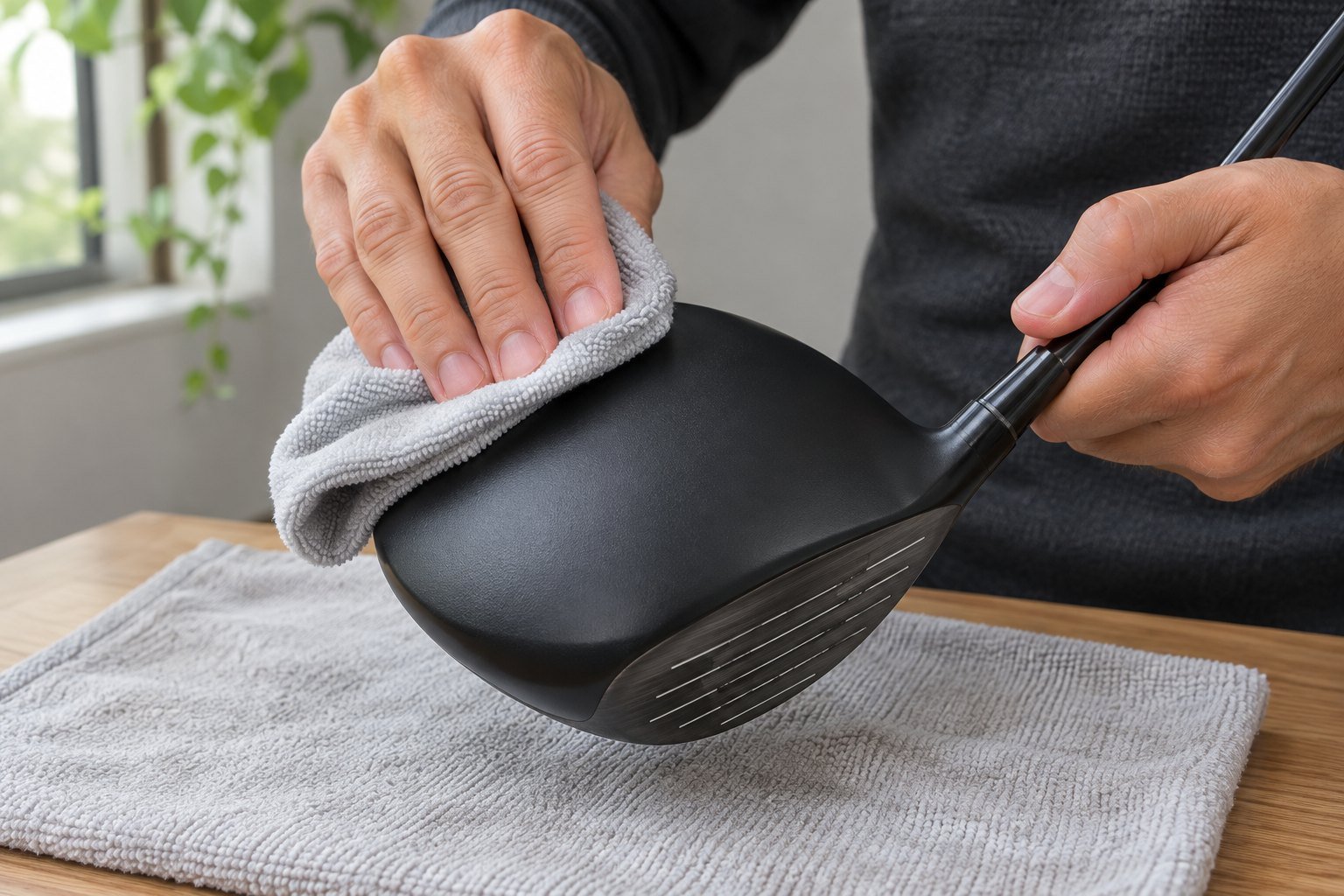
Leave general metal polish, abrasive pads, solvent cleaners and household rust remedies out of the starting kit unless the equipment maker explicitly approves the product and method. The purpose here is ordinary care. A mark that remains does not establish that the surface needs polishing or that its original finish should be removed.
Grips get their own check. Golf Pride recommends a soft brush with soap and water, thorough drying, and storage away from prolonged sun and heat. That is guidance for its grips, not a universal recipe for every leather or specialist putter grip. [4]
Back to top ↑When a water-carrying brush earns its place
Consider one only when you have a specific problem: you want to carry a little cleaning water during a round and your permitted routine would benefit from a combined container and brush. If a suitable damp towel and existing brush already work for you, there is no missing function to buy.
The Masters Water Bottle Club Cleaner, maker code ZDGA0120, combines a refillable reservoir, nylon brush and bag clip. Masters describes releasing water through the brush by pulling the replaced top upwards to its click position and squeezing the bottle. Those are product features, not evidence that its bristles or water delivery suit every club. [5]
Clubhouse Golf listed the black version, product code ACMAS010, at £4.99 and in stock when checked on 24 November 2026. Check the current price, delivery charge and availability before ordering; £4.99 is the item price, not a delivered total. [6]
Choose it for carrying water conveniently, after confirming that the method suits your equipment. Skip it for surfaces whose instructions require a more controlled cloth-only approach, or when it would simply duplicate supplies you use comfortably.
View the Masters Water Bottle Club Cleaner at Clubhouse Golf
The illustrations show generic tools; none depicts this named product. There is no comparative cleaning, leakage or durability test behind the example.
Back to top ↑A completed kit decision: buy the missing function
This fictional example is an editorial exercise, not a test report or a real shopping basket. Sam already owns two suitable clean cloths, a small soft brush and a bowl. The clubs’ actual instructions have been checked and permit those tools for the intended surfaces.
On a phone, swipe within the table to see all columns.
| Candidate | Decision | Reason |
|---|---|---|
| New branded towel | Keep the existing cloths | They already provide separate cleaning and drying surfaces. |
| Boxed kit with several brush heads | Defer | There is no identified job that the existing suitable brush cannot do. |
| Water-carrying brush | Optional later purchase | Sam sometimes lacks water during a round; first try preparing the existing towel as the club instructions allow. |
| Metal polish or rust remover | Do not buy for this task | No maker-approved finish-treatment need has been established. |
| Specialist putter cloth | Check before buying | Only add it if Sam’s exact putter instructions require the relevant treatment. |
Sam spends nothing now. If carrying water remains a practical problem, the optional brush becomes a purchase with a defined purpose. If the cloths or brush prove unsuitable, replace that component. Neither outcome requires buying every item sold as a complete cleaning system.
Back to top ↑Pack a small course kit and finish the job at home
For a round, choose the few permitted tools you can retrieve easily without delaying play: a suitable towel or cloth, the authorised brush if needed, and any planned way to carry water. Do not add an experimental chemical treatment to the bag because it came in a set. Keep a more involved cleaning or finish-care job for a place where you can follow the directions.
At home, give the cleaning supplies the same attention as the clubs. Remove collected dirt from tools as their instructions allow, separate damp items and replace a cloth or brush that no longer suits its job. A pouch is useful for organising dry supplies; it need not be a reason to seal everything away immediately after use.

Titleist specifies that clubs and headcovers should be completely dry before storage. Golf Pride similarly calls for thorough grip drying and a cool, dry storage location away from sunlight. Plan that finishing step before packing the bag. [1] [4]
Cleaning also gives you a chance to notice changes. If you see a possible crack, loose head or damaged shaft, set the club aside for professional assessment instead of treating it as a cleaning problem. For the next decision, read when to replace, repair or keep your irons.
Back to top ↑Questions about wear and replacement
Can a brush restore worn grooves?
The brush in this kit is for permitted cleaning. Do not treat it as a groove-repair tool or promise a measured performance gain after removing dirt. If you are concerned about wear, ask for an assessment rather than changing the groove edges yourself.
Should I buy new grips if cleaning does not improve the feel?
First check condition and obtain advice about any loose or damaged installation. If replacement is appropriate, choose the finished grip deliberately. Our golf club grip-size guide explains how to compare a replacement without assuming that a larger size is the answer.
Back to top ↑Start small, then add with a reason
Build the kit around the equipment you own: suitable clean cloths, an approved soft brush and the specified water-and-cleaner method. Keep grips and specialist finishes separate in your planning. Give drying a place in the routine before buying more cleaning hardware.
Add a water-carrying brush when it solves an actual course-use problem, or a specialist cloth when the exact finish requires it. Otherwise, a compact kit assembled from suitable supplies is a complete decision. The useful result is care you can repeat correctly, not the greatest number of accessories.
Back to top ↑Sources and checks
Research and specifications checked on 24 November 2026. Manufacturer descriptions are identified in the text; practical checklists and worked examples are editorial guidance, not product testing.
- Titleist — Warranty, Care, and Repair: cleaning and storage — checked 24 November 2026
- Titleist — Club Care 101: manufacturer staff guidance, January 2017 — checked 24 November 2026
- Scotty Cameron — Putter Care Cloth and finish-specific care — checked 24 November 2026
- Golf Pride — Grip Care — checked 24 November 2026
- Masters — Water Bottle Club Cleaner, ZDGA0120 — checked 24 November 2026
- Clubhouse Golf — Masters Water Bottle Club Cleaner, black — checked 24 November 2026
Illustrations in this article were created for Taylor’s Trailblazing Golf. Third-party photographs, where used, are credited beside the image or in the source list.