

Golf Club Grip Size: Measure Hands and Test Feel Before Regripping
Use the hand measurement to choose samples, then specify a finished grip you have tried.
Original conceptual illustration; not a product or test photograph.
Golf club grip size is easiest to choose when a hand measurement starts the process rather than finishes it. Your hand length can identify a sensible first sample, but the shape, taper, texture and finished build still need to feel manageable on an actual club. Regripping a complete set because a chart points to one word, such as midsize, skips several useful checks.
This guide deals with swing-club grips: the grips on drivers, woods, hybrids, irons and wedges. Putter grips involve different shapes and a different fitting task, so they are not folded into the same sizing rule. The approach here is research-led, using manufacturer guidance to establish a starting point and proposed comparisons to help you describe what works. It does not claim a grip will cure pain, correct a swing fault or produce extra distance.
Before ordering, gather a ruler, your usual glove and one club whose current grip you know well. You are aiming to give a fitter or installer a clear description of the desired finished result. That is more useful than asking for a bigger grip without identifying whether the problem is diameter, lower-hand shape, surface condition or something else.
Use named guidance
Record the hand, points and units.
One useful variable
Separate diameter, taper and surface condition.
Finished feel matters
Core size is not the outside size you hold.
Trial one club
Keep the successful model and build on record.
Golf club grip size: start with a measurement, not a verdict
Use the manufacturer's measurement points
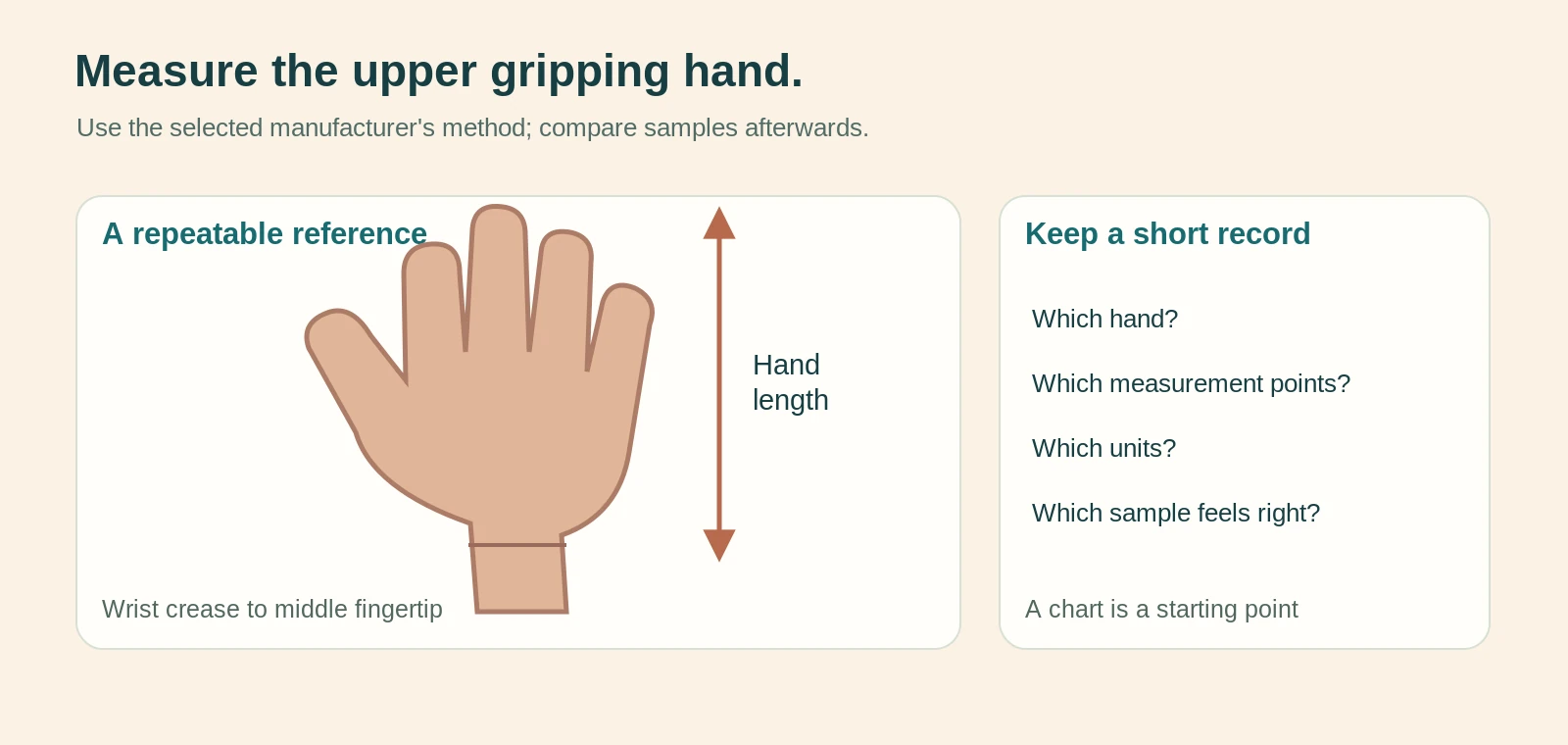
Golf Pride's current UK swing-grip guide measures the upper gripping hand from the wrist crease to the tip of the middle finger. Its published starting bands are junior below 5 inches, undersize 5 to 6.5, standard 6.6 to 7.5, midsize 7.6 to 9 and jumbo above 9. These are that manufacturer's guide bands, not universal biological boundaries. [1]
Lay the hand comfortably open and position the ruler consistently. Do not stretch the fingers dramatically or switch between wrist creases to make a borderline result fit a preferred category. Repeat the measurement and record what you actually read, including the units. If the result sits near a boundary, keep the uncertainty visible and compare neighbouring samples rather than inventing precision.
Treat a borderline result as an invitation to compare
A measurement close to the edge of a chart is not a problem that needs solving with a more forceful reading. It simply makes an adjacent size comparison worthwhile. The same applies when your hand seems to fit one category but the sample feels awkward. A chart helps organise the enquiry; it is not a command to ignore your own secure, comfortable hold.
Avoid converting a rounded inch measurement into an overly precise millimetre prescription. The original method, reading and chart remain approximate starting tools. Keep the written record simple: which hand, which points, which units and which samples will be compared. That information is enough to make a fitting conversation more specific without pretending you have already selected the finished grip.
Separate hand length from hand proportions
One measurement cannot describe every contact point
Two people with a similar wrist-to-fingertip measurement can still experience the same grip differently. For a useful comparison, notice where the upper hand contacts the grip, how the fingers settle and whether the lower hand feels supported. You do not need to categorise your anatomy with a complicated formula; describe the contact that feels awkward or uncertain.
PING's fitting approach uses hand length and longest-finger length as reference information, while also allowing the final recommendation to reflect observation and player feedback. This reinforces the role of a measurement as a starting point rather than a complete answer. [2] Keep different manufacturers' methods labelled rather than merging their charts into an invented universal system.
Glove size is a secondary clue
A glove label can help locate an initial sample, but it is not a substitute for checking the grip itself. Record the brand and glove size if that is the reference you use, especially when you normally choose a cadet or another particular fit. Do not assume that every glove carrying the same letter produces an identical hand-size description.
Try the grip with the glove arrangement you normally use for golf. If you alternate between gloved and ungloved play, note whether the preference changes. The goal is a practical fit under your usual conditions, not a tidy answer that only feels convincing while standing in a shop with unfamiliar equipment.
Inspect the existing grip before replacing its size
Wear can confuse the comparison
Look at the grip already fitted to your reference club. Is the surface intact, clean and secure, or has it become visibly worn? A new sample may feel better because its surface is fresh, even if its diameter is not the feature that matters. Comparing an old, neglected grip with a new model changes more than size.
Record the current model and any size marking you can identify without damaging it. If the build underneath is unknown, say so. Do not assume the word standard on a grip completely describes its finished size on that shaft. A useful baseline includes what is known, what is uncertain and why you are considering a change in the first place.
Check security before any swing
If the grip twists, slips or appears loose on the shaft, stop using the club until a competent installer checks it. That is not a suitable condition for testing whether another diameter might feel better. Likewise, do not practise swings with an unfitted display grip simply pushed onto an unsuitable shaft.
For ordinary surface care, follow the grip manufacturer's directions. Golf Pride recommends a suitable soap-and-water cleaning approach for its grips, with drying and storage guidance; another material or maker may specify something different. [3] Clean an appropriate existing grip before comparing it with a new sample, but do not treat cleaning as a repair for a loose or damaged installation.
Identify the variable you want to change
Diameter, taper and surface are separate choices
A grip can feel different because the upper portion is thicker, the lower portion is fuller, the taper is reduced or the material has another texture. If all of these change at once, you may like the result without knowing which feature helped. That is acceptable as a preference, but it makes a precise sizing conclusion harder to defend.
Write a short description before sampling. For example, the upper hand feels secure but the lower hand seems to need more support, or the overall grip feels bulky although the texture is pleasant. Those descriptions point towards different comparisons. Asking only for a larger size may overlook a model with a different shape that addresses the actual concern more directly.
Begin with the narrowest useful comparison
Where possible, compare adjacent sizes in the same model before changing material and taper. Then explore a shape change separately. A retailer or fitter may not have every combination available, so record where the comparison is imperfect rather than pretending different products isolate diameter alone.
You do not need a long tournament of samples. Two or three well-chosen options can be more informative than a dozen unrelated grips handled briefly. Give each a consistent, unforced hold, note the difference and return to the original sample. This helps distinguish a genuine preference from the temporary appeal of anything that feels new.
Understand core size and finished outer size
The hole inside is not the size you hold
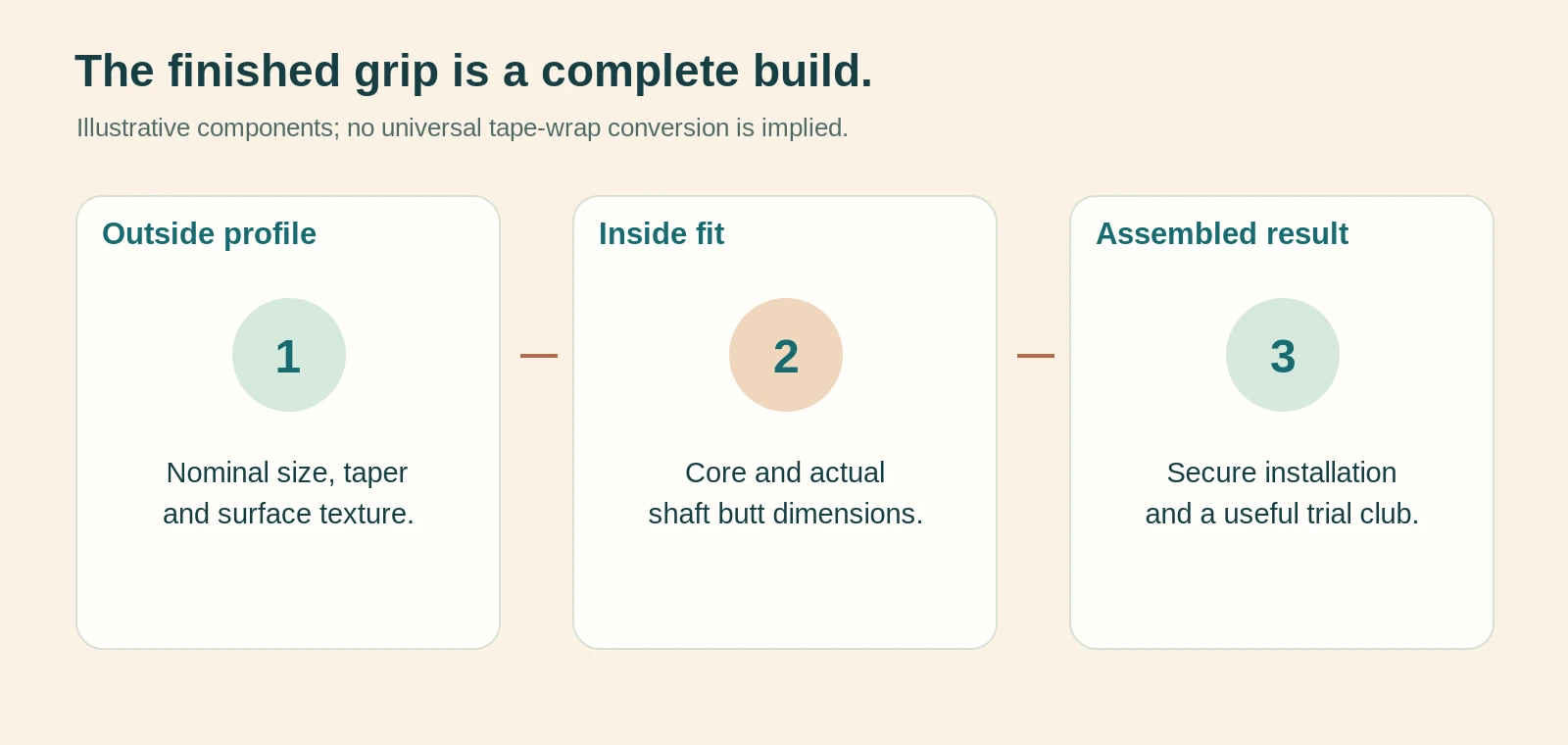
Core size refers to the grip's internal fit, not simply the finished outside diameter felt by your hands. Golf Pride gives the example of a smaller core fitted over a particular shaft diameter producing a different finished feel from a larger core on that same shaft. Therefore, a core marking should not be read as a direct substitute for the size category on the outside. [1]
Ask the installer to consider the actual shaft butt and the grip model together. This is especially useful with a mixed set or an older club whose build history is unknown. You do not need to remove grips yourself to investigate. Provide the club details and let a competent builder establish the dimensions needed for a suitable installation.
Finished size is the meaningful request
Rather than saying only that you want a particular number of wraps, describe the sample you liked and ask how its finished feel can be reproduced appropriately. Tape thickness, shaft dimensions and the selected grip all belong to the build. A wrap count detached from those details is not a complete specification.
If a precise finished diameter is being discussed, agree where along the grip it is measured and how the measurement is taken. A tapered object does not have one diameter everywhere. The useful result is a repeatable build reference, not a misleadingly exact number that another installer measures at a different position.
Use finger contact as a check, not a forced pose
Look at your normal hold
Golf Pride describes a light relationship between the upper-hand fingers and heel pad as a fitting cue. It should not be treated as a reason to contort the hand until a photograph resembles a diagram. [1] Set your hands naturally in the way you normally hold a swing club, then notice the contact and discuss anything that feels awkward with a fitter.
If you change hand placement substantially while comparing sizes, you may change the result of the check. Keep the hold as consistent as you reasonably can, without forcing it. A fitter or coach can help separate a grip-size question from a setup question when the distinction is unclear. This article does not diagnose swing technique from finger position.
Avoid squeezing to prove a size fits
A sample is not a good match merely because you can clamp it tightly enough to remove every gap. Equally, a visible gap does not establish a universal fault without context. Focus on a secure, manageable hold that does not require an artificial effort just to satisfy a chart cue.
Stop if the comparison causes pain, numbness or another concerning symptom, and seek appropriate professional advice rather than treating a larger grip as a remedy. The purpose of equipment fitting is not to replace medical assessment. A purchase decision should not depend on a promise that one diameter will resolve a health condition.
Build a useful sample session
Keep the basic conditions consistent
Try samples with your usual glove and a familiar stance. Where fitted demonstration clubs are available, choose comparisons as similar as possible in head, shaft and length. A heavier or longer club can change your impression of the grip, so note those differences rather than attributing everything to the rubber in your hands.
Begin with a stationary hold and small, safe movements permitted by the setting. Do not make full swings inside a shop unless there is a designated, supervised area for that purpose. The first task is simply to identify which samples feel manageable and which create an obvious concern worth investigating further.
Write observations before hearing the sales explanation
For each sample, note upper-hand feel, lower-hand feel, surface preference and whether you can settle your hands without repeated adjustment. Write those notes before looking for a reason in the marketing description. This reduces the temptation to describe every new feature as helpful merely because it is presented as an improvement.
Then compare the notes with the product's actual characteristics. A preference for a fuller lower hand may point towards taper rather than a larger overall diameter. A preference for a fresh surface may not require any size change. The session becomes useful when your observation and the proposed equipment change are clearly connected.
A sample record that separates feel from the variables changed. This is a suggested comparison, not a test result.
| Record | Useful observation | Avoid concluding |
|---|---|---|
| Upper hand | Comfortable contact without a forced hold. | A chart alone has completed the fit. |
| Lower hand | More or less support; note the taper. | Every difference is overall diameter. |
| Surface | Texture and condition with normal glove use. | A fresh grip proves the old size was wrong. |
| Finished club | Secure build and manageable ordinary shots. | One excellent strike proves a universal benefit. |
Move from handling to a properly fitted trial club
Regrip one suitable club first
Before committing to the full set, consider a trial on one representative club, agreed with a fitter or installer. Choose a club you use often enough to assess the change but whose other specifications are familiar. Keep the previous grip details and record exactly what has been fitted so you can describe the comparison later.
The installation should be secure and complete before hitting balls. Follow the installer's and manufacturer's curing instructions for the actual materials and method used. Golf Pride publishes installation guidance, but a general minimum should not override longer requirements for a different system or local conditions. [4] Do not test a grip early simply because it feels dry on the outside.
Keep the first session modest and purposeful
Use an appropriate practice setting and start with comfortable, ordinary shots. You are checking whether the grip remains manageable during use, not trying to prove that the purchase has transformed your swing. Notice any repeated hand adjustment, concern about security or mismatch between the static sample and the fitted club.
Do not judge from one excellent strike or one poor strike. A short sequence can reveal a practical problem, but it cannot establish a reliable scoring improvement. Record the conditions and repeat the comparison on another suitable occasion before changing the entire set, particularly when the first impression is uncertain rather than clearly positive.
Separate grip preference from ball-flight claims
A shot pattern has more than one possible explanation
A hook, slice or inconsistent strike should not automatically be assigned to grip diameter. If a sample changes how you hold the club, that may be relevant to a fitting discussion, but it does not justify a universal rule that bigger grips fix one miss and smaller grips fix another. Keep the observation specific to the session and seek coaching or fitting input where needed.
A useful note says that a particular build felt easier to hold consistently during the trial. A much stronger claim, such as eliminating a miss or adding distance, would need evidence this article does not provide. Avoid buying a full set of grips on the strength of a promise that skips those distinctions.
Compare ordinary use, not your best shot
Record whether the grip works across the shots you normally ask that club to play. A wedge used for varied-length shots may raise a different handling question from a driver used mainly for full swings. This does not mean every club needs a different grip; it means the intended use should be part of the conversation.
If you use basic shot notes, keep them separate from the comfort notes. Good contact can occur with an awkward-feeling sample, and a comfortable sample does not guarantee good contact. A fitter can help interpret the combined picture without treating either one as a complete verdict on grip size.
Consider the lower hand and reduced taper separately
More support need not mean more everywhere
Some grip designs provide a fuller lower section while retaining a different upper-hand feel. When that is the feature you prefer, increasing the overall size may be an unnecessarily broad change. Compare the actual shapes rather than assuming two grips carrying the same size word will feel the same from top to bottom.
Describe where you want the difference. For example, the lower hand feels less settled while the upper hand already feels manageable. That gives an installer or fitter a clearer starting point than asking for something thicker. It also helps avoid a full-set purchase that solves one contact point while making another less comfortable.
Keep model changes visible in your notes
If you move from a tapered model to a reduced-taper design, record the model name as well as the nominal size. Do not describe the outcome simply as standard versus midsize when the shape has also changed. Your future replacement order needs the actual product and build, not a simplified memory of the category.
The same applies to texture and firmness. A softer-feeling material can change your preference without proving that its diameter is more suitable. You are allowed to choose a combination because you like it, but be honest about what the comparison establishes. A good personal preference does not need an invented single-variable explanation.
Mixed sets and different shaft butts need a build conversation
Matching labels may not match finished feel
A set assembled from several brands or generations can contain different shaft constructions. Do not assume identical grip labels and identical tape counts will necessarily produce the finished feel you intend on every club. Ask the installer how the relevant dimensions will be checked and how consistency will be assessed where that is your goal.
This is particularly relevant when replacing grips on only part of a set. Bring a club whose grip you like as a physical reference, together with any known build details. A sample in the installer's hands is more useful than a memory that the old set felt about right. Avoid removing an acceptable reference before its characteristics have been recorded.
Consistency is a choice to define
Some golfers prefer a similar feel throughout the swing clubs; others may have an intentional difference for particular uses. Either way, state the aim clearly. Do not let an unexplained variation become an accidental feature of the job, and do not assume a variation is wrong merely because the set is not visually identical.
Ask how each club will be labelled in the work record. Model, nominal size, relevant build details and any intentional exceptions should be easy to recover later. This makes future maintenance simpler and reduces the risk that a replacement grip is fitted according to an incomplete verbal instruction.
Make wet-weather and glove comparisons relevant
Recreate your ordinary hand arrangement
A grip comparison made with bare, dry hands may not answer the same question as your usual gloved golf. Begin with the arrangement you most often use. Where you also play with rain gloves or another legitimate seasonal setup, compare those separately on appropriate, securely fitted equipment and within the demonstration conditions.
Do not wet a retailer's sample without permission or deliberately make a club slippery to test its limits. Your aim is a realistic handling comparison, not a grip-strength challenge. Record whether a material feels manageable with the actual glove you intend to wear, and keep texture observations separate from the diameter question. A surface preference under one arrangement does not establish that the size chart was wrong.
Explain the conditions to the fitter
A useful note says that the current grip feels acceptable with a normal glove but that another familiar hand arrangement changes the preference. That gives the fitter a specific comparison to organise. A vague claim that the grip fails in winter may include cold hands, different gloves, moisture, changed clothing and reduced practice, none of which should be automatically assigned to diameter.
Where the conditions cannot be reproduced appropriately, retain the uncertainty. Manufacturer claims about surface technology can help identify a candidate, but they do not replace your own suitable trial. Avoid purchasing the full set because a brief indoor sample was described as ideal for every weather situation. Choose a build for the conditions you can meaningfully assess and revisit unresolved practical concerns with the fitter.
When two fitting suggestions disagree
Check whether they used the same starting information
One recommendation may come from a hand-length chart, another from a glove label and a third from handling a fitted club. They can differ without any person being careless, because they may answer different stages of the process. Ask each adviser what information supports the recommendation and whether the exact grip model, shaft and finished build were considered.
Compare the language too. A recommendation to try midsize is not the same as a conclusion that a particular midsize build has been tested successfully. Keep those stages separate in your notes. Otherwise, an initial screening suggestion can gain the authority of a completed fitting simply because it has been repeated several times.
Use the disagreement to choose the next comparison
Rather than voting between the recommendations, identify the practical test that would distinguish them. If one adviser suggests a larger overall grip and another suggests a fuller lower hand, compare those actual shapes while keeping the rest of the club as similar as possible. If the disagreement concerns a borderline measurement, repeat the measurement by the relevant method and try the neighbouring samples.
A trial may still produce two acceptable choices. In that case, ask which option is easier to reproduce across your actual set and which surface you prefer. The decision does not need a dramatic winner. It needs a suitable, documented build and an explanation honest enough that the next replacement does not restart the whole debate from an incomplete label.
Budget for the complete job rather than the grip alone
Obtain a quote for the agreed build
Ask the installer to separate the grip product, installation work and any additional work genuinely required for the clubs. No national price range is assumed here. A current quote for the exact job is more useful than a generic low price that excludes fitting, removal or an unusual build requirement.
Confirm how the successful trial will be reproduced and which clubs are included. A set can contain an extra wedge or a replacement wood that is easy to overlook when asking for all the irons. Give the installer a written list and identify intentional exceptions. This protects the build decision as well as the cost comparison.
Keep the existing reference until it is documented
Before every old grip is removed, make sure the club whose feel you want to preserve has been recorded. Photograph identifying markings where useful and retain the fitter's description of the finished build. There is no need to keep worn rubber indefinitely, but removing the only clear reference before the job is specified can make a later disagreement harder to resolve.
Compare value through the complete result: appropriate products, secure installation and a record that supports future maintenance. A bargain that leaves the intended size or build uncertain is not directly comparable with a properly specified job. The point is not to choose the most expensive service; it is to make sure competing prices describe the same work.
Prepare a clear regripping request
Describe the successful trial
A useful request names the grip model, size, preferred shape and the trial club whose feel should be reproduced. Include the fitter's agreed build details rather than inventing a wrap count yourself. Explain whether the aim is consistency across the set or a deliberate exception for a particular club.
Also discuss logo or alignment orientation where relevant to the grip and club. Do not assume the visual result is obvious, especially with adjustable clubs whose shaft orientation may change. Let the installer explain the implications for the chosen product. A short conversation before the job is easier than discovering afterwards that an intended feature is positioned differently from your expectation.
Agree the handover checks
Ask when the clubs may safely be used, how to care for the grips and what to do if an installation feels loose or unusual. On collection, confirm the requested models and any recorded exceptions. Look for obvious issues without twisting aggressively or attempting to prove the installation's strength yourself.
Keep the work record with the club details. It need not be elaborate, but it should distinguish the successful trial from an earlier rejected sample. When you eventually replace a worn grip, that record allows a more informed conversation than asking for whatever was fitted last time and hoping the same result is remembered.
Care and replacement: assess condition, not a calendar alone
Build a simple inspection habit
Check the grips periodically for obvious wear, damage and security, particularly before returning to play after a long break. Follow the manufacturer's cleaning and storage advice for the exact material. Do not apply a universal chemical treatment or aggressive abrasive method because it worked on another type of grip.
For Golf Pride's referenced care guidance, cleaning and drying are routine maintenance steps, not a way to restore every worn grip indefinitely. [3] If the grip is loose or structurally damaged, stop using the club and have it assessed. Surface appearance and installation security are related ownership checks, but they are not interchangeable.
Replace with the established build, then reassess when needed
When a grip you liked wears out, begin with the documented model and build rather than assuming you should automatically move up or down a size. If your preferences, glove use or physical circumstances have changed, return to a sample comparison. A previous successful fit is a useful reference, not a lifetime rule that must never be revisited.
Avoid treating replacement frequency as a competitive target. Actual condition, use and manufacturer guidance are more relevant than feeling obliged to regrip on the same date as another golfer. The purpose is dependable equipment in a suitable condition, not replacing a serviceable build simply because a calendar reminder has appeared.
Worked examples: three reasons to pause before a full-set change
The new grip feels better, but the size is unchanged
Imagine a golfer who handles a fresh standard-size sample after years with a worn grip. The new surface feels more secure, so the initial conclusion is that the club needs a different size. Before accepting that explanation, compare a fresh version of the existing size and note whether the improvement remains. The main issue may be condition rather than diameter.
This example is hypothetical. It does not claim that cleaning or replacement will resolve every concern. It shows why the starting grip's condition belongs in the record. Without that information, a perfectly reasonable preference can be translated into an unnecessary change across the whole set.
A borderline hand measurement produces two workable options
A second golfer measures near a chart boundary and finds both adjacent sizes manageable. Rather than forcing a winner from the ruler, compare the options on an appropriately fitted trial club and describe any meaningful difference during normal use. If neither offers a clear advantage, availability, preferred texture and consistency with the existing set may reasonably influence the decision.
A third golfer likes the upper portion of the current grip but dislikes the lower-hand feel. That points towards a taper or shape comparison before enlarging everything. These situations demonstrate the same principle in different ways: identify the actual concern, isolate the most relevant change and avoid treating one size label as a complete explanation of the hands' experience.
Pros and cons of the main sizing approaches
Measurement-led selection
A measurement gives the fitting process an organised starting point. It helps a retailer or fitter select sensible samples and makes your enquiry more specific. However, it cannot describe the whole finished grip, the shaft underneath or every aspect of your hold. Its main value is narrowing the comparison, not removing the need to handle the equipment.
Charts also differ in their methods and categories. Keep the manufacturer's name attached to the chart and do not combine boundaries from several guides into a new rule. A slightly untidy but honest record of a borderline measurement is more useful than a falsely precise answer that discourages you from trying the adjacent option.
Trial-club selection
A properly installed trial lets you assess the grip during ordinary use before committing to every club. It also provides a physical reference for the installer. The limitations are time, possible fitting cost and the fact that a short practice session is not a controlled performance study. Keep the conclusions proportional to what you observed.
The strongest approach combines both methods: a measurement to choose the first samples, a handling comparison to identify a promising build and a trial club to confirm practical suitability. None needs to produce a dramatic improvement claim. A grip that is comfortable, secure and consistently reproducible can be a worthwhile result in its own right.
Common mistakes before regripping
Ordering by glove size alone
A glove label can be a useful clue, but it should not replace measuring by the chosen manufacturer's method and trying the grip. Nor should one person's midsize recommendation be copied because their glove looks similar to yours. Keep hand proportions, shape and finished build in the discussion rather than treating a clothing-style label as a complete specification.
Another mistake is confusing core size with outside size or specifying tape wraps without identifying the tape, shaft and grip. Ask for an appropriate finished result based on a known sample. The installer should have enough information to explain the build rather than being asked to reproduce an undefined feeling from an isolated number.
Using a loose sample or an uncured installation
Do not swing a club whose grip is loose, temporarily pushed on or not ready for use. Wait for the actual installation's instructions to be satisfied. A rushed trial can create a safety problem and produces a poor basis for judging feel. Secure equipment is a prerequisite, not another variable to test casually.
Finally, do not regrip the complete set solely because one exceptional shot followed a change. Keep the decision tied to repeated, ordinary handling and an honest assessment of what changed. Where discomfort or a swing concern persists, seek the appropriate professional input instead of escalating grip size in the hope that the next category must solve it.
Frequently asked questions
What is the best golf club grip size for my hand length?
Use the relevant manufacturer's measurement method to identify a starting sample, then compare the actual grip. Golf Pride and PING provide useful fitting references, but their guidance should remain attached to their own methods. A hand-length category does not fully specify taper, texture, shaft fit or finished diameter. The best practical choice is the build you can hold securely and comfortably in normal use, confirmed through a suitable trial rather than a chart alone.
Is midsize only for people with large hands?
Do not use that as a rigid rule. A size category is a starting description, while preference and finished construction still matter. However, choosing a larger grip simply because it is fashionable is no better than refusing to try one because of a stereotype. Measure, compare adjacent samples where appropriate and describe the result. Avoid assuming that an equipment preference establishes a medical benefit or a predictable change in ball flight.
How many tape wraps equal the next size?
There is no wrap count offered here as a universal conversion. Tape thickness, shaft dimensions, grip core and the position being measured affect the finished build. Ask a competent installer how to reproduce a sample you like and record the agreed details. Golf Pride discusses build-up options, but those should be used in the context of the actual installation rather than treated as a standalone arithmetic rule for every grip and shaft. [4]
Should every club have the same grip size?
That depends on the intended build and your preferences. Many golfers may want a consistent feel across swing clubs, while a particular club may have a deliberate exception. Define the aim and have the installer consider the actual shafts. Matching labels alone may not describe the finished result. Putter grips are a separate fitting task and should not automatically inherit the swing-club size chosen from a hand-length chart.
Can a larger grip fix a hook or relieve hand pain?
This guide makes neither promise. A ball-flight pattern can have several causes, and pain or other symptoms require appropriate professional assessment rather than an equipment prescription from an article. A grip comparison can help describe what feels manageable, but it is not a diagnosis. Stop a trial that causes concerning symptoms, and seek fitting, coaching or healthcare advice according to the issue involved.
Can I try the new grips immediately after installation?
Use them only when the installer and applicable product instructions say the installation is ready. Curing requirements depend on the actual materials and method, so do not assume a general time quoted online covers your clubs. If a grip feels loose or twists, stop using it and have the installation checked. An early swing is not a sensible way to test whether the bond has become secure.
Final recommendation: specify a finished grip you have tried
Measure the upper hand using a named manufacturer's method, then compare a small number of relevant samples. Keep size, taper, surface condition and core fit separate in your notes. When a promising option emerges, use a securely installed trial club before committing to the set.
Give the installer the successful sample and a clear record of the intended build. That approach turns golf club grip size from a guess based on one label into a repeatable equipment decision. The goal is a secure, manageable hold that suits your normal use, without promises about injury relief, extra distance or automatic swing correction.
Sources and fact-checking notes
Official pages were checked on 4 October 2026. Specifications refer to the named model or document, not every product in its category. The practical checks and examples in this guide are research-led suggestions, not reported results from hands-on product testing.
- Golf Pride UK – swing grip size guideUpper-hand measurement, current starting bands, finger-contact cue and core-size distinction.
- PING Europe – colour-code fitting chartHand and finger references are fitting starting information, alongside observation and feedback.
- Golf Pride UK – grip careCare and storage guidance for the maker's grips; not a universal instruction for all materials.
- Golf Pride UK – installation FAQsInstallation and build-up considerations; follow the actual installer/material requirements.
Product pages, model options and rule guidance can change. Recheck the exact item and applicable document before relying on a technical or competition decision. No product price, availability or performance outcome is guaranteed by inclusion here.
Illustrations in this article were created for Taylor’s Trailblazing Golf Gear. Third-party photographs, where used, are credited beside the image or in the source list.