
Golf Travel Covers: Soft-Sided vs Hard-Shell Options
Choose the cover that fits your clubs, your transport and the space you have when the trip is over.
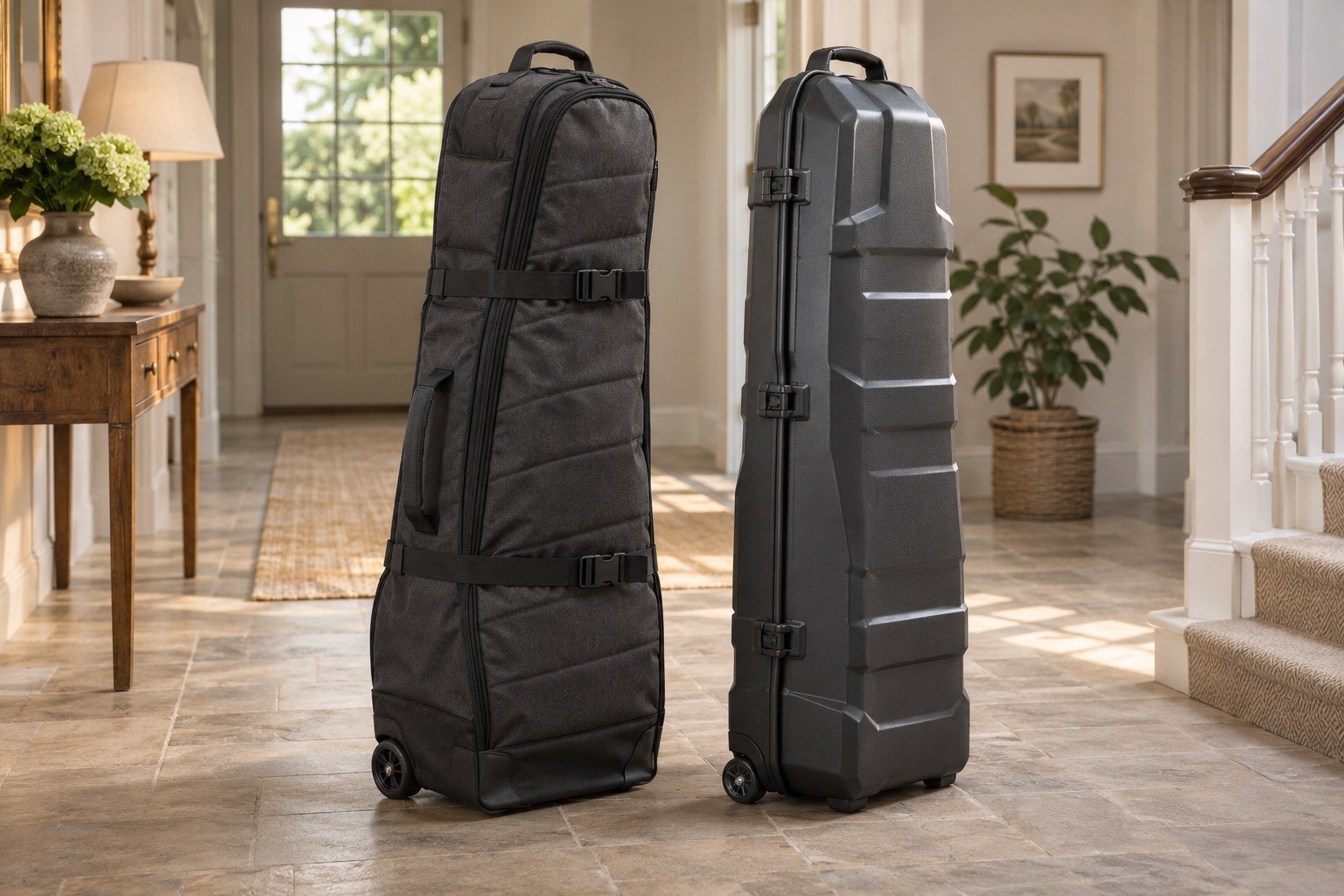
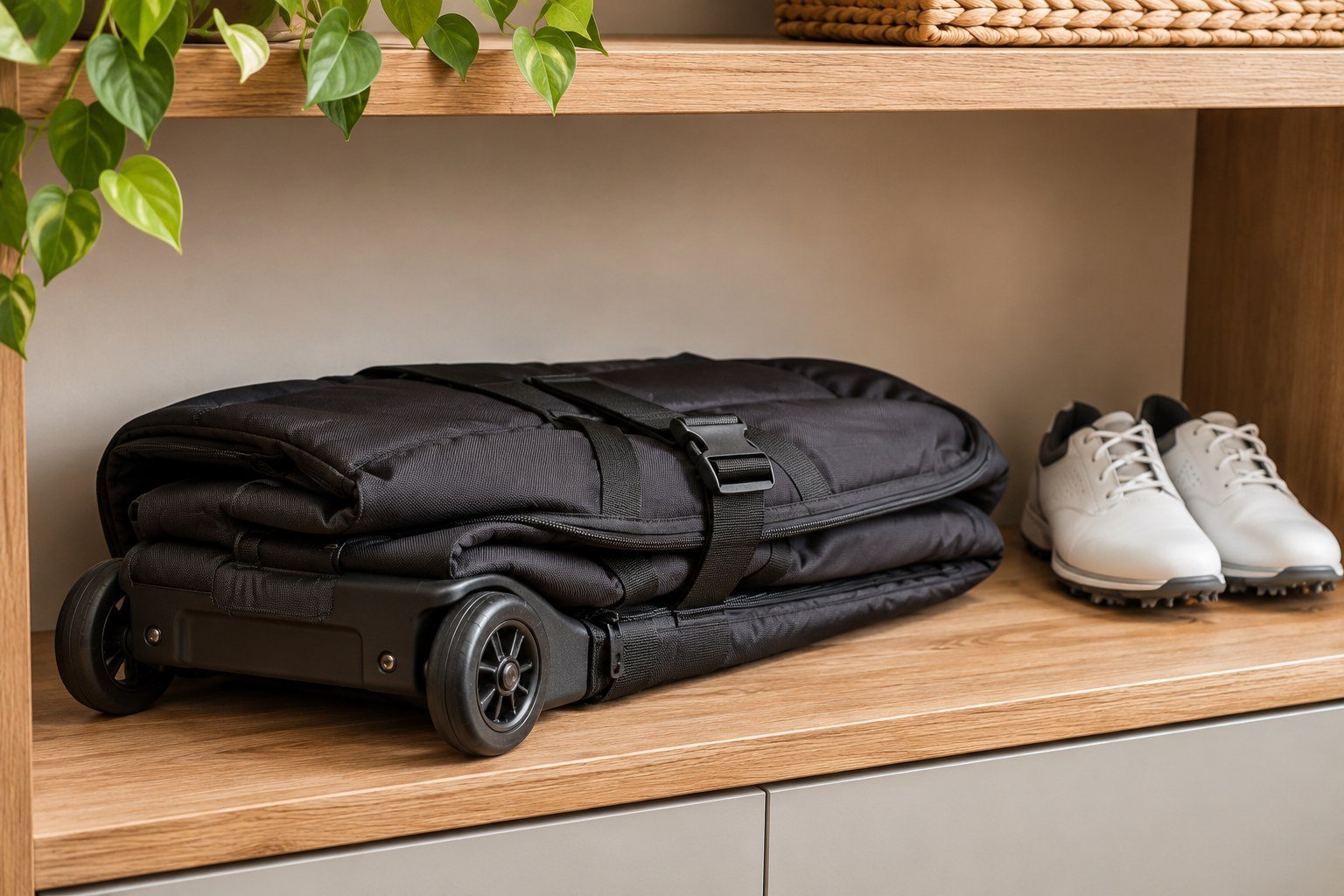
AI illustration of generic travel covers; the scene does not depict or test the named models.
Golf travel covers have a surprisingly demanding job. They must contain an awkwardly shaped bag, protect its contents and remain manageable through the car park, terminal and final transfer. Then they need somewhere to live between trips. A cover can look reassuring in a shop and still be the wrong purchase if the loaded bag will not fit or the rigid case cannot go in the car.
This research-led guide compares the choices through published construction details and practical checks. The named examples illustrate different designs; they have not been put through comparative impact tests for this article.
This is a research-led guide. How we assess golf equipment explains the evidence behind our recommendations.
This guide contains affiliate links. If you buy through them, Taylor’s Trailblazing Golf may earn a commission at no extra cost to you.
Measure the loaded bag, including its widest handles and covered clubheads.
A hard cap and a full rigid enclosure are different constructions.
A case that fits the flight must also fit the car and accommodation.
Compare golf travel covers by construction
The useful question is how much of the packed bag is surrounded by rigid material, where the padding sits and how the contents are held. A fabric cover can have a substantial wheel base; a cover sold with a hard top can still have flexible sides. Read the actual description rather than treating the product name as a protection rating.
| Type | Useful characteristic | Main compromise | Start here if… |
|---|---|---|---|
| Soft-sided, usually with a reinforced base | The fabric body can fold or compress for storage; padding and restraints form much of the protective arrangement. | Flexible panels do not form a continuous rigid enclosure. | You have limited storage or a small transfer vehicle, and the airline accepts the design. |
| Hybrid with a rigid head section | A moulded cap surrounds the clubhead area while the body remains flexible. | Protection changes along its length; the sides and closure still need checking. | You want more structure around the top without storing a full-length rigid case. |
| Full hard shell | A rigid enclosure surrounds the packed bag and retains its overall shape. | The same fixed shape occupies space in the vehicle and at home; empty weight can be substantial. | You can transport and store its dimensions, and the complete load stays within your allowance. |
These are construction-based trade-offs, illustrated by the Callaway, Bag Boy and SKB designs below.[2][3][4] They do not establish a universal winner in an airport impact or crush test. Padding, closures, fit, condition and packing all remain relevant.
Do not let a stiff-looking exterior compensate for a poor fit. A case that needs pressure on the clubheads to close has failed the first check, however impressive the latches look.
Check the carrier’s packaging rule before buying
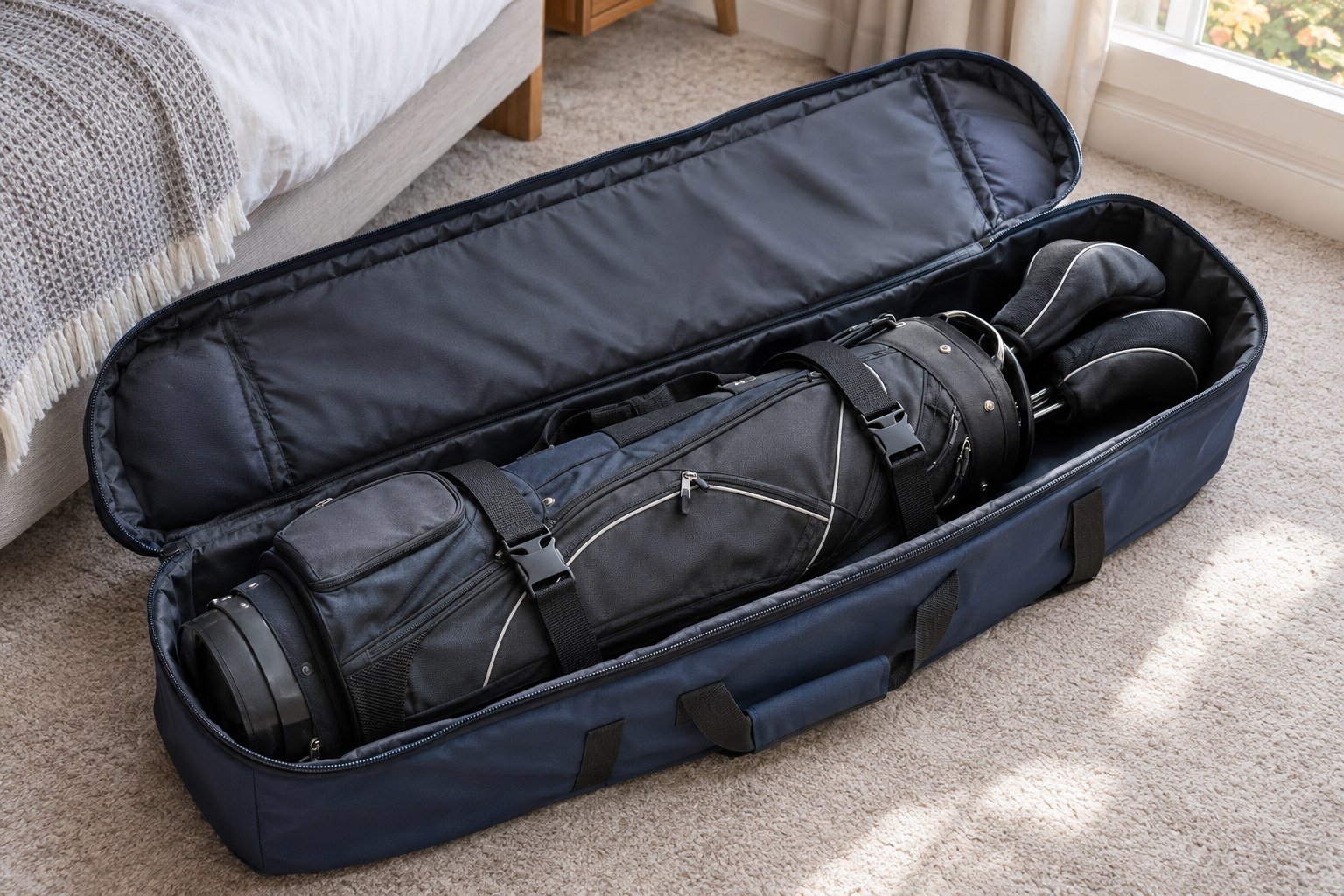
British Airways currently accepts golf equipment in a protective golf bag or hard case as an item of an included checked-baggage allowance. Its golf guidance also covers advance notification and out-of-gauge drop-off. Do not assume that a hard shell is universally required.[1]
Check the requirements for your actual journey before ordering. Save the relevant page and the booking’s allowance together, so a general baggage figure is not mistaken for a golf-equipment entitlement. Where another airline operates a connecting sector, obtain its answer too.
- What packaging does the airline require for golf clubs?
- Is golf equipment included in your booked baggage, or must it be added separately?
- What are the permitted packed weight and external dimensions?
- Does your insurer specify a type of travel case or particular precautions?
If a relevant condition requires a rigid case, resolve that before judging whether a soft cover would otherwise be convenient. A product described as suitable for air travel cannot settle every carrier’s acceptance rules or the terms of an individual insurance policy.
Back to top ↑Three researched designs that show the differences
These examples are selected for their different construction, not as a ranked shortlist. Specifications and UK listings were checked on 23 November 2026. Confirm the exact version, usable capacity and current availability before buying; no price or delivery promise is assumed here.
Callaway Clubhouse Travel Cover: a folding fabric design
Callaway lists a fabric body, a folding storage arrangement, a reinforced wheel base and its Driver Defender accessory for the Clubhouse Travel Cover. It is a useful example of a soft-bodied design that includes more than an outer fabric sleeve.[2] The official UK page does not supply enough dimensional detail to confirm your own loaded bag’s fit. Ask for that information rather than inferring it from the photographs.
If compact storage is important, check the Clubhouse Travel Cover at Callaway UK and compare its packed dimensions with your equipment before deciding.
Bag Boy T-10: a hard top with a flexible body
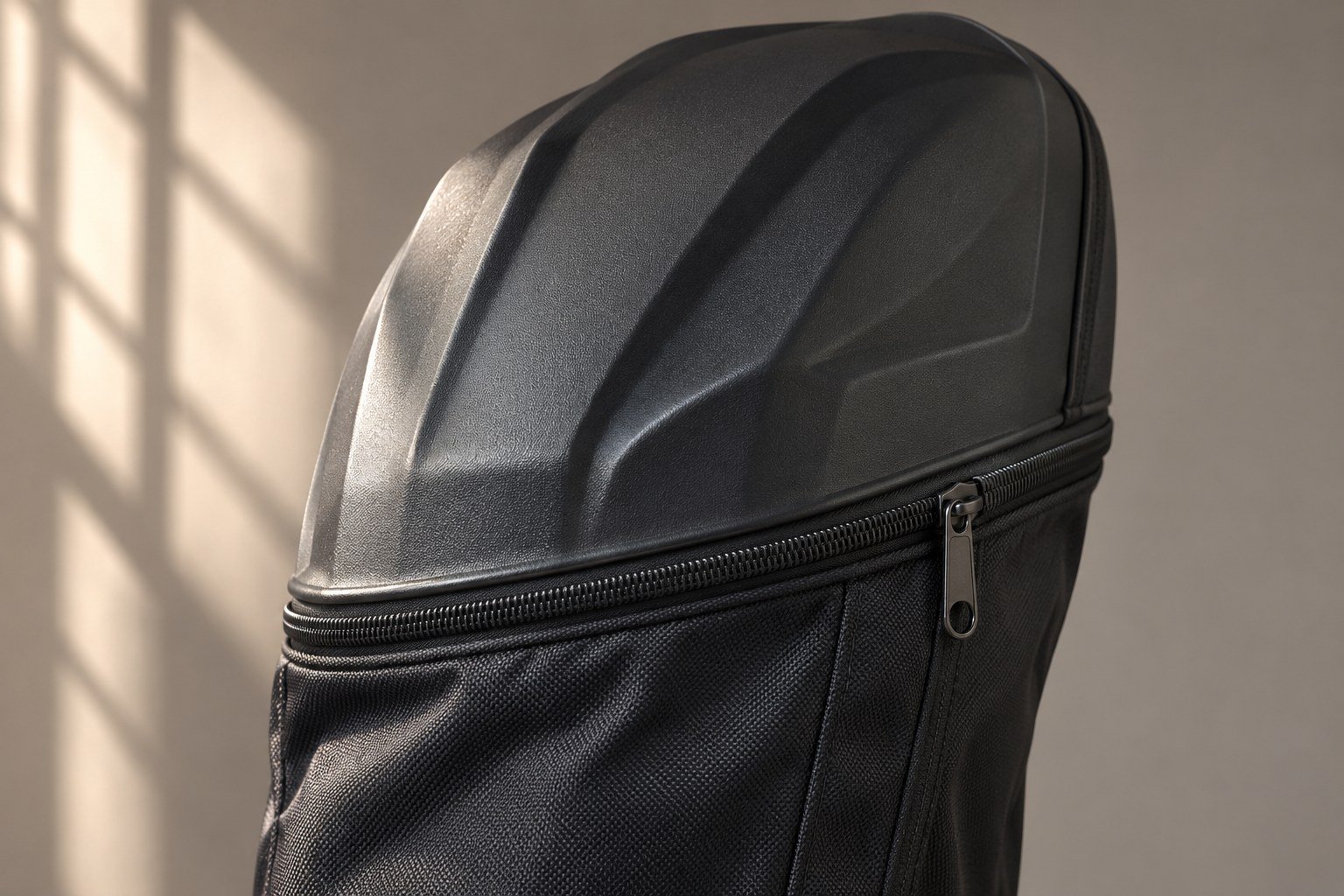
The T-10 combines an ABS top with a 600D polyester body and an internal compression strap. Its body stores inside the top section.[3] The Black/Royal Blue listing at Clubhouse Golf states capacity for a 48-inch driver and a cart bag up to 10 inches.[5] Treat that as the retailer’s stated fit, not proof that every bag with a nominal 10-inch top fits equally well.
This is worth considering when clubhead-area structure and compact storage are both priorities. The fabric sides remain flexible, so assess the full packing arrangement. View the Bag Boy T-10 at Clubhouse Golf to check the exact listed version.
SKB Deluxe Standard ATA, 2SKB-4814W: a full rigid case
SKB describes this model as a hard case for carry or stand bags and drivers up to 48 inches. Its published product weight is 7.13kg. Crucially, the manufacturer warns that newer bags with protruding top moulded handles exceeding 12 inches in overall width will not fit this case.[4] That is a much more useful buying detail than assuming all rigid golf cases take all golf bags.
Use it as an example of the rigid-case approach, then obtain a fit confirmation for your bag from a UK supplier. Its listed weight belongs in your baggage calculation before clubs or accessories are added.
Measure the packed shape, not just the driver
Use this worksheet with the bag and clubs you actually intend to take. It is a practical screening method, not a crash test or a manufacturer’s clearance specification. Keep any required headcovers, padding and approved support accessory in place while checking.
| Check | What to measure or observe | Reject or query the fit when… |
|---|---|---|
| Total packed height | Measure from the bag’s base to its highest packed point, including headcovers or a fitted support. | The closure presses against that point or the maker’s usable height is unclear. |
| Widest upper section | Include handles, the arrangement of clubheads and any protruding putter well. | The cover stretches tight or the shell catches the bag’s handle. |
| Body and base | Check filled pockets, stand-leg mechanism and the base shape. | The bag sits crooked or a mechanism bears against the closure. |
| Internal restraints | Fasten them using the intended routing and see whether the golf bag remains located. | Straps miss the bag, run across vulnerable parts or cannot be adjusted properly. |
| Closure | Close the zip or latches with the complete planned contents inside. | Closing needs force, traps material or compresses clubheads. |
| Outside envelope | Measure the closed cover, including its fixed wheels and handles. | It exceeds the carrier’s rule or your vehicle’s usable space. |
Published interior dimensions are more helpful than exterior dimensions for club fit, but the opening and the shape inside matter as well. A rectangular measurement cannot fully describe a contoured case. SKB’s moulded-handle warning illustrates why a simple length comparison is insufficient.[4]
If shopping online, send the retailer your bag’s full name and these measurements. Ask a specific question: will this loaded profile fit with the closures unstressed? Keep the answer and check the return conditions before carrying out a home trial. Do not take a cover on a trip and assume it can still be returned as unused.
Back to top ↑Check the car and storage space as carefully as the flight
A rigid case keeps its shape after the clubs come out. That can be awkward when several golfers share a transfer or when the only storage at home is a shallow cupboard. Make a simple plan for three moments: the loaded journey to the airport, the destination transfer and the empty case between rounds.
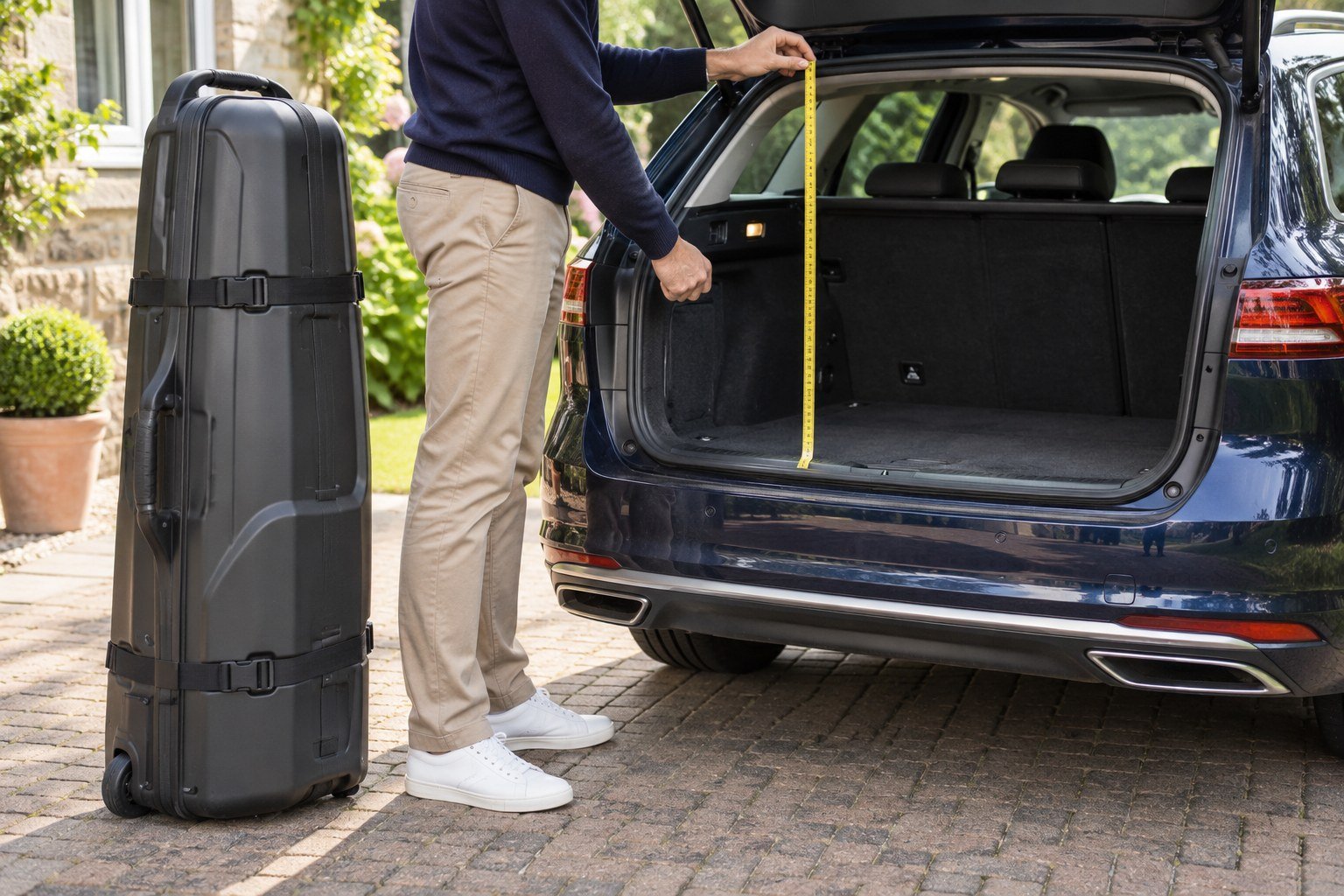
Measure the boot opening as well as the space behind it. A long object may fit diagonally inside but not pass through the opening at the same angle. Allow for passengers and their ordinary suitcases. Do not base the plan on folding a seat that somebody needs, leaving a case unsecured or obstructing the driver’s view.
For a hired vehicle or booked transfer, describe the number of golf cases and their external dimensions. A vehicle category name is less useful than confirmation that the operator can accommodate that load. Two golfers with rigid cases create a different packing problem from two golfers with flexible covers that can be emptied and folded.
At a shop or during a permitted home trial, check the handle positions and rolling balance with a representative load. A handle that works for pulling may be poorly placed for lifting into a boot. Use assistance for an awkward load rather than making the lightest cover the only goal.
For frequent trips, ask whether wheels, handles and other wear parts can be replaced. For one occasional journey, borrowing a sound, correctly fitting cover may be the more sensible first step than buying a bulky case you have nowhere to keep.
Pack so the cover’s protection can work
Start with the instructions for your exact cover. The aim is to secure the golf bag within it and keep the clubheads and other vulnerable parts from becoming loose contact points. Stuffing every remaining gap with clothing is not a substitute for the intended restraints, and the airline may limit what belongs in a sports-equipment bag.
- Empty the golf bag’s pockets first. Remove forgotten loose items and check the complete travelling load.
- Put the golf bag into the cover in its intended orientation. Keep its stand mechanism and protruding accessories clear of pressure points.
- Use the internal restraints as designed. They should secure the bag without forcing shafts or clubheads against a hard edge.
- Keep appropriate headcovers in place and arrange padding deliberately around vulnerable contact areas, following the maker’s guidance.
- If using a travel support, check its compatibility and set it according to its own instructions.
- Close the cover, confirm there is no strained zip or latch, and weigh the finished item.
Club Glove’s packing guidance uses a support arm and padding around irons, illustrating that the cover is only one part of the packing system.[6] It is guidance for that manufacturer’s products, not proof that any improvised pole or packing arrangement is suitable for every cover.
Some guidance also recommends removing a driver head. Only consider that for a club designed for removal, using the club maker’s instructions and the correct refitting procedure. Do not dismantle a bonded head or improvise a repair for travel. Ask a golf professional or the manufacturer when uncertain.
Keep the closing step easy to repeat. If inspection requires the bag to be opened, a clear arrangement with properly fastened restraints is more useful than a complicated bundle held together by several improvised layers. Photograph the packed arrangement for your own reference, then secure it as the manufacturer intends.
No shell, support or packing technique makes clubs immune to mishandling. Buying protection is worthwhile; treating it as a guarantee is not a sound basis for choosing a case.
Back to top ↑Choose around the constraint that would spoil the trip
| Your main constraint | Direction to investigate | What would change the answer |
|---|---|---|
| Small home, occasional trip | A folding soft cover or compact hybrid. | A carrier or policy condition requiring another construction, or poor restraint of your bag. |
| Preference for a complete rigid enclosure | A full hard-shell case that matches the loaded bag. | Insufficient baggage headroom, unsuitable vehicle space or difficult handling. |
| Several golfers sharing transport | Compare the group’s complete loaded dimensions before individual purchases. | A confirmed larger vehicle or a different transfer arrangement. |
| Existing serviceable cover | Keep it if it passes the same fit, condition and acceptance checks. | Damaged closures, failed restraints or a new bag that no longer fits. |
Decide which constraints are non-negotiable, then compare price. There is little value in saving money on a cover that forces an unplanned vehicle change. Equally, an expensive rigid case is not automatically better value for someone who flies once and cannot store it.
An illustrative £150 purchase spread across six return trips is £25 per trip before repairs, storage or any resale value. That arithmetic can help compare ownership with a real hire quote, but it does not predict how long the cover will last. Use your own expected number of trips, and do not count journeys you are unlikely to take simply to justify a purchase.
Inspect condition before replacing or reusing a cover
For a cover you already own, or one you are considering second-hand, inspect the complete closure and restraints before the next trip. Run a zip through its full length. Check attachment points, stitching, wheels and handles. On a rigid case, look closely at hinges, latches and shell damage, including the area around the wheel mounts.
A superficial mark and a damaged closure are different problems. If a latch no longer aligns, a strap anchor is pulling away or a crack affects the case structure, obtain the maker’s advice. Do not assume that tape, a tighter external strap or extra padding restores the intended protection.
Compare the cost and availability of approved replacement parts with a replacement cover. Ask about warranty eligibility separately when buying used; possession of an old receipt does not by itself tell you what a manufacturer will cover.
The strongest choice is the one that clears all four practical gates: the packed equipment fits, the carrier accepts it, the total load is manageable and the case works with your transport and storage. After that, choose the construction whose compromises you are most comfortable living with. A correctly fitting cover you can pack consistently is a more useful purchase than an impressive specification that fails the journey.
Back to top ↑Frequently asked questions
Can a golf bag’s rain hood replace a travel cover?
A rain hood covers the upper part of the playing bag. Assess an airport travel cover as a separate item that encloses and secures the travelling load. Do not assume that a hood satisfies a carrier’s protective-packaging requirement; obtain confirmation if the wording is unclear.
Does a hard shell mean the case is waterproof?
Do not infer a water-protection rating from a rigid exterior. Check the exact product’s seams, closures and stated water-resistance specification. If no relevant rating is given, avoid treating the case as watertight or leaving it exposed unnecessarily.
Can two golfers share one large cover?
Only after confirming the cover’s intended capacity, safe restraint of both sets and the airline’s rules for the packed item. A larger enclosure does not create a second baggage allowance. Compare the total weight and handling with taking two correctly booked items before deciding.
Sources and checks
Sources consulted on 23 November 2026. Manufacturer and retailer descriptions are attributed claims; illustrations do not show tested products. Recheck changing specifications and travel terms before purchase or departure.
Illustrations in this article were created for Taylor’s Trailblazing Golf. Third-party photographs, where used, are credited beside the image or in the source list.


