Golf Trolley Brakes: Parking, Control and Maintenance
A stopped motor, a parking brake and controlled downhill speed are different functions. Knowing which one your trolley provides matters more than the word “braking” in a feature list.
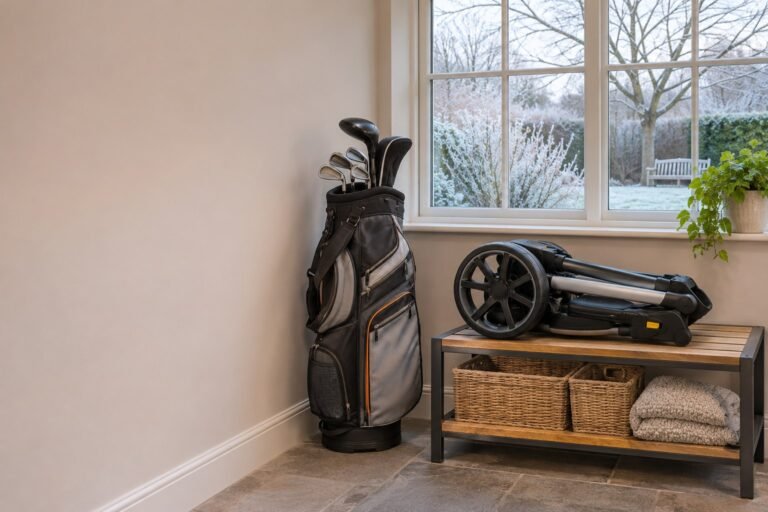
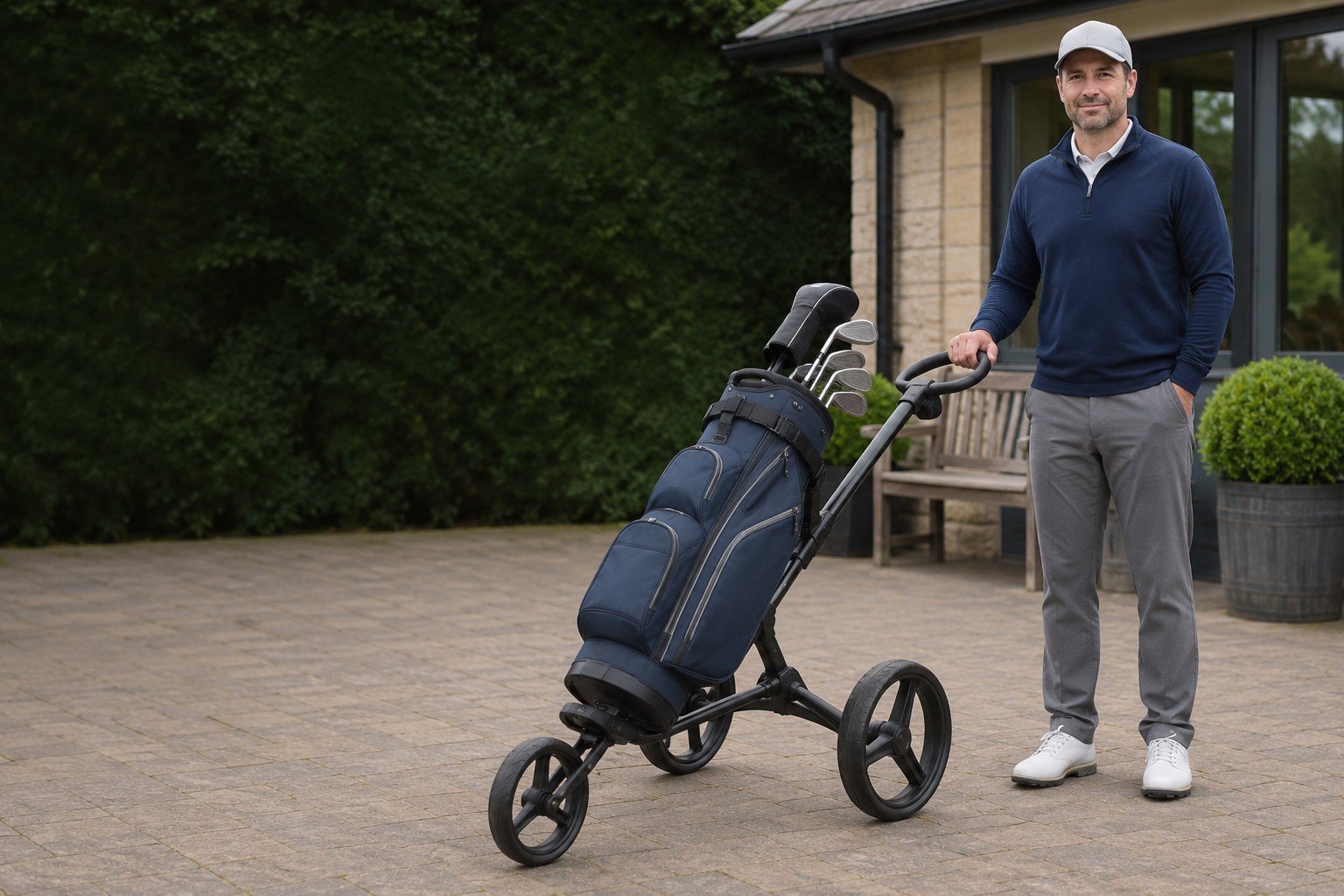
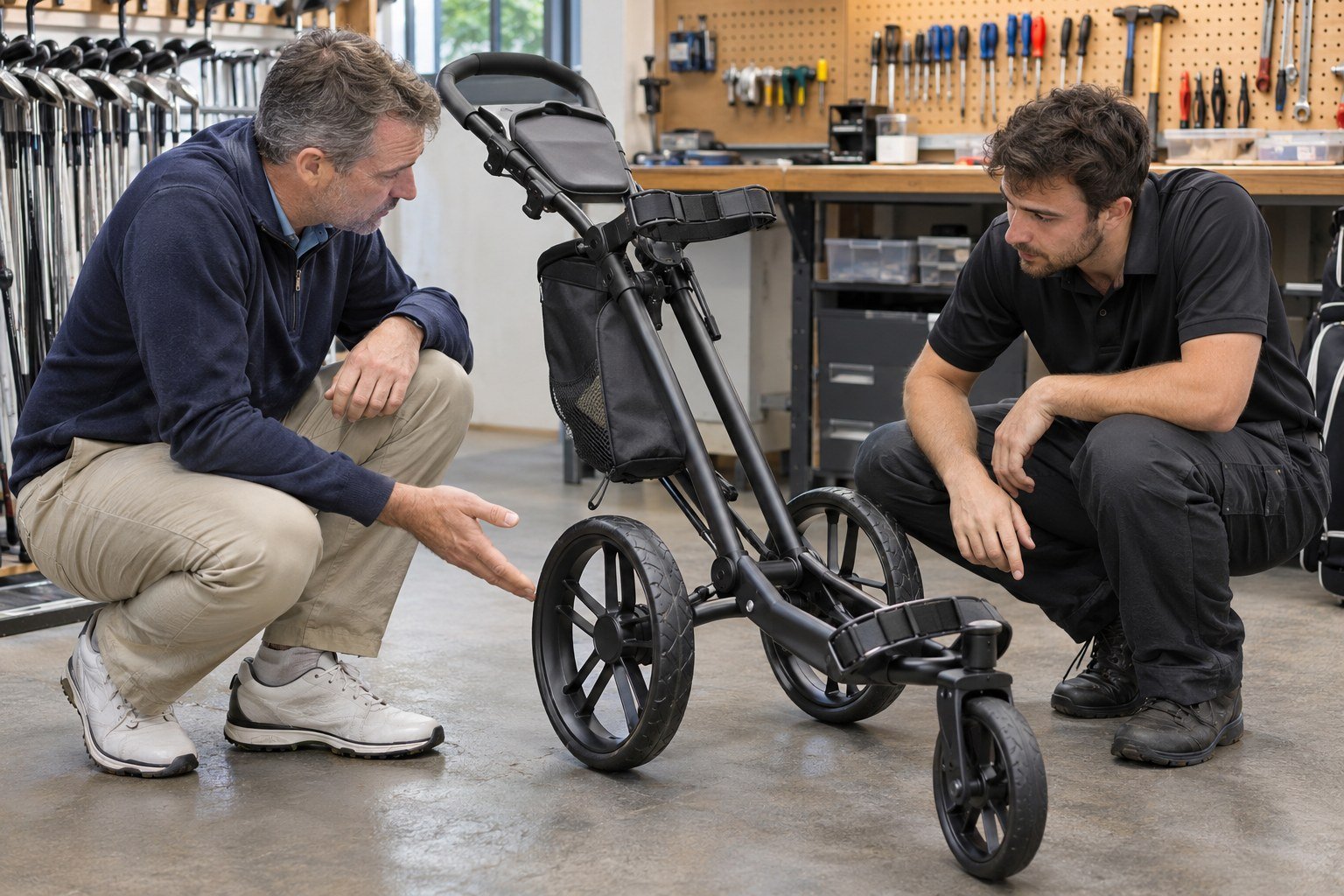
AI illustration. Identify the model’s brake functions before relying on them.
This guide contains affiliate links. If you buy through them, Taylor’s Trailblazing Golf may receive a commission at no extra cost to you.
Before comparing golf trolley brakes, identify the job you need them to do. Holding a parked trolley and controlling its movement are different tasks. The model instructions should explain which functions your equipment provides.
Research-led guidance for UK golfers. Read how we assess golf equipment for the distinction between documented features and hands-on testing.
Parking, descent assistance and a stop command answer different needs.
The standard and braking versions may have different hardware and instructions.
A short level-ground check cannot certify hill-holding performance.
Record the control, mode and symptom before seeking service.
Golf trolley brakes do different jobs
Begin with three questions: how do you stop normal movement, what holds the parked trolley, and what controls its speed during a descent? A product may answer those questions with different mechanisms. A control labelled Stop is not, by its name alone, evidence of a parking function.
On a small screen, swipe inside the table to read every column.
| Function | Documented example | What to establish for your trolley |
|---|---|---|
| Manual parking brake | Clicgear’s Model 4 guide requires the brake when parking.[1] | Its operating control, engagement indication and release procedure. |
| Electronic parking brake | The 2026 Motocaddy M1 DHC manual describes a separate parking-brake setting.[2] | The exact activation sequence and relevant power/operating conditions. |
| Downhill assistance | The 2026 PowaKaddy FX3 manual describes optional EBS as assisted hill-descent braking.[3] | Whether that version has the feature and what limitations apply. |
| Remote stop command | A handset control needs its own operating instructions. | What Stop, handset lock and loss of signal each do. |
Use the exact manual rather than filling gaps with assumptions from another trolley, an electric bicycle or a car. The model’s full name, generation and braking suffix belong in the comparison. A photograph of a similar console is not enough to establish the controls.
For an existing trolley, the immediate decision is whether it operates normally and whether you understand its intended use. For a purchase, decide which functions your usual route requires before comparing screen size, folding convenience or accessories.
Back to the start ↑Learn the controls while the trolley is stationary
Locate the current instructions for your particular version. Find the stopping control, any parking setting and the release procedure before loading up for a round. If the displayed symbols or physical controls differ from the manual, resolve the model identification first.
Clicgear’s Model 4 guide also warns that forcing the front wheel to rotate with the brake engaged can damage brake components.[1] That supports a straightforward habit: release the brake as instructed before moving away. It is not evidence that this mechanism should be used to regulate downhill speed.
On the 2026 M1 DHC, Downhill Control (DHC) regulates speed on descents. Its separate parking brake is activated while stationary: dial to 1, then one further click. P and 1 alternate on screen; pressing On/Off starts the trolley and releases the brake.[2]
Those instructions illustrate why a model suffix matters. Do not copy the sequence to a standard M1, another generation or another brand without checking its own manual. Nor should you assume an electronic setting remains active after a battery is switched off, removed or disconnected; establish that behaviour from the relevant instructions or manufacturer.
Keep gloves, towels and accessory straps clear of the controls. You should be able to identify and reach the intended control without moving the bag or searching through an unfamiliar menu. Ask the retailer to demonstrate the sequence if the manual leaves you unsure.
Make parking a deliberate part of the round
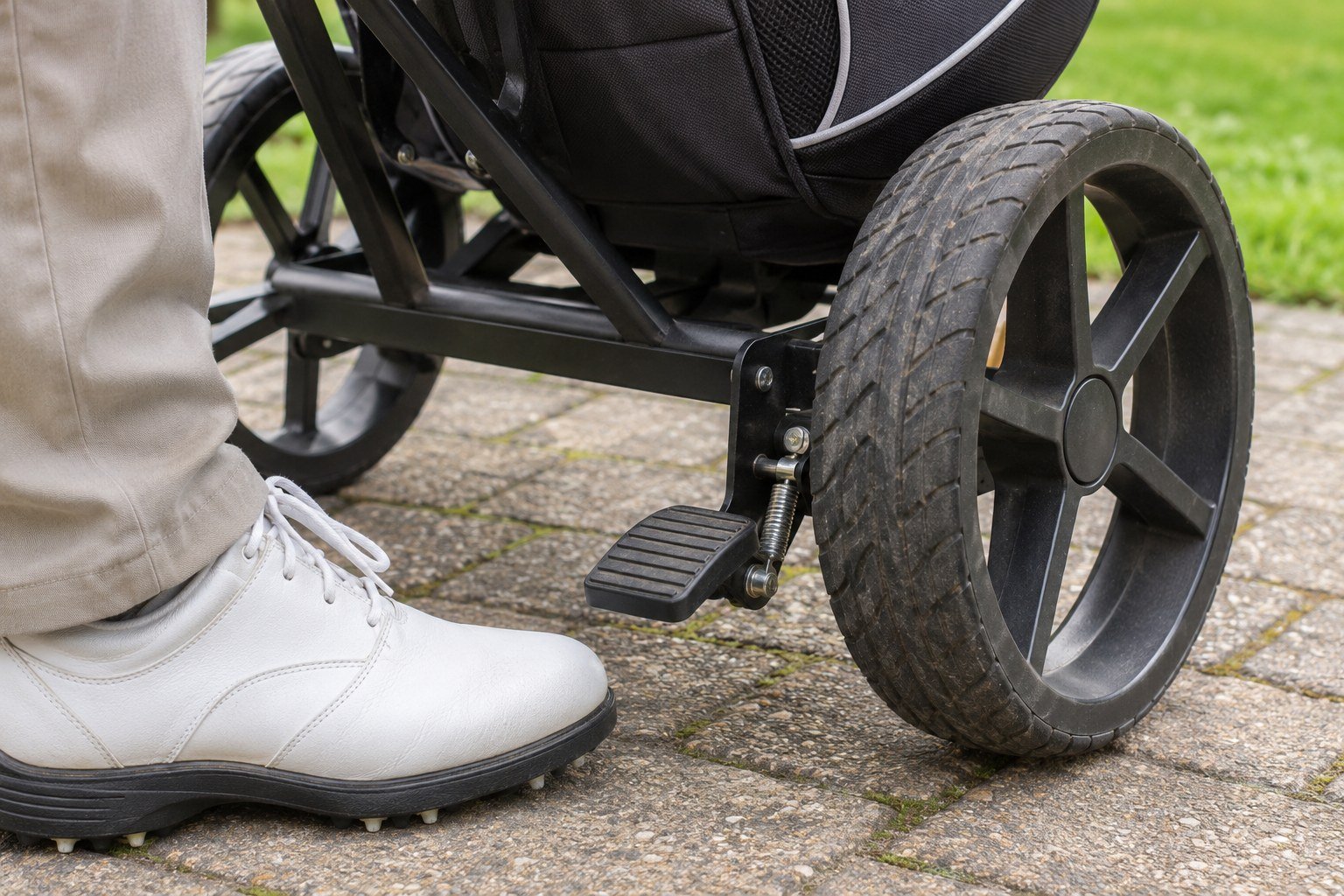
Choose a suitable place to stop before you begin reaching for a club, opening a pocket or removing an accessory. Prefer firm, level ground with space around the trolley and a clear route for other people. A convenient spot beside water, a path edge or a drop is not a sensible place to discover a control problem.
- Bring normal movement to a stop using the prescribed control, maintaining supervision as the manual directs.
- Apply the parking function, if fitted, in the sequence required by the manual.
- Check its specified indicator or mechanical position without forcing the trolley against the brake.
- If the trolley moves unexpectedly or the control will not engage normally, retain control and stop using it until the problem is resolved.
- Before moving away, release the parking function as instructed and check that the route is clear.
This is an ordinary-use routine, not a holding-force test. Do not add weight, leave the trolley on a steeper slope, or stand downhill and let it move towards you to see whether the brake catches. A brief observation on level ground cannot prove what will happen on every gradient or surface.
For a trolley without a dedicated parking brake, follow its own parking instructions and choose a suitable location. Avoid inventing a substitute by wedging a club into a wheel or tying a control in position. If you cannot park it securely within its intended use, arrange a different suitable trolley or ask the supplier for help.
Back to the start ↑Separate downhill assistance from a remote stop
Downhill assistance concerns movement. A separate parking function concerns the stationary trolley. Both can be useful, but the presence of one does not establish the other.
The 2026 FX3 manual says EBS requires the trolley to be powered and its wheels engaged with the clutch. It warns that EBS is not a complete parking brake and that steep, wet or loose conditions can produce wheel locking and slipping; it instructs users to retain a firm grip on the handle on slopes.[3]
Use those limitations when choosing a route and deciding whether a machine suits your normal course. A setting that controls speed cannot make an unsuitable surface acceptable. Do not practise by deliberately releasing a trolley downhill or waiting for it to accelerate before intervening. Ask for a supervised demonstration of normal use in a suitable setting if you are unfamiliar with the system.
The 2026 M7 REMOTE manual distinguishes quick stopping with Stop from gradual stopping by reducing speed. Handset locking is a separate function.[4] Read the model’s complete remote instructions rather than treating locking, time-out and stopping as interchangeable actions.
When comparing remote models, ask what happens in each operating mode, what the user must do before parking and how to regain ordinary control. A manufacturer’s safety cut-out is not a reason to let a trolley travel beyond the intended operating area or out of supervision.
Keep the braking question narrow: can you understand and use the required controls consistently? If the answer is uncertain, a different interface or a simpler trolley may be more useful than additional automation.

Inspect visible parts without adjusting the mechanism
A basic inspection should help you describe a condition, not certify an internal brake as safe. Work with the trolley unloaded, stable and on level ground. For a powered trolley, follow the manufacturer’s shutdown and battery-removal instructions before cleaning or examining the mechanism; do not rely on an electronic parking state to support the inspection.
- Identify the brake control and check for visible breakage, looseness or obstruction.
- Look at accessible cable housings or external connections without pulling them apart. Record damage, a displaced covering or a part trapped by a bag strap.
- Inspect the relevant wheel and surrounding area for mud, grass or another obvious obstruction.
- Check that wheels and any approved replacement parts are installed as their instructions require.
- Compare the normal control position with the manual. Do not force a pedal, lever or dial to match a photograph.
- Stop if you find damage or cannot establish the correct arrangement. Contact the maker or appropriate service agent.
If nothing appears damaged, use only the maker’s ordinary pre-use checks. An accessible mechanism may still need specialist attention. Do not alter cable tension, bend a bracket, file a brake part, open a motor or probe wiring to improve the result.
Keep the symptom distinct from the suspected cause. “The lever reaches its normal position but the trolley moves” is useful. “The cable needs tightening” is a diagnosis you may not be qualified to make. That distinction gives the service agent a better starting point and avoids an adjustment masking the real fault.
Turn the symptom into a clear service enquiry
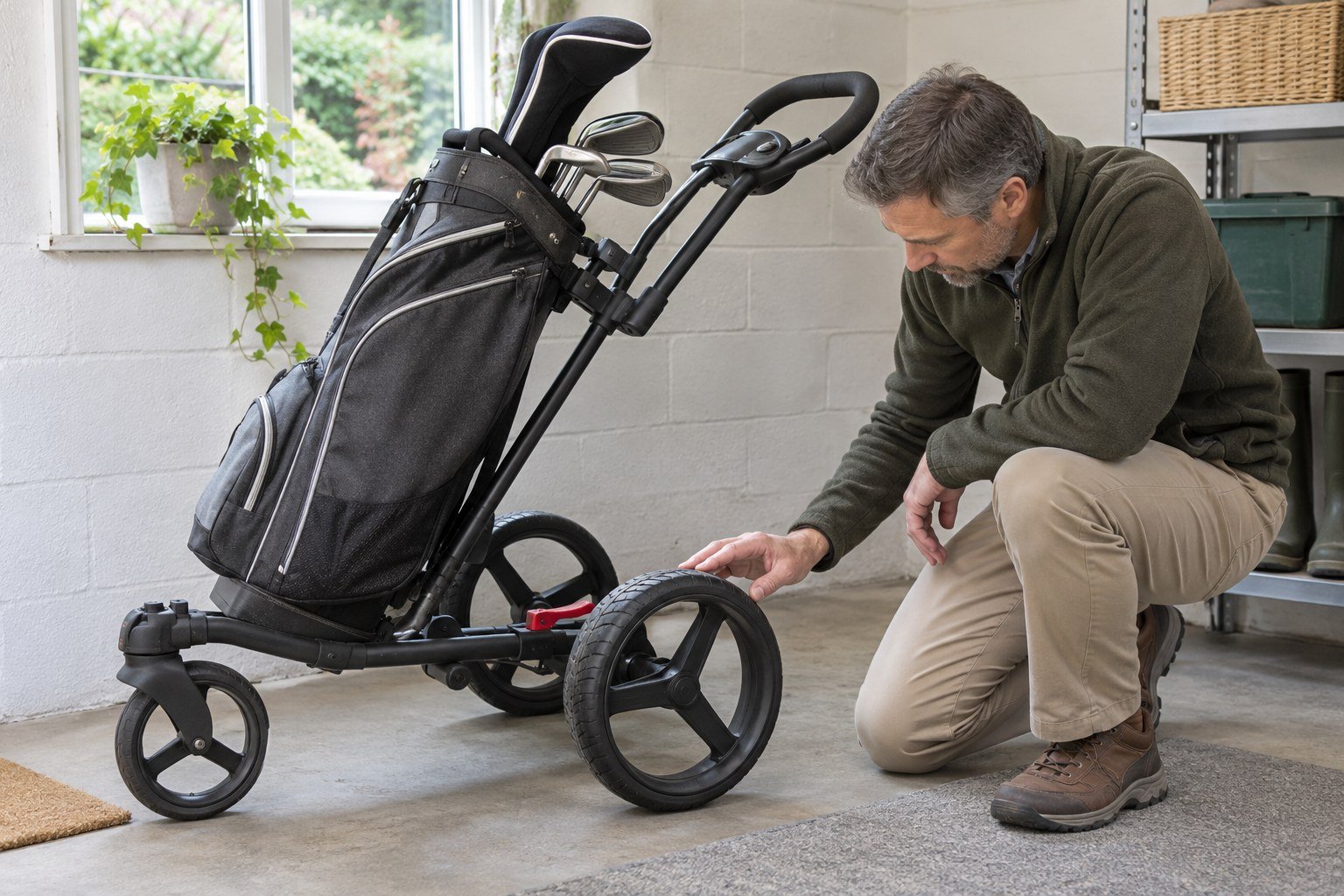
Use this checklist after stopping use, without repeatedly recreating a fault. Photographs can show a control position or visible damage while the trolley remains stationary. Do not record a video by intentionally causing uncontrolled movement.
On a small screen, swipe inside the table to read every column.
| Observation | Useful detail | Next step |
|---|---|---|
| Brake will not engage or release normally | Exact control, operating mode and any displayed symbol. | Stop use and request model-specific advice. |
| New clicking, scraping or resistance | Where it appears to come from; any recent wheel change or impact. | Inspect visible condition and permitted cleaning needs; seek service if unresolved. |
| Unexpected movement while parked | Which parking action was used, surface and observed movement. | Do not repeat on a slope; arrange assessment. |
| Unreliable electronic or remote response | Model, mode, warning display and the command used. | Stop using the trolley; follow the manufacturer’s support route. |
A useful message is: “My trolley is [model/year/serial]. In [mode], using [control], I observed [symptom]. It began after [known event, or unknown]. The wheels are [original/identified replacement]. I have stopped using it. Which parts or photographs do you need, and can you assess it before any repair is authorised?”
PowaKaddy advises contacting the service agent before visiting and agreeing what equipment to bring; it also recommends obtaining a repair quotation before giving the go-ahead.[5] That is a useful way to avoid ordering a speculative replacement part.
Back to the start ↑Keep cleaning separate from brake repair
After a muddy round, clean according to the trolley instructions and let the equipment dry before storage. Use an appropriate work area so the trolley is stable and loose contents do not fall into moving parts. Avoid allowing a damp cover to conceal debris until the next round.
The 2026 FX3 manual calls for gentle cleaning, prohibits jet washing or immersion and specifies approved parts for repairs.[3] Apply that example only within its scope; your own manual decides which components may be removed and what maintenance is permitted.
Do not spray a lubricant into the brake simply because a control feels stiff. Lubrication instructions for an axle or another moving part are not permission to coat a braking surface, cable or electrical component. If you cannot identify the prescribed product and location, ask before applying anything.
Store the trolley so the brake lever, pedal and cables are not being crushed by luggage or another item. Follow its folding procedure rather than using the brake control as a lifting point. When unpacking it, check that a travel cover, accessory or strap has not caught around the controls.
There is no service interval that this guide can assign to every trolley. Keep the manufacturer’s schedule, if supplied, and treat new or worsening symptoms as a reason to seek advice rather than waiting for a calendar date.
Back to the start ↑Repair a fault or buy the function you actually need
A repairable parking fault is a service question. A trolley that lacks the descent assistance you need is a suitability question. Separate them before comparing replacement products: repairing a mechanism restores its intended function, whereas adding a different feature may require another model.
Ask for a clear assessment, the correct part, fitting arrangements and the total repair cost. Compare that with the condition of the whole trolley and the practical cost of a suitable replacement. Do not discard a sound trolley because its controls are unfamiliar, or retain one whose braking operation remains unreliable.
If you are buying for separate downhill-control and parking functions, the Motocaddy M1 DHC 18-hole lithium bundle at Clubhouse Golf is an exact listing to investigate; the retailer identifies both features.[6] If your priority is assisted descent, the PowaKaddy FX3 EBS 18-hole lithium bundle at Clubhouse Golf provides a different example.[7] Confirm the model year, supplied manual and battery bundle before ordering. These are feature-led options to discuss, not tested winners or equivalent parking systems.
Request a demonstration of the controls, normal release and any relevant operating modes. Ask how the trolley should be parked when power is off and what support is available if the controls become inconsistent. Do not infer the answers from a generic “braking” badge or a different model shown beside it.
Our recommendation is to keep a normally operating trolley whose functions suit your use, seek service for a fault, and buy a different model only when it meets a clearly defined need. The wider Trolleys & Course Accessories guides cover the other compatibility questions that belong in the decision.
Questions before you decide
Is a trolley parking brake a security lock?
Do not treat it as an anti-theft device. A brake’s parking function and a security feature are separate matters; check any security claim against the exact product instructions.
Can a wheel upgrade add downhill braking?
Do not assume that it can. Ask the manufacturer about the complete trolley system and approved wheel application. A different tread does not, by itself, establish an electronic or mechanical braking function.
Can I buy a used trolley without seeing its brake operate?
Ask for the exact model instructions, condition history and an appropriate demonstration of ordinary operation. Decline a demonstration involving a deliberate runaway or steep-slope test. If a brake fault or uncertain modification remains, obtain a service assessment before relying on it.
Sources and editorial checks
Manufacturer specifications and instructions inform this guide. The comparison and checklists are editorial decision aids, not results of hands-on product testing.
- Clicgear — Model 4 User GuideOfficial guide linked by Clicgear’s current Resource Center; parking and front-wheel warning visually checked. Consulted 23 November 2026.
- Motocaddy — 2026 M1/M1 DHC Instruction ManualPage 23, DHC-only parking instructions. Consulted 23 November 2026.
- PowaKaddy — 2026 FX3 Owner’s Manual, revision 2Pages 8–9, optional EBS limitations and care. Consulted 23 November 2026.
- Motocaddy — 2026 M7 REMOTE Instruction ManualPages 17–18; consulted 23 November 2026.
- PowaKaddy — FAQs and TechnicalService-agent enquiry and quotation guidance. Consulted 23 November 2026.
- Clubhouse Golf — Motocaddy M1 DHC, 18-hole lithium bundleExact UK listing and separate DHC/parking feature descriptions, checked 23 November 2026. No price or availability assertion.
- Clubhouse Golf — PowaKaddy FX3 EBS, 18-hole lithium bundleExact UK EBS listing checked 23 November 2026. Confirm the offered generation and its instructions; no price or availability assertion.
Illustrations in this article were created for Taylor’s Trailblazing Golf. Third-party photographs, where used, are credited beside the image or in the source list.