Folded Electric Trolley Dimensions: Will It Fit Your Car?
The trolley must pass through the opening, move into position and share the boot with the rest of your kit. Three published measurements begin that check; they do not finish it.
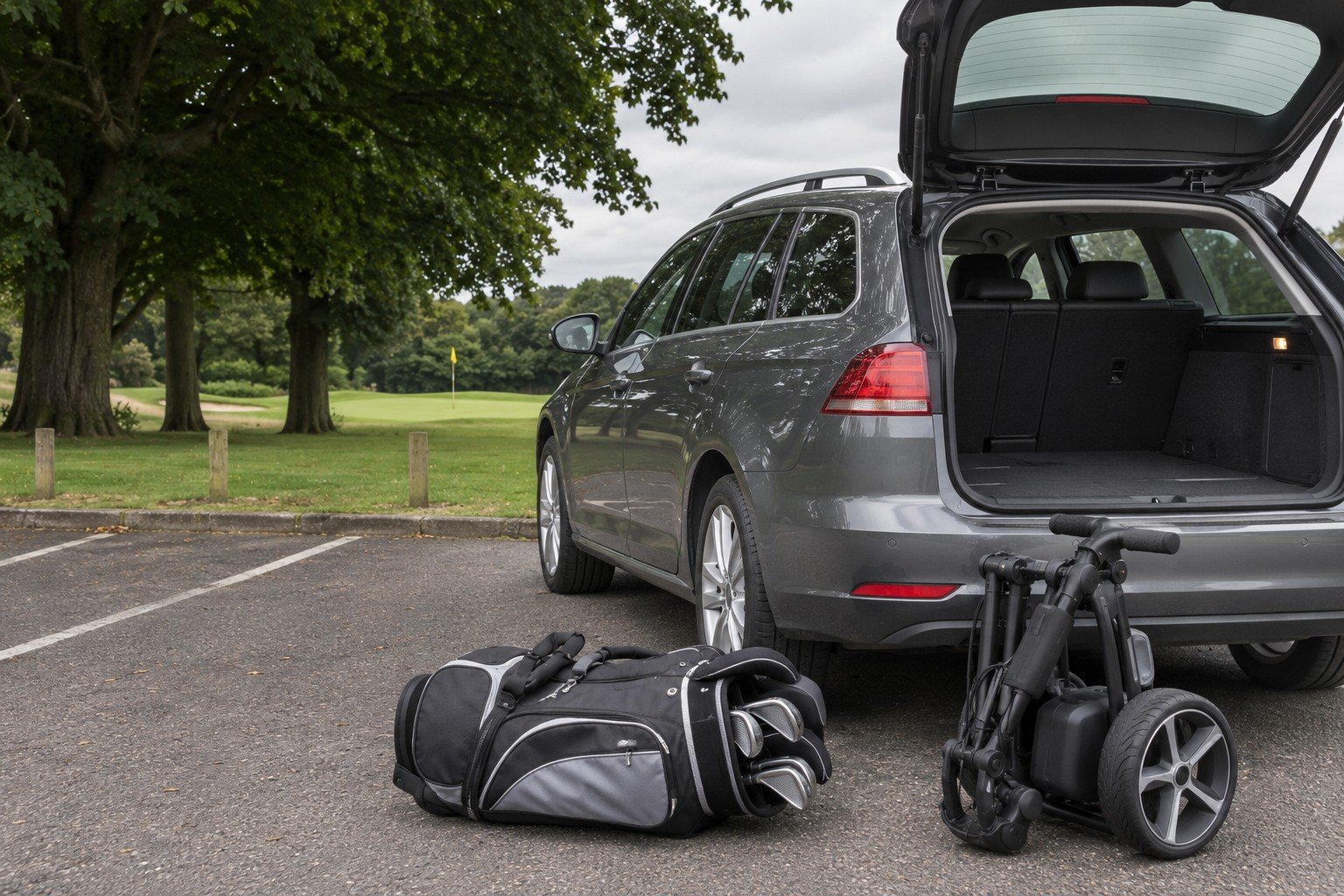
AI illustration. Consider the whole loading task before comparing folded size.
This guide contains affiliate links. If you buy through them, Taylor’s Trailblazing Golf may receive a commission at no extra cost to you.
A folded trolley has to pass through the boot opening, sit inside it with the rest of your kit and come out again without an awkward manoeuvre. Start with that whole loading task before comparing the smallest quoted dimensions.
Research-led guidance for UK golfers. Read how we assess golf equipment for the distinction between documented features and hands-on testing.
Record the model, wheels, battery and accessories with the dimensions.
The narrowest part of the loading path may decide the fit.
Write down how the folded trolley will enter and rest.
Leave usable space for the bag and a manageable loading routine.
Read folded electric trolley dimensions as a defined setup
A folded-size specification is a useful starting point, provided you know what was measured. Identify the precise model, generation and folded arrangement before comparing three numbers with your boot. A familiar product name can survive several revisions, while a removable wheel or accessory can change the space you need.
The examples below preserve each manufacturer’s axis labels. Motocaddy uses length, width and height; these PowaKaddy pages use height, width and depth. Those labels describe the maker’s presentation, not the orientation you must use in the car.
On a small screen, swipe inside the table to read every column.
| Exact example | Published dimension order | Configuration still to confirm |
|---|---|---|
| Motocaddy M1, 2026 model | 650 mm L × 470 mm W × 410 mm H.[1] | The dimension row does not state wheel orientation or whether the battery is installed. |
| PowaKaddy CT6, current 2.8-inch widescreen/USB-C version | 510 mm H × 425 mm W × 375 mm D.[2] | Wheel and battery states are not attached to the folded-dimension row. |
| PowaKaddy FX1, current USB-C/rotary-control version | 805 mm H × 560 mm W × 346 mm D.[3] | Confirm the wheels, battery and any attachments used to obtain the stated size. |
These figures are manufacturer specifications, not measurements from our own handling tests. A missing configuration note is a question for the supplier, not permission to label a size “wheels on”, “wheels off” or “battery included” by assumption.
Ask for a photograph of the measured folded arrangement and confirmation of its three maximum dimensions. Keep that information with the product code. If a listing and manual appear to describe different generations, resolve the mismatch before relying on either.
Back to the start ↑Measure the usable boot, starting at the opening
Set up the car as it will normally travel: seats in their usual positions, load floor at the height you use and any liner or parcel shelf that will remain fitted. Do not base the purchase on a seat-folding arrangement you need to reverse whenever a passenger joins you.
Begin at the aperture, not the widest part of the boot. Measure the opening at the height through which the folded trolley must pass. Curved corners and trim can make a wide opening narrower higher up. Note the lip or sill that the trolley must clear and any overhead obstruction.
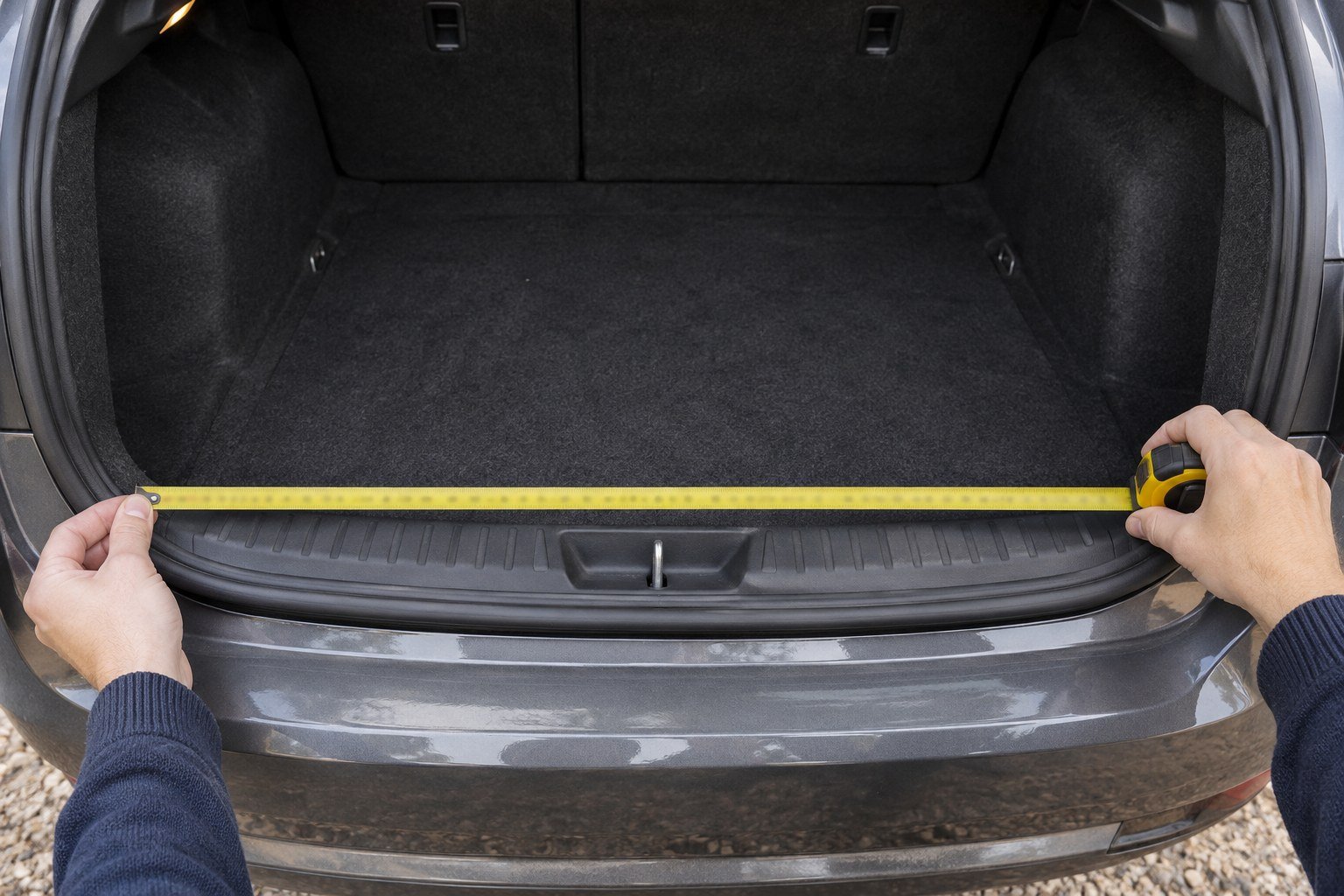
Then measure the space behind the opening. Record the narrowest usable width between intrusions, the available depth to the seat backs and the height beneath the closed tailgate or shelf. A hatchback’s sloping rear glass can reduce clearance above the load floor even when the floor itself looks generous.
Think in three separate stages: crossing the opening, moving or turning inside, and resting in the final position. The largest measurement from each stage cannot be combined into an imaginary rectangular space that exists nowhere in the car.
Keep measurements in one unit; millimetres make small clearances easier to see. Record which surface each figure refers to. “Width between wheel arches with liner fitted” is more useful than “boot width”. A manufacturer’s boot capacity in litres does not describe these individual restrictions.
Back to the start ↑Check the entry path as well as the final position
Sketch the folded trolley as a simple rectangular envelope using its greatest length, width and height in the chosen configuration. Assign one dimension to left-to-right space, one to vertical space and one to travel into the boot. Write the orientation down rather than silently swapping numbers between comparisons.
For a straight, level entry, compare the envelope’s width and height with the narrowest relevant opening along that path. If either is larger, that straight orientation fails the check. Rotating the trolley may create another option, but it also needs room to turn and must be an acceptable way to support and handle the actual machine.
A worked example with deliberately invented measurements
Suppose a folded envelope is 660 mm long, 480 mm wide and 420 mm high. A hypothetical car has a clear 510 mm-wide, 440 mm-high opening along the proposed straight path and 700 mm of usable depth. The arithmetic leaves 30 mm across the width, 20 mm vertically and 40 mm in depth.
Those are total gaps, not gaps on each side. They establish only a close paper comparison. They do not allow for hands, a cover, protruding fittings, irregular corners or the tailgate’s closing path. These invented figures are not a fit report for any named car or trolley.
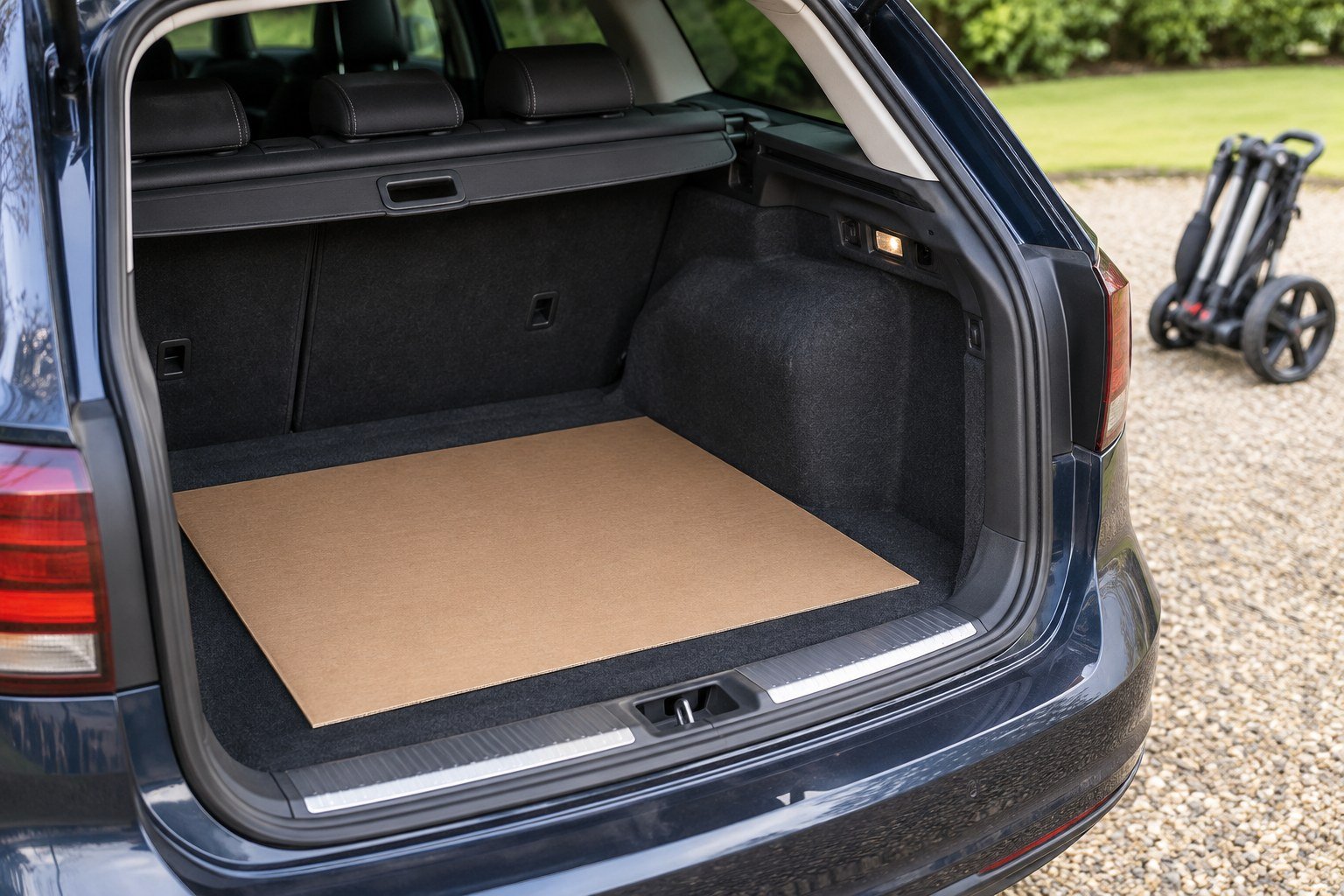
A rigid cardboard envelope can help visualise a shortlist, but it does not reproduce weight, grip positions or the trolley’s detailed shape. A failed box check also does not prove that a narrower, sculpted part cannot pass. Resolve marginal or diagonal arrangements with a careful physical trial, not a confident claim based on volume or one diagonal measurement.
Back to the start ↑Choose the wheel and battery routine before measuring
Decide how much preparation you are willing to repeat after every round. A trolley that fits with its wheels reversed may be practical; one that needs awkward dismantling, loose parts and a completely cleared boot may be less appealing. Compare the arrangement you will actually use.
The 2026 M1/M1 DHC manual allows wheel inversion and folding with the battery installed. These permissions do not identify the measured configuration.[4]
PowaKaddy’s current CT6 manual permits inward wheel positioning for storage and transport, and retention of the battery in its tray with the battery switched off. Again, confirm the measurement configuration separately.[5]
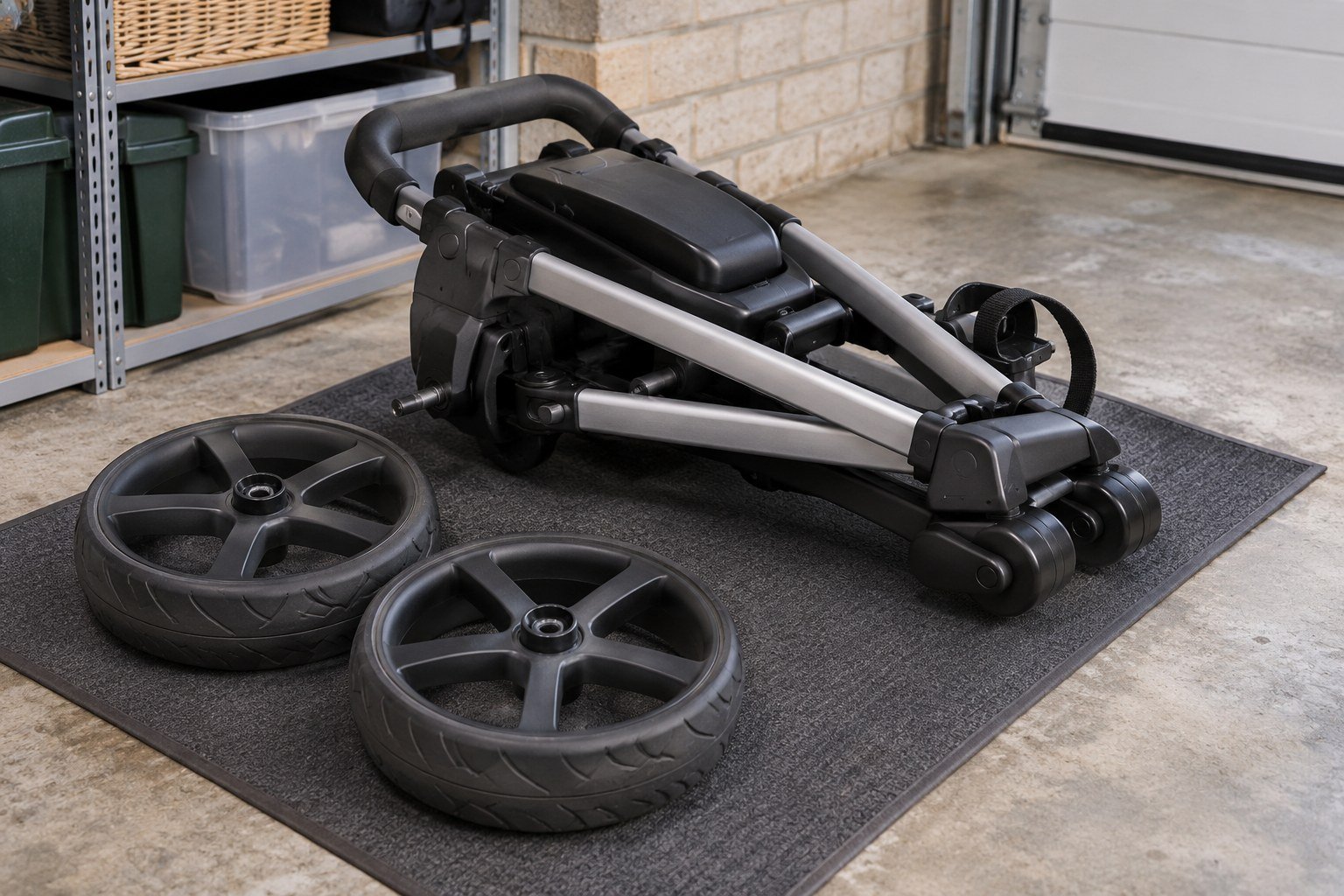
Record the state of the main wheels, front wheel, anti-tip equipment, battery and handle. Include an accessory holder or transport cover if it will stay fitted. Follow the model’s folding order and remove only the items its maker permits you to remove.
Do not assume another set of wheels produces the same folded width. Ask about your actual summer or winter setup. Likewise, a carry cover’s published dimensions may describe its own shape rather than guarantee a particular trolley fit.
If separate wheels or a battery are part of the plan, give them a defined, protected place in the car and follow their transport instructions. Moving them out of the main envelope does not make them disappear from the total packing problem.
Back to the start ↑Make room for the golf bag and the loading task
A trolley-only fit can be misleading. Bring the golf bag, shoes, waterproofs and other items that normally share the boot. If two people travel to golf together, check two complete sets rather than assuming the spare floor area will take the second load.
Plan a repeatable loading order. The bag and trolley should have sensible support without forcing pressure onto a display, control dial or fragile fitting. Use the vehicle’s instructions for securing the load, and the trolley maker’s guidance for lifting and transport. Do not make a loose pile of components your permanent solution.
The loading motion matters too. A compact trolley can still be awkward to lift over a high sill or place deep inside a boot. Try the intended grips and movement with appropriate help; do not perform a difficult lift just to prove that a purchase is possible.

Allow for the equipment after a wet round. A liner, wheel cover or separate bag for dirty items occupies space, and you still need to remove the kit without scraping trim or handling it in an uncomfortable position. An arrangement that only works when everything is clean and carefully staged may become tiresome.
Check the reverse journey as well: can you remove the bag and trolley in a sensible order when parked in an ordinary space? A useful fit makes arriving at the course and returning home straightforward.
Back to the start ↑Use this stationary fitting worksheet before ordering
Ask the retailer whether you can try the correct model in your car. Choose a safe parked position, put the trolley into its approved transport state and use the normal golfing load. This is a fit and usability check, not a test of the vehicle’s carrying limits.
On a small screen, swipe inside the table to read every column.
| Record | What to establish |
|---|---|
| Trolley identity | Full model, generation, product code and relevant accessories. |
| Folded state | Wheel positions, battery position, folded handle and any retained fittings. |
| Measured envelope | Three greatest dimensions, including the cover if used. |
| Vehicle setup | Seat and load-floor positions, liner, shelf and other normal cargo. |
| Entry and movement | Clearance through the aperture and any necessary turn inside. |
| Final position | Stable support, protected controls, room for the bag and proper load restraint. |
| Closure and removal | Tailgate closes normally without touching the equipment; unloading remains manageable. |
| Outcome | Confirmed for this setup; workable with a named compromise; or not confirmed. |
Lower the tailgate cautiously only after checking clearance. Do not use the door, a powered closing mechanism or your body weight to compress the equipment into place. If clearance is uncertain, stop and inspect rather than forcing closure.
A successful check applies to that combination. A different battery position, winter wheels, new liner or changed seat arrangement calls for another look. Keep a photograph of the final arrangement so that you can repeat it without guessing.
Back to the start ↑Buy the fit you can repeat, not the smallest headline
The three published examples illustrate different folded shapes. Use them to identify candidates for a fitting check, rather than rank them by the smallest individual number. A short, taller package and a longer, flatter one can suit different loading paths.
For the 2026 M1 example, view the M1 18 Hole Lithium listing at Clubhouse Golf and ask the supplier to confirm the exact generation and measured arrangement.[6]
For the compact CT6 example, view the CT6 18 Hole Lithium listing at Clubhouse Golf. For the longer FX1 shape, view the FX1 18 Hole Lithium listing at Clubhouse Golf. The battery-bundle labels identify those listings; they are not a promise of range in your conditions.[7][8]
These are verified product destinations, not models we have physically fitted to a car. No current price or continuing stock availability is assumed. Check the supplied version, demonstration arrangements and return conditions before ordering, especially when the paper clearances are small.
Make the decision from the whole routine. Keep an existing trolley that fits and remains suitable. Consider a different fold when it solves an awkward loading path, repeated dismantling or lack of room for the rest of your kit. If the fit remains unconfirmed, a better product photograph is not a substitute for a measurement or trial.
The result you want is specific: this trolley, in this transport configuration, fits this car with the usual load and can be put away and removed sensibly. The wider Trolleys & Course Accessories guides cover the other decisions that should accompany that practical fit.
Back to the start ↑Questions before you decide
Can I compare the biggest trolley measurement with the boot diagonal?
A single diagonal cannot show whether a three-dimensional object will pass through an opening or turn inside it. Check the width and height along the intended entry path and the final support position. A possible diagonal arrangement needs a physical trial with the actual shape and handling method.
Does a bigger boot capacity in litres guarantee an easier fit?
No. A capacity figure does not tell you the opening shape, sill height, wheel-arch intrusion or clearance under a sloping tailgate. Measure the spaces the folded trolley must actually pass through and occupy, with the seats and load floor in their usual positions.
Should I remove the battery just to make the trolley smaller?
Follow the exact model’s transport instructions and compare both the folded frame and any separately carried components. Removing a battery may change the lifting task without changing the greatest outside dimensions. Do not assume it reduces the package size; measure the permitted configuration and give the battery a suitable transport position.
Sources and editorial checks
Manufacturer specifications and instructions inform this guide. The comparison and checklists are editorial decision aids, not results of hands-on product testing.
- Motocaddy UK — 2026 M1Current 2026 model: published dimensions 650 mm L × 470 mm W × 410 mm H. Wheel orientation and battery state are not specified beside that dimension row. Checked 23 November 2026.
- PowaKaddy — CT6 current UK specificationCurrent 2.8-inch widescreen/USB-C version: folded 510 mm H × 425 mm W × 375 mm D. Manufacturer axis labels retained; dimension-row configuration not assumed. Checked 23 November 2026.
- PowaKaddy — FX1 current UK specificationCurrent USB-C/rotary-control version: folded 805 mm H × 560 mm W × 346 mm D. This is not a claim that every FX1 generation shares the figure. Checked 23 November 2026.
- Motocaddy — 2026 M1/M1 DHC instruction manualPages 10 and 13: wheel inversion and folding with the battery installed. Checked 23 November 2026.
- PowaKaddy — CT6 owners manual, 2026 REV2Pages 4–5: inward wheel position for storage/transit and battery retained in its tray only with power off. Checked 23 November 2026.
- Clubhouse Golf — M1, 18 Hole Lithium BatteryVerified current 2.8-inch M1 listing and named battery bundle. Confirm the exact generation and supplied configuration before ordering. Checked 23 November 2026.
- Clubhouse Golf — CT6, 18 Hole Lithium BatteryVerified UK 2.8-inch/USB-C CT6 listing with the same stated folded dimensions. No price or continuing stock claim. Checked 23 November 2026.
- Clubhouse Golf — FX1, 18 Hole Lithium BatteryVerified UK USB-C FX1 listing with the same stated dimensions; retailer copy says the model joined the range in 2025. No invented 2026 redesign claim. Checked 23 November 2026.
Illustrations in this article were created for Taylor’s Trailblazing Golf. Third-party photographs, where used, are credited beside the image or in the source list.