A Small-Space Golf Practice Kit Under £100: Prioritise Feedback Over Gadgets
A putting-led setup with a clear job for every item and money deliberately left over.
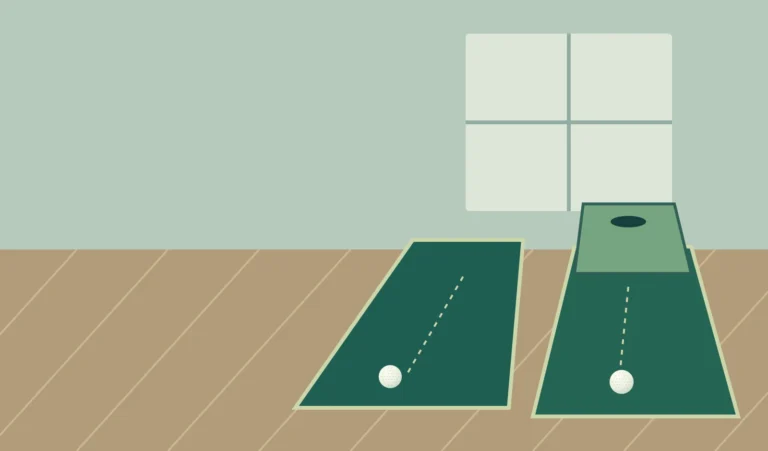
Original conceptual illustration; not a product or test photograph.
A small-space golf practice kit under £100 should begin with a useful question: what will each item tell you after a shot? A mat can provide a repeatable rolling surface, a simple gate can show start direction and a mirror can help check an address reference. Several gadgets that all give the same vague impression of "a good stroke" are not necessarily a better kit.
For most genuinely small indoor spaces, a putting-led setup is the sensible starting point. This guide does not pretend that a compact mat and an inexpensive net create a safe full-swing simulator. The proposed kit assumes you already own a putter and suitable balls, and it prioritises observable feedback, easy storage and a budget reserve. It is a research-led selection, not a hands-on product test or a promise of lower scores.
A repeatable surface
Measure stance and stopping room too.
An address mirror
Buy it only for a clear reference question.
£84.98 example
Includes two items and stated allowances.
Not a swing bay
A small net does not certify a safe room.
A small-space golf practice kit under £100: the priorities
Buy information before entertainment
A useful practice item helps you observe something specific. It might show whether the ball starts through a corridor, whether it finishes in a pace zone or whether your address reference is repeatable. Before buying, write the observation beside the item. If you cannot explain what new information it adds, postpone it rather than filling the budget because there is money left.
This does not mean practice must be joyless. An enjoyable target can help you return to the session, but entertainment and diagnostic value are different benefits. A small kit can include both when the purpose is clear. The problem is paying for several devices while still being unable to say why a putt missed or what you intend to practise next.
Let the room set the scope
A narrow room may be suitable for putting while being entirely unsuitable for chips or swings. The size of a purchased net does not establish clearance around the golfer, containment of mishits or protection of the surroundings. Keep the proposed indoor kit putting-only unless a separate, properly assessed facility supports another activity.
This scope is a deliberate trade-off. You gain a manageable setup that can be used regularly without claiming to practise every part of golf at home. Longer-game work can remain at a driving range or another authorised area. Spending the entire budget on a cramped imitation of a full practice bay is not automatically better than doing one useful task well.
Measure the usable area, not just the empty floor
Include stance and stopping space
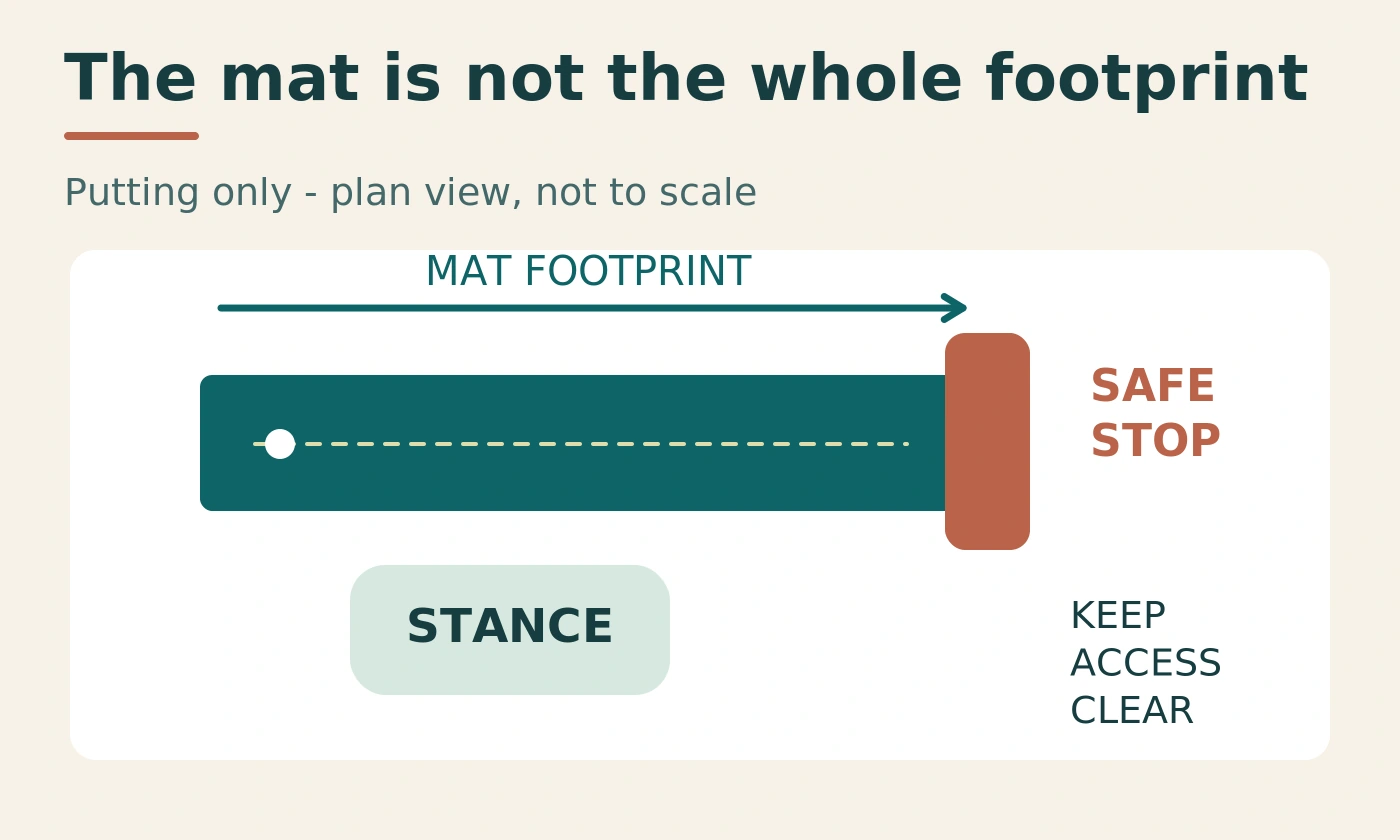
Measure where the mat would lie, where you would stand and where the ball would stop if it missed the target. Include doors, furniture, radiators and the route other people use through the room. A mat's published length and width describe the product, not the complete space required to use it comfortably and safely.
For example, the PuttOUT Slim Mat is listed as 240 cm by 25 cm. You still need room beside it for your normal putting stance and beyond the working target for a safe stop. Do not place it where opening a door changes your stance or where a missed putt can roll down stairs. The room must accommodate the activity, not merely the rolled-out strip. [1]
Test the layout before ordering
Use paper or a loose, removable reference to outline the proposed footprint on an appropriate floor, then take your normal putting stance with the putter. Do not make full swings to "check the ceiling" in a confined room. This is a putting-space assessment. Confirm that the stroke, your feet and the ball path remain clear without needing to manoeuvre around furniture.
Try the arrangement at the time you expect to practise. A space that is available for a photograph may be a busy walkway in the evening. If setting up requires moving half the room, you may use it less than a simpler alternative. The best small-space kit is one that fits the household as well as the budget.
Run a no-purchase pilot before building the basket
Check whether the habit fits the household
Before ordering equipment, try a few brief putting-only sessions using a suitable existing surface, your putter and a safe stopping arrangement. This is not a claim that the surface reproduces a green. It is a practical check of whether the room, timing and setup routine work for you. Notice whether the area stays clear and whether putting the equipment away is straightforward.
If the household arrangement fails, buying a longer mat will not necessarily solve it. A different room, a shorter session or practice at another time may be the useful change. The pilot costs nothing when the necessary safe basics are already owned, and it can prevent purchasing a kit that spends most of its life in the packaging.
Buy the item that removes the real limitation
After the pilot, identify what prevented a useful session. An inconsistent carpet suggests that a suitable mat may add value. Difficulty recording a task may need only a clearer notebook entry. A recurring technical question may be better taken to a coach than answered by an unrelated accessory.
This makes the shopping list a response to use rather than a collection of attractive objects. The proposed basket is one workable starting example, not an instruction to buy both products regardless of your room. Keep the optional item optional and preserve the reserve until an actual limitation gives it a purpose.
The checked starter basket and its assumptions
Two paid items, with room left in the budget
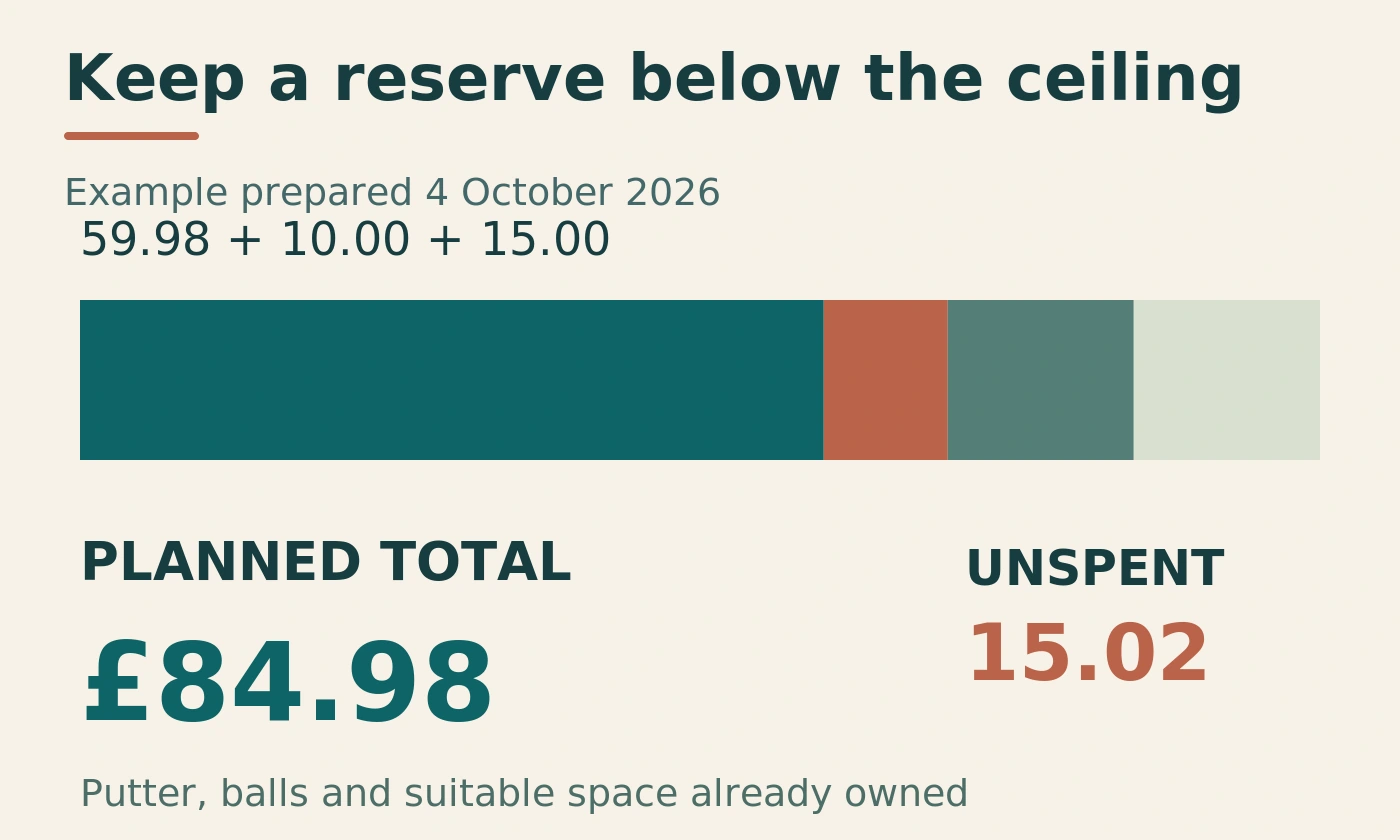
On 4 October 2026, the manufacturer listed the PuttOUT Slim Putting Mat at £39.99 and the Compact Putting Mirror at £19.99. Their combined listed item price was £59.98. These are dated observations, not a guarantee of future price, delivery eligibility or stock at checkout. The links in this guide are ordinary manufacturer links, not affiliate links. [1] [2]
Start with the mat as the principal surface purchase. The mirror is optional and should be bought only when you want an address reference it can provide. A simple soft marker arrangement and written scorecard can cover start-line and pace tasks without another specialist gadget. You do not need to spend close to £100 to make the kit complete for its intended purpose.
Distinguish prices from allowances
The consumables and delivery figures below are planning allowances prepared on 4 October 2026, not quoted retail prices or a promised shipping charge. Recalculate the total using the actual checkout amount. The remaining reserve is deliberately unspent so a small change in delivery cost does not push the plan over budget.
| Item | Basis | Budget figure |
|---|---|---|
| PuttOUT Slim Putting Mat | Manufacturer price checked 4 October 2026 | £39.99 |
| PuttOUT Compact Putting Mirror | Manufacturer price checked 4 October 2026; optional | £19.99 |
| Suitable low-tack tape or soft flat markers | Planning allowance, not a quote | £10.00 |
| Delivery / contingency | Planning allowance; verify checkout | £15.00 |
| Planned total | Includes both paid items and allowances | £84.98 |
| Unspent amount below £100 | Arithmetic reserve | £15.02 |
On smaller screens, scroll this table sideways.
This assumes an existing putter, balls, notebook or paper, phone if used, and a suitable soft backstop. Starting with none of those requires a different budget. Do not hide the cost of essential equipment by treating it as already owned when it is not.
Choose the surface for consistency, not a speed promise
A compact mat can make sessions comparable
The main reason to use a mat is to have a recognisable practice surface and references that are easy to reset. PuttOUT describes the Slim Mat as having printed distance, alignment and pace markings. Those are useful features to examine, but the manufacturer's performance claims should not be treated as results from this website. [1]
Whatever surface you choose, look for a flat, stable placement and a roll that is consistent enough for your chosen task. A ridge or curl can turn a start-line exercise into a test of the mat. Let the product settle according to its care instructions, and inspect it before each session rather than compensating for a persistent surface defect in your stroke.
Your home surface is not every green
A mat may be marketed with a speed comparison, but the practical roll also depends on the product's condition and supporting floor. Do not assume that a putt travelling a particular distance indoors will travel the same distance at the course. Use the surface to practise a task consistently, then calibrate pace on the actual green before play.
An existing carpet can be a no-purchase starting point when it gives a usable roll, although pile direction, seams and unevenness may limit the comparison. Describe those limits rather than pretending the surface is standardised. If the carpet introduces obvious sideways movement, use it only for an appropriate task or wait for a better surface instead of drawing conclusions from distorted feedback.
Use a mirror only when it answers a question
Define the reference you want to see
A putting mirror can help you observe an address relationship, such as eye position relative to a marked line or the putter face against a reference. PuttOUT's Compact Mirror is described as a small alignment aid with a protective surround and grip on its underside. Check its intended use and the suitability of the supporting surface before placing it down. [2]
The mirror does not diagnose the correct posture or length for every golfer. It shows a relationship that you still need to interpret. A useful question is whether you can return to the same comfortable reference, not whether you can force your body to match a printed line. Persistent fitting or physical concerns need the appropriate professional rather than more mirror practice.
Remove it for part of the session
Use the mirror briefly, then take it away and repeat the task. This checks whether you can reproduce the reference without continually looking at the aid. A practice routine that depends entirely on the mirror may become a routine for using the mirror rather than a routine you can take onto a green.
Skipping the mirror is reasonable when you have no specific address question. That saves £19.99 against the checked 4 October 2026 basket and leaves a simpler kit. The budget is a ceiling, not an instruction to buy everything listed. Add a tool when you know what it will contribute, not because another golfer's setup contains one.
Build a start-line task with simple references
A corridor can show the first part of the roll
Create a visible corridor using the mat's markings or soft, flat references placed safely outside the intended ball path. Begin with a generous width that gives clear feedback without turning every attempt into a collision. Do not use sharp, brittle or easily scattered objects. Any marker should be suitable for the floor and easy to remove.
The task is to send the ball through the chosen corridor from a consistent start point. Record a simple pass or miss, with the miss direction. This does not identify every cause of the result, but it gives a clearer observation than repeatedly putting towards a distant cup and judging the whole stroke by whether the ball happened to drop.
Do not make the gate artificially impressive
A very narrow gate can create a dramatic challenge while being frustrating or poorly suited to the purpose. Start with a width that lets you observe ordinary variation, then adjust deliberately. Record the width or reference used so a later score is comparable. Ten successes through a wider corridor are not directly equivalent to ten through a much narrower one.
Keep the putter head clear of the markers unless the tool was specifically designed for another task. The exercise is about the ball's start direction, not striking obstacles. If you find yourself steering or making an unnatural stroke solely to beat the gate, simplify the task or discuss it with a coach rather than assuming a harder setup is better practice.
Add a pace zone without buying another gadget
Define where a useful finish would be
Use a visible stopping zone on the mat or an appropriate flat reference beside it. The ball should be able to roll naturally without hitting a hard object at the front of the zone. Choose a distance that fits the room and leaves a safe backstop beyond it. Record whether each attempt finishes short, within the zone or long.
This gives you information that a simple hole count may hide. A putt can start well but finish far beyond the intended area, while another can miss the centre of a target yet have useful pace. Keeping those observations separate helps you decide what to practise next instead of treating every miss as the same problem.
Change one demand at a time
First keep the start point fixed. Once the task is familiar, vary the start point within the available safe space while keeping the stopping zone clear. Do not simultaneously narrow the corridor, lengthen the putt and change the surface, because an altered score would then have several possible explanations.
A small room limits the range of pace work you can do, and that is acceptable. Practise the short distances the space supports, then use a practice green for longer putts. The home kit is not incomplete because it cannot reproduce a long outdoor putt. It is incomplete only if you pretend that it provides information beyond the task it actually allows.
Make the notebook the centre of the kit
Record the task, not a judgement about yourself
A useful entry might read: "Ten attempts from the marked start point; six through the corridor; three left, one right; pace not scored." That describes the session without turning it into a verdict on your ability. The numbers are observations, and the next session can use the same task to check whether the pattern repeats.
Avoid vague entries such as "putted badly" or "new aid works". They do not say what happened or whether the task changed. Write the surface, distance, reference width and any interruption that affected the session. This takes little time and adds more practical value than buying a device whose feedback you never record or use.
Keep a small set of comparable tasks
Choose two or three tasks and retain their definitions for a few sessions. For example, one can focus on start direction, another on the stopping zone and a third on rebuilding the setup before each attempt. Do not redesign every task each day and then compare the scores as though the difficulty remained constant.
The notebook also tells you when an extra purchase is unnecessary. If the current kit already shows the issue clearly, another aid may simply duplicate the information. Spend time understanding the recurring observation, or bring it to a coach, before buying a new tool because the existing one has not produced an immediate improvement.
A suggested ten-minute session
Keep the first half simple
This is an editorial practice plan, not a coaching prescription. Spend the first minute clearing the area and checking the mat and backstop. Use a few relaxed rolls to confirm the surface is behaving normally. Then spend roughly four minutes on one defined task, such as a start-line corridor, with a consistent routine and a manageable number of attempts.
Step away between putts often enough to practise finding the setup again. Do not chase a high repetition count at the expense of attention. If a phone timer is helpful, place it safely away from your feet and the ball path. The timer should keep the session bounded, not encourage rushing or ignoring other people using the room.
Finish with transfer and a brief note
For the next few minutes, remove any optional reference and repeat a related ordinary putt. Notice whether the task remains understandable without the aid. Use the final minute to record the result and put the kit away. A complete session includes safe setup and storage; it does not end when the last ball stops.
If the session becomes frustrating, shorten it rather than buying another gadget to make it feel productive. The purpose is attentive, repeatable practice. A few clear observations are more useful than a long session of increasingly forced strokes. Bring a persistent pattern to a qualified coach when you need help interpreting what the feedback means.
A simple week that does not require daily purchases
Repeat before you escalate
Use the same start-line task for two short sessions, then the same pace task for two more. On another day, combine a familiar setup with an ordinary target and no extra aid. These are suggested ways to organise limited time, not a guaranteed training schedule. Adapt the frequency to the space, household and attention you actually have.
Keep the task difficulty stable long enough to make the notes meaningful. If you narrow a corridor, write that change down and begin a new comparison. Progress is not always a rising score: a similar score on a deliberately harder task may represent a different observation, but the distinction should be explicit rather than implied.
Leave room for outdoor calibration
When possible, spend part of a normal practice-green visit checking the same general skills without trying to reproduce the indoor surface exactly. Use the green's available space, respect other users and recalibrate pace. A home mat can support regular practice, but it cannot tell you how fast today's green will roll.
Do not turn an ordinary round into a training-aid session. The R&A's equipment rules restrict the use of aids that create an advantage in preparing for or making a stroke. Keep the kit for appropriate practice and ask the committee about any uncertain competition situation. Being convenient to carry does not make an aid permissible to use during play. [3]
Use the phone you already own carefully
A recording can answer a limited question
A short recording can show whether your setup changes between attempts or whether a marker is being placed consistently. Put the phone on a stable existing support outside the stroke and ball path. Avoid balancing it where it can fall onto the mat or distract you. You do not need a paid app merely to record an ordinary view of the task.
Keep the camera position similar when comparing sessions. A different lens angle can make the same movement look different. Do not report tiny measurements from ordinary video as calibrated fitting data. The phone is useful for a broad observation or for sharing a clip with a coach, not for manufacturing precise numbers unsupported by the recording method.
Avoid paying for feedback you cannot interpret
Before subscribing to an app or buying a sensor, identify the decision its information would help you make. Consider ongoing costs, compatibility and whether the output adds anything beyond the current task and notebook. A device can produce many numbers while leaving you unsure which one matters or how it relates to the putt you just made.
The under-£100 plan does not need a subscription. Keep the existing phone optional and use it sparingly. If a coach recommends a particular recording or measurement, that creates a clearer reason to invest later. Until then, a simple, well-defined task is more useful than a complex display that gives the practice session an appearance of precision.
Do not turn foam balls into permission for indoor swings
Soft equipment still needs a safe environment
A foam or reduced-flight ball does not remove the risk created by a swinging club, a mishit or an unsuitable room. This putting-led kit does not include indoor chipping or full swings. Do not infer that a soft ball makes a low ceiling, nearby window or shared living area acceptable for those activities.
Product-specific instructions also matter. Decathlon's INESIS home putting-ball product, for example, states that the balls are only to be used with a putter. The fact that a ball has a soft covering does not make it a general indoor hitting ball. Follow the actual product's stated use instead of treating all soft golf-like balls as interchangeable. [4]
Keep nets outside this budget's promise
A net purchase raises separate questions about clearance, containment, condition, anchoring and the surrounding area. Those cannot be settled by adding a cheap net to a small-room shopping list. If full-swing practice is your goal, assess that project separately and use an appropriate facility while the space and equipment are unresolved.
This is not a reason to dismiss home practice. It is a reason to choose the type of practice the environment supports. A compact putting station can be useful without pretending to replace a driving range. Keeping the scope honest protects both the budget and the household from a purchase that cannot safely be used as imagined.
Adapt the kit to the room you actually have
A living-room setup needs fast removal
In a shared room, choose a position that can be cleared completely after practice. Roll or store the mat as the manufacturer recommends, gather every ball and remove temporary references. Do not leave a narrow mat across a walking route because it looks unobtrusive. Household members should not need to remember where a practice station has been left.
A basket or existing cupboard space can keep the small items together without another purchase. Check that the stored mat is not being crushed or bent in a way that affects its next roll. A kit that takes only a short time to set out and put away is more likely to remain practical than one that permanently occupies a shared space.
A hallway or garage needs different checks
A hallway may appear ideal for a long strip but can also be an essential access or escape route. Do not block it or practise while people need to pass through. A garage may offer space but have an uneven, dirty or damp floor that affects the mat and ball. Assess the actual surface rather than treating any spare rectangle as suitable.
If the available room is shorter than the proposed mat, do not fold the product into a hump and call it a feature. Choose a shorter suitable option, use a permitted shorter working area without damaging the product, or begin with a no-purchase task that fits. The right response to insufficient space is to change the plan, not to force the equipment into it.
Store and maintain the kit so the feedback stays useful
Surface condition is part of the practice setup
Before use, check for curls, grit, dampness and objects beneath the mat. A small lump can change the ball's path and make a technical task misleading. Follow the manufacturer's care instructions rather than applying heat, strong cleaners or improvised flattening methods. The objective is a stable surface, not a cosmetic repair that introduces another problem.
Keep the balls and putter face clean enough for an ordinary comparison. Remove loose markers after the session and check that a mirror's underside is suitable for the surface where you place it. A small kit is easy to inspect, which is one advantage of not filling the room with unnecessary equipment.
Replace only what has stopped doing its job
A worn reference or damaged surface may need attention, but a new colour or promotional bundle is not a maintenance requirement. Ask whether the current item still provides clear feedback. If it does, continuing to use it is a reasonable decision. The purpose of the kit is practice, not keeping pace with every accessory launch.
When a component fails, review whether the task can be performed with something simpler before buying an upgrade. A replacement should solve an observed problem, such as an unreliable surface or an unreadable reference. That keeps future spending connected to use rather than allowing a small initial budget to become an open-ended collection.
Decide what deserves the next pound
Upgrade the weakest useful part
After several sessions, review the notes and the practical experience. Is the surface limiting the task? Is storage so awkward that you rarely practise? Do you need a coach to interpret a recurring pattern? Those are different problems, and each suggests a different next step. Buying a more elaborate target will not necessarily solve any of them.
The most valuable next purchase may be no purchase at all. A simpler task, a better room arrangement or a short coaching conversation may be more useful than another aid. Do not assume that additional spending is required because progress has not appeared immediately. The kit is a way to collect feedback, not a machine that guarantees improvement.
Keep the budget calculation honest
Recheck current item prices, delivery and any necessary accessories before ordering. The checked example and allowances are dated 4 October 2026, and the total should be recalculated at checkout. Do not rely on a newsletter discount, membership benefit or regional shipping offer unless you are actually eligible and willing to meet its conditions.
The proposed basket remains deliberately below the ceiling so those details have room to change. If a price increase pushes it over, omit the optional mirror before compromising the basic safe setup. A complete, useful putting station can be modest. An under-budget claim should never depend on excluding an unavoidable charge or pretending an essential item is free.
Pros and cons of a putting-led kit
Why it suits a small budget
The kit has a clear purpose, uses a manageable amount of floor space and can provide more than one kind of feedback without a subscription. It is easy to start with the surface alone and add a mirror only when needed. The unspent reserve also makes the plan less dependent on a temporary offer or a perfect delivery assumption.
Because the tasks are written down, you can use the same equipment in different ways without buying a new gadget each week. Start direction, pace and setup repeatability are distinct observations even when the physical kit remains small. That is the main reason to prioritise feedback over the number of items in the basket.
What you give up
You do not get full-swing practice, measured launch data or a realistic reproduction of every green. A narrow mat also limits the range of distances and targets. Those limitations are acceptable when stated clearly, but they should shape expectations. The kit supports a specific type of practice rather than becoming a complete golf facility.
The surface and references still require attention, and the feedback may need interpretation by a coach. A product cannot decide which technical change is right for every golfer. The sensible result is a more organised practice habit with clearer observations, not an automatic promise of better scoring.
Common buying and practice mistakes
Spending the whole budget before choosing a task
Avoid buying a mirror, gate, returner and sensor simply because they fit within a promotional bundle. Decide which observations you need and whether each item adds something distinct. A smaller basket can be more useful when it is easy to set up and you understand exactly what every component does.
Another mistake is treating the mat dimensions as the required room dimensions. Include the golfer, stroke, safe stopping area and household access. If those do not fit comfortably, choose a different arrangement before ordering. A product that technically lies on the floor can still be unsuitable to use there.
Practising only with the aid in place
Include some ordinary putts without the optional reference so the session does not become solely an exercise in beating a gadget. Keep the task definition and note what changes when the aid is removed. This gives a more useful picture than a high score achieved only with every guide in place.
Finally, do not describe a manufacturer's advertised speed or benefit as your own test result. Product specifications help explain the selection, while your actual observations belong in the notebook. Keeping those evidence types separate makes both the purchase and the practice routine easier to judge honestly.
Frequently asked questions
Can this kit be built for less than £100?
The checked two-item basket was £59.98 on 4 October 2026, with planning allowances bringing the example to £84.98. That assumes an existing putter, balls and suitable space. Recalculate the actual checkout total and omit the optional mirror if necessary. The figure is a dated plan, not a guaranteed future offer.
Is the mirror essential?
No. Begin with a repeatable surface, safe backstop and a defined task. A mirror is useful when you have a specific address reference to observe, but it does not automatically improve the session. Add it only when it answers a question that the existing kit cannot answer clearly.
Can I use ordinary carpet instead of a mat?
A suitable carpet can support a no-purchase trial, but seams, pile direction and unevenness may affect the roll. Use it only for tasks its behaviour allows, and do not treat its pace as equivalent to a golf green. A mat becomes worthwhile when it solves a real consistency or setup problem.
Do I need a ball-return device?
Not for this plan. Returning to collect the ball can provide a natural opportunity to rebuild the setup. A returner may be convenient in another routine, but convenience alone does not make it essential. Prioritise a clear task and safe stopping area before paying to increase the number of repetitions.
Can I practise chips with foam balls indoors?
This guide does not recommend that in a small indoor space. Soft balls do not remove the risks from a swinging club or an unsuitable room, and some home balls are expressly putter-only. Assess any non-putting activity separately with appropriate space, equipment and product instructions. [4]
Will ten minutes a day lower my handicap?
No improvement is guaranteed by this guide. A short, attentive session can provide useful observations, but scoring depends on many factors beyond a home putting task. Keep the routine manageable, record what you actually observe and seek coaching when you need help interpreting a persistent pattern.
Final recommendation: start smaller than the ceiling
Buy a repeatable surface only when your room can accommodate it, then use simple start-line and pace tasks with a notebook. Add the mirror when you have a specific reference to check. Keep the remaining money available for a real need rather than spending it to make the setup look complete.
The best small-space golf practice kit under £100 is not the one with the most accessories. It is the one you can set up safely, use attentively and put away easily, with feedback clear enough to inform the next session. Keep it putting-led, keep the budget assumptions visible and leave full-swing practice to an appropriate facility.
Sources and fact-checking notes
Official material was checked on 4 October 2026. Manufacturer specifications and instructions are distinguished from the suggested practical checks in this guide. Illustrative examples are not original product-test results. Check the exact current model instructions before acting on a consequential specification.
- PuttOUT – Slim Putting MatListed at £39.99 on 4 October 2026; dimensions 240 cm by 25 cm. Checkout terms can change.
- PuttOUT – Compact Putting MirrorListed at £19.99 on 4 October 2026; optional item, not a tested performance recommendation.
- R&A – Rule 4, The Player's EquipmentTraining-aid use in a round is distinct from permitted practice.
- Decathlon – INESIS home putting ballsProduct-specific putter-only use warning. Not an endorsement for indoor chipping or full swings.
Illustrations in this article were created for Taylor’s Trailblazing Golf Gear. Third-party photographs, where used, are credited beside the image or in the source list.