

Golf Club Fitting Fees: What Should Be Included in a Useful Session?
Compare the service and the written outcome before comparing the booking price.
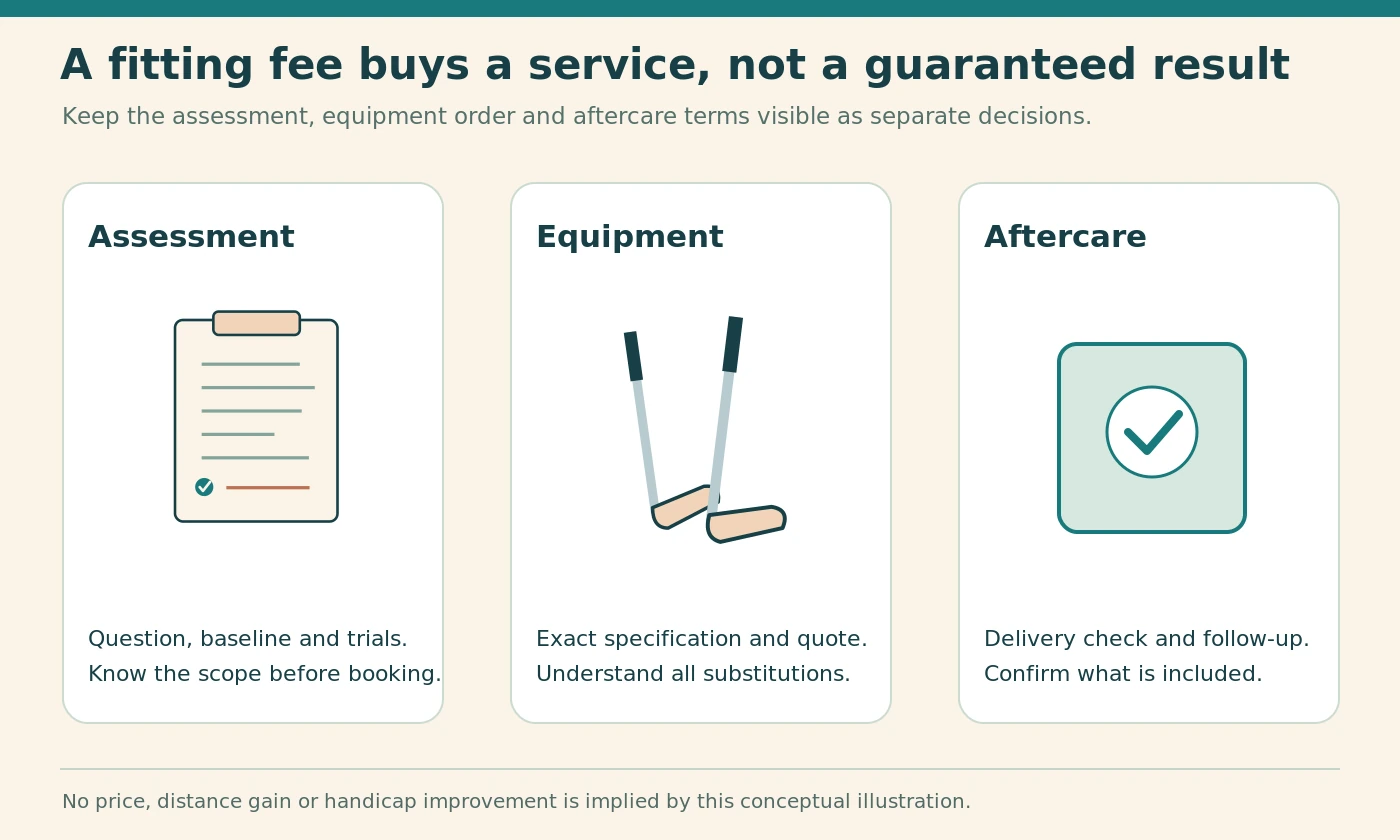
Original conceptual illustration; not a product-test photograph.
Golf club fitting fees make sense only when you know what the appointment includes. A free session, a paid consultation and a fee credited against a purchase can all lead to useful information, but they are not automatically the same service. Compare the scope, evidence and written outcome before comparing the amount on the booking screen.
The most valuable result may be a specification for a new club, a reason to keep an existing one or a clear explanation that another change should come first. A session should not be judged solely by whether you leave with an order. You are trying to resolve a practical equipment question, not earn permission to buy the most expensive option.
This guide uses dated examples from published UK fitting services and an original booking checklist. It does not claim first-hand visits to those studios or guarantee better scores, distance or injury relief. Prices illustrate different charging structures; they are not a national average or a ranking of fitters.
A defined question
Match the category, facility and demo options to your need.
Your current club
A baseline makes the proposed change more meaningful.
An explained specification
Know what was tested, recommended and left uncertain.
A complete total
Separate fitting, equipment, upgrades and credit conditions.
Golf club fitting fees: buy a defined service
Start with the question you need answered
Write down the decision before searching for an appointment. You might want to know whether your current driver deserves replacing, whether an iron set has suitable gaps or whether a particular grip and shaft combination is worth investigating. A clear question helps the fitter explain the appropriate scope.
Avoid beginning with a vague request to be fitted for everything when only one part of the bag concerns you. Conversely, do not book a narrowly defined driver session and expect a full iron, wedge and putter assessment to be included without agreement.
Separate assessment, specification and purchase
A fitting can involve discussion, measurements, trials, analysis and a recommendation. Ordering or building the clubs is another part of the transaction, even when the same business supplies both. Ask what you receive if you choose not to buy equipment that day.
That question is not confrontational. It establishes whether you are paying for an independent usable outcome, accessing a retail service or entering a purchase-linked arrangement. Each can be legitimate, provided the terms and expectations are clear before the appointment.
Understand the three common charging structures
Free and standalone paid appointments
A free retail appointment has no stated fitting charge under the advertised arrangement, but you should still check what is included at the selected location. A standalone paid session places an explicit price on the fitting service. Neither description, on its own, proves how thorough the session will be.
Compare the available clubs, appointment length, fitter interaction and written outcome. A charge is not a quality certificate, and a free service is not automatically inadequate. The useful comparison is what each provider can do for your specific question.
Purchase-linked credit or waiver
Some providers waive or credit fitting fees when you buy qualifying equipment. Ask whether this applies to every purchase, only certain categories or a minimum spend. Confirm the deadline and whether the benefit covers the whole fee or only part of it.
A credit should not push you into equipment you would otherwise reject. Consider the total transaction and the value of retaining the option not to buy. Treat an unclear redemption rule as a question to resolve, not an assumed discount in your budget.
Use current published examples carefully
Free retail fitting and timed paid sessions
American Golf advertises free in-store custom fitting. Its page also advises checking the particular store for the technology available. This example was checked on 4 October 2026; confirm the selected location, appointment category and current terms before booking. [1]
Tour X's published prices, checked on 4 October 2026, include a driver fitting at £80 for 75 minutes and an iron fitting at £80 for 75 minutes. Its full-bag service is listed at £250 for three 90-minute sessions, excluding the putter. These are provider-specific examples, not standard industry durations. [2]
A published purchase-linked arrangement
SGGT's pricing page says fitting fees are waived when purchasing new clubs. It also describes an explained specification, component-level quote and emailed Trackman reports. The page was checked on 4 October 2026; request the current booking fee and exact waiver conditions directly rather than assuming an amount not stated there. [3]
The point of these examples is their different structure. A free appointment, a single-category paid session and several full-bag sessions are not interchangeable products. Use them to improve your questions rather than to declare the smallest advertised number the best value.
Published UK service examples checked 4 October 2026, not an industry average or ranking. Reconfirm the current fee and terms before booking.
| Provider / service | Published charge or structure | Scope to confirm |
|---|---|---|
| American Golf [1] | Free in-store custom fitting advertised | Selected category, local facilities and written outputs. |
| Tour X driver or iron fitting [2] | £80 for 75 minutes per category | The exact booked category and what you receive afterwards. |
| Tour X full bag [2] | £250 for three 90-minute sessions | Putter excluded; confirm sequence and booking terms. |
| SGGT [3] | Fees waived when buying new clubs | Ask for the current fee and exact qualifying-purchase conditions. |
Ask what full bag actually covers
Count the categories, not the phrase
Ask whether a full-bag appointment includes the driver, fairway woods, hybrids, irons, wedges and putter. Also ask whether each category receives its own assessment or whether some are reviewed briefly alongside another. A broad title can conceal important exclusions.
Tour X's published full-bag example explicitly excludes the putter, which illustrates the value of reading the detail. Do not assume that another provider uses the same definition. Confirm the exact scope on the booking record for the service you choose. [2]
Consider whether to split the work
Several focused appointments may suit a golfer who would struggle to make representative swings through one long session. Another player may prefer a broader review before deciding which categories need attention. Discuss the sequence with the fitter rather than choosing only by total minutes.
Ask whether a later session can build on the earlier findings and whether the overall price changes. A split arrangement should be explicit, especially when a purchase credit or package fee depends on completing a particular booking structure.
Check the available equipment before travelling
Confirm relevant stock, not just the number of brands
Tell the provider whether you play right- or left-handed and describe any unusual length, grip or shaft requirements you already know about. Ask whether suitable trial equipment will actually be available for the booked category and date.
A large brand list does not establish that every head, loft, shaft weight or grip can be tried in your configuration. A narrow but relevant selection can be more useful than a broad display that lacks the options you need. The fitter should be able to explain the practical limits.
Distinguish single-brand and multi-brand services
A manufacturer-led fitting can explore options within that brand, while a multi-brand service may compare several manufacturers. Decide which question you want answered. Neither should be presented as a comparison it did not perform.
Ask about the intended selection before booking. If you already want to assess a particular brand, a focused session may suit you. If you want a broad comparison, establish which alternatives are available rather than assuming independence from the word custom.
Bring a meaningful baseline
Your current clubs are part of the evidence
Titleist's fitting guidance asks golfers to bring their current set and explains that existing clubs help establish baseline data. That is a useful preparation principle: a new option should be compared with what you actually use, not just with another new option selected in the studio. [4]
Tell the fitter about any adjustments, repairs or uncertain specifications. A club bought second-hand may not match the original catalogue description. You do not need to diagnose it yourself; simply distinguish what you know from what you have assumed.
Describe the problem without prescribing the answer
Useful observations include difficulty judging a gap, discomfort with a grip shape or a pattern you repeatedly notice. Less useful is insisting that a particular shaft label must be the solution before the assessment begins. Give the fitter room to investigate.
Also describe your normal course use and priorities. A golfer who values predictable carry into greens may make a different trade-off from one focused on a specific tee-shot option. These preferences should guide the discussion without becoming promises of a particular result.
Allow for warm-up, conversation and breaks
Appointment length is not continuous hitting time
A worthwhile session needs time for discussion, setup, explanation and decisions as well as shots. Do not assume that a 75-minute appointment means 75 minutes of uninterrupted hitting. Ask how the provider normally structures the time.
Titleist describes approximately 30-60 minutes per club category as general guidance and encourages pacing and breaks during longer fittings. That is its published guidance, not a universal minimum that every useful service must match. [4]
Protect the quality of the comparison
Arrive with enough time to avoid rushing, following the provider's instructions about warming up. Tell the fitter if you become tired, uncomfortable or unable to reproduce your ordinary movement. Continuing solely because time remains may not improve the information gathered.
Ask before booking how an interrupted or unproductive session is handled. Is there a shorter follow-up, a rescheduling option or a separate charge? There is no single policy across providers, so clarify it while you still have a choice about the appointment.
Expect an interview and an appropriate starting specification
Measurements are a starting point
PING describes using static information such as height, wrist-to-floor and hand size in its fitting process, then refining recommendations through shots and feedback. The distinction matters: a measurement-based starting point is not necessarily the complete assessment. [5]
You do not need to demand a particular test from an internet checklist. Instead, ask how the fitter will use your measurements, current equipment and observed results to investigate the question you booked. The explanation should be understandable without specialist vocabulary.
Feedback belongs in the process
Report how the club feels and whether an option is practical for you, but separate preference from measurement. You can dislike a look or feel even if a particular number improves. A useful discussion acknowledges both rather than pretending that a screen can make every decision.
Likewise, a familiar feel does not automatically prove that nothing should change. The session should help you weigh the evidence and your preferences together. Ask the fitter to explain the trade-off when those point in different directions.
Ask how the ball and hitting environment are controlled
Identify the ball used
Find out which ball will be used and whether it is comparable with the ball you normally play. If the session uses a different type, ask how that affects the interpretation and whether a later confirmation is appropriate. Do not silently compare unlike conditions.
You do not need to arrive with a technical theory about every ball characteristic. The useful question is how the provider keeps the comparison fair and explains any limitations. Record the ball model in the report so the result remains understandable afterwards.
Understand mats, turf and indoor space
Ask whether the fitting is indoors, outdoors, from a mat or from turf, and why that setup suits the booked category. An indoor session and an outdoor session offer different observations; neither label alone establishes the quality of the whole service.
For a wedge or fairway-wood question involving turf interaction, explain that priority before booking. A provider may offer a separate suitable area or recommend a different session. It is better to discover a scope limitation beforehand than to expect a facility to provide something it never advertised.
Know what the launch-monitor display represents
Measured and adjusted data need labels
Ask which figures are measured, calculated or adjusted under the system's settings. Trackman's explanation of Normalization describes standardising trajectory information to selected conditions, rather than simply repeating the observed shot in whatever conditions occurred. That distinction should be clear when a report uses normalised values. [6]
This is not a reason to distrust calculated information. It is a reason to know what comparison is being made. A result is easier to interpret when the settings, ball and environment are documented rather than left implicit.
Do not compare carry with total distance
Trackman's parameter definitions distinguish carry-related distance from total distance. Ask which measure the fitter is discussing and what any roll assumptions mean for the question you are trying to answer. A larger total-distance number should not quietly replace a carry comparison. [7]
Similarly, make sure the units are clear and consistent. You should leave able to explain the principal finding in ordinary language, not merely remember that one coloured bar was longer than another. Interpretation is part of what makes the session useful.
Look for representative shots rather than a highlight reel
Agree how unusual shots are handled
Ask how the fitter treats obvious misreads, interrupted swings and ordinary mishits. There can be legitimate reasons to exclude an invalid measurement, but deleting every disappointing result creates a different comparison from examining the shots you typically produce.
The aim is not to impose one universal sample size. It is to understand what the displayed summary includes. A transparent explanation of excluded shots is more useful than an impressive average whose underlying selection is unclear.
Return to the baseline where useful
A proposed comparison method is to revisit the current club after trying candidates, especially if your movement has changed as you warmed up. This can help you discuss whether the apparent difference belongs to the equipment, the order of testing or an increasingly comfortable session.
The fitter should manage the practical sequence. Do not turn the appointment into a rigid experiment that ignores fatigue or the original question. Instead, ask for enough repeated comparison to make the recommendation credible, with uncertainty acknowledged when the differences remain unclear.
Define the result before chasing the biggest number
Choose a small set of priorities
Before testing, agree what would count as a useful change. It might be a more suitable flight, a clearer distance gap, a comfortable specification or a more manageable pattern of misses. Not every category should be reduced to maximum distance.
Keep the priorities realistic and connected to actual use. A club that produces one exceptional shot may still be a poor choice if the ordinary result is less suitable. The session should show why the selected option addresses the problem you brought.
Consider trade-offs explicitly
Ask what you give up as well as what you gain. A change that improves one measured outcome may alter another or require a different set composition. A good explanation does not need to make every candidate look perfect.
When the evidence is close, acknowledge it. The recommendation might reasonably depend on price, feel, availability or keeping the current equipment. Small uncertain differences should not automatically become a dramatic purchasing claim.
Insist on an identifiable build specification
A shaft label alone is not enough
A useful written specification should identify the exact clubhead and relevant loft or setting, shaft model and version, length and grip details. Where lie, weighting or other build choices matter, ask for those to be stated in the provider's normal specification format.
Do not accept an ambiguous description such as a regular shaft if several different products could fit it. The purpose is to know what was recommended and what will be ordered. You are not asking for proprietary expertise to be reduced to a slogan.
Connect the trial club to the final order
Ask whether the delivered club will match the trial configuration and what differences, if any, should be expected. A fitting connector, available demo length or temporary grip arrangement may need explanation. Do not assume every detail transfers automatically.
Have any deliberate substitution written down before payment. If the quoted shaft or grip changes because of stock, ask whether the new combination still reflects the fitting recommendation or needs confirmation. A specification is useful only when it remains connected to the equipment supplied.
Request a report you can understand later
Define the take-away before booking
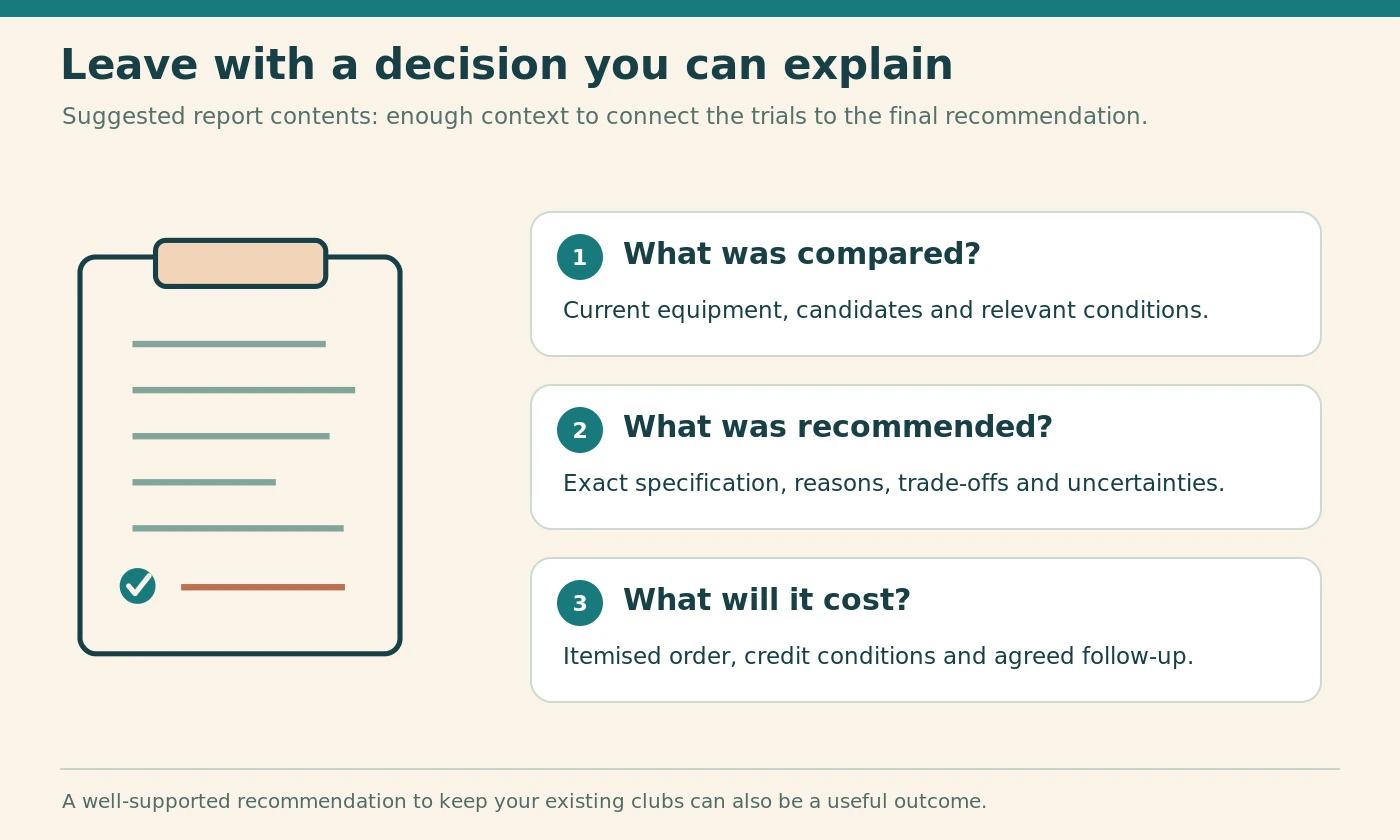
Ask whether you receive a written specification, a session summary, relevant data and an itemised quotation. SGGT explicitly describes several of these outputs on its pricing page, showing that report contents can be stated before a visit rather than left to chance. [3]
Other providers may use different formats. A plain, well-explained summary can be more helpful than an enormous unlabelled data export. The important point is that you understand what was compared, what was recommended and why.
Keep context with the numbers
The report should make sense after the conversation has faded. Ask for the date, category, ball or relevant conditions, candidate identities and final specification to be clear. Note any question the session did not resolve.
Confirm how and when the report will be sent and whether access depends on an account or temporary link. Save a copy for your own records once received. Do not assume that a screen shown briefly during the appointment will remain accessible indefinitely.
Get a complete price for the recommended equipment
Separate every charge that affects the decision
Ask for the fitting fee, equipment price, component upgrades, build work and delivery to be clearly identified where they apply. Confirm whether the quoted total includes VAT and any other relevant charges rather than making assumptions from a headline price.
A component-level quote helps you understand what drives the difference between options. It also lets you ask whether a lower-cost alternative was actually tested or merely listed as a theoretical possibility. Price transparency should support the evidence, not replace it.
Compare stock and upgraded options fairly
A premium shaft or grip should have an understandable reason for being recommended. Ask what happened when a suitable lower-cost option was considered, and whether the difference was convincing for your priorities. An expensive component is not automatically a necessary one.
Equally, do not reject an upgrade solely because it costs more if the evidence and your budget support it. The useful decision combines performance relevance, comfort, total cost and uncertainty. It should not be driven by prestige or by a reflex to choose the cheapest specification.
Read purchase-credit conditions before relying on them
Ask about scope and timing
Confirm which purchases qualify, how long you have to order and whether a deposit changes the arrangement. Ask what happens when equipment is unavailable or when you choose a different category from the one fitted. Keep the response with the booking confirmation.
Also clarify whether the fee is waived immediately, refunded later or credited against the final bill. Those mechanisms can affect cash flow and the apparent total. Do not count the same credit twice when comparing quotations.
Compare the total with and without buying
Make two simple scenarios: attend and buy nothing, or attend and purchase the recommended equipment. Use confirmed figures in each. This reveals the actual cost of preserving the option not to buy and prevents a nominally free fitting from dominating the whole decision.
For example, a clearly stated standalone fee can be acceptable if you value an assessment without a purchase commitment. A purchase-linked offer can also suit you when the equipment is appropriate and the complete price is competitive. Neither structure decides the answer in isolation.
Check cancellation, follow-up and aftercare
Booking terms are part of the service
Before paying, read the provider's current cancellation, rescheduling and late-arrival terms. Ask what happens if the relevant trial equipment is unavailable or the session cannot be completed as planned. Do not assume another studio's policy applies.
Where a deposit is required, confirm whether it is part of the stated fee or an additional payment. Keep the booking category and duration visible on the confirmation. A short written record is easier to resolve than a later disagreement about a verbal description.
Understand the post-delivery check
Ask whether there is a specification check, collection fitting or follow-up after the clubs arrive. Find out what concerns the provider will assess and whether any appointment is included or charged separately. Do not interpret the word aftercare as an unlimited guarantee.
If the delivered club appears different from the order, raise that specific issue promptly with the supplier. Keep the quotation and specification available. A build discrepancy and dissatisfaction with on-course results are different questions and may need different evidence.
Make room for beginners and less typical requirements
Describe needs before booking
A beginner can ask for a straightforward assessment without requesting an elaborate optimisation exercise. Someone with limited stamina, restricted comfortable movement or a requirement for accessible facilities should describe those needs when booking. The provider can then explain whether the session is suitable.
Avoid self-prescribing a club modification as treatment for pain or a health condition. Fitting is not medical diagnosis. If a movement hurts, stop and seek appropriate advice rather than trying to complete the appointment at any cost.
Ask about women, juniors and left-handed options
Do not infer inventory from marketing photographs. Confirm that the relevant heads, lengths, grips and shaft options are available for the person being fitted. A service designed around a standard demo selection may need advance preparation.
For a junior, discuss present fit, expected use and the provider's approach to future review without assuming oversized clubs are the correct answer. For any golfer whose requirements fall outside common stock, a clear advance conversation can be worth more than a long appointment with unsuitable equipment.
Distinguish fitting from coaching and repair work
Clarify the boundary of the appointment
A fitter may identify that a technique discussion would be useful, but a fitting appointment is not automatically a lesson. Ask whether coaching is included, separate or outside the service. That avoids paying for one type of help while expecting another.
Similarly, checking a specification does not necessarily include changing grips, bending clubs or rebuilding shafts. Agree any workshop work and its price before it begins. This guide does not provide a do-it-yourself procedure for modifying equipment.
Coordinate significant planned changes
Tell the fitter when you are already working with a coach on a substantial change. The sensible timing of a purchase may depend on that context. Do not hide it because you worry the fitter will recommend waiting.
An honest recommendation to postpone, simplify the assessment or retain an existing club can be a useful outcome. The fee should buy an informed service, not a predetermined answer that every golfer needs a new set immediately.
Recognise a useful keep-your-clubs result
No purchase can still answer the question
If the current club performs suitably for the agreed priorities and the alternatives do not offer a convincing improvement, keeping it may be the sensible recommendation. Ask the fitter to explain that result and record any remaining limitations.
A session that prevents an unnecessary purchase can have value even without a dramatic new specification. However, the reasoning should still be clear. Simply saying everything looks fine after little investigation is not the same as a documented comparison.
Separate small changes from replacement
The discussion may identify maintenance, a grip change or another limited adjustment worth assessing before replacement. Ask what evidence supports that suggestion and what further work would be required. Do not assume the fitting fee includes the implementation.
Where the answer remains uncertain, a staged decision can be reasonable. You might address one clear issue and review it before committing to a larger order. The timetable should reflect your needs and the provider's actual terms, not artificial urgency.
Compare two quotations without losing the detail
Build a like-for-like service comparison
Write down category coverage, time structure, relevant demo inventory, baseline method, report contents, fee and credit conditions. Add travel and any confirmed follow-up costs separately. Leave an unknown field blank or marked for clarification rather than inventing an average.
The cheapest headline appointment may cover less, while the most expensive may include services you do not need. A clear comparison shows those differences without pretending that every studio offers the same product at a different price.
Keep equipment and assessment comparisons separate
Then compare the recommended equipment quotations using exact specifications. Similar clubhead names can hide different shafts, grips, set composition or build services. A price difference is meaningful only after those differences are understood.
Do not turn the fitting report into a shopping list stripped of the context that produced it. If another supplier proposes substitutions, ask the original fitter or a suitably qualified alternative to explain whether the recommendation still applies. A cheaper but different build is a different offer.
Use a worked booking decision without invented market averages
A single-category question
Imagine you only need to assess whether your driver should be replaced. Start by asking providers what their driver session includes, whether your present club will be tested and what you receive afterwards. Compare that scope before considering a full-bag package.
The published Tour X driver example is £80 for 75 minutes, checked on 4 October 2026. It illustrates a clearly specified category and duration; it does not prove that it is the right provider for this hypothetical golfer or that a different session would be poor value. [2]
A broader but staged question
Now imagine you are uncertain about several categories and cannot comfortably hit for a long continuous period. Ask about a staged review, what each visit covers and how findings carry forward. A multi-session structure may be relevant, but only if its contents match the questions you need answered.
These scenarios deliberately avoid invented savings or score improvements. The decision is about a service you can understand and afford. Any claimed equipment benefit still needs evidence from your own fitting rather than from the arithmetic of a booking package.
A practical list of questions to send before booking
Define the assessment
Send a brief message describing your current clubs, the category and the problem. Ask which equipment can be tried, whether the present club will form a baseline, how long the appointment lasts and what limitations the facility has for the intended assessment.
Mention relevant handedness, length, grip or accessibility requirements. Include your equipment budget so the provider can explain whether suitable options are available within it. A budget is useful information, not a reason to be embarrassed or a challenge to spend every pound.
Define the outcome and terms
Ask for the current fee, purchase-credit conditions, report contents and any follow-up arrangement. Confirm that you can choose not to purchase and what the fitting then costs. Request the cancellation terms before making a payment.
A provider does not need to promise the final specification before meeting you. It should, however, be able to describe the service being sold. If the answers remain vague, resolve that uncertainty before booking rather than hoping it disappears at the studio.
Read a sample comparison without mistaking it for proof
A fictional result with an obvious unanswered question
Imagine a session summary in which the current club has six recorded shots and a candidate has only two. The candidate's best result is longer, but the summary does not show the other outcomes or explain the different sample sizes. These invented details illustrate a reporting question, not an actual fitting result.
Ask how the fitter reached the recommendation from that evidence. There may be a sensible explanation, such as a clearly unsuitable initial option or a limited trial, but the displayed best shot alone does not establish a dependable advantage. Request the relevant context before treating the picture as a purchasing instruction.
Use the report to guide a conversation
Now imagine that two candidates have similar central results but different patterns of misses. The useful discussion concerns which pattern better serves the agreed purpose, how representative the attempts were and whether another comparison would change the decision. No universal percentage improvement follows from this hypothetical example.
A reader should be able to follow that reasoning without being told that a tiny numerical difference is automatically meaningful. Ask what remains uncertain and what would count as sufficient evidence to keep the current club. A report becomes useful when it makes the decision clearer, not when it creates a false sense of certainty.
Put a spending boundary around the session
Separate the assessment budget from the equipment budget
Before booking, decide what you are comfortable spending on advice and what you could spend on equipment if the evidence supports a change. State those as two separate limits. This makes it easier to consider a paid assessment without assuming that every recommendation must lead to an immediate order.
Include practical costs such as travel only when you know them, and avoid filling a budget with invented averages. The relevant total is yours. A nearby focused session may be preferable to a longer trip for facilities that do not address a different question for you.
Decide what would justify exceeding the initial plan
You do not need to promise an inflexible purchase amount, but decide how you will handle a recommendation above it. Ask for a suitable lower-cost comparison and take time to consider the evidence. Do not assume that a credit deadline is a reason to remove your own spending boundary.
An unaffordable recommendation can still contain useful information, such as a preferred specification or a reason not to buy a particular alternative. Ask whether there is an appropriate staged approach. The fitting should leave you better informed, not obliged to make a financial commitment that does not suit you.
Check the delivered set against the agreed order
Keep the paperwork together
When equipment arrives, compare the order, invoice and written specification before treating the transaction as finished. Confirm the visible model, set composition, shaft and grip identities and any documented settings. Ask the supplier to verify measurements that need appropriate equipment rather than attempting technical adjustments yourself.
Photograph any obvious discrepancy and contact the supplier promptly through its normal process. Do not change the build first and then ask why it differs. Keeping the original condition and documents clear makes the factual question easier to resolve.
Arrange a sensible confirmation when included
If the provider includes a follow-up, ask what it is intended to check and bring the original report. A delivered-specification check, a short familiarisation session and a complete refitting are different services. Agree which one is being offered rather than expecting an unlimited repeat of the original appointment.
Describe concerns specifically: a different grip model, an unfamiliar setting or a result that raises a question under comparable conditions. Avoid presenting one disappointing round as proof that the entire fitting was wrong. Equally, do not ignore an identifiable build mismatch merely because the clubs were custom ordered.
Pros and cons of paying for a fitting
Potential value
A well-defined fitting can organise an equipment decision around evidence, relevant alternatives and a documented specification. It can expose assumptions about your existing clubs and help you understand why a proposed change is or is not worthwhile.
A paid session may be attractive when you want a usable assessment without committing to a purchase. That benefit depends on the actual terms and output, not simply the existence of a fee. Confirm what you will take away and how it answers your question.
Limits and costs
A fitting is a sample of your performance in particular conditions, not a guarantee about every future round. Equipment changes also cannot promise to solve every technical, tactical or physical difficulty. Be cautious when a sales claim goes beyond the evidence gathered.
You also spend time, travel and possibly a fee even when the result is to keep your clubs. That can still be worthwhile, but it should be a deliberate choice. A narrower session or a postponed purchase may be more appropriate than the largest package available.
Common mistakes to avoid
Judging only the headline price
Do not compare a free single-category appointment with a paid multi-session assessment as though their labels describe identical work. Check exclusions, written outputs and purchase conditions. Equally, do not assume an expensive appointment must offer an independent recommendation.
Another mistake is forgetting the current clubs or failing to mention an unusual requirement until arrival. Those omissions can weaken the comparison or leave unsuitable trial equipment. The booking conversation is part of getting value from the session.
Accepting an impressive but unusable result
Avoid leaving with only a best-shot number and a verbal description of a shaft. Ask for the complete specification, relevant comparison and itemised quote. If you do not understand why a particular option was selected, request an explanation before ordering.
Finally, do not let a purchase credit create urgency that overrides discomfort, uncertain evidence or an unaffordable total. A fitting should improve a decision, not make it harder to say no. Keeping the existing club remains a legitimate option throughout the process.
Frequently asked questions
How much should a golf club fitting cost in the UK?
There is no single price that describes every service. The examples checked on 4 October 2026 include free retail fitting, category-specific paid sessions and purchase-linked fee waivers. Compare your chosen provider's current scope and terms. Do not treat those examples as a statistical market range or assume the fee includes new equipment. [1] [2] [3]
Is a free fitting less useful than a paid one?
Not automatically. Look at the available equipment, baseline comparison, explanation and written outcome. A paid session can be poorly matched to your needs, while a free service can answer a focused question well. Understand the commercial arrangement and assess the actual process rather than making the fee itself a quality score.
Should the fitting fee be refunded when I buy clubs?
Only when the provider's terms say so. Ask about qualifying purchases, deadlines, minimum spending and the mechanism used for a waiver or credit. Keep the answer in writing. A standalone fee is not inherently unreasonable, but it should not be presented to you as refundable unless that has been agreed.
What should I receive at the end?
For an equipment recommendation, ask for an identifiable specification, an explanation of the relevant comparison and a complete quote where a purchase is proposed. Agree report contents before booking. The format can vary, but you should understand what was recommended, what remains uncertain and whether any follow-up is required.
Can the fitter recommend keeping my current clubs?
Yes, that can be a useful outcome when the assessment supports it. Ask why the current equipment remains suitable and whether any limited maintenance or further investigation is suggested. The session should resolve your equipment question, not guarantee a sale or force an upgrade where the comparison is unconvincing.
Do I need to fit the whole bag at once?
No single schedule suits everyone. Discuss priorities, stamina and the relationship between categories. A focused appointment can answer a specific replacement question, while a wider review may help with set composition. Confirm exclusions and the structure of any staged service before comparing its price with a shorter appointment.
Does a fitting guarantee more distance or a lower handicap?
No guarantee follows from attending a fitting or buying its recommendation. Judge the evidence gathered for your agreed priorities and recognise the limits of a session. Be particularly cautious about promises that extend beyond equipment suitability, such as injury relief or assured scoring improvement.
What happens if I am having an unusually poor session?
Tell the fitter rather than trying to hide it by swinging harder or rushing. Discuss whether the observations remain useful and what the booking terms allow if the assessment cannot be completed meaningfully. Clarify rescheduling and follow-up policies beforehand; do not assume every provider offers the same response.
Final recommendation
Pay for a fitting only after you can describe the service, the question it will address and the information you will receive. Compare scope before price, bring a meaningful baseline and ask how the trials lead to the recommended specification. Keep the assessment and the equipment order clear as separate decisions.
The best-value session is the one that supports a sensible choice within your budget, including the choice to keep your current clubs. A transparent fee, a credible comparison, an understandable report and clear aftercare terms are more useful than a dramatic promise or a headline discount that cannot be separated from the purchase.
Sources and fact-checking notes
Editorial review: 4 October 2026. Named product and service details come from the official sources below. The practical checking routines and hypothetical examples are editorial guidance, not reported hands-on tests. Specifications, availability and terms can change; confirm the exact model or booking before acting.
- American Golf – custom fittingFree in-store fitting advertised; check the selected location's facilities and booking scope. Price status checked 4 October 2026.
- Tour X Golf – pricesDriver and iron fitting: £80 / 75 minutes each. Full bag: £250 / three 90-minute sessions, excluding putter. Checked 4 October 2026.
- SGGT – custom fitting pricingPublished purchase-linked fee waiver, explained specifications, component quote and emailed reports. Confirm actual fee and waiver conditions. Checked 4 October 2026.
- Titleist UK – fitting guidanceCurrent-club baseline, preparation and general category-duration guidance; not a universal session standard.
- PING Europe – fitting processStatic starting information, trial shots and golfer feedback.
- Trackman – Normalization explainedDistinguishes standardised conditions from observed shot conditions; no accuracy ranking is inferred.
- Trackman – data parameter definitionsCarry and total-distance definitions; context and settings must accompany a comparison.
Illustrations in this article were created for Taylor’s Trailblazing Golf Gear. Third-party photographs, where used, are credited beside the image or in the source list.