
High-MOI vs Low-Spin Drivers: Which Trade-Off Matters More?
Compare the flight you can repeat, the misses you can afford and the launch conditions you need.
- Forgiveness explained
- Spin in context
- A practical comparison sheet
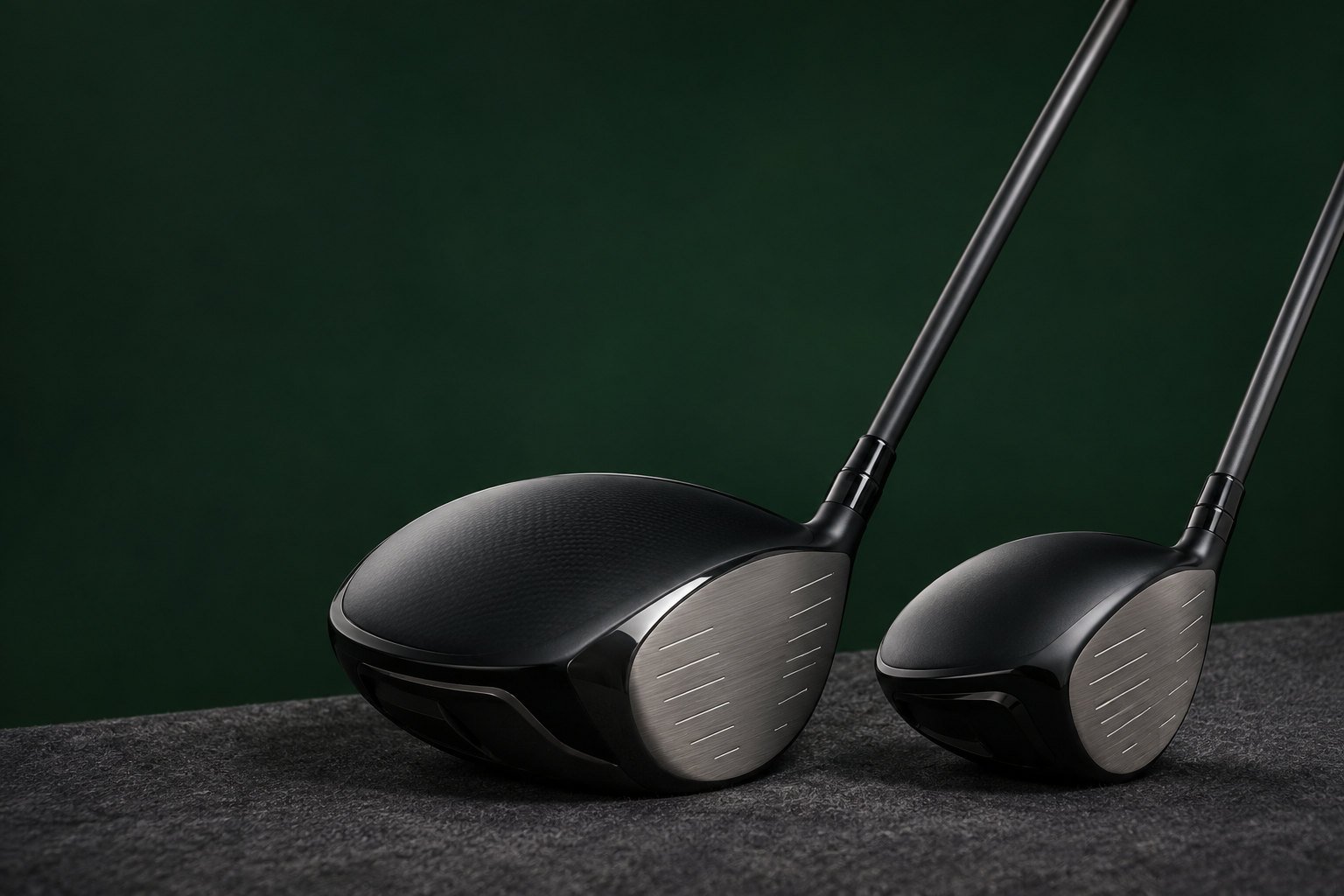
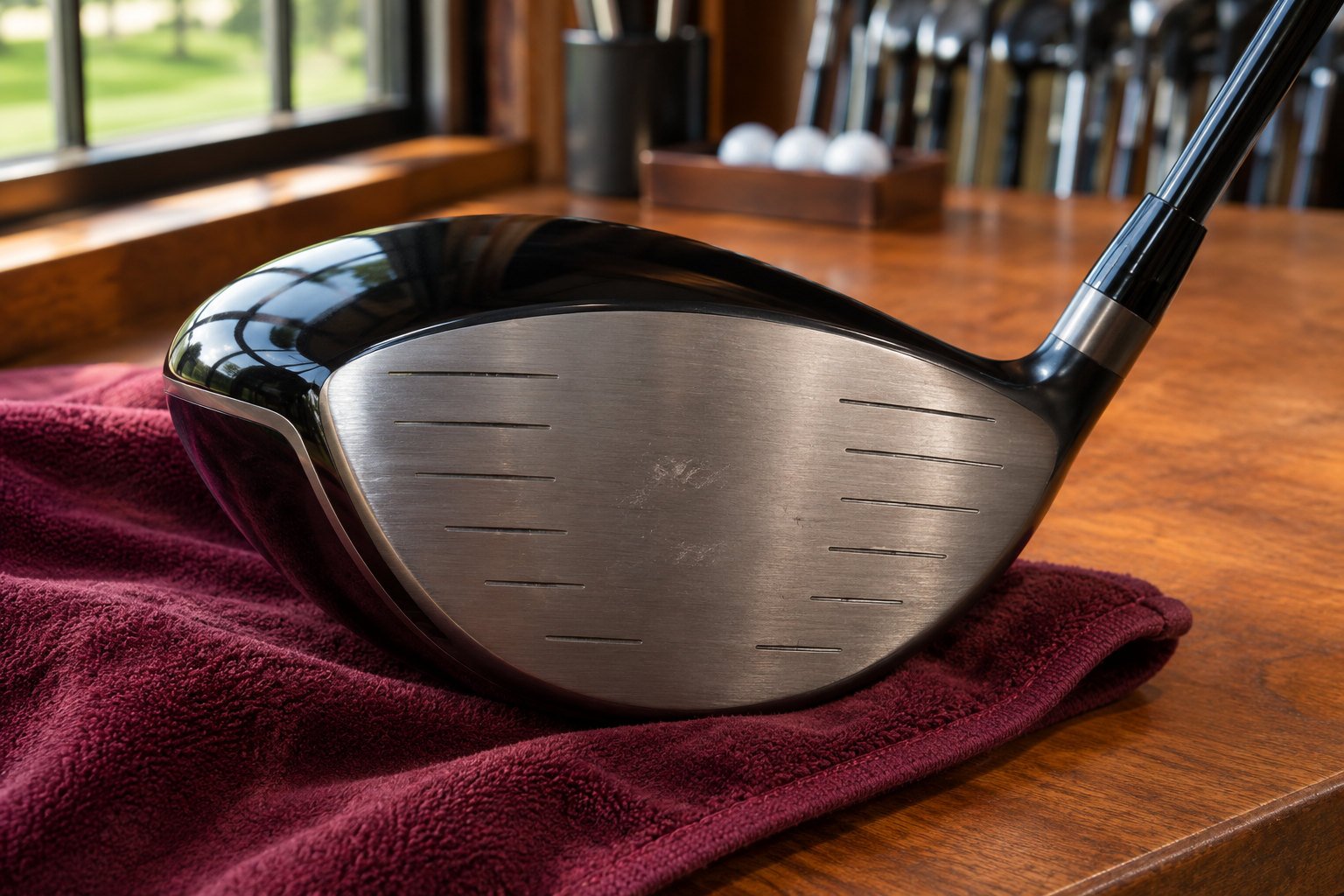
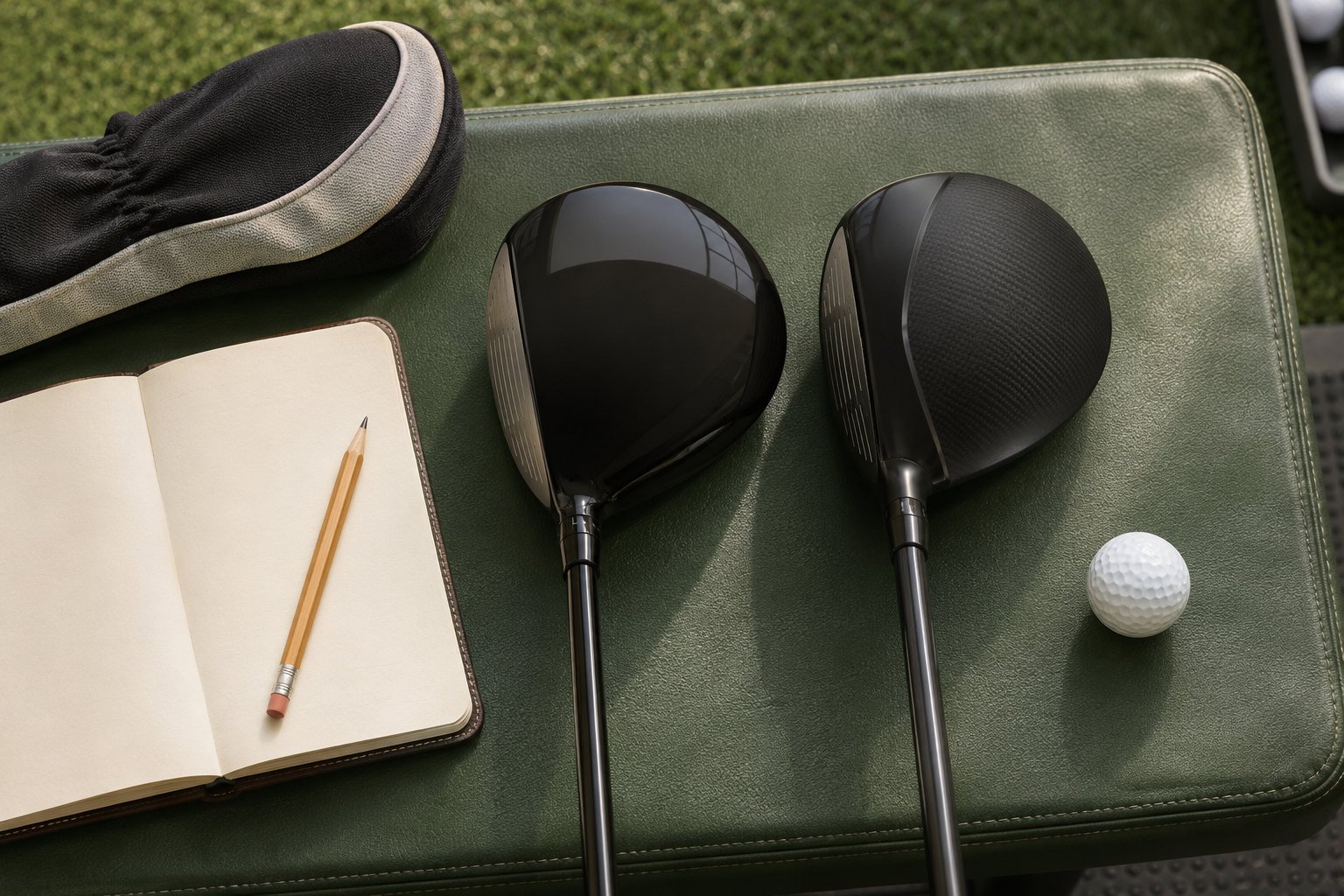
AI-generated illustrations show generic golf equipment and settings. They are not photographs of the named products or records of product testing.
When a driver produces one wonderful shot and several expensive misses, its best number can make the wrong club look convincing. High-MOI vs low-spin drivers is a choice about which problem most needs solving: unstable results across the face, unsuitable launch and spin, or both.
Start with your ordinary strike pattern and the job the driver must do on your course. Then compare complete builds. This research-led guide explains the design claims and supplies a practical method for judging them; it does not present personal testing or a ranking of the models mentioned.
Treat MOI as one feature
Resistance to twisting contributes to forgiveness, but the face, centre of gravity and your delivery also matter.
Optimise spin
The lowest reading is not automatically the best flight for your speed and launch.
Keep ordinary misses
A comparison that deletes the strikes you make on the course cannot answer your buying question.
Separate carry and roll
Check whether the apparent gain depends on a modelled bounce or on useful distance through the air.
High-MOI vs low-spin drivers: two different labels
MOI, or moment of inertia, describes resistance to rotation. In a driver head, greater resistance to twisting during an off-centre collision contributes to forgiveness. It works alongside the face design and centre-of-gravity position; it is not a complete measurement of how far or straight you will hit a club. [1]
Low-spin describes a performance intention. Its value depends on the launch conditions you produce. Trackman recommends fitting launch and spin together in the context of club and ball speed, rather than choosing either number in isolation. [2]
| What is costing you? | Priority to investigate | Evidence to seek |
|---|---|---|
| Ordinary heel/toe misses lose useful carry or finish badly | Stability and performance across your impact pattern | Carry and directional spread for all comparable shots, with impact locations |
| Repeatable contact still produces an inefficient flight | Launch, spin and speed together | A fitting comparison that explains why spin reduction helps this flight |
| Low shots struggle to carry hazards | Enough launch and carry before chasing a lower spin reading | Reliable airborne distance, including ordinary imperfect strikes |
| Large misses appear on both sides | The complete build and delivery pattern | What changes between misses; a more forgiving label alone cannot settle the cause |
Scroll within the table to see all columns.
This is an editorial order of investigation, not a handicap-based prescription. A fast swing does not by itself prove you need the lowest-spin head. Nor does a higher handicap prove that every low-spin model is unsuitable.
Know what an MOI number actually describes
Mass placed farther from an axis of rotation increases resistance to twisting about that axis. A clubhead has more than one relevant axis, which is why you may encounter both individual and combined MOI figures. Compare like with like before treating a larger number as a larger improvement. [1]
PING’s G430 MAX 10K name, for example, refers to a combined MOI above 10,000 g·cm². That is the manufacturer’s stated combined value, not a single-axis number and not a measured benefit for your swing. PING also describes the model as designed to launch higher with less spin, illustrating that stability and spin reduction can coexist. [3]
High MOI cannot aim the face for you. It concerns resistance to rotation, while starting direction depends strongly on the face delivered at impact. A very stable collision can still launch a ball away from the target. [1][4]
The useful fitting question is therefore quite specific: when you miss your usual contact point, does this complete driver leave you a better next shot? Compare both lost carry and direction. A head that protects distance on a mishit may still be unsuitable if you cannot deliver it consistently.
Be cautious with descriptions such as “maximum forgiveness”. They can refer to a manufacturer’s own range and chosen design priorities. They are not a universal leaderboard covering every golfer and competing model.
Check the spin problem before buying its proposed cure
Spin rate is how quickly the ball rotates after impact. It helps shape the flight, and driver spin must supply useful lift without becoming excessive for the launch and speed. There is no single target that suits every golfer and condition. [5]
Spin loft helps explain the delivery. It is the three-dimensional angle between the head’s movement and face orientation at impact; dynamic loft minus attack angle is a useful approximation, rather than the full definition. With other factors held constant, greater spin loft tends to increase spin. [6]
Impact height also matters. Trackman specifically identifies vertical gear effect as an important influence on driver spin and recommends interpreting contact point alongside launch and spin. A high reading from a low-face strike does not, on its own, prove the head’s design is unsuitable. [7]
Ask the fitter to compare like-for-like contact as well as the whole shot pattern. If the “low-spin winner” was struck higher on the face, you need to know whether the improvement follows the head, the strike, or both. Keep your ordinary poor contacts in a separate view rather than erasing them.
Equally, avoid judging a club by the impressive flight of a single low-spin strike. Check its carry, landing pattern and repeatability. A number becomes useful when it explains the shot and the decision, not when it happens to be lower.
Use ball speed rather than swing speed alone when discussing the resulting flight. The relevant launch-and-spin balance is connected to the speed of the ball leaving the club, and that relationship belongs in the fitting conversation. [2]
Read the actual design, not just the model suffix
The examples below show why a strict “forgiving or low-spin” split is too simple. They are documented design approaches, not a cross-brand performance test. Names and manufacturer descriptions were checked on 21 November 2026; confirm the exact model and build before ordering.
| Exact model | Manufacturer’s design description | What remains to test |
|---|---|---|
| PING G440 K | PING emphasises high MOI, a lower/deeper centre of gravity and adjustable CG positioning. [8] | Whether your strike pattern, carry and dispersion improve with the complete fitted build |
| Titleist GT2 | Rearward mass increases stability while lower/forward mass is used to tune speed and spin. [9] | Whether this balance is more useful than a stronger spin-reduction option |
| Titleist GT4 | A 430cc head with forward/rear weight positions: the forward setting prioritises stronger spin reduction; rearward weighting gives a more balanced stability/spin setting. [10] | Which permitted weight arrangement gives the more reliable flight for you |
| Callaway Quantum Triple Diamond Max | A 460cc design described as combining lower spin with added forgiveness; its perimeter weight offers neutral and fade settings. [11] | Whether its launch, strike response and directional tendency match your needs |
Scroll within the table to see all columns.
GT2 and GT4 here mean those exact GT models, not similarly named replacements. Their specifications must not be transferred to another generation. Likewise, “Max” in one family does not define the same weighting, spin or directional bias as “Max” in another.
A setting that moves weight towards the heel or toe addresses a different comparison from moving it forwards or backwards. Follow the actual model’s instructions and ask which variable the fitter is changing. A weight track is a way to explore a design, not a universal prescription.
Compare two candidates without rewarding one lucky strike
Agree the success criteria before hitting: the carry you need, a sensible landing corridor and the miss you most want to reduce. Include your current driver. Without that baseline, you can choose the best of two new clubs while overlooking the one already in your bag.
Keep the comparison understandable
Use the same ball model, target, monitor settings and broadly similar conditions. Record loft, hosel setting, weight position, shaft, playing length and grip. Where practical, let the fitter hold those build variables steady during the head comparison. If several change together, judge it as a comparison of complete builds and avoid attributing everything to MOI.
Use short alternating groups with breaks. There is no magic number of shots that guarantees a decision; take enough comparable swings for your normal misses to appear without letting fatigue dictate the outcome. If the result changes whenever the order changes, investigate rather than rushing to buy.
Keep two views of the evidence
- All normal, comparable swings show what you are likely to live with. Keep the mishits you recognise from the course.
- Similar strike locations help explain the design response. Ask what happens on your common heel, toe or low-face contact.
Exclude genuine read failures and clearly interrupted attempts by an agreed rule, with a note explaining each exclusion. Do not remove a shot merely because it spoils the average.
| Record for each build | Why it helps |
|---|---|
| Typical carry and shortest ordinary carry | Separates an attractive middle result from a hazard-carry problem |
| Left and right extent of the landing pattern | Shows whether one dangerous miss was exchanged for another |
| Shots inside the agreed landing corridor | Connects the comparison to a practical tee-shot task |
| Ball speed, launch and spin, with strike location | Helps explain the result instead of choosing by one reading |
| Number of shots retained and excluded | Makes a flattering filtered result easier to spot |
Scroll within the table to see all columns.
This worksheet is our suggested decision method. It is not measured product data or a statistical guarantee. If the difference is small or inconsistent, repeat the comparison on another suitable day before treating it as a durable improvement.

Judge carry and roll against the courses you play
Trackman defines carry to a point at the same elevation as the launch, while total distance uses a calculated resting position. Those are different outputs. Ask what the monitor measures directly, what it calculates and whether any normalisation or ground assumptions are being applied. [12]
For a course where you must fly a hazard, prioritise the carry you can produce repeatedly. A larger predicted total cannot rescue a ball that lands short of the required carry. For a more open hole with useful running ground, the balance may be different, but you still need the landing direction to work.
Use familiar holes to discuss the result with your fitter: a forced carry, a narrow tee shot and a wide hole where distance is valuable. This is more informative than asking which design is universally longest. Avoid judging every future round through one firm, calm range session.
A windy-day comparison needs particular care. Changing wind can change observed flight while you are switching clubs. Record the conditions and repeat the most promising comparison in a suitable session if the evidence is muddled. Do not make the strongest low-spin setting a default simply because a headwind is forecast.
For year-round golf, ask whether the chosen build has enough flexibility to remain useful when carry matters more than run. Use only the manufacturer’s permitted adjustments, and keep a record of settings that were actually assessed.

Choose the build, then check the buying options
If forgiveness across your impact pattern is the main need, view the PING G440 K at Clubhouse Golf as one fitting candidate. The verified listing is a men’s right-handed model; confirm the correct hand and fitted specification. Its presence in the comparison is not a claim that it will outperform your current driver. [8][13]
If you need lower spin while retaining a full-size head, view the Quantum Triple Diamond Max at Callaway UK. Check the exact version: it is distinct from the Quantum Triple Diamond and Quantum Max D. Its neutral/fade weight options also need to suit the directional problem you are trying to solve. [11]
Before paying, match the order to the trial: head, loft, playing hand, shaft, finished length, grip and weight configuration. Check availability and the retailer’s current custom-order and return terms for that build. No price or stock promise is made here.
For a head-only or used purchase, first work through our driver head and shaft adapter compatibility checks. An inexpensive head becomes a different proposition if it needs another shaft, missing hardware or professional inspection.
Keep “no purchase” on the table. If the new club’s advantage disappears when ordinary misses are retained, further fitting or work on contact may be a better use of the budget.
Prioritise the limitation you can demonstrate
Give high MOI and wider-face performance more weight when your common mishits are the costly part of driving. Give spin reduction more weight when a measured, reasonably repeatable flight improves with it. The strongest choice may combine both priorities.
Choose the complete driver that supplies the carry you need and the spread you can play with. If the evidence comes down to one unusually good strike or an unexplained spin number, you have a reason to keep comparing rather than a reason to buy.
Sources
Sources checked on 21 November 2026. Product names refer to the exact models described.
- Titleist Learning Lab — Moment of Inertia (MOI)Resistance to rotation, weight distribution and MOI as one contributor to forgiveness. Checked 21 November 2026.
- Trackman — What is Launch Angle?Launch, spin and speed considered together in fitting. Checked 21 November 2026.
- PING UK — G430 MAX 10K DriverManufacturer's combined-MOI naming and launch/spin description; an exact-model example, not a current-range ranking. Checked 21 November 2026.
- Trackman — What is Face Angle?Face angle's influence on starting direction. Checked 21 November 2026.
- Trackman — 3 Steps to Improve Your Spin Rate in GolfDriver spin, lift and the need for an appropriate personal range; no suggested tour number used as an individual target. Checked 21 November 2026.
- Trackman — What is Spin Loft?Three-dimensional definition and dynamic-loft/attack-angle approximation. Checked 21 November 2026.
- Trackman — What is Spin Rate?Contact position and vertical gear effect as influences on driver spin. Checked 21 November 2026.
- PING UK — G440 K DriverManufacturer's high-MOI and lower/deeper-CG design description; no numerical performance gain claimed. Checked 21 November 2026.
- Titleist — GT2 DriverExact GT2 split-mass description combining rearward stability with low/forward weighting. Checked 21 November 2026.
- Titleist — GT4 Driver430cc GT4 and the maker's distinct forward/rearward weight-position priorities. Checked 21 November 2026.
- Callaway UK — Quantum Triple Diamond Max Driver460cc design, stated lower-spin/forgiveness combination and neutral/fade settings. Checked 21 November 2026.
- Trackman — 40+ Trackman ParametersCarry and calculated-total definitions; used for measurement interpretation, not software-feature claims. Checked 21 November 2026.
- Clubhouse Golf — PING G440 K Golf DriverVerified UK product listing and men's right-handed designation; no stock, delivery or price claim. Checked 21 November 2026.
Illustrations in this article were created for Taylor’s Trailblazing Golf. Third-party photographs, where used, are credited beside the image or in the source list.


