Iron Length for Taller Golfers: Test Options Beyond Height Charts
Measure the starting point, compare complete builds and put the successful specification in writing.
AI illustration: height helps frame the fitting question; the complete trial decides it.
Choosing iron length for taller golfers starts with a measurement, but it ends with a club you can use. Being tall is a sensible reason to investigate length. It does not tell you which finished build will give you a comfortable setup, useful contact and dependable shots across your set.
The practical approach is to establish what you play now, use a recognised fitting chart as a starting point and compare suitable complete trial clubs before altering anything. This guide gives you a decision matrix, a trial record and an order checklist to take to a fitter. You can finish the process with longer irons, your existing lengths or a reason to investigate another part of the build.
This guide contains affiliate links. If you buy through them, Taylor’s Trailblazing Golf may receive a commission at no extra cost to you.
Record actual playing length and the exact model before using labels such as standard or plus half an inch.
Use suitable fitting or demo clubs while leaving your own set intact.
A promising middle iron needs support from the longer and shorter clubs you intend to carry.
Specify length, reference model, shaft, lie and grip together, with the total cost in writing.
Use height and wrist-to-floor as a starting point
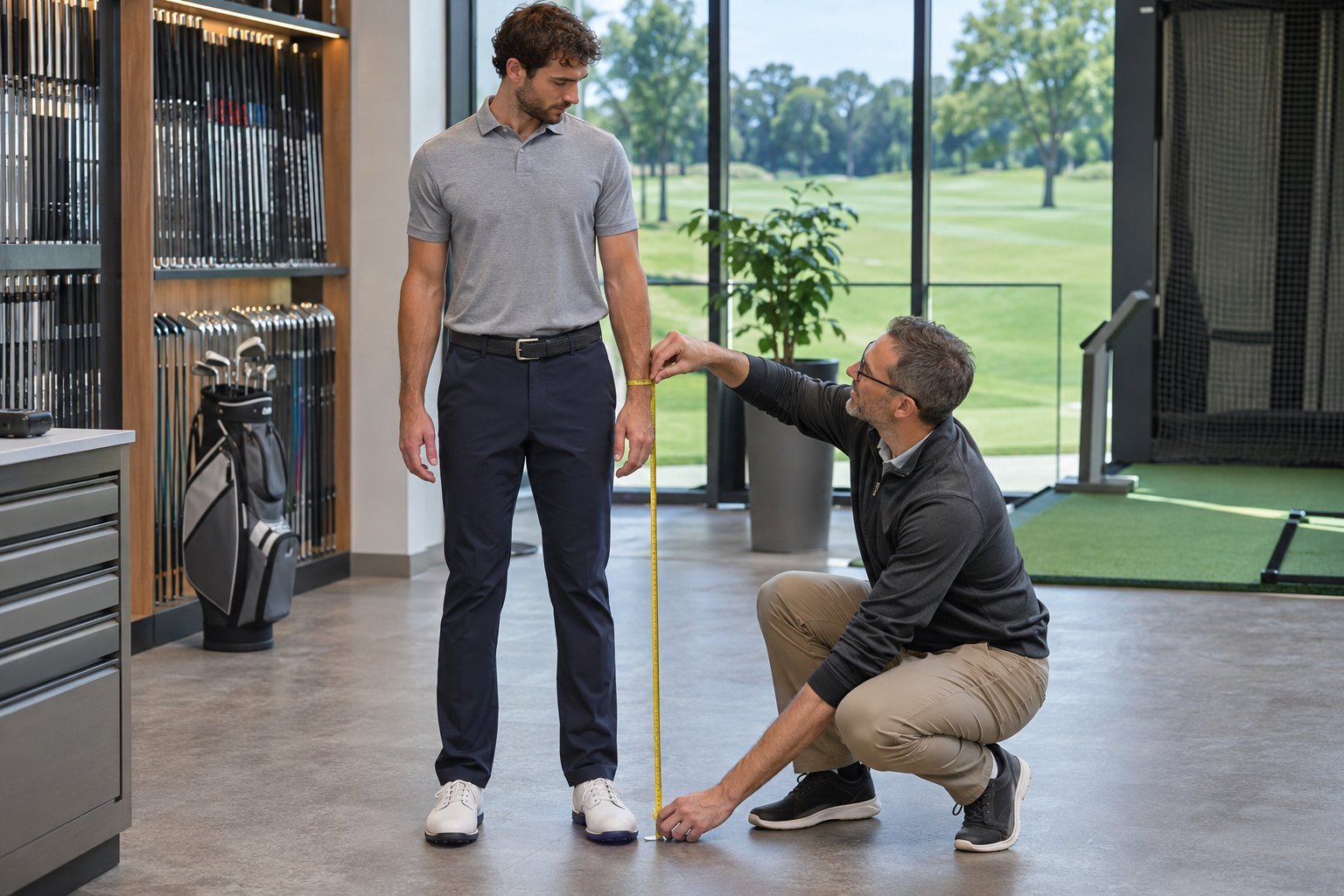
PING’s colour-code chart uses height and wrist-to-floor measurements to establish an initial lie-angle colour code and recommended length. It is a static fitting reference. [1] Follow that manufacturer’s measurement instructions, with a helper or fitter where needed, so your starting numbers are repeatable.
Callaway’s iron-fitting protocol also combines a static wrist-to-ground measurement with observation of the player’s posture when assessing shaft length. [3] That provides a useful question for your appointment: does the suggested starting length work when you address and strike a ball?
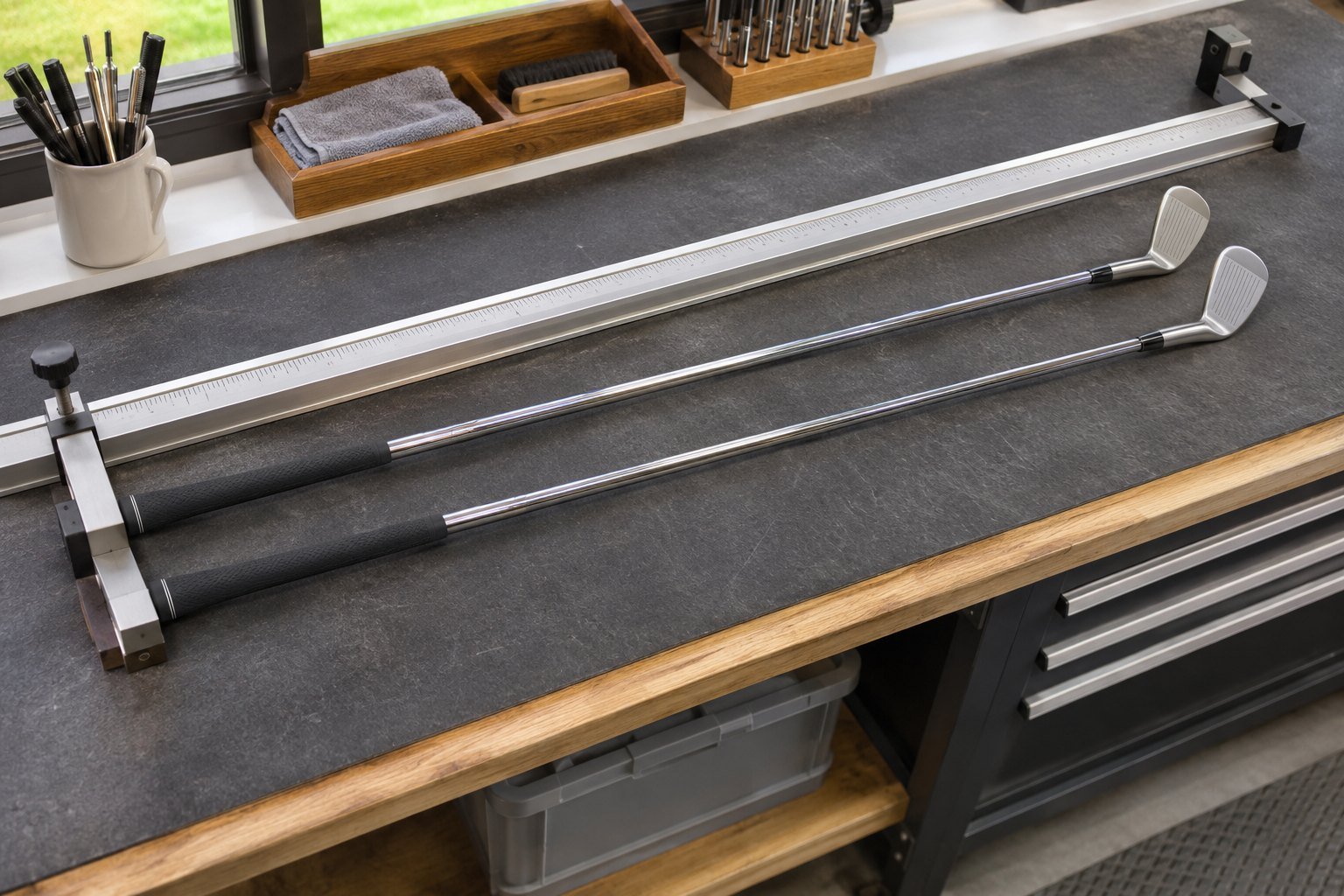
Take your current irons along. Ask the fitter to record the actual playing length of the clubs used in the comparison, the measurement method and the exact head model. A description such as “standard length” needs its reference. Likewise, an advertised “plus half an inch” leaves an unanswered question until the seller identifies the specification from which that addition was made.
Write down the problem in ordinary language. “I struggle to settle into the short irons” gives the fitter something to examine. “I need an extra inch because of my height” commits you to a solution before the trial has begun. Bring previous fitting reports if you have them, and explain what you liked about the clubs as well as what you want to improve.
Iron length for taller golfers: choose the next useful test
Use this matrix to choose a question for the session. The suggested actions are an editorial framework for discussing your own clubs with a fitter; they are not a set of height-based prescriptions.
Swipe within the table to see all columns.
| What you have noticed | What to establish | A reversible next step |
|---|---|---|
| A chart suggests a longer build | Current measured length, chart reference and the setup you use. | Compare the suggested starting build with your own club before ordering. |
| Short irons feel awkward at address | Whether the issue appears with several short irons and in normal shots. | Ask to test an appropriate short-iron alternative as well as a middle iron. |
| A longer 7-iron feels promising | Whether contact and useful shots improve when you return to it later. | Repeat the comparison, then check a longer and a shorter club. |
| The long irons are already difficult to use | The role of those clubs and the ordinary misses you want to reduce. | Test that part of the proposed set before approving a blanket length change. |
| A used set is advertised as longer | Actual lengths, full build, condition and any previous alterations. | Request a measurement report and a suitable trial arrangement before buying. |
Several rows may apply. Decide which question matters most before the session so the appointment has a clear purpose. A comfortable first swing is useful feedback, but keep it alongside the pattern of shots and the rest of the set.
Back to top ↑Build a trial that leaves your current set intact
PING describes a fitting process that begins with static measurements and moves into hitting shots, using launch-monitor information and the golfer’s feedback to refine the recommendation. [2] Ask for that transition from a starting specification to an observed comparison.
Use complete demo clubs or a manufacturer-designed fitting system operated by the fitter. Leave your own irons unchanged while you investigate. Cutting, extending or assembling trial clubs is work to discuss with a qualified club builder after the specification has been established.
- Begin with your current club after a normal warm-up. Note the ball, surface and intended shot.
- Try the proposed alternative in manageable blocks. Keep head model, loft, shaft and grip as comparable as the available equipment allows.
- Record every difference that remains. A different head or substantially different shaft makes this a comparison of complete builds, so the result cannot be credited to length alone.
- Return to your current club during the session, then revisit the candidate. Take breaks when needed.
- Keep ordinary misses in the record and discuss obvious reading errors separately. Do not build the decision around the single longest shot.
Agree what would count as useful before looking at the results: a setup you can settle into, a more useful contact pattern, an acceptable directional spread or a clearer job for the club. You need enough comparable shots to judge that question. There is no benefit in inventing a universal number of swings for every golfer.
If the required build is unavailable, record that gap. A nearby specification may help narrow the search, but ask how the final proposed build will be confirmed before committing to a whole set.

Keep the rest of the build visible
A length recommendation belongs on the same sheet as the head, shaft, lie and grip. Ask the fitter to review the complete proposed build, including its weight and balance, and explain which details can be reproduced in the clubs you would receive.
For example, if the trial iron has a different shaft model and grip from yours, record those changes beside the length. You may prefer that complete combination. The trial has simply left you with more than one possible explanation for the preference, which matters if you later order only the length change.
Ask how the lie angle will be assessed with the selected build and how the final specification will be checked. Keep the grip you intend to order in the discussion too. Our guide to measuring and testing golf grip size gives you a practical way to describe that part of the club.
For an existing set, request an assessment of whether the proposed work is appropriate for those heads and shafts, what components would be retained and how the finished clubs would be measured. A successful fitting trial is the brief for a professional build; it does not establish that every old set can be altered to match it economically.
Back to top ↑Check a longer iron, a middle iron and a short iron
Before approving the set, ask to explore its different jobs. A 5-iron, 7-iron and pitching wedge could be useful examples if those are clubs you carry. Choose the actual clubs around your bag and the fitting equipment available.
Swipe within the table to see all columns.
| Part of the set | Question to answer | Useful evidence |
|---|---|---|
| Longer iron | Can I use this build for the shot that earns it a place? | Ordinary contact, direction and useful carry alongside the club above or below it. |
| Middle iron | Does the original improvement repeat when I return to the comparison? | Repeated blocks with both current and proposed builds, with differences recorded. |
| Short iron or set wedge | Can I settle into the setup and play the shots I need? | Full shots and the relevant controlled shots, with feedback on setup and contact. |
Keep the result specific. “The 7-iron felt easier” is useful, but it leaves the longer and shorter clubs unresolved. If one end of the proposed set is unconvincing, ask the fitter to revisit the overall specification or set make-up.
A fitting may not offer every head and length combination. In that case, ask what the recommendation for the untried clubs is based on and whether further testing is possible. Keep that uncertainty in your decision instead of quietly treating a middle-iron trial as evidence for every club.
Take a trial record you can read after the appointment
Copy these fields into a notebook. Use separate columns for your current club and each candidate, and ask for the fitting report. This is a blank comparison structure for your own observations; it contains no example performance results.
Swipe within the table to see all columns.
| Field | What to write down for each build |
|---|---|
| Identity | Head model, iron number, loft, shaft model and flex, grip and handedness. |
| Length | Measured finished playing length, measurement method and any stated difference from the named model’s baseline. |
| Session | Date, ball, hitting surface, intended shot and any conditions that changed. |
| Setup and contact | Your setup feedback and the observed strike pattern, including ordinary misses. |
| Shot pattern | Recorded carry and direction where measured; clearly label estimates when measurements are unavailable. |
| Decision | What improved, what became less useful and which part of the set still needs checking. |
Keep the fitter’s recommendation separate from your own comments so both remain clear. If you felt more comfortable but the shot pattern was inconclusive, write exactly that. It is a good reason to ask another question or arrange a further comparison.
Ask in advance whether written specifications and results are included in the appointment. Our guide to what a golf club fitting fee should include helps you compare the service before booking.
Back to top ↑Make the order precise enough to check on delivery
The final order should describe the clubs you agreed to buy. Request a copy before paying and keep it with the fitting report.
Swipe within the table to see all columns.
| Order item | What needs to be unambiguous |
|---|---|
| Heads and set make-up | Brand, exact model and generation, handedness, iron numbers and any included wedges. |
| Finished lengths | The agreed length for each club, measurement method and named manufacturer/model baseline for any plus-or-minus notation. |
| Shafts | Full model, stated weight version and flex, plus any specifically agreed build details. |
| Loft and lie | The agreed specifications and the reference behind any adjustment description. |
| Grips and balance | Exact grip, size and agreed build-up; any weight or balance target the fitter has specified. |
| Service and payment | Complete price, included checks, delivery estimate and the seller’s terms for the proposed custom order. |
“Half an inch longer” can be a useful shorthand during a conversation. In an order, attach it to a named reference and ask for the finished length as well. If the retailer and fitter use different measurement methods, have them resolve that before production.
Once you have the specification, you can browse custom-fit clubs at Clubhouse Golf. Confirm that the chosen model can be supplied to the complete agreed build; a selectable length option alone does not answer every item on the order.
Compare complete costs before choosing a route
Compare a new custom order with professional work on a suitable existing or used set only after the proposed work has been assessed. Count the same clubs and the same necessary services on each side.
Swipe within the table to see all columns.
| Cost item | New set route | Used set plus approved work |
|---|---|---|
| Seven irons | £700 | £380 |
| Professional work | Included in assumed set price | £210, excluding replacement grips |
| Grips | Included in assumed set price | 7 × £12 = £84 |
| Fitting | £75 | £75 |
| Delivery | £10 | £15 |
| Total | £785 | £764 |
In this fictional example the used route saves £21. That narrow difference would deserve a careful look at condition, specification and the services included. Replace every figure with written quotes, avoid counting a grip or fitting fee twice and include any confirmed fitting credit accurately.
If Callaway is one of the brands on your shortlist, its UK iron range provides a place to explore the available models. Ask about the specific build from your fitting before comparing a displayed starting price with a complete quote.
Back to top ↑Let the repeatable result decide
My recommendation is to preserve your current set until a suitable trial provides a useful reason to change it. Take the measurements, compare complete builds, revisit the current club and check the longer and shorter irons before approving the order.
A longer specification can be the outcome of that process. Keeping your present lengths can be equally sensible when the alternative has not demonstrated a useful improvement. If the result remains unclear, keep the record and resolve the unanswered question before paying for irreversible work across the set.
The Irons, Wedges & Putters guides cover the related fitting decisions. Height starts the conversation; the trial and the written specification make it an actionable purchase decision.
Back to top ↑Sources and further reading
Sources checked on 22 November 2026. Product descriptions are attributed to their makers; the comparison methods and buying judgements are editorial guidance.
Illustrations in this article were created for Taylor’s Trailblazing Golf. Third-party photographs, where used, are credited beside the image or in the source list.