Rescue Hybrid vs Utility Iron: Tee, Rough and Turf Decisions
Choose for the shot you face most often, then check what the same club can manage from less comfortable lies.
- Tee-shot role
- Light-rough limits
- Real-turf comparison
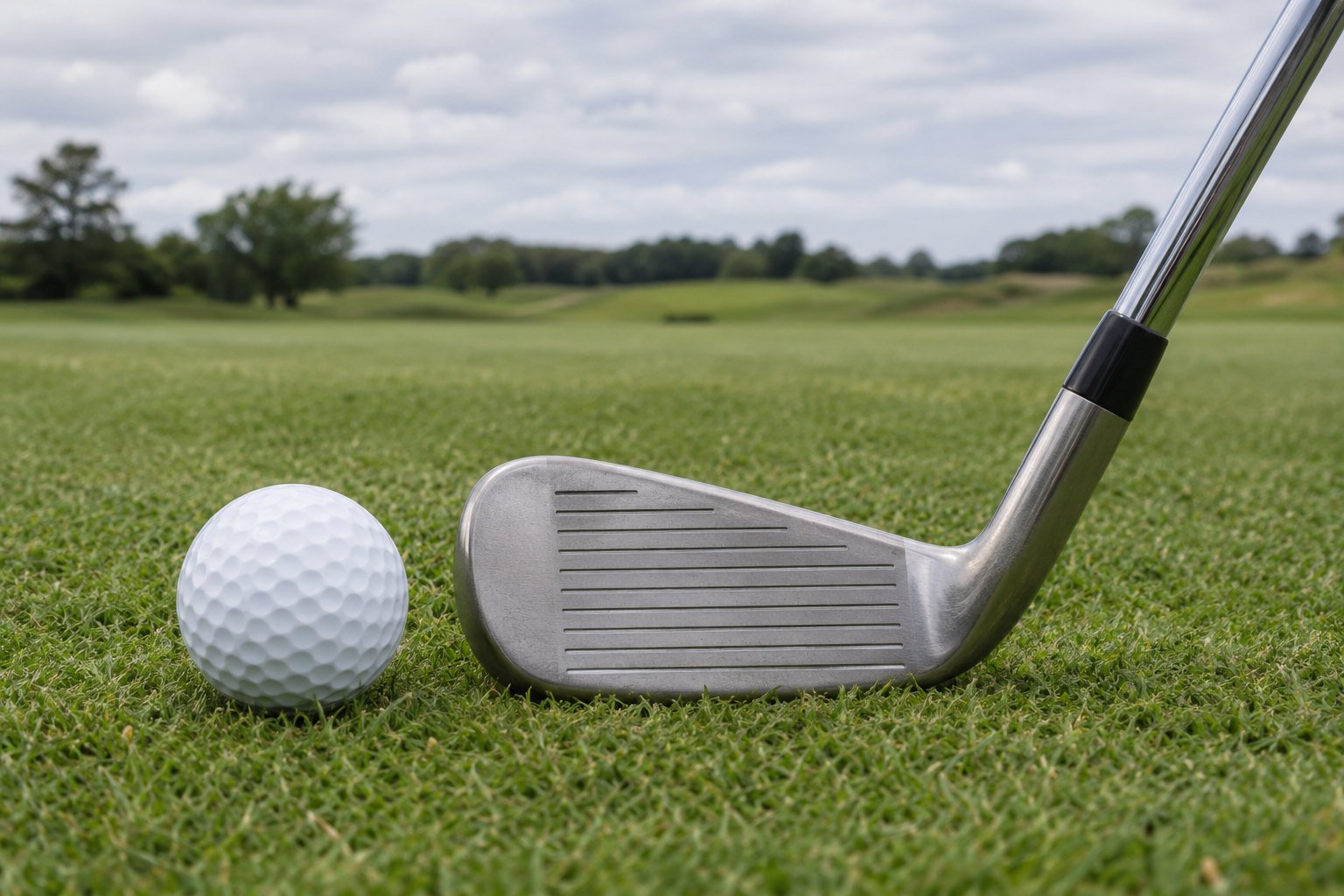
AI-generated illustrations show generic golf equipment and settings. They are not photographs of the named products or records of product testing.
A rescue hybrid vs utility iron decision starts with the ground beneath the ball and the landing area ahead. A club that earns its place on a narrow tee shot may offer little help from the rough beside that fairway. Another may be useful from several lies without producing the particular tee flight you want.
The useful comparison is between two complete clubs doing the same job. This guide looks at specialist utility or driving irons alongside rounded, wood-style hybrids. It focuses on tee, rough and turf choices, rather than assuming either club simply replaces the same-numbered iron in a set.
Mostly a tee club?
Compare the whole landing pattern, the carry needed to clear trouble and the room available for run.
Frequently off the fairway?
Give playable light-rough shots their own trial. A successful fairway strike does not establish rough performance.
One club for several jobs?
Write down the main job and an acceptable compromise. Neither shape should win merely by looking versatile.
Understand the shapes behind the names
TaylorMade uses Rescue in its hybrid model names: its Qi4D Rescue page describes the club as a hybrid. Here, “rescue hybrid” means that familiar rounded, wood-style category; it is not a separate technical class that guarantees escape from trouble. [1]
A utility or driving iron usually presents a more iron-like outline. Yet those labels do not settle the flight. TaylorMade describes its P·UDI as a compact option designed for a mid-low launch, while the P·DHY has a shallower face, wider sole and lower centre of gravity aimed at a mid-high launch. Both sit within its utility family. [2]
Titleist makes the overlap particularly clear: it describes U·505 as an iron-shaped hollow-body club with more hybrid-like performance, and positions it for higher launch than T250·U. Those are the manufacturer’s design intentions, not evidence that either model will produce a particular result for you. [3]
So ask what lies behind the label: head shape, sole design, loft, shaft and assembled length. “Hybrid”, “utility” and “driving hybrid” can describe overlapping products in a shop. A photograph helps identify the category, but the exact model and build must be on the comparison sheet.
Use a lie-and-course decision matrix
Choose the row that best describes your main reason for buying. The starting choice below is a question to investigate, not a predicted winner. Add a second row for the awkward shot you still need the club to handle.
| Situation | Useful starting comparison | Evidence that matters |
|---|---|---|
| Narrow tee shot with room to run | Include a utility iron if its proposed flight suits the landing area; keep a hybrid in the trial. | Where ordinary shots finish, including the longer bounces and both sides of the miss. |
| Tee shot over a hazard | Compare whichever builds can provide dependable carry at your normal effort. | The shorter carries, not just average or total distance. |
| Playable light rough | Start by assessing a hybrid, then test the utility from comparable lies. | Clean contact, successful escape and control of the finishing area. |
| Tightly mown fairway | Keep both shapes available until you have hit them from real turf. | Strike consistency and whether the required flight survives an ordinary imperfect swing. |
| Long shot towards a guarded green | Compare the flights you can produce, including a more launch-friendly utility if relevant. | Carry, landing angle and observed stopping behaviour where a grass trial allows it. |
| Ball deeply buried or obstructed | Reconsider the long-club shot altogether. | A realistic route back to playable ground with a club you can control. |
Scroll within the table to see all columns.
Weight the rows according to your golf. If most intended uses are tee shots, that role should dominate the decision. If the club mainly advances the ball from grass, a convincing tee demonstration has answered only a small part of the question.
From the tee, define the safe landing area first
Describe the tee shot in both distance and direction. Where must the ball carry? At what distance does the fairway narrow? Is there trouble through the far side, and is a shorter approach still manageable? These questions reveal whether you need a lower-running option, more reliable airborne distance or simply a club you strike more consistently.
Keep carry and total distance separate. Foresight defines total distance as flight plus bounce and roll; its ball-flight outputs are calculated from measured launch conditions. A simulator’s long total is therefore not a promise that the ball will run the same distance on your fairway. [7]
A utility may earn this role if the flight and landing spread work for you. It does not become an accurate “fairway finder” just by having a smaller head than a driver. Retain the shots that miss the intended corridor, including the ones you would rather explain away. A hybrid deserves the same scrutiny.
Test each club with a sensible, repeatable tee setup agreed with the fitter. Record tee height rather than changing it unnoticed between attempts. You are choosing a club for your normal tee shot, so the comparison should not depend on producing a special swing you rarely use.
If you actually need substantially more tee distance than either candidate provides, widen the question. The mini-driver versus fairway-wood tee guide examines that different part of the bag. Buying a utility simply because it is marketed for driving may leave the original problem untouched.

In rough, inspect the lie before trusting the category
PGA Play identifies the hybrid’s head shape as a reason it can move through longer grass more readily than many irons. That makes a hybrid a sensible candidate for a light-rough trial; it does not establish superiority over every modern utility iron or from every lie. [4]
Look at how the ball sits and how much grass surrounds the route into it. A ball supported near the top of light grass presents a different task from one nestled down, even if both are only a pace off the fairway. Describe those conditions in your notes instead of giving every shot a single “rough” label.
During an authorised grass practice session, compare similar lies without trying to reproduce the same disturbed patch. Record whether the ball reached the intended safe area and whether the miss would leave a straightforward next shot. Distance is useful only after the escape itself is dependable.
Do not plan a forced carry using your best clean-fairway result. If you have no credible evidence that either club can produce the required shot from this lie, choose a more manageable route and a club with which you can advance the ball reliably. A shorter recovery can meet that objective perfectly well.
Keep difficult rough outside the promise of the purchase. Buying a club that improves the playable lies you often encounter is a more realistic goal than expecting it to solve every recovery.

From turf, compare contact as well as flight
Neither a tight fairway nor soft ground selects the winner automatically. Ask for a turf comparison that resembles your usual course: a well-supported range ball and a closely mown fairway lie need not feel like the same task. Keep your normal swing intention, then record what the club actually produces.
Sole design is worth investigating, but brochure language cannot replace this check. Callaway describes the Quantum Max hybrid’s stepped sole as reducing sole contact with the turf. That explains a design feature to assess; it does not demonstrate how much it will improve your contact or how it compares with an iron-shaped alternative. [5]
For shots towards a green, judge the landing as well as the launch. A flight that looks pleasantly strong can still be unsuitable if it does not reach the target reliably or leaves too much uncertainty about the finish. Conversely, a higher flight is useful only when it supplies the distance and control required.
Keep a separate note for wet, soft ground and for firmer conditions when you have the chance to observe both. You need not buy a different club for every season. You do need to know whether a proposed all-purpose club relies on a landing response your course offers only occasionally.
Wind belongs in this record as context. Compare the two clubs in similar conditions and note the wind you faced. Do not turn one calm indoor result into a claim about control on an exposed course, or choose the lowest flight merely because wind sometimes occurs.
Run a comparison that answers the real question
Bring the club already doing this job, even if it is the one you intend to replace. It provides a useful reference: the new option should improve a recognisable task, not merely win a comparison between two unfamiliar clubs.
- State the primary job. Write one sentence, such as “a tee shot that stays short of the narrowing fairway” or “a long advance from playable light rough”. Add the consequence of the usual miss.
- Choose plausible builds. Ask the fitter to select candidates capable of doing that job. The same club number or nominal loft does not make two different designs equivalent. Record the full model, loft, shaft, length and settings.
- Keep the comparison consistent. Use the same ball model and target where possible. Note whether carry is observed, calculated or adjusted by the system, and keep any environmental settings consistent.
- Alternate clubs and retain ordinary misses. Give yourself time to settle, then switch between candidates rather than judging one while fresh and the other while tired. Remove only a clear recording fault, with its reason noted.
- Add the relevant lies. Tee, fairway and light-rough results should have separate records. If turf access is unavailable, mark that part of the decision as still unanswered.
- Return to the main job. Compare the full pattern and the consequences of the misses. If neither option improves it convincingly, keep the current club and investigate the remaining problem.
There is no magic shot count that makes a changing pattern reliable. Continue only while your normal swing and concentration are representative; revisit a close result on another occasion if practical. A fitting should leave you with understandable evidence and a specification, so check what a useful fitting fee should include before booking.
A worked decision: one club, two different priorities
Illustrative example — no player or test results are being reported. Imagine a golfer who wants a club for a short par-four tee shot and an occasional second shot from light rough. Trouble narrows the tee landing area beyond the preferred finishing zone.
The first trial should establish which candidate keeps ordinary tee shots within that zone while carrying the trouble before it. A longer average is not automatically an improvement: it may bring the narrowing back into play.
Next, ask whether the preferred tee club can handle the light-rough task well enough. If it cannot, the golfer must choose which job deserves the space in the bag. A utility that excels at the dominant tee role can remain a sensible specialist choice. A hybrid that performs both jobs acceptably may be the more useful compromise.
Change the course and the answer may change. If the main tee shot instead requires carrying a hazard, the shorter airborne results become more important than useful run. This is why the decision matrix starts with the shot and its consequences rather than a handicap label.

Check the exact build before buying
Use named models to investigate different design approaches, then order the build that earned its place. The Titleist U·505 specification page is a useful reminder that a utility can be designed for more hybrid-like launch. [3]
For the wider-soled utility example discussed earlier, Clubhouse Golf’s TaylorMade P·DHY listing is the men’s right-handed graphite version. Confirm the exact loft, shaft and length with the retailer against your fitting record, rather than ordering by the number alone. [6]
For a rounded hybrid with an explicitly described sole feature, Callaway UK’s Quantum Max hybrid page provides the model details and configuration choices. Its suitability still depends on your comparison; the sole description is a reason to test the club, not a ranking against the utility. [5]
Confirm handedness and the complete specification before paying, particularly when a shop uses similar names for several builds. Ask what happens if the delivered specification differs from the order, and check the actual custom-order terms. A useful purchase is the club that reproduced your chosen task, with a clear record of what was supplied.
Let the recurring shot choose the club
A rescue-style hybrid and a utility iron can both be useful long clubs, with more overlap than their names imply. Define the main tee, rough or fairway task, compare appropriate builds and keep the ordinary misses in view. Choose the useful specialist or the acceptable compromise that your course requires. Where a crucial lie remains untested, leave that question open before buying.
Sources
Sources checked on 22 November 2026. Product names refer to the exact models described.
- TaylorMade UK — Qi4D RescueRescue naming within the hybrid category and the model’s described construction.
- TaylorMade UK — Is a Driving Iron Right for Your Game?The different design intentions of P·UDI and P·DHY utility irons.
- Titleist UK — U·505 Utility IronsHollow-body construction and the manufacturer’s positioning of U·505 relative to T250·U.
- PGA Play — A Beginner’s Guide to Hybrid Golf ClubsHybrid head shape and its possible usefulness from fairway, rough and tee.
- Callaway UK — Quantum Max HybridsThe manufacturer’s description of the stepped sole and UK model configuration.
- Clubhouse Golf — TaylorMade P·DHY Utility Golf Iron HybridThe named men’s right-handed graphite product and its ordering options.
- Foresight Sports — Ball Launch Data: Measurements & Ball Flight ResultsCarry, total distance and the distinction between measured launch conditions and calculated flight.
Illustrations in this article were created for Taylor’s Trailblazing Golf. Third-party photographs, where used, are credited beside the image or in the source list.