Buying an Incomplete Iron Set: Which Missing Clubs Matter?
Work out which gaps matter, whether the right replacement exists and what the finished set would really cost.
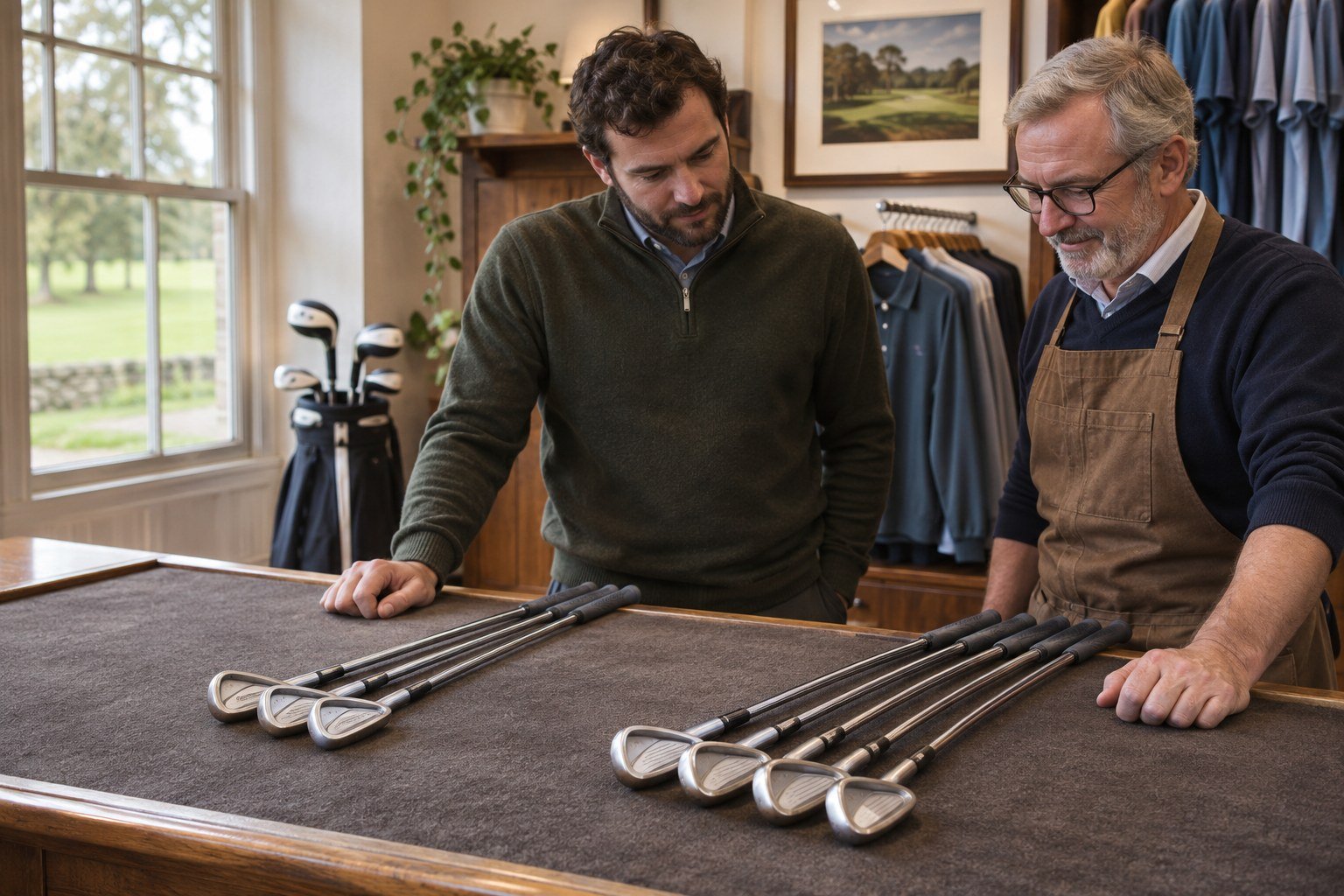
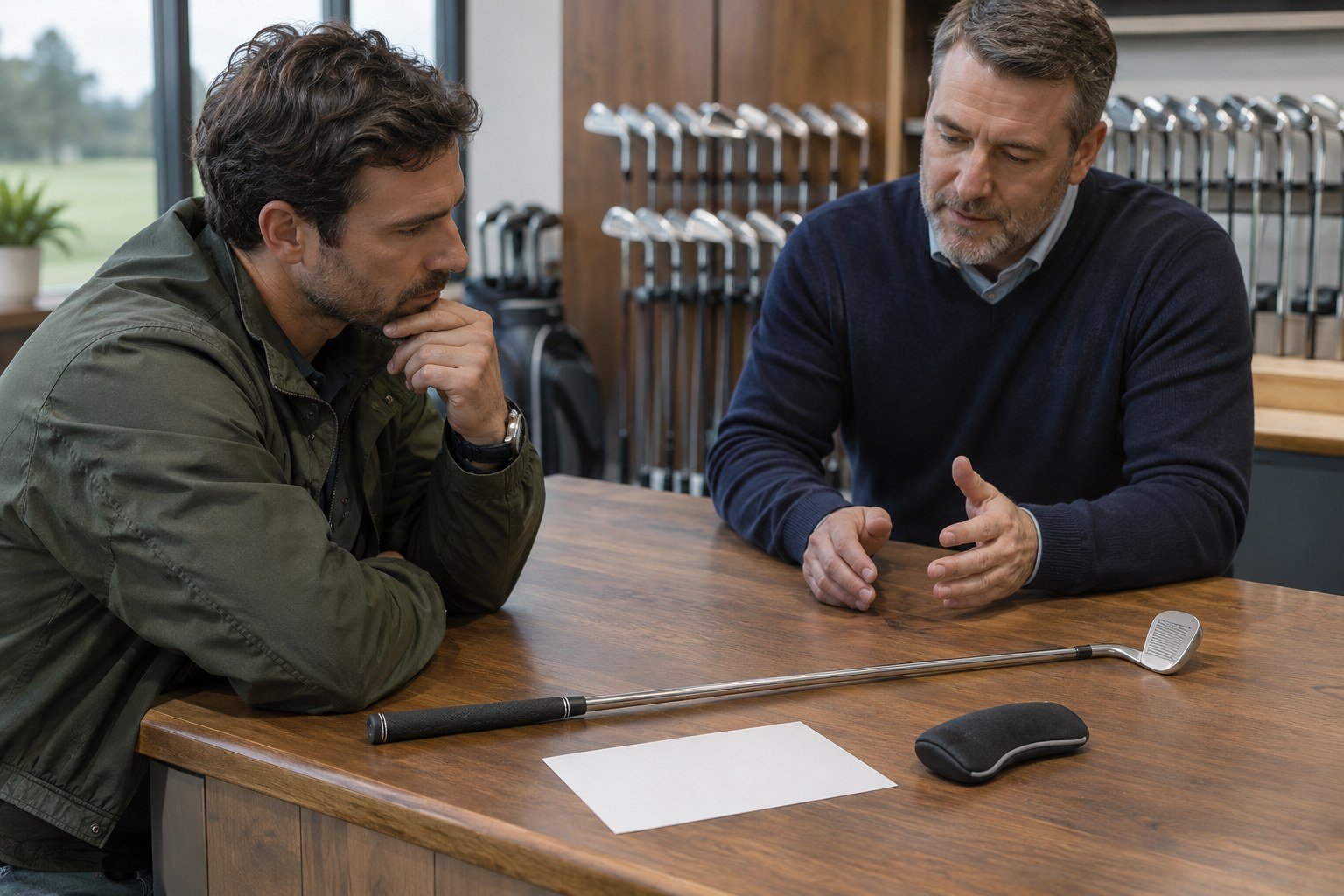
AI illustration of an incomplete-set buying discussion; the generic clubs do not represent a named model.
A set with one iron missing can be excellent value if that club has no job in your bag. The same listing becomes a poor buy when the absent club covers a regular approach and a suitable replacement is difficult to find.
Before buying an incomplete iron set, separate two questions: which missing clubs you actually need, and what it will cost to obtain those exact clubs. The answer should be clear before you pay for the bundle.
Ad – includes affiliate links. If you buy through these links, Taylor’s Trailblazing Golf may earn a commission at no extra cost to you. Recommendations consider fit, drawbacks and alternatives.
A missing middle iron and an unused long iron create different buying decisions.
A live model page does not guarantee the required number and build.
Add delivery and necessary work before deciding what the bundle is worth.
Which missing irons change the buying decision?
Write down every club included, using the seller’s photographs and written description. “Six irons” could mean 5, 6, 7, 8, 9 and pitching wedge, or 4, 5, 6, 8, 9 and pitching wedge. The first is a continuous six-club run; the second has a 7-iron missing. The count alone hides the difference.
Next, mark the clubs you intended to use. The following priorities are a buying framework, not a rule that every golfer needs the same numbers.
Scroll sideways to read all columns on a small screen.
| Missing club or group | Question to resolve | Buying implication |
|---|---|---|
| A long iron at the end of the range | Would this iron provide a useful shot beyond your longest retained iron, or is that job already covered? | It may be an acceptable omission. Do not automatically pay to restore a catalogue sequence. |
| A middle iron within the run you want | What will you use for the shots between the clubs on either side? | Treat the replacement as essential until a workable alternative has been demonstrated. |
| The 9-iron or pitching wedge | Does its absence leave an awkward approach distance before your existing wedges? | Investigate early; a familiar wedge elsewhere in the bag may not cover the missing full-shot role. |
| A set gap wedge, labelled with a letter or loft | Was it included in this particular listing, and do your current wedges already cover the transition? | Check the actual specification and job before deciding it is missing or necessary. |
| Several adjacent irons | Would the clubs remaining form a useful core, or would you be buying a rebuilding project? | Price every essential addition together and establish whether the resulting set still makes sense. |
A seller offering 5–PW has not necessarily lost a 4-iron: that may simply be the stated set being sold. Likewise, a separate sand or lob wedge is not an omission unless it belongs to the promised contents. Establish the agreed list before negotiating a discount for something the seller never included.
Decide whether the missing shot is already covered
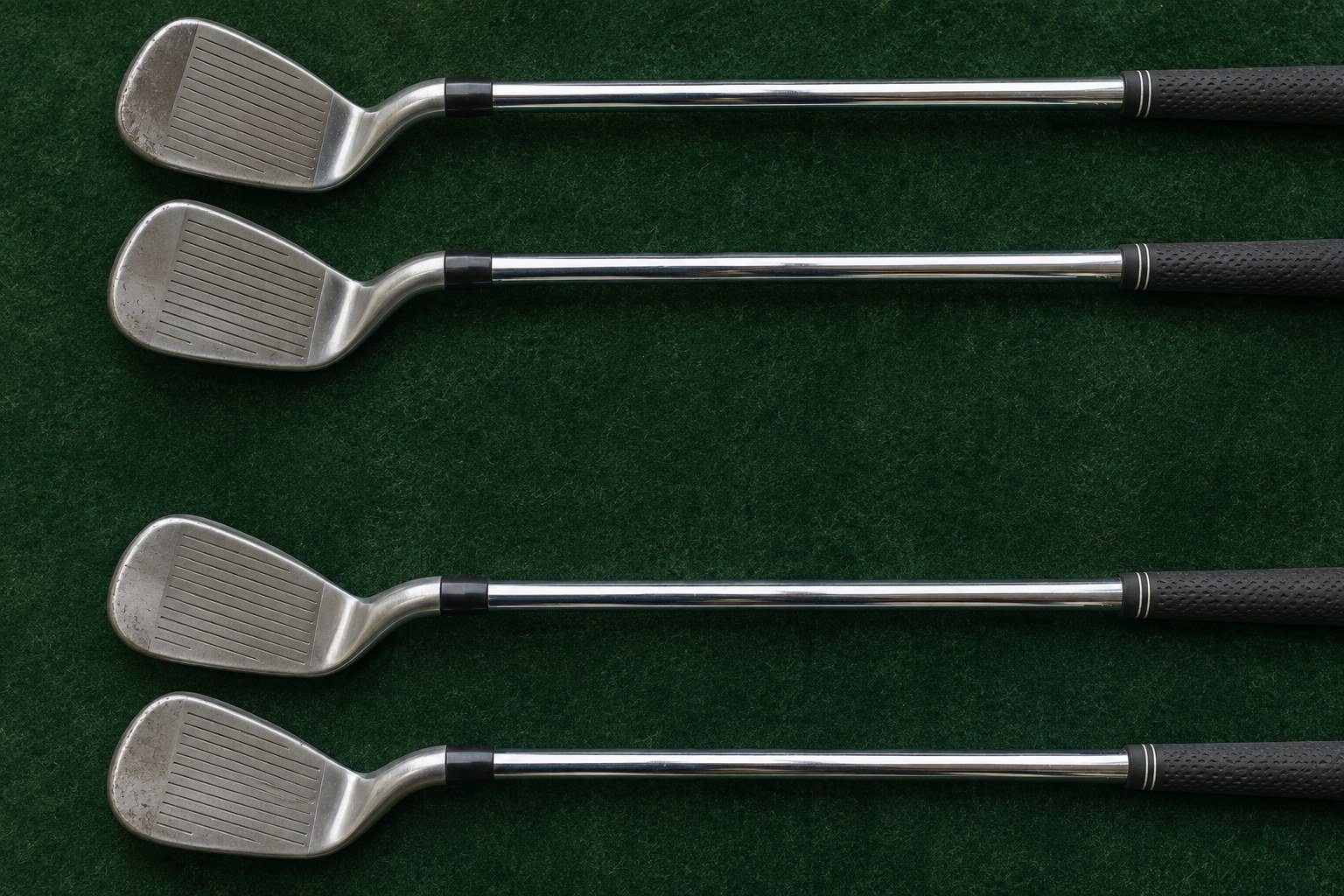
Take the most important absent club and write one sentence: “I need this club for…” Include the approximate approach or tee-shot job, the usual lie and what happens if the ball falls short or runs too far. If you cannot name a recurring use, the missing number may be a low priority.
For a missing 7-iron, an existing 7-iron is a possible stopgap, not an automatic match. Keep it in the proposed bag and compare it with the prospective set’s 6- and 8-irons before relying on the combination. If a trial is unavailable, record that uncertainty rather than assuming your old distances transfer to the new clubs.
A missing long iron offers a different decision. You may already have a hybrid or fairway wood that supplies the shot you want. There is little reason to add another purchase solely to make the numbers look continuous. Check the transition to the longest iron you will actually keep.
Make a distinction between an acceptable compromise and an expensive distraction. Using a comfortable shorter shot and laying up may suit an occasional distance. Continually improvising around a missing club on approaches you meet several times a round deserves more attention. Judge the hole you would have to play differently, not the empty place in a photograph.
Back to top ↑Locate an essential replacement before buying the set
Search for the replacement while the incomplete set is still only a candidate. An old product page, an expired sale or a seller’s assurance that singles are “easy to find” does not establish a club you can obtain.
For example, PING’s current UK G430 page describes that model as available for fill-in or replacement only. It requires ordering through an authorised PING retailer with a valid serial number and asks buyers to confirm product and component availability.[1] That is a route to enquire about, not a guarantee that your required head and shaft are available.
Ask for written confirmation of the exact club, the build offered, the delivered price and the expected supply time. If a retailer must obtain a manufacturer quote, leave the item unresolved until that answer arrives. A listing showing another loft, handedness or shaft is evidence of a different club.
Scroll sideways to read all columns on a small screen.
| Evidence you have | What it establishes | Next step |
|---|---|---|
| A matching club with an identifiable seller, full details and a current delivered quote | A credible purchase route, subject to the seller’s actual terms and availability | Confirm both the replacement and the incomplete bundle can be obtained as planned. |
| The model appears online, but the required build or club number is unclear | The family exists; your replacement is still unconfirmed | Ask about the exact missing number and build before making an offer. |
| Only old listings, unsuitable variants or a promise to search later | No dependable completion route | Value the bundle as the clubs actually present, or leave it if the missing club is essential. |
Do not let a small deposit or a limited-time listing reverse the order of the decision. If the purchase only works once one particular club is found, that club is a condition of the purchase. A larger budget cannot make an unavailable component appear.
Back to top ↑A matching number is only the start
Record the full model and generation, handedness, missing number, shaft model and flex, playing length, loft and lie specification, and grip. Use these details to request the replacement; have a qualified fitter or club technician resolve measurements you cannot establish. A photograph of a familiar badge is not a complete build specification.
Pitching-wedge labels show why that matters. PING lists the standard G430 PW at 41°, while the standard i230 PW is 45°.[1][2] Choosing either simply because it says PW would ignore that difference. These are manufacturer design specifications, not measurements of a particular used club.
Even within a model, confirm the ordered specification. The G430 table lists standard, Power Spec and Retro Spec lofts.[1] Ask whether the set was built or subsequently altered to something other than standard; do not order a replacement from the catalogue row alone.
You do not need cosmetic perfection to make a useful set. An odd-looking replacement can be acceptable if it provides the intended shot and you are comfortable with its feel. Conversely, the right badge with an unsuitable build is not a solved problem. Trial a mixed replacement alongside both neighbours, including its ordinary misses.
If matching requires reshafting, extending, shortening or altering loft or lie, obtain a professional assessment and an itemised quote first. Do not assume every head can be adjusted to the specification you want, or treat a planned alteration as a reason to buy an unsuitable club now. The guide to what a useful fitting fee should include helps separate an assessment from any additional workshop charges.

Calculate the cost of the set you will actually use
The examples below use invented GBP amounts solely to explain the decision. They are not current retailer prices, repair tariffs or quotes for a named model. Replace every amount with the cost of your actual listing, required work and realistic alternative.
Example A is a 4–PW set with the 7-iron missing. The buyer wants all seven clubs and has located a suitable replacement. Example B is a 5–PW bundle whose buyer has no use for a 4-iron; its absence requires no extra purchase. Both examples assume the remaining clubs are otherwise suitable.
Scroll sideways to read all columns on a small screen.
| Cost item | A: essential 7-iron missing | B: no 4-iron needed |
|---|---|---|
| Price of the clubs present | £240 | £215 |
| Delivery of that bundle | £15 | £15 |
| Required replacement iron | £75 | £0 |
| Replacement delivery | £8 | £0 |
| Professional checking or agreed adjustment | £20 | £20 |
| Required replacement grip, fitted | £12 | £0 |
| Total to obtain the usable set | £370 | £250 |
| Suitable complete alternative, delivered and ready for the same required jobs | £350 | £295 |
| Difference from the alternative | £20 more expensive | £45 less expensive |
A’s £240 headline becomes £370 once the essential club and associated costs are included. The £350 complete alternative costs £20 less. B remains £45 cheaper because its buyer genuinely does not need to restore an unused long-iron position.
The alternatives must be fair comparisons: suitable build, required club range, acceptable condition and all known delivery or preparation costs included. The table assumes the comparison sets need no further work. If they also need grips or alterations, add those costs to their side rather than charging only the incomplete set.
Count each charge once. If a replacement quote includes the correct grip and fitting, do not add the same work again. If you would buy an additional wedge under either option, include it on both sides or keep it outside both totals. Speculative resale of an unwanted club should not be necessary to make the purchase affordable.
Set a maximum offer before the negotiation
Work backwards from a usable alternative. In Example A, the costs beyond the bundle’s asking price total £130: £15 delivery, £75 replacement, £8 replacement delivery, £20 checking and £12 for the fitted grip.
With a £350 ready-to-use alternative, the bundle price must be no more than £220 to break even: £350 − £130 = £220. If this buyer also wants a £30 allowance for the inconvenience and remaining uncertainty, their maximum offer becomes £190.
The £30 is a chosen allowance in this example, not an industry rule or a calculated chance of failure. Decide what saving would make the extra arranging, delay and uncertainty worthwhile for you. If the essential replacement cannot be confirmed at all, an allowance does not solve the problem.
This gives the negotiation a reason. You can explain that the missing 7-iron and necessary work change the total cost, rather than asking for a random percentage off. If the seller will not meet a sensible figure, the complete alternative remains available for comparison.
Use the same calculation for several missing clubs, with a separate line for each. Be cautious about a deal that only works if every later purchase arrives at the cheapest imagined price. A rebuilding project can be enjoyable, but its budget should reflect the project you are choosing.
Back to top ↑Compare realistic alternatives, then buy or leave it
Check more than another incomplete listing. A complete used set, a suitable new set and keeping your current clubs can each provide a useful reference. Price the clubs and build you need; dividing the headline price by the number of clubs can reward extras you will never use.
For new-set benchmarks, Callaway’s UK iron category lists sets and individual irons, which can help you compare the offered combinations.[3] Clubhouse Golf’s iron category covers new irons and explicitly says it does not sell second-hand irons.[4] Neither page establishes that a discontinued missing iron is available, and neither replaces a quote for your exact build.
Before ordering either part of the purchase, read the terms for that seller and item. Check what happens if the club arrives different from its description, whether any return conditions affect the trial you intend, and whether bespoke work changes the options. Do not plan on returning an altered club without first understanding the applicable terms.
Scroll sideways to read all columns on a small screen.
| Decision | Evidence needed |
|---|---|
| Buy it as it stands | Every club you need is present, or a tried existing club covers the omission; the delivered cost is worthwhile. |
| Buy it with a completion plan | Each essential replacement is identified and obtainable in an acceptable build; the total and timing compare favourably with a usable alternative. |
| Pause | A required club, build detail, delivered quote or meaningful trial remains unresolved. |
| Leave it | The essential replacement cannot be found, the completed cost loses its advantage, or the resulting set still leaves an awkward recurring shot. |
Keep a short purchase note: the exact clubs included, the missing club’s job, the confirmed replacement route, the total cost and your maximum offer. If those five entries make sense together, the listing deserves consideration. If one is still a hopeful guess, keep looking.
Sources and method
This guide brings together manufacturer information and the sources below. The decision aids are editorial suggestions for your own equipment checks, comparisons or fitting. No personal product test or measured performance result is claimed. Read how we review golf gear for the site’s evidence standards.
- PING UK: G430 irons — replacement conditions and specifications
Checked 22 November 2026. - PING UK: i230 irons — specifications
Checked 22 November 2026. - Callaway UK: irons and combo sets
Checked 22 November 2026. - Clubhouse Golf: golf irons category
Checked 22 November 2026.
Illustrations in this article were created for Taylor’s Trailblazing Golf. Third-party photographs, where used, are credited beside the image or in the source list.