How Many Irons Do You Need? Building a Practical Core Set
Choose a useful iron span, connect it to your wedges and long clubs, and count the whole bag before ordering.
AI illustration of a compact bag; the counted examples below explain the club choices without treating this generic scene as a specification.
A 5–PW set contains six clubs. That tells you what is in the box, but it does not establish whether the 5-iron adds a useful shot or whether the pitching wedge connects comfortably to the rest of your wedges.
Build the core around those two boundaries. Keep the irons that give you dependable choices between them, then allocate the remaining places to the other shots you need.
Ad – includes affiliate links. If you buy through these links, Taylor’s Trailblazing Golf may earn a commission at no extra cost to you. Recommendations consider fit, drawbacks and alternatives.
Start with the longest dependable iron and check the pitching-wedge transition.
Keep a middle step or specialist option when it changes a real choice.
Driver, woods, hybrids, separate wedges and putter share the same total.
How many irons are in your proposed core?
Use a simple counting convention before comparing options. In this guide, the core includes the numbered irons and the pitching wedge, abbreviated PW. Any gap wedge, sand wedge or lob wedge is counted separately. That avoids counting the PW once in an iron set and again in the wedges.
Write the clubs out rather than using a label such as “half set”. For example, 6, 7, 8, 9 and PW means five core clubs. If your pitching-wedge role is filled by a separate wedge, put that actual club in the same place on your plan and count it once.
The R&A’s Rule 4.1b sets a maximum of 14 clubs at the start of and during a round; starting with fewer is permitted.[1] It is a ceiling for the whole bag, not a target number of irons. Choose your intended playing bag before the round.
There are two separate questions: how many distinct iron shots you can use, and how many spaces remain once the other clubs are included. A spare space is not evidence that another iron would help.
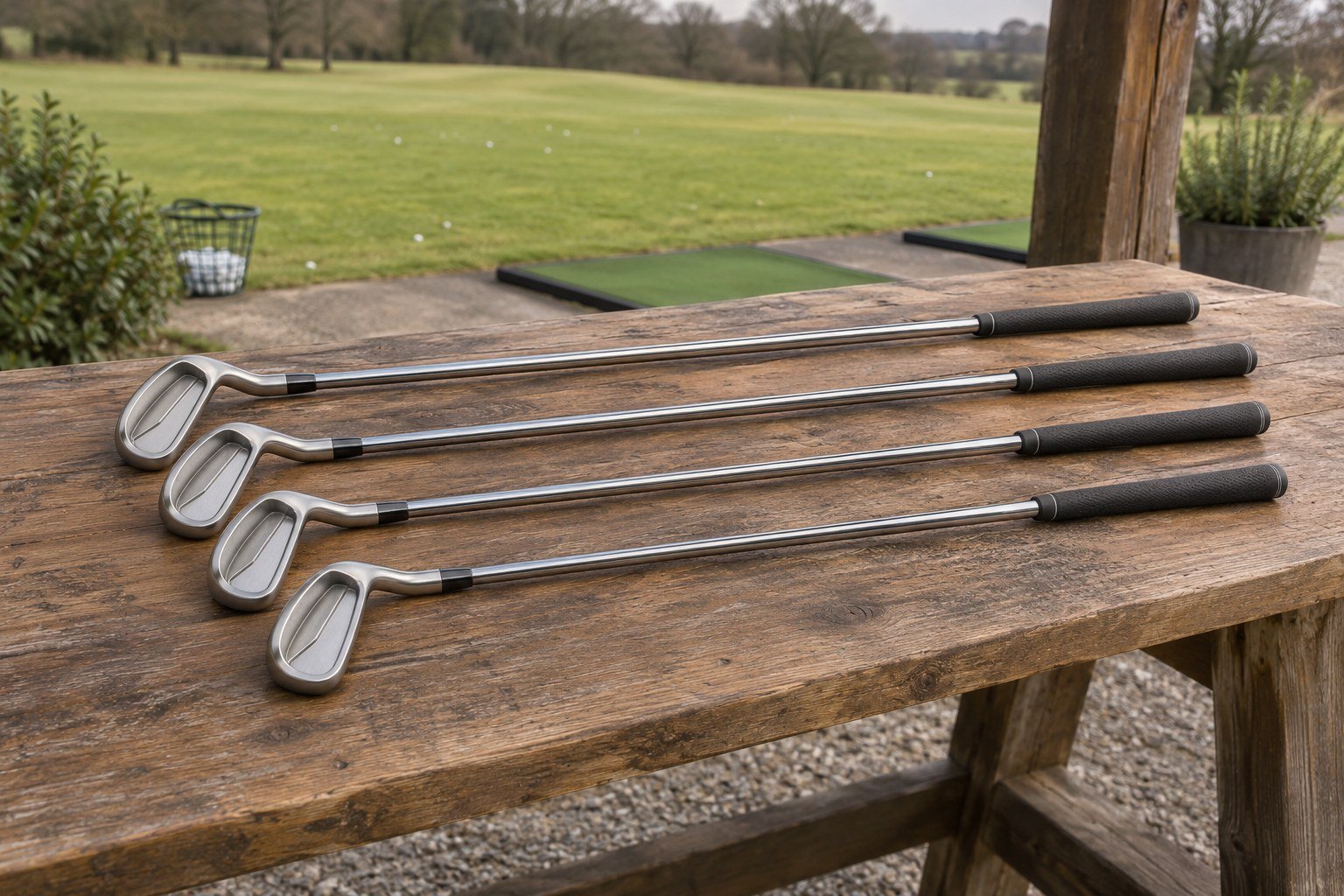
Five complete bag maps, with the pitching wedge counted once
These are illustrative arrangements to compare, not recommended sets for particular handicaps, ages or swing speeds. Every driver, hybrid, wedge and putter is included in the total. The names identify places in a plan; they do not assign a distance to any club.
Scroll sideways to read all columns on a small screen.
| Plan | Core, including PW | Driver, woods and hybrids | Other wedges | Putter | Total |
|---|---|---|---|---|---|
| A — compact eight-club bag | 7, 8, 9, PW: 4 | Driver and one hybrid: 2 | SW: 1 | 1 | 8 |
| B — five-iron core | 6, 7, 8, 9, PW: 5 | Driver, one fairway wood and one hybrid: 3 | GW and SW: 2 | 1 | 11 |
| C — six-iron core | 5, 6, 7, 8, 9, PW: 6 | Driver, one fairway wood and one hybrid: 3 | GW, SW and LW: 3 | 1 | 13 |
| D — seven-iron core | 4, 5, 6, 7, 8, 9, PW: 7 | Driver, one fairway wood and one hybrid: 3 | GW, SW and LW: 3 | 1 | 14 |
| E — five irons within a full bag | 6, 7, 8, 9, PW: 5 | Driver, two fairway woods and two hybrids: 5 | GW, SW and LW: 3 | 1 | 14 |
GW, SW and LW mean gap, sand and lob wedge. A’s single separate wedge leaves fewer short-game choices, so its buyer must be comfortable with the shots remaining. It is a compact arrangement to test, not a claim that one wedge can automatically cover every approach and bunker.
B and C leave room unused. That is acceptable if the important shots are covered. C only becomes D when the 4-iron earns a job; filling the fourteenth place is not enough reason.
D and E both contain 14 clubs but have different iron counts. E needs a convincing reason for all five of its longer clubs. If those options largely repeat one another, a smaller bag may be more useful. The comparison shows why the total count cannot determine your iron span.
Adapt the maps to clubs you already own before turning them into a shopping list. Retaining a useful wedge or hybrid can be more sensible than rebuilding everything around an advertised iron-set range.
Back to top ↑Find the longest iron that adds a dependable choice
Start with the longest iron you currently choose with some confidence. Compare it with the next longer iron and the club you would use above the iron set. Ask what each makes possible on a normal shot.
For approach comparisons, separate flight from run. Trackman defines carry as airborne distance, reported for a landing area at the same elevation as launch.[2] A shot that rolls farther has not necessarily supplied the extra clearance you need.
Use repeated representative shots from the lie that matters. Keep the same ball and conditions as consistent as the facility permits, retain ordinary mishits, and compare the landing area as well as the longest result. If you cannot see or measure the first landing reliably, leave the exact distance unknown. Follow the facility’s observation arrangements and stay out of an active range.
Scroll sideways to read all columns on a small screen.
| What the comparison shows | What it means for the iron span |
|---|---|
| The next longer iron repeatedly provides useful extra carry with an acceptable finish | It is a candidate for extending the core by one club. Check the transition to the next club above it. |
| Only its best strike is longer; ordinary results repeat the current longest iron | The extra iron has not yet shown a dependable new approach role. Retain the shorter boundary while you investigate. |
| A hybrid or wood already supplies that longer approach more usefully | The iron core can stop earlier, provided the transition works for your actual shots. |
| The iron adds a valued specialist tee or running shot, but little approach separation | It may earn a separate specialist role. Count it, but do not treat it as proof that everyone needs a longer core. |
Consider a hypothetical golfer whose 6-iron provides a useful step beyond the 7-iron, while the 5-iron adds length only on unusually good contact. If a hybrid supplies the next dependable approach, 6–PW is a sensible core to investigate. That is a description of a decision, not a prescribed set for a handicap.
The reverse can also be true: a golfer may demonstrate a clear job for a 4-iron. Keep it when the result supports the choice. The number of irons should follow the usable shots, rather than a reputation attached to a particular number.

Make the short end connect to your wedges
The pitching wedge deserves its own check. Write down its stated or measured loft, the shorter club you would normally choose next and the full or controlled shots you expect from both. Ask a fitter to resolve uncertain specifications rather than assuming a familiar label describes a particular club.
Then test the approach that falls between those options. Can you play it comfortably with a repeatable choice, or are you regularly caught between a full wedge and an uncomfortable reduced swing? The answer matters more than keeping the same number of irons as your previous set.
Consider the opposite situation too. If two adjacent short clubs repeatedly serve the same full-shot distance, ask whether either has another dependable job. Different short-game use can justify keeping both, but the distinction should be one you can explain and use.
Do not remove the PW simply to reach an attractive club count if it leaves an important approach uncovered. Equally, a pitching-wedge role can be filled by a suitable individual club if that combination works. In either case, record the actual club and include it once in the bag total.
Changes at this end can alter the number of separate wedges you want. Recount the complete bag after testing the transition; a core that looks economical in isolation may require another purchase just below it.
Back to top ↑Keep useful steps through the middle
Once the boundaries are clear, check the clubs between them. A continuous run such as 6, 7, 8, 9 and PW is an easy plan to understand, but the numbers do not prove that every step is useful for you.
Take a familiar approach at each part of the range and name the club you would choose. If two clubs seem interchangeable, compare their normal flight, landing and misses before removing one. One may still be the more comfortable choice for a different lie or a controlled shot.
A deliberately spaced small set is another option. Carrying, for example, 6, 8 and PW leaves wider numbered steps and asks you to cover more shots with the remaining choices. Try that arrangement using clubs you already own. Do not assume that fewer clubs automatically make the required shots easier.
For a golfer who rarely practises reduced swings, removing a useful middle iron can create more uncertainty than omitting an unused long iron. For someone who enjoys a compact set and is comfortable with its limitations, the trade-off may be worthwhile. Describe the compromise honestly rather than calling every shorter set an improvement.
A useful core is allowed to be simple. It should still offer an intelligible route from a longer approach to the short end, without relying on a club left at home to solve the awkward distance.
Back to top ↑Decide whether to add, remove or keep an iron
Review recent club choices or the holes you play regularly. Note the shot, the club selected and the alternative you wished you had. Include times you wisely laid up; wanting to reach every green is not itself evidence of a missing iron.
Scroll sideways to read all columns on a small screen.
| Proposed change | Evidence to collect | Check before deciding |
|---|---|---|
| Add one longer iron | A recurring shot that the current longest iron and next club above do not cover comfortably | The new club supplies a distinct choice on representative strikes and does not merely repeat a hybrid. |
| Remove the longest iron | Repeatedly choosing another club for its supposed job | The new longest iron connects usefully to the remaining longer club. |
| Remove a middle iron for a smaller bag | A clear plan for the approaches that would lose their usual club | The replacement shot is comfortable enough to use when the miss matters. |
| Change the PW or add a set wedge | A recurring awkward transition at the short end | The revised arrangement improves that transition and the complete bag count still works. |
| Keep the current core | The important approaches already have dependable choices | Any proposed purchase offers a meaningful new job rather than just another club. |
Change one part of the core at a time when possible. For example, leave the 5-iron at home for a planned comparison round while retaining the other familiar clubs. Note the occasions when its absence matters, rather than judging the experiment solely by the final score.
Balance frequency against consequence. An infrequent shot over trouble may deserve a dependable option; a common distance with a generous lay-up may allow a comfortable compromise. The record helps you make that choice without inventing a universal gap or a promised number of strokes saved.
If the proposed iron span still feels uncertain, take the current clubs and this role list to a suitable fitting. Ask for a recommendation on the whole core, including the clubs at either end, rather than agreeing to buy the standard package before the comparison.

Order the actual iron range you intend to use
Write the required clubs individually on the quotation. Confirm the exact heads, handedness, shaft, length, loft and lie specification and grips, along with the complete delivered price. A display price for “irons” is not enough to identify the contents you will receive.
Some current buying pages distinguish whole sets from individual clubs: Callaway’s UK Quantum Max iron configurator has separate Sets and Singles controls.[3] Clubhouse Golf also has a specific Quantum Max iron listing with steel shafts.[4] These provide examples of routes to compare after the core and build are chosen, not a recommendation that this model suits every reader. Confirm the actual selectable clubs and availability for your build.
Obtain a quote for the exact smaller core and for any standard package you are considering. Fewer ordered clubs do not automatically mean a lower final quote. If a suitable package costs less, you can own the extra club and leave it out of your playing bag; check whether that is still the best use of your money.
Include any necessary wedge or longer-club change in the comparison. Also separate the equipment price from assessment and build charges. The guide to what a useful fitting fee should include explains questions about the service, written specification and purchase-credit conditions.
There is no need to replace a sound existing core to make its count look conventional. A clear final plan names the longest useful iron, the reliable choices through the middle, the pitching-wedge transition and every other club carried. Buy another iron when it improves one of those choices; otherwise, keep the space and the money.
Sources and method
This guide brings together manufacturer information and the sources below. The decision aids are editorial suggestions for your own equipment checks, comparisons or fitting. No personal product test or measured performance result is claimed. Read how we review golf gear for the site’s evidence standards.
- The R&A: Rule 4 — The Player’s Equipment
Checked 22 November 2026. - Trackman: Carry (Tee to Green)
Checked 22 November 2026. - Callaway UK: Quantum Max Irons
Checked 22 November 2026. - Clubhouse Golf: Callaway Quantum Max irons with steel shafts
Checked 22 November 2026.
Illustrations in this article were created for Taylor’s Trailblazing Golf. Third-party photographs, where used, are credited beside the image or in the source list.