Irons for Mid-Handicap Golfers: Define the Upgrade Before Shopping
Define the improvement you need, protect what already works and compare the complete fitted set.
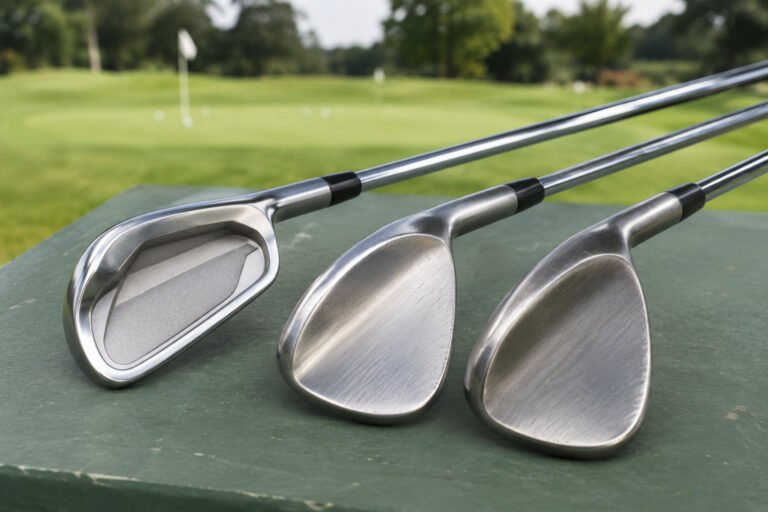
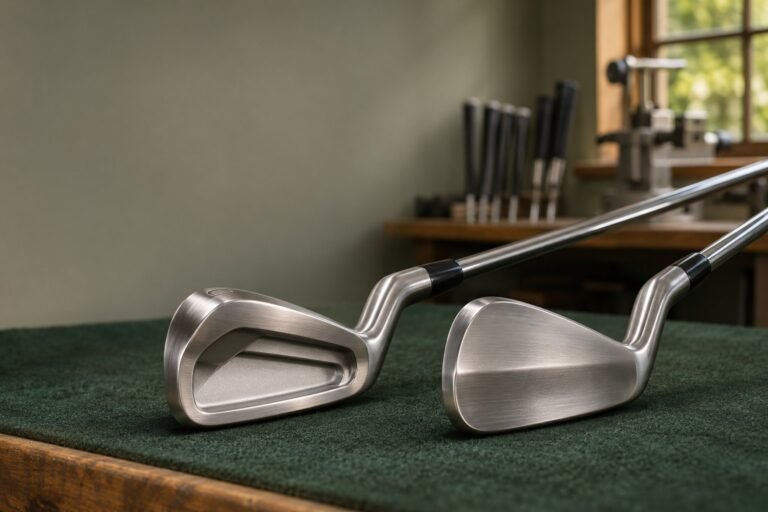
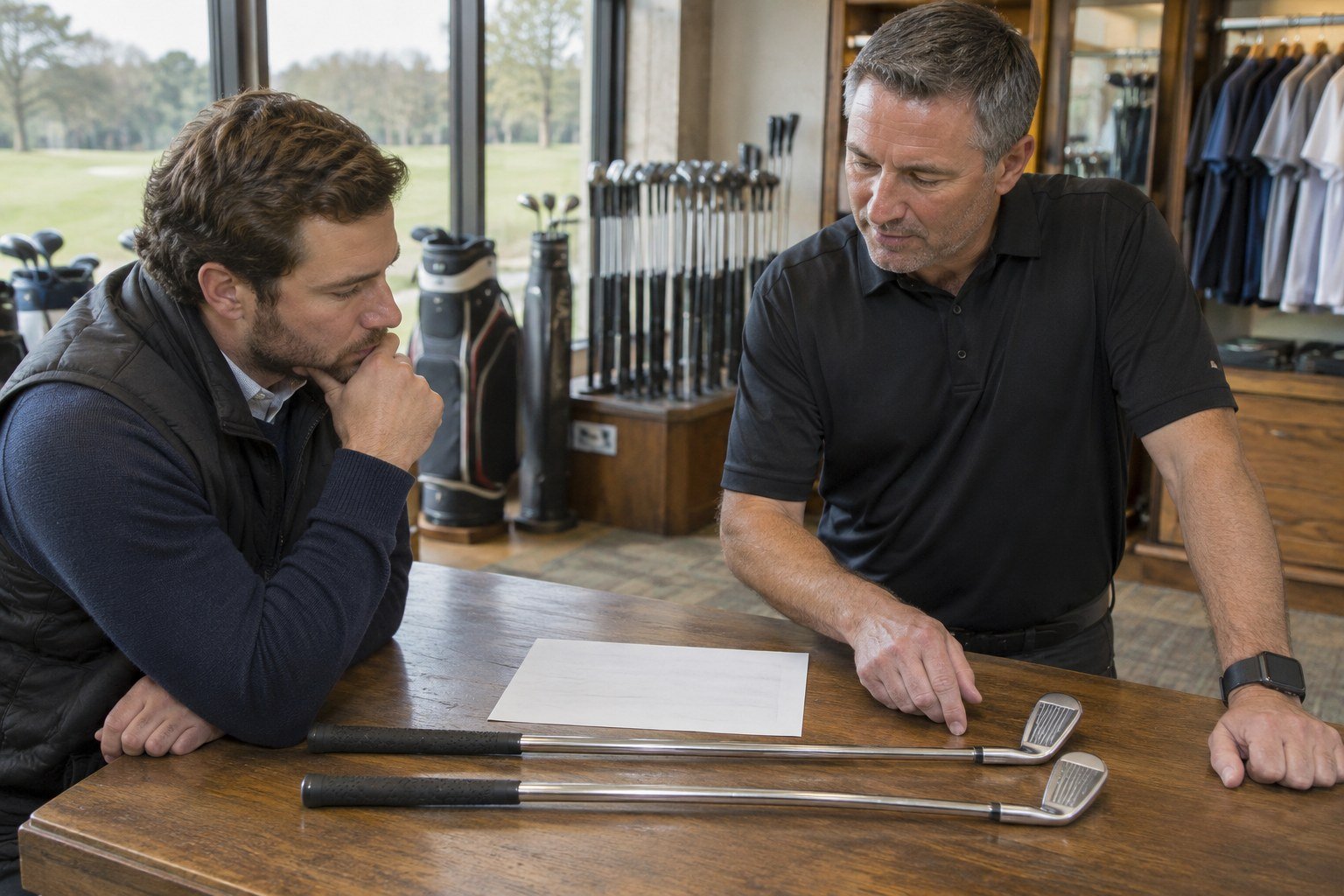
AI illustration of an iron comparison; the clubs are generic and do not depict either model discussed in the guide.
The right irons for mid-handicap golfers start with a reason to change. Your current set may need a more dependable long iron, a better front-to-back pattern or a build that is easier to use. A new badge and a longer best shot do not establish any of those improvements. Define the benefit first, then make a candidate earn the replacement.
Ad – includes affiliate links. If you buy through these links, Taylor’s Trailblazing Golf may earn a commission at no extra cost to you. Recommendations consider fit, drawbacks and alternatives.
Choose the outcome that would make a meaningful difference to your approaches.
Say which useful result you are unwilling to lose in exchange for an improvement.
Compare the present set with the complete proposed build before deciding to replace it.
What should irons for mid-handicap golfers improve?
Start with a sentence about an actual shot: “My ordinary 6-iron misses finish short of the safe part of the green; I want more of them to reach it without bringing the left bunker into play.” That is an upgrade goal. “I have improved, so I need a players iron” is a shopping category looking for a reason.
Choose one main improvement and one result you will protect. You might accept a slightly larger head to reduce short misses, but refuse to exchange them for a wider left-to-right pattern. Your priorities should come from the approaches you play, rather than a model’s place in a range.
| Recurring problem | Improvement worth testing | Result to protect | A misleading win |
|---|---|---|---|
| Ordinary strikes finish short | More shots clear the relevant front boundary | Manageable left and right misses | One exceptional shot travels much further |
| Some approaches run through | More useful landing and stopping behaviour | Enough carry to reach the safe area | A shorter total-distance number with inadequate carry |
| Distances vary too much | A tighter front-to-back pattern on normal swings | The useful distance of solid strikes | A tidy average hiding very short and very long shots |
| One side is expensive | Fewer misses towards that boundary | No new severe miss on the opposite side | The average finishes central because misses split both ways |
| Only the longest irons disappoint | A more dependable long-approach option | The short irons already doing their job | Replacing every club because two struggle |
This is a decision matrix, not a diagnosis. The same short miss could follow poor contact, an unsuitable club choice or a build that does not suit you. Record the pattern before deciding that the head needs replacing.
Also separate performance from preference. Enjoying a different look, sound or finish is a legitimate reason to spend discretionary money. It does not need to be dressed up as a proven scoring improvement.
Back to top ↑Give the current set a fair chance
Your existing irons are the reference because they are the alternative you already own. Record their exact model, shaft, flex label, length and any known loft or lie changes. If the build history is unclear, ask a fitter or club technician to measure it. Do not assume an old set still matches its original catalogue.
Then describe three ordinary uses: a comfortable short-iron approach, a middle-iron approach and the longest iron you actually rely on. For each, note the intended landing area, common miss and whether the problem appears from grass, a mat or both. A useful entry is “7-iron, fairway, often short after a heavy strike”, rather than “irons inconsistent”.
Keep several recent examples when available. Do not rebuild your entire buying brief around one poor round. Equally, do not erase a recurring poor strike because it fails to resemble the swing you hope to have.
Before comparing new heads, have obvious equipment issues assessed. A loose component needs attention; uncomfortable or worn grips deserve their own decision. Ask whether correcting the existing build is feasible and sensible before treating a complete replacement as the only remedy. Structural repairs and loft or lie alterations belong with an appropriate professional.
Write the ownership alternative in full: keep the set as it is, maintain it, investigate a specific adjustment, or change a limited part. That makes the new-set proposal compete against real choices.
Compare complete builds, not matching club numbers
A comparison between two clubs stamped “7” does not automatically compare the same specification. PING lists its G440 7-iron at 37 inches, with loft options of 29° standard, 27.5° Power Spec and 31° Retro Spec. These are published design specifications, not measurements of the particular club in your hand. [1]
That example matters even when you are choosing between two builds of one model. Record the actual configuration before deciding what caused a different result.
| Record | Why it belongs beside the comparison |
|---|---|
| Exact head, version and club | Keeps a different generation or neighbouring model out of the result |
| Actual or confirmed loft and lie | Identifies specification changes concealed by the sole number |
| Shaft model, flex and length | Makes the candidate reproducible; “regular steel” is not a complete order |
| Grip model and size | Prevents a preferred grip from being mistaken for evidence about the head alone |
| Ball and surface | Shows whether the two results came from a comparable task |
| Any adjustments and fitted options | Separates a stock catalogue build from the club you tested |
You are buying a complete club, so its combined result is what matters. There is no need to prove that the head alone deserves the credit. There is a need to avoid testing one combination and ordering a different one because both carry the same model name.
Use two comparisons where possible. First, compare the current and proposed builds to understand what changed. Then choose the appropriate club from each set for the same approach. A new 8-iron might cover the job of your current 7-iron. Assess whether it does that job better, and what happens to the distances on either side.
If changing several variables produces a promising result, have the final configuration written down. If the result is confusing, simplify the next comparison with the fitter instead of collecting more unrelated models.
Judge the flight that reaches your target
For an approach, identify where the ball must arrive through the air and where it may finish. Trackman’s Carry parameter measures airborne distance to the launch elevation. Its Total parameter is a calculated resting distance, using assumptions about flat ground and surface hardness. Those are different answers to different questions. [2] [3]
A simulated total that looks ideal does not establish clearance over a bunker. Nor does reaching a carry number establish that the ball will stay on a particular green. Landing angle influences bounce and roll; with other factors equal, a flatter arrival produces more of both. [4]
For your upgrade decision, use a target area with a near boundary, a far boundary and an acceptable width. Choose them for a representative shot, not to make a favourite candidate look good. Do not turn a single launch or spin number into a universal pass mark.
Keep the comparison recognisable
Use the same type of ball, target and surface for both builds where practicable. Alternate short groups with your current club so a change in timing or tiredness is easier to notice. Keep ordinary poor strikes in the record once the comparison starts. Mark a device error or an interrupted swing separately, with the reason, rather than quietly deleting an inconvenient result.
Ask to see the individual shots as well as the summary. A central average may describe no shot you actually hit. Look at the normal group, the short end and the costly outliers, then ask whether the pattern repeats when you return to the candidate.
If landings cannot be seen or the equipment cannot measure the relevant outcome, leave that question open. An indoor result can narrow a shortlist; an uncertain turf or stopping question still needs suitable evidence. This is a buying method, not a statistically validated minimum-shot protocol.

A worked example: fewer short shots can still be the wrong upgrade
Imagine a golfer whose main problem is finishing short of a safe approach area. The protected result is lateral control. The figures below are invented to demonstrate the decision; they are not results for any named iron. Twelve attempts keep the example readable and are not a recommended proof threshold.
Each build uses the club selected for the same approach role. Record each attempt once: outside the width first, otherwise short, inside or beyond the chosen depth. This avoids counting a short-and-wide shot twice. In this illustration every landing is known.
| Outcome | Current build | Candidate A | Candidate B |
|---|---|---|---|
| Inside the chosen width and depth | 6 | 5 | 8 |
| Short, within the width | 4 | 2 | 2 |
| Outside the width | 2 | 3 | 2 |
| Beyond the depth, within the width | 0 | 2 | 0 |
| Total attempts | 12 | 12 | 12 |
Both candidates halve the short category in this invented sample. Candidate A also creates more wide and long outcomes, so “fewer short misses” is an incomplete verdict. Candidate B is the more promising next trial because its extra useful shots do not come with a worse protected result here.
That is a reason to continue evaluating B, not a guarantee that it is superior. Small samples move around. Repeat the comparison and examine the actual misses: two shots a pace outside the target are a different concern from two shots heading towards a penalty area.
Check club selection before blaming a faster build for long misses. If A was simply the wrong club for the distance, repeat with the appropriate club. The upgrade must work as a set you can use, rather than win or lose through a misleading number-for-number contest.
Back to top ↑Make the improvement survive beyond the demonstration iron
A promising middle iron earns a wider check. It does not settle the purchase of every club bearing that model name. Confirm the shortest club in the proposed set, a middle club and the longest one you expect to use. Give attention to the part of the set where the original problem occurs.
At the short end, establish how the proposed pitching or approach wedge connects to the wedges you will retain. At the long end, establish whether the final iron gives a useful shot before your hybrid or fairway wood takes over. Use your results to judge those joins; a neat loft sequence on paper is only a starting point.
If the current short irons remain dependable, preserve that as an option. A partial replacement or mixed set can be considered, with the build and distance transitions checked. Conversely, keeping familiar short irons purely from habit is not compulsory if a whole-set change shows a clear benefit you value.
The useful question is “Which clubs need changing to deliver the improvement?” A complete set, a smaller change and no change are all valid answers. Avoid adding an unused long iron just because it makes the order look complete.
Back to top ↑Use model claims to choose questions, then compare the fitted order
Product descriptions can help identify what to investigate. They cannot tell you whether a new set beats the irons you own. Two examples show how to keep that distinction useful.
PING G440: establish the loft configuration
The G440’s published loft alternatives make the order specification part of the decision. [1] If it enters your shortlist, compare the configuration you would buy and ask how its results connect to the clubs you will keep. A listing for a particular hand and shaft material is a starting point for an order, not a substitute for the fitted build.
Callaway Quantum Max: test the claimed benefit you need
Callaway describes the Quantum Max’s Ai-optimised face in terms of speed and consistency, and its progressive Tri-Sole in terms of turf interaction across the set. Those are manufacturer claims that suggest useful comparison questions. [5] If your upgrade goal concerns ordinary short misses, examine those misses; if it concerns grass contact, a favourite shot from a mat does not answer it.
Neither example is a recommendation for every mid-handicap player, and this guide has not measured either model. They illustrate the difference between selecting a plausible candidate and establishing a worthwhile purchase.
Once a candidate passes the comparison, obtain a price for the exact clubs, shafts, lengths, grips and adjustments. Include essential work and any changes needed at the ends of the set. Treat an unconfirmed resale estimate as uncertain money. A lower headline set price is less useful if it excludes what your tested configuration requires.
Buy only when the improvement and the compromise are clear
Before paying, complete five sentences. If you cannot, the missing answer identifies the next step.
- My current irons repeatedly struggle with this specific shot or outcome.
- The proposed build improves that outcome in a comparison that includes my ordinary misses.
- The result I wanted to protect remains acceptable, and I understand any new compromise.
- The improvement holds across the clubs I need and joins sensibly to the rest of my bag.
- The written order matches the tested build, and the full cost is worth that benefit to me.
Keep the present set when the advantage disappears outside a few best strikes or merely changes which number you use for the same shot. Investigate maintenance or a specific adjustment when that addresses the actual concern. Repeat the comparison when conditions or missing observations leave the result uncertain.
If the comparison needs professional help, check what a useful club-fitting fee should include and decide what you want the appointment to resolve before paying. A useful session should leave you with a clear current-versus-proposed decision, including the possibility that your existing irons remain suitable.
Replace the necessary clubs when the improvement survives those checks and the trade-off is acceptable. There is no need to graduate into a smaller head, buy the latest release or wait for a particular handicap. The purchase is justified by the shots it helps you play and the limitations you are willing to keep.
Back to top ↑Sources and method
This guide brings together manufacturer information and the sources below. The decision aids are editorial suggestions for your own equipment checks, comparisons or fitting. No personal product test or measured performance result is claimed. Read how we review golf gear for the site’s evidence standards.
- PING UK — G440 iron specifications and loft options
Checked 22 November 2026. - Trackman — Carry parameter
Checked 22 November 2026. - Trackman — Total parameter
Checked 22 November 2026. - Trackman — Landing Angle parameter
Checked 22 November 2026. - Callaway UK — Quantum Max Irons
Checked 22 November 2026.
Illustrations in this article were created for Taylor’s Trailblazing Golf. Third-party photographs, where used, are credited beside the image or in the source list.