Golf Wedge Loft Gapping: Build Around Your Pitching Wedge
Use the actual pitching wedge, then fit the shots between and below it.
- Check the PW loft
- Measure carry gaps
- Map partial shots
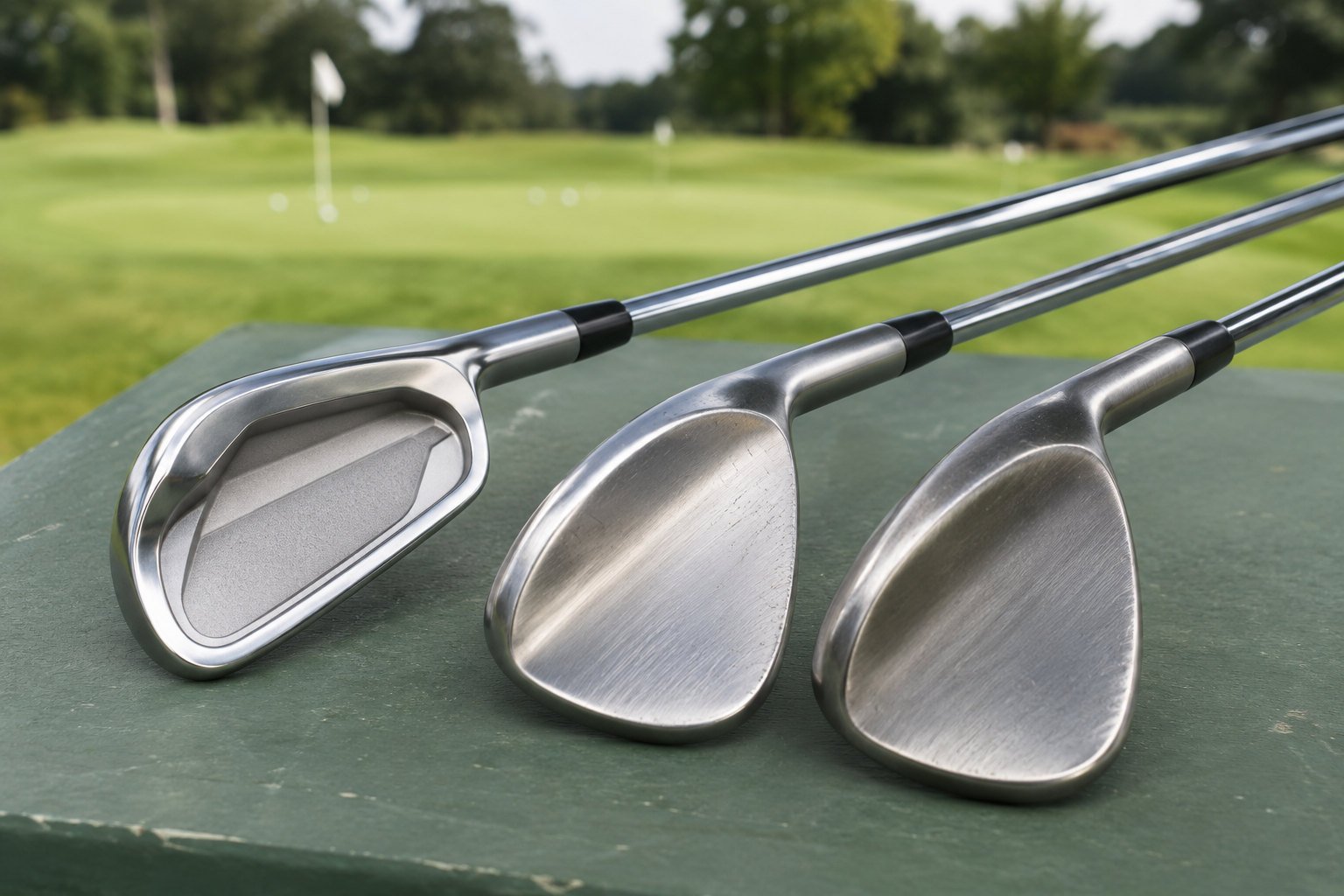
Start the loft map with the pitching wedge you actually play. AI-generated illustrations show generic golf equipment and settings. They are not photographs of the named products or records of product testing.
Golf wedge loft gapping starts with the pitching wedge already in your bag. Its label does not tell you its loft, and its loft alone does not tell you how far you carry it. Buying a familiar 52°, 56° and 60° combination before checking that starting point can leave the first approach gap unresolved.
The useful sequence is to identify the exact pitching wedge, measure its ordinary carry, then compare the next wedge against it. After that, map the shorter shots you actually play. You are building a set of dependable choices, including partial swings, rather than trying to make every loft interval look identical.
The tables below separate current manufacturer specifications from illustrative loft routes and invented carry figures. Use the blank worksheet to record your own clubs and results before placing an order.
Anchor the map
Confirm the actual pitching wedge, including any custom loft or uncertain second-hand history.
Check the first step
Compare a candidate wedge with your pitching wedge before completing the loft sequence.
Keep the useful shots
Record stock and repeatable partial carries, with the strike pattern and landing behaviour.
Golf wedge loft gapping starts with your pitching wedge
Look up the full iron model and generation, then check the specification against the original order. “PW” is a position in the set, not a fixed loft. The current examples below show why the exact variant matters. They are published design specifications, not measurements of an individual club. [1][2]
| Published model or configuration | Pitching-wedge loft | What to check |
|---|---|---|
| PING G440, standard | 42° | Power Spec is 41°; Retro Spec is 42.5°. [2] |
| Titleist T250, standard | 43° | Do not substitute the Launch Spec chart. [1] |
| Titleist T150 | 44° | Use the chart for the exact generation. [1] |
| Titleist T100 | 45° | This is the current published model’s figure. [1] |
| Titleist T250 Launch Spec | 47° | The named configuration changes the starting point. [1] |
Scroll within the table to see all columns.
If your club has been adjusted or its history is unknown, ask a qualified fitter or club repairer to measure it. Do the same for the next club already in the bag: an A, U, G or numbered wedge may already occupy the distance you were about to buy.
Include the 9-iron in the baseline. Vokey’s fitting process begins with an equipment assessment that includes the 9-iron and pitching wedge, looking at specifications such as loft, lie and shaft. That prevents the wedge discussion from starting in isolation from the irons above it. [3]
Write down what is known and what still needs checking. Do not silently turn an online standard specification into a claim about a custom or previously owned club.

Use loft intervals to make a shortlist
Vokey recommends 4–6° of loft separation as its starting guidance for wedge gapping. Treat that as a manufacturer’s fitting suggestion. It is not a universal requirement, and it does not mean every 4°, 5° or 6° step will produce the same carry difference for you. [3]
Two simple paper routes show how the pitching wedge changes the first question. These are arithmetic examples to take into a fitting, not complete bag prescriptions or recommendations for a particular player.
| Starting PW | First candidate | Next candidate | Loft steps to investigate |
|---|---|---|---|
| 43° | 48° | 54° | 5°, then 6° |
| 47° | 52° | 58° | 5°, then 6° |
Scroll within the table to see all columns.
Both routes have the same numerical spacing, but they start from different clubs. Neither tells you whether the first candidate will fly the required distance, or whether the later wedge will suit the pitches and sand shots you need.
Keep the first addition open. If a 43° pitching wedge and a proposed 50° wedge leave a troublesome measured carry gap, compare an appropriate alternative before buying the rest of a matching set. Conversely, a larger loft difference is not automatically a fault if the actual shots cover your needs reliably.
The aim is a useful progression from your existing equipment. Changing every wedge to reproduce somebody else’s loft sequence is an expensive way to avoid measuring that progression.
Measure the first carry gap before buying
Start with ordinary stock swings: the familiar, controlled swing you would choose for a clear approach, not an attempt to find the longest possible shot. Warm up, then compare the pitching wedge with one or two candidates while you can still make representative swings. Alternate short blocks so that one club does not receive all the fresh attempts and another all the tired ones.
Use carry as the main distance reference. Trackman defines carry at the point where the flight returns to the height from which it was launched. That figure excludes subsequent bounce and roll; the landing and finish on a sloping green are separate considerations. [4]
Keep the ball model, hitting surface and intended shot consistent. Record whether a monitor result uses the conditions of the session or a calculated setting, and do not merge those modes without explanation. If you are observing landing areas on a range, label the carries as estimates and avoid false single-yard precision.
Keep ordinary thin, heavy and off-centre results in the main record, with a strike note. Separate a failed monitor reading from a bad golf shot. Then examine both the typical carry and the front-to-back spread, plus the start direction. A candidate that fills a gap on its best strike but repeatedly misses short may not solve the practical problem.
Before booking, ask whether your own pitching wedge can be measured and whether the relevant next-wedge lofts are available in your handedness. The fitting-fees guide explains how to agree the scope and written report.
See how stock and partial carries work together
Illustrative example: every carry below is invented for one unnamed golfer. These are not product-test results, distance goals or a recommended wedge set.
| Club in the example | Stock median carry | Comfortable reduced-swing median |
|---|---|---|
| 43° pitching wedge | 118 yd | 100 yd |
| 48° wedge | 103 yd | 86 yd |
| 54° wedge | 88 yd | 72 yd |
Scroll within the table to see all columns.
The two stock carry steps are each 15 yards: 118 minus 103, then 103 minus 88. The loft steps are different, at 5° and 6°. This invented pattern illustrates why you need both columns of information; it does not suggest that either loft step should produce 15 yards in your set.
The reduced pitching-wedge swing at 100 yards is close to the stock 48° wedge at 103 yards. That overlap need not make either club redundant. They are different shot options to compare for flight, contact, carry spread and the landing area available.
Suppose this golfer often faces an approach around 110 yards. The table does not yet establish a dependable 110-yard shot. The next task is to practise and measure a suitable adjustment, or reassess the first wedge if that gap remains difficult in normal play. Writing a distance between two known numbers does not create a stock shot.
A median is the middle value after sorting the attempts, or the mean of the two middle values for an even count. Keep the individual results and their spread alongside it. A neat median can coexist with too many short misses for the intended target.
Build a small partial-shot map you can remember
Choose one comfortable shorter swing you already recognise, then add another only if it gives you a useful extra shot. Give each intention a plain label that means something to you. If you use “half” or “three-quarter”, record the actual carry rather than calculating it as a fraction of the stock distance.
Keep the face position, lie and intended flight clear. A square-faced pitch from closely cut grass and an open-faced shot from rough should not share one average merely because the same wedge was used. Create a separate entry when the task changes.
Check the repeated landing area first, then the finish. For a running shot, release may be part of the intended result; for a pitch over a bunker, the dependable carry matters immediately. Note the conditions rather than expecting one recorded finish to apply to every green.
Keep one ball model while building this map. If you also want to compare balls, do that as a separate exercise: the structured short-game ball test explains how to record landing and finishing positions without pretending that visual observations measure spin.
Repeat the most useful entries on another day. A simple map you can reproduce is worth more than a page of distances you obtained once by making a different swing for every ball.
Keep a worksheet that joins loft to actual shots
Copy one row for every club-and-shot combination you intend to use. Keep the club specification at the top of the sheet so that a later adjustment or replacement does not inherit the old numbers by accident.
| Field | Your record | Why it matters |
|---|---|---|
| Exact club | Model, generation, hand, stated or measured loft | Identifies the actual starting point. |
| Complete build | Length, lie, shaft, grip; bounce and grind if specified | Distinguishes clubs with the same loft label. |
| Shot intention | Stock / named partial; lie and face position | Keeps different tasks separate. |
| Conditions | Date, ball, surface, weather or monitor settings | Makes later comparisons understandable. |
| Carry evidence | Individual attempts, typical carry, spread and strike notes | Shows whether the shot is dependable. |
| Landing and finish | Observed area or clearly labelled monitor output | Connects distance with the intended target. |
| Next decision | Keep / practise / compare another loft / confirm outdoors | Turns a number into a useful next step. |
Scroll within the table to see all columns.
A matching set wedge and a specialist wedge can both be candidates for the first addition. Compare the finished clubs rather than assuming equal loft makes them interchangeable. Vokey’s fitting sequence selects lofts using fuller shots, then assesses bounce and grind through different shots and turf interaction. That is a useful reason to leave time for the shots beyond the distance chart. [3]
If a loft adjustment is proposed, ask about the exact head and its consequences before authorising it. Titleist has explained, in its WedgeWorks guidance, that strengthening loft can reduce bounce and increase offset. A bend changes more than the number on your map; have a qualified professional assess the work and retest afterwards. [6]

Choose the exact wedge only after the gap is clear
Once you know which loft to test or order, check handedness, bounce, grind and the complete shaft-and-length specification. “A 50-degree wedge” is still an incomplete buying instruction.
For example, the official UK Callaway Opus SP Chrome specification and configurator lists the men’s 50° S-Grind with 10° bounce for right- and left-handed players. Its 50° W-Grind with 12° bounce is listed as right-handed only. Those are distinct choices within the same loft, and current selectable stock should be confirmed before ordering. [5]
If a Vokey option is on your fitting shortlist, Clubhouse Golf’s Vokey SM11 Tour Chrome listing provides loft, bounce and grind choices with custom-fit information. Titleist’s own specification chart lists both 50.08F and 50.12F: each is 50° with the F grind, but the stated bounce differs. Choose the exact tested combination rather than whichever 50° happens to be selected in a basket. [1][7]
These examples help turn a fitting result into an identifiable order. Neither is a recommendation to replace a wedge that already covers the required shots. Confirm the written build, total price and applicable order terms with the seller; do not assume a custom club can be exchanged simply because the loft sequence later proves unsuitable.
After delivery, compare the club with the agreed specification and repeat the first-gap and partial-shot checks. Keep the worksheet current if the pitching wedge, ball or a significant part of the build changes.
Let the pitching wedge anchor a usable shot map
Begin with the pitching wedge you actually play, then use its specification and measured carry to choose the first comparison. Published loft intervals can narrow the options, but your stock and partial shots determine whether the gaps work. Keep the individual results, check the landing job and order the exact build. A wedge earns its place by giving you a dependable shot you need.
Sources
Sources checked on 22 November 2026. Product names refer to the exact models described.
- Titleist UK — Golf Club SpecificationsCurrent T-Series pitching-wedge lofts, Launch Spec distinction and SM11 50° F-grind options.
- PING UK — G440 IronsStandard, Power Spec and Retro Spec pitching-wedge lofts; design-specification qualification.
- Vokey — Get Custom FitManufacturer fitting sequence, assessment of existing 9-iron and PW, and attributed 4–6° starting guidance.
- Trackman — Parameters: Carry (Tee to Green)Definition of carry at the launch elevation.
- Callaway UK — Opus SP Chrome WedgeOfficial UK men’s product table and configuration choices for loft, bounce, grind and handedness.
- Titleist Newsroom — Vokey WedgeWorks 44F Pitching WedgeManufacturer explanation of how strengthening wedge loft affects bounce and offset.
- Clubhouse Golf — Titleist Vokey SM11 Tour Chrome Golf Wedge, Steel ShaftRetail product identity, specification choices and custom-fit ordering information.
Illustrations in this article were created for Taylor’s Trailblazing Golf. Third-party photographs, where used, are credited beside the image or in the source list.