When to Replace Your Irons: Wear, Gapping and Repair Options
Use condition, carry patterns and repair choices to decide how much of the set needs to change.
- Keep, repair or replace
- Carry review
- Workshop brief
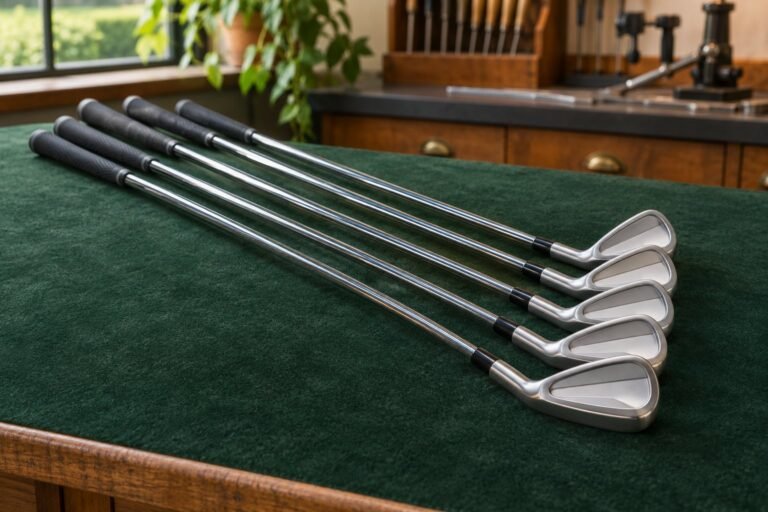
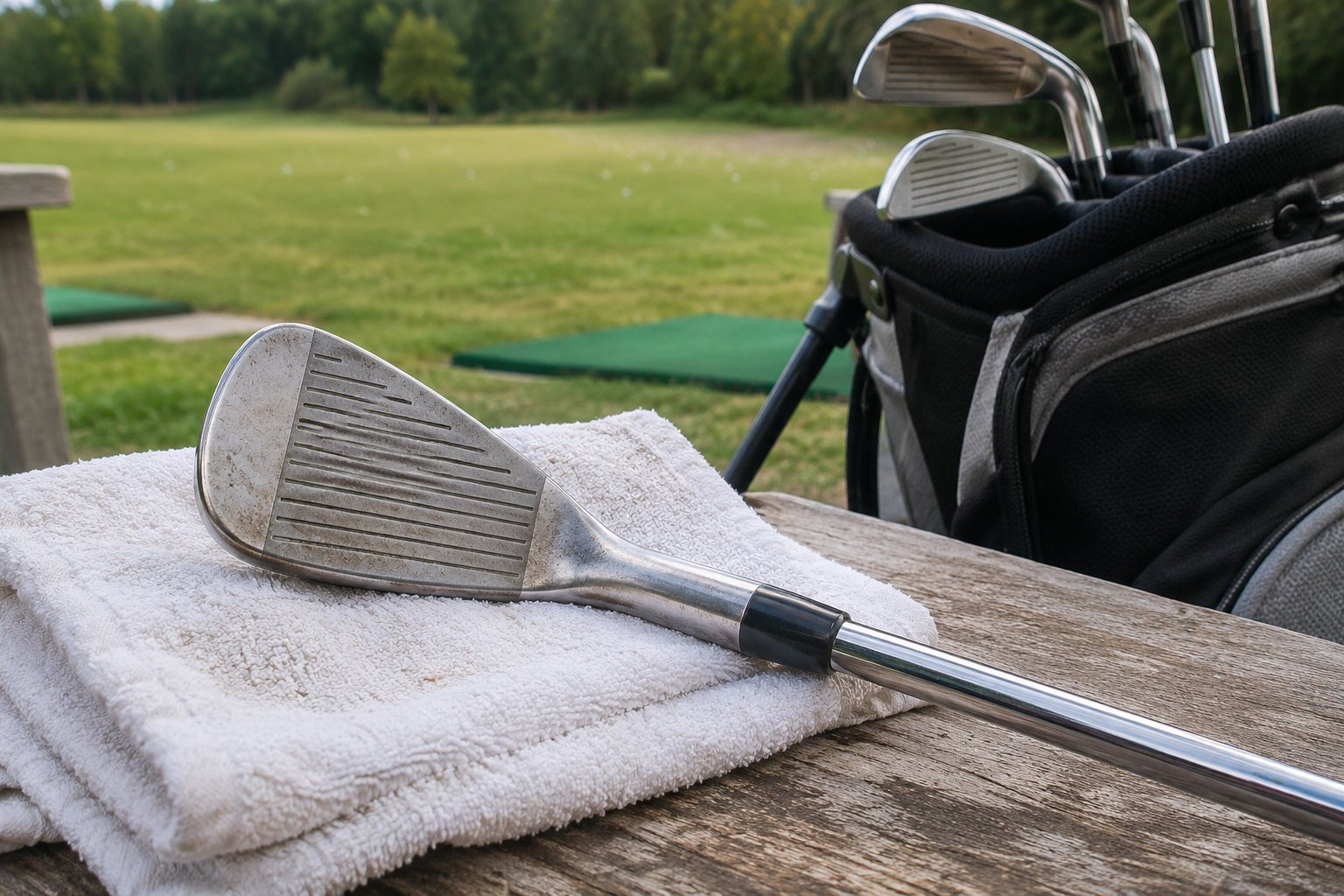
Condition and useful performance are more informative than the age of the set alone. AI-generated illustrations show generic golf equipment and settings. They are not photographs of the named products or records of product testing.
The question of when to replace your irons becomes easier when you name the problem. A slippery grip, a missing 8-iron and two long irons that finish together need different responses. The age printed in a product history does not tell you which response is right.
Start by separating condition from performance. Have possible damage assessed before playing on. If the clubs are sound, compare the shots they produce with the jobs you need, then price the smallest change that could solve the problem.
Keep and monitor
The clubs are sound and their normal shots still cover useful distances. Cosmetic wear alone has not established a reason to replace them.
Inspect or repair
One component, one club or an uncertain alteration is the issue. Find out what can be put right and what the finished repair will cost.
Compare replacements
The problem remains after assessment, affects several clubs, or cannot be solved with a suitable repair. Test a different build against the current set.
First decide whether the club needs inspection
Clean the clubs so you can see the faces, shafts and joints. Separate marks you have always known about from a new change, especially after a heavy impact, transport damage or an unexpected movement in the club.
If you see a possible crack, a bent shaft, a damaged graphite area or movement between head and shaft, stop using that club and ask a qualified technician or the manufacturer’s service channel to assess it. Do not try to prove that it is sound by hitting more balls. A photograph or a home checklist cannot certify a structural repair.
| Observation | Useful next step | What it does not establish |
|---|---|---|
| Ordinary face and sole marks | Clean, inspect and compare with any known change in use | That every marked club needs replacing |
| Grip feels slick or material is breaking down | Assess the grip and price a suitable replacement | That the head or whole set is worn out |
| Possible crack, bend or loose component | Set the club aside for professional assessment | That a home adjustment or cosmetic cover will solve it |
| Unknown extension, reshaft or alteration | Have the actual build checked before deciding what to change | That the original catalogue specification still describes it |
Scroll within the table to see all columns.
A ferrule moving away from the hosel and a head moving on the shaft are different observations. Describe what you can see without diagnosing the cause. The technician needs to establish whether it is cosmetic, repairable or evidence of a larger problem.
PING’s service information lists regripping, reshafting, shaft-length work and loft/lie adjustments among repair requests. That gives you useful questions to ask; it does not mean every operation is suitable for every old club. Confirm the available service for your model through its UK service channel or an authorised retailer. [1]
Separate face wear from grip wear
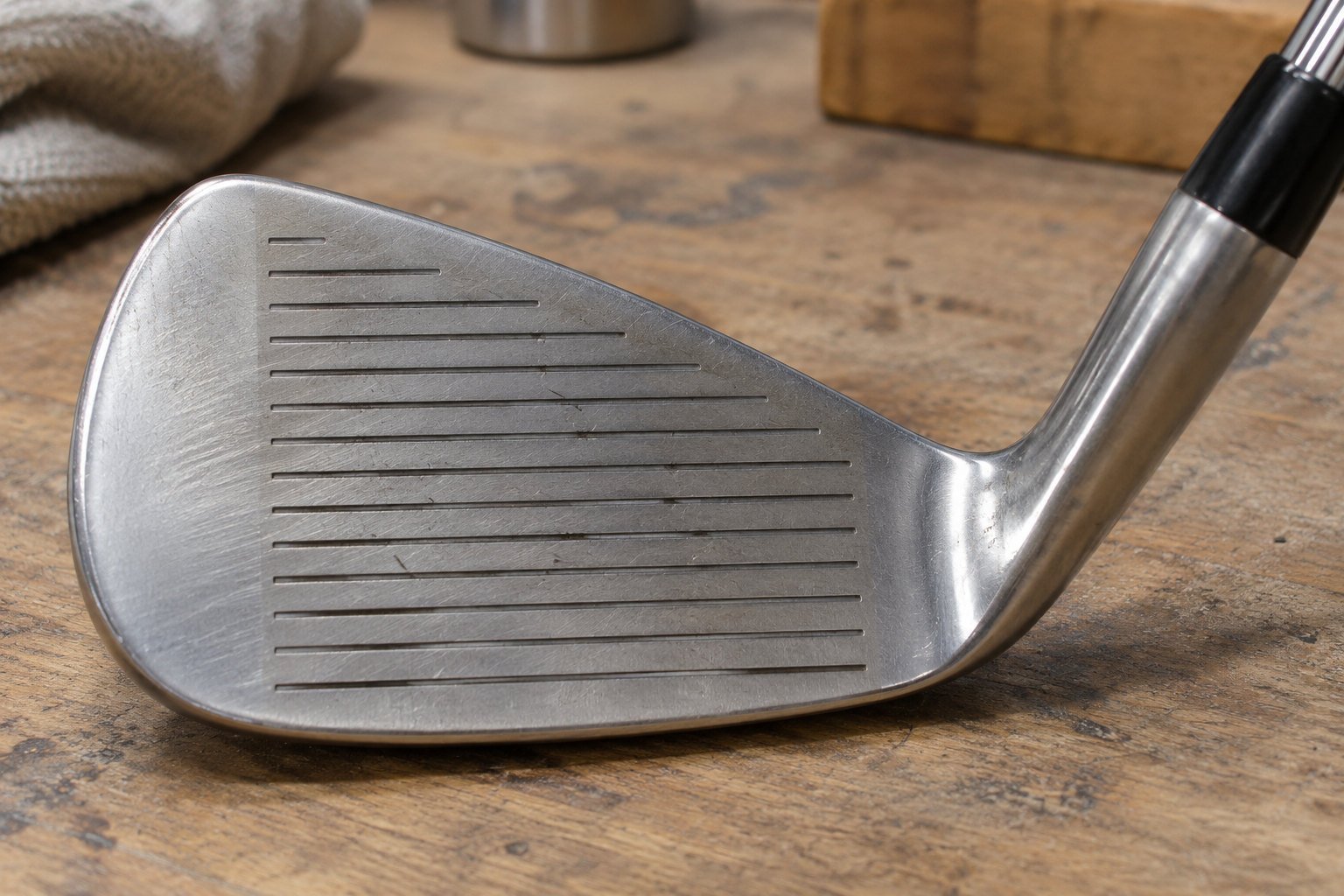
Inspect the most frequently used irons as well as the best-looking one. Note concentrated face wear, damaged groove edges or corrosion that concerns you, then ask for an assessment if their significance is unclear. A shiny strike area is an observation, not a measured estimate of remaining life.
Avoid choosing a whole-set replacement date from a rule about years owned or rounds played. Your decision needs the condition of these clubs and the shots they produce. Likewise, results from a particular wedge-wear comparison should not become an expiry date for every iron in a set.
Check the part you hold
Golf Pride identifies a slick, glossy surface, a harder feel and crumbling rubber or cord as signs of grip wear. Its care guidance recommends regular cleaning with a soft brush, soap and water, plus storage in a cool, dry place away from sunlight. Follow the care instructions for your particular grip and let it dry before reassessing it. [2][3]
If a sound club’s grip still feels unsuitable after appropriate care, price a replacement before shopping for heads. Choose the finished grip size and feel deliberately; our grip-size guide explains why measuring and trying a build is more useful than changing every grip on a guess.
For a concrete component-price example, Clubhouse listed the black, standard Golf Pride Tour Velvet 360 at £6.99 on 22 November 2026. Six would cost £41.94 for the grips alone, before any labour or delivery. That arithmetic is not a regripping quote or a recommendation that this size suits everyone. Ask the installer to confirm the grip, shaft fit and finished build. Check the black Tour Velvet 360 grip at Clubhouse Golf. [4]
Grips are a sensible repair target when the grip is the problem. They should not be presented as a guaranteed cure for distance loss, direction or an inconsistent strike.

Check whether the irons still do separate jobs
A set can be mechanically sound yet leave an awkward distance uncovered. It can also produce a disappointing session without needing replacement. Start by writing the problem as a shot: “my 5-iron adds little usable carry to the 6-iron”, or “I cannot judge the shot between my pitching wedge and next wedge”. That gives you something to investigate.
Use carry for the main approach-distance comparison. Trackman defines its carry value at the same elevation as the launch point, so check how a monitor handles slopes and normalisation. Do not mix that number with the distance a ball finishes after bouncing and rolling. [5]
A practical review session
- Keep the comparison consistent. Use the same ball type, target and broadly comparable conditions. Record whether you are hitting from a mat or turf, and whether the displayed data are adjusted.
- Warm up, then use normal swings. Alternate clubs in short blocks so fatigue or a changing swing does not all fall on the last iron.
- Keep a record of the ordinary misses. Mark obvious mishits and unreliable readings, but do not present only your longest or prettiest shots as everyday performance.
- Look at the group. Record typical carry, the spread of carry distances and the left-to-right pattern. Compare what happens when contact is less than ideal.
- Repeat an unclear result. A small difference in one short session is a reason for another comparison, not proof that an iron has become obsolete.
There is no need to force every gap to one yardage. Ask whether the clubs give you distinguishable, useful options for your course and whether the shots land in a way you can use. Trackman explains that landing angle influences bounce and roll; extra distance by itself does not establish better approach control. [6]
| Pattern you find | Question to investigate | Possible next step |
|---|---|---|
| Two longer irons produce similar carries | Is the issue strike, flight, build or the job assigned to them? | Assess those clubs and compare a suitable alternative for that part of the bag. |
| One iron behaves differently from its neighbours | Does its actual specification or condition differ? | Inspect and measure it before replacing the set. |
| Every iron is shorter in one session | Did balls, conditions, measurement settings or your delivery change? | Recheck under comparable conditions before attributing the result to wear. |
| Sound clubs repeatedly leave a useful shot uncovered | Would a different build or club selection address that shot? | Take the evidence to a fitting comparison. |
Scroll within the table to see all columns.

A missing or damaged iron does not settle the whole-set decision
Identify the exact model and generation before searching for a replacement. Record the club number, hand, shaft model and flex, length, lie, loft and grip build. Retain any serial information and original order details. The same number stamped on a different head does not establish the same specification or useful distance.
There are manufacturer routes worth checking before accepting a poor match. PING’s current UK G430 page labels the model as fill-in or replacement only. It instructs owners to order through an authorised PING retailer with a valid serial number and to confirm product and component availability with Consumer Relations. That is a specific route for this model, not a promise that every discontinued iron remains available. [7]
For an existing Apex Ai200 set, review the Apex Ai200 single-club fields at Callaway UK. The page separates Sets and Singles and includes shaft, length, lie and loft fields. Confirm the exact replacement selection and component availability with Callaway; the presence of configuration fields does not prove that every combination can currently be ordered. [8]
A used matching iron may also be worth considering. Ask for its measured specification and condition, and budget for any agreed work. After repair or replacement, compare its carry and flight with the neighbouring irons. Matching the model badge is the start of that check.
If the exact match cannot be sourced, take the adjacent irons to a fitter. The goal is a club that fills the required job without an awkward transition. You may need to change one part of the set, but the absence of one original head is not evidence that every remaining iron has stopped being useful.
Get a repair quote you can compare with replacement
Give the technician a description of the problem, not just an instruction to replace a part. “This shaft feels different from the others and the club was bought separately” is more informative than ordering a reshaft without an assessment.
| Put this in the brief | Ask for this in the answer |
|---|---|
| Model, club number, known build and alteration history | What the technician found and any remaining uncertainty |
| The condition concern or repeatable shot problem | Whether the proposed work addresses that concern |
| Which neighbouring clubs the iron must work with | The proposed finished specification and how it will be checked |
| Your budget and timing | Parts, labour, shipping, component availability and completion estimate |
| Any original purchase or warranty information | Whether a manufacturer assessment is appropriate before paid work |
Scroll within the table to see all columns.
Separate an inexpensive local repair from rebuilding most of the set. A replacement grip, a single suitable shaft repair and a full reshaft are different proposals. Compare the complete quoted result with a suitable replacement, including any fitting or follow-up work needed on that replacement.
Do not approve loft or lie work on the assumption that all heads tolerate the same change. Have the technician confirm what is appropriate for that exact model, condition and alteration history. There is no useful universal “safe number of degrees” to apply here.
After the work, ask what was actually changed and keep the specification with your club records. Check the repaired club against the original problem and its neighbours. If the result is still uncertain, resolve that before paying to apply the same change across every iron.

When to replace your irons: the case for a different set
Move towards a different set when assessment finds broader condition problems, necessary components or repairs are impractical, or a well-run comparison shows that a different build solves a persistent issue across the irons. You may also find that your current club selection no longer matches the shots you want to play.
Bring sound current clubs to the fitting. Compare an iron near the middle of the set, but also check the longest iron you expect to use and the transition into your wedges. A pleasing demonstration with one 7-iron does not tell you how the whole proposed set will work.
Write down the actual improvement you want to retain: more dependable carry, a useful separation between clubs, a manageable miss or a flight that works on your approaches. Check the head and build specifications when comparing distance. A longer shot with a differently lofted club is not, on its own, evidence that your old face was worn out.
For the service questions, our golf club fitting fees guide explains what to ask about current-club comparisons, written recommendations and purchase credits.
Finish with one clear decision
- Keep: the set is sound and useful; record a baseline and revisit a specific change in condition or performance.
- Repair: the issue is identified, the work is appropriate and the finished cost makes sense.
- Replace one part: a matching iron or a different top or bottom club solves a local gap.
- Replace the set: the broader case is established and the proposed build has been compared with what you already own.
A desire for new irons is a legitimate personal preference too. Keep that separate from a claim that the existing set has reached a technical expiry date.
Replace the problem you have identified
Start with inspection, then review the useful shots and get a written quote for any proposed work. A sound set with dependable gaps may only need care. A worn grip or one missing iron may call for a small intervention. Replace more of the set when the condition assessment or a fair performance comparison gives you a clear reason to do so.
Sources
Sources checked on 22 November 2026. Product names refer to the exact models described.
- PING UK — Frequently Asked QuestionsManufacturer repair categories and product-assessment information. Confirm model-specific UK service arrangements.
- Golf Pride — Grip WearManufacturer examples of slickness, hardening and material breakdown. No universal replacement interval adopted.
- Golf Pride — Grip CareCleaning and storage guidance; regional sales promotions are not relevant to this article.
- Clubhouse Golf — Golf Pride Tour Velvet 360 Grip, BlackStandard black grip, product GRGOL039, £6.99 component price checked 22 November 2026; installation is a separate cost.
- Trackman — What Is Carry?Carry definition at the launch elevation and its relevance to approach shots.
- Trackman — Parameters: Landing AngleLanding angle and its relationship with bounce and roll. No universal player target prescribed.
- PING UK — G430 IronsCurrent fill-in/replacement instructions, serial-number requirement and component-availability qualification; checked 22 November 2026.
- Callaway UK — Apex Ai200 IronsSet and single-club configuration fields; exact replacement availability and build must be confirmed.
Illustrations in this article were created for Taylor’s Trailblazing Golf. Third-party photographs, where used, are credited beside the image or in the source list.