Wedge Length and Lie: What to Check in a Fitting
Bring your current clubs, test the shots each wedge must play and leave with dimensions that can be measured again.
A wedge at address illustrates the setup question; a static view does not establish the correct lie at impact.
Some links in this guide are affiliate links. If you buy through them, Taylor’s Trailblazing Golf may earn a commission at no extra cost to you.
Wedge length and lie deserve more attention than a quick instruction to copy your irons. Your gap wedge may spend most of its time on approach shots; your highest-lofted wedge may be used with a shorter grip and an open face. A useful fitting has to accommodate those jobs.
Begin with the clubs and shots you already know, then compare changes against that baseline. This research-led guide explains what to bring, how to make the trial useful and what to put on the order. It does not prescribe a personal length or lie angle from your height or handicap.
Bring the pitching wedge and every wedge being considered for replacement or adjustment.
Identify the approach, pitch, chip and bunker shots each wedge must retain or improve.
Compare suitable demonstration builds before committing to cutting or bending.
Keep the measured baseline, agreed finished dimensions and exact order together.
Give the fitter a job for each wedge
Vokey’s fitting guidance starts with your existing equipment, including short-iron loft, lie and shaft specifications. Its process then moves through distance gaps and greenside shots. That is a helpful sequence for a length-and-lie appointment: the dimensions need a playing purpose. [1] [2]
Bring the ball you normally play if the venue allows it, your golf shoes, and any previous fitting sheet. Tell the fitter which shots are dependable and which misses are costly. “My 56° is awkward on a short pitch” gives the session a clearer task than “I think all my wedges should be flatter”.
Swipe within the table to see all columns.
| Wedge’s main job | Bring this observation | Ask to protect or improve |
|---|---|---|
| Approach club | Typical carry and whether the start line is repeatedly left or right | A comfortable normal grip, reliable strike and a useful distance gap |
| Everyday pitch-and-chip club | How far down you normally grip and your common turf conditions | A setup you can repeat on shorter swings |
| Open-face or bunker club | The shots you actually attempt, including your usual face position | Usable sole contact and confidence in the intended setup |
| One wedge covering several jobs | Which shots matter most often, rather than the most impressive shot | A workable compromise across those jobs |
This is a preparation worksheet, not a diagnosis. A miss pattern gives the fitter something to investigate; it does not identify the cause by itself.
What wedge length and lie measurements tell you
Playing length describes the finished club, measured using an agreed method. Static lie is the club’s specified shaft-to-ground angle; dynamic lie describes the angle of the lower shaft relative to the horizontal at impact. Trackman identifies dynamic lie as relevant to turf interaction, strike location and launch direction. The two lie values need not be identical when a golfer delivers the club. [3]
PING describes taking height, wrist-to-floor and hand measurements to establish initial iron specifications, then refining them through shots and fitter assessment. Treat a static recommendation as the beginning of your wedge conversation. It cannot show how you play a delicate pitch or what happens when you open the face. [4]
Do wedges have to match your iron lie?
Use your iron specification as context, then ask the fitter to test whether it works for each wedge’s role. There is no useful universal instruction to make every wedge one degree flatter. Equally, a familiar iron setting should not be discarded merely because a wedge has more loft. Require a reason tied to your repeated results.
For the broader iron discussion, see our guide to checking iron lie before adjustments. Here, the extra requirement is to assess the shorter and more varied shots that distinguish wedge use.
Check the actual stock specification
“Standard” needs a model name beside it. The Titleist UK specification table, checked on 23 November 2026, lists the following stock dimensions for Vokey SM11 wedges. These are useful reference points, not recommended measurements for you. [5]
Swipe within the table to see all columns.
| SM11 loft group | Listed stock length | Listed standard lie |
|---|---|---|
| 44°, 46° and 48° | 35.75 inches | 64° |
| 50° and 52° | 35.50 inches | 64° |
| 54° and 56° | 35.25 inches | 64° |
| 58° and 60° | 35.00 inches | 64° |
This example shows why a wedge set need not progress by the same length increment at every loft. It also shows why ordering every wedge “half an inch longer” does not mean every finished club will be the same length.
Measurement conventions deserve a check when comparing brands or older equipment. Callaway’s FAQ explains that its change to a ground-plane measurement method altered some published lengths without changing the physical clubs. Ask the fitter to measure your current and trial clubs consistently, and have the seller confirm how the final order will be specified. [6]
A relative instruction such as “one degree flat” should sit beside an absolute target: for example, a 63° target relative to a confirmed 64° model standard. Ask the fitter to put both the standard and agreed final angle on the order.
Find a usable length before finalising lie
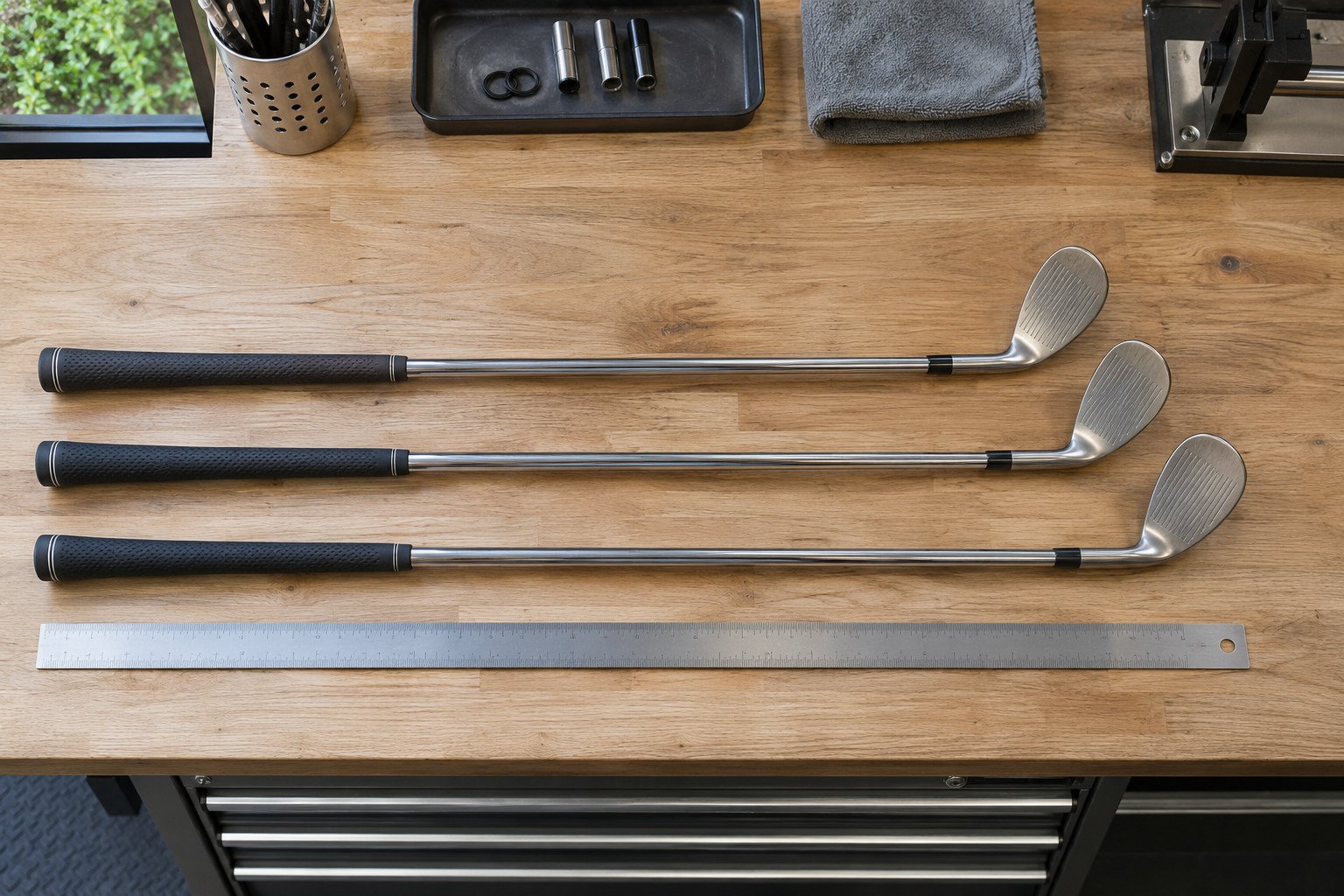
Ask to compare lengths that let you address the ball comfortably and swing without deliberately standing taller or crouching to suit the club. Agree the grip position for each shot before judging the result. Otherwise, a trial club may appear shorter simply because you have moved your hands.
A brief grip-down trial with your own wedge is a useful conversation starter. Record where your hands are and how the setup feels. It does not reproduce every aspect of a permanently shortened build, so use the observation to request an appropriate demonstration club rather than treating it as a cutting instruction.
Use a small, repeatable comparison
- Hit a short group with your current wedge using a familiar shot.
- Try the proposed length on the same shot, keeping the ball and target consistent.
- Return to the current club before changing to another shot.
- Record comfort, strike location, start direction and carry spread. Keep the ordinary misses in the record.
For an approach wedge, include the normal full or controlled approach swing you use on the course. For a wedge mainly used around the green, include the shorter swing and lower grip position you actually play. A length that feels pleasant while wagging the club has only passed the setup check.
Ask which other parts of the demonstration build differ. If the head, shaft, grip and length all change together, the comparison can identify a preferred whole club, but it cannot isolate length as the reason.

Check lie across your real wedge shots
Once a workable trial length is established, ask the fitter to assess delivery with the proposed build. Vokey’s fitting process explicitly combines ball flight, divots and turf interaction when assessing lie, bounce and grind. A mark or a number becomes more useful when it agrees with what the shots are doing. [2]
Swipe within the table to see all columns.
| Shot to include | Useful observations | Question for the fitter |
|---|---|---|
| Normal approach | Repeated strike, initial direction and carry pattern | Does the proposed lie improve the pattern without requiring a new setup? |
| Stock partial pitch | Your usual grip position, contact and landing pattern | Does the change still work on a shorter swing? |
| Normal chip | Ease of setup and whether contact stays predictable | Are we preserving the shot I use most often? |
| Open-face shot or bunker shot, where relevant | Your actual face position and the sole’s interaction with the surface | Is this a lie issue, a sole choice or a technique question? |
Do not demand that every shot produce the same measurement. Changing the setup changes the question being asked. Agree which shots have priority and whether the final club makes an acceptable compromise.
A photograph with the toe raised at address does not, on its own, explain delivery at impact. Nor should one poor strike trigger another adjustment. Ask what evidence repeats and what remains uncertain. If the session is indoors, identify any turf or bunker question that needs a later outdoor check.
When the difficulty appears to be the sole’s interaction with the ground, our guide to manufacturer wedge-grind labels helps separate that buying choice from length and lie.

Leave with a complete fitting and order sheet
The most useful fitting record links the change to a reason and makes the final club reproducible. Ask for one line per wedge rather than a single instruction covering the entire set.
Swipe within the table to see all columns.
| Record | What to write down |
|---|---|
| Club identity | Brand, model, finish, handedness, loft, bounce and grind |
| Measured starting club | Current finished length and lie, plus any known previous alterations |
| Agreed final dimensions | Finished length in inches, lie in degrees and the model standard used for any relative adjustment |
| Remaining build | Exact shaft and flex, grip model and size, and any agreed build-weight target |
| Playing reason | Priority shots, observed benefit and any compromise accepted |
| Trial conditions | Ball, mat or turf, grip position, and shots still awaiting an outdoor check |
| Supply and verification | Who will build or adjust it, confirmation of feasibility, and the collection check |
Keep the trial notes separate from the order. “This felt easier” is useful feedback; it is not a manufacturing specification. “One degree flatter than my old wedge” is also incomplete unless the old wedge’s actual lie was measured.
Before authorising an alteration, have the fitter confirm that the exact head and build can accommodate it. Cutting, extending or bending should be a club-building decision, including a check of the finished result. If the proposed adjustment cannot be achieved appropriately, compare a suitable alternative build.

Decide whether to keep, adjust or order
Keep the current wedge when its setup is comfortable, the priority shots work and the trial does not produce a worthwhile repeatable improvement. A fitting can confirm a good existing choice.
Consider an adjustment when the head and sole already suit the task, a trial supports the change, and the builder confirms the work is feasible. Ask for the full cost before deciding.
Consider another wedge when the preferred result depends on a different head, sole or build, or when an appropriate adjustment is unavailable. Compare the complete club rather than buying a head and assuming the dimensions can be corrected afterwards.
Check the exact order against a current UK listing
Clubhouse Golf lists the Titleist Vokey SM11 Tour Chrome steel-shaft wedge, while Callaway’s UK store lists the Opus SP Chrome. These are relevant places to check an order after a fitting. Neither listing establishes that a particular custom length, lie, handedness or grind is available for your chosen combination; confirm those details with the seller before buying. [7] [8]
Check SM11 Tour Chrome at Clubhouse Golf
Check Opus SP Chrome at Callaway UK
Use the written specification as your shopping list. If a seller cannot confirm it, resolve the difference before placing the order rather than substituting an apparently similar stock wedge.
Make collection part of the fitting
Bring the fitting sheet when you collect the club. Ask the builder or fitter to verify the finished length and lie, then check the head, shaft, grip and handedness against the order. Repeat the priority shots if the venue allows it, using the grip positions agreed during the trial.
For your first practice session, start with one familiar approach and one familiar greenside shot. Note anything that consistently differs from the trial; take those observations back before requesting another change.
Your final question should be: “Which measured change helped which shot, and can we verify that change in the club I am taking away?” A clear answer is more valuable than a fashionable lie setting or a standard length chosen without a trial.
Sources and checks
- Vokey — Wedge Fitting FAQsManufacturer fitting guidance, published 20 June 2024; existing equipment, gapping and greenside assessment.Checked 23 November 2026.
- Vokey — The Wedge Fitting ProcessManufacturer process: current short-iron specifications, gap fitting, and assessment of turf interaction, divots and ball flight.Checked 23 November 2026.
- Trackman — Dynamic LieTechnical definition of dynamic lie and its fitting relevance; updated 18 August 2025.Checked 23 November 2026.
- PING — How We FitManufacturer explanation of initial static measurements followed by shot analysis and refinement.Checked 23 November 2026.
- Titleist UK — Custom Components and Club SpecificationsCurrent SM11 stock length and lie table; dimensions are model specifications, not personal recommendations.Checked 23 November 2026.
- Callaway — Club-Length Measurement FAQManufacturer explanation of its ground-plane measurement change and published-length conventions.Checked 23 November 2026.
- Clubhouse Golf — Vokey SM11 Tour Chrome Steel ShaftExact UK retailer destination checked; no price, stock or custom-build availability promise.Checked 23 November 2026.
- Callaway UK — Opus SP ChromeExact UK manufacturer shopping destination checked; configuration availability must be confirmed.Checked 23 November 2026.
Illustrations in this article were created for Taylor’s Trailblazing Golf. Third-party photographs, where used, are credited beside the image or in the source list.