Golf Ball Dimple Patterns: What Can Buyers Actually Verify?
Check the specification, identify the generation and match each conclusion to its evidence.
A model name and a dated specification offer more useful buying evidence than an unfamiliar pattern alone. AI-created illustration of generic golf balls.
A dimple count looks reassuringly precise. It is a number you can put beside another number, unlike a promise of exceptional flight. The useful buying question is what that number establishes—and what still needs evidence.
Ad – includes affiliate links. Taylor’s Trailblazing Golf may earn a commission from qualifying purchases. Our recommendations follow the reader’s needs and the available evidence. Read our disclosure.
Golf ball dimple patterns: what does the specification describe?
Dimples belong to the ball’s aerodynamic design. Titleist identifies their arrangement, depth, count and edge angle as design variables, considered alongside the ball’s speed and spin. That is already a broader description than “more dimples” or “fewer dimples”. [1]
Swipe or scroll the table to see all columns.
| Feature | What to look for | What it does not establish alone |
|---|---|---|
| Count | The published number of dimples for the exact model. | A ranking of performance or quality. |
| Shape and arrangement | The description of individual recesses and how the pattern is organised. | The full three-dimensional surface geometry. |
| Depth and edge profile | Any actual dimensions or explanation the maker supplies. | Dimensions absent from the description or photograph. |
| Flight claim | The stated result and the evidence behind it. | A measured advantage over your current ball. |
Read a pattern name as a description that needs context. It may refer to geometry, a development concept or a branded package of features. If the page does not explain the term, record that gap. You do not need to invent a technical translation to make a sensible purchase.
Three dated specifications you can check
These examples show what a buyer can verify in manufacturer documentation. They are not a performance shortlist, and a familiar model name should not be assumed to retain the same specification indefinitely.
Swipe or scroll the table to see all columns.
| Exact example | Manufacturer’s published detail | Supported conclusion |
|---|---|---|
| Titleist 2025 Pro V1 | 388 dimples in the stated spherically tiled tetrahedral design. [2] | The 2025 launch documentation identifies that count and design. |
| Titleist 2025 Pro V1x | 348 dimples in the stated spherically tiled tetrahedral design. [2] | A closely related model has a different published count. |
| Srixon 2025 Z-STAR | 338 Speed Dimple Pattern in the 2025 Z-STAR Series announcement. [3] | The count and named pattern are documented for that generation. |
The table deliberately stops short of calling 388 better than 348 or 338. The models are complete golf balls with other design differences. Counting one feature does not hold those differences constant, and the figures are not measured results from a comparison conducted for this article.
Keep the date with your note. A retailer may sell more than one generation under a similar family name. If its photograph, title and description disagree, ask which version will arrive. A clear answer about the supplied ball is more useful than another paragraph of general aerodynamic language.
Sort the claim before judging the evidence
A technical product page can contain a specification, an explanation of the maker’s design intention and a performance claim in adjacent sentences. Give each its own treatment. Srixon’s 2025 announcement, for example, supplies a dimple count and also describes intended aerodynamic benefits. Confirming the first does not independently measure the second. [3]
Swipe or scroll the table to see all columns.
| Statement you encounter | Evidence needed | Useful buying response |
|---|---|---|
| “This model has 338 dimples” | An identifiable manufacturer specification for that model and generation. | Record it as a documented specification. |
| “This pattern is designed for consistent flight” | The maker’s explanation; comparative evidence if an advantage is claimed. | Attribute the design claim rather than treating it as your result. |
| “It has more dimples, so it must be better” | A relevant comparison that could support the proposed conclusion. | Do not use the count as a quality score. |
| “This is the same pattern as the older ball” | Matching generation-specific documentation, including what “same” means. | A shared count alone does not settle the claim. |
Depth is a good example of the missing detail
Titleist describes a development stage in which engineers adjust dimple depths and edge angles after identifying a pattern for a particular ball construction. That illustrates why a count is an incomplete description: further design work can happen without the number itself explaining the change. [4]
You do not need access to a manufacturer’s entire design file. You do need to recognise when the retail information runs out. “Depth not published in the source I checked” is a useful entry in your notes. A depth guessed from a glossy photograph is not an improvement on that honest gap.

Use a compact claim-audit worksheet
The following is an original buying worksheet, not a test of aerodynamic performance. Complete it for a ball you are considering. Its purpose is to stop a specific fact becoming a much larger conclusion as you move between a product page, a shop listing and your shopping basket.
Swipe or scroll the table to see all columns.
| Field | What to write | What to do with uncertainty |
|---|---|---|
| Identity | Full model, generation, colour or other variant, and the retailer’s item description. | Ask the seller before comparing two uncertain versions. |
| Published detail | The actual count or pattern description, with the original source and date. | Leave unavailable dimensions marked as not supplied. |
| Claim type | Specification, manufacturer design claim or measured comparison. | Do not promote a claim to a measurement. |
| Comparison conditions | For a reported result: comparator, launch conditions, method and what was measured. | If those details are missing, limit the conclusion accordingly. |
| Buying consequence | The practical reason this information changes your choice, if any. | No useful consequence is a valid result; keep the existing shortlist. |
A worked example without invented test results
Suppose you are checking the 2025 Pro V1. The manufacturer’s announcement supports recording a count of 388. It also identifies the 2025 Pro V1x as having 348. Your audit can therefore verify the two published counts. It cannot conclude from those figures that the first ball is longer, more accurate or better suited to you. [2]
The useful next step is to check that the retailer’s item is the intended generation, then decide whether the complete ball deserves a trial for your actual needs. Nothing in that process requires awarding extra points to the larger number.
If a comparison does report results, ask what was compared. Two different complete balls can answer a whole-ball question. They do not automatically isolate the effect of their dimple patterns. A result for one set of launch conditions also needs care before it becomes a claim about every golfer.
What a close-up photograph can and cannot verify
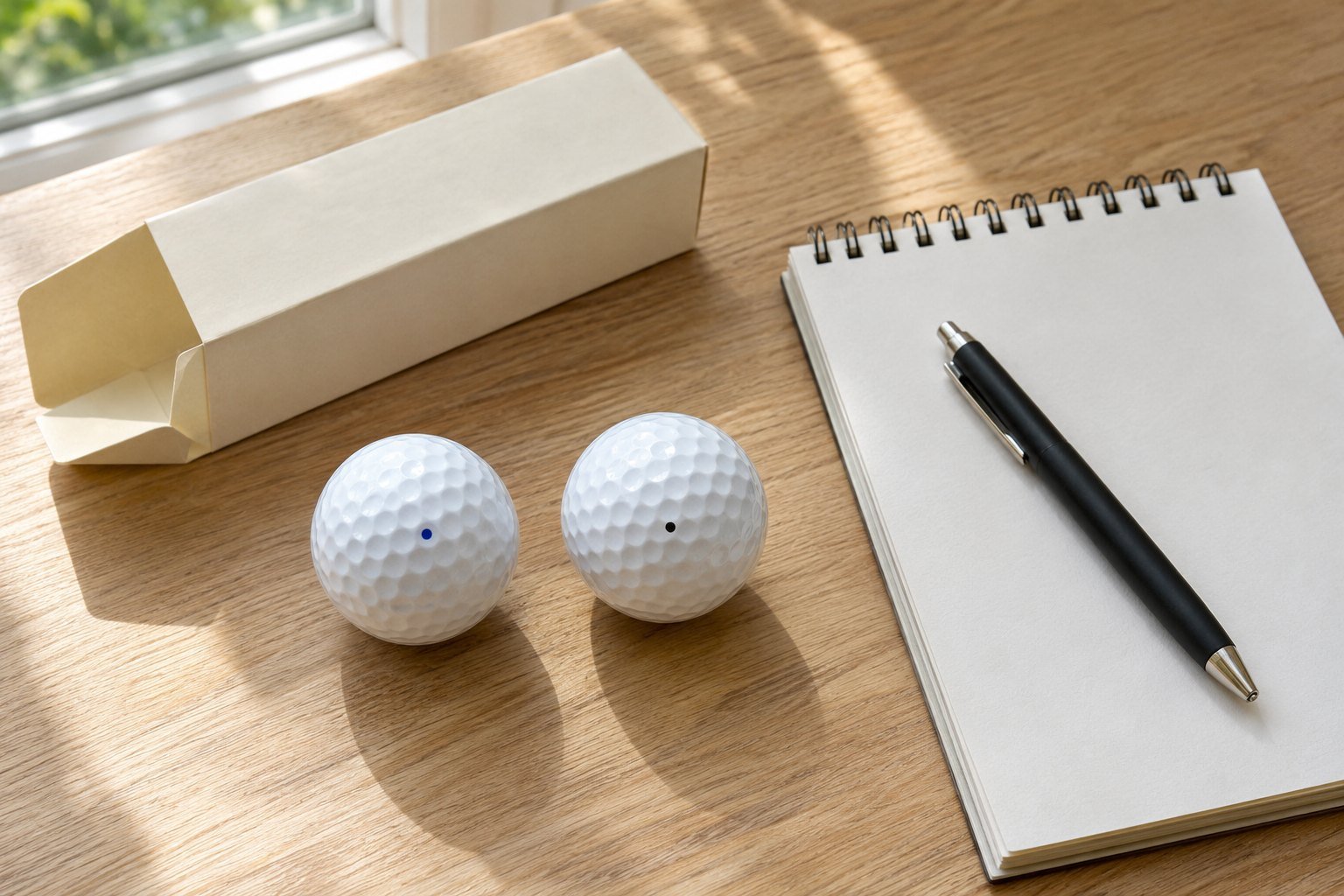
A clear photograph can help you read original markings, compare the supplied item with its packaging and notice visible surface features. It is also useful when asking a seller to resolve a mismatch. Photograph the ball and its sleeve together so that the image retains that context.
It is a much weaker tool for establishing small three-dimensional dimensions. Lighting and viewpoint change how a recess looks, and a single view does not show the whole sphere. Manually counting an unfamiliar pattern is possible in principle, but it is easy to lose your place. A published manufacturer specification is generally the more practical starting point.
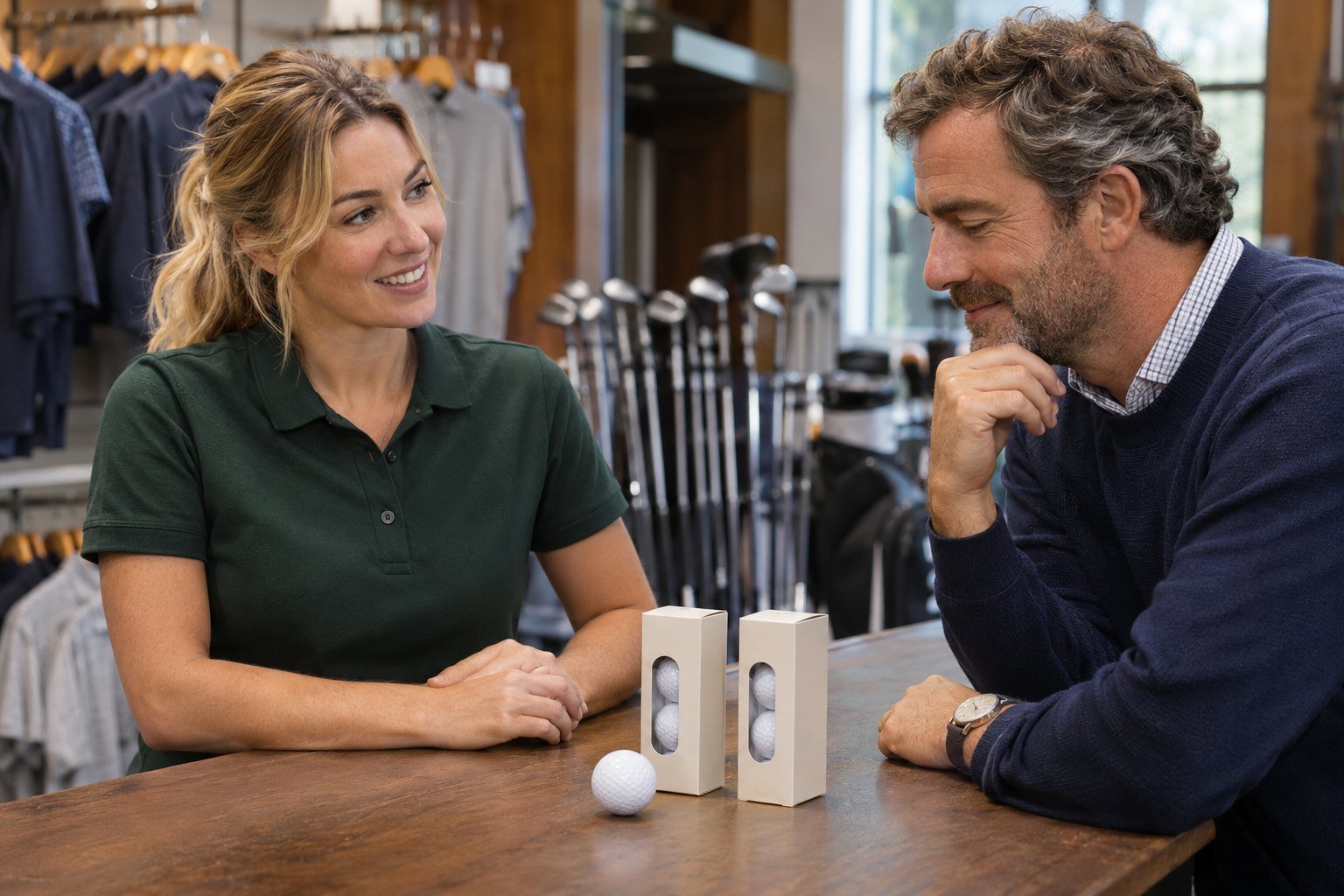
Even a correct manual count would establish only that count. It would not reveal every depth, edge profile or aerodynamic property. The generic AI-created images in this guide are illustrations of the buying process; none is evidence for a named model’s pattern or count.
Conformance is a separate check from performance preference
The R&A’s Equipment Rules cover matters including ball size, weight, spherical symmetry, initial velocity and the Overall Distance Standard. The symmetry requirement concerns the ball’s properties and behaviour. These standards are not a retail league table based on dimple count. [5]
The R&A also explains that models submitted and found to conform enter the List of Conforming Golf Balls, updated monthly. A competition may adopt a Local Rule requiring a ball on that current list. Check the competition’s requirements and the original ball markings; do not treat a familiar-looking surface as proof of identity or eligibility. [6]
Use the official conforming-ball lookup when that check is relevant, and ask the Committee if the identification is uncertain. This article does not certify the current listing status of an individual ball in your bag.
Let the evidence change the purchase only when it helps
- If the version is unclear: resolve the identity before buying. An attractive technical description for a different generation is not enough.
- If the only advantage is a larger dimple count: keep your shortlist. The number alone has not established a benefit.
- If a whole-ball comparison answers a real playing question: use that result at the level it supports, without attributing every difference to the surface pattern.
Our structured golf-ball fitting guide provides a practical way to compare complete models. That is the next step when your question becomes “Which ball works better for the shots I need?” rather than “Which specification has actually been documented?”
When you have identified the model and generation you want to investigate, you can browse golf balls at Clubhouse Golf or explore Callaway UK’s golf-ball range. These are range links; confirm the selected generation, variant and quantity before ordering.
A useful dimple check ends with a clear boundary: this is the specification I verified, this is the claim its maker makes, and this is what I still do not know. If the extra information does not improve the buying decision, there is no need to change a familiar suitable ball simply to obtain a different number.
This is a research-led specification audit, not an aerodynamic or playing test. See how we review golf gear and the wider Golf Balls guides for related decisions.
Sources
Primary sources checked on 23 November 2026. The model table uses explicitly dated 2025 announcements. Manufacturer specifications and design explanations are distinguished from independent measurements.
- Titleist Learning Lab: Aerodynamics — arrangement, depth, count and edge angle as design variables.
- Titleist: introducing the 2025 Pro V1 and Pro V1x, 13 January 2025 — generation-specific dimple counts and descriptions.
- Dunlop Sports: 2025 Srixon Z-STAR Series announcement, 6 January 2025 — the published 338 Speed Dimple Pattern and attributed design claims.
- Titleist Learning Lab: Optimization — adjustment of dimple depth and edge angles during development.
- The R&A: Equipment Rules, Part 4, Conformance of Balls — the scope of ball standards and spherical symmetry.
- The R&A: Equipment Rules, Part 3, The Golf Ball Playing Rules — conformance submissions, the monthly list and competition requirements.
Illustrations in this article were created for Taylor’s Trailblazing Golf. Third-party photographs, where used, are credited beside the image or in the source list.