
Electric Trolley Warranties: Battery and Electronics Exclusions
Read the component, the remedy and the conditions before giving a long warranty much weight.
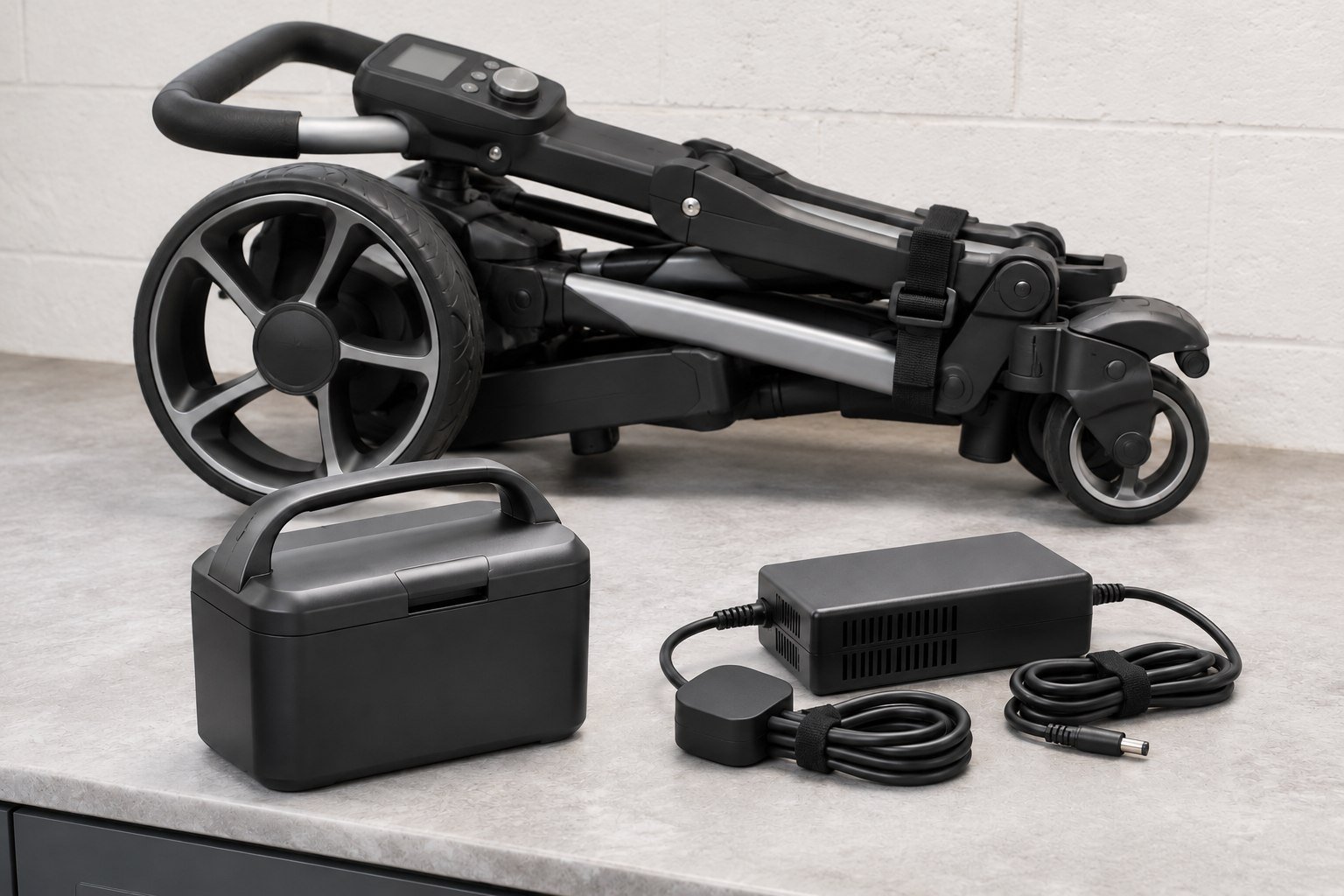
Keep the purchase record and the warranty terms for the exact trolley, battery and charger. AI-created category illustrations show generic equipment, not the named products or a product test.
Electric trolley warranties are easiest to compare when you stop treating the trolley as one item. The frame, main battery, charger, remote handset and handset battery can have different terms. A prominent battery promise may tell you very little about the cost of fixing a controller fault.
This guide uses manufacturer terms checked on 23 November 2026, then turns them into questions for a purchase or claim. It is a research-led comparison of published wording, not a report of successful claims or a judgement about an individual fault. Keep the terms supplied with your purchase: today’s page may not describe an older sale.
A five-year battery scheme need not mean five years of free replacement.
Main battery, charger and handset battery are separate entries to check.
Model, battery type, purchase date and original sales paperwork matter.
Ask about inspection and carriage charges before sending equipment or authorising work.
Electric trolley warranties: start with the exact package
Use the examples below to see which questions matter. They are not a ranking of customer service, repair quality or likely claim success. Read the full policy alongside the receipt and product identification.
Scroll the table horizontally on a small screen to see every column.
| Example and scope | What the published wording says | What to confirm |
|---|---|---|
| Motocaddy standard electric trolley and 28V lithium sections | Trolley: 24 months, excluding M-TECH. Battery: 24 months, extendable to 60 months by registration within 45 days. Charger: 12 months. [1] | Use the section for the exact battery and purchase; an extended battery term does not extend the charger. |
| PowaKaddy UK/ROI terms effective 1 January 2026 | Electric trolley and charger: two years. Plug ’n’ Play 12V/30V lithium: three years of full cover, followed by discounted replacement terms in years four and five. [2] | Check the purchase-year policy and whether a proposed claim qualifies for the stated remedy. |
| Stewart Golf published component table | New trolley and its included lithium battery: two years. The table lists 12 months for a separately bought lithium battery and for a handset battery. [3] | The same page later uses broader two-year battery wording. Obtain written confirmation for a separate battery purchase. |
Motocaddy’s page also contains separate NCM and historical LiFePO4 sections with different wording. Its current 28V section specifies an 80% retained-capacity promise; do not apply that figure to every older battery. [1]
Save the relevant terms and the retailer’s written confirmation. A screenshot of a banner without its conditions is a poor substitute for the actual agreement.
Read the remedy behind “five years”
A warranty’s practical value depends on what happens when an eligible fault appears. A repair at no charge, a replacement with a customer contribution and a discount on a new purchase are different outcomes.
PowaKaddy’s 2026 lithium scheme offers a 30% discount from the listed replacement price in year four and a 15% discount in year five, following its initial three-year full warranty. Those are discounts, not the proportion the customer pays. [2]
A simple illustration of the difference
If the relevant listed battery price were £300, a 30% discount would remove £90 and leave £210 to pay. A 15% discount would remove £45 and leave £255. The £300 is an invented planning input, not a current battery price or a guaranteed claim quotation; any separate charges would also need checking.
Ask which price the discount uses, which replacement is supplied and whether it is compatible with your existing trolley and charger. A percentage based on a manufacturer’s list price is not necessarily a saving against every retail offer you might find.
Also ask what happens to the warranty after the remedy. Do not assume a repair restarts the clock, or that a discounted replacement follows exactly the same rule as a free replacement. Get the answer for the scheme being offered, in writing.
For your own comparison, record two figures: the maximum amount you might need to pay for a qualifying later-year claim, and the price of an appropriate alternative. That makes the decision more useful than comparing two large numbers on warranty badges.
Back to guide contents ↑Check the electronics as carefully as the main battery

“Electronics excluded” is too broad a description to accept without clarification. Ask which component is involved, which clause applies and whether the decision concerns the part itself, the cause of the fault or the length of cover. This question list helps you separate those possibilities; it does not diagnose the equipment.
Scroll the table horizontally on a small screen to see every column.
| Component | Question for the seller or warranty provider | Useful evidence to keep |
|---|---|---|
| Main trolley battery | Which exact battery type and term apply? How is a claimed loss of performance assessed? | Battery identification, purchase date, charge history and a clear account of the change. |
| Battery charger | Does it have a separate warranty period? Must the provider inspect it with the battery? | Charger identification and photographs of its external condition, taken while unplugged. |
| Motor, controller or display | Is the reported symptom being assessed under the trolley warranty? What cause has been identified? | When the symptom began, any error message and whether it is intermittent. |
| Remote handset and its battery | Are the handset unit and its internal battery covered for the same period? | Handset details and a description of the problem; no dismantling is needed for this record. |
| Leads, connectors and switches | Is the issue treated as a defect, wear, accidental damage or another exclusion? | Clear external photographs and the circumstances in which the issue appeared. |
Describe what you observed rather than deciding which internal part has failed. “The display lights up but the trolley does not move” is more useful than an unsupported diagnosis that the motor has died. If support requests a demonstration, follow its safe instructions; do not reproduce a fault that could let the trolley move unexpectedly.
Back to guide contents ↑Read an exclusion alongside the cause of the fault
The word “excluded” needs context. Motocaddy’s standard electric terms cover manufacturing defects during normal use and exclude accidents, misuse and commercial use. [1] That is a reason to preserve the history of the equipment, not a way for this article to decide whether a particular claim should succeed.
Stewart’s current wording makes a useful distinction: a non-genuine part does not automatically end the warranty; it says it will decline a claim where that part or modification caused the fault. [3] Do not turn one manufacturer’s clause into a rule for every trolley, and do not assume that every accessory has the same effect on cover.
For a disputed exclusion, work through three questions:
- What is the actual component or function being assessed?
- Which applicable clause is being relied on?
- What inspection or other evidence connects the reported problem with that exclusion?
Keep accidental events in the account. Omitting a drop, immersion or previous repair makes the assessment less reliable. Equally, a photograph showing a cosmetic scratch does not tell you which electronic component has failed or why; ask for the provider’s explanation.
If a battery or charger appears damaged or behaves abnormally, stop using it and obtain the maker’s instructions. Do not open it, bypass a connection or keep charging it to gather evidence for a claim.
Back to guide contents ↑Build a short, useful claim record

A clear first message can reduce the back-and-forth without turning you into a repair technician. Citizens Advice recommends checking the paperwork and having purchase evidence, fault details and the warranty available when claiming. Its guidance also explains that a manufacturer warranty can still be useful if the original trader has stopped trading. [5]
Prepare one folder containing the receipt, the applicable warranty terms, any registration acknowledgement and photographs of the trolley, battery and charger identification. Add a short timeline: when the problem first appeared, what you were doing, and whether the equipment has been used or repaired since.
Write the symptoms in ordinary language. Note whether the problem is constant or intermittent, and copy an error message accurately. Include relevant circumstances such as a recent impact or an unusually wet outing, without trying to infer what is happening inside a sealed unit.
Ask for a case reference and keep the response with the same records. If a telephone conversation gives an important instruction or quotation, request an email summary. An agreed description helps prevent “inspect the battery” becoming “replace the entire trolley” through a misunderstanding.
For a used trolley, check transferability before relying on the original receipt. PowaKaddy’s current terms distinguish a transferable trolley warranty from a non-transferable battery warranty. [2] The seller’s remaining cover and your own entitlement to claim are separate questions.
Back to guide contents ↑Agree diagnosis, packing and costs before sending it
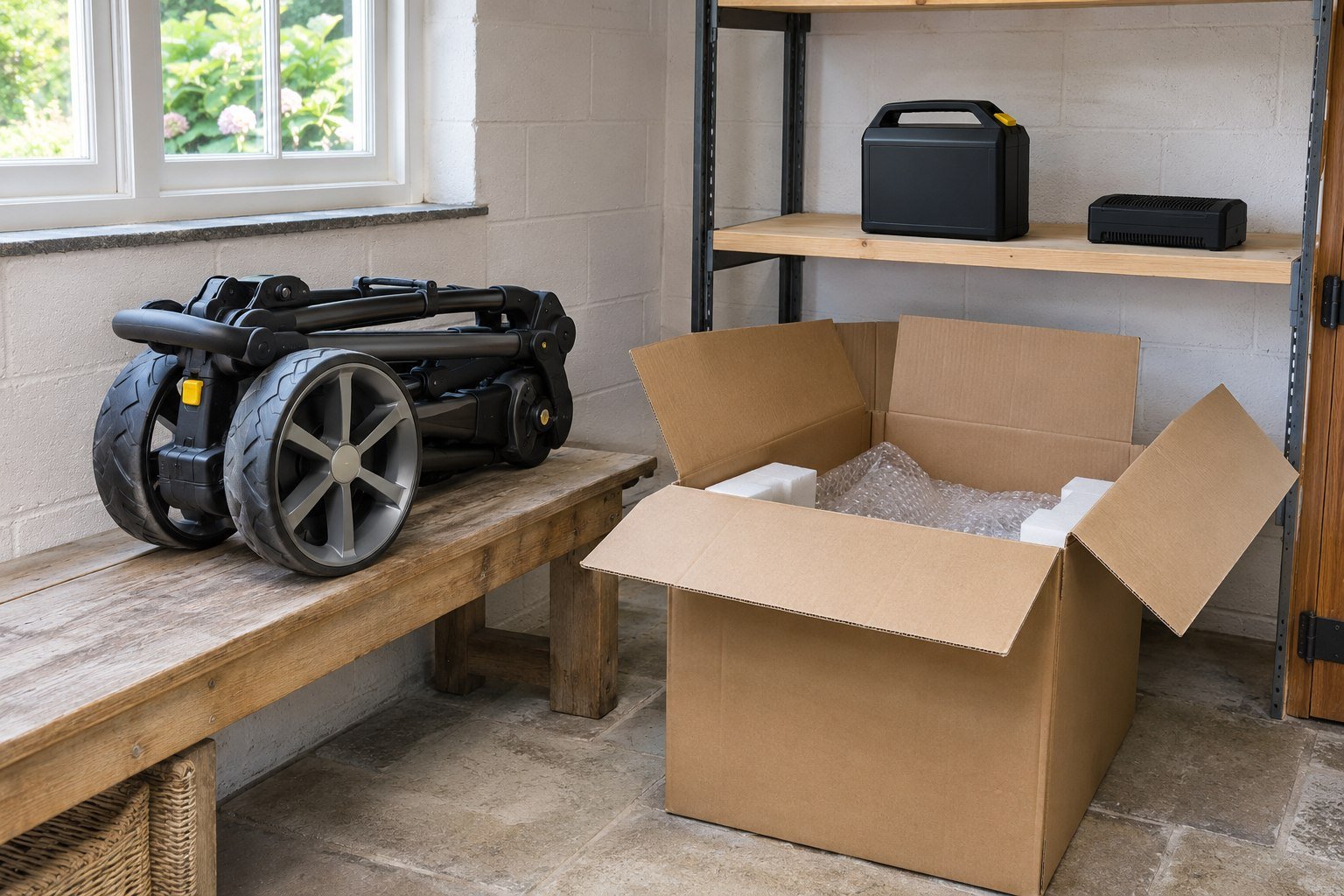
Do not book an ordinary courier first and work out the return process afterwards. Ask the provider whether it wants the frame, battery, charger, handset or the complete system. Battery transport and packaging need the provider’s specific arrangements; a trolley travel cover is not proof that a parcel is correctly packed.
Before handing over equipment, establish:
- Whether the initial assessment is chargeable, and when that charge is waived.
- Who pays collection and return costs if a covered defect is confirmed, no fault is found, or an exclusion applies.
- Which packaging and carrier the provider requires.
- Whether you will receive a quotation before chargeable parts or labour are authorised.
- How the trolley will be returned if you decline a repair.
Motocaddy’s current terms warn that an uncovered fault can lead to courier, administration, parts and labour charges, which it says will be explained before chargeable work proceeds. [1] An inspection charge is therefore a separate question from whether a repair is eventually covered.
Keep the agreed amount and scope together. “Please assess the fault and quote” is different from permission to carry out any repair at any price. If you need the trolley for a forthcoming trip or competition, ask for an estimated turnaround rather than assuming a warranty promises a particular completion date.
Back to guide contents ↑Keep the manufacturer warranty and seller route distinct
For a consumer purchase from a business, a manufacturer warranty adds to the legal rights connected with the sale. GOV.UK explains that customers can still have a right to repair or replacement when a warranty has expired. Whether a particular remedy is available depends on the facts; expiry alone does not answer the question. [4]
If you are raising a statutory faulty-goods issue, identify the business that sold the equipment to you. If you are using a manufacturer warranty, follow its claim procedure. Keep your correspondence clear about which route you are asking the recipient to consider, rather than assuming every request must go through the manufacturer.
A private second-hand sale is a different situation from buying from a trader. Do not assume that a transferable manufacturer warranty creates the same rights as a new retail purchase. Citizens Advice’s warranty page links to guidance for the different UK nations and to further consumer help if the wording or response is unclear. [5]
The useful final check
Before buying, be able to name the covered components, relevant dates, remedy and claim costs. Before claiming, be able to identify the product, describe the symptoms and produce the purchase evidence. If a key clause is ambiguous, get it clarified before relying on it.
A longer headline warranty is useful only when its actual terms help with the problem you might face. Prefer a clear, applicable promise and an understood claim process over an impressive year count with unanswered questions. Our trolleys and course accessories guides cover the other parts of choosing and caring for the system.
Back to guide contents ↑Sources
- Motocaddy UK — Warranty Information
Standard electric, 28V battery and charger terms; separate battery sections and claim costs. Checked 23 November 2026. - PowaKaddy — UK & Ireland warranty terms, effective 1 January 2026
Component cover, pro-rata replacement discounts, exclusions and transferability. Earlier purchase-year terms must be checked separately. Checked 23 November 2026. - Stewart Golf — Warranty
Component table, general battery wording and the causation qualification for non-genuine parts. Separate-battery wording needs purchase-specific clarification. Checked 23 November 2026. - GOV.UK — Accepting returns and giving refunds: the law
Consumer rights and warranty expiry are separate questions. General guidance for business-to-consumer sales. Checked 23 November 2026. - Citizens Advice — Claim using a warranty or guarantee
Claim records, manufacturer claims when a trader closes, and routes to further advice. Page identifies its jurisdiction and links to other UK nations. Checked 23 November 2026.
Illustrations in this article were created for Taylor’s Trailblazing Golf. Third-party photographs, where used, are credited beside the image or in the source list.