
Golf Trolley Winter Storage: Moisture and Battery Guidance
Put away a clean, dry trolley—and give each battery the routine its own instructions require.
Choose a dry storage space and follow the battery maker’s separate winter instructions. AI-created category illustrations show generic equipment, not the named products or a product test.
Golf trolley winter storage has two separate jobs: protecting the frame from a damp, dirty lay-off and keeping the battery system within its manufacturer’s instructions. The place that accommodates muddy wheels is not automatically the right place for a lithium battery or remote handset.
Start with the exact trolley, battery and charger you own, including their generation. This guide compares current manufacturer instructions and supplies a practical record sheet. It does not measure battery life or promise that a particular storage routine will reverse wear or repair a damaged component.
The frame, main battery, handset and charger may need different storage positions.
The examples below have different charging intervals; do not average them.
Record an action and date from your own manual, rather than relying on memory.
Leave time for charging, a normal external inspection and any support advice.
Golf trolley winter storage: separate the frame from the battery
Lay out the equipment before choosing its winter home. Include the remote handset if there is one, the correct charger, removable wheels and the cover. That makes it harder to overlook a small rechargeable component while concentrating on the large frame.
Scroll the table horizontally on a small screen to see every column.
| Part of the system | Job before storage | What the chosen space must allow |
|---|---|---|
| Trolley frame and wheels | Remove debris and moisture using the model’s approved cleaning method; fold only as instructed. | Stable support, access for inspection and no boxes pressing on the handle, display or bag supports. |
| Main battery | Identify it, check its external condition and follow the specified charge, disconnection and storage procedure. | The temperature, dryness and surface requirements in its instructions, with safe access for later checks. |
| Rechargeable handset | Find its own charging cable and storage guidance; do not assume the main-battery routine covers it. | A known, accessible place where it cannot be lost in a wet pocket or left in a cold car. |
| Charger and leads | Inspect externally while unplugged and store without crushing the cable. | A dry position that keeps the correct charger identifiable and ready for the next scheduled charge. |
| Cover or wheel bag | Clean and dry it separately before enclosing dry equipment. | Access to reopen it and check the contents, rather than a sealed package forgotten until spring. |
This is an organisation checklist, not an instruction to disconnect a part in a way its maker has not approved. Use the release mechanism and lifting points specified for your trolley. If the battery is not intended to be removed by the owner, ask the manufacturer how to store the complete unit.
Choose places you can actually reach. A battery behind a stack of boxes is easy to miss when its next charge is due. Keep the instructions and date record with the equipment, without covering ventilation openings or attaching anything to electrical contacts.
Back to guide contents ↑Clean first, then make room for drying

Do the dirty work before the trolley goes into a cupboard or travel cover. Avoid folding clumps of grass and wet debris into joints, wheel recesses or the bag supports. Switch the system off and follow its instructions for removing or isolating the battery before cleaning.
Cleaning methods differ. PowaKaddy’s 2026 FX3 manual permits a sponge and warm water for the frame but prohibits jet washing or immersion. [2] Stewart’s VERTX FAQ instead specifies a soft cloth for debris and its approved surface-cleaning method, and warns against water, hoses and pressure washers. [5] Do not transfer one model’s washing method to another.
Motocaddy’s 2026 M1/M1 DHC manual calls for indoor storage, wiping off excess water and damp-cloth cleaning without a pressure washer. [4]
After cleaning, leave the frame accessible until it is dry enough to put away. Check the areas that are easy to overlook: the underside of the battery tray, pockets in a separate cover, wheel covers and any fabric straps. There is no useful universal “leave it for two hours” rule; conditions and materials differ.
Do not use a radiator, hairdryer or improvised heating arrangement to hurry the battery or electronics. If a component appears water-damaged, drying the outside does not establish that it is safe to charge. Ask the manufacturer how to proceed.
For a manual push trolley, the frame-and-wheel part of this routine still matters. It simply has no drive battery to maintain. Follow its own brake, wheel and folding instructions instead of adopting electric-model maintenance by analogy.
Back to guide contents ↑Use named battery guidance, not a universal winter rule
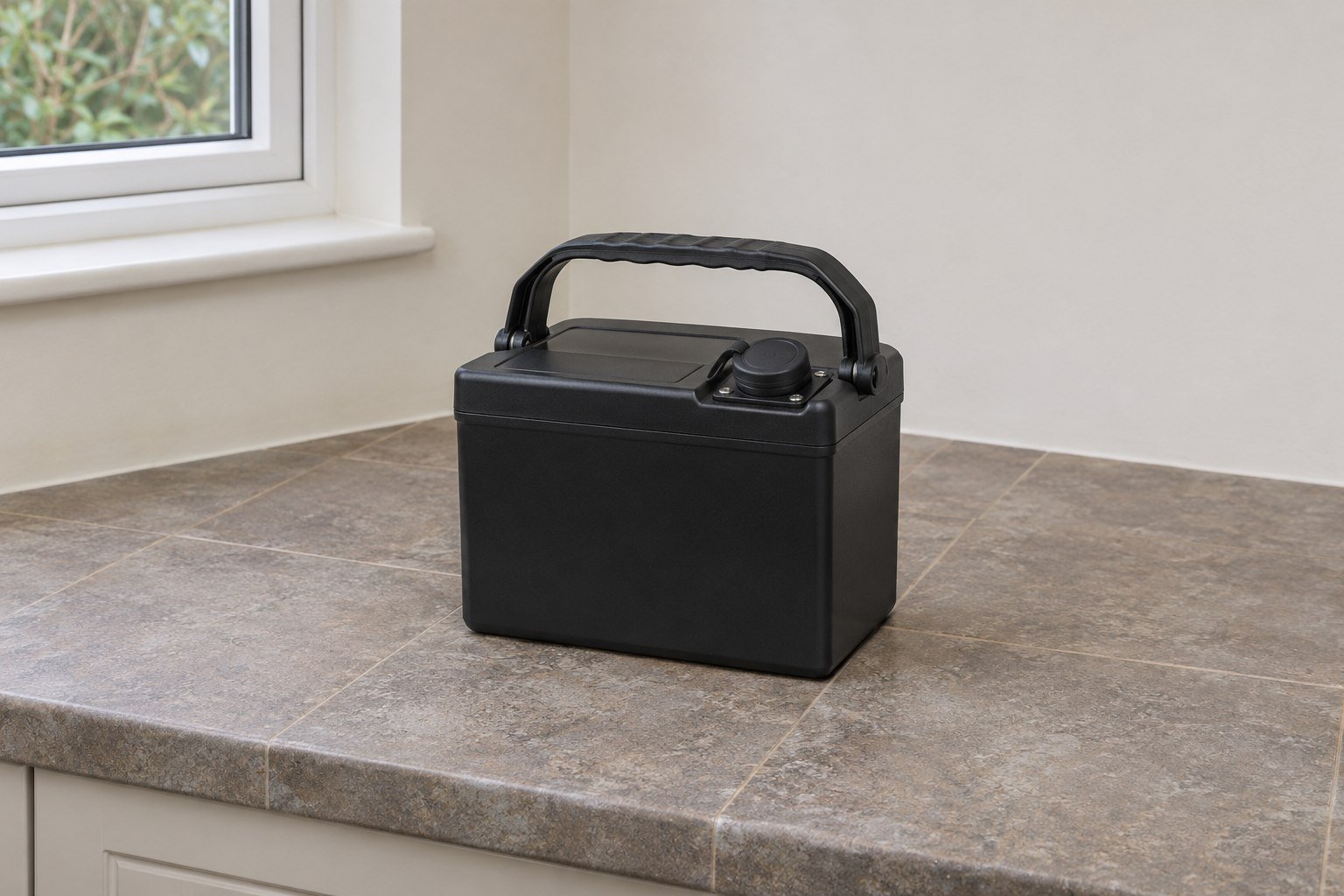
The examples below are deliberately kept separate. They show why a reminder copied from a friend’s trolley may be wrong for yours. They are summaries of the stated guidance, not permission to use a different battery, charger or charging method.
Scroll the table horizontally on a small screen to see every column.
| Manufacturer guidance used | Storage conditions and preparation | Charging during the lay-off |
|---|---|---|
| Motocaddy current lithium battery care guide | Fully charge before extended storage; use a dry, non-carpeted surface within 10–30°C. Disconnect the charger afterwards. [1] | Do not leave it more than two months without charging; top up before use. [1] |
| PowaKaddy 2026 FX3 manual, lithium battery section | Fully charge, then store cool and dry, away from sunlight and excessive heat or cold; ideally at room temperature. [2] | Charge once every three months during storage. [2] |
| Stewart Golf “Keeping Your Batteries Safe”, trolley and handset batteries | For more than one month away, fully charge both, disconnect, switch off and store dry at 15–25°C. [3] | Give both a full charge cycle monthly and a full charge before the next round. [3] |
Do not choose the longest interval in the table because it is convenient. Identify the instructions for your own battery, including any updated guidance for that model. If the supplied manual and a current webpage appear to disagree, ask the maker with the model and serial details rather than inventing a compromise.
The table concerns the stated lithium systems. A lead-acid battery, replacement battery from a different supplier or older electrical system needs its own instructions. A similar plug or a familiar brand name does not establish that the same winter routine applies.
Charge cycle does not mean a home discharge experiment
Follow the charging procedure given for the named battery. Do not run a trolley until it stops, connect a makeshift load or open a battery to prepare it for winter. If the instructions are unclear, get clarification before proceeding.
Keep a record of the battery identity with its charger. If you own more than one trolley, put their manuals and charging equipment in clearly separate places so that a routine winter check does not become a compatibility guess.
Back to guide contents ↑Choose storage and charging places separately
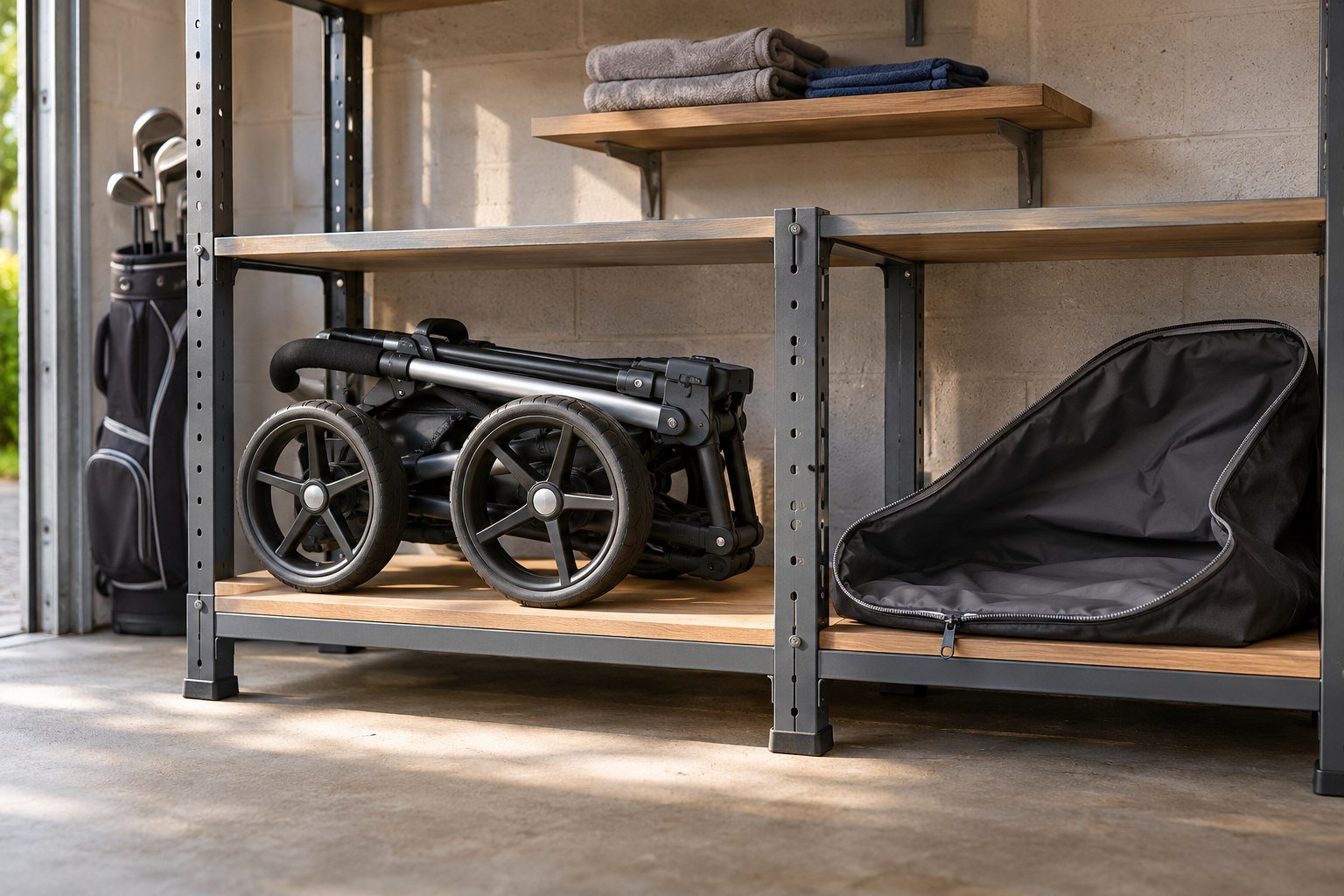
A dry frame may fit neatly into a garage corner while its battery needs a different location. Judge the battery space against the specified conditions, not the name of the room. A garage that is comfortable in October may be much colder during a January lay-off.
Stewart distinguishes operating temperature from charging and storage temperature, and tells owners to bring cold batteries back to room temperature before charging. [3] Being able to play in cold weather is therefore not evidence that a battery can be charged straight from a freezing car boot.
Pick a stable position where the unit will not be knocked down or buried under clothing. The charging location must also satisfy the ventilation and surface requirements in the actual instructions. PowaKaddy’s FX3 manual specifies a hard, flat charging surface and says not to cover the charger or battery. [2]
A zipped travel bag may keep dirt off other belongings during transport, but do not treat it as temperature control or as a charging enclosure. Take the equipment out and use the maker’s required setup when a charge is due. Repack only when the items and cover are dry.
Think through access during the whole break. If you will be away for longer than the specified interval, make an arrangement consistent with the manufacturer’s guidance before leaving. Do not solve the problem by leaving a charger connected unattended for weeks.
Back to guide contents ↑Make a winter record you can use in a minute
Write down actions rather than vague reminders to “check the trolley”. A short record helps you follow the correct routine without rereading several manuals every time.
Scroll the table horizontally on a small screen to see every column.
| Record field | What to enter | Why it helps |
|---|---|---|
| Exact equipment | Trolley generation, battery identification, charger identification and handset if present. | Keeps the routine tied to the components you actually own. |
| Instruction source | Manual title or saved manufacturer link and the relevant storage section. | Lets you recheck the wording if anything is uncertain. |
| Last use and last completed charge | The actual dates, recorded when the actions occur. | Avoids treating the date you put the frame away as proof the battery was charged. |
| Next required action | The task and date derived from the applicable instructions. | Turns a monthly, two-month or three-month interval into a usable reminder. |
| Storage observations | Whether the location remains dry, accessible and within the specified conditions. | Helps you spot a room or access problem before the next planned round. |
| Unresolved issue | Fault description, support reference and whether use or charging has been stopped. | Prevents a problem being forgotten and treated as resolved just because the trolley was stored. |
If the routine changes—for example, you play one unexpected winter round—update the record from what you actually did. Do not leave a reminder that assumes the battery has remained unused since November.
A calendar reminder can support the record, but it cannot tell you whether the charge completed normally or the storage room stayed suitable. Mark an action complete only after it has happened. This is a practical household system, not evidence that a battery has retained a particular capacity.
Back to guide contents ↑Check the system before the first round back

Allow time before your first booking to retrieve, charge and inspect the equipment normally. Discovering a missing charger or stuck folding latch in the car park leaves fewer sensible options.
- Look for new damage or moisture before connecting anything. If a battery or charger seems damaged, stop and seek the maker’s advice.
- Use the correct charging procedure and observe its completion instructions. Do not treat an unusual light sequence as a successful charge.
- Unfold and assemble the frame as directed. Check the locks, wheel attachment, bag supports and normal parking arrangement.
- Follow the manufacturer’s routine functional checks in a clear, suitable area. Keep control of the trolley and stop if something is abnormal.
- Pack the approved battery, charger if needed, handset and any essential accessories for the actual day.
Motocaddy’s care guide says not to charge or use a battery when damage is suspected and advises against overnight or prolonged unsupervised charging. [1] Asking for support is more useful than repeated “test charges” of a questionable unit.
A normal start-up is not a measured endurance test. If your plans depend on two rounds, check the exact battery application and conditions in our guide to 36-hole trolley battery claims. Storage care does not turn a conditional range claim into a guarantee.
Buy only to solve an identified problem
You do not need a new trolley, charger or cover simply because winter has arrived. Start with a suitable space and a reliable routine. Replace missing or damaged equipment only after identifying the correct part and obtaining the necessary compatibility or safety advice.
The best winter plan is one you can maintain: a clean, dry frame, correctly stored batteries, an accessible charger and a written next action. Recheck the arrangement when conditions change rather than assuming a tidy cupboard means every component is being looked after.
Back to guide contents ↑Sources
- Motocaddy UK — How to care for your Motocaddy lithium battery
Current storage interval, conditions, disconnection and damaged-battery precautions. Match guidance to the exact battery and manual. Checked 23 November 2026. - PowaKaddy — 2026 FX3 owner’s manual, revision 2
Battery storage, charging safety and frame maintenance, especially pages 8–9. These instructions are identified by model rather than applied to every trolley. Checked 23 November 2026. - Stewart Golf — Keeping Your Batteries Safe
Main and handset batteries: temperature distinction, long storage and monthly charging. Checked 23 November 2026. - Motocaddy — 2026 M1 / M1 DHC instruction manual
Frame care on page 5. Checked 23 November 2026. - Stewart Golf — VERTX FAQ
Model-specific cleaning instructions; not a universal cleaning method. Checked 23 November 2026.
Illustrations in this article were created for Taylor’s Trailblazing Golf. Third-party photographs, where used, are credited beside the image or in the source list.