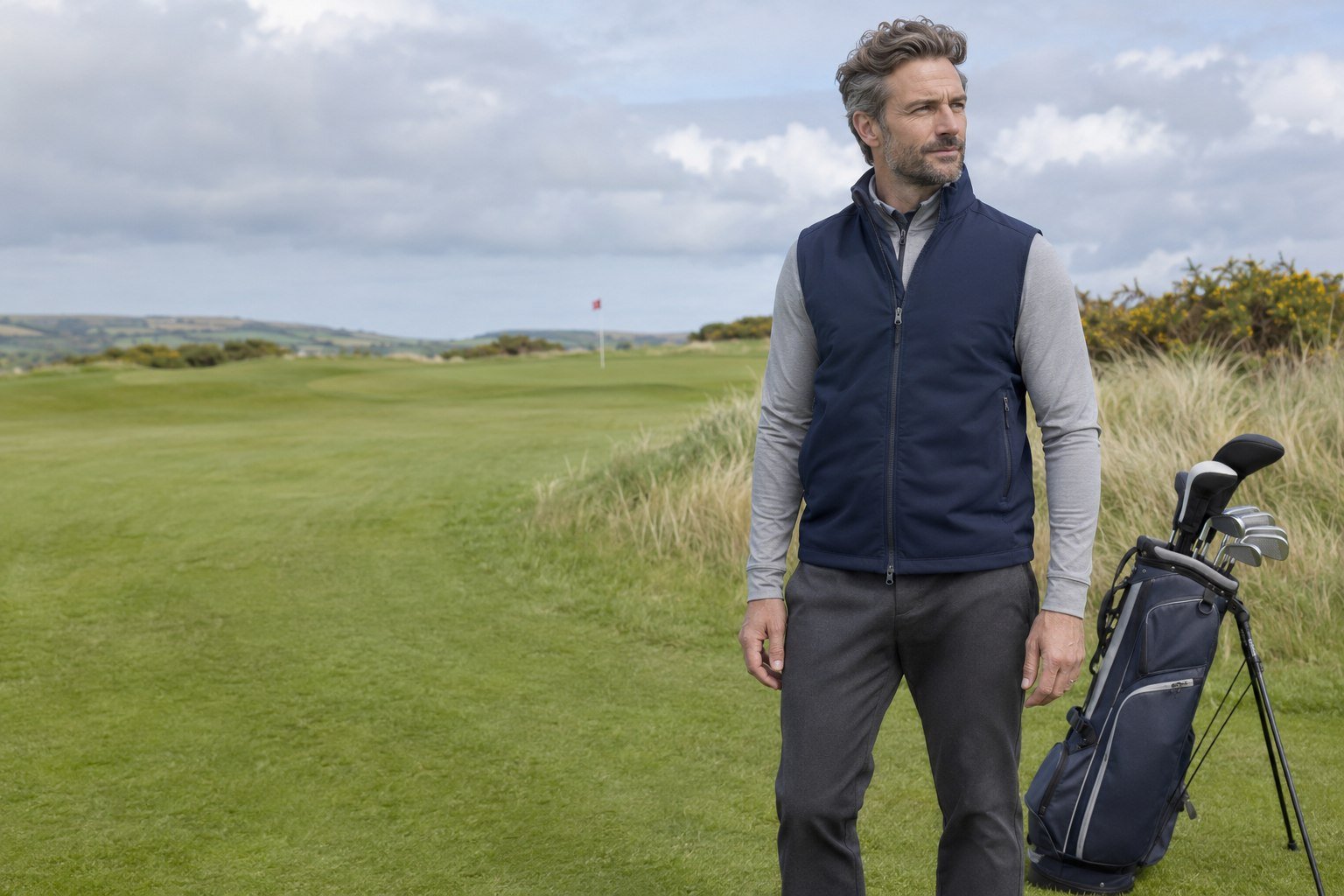
Windproof Golf Layers: Shells, Gilets and Movement
Choose coverage first, then check how the whole outfit moves.
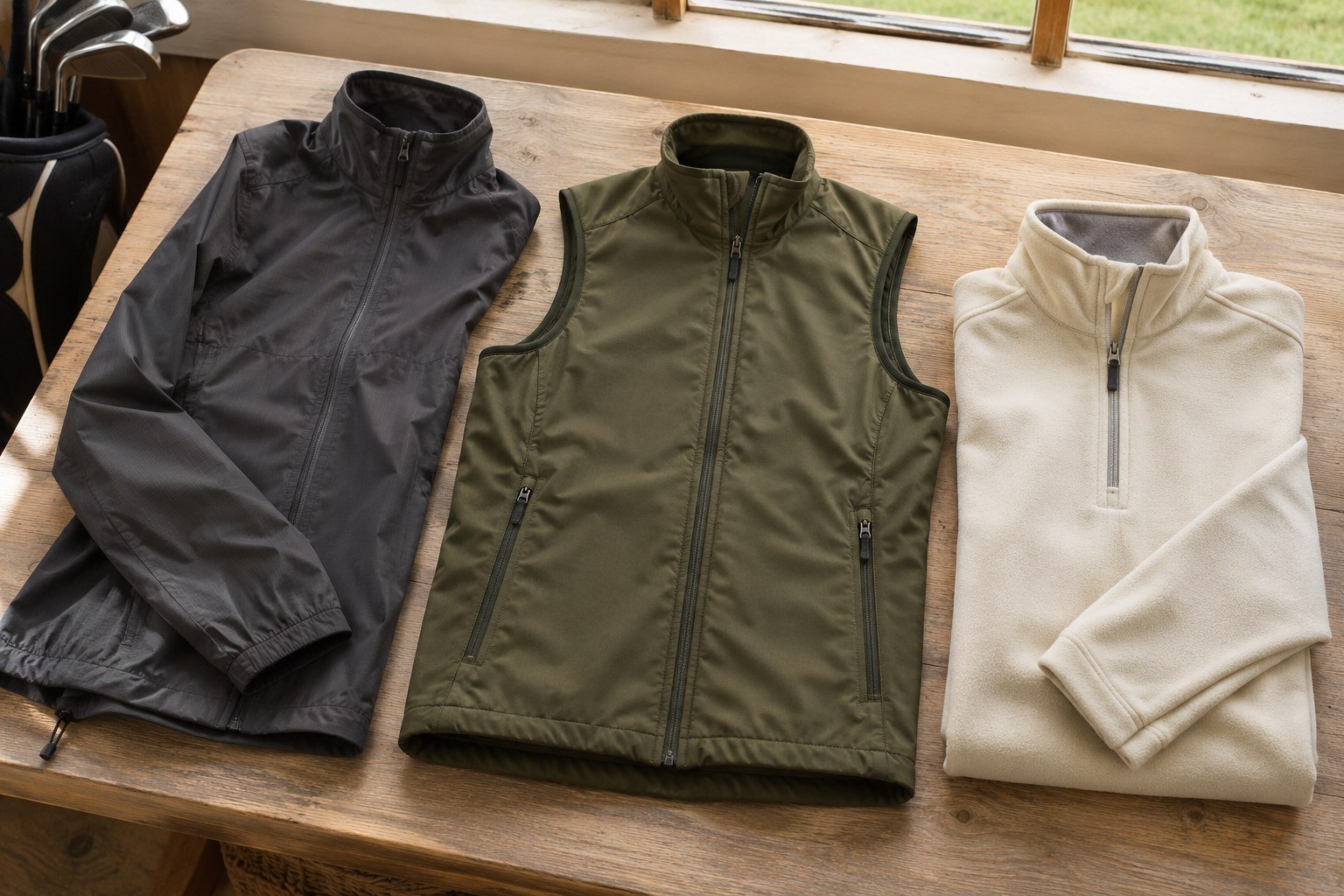
A gilet is one option to compare when you want torso coverage with free sleeves. AI-created category illustrations show generic clothing and equipment, not the named products or a product test.
Windproof golf layers are easiest to choose when you start with the gap in your current outfit. Perhaps the sleeves of your jumper feel exposed on an open tee. Perhaps your body wants another layer but your arms already feel crowded. Those are different problems, and a thicker jacket will not automatically solve both.
This guide separates wind coverage, added warmth and room to move. It combines current garment specifications with an original decision grid and a practical try-on routine. The product examples are research-led illustrations of different constructions; they have not been tested for wind resistance, warmth or swing performance by Taylor’s Trailblazing Golf.
This guide contains affiliate links. If you buy through them, Taylor’s Trailblazing Golf may receive a commission at no extra cost to you.
Compare full sleeves before adding more padding to the body.
Try a windproof gilet over the sleeves you already like.
Change the layer combination before automatically sizing up.
A separate wind layer may add little to your usual rounds.
Windproof golf layers: separate three different jobs
Think of a garment specification as three questions: does it block wind, how much insulation does it add, and what rain protection does the maker claim? A reassuring answer to one does not settle the other two. “Thermal”, “stretch” and “softshell” should prompt a closer look at the actual description, not act as substitutes for it.
Galvin Green, for example, places its windproof, water-repellent INTERFACE-1 jackets in conditions including wind, cold and light rain. That is a useful stated role, but it is not the same claim as a waterproof rain jacket. Match the rain protection you carry to the forecast rather than upgrading the meaning of “water repellent”. [1]
For this guide, a shell means the outer garment providing weather protection. It does not automatically mean unlined or uninsulated. A gilet means a sleeveless garment; it may be padded, lightly lined or primarily a wind barrier. Check both construction and coverage before comparing two prices.
Write down one sentence about your last uncomfortable round: “My forearms felt exposed”, “I kept taking the jacket off on hills”, or “My outer layer pulled across my shoulders”. Use that observation to choose the next change. Buying a warmer garment for a movement problem is an expensive experiment.
Back to guide contents ↑Choose a shape around the coverage you need
The grid below is a selection aid, not a temperature chart. “Windproof” remains something to confirm in the exact model specification. None of these shapes guarantees a comfortable fit or a particular level of warmth.
Scroll the table horizontally on a small screen to see every column.
| Garment approach | Useful starting point | Trade-off to examine | Try-on priority |
|---|---|---|---|
| Full sleeves with little added insulation | You want wind coverage over an outfit whose warmth already suits you. | Warmth must still come from the overall combination; confirm how the particular shell is lined. | Shoulder reach, forearm room and cuffs over your usual sleeves. |
| Full sleeves with lining or padding | You want coverage and another source of insulation in one garment. | The extra warmth cannot be separated from that jacket; it also has to fit into the bag when removed. | Closed-zip movement over your normal winter middle layer. |
| Windproof gilet | Your torso needs protection while your existing sleeves already work. | Your arms remain dependent on the layers underneath; check whether the gilet itself is padded. | Armhole edges, shoulder width and the hem when you turn. |
| An existing jacket with confirmed wind protection | You already own an outer layer that covers the conditions. | A second garment needs a clear benefit in fit, venting or packing to justify the cost. | Repeat the same movement and bag checks before shopping. |
A gilet can remove an extra sleeve from the outfit, but its armholes and chest still need to fit. Equally, a full-sleeve garment with a suitable cut may work better than a tight gilet. Choose through the actual movement check rather than assuming that fewer sleeves must mean a better swing.
Try it on closed, over your actual golf layers
Bring the base layer and middle layer you expect to wear. A jacket that feels roomy over a thin T-shirt tells you little about how it will fit over your winter outfit. Use the maker’s chart for that exact garment and follow its measurement instructions; do not add an arbitrary allowance to a body measurement.
The published golf clothing size-chart guide helps organise those measurements before you compare labels. If two sizes bracket your measurements, compare them in the intended outfit rather than assuming the larger one is automatically safer.
- Set the starting position. Close the zip, settle the underlying sleeves and adjust the hem as you intend to wear it. Check that the collar is comfortable with your head upright.
- Reach forwards. Extend both arms as if taking your address position. Notice pulling across the upper back, pressure at the front of the armholes and sleeves that retreat up the wrist.
- Turn gently each way. With clear space and no club, rehearse a comfortable shoulder turn. Notice whether the body of the garment twists and stays displaced afterwards.
- Bend and recover. Bend as you would to pick up a ball. Check the back hem, waistband overlap and whether the front bunches against your stomach.
- Use the outfit. Reach into a trouser pocket, operate the jacket zip and put a glove on. A small inconvenience repeated through a round can matter more than a feature you rarely use.
If something binds, remove one underlying layer and repeat the same movement. That helps identify whether the problem is the outer garment, a crowded combination or a sleeve caught underneath. It does not prove which size will be warm enough outdoors.
Useful stopping rule: if the garment only feels acceptable with the zip open, test another cut or combination. Your fit check should include the closed position you expect to use when exposed to the wind.

Check the openings, not just the fabric
A fabric claim cannot tell you how a particular collar, cuff or hem will sit on your body. These are worth inspecting separately because they are the parts you can adjust during a round.
Collar and neck
Close every collar you intend to wear together. Turn your head as if following a ball and look down towards the address position. Decide whether you want the outer collar raised, folded or partly open. A high collar is only useful if you are willing to wear it that way.
Cuffs and armholes
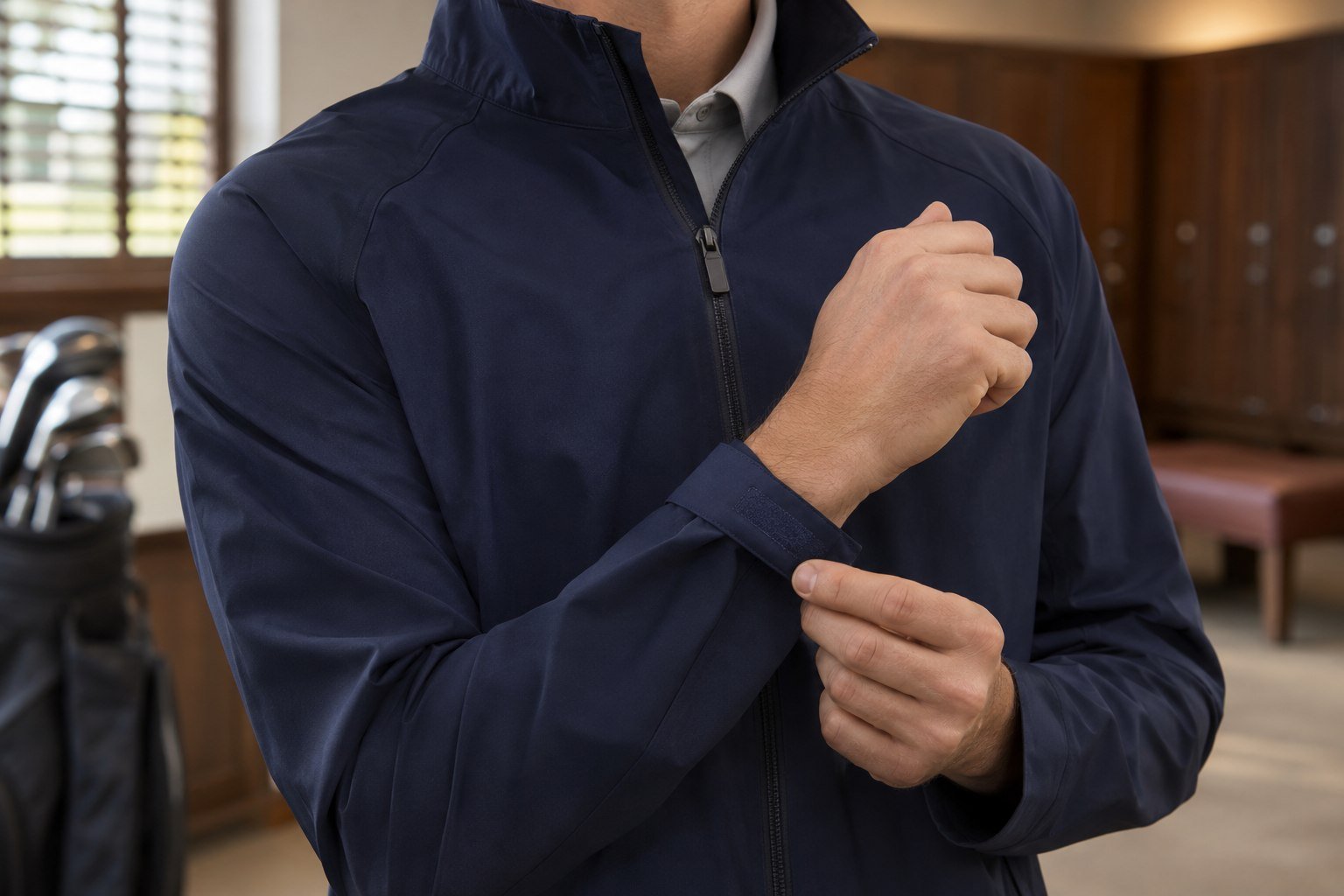
Check cuffs with the underlying sleeve in place and your normal glove on. Look for a stack of fabric at the wrist or a cuff that interferes with the fastening. On a gilet, check the armhole with your arms forwards as well as relaxed; an edge that seems loose when standing may sit differently during the swing.
Hem and front zip
Try the hem adjustment without pulling it so tight that the garment rides up. Check that any cord or toggle is stowed neatly. A full zip gives you a wider opening than a short neck zip, but the best choice is the one you can operate easily and use without the garment becoming awkward.
Plan an adjustment for the walk between shots as well as for standing on a tee. Opening a zip or removing a layer changes the outfit immediately; the word “breathable” does not tell you whether your particular combination will feel right throughout a round.
Two current examples: compare the job before the price
These men’s garments illustrate a full jacket and a padded gilet from one manufacturer. They are not a best-buy ranking, a complete market comparison or evidence that this price level is necessary. Use their specifications to see how coverage and insulation can differ.
Scroll the table horizontally on a small screen to see every column.
| Example and exact code | Documented construction | What to decide for yourself |
|---|---|---|
| Galvin Green Lloyd, Navy/White B01000449349 | The maker lists windproof and water-repellent fabric, a regular fit, elasticated cuffs and an adjustable hem. It also claims thermal insulation, so this is not an example of a completely uninsulated shell. [2] | Does the sleeved jacket fit over your chosen middle layer, with room at the shoulders and wrists? |
| Galvin Green Luca, Forged Iron/Black B01000619237 | The maker describes a windproof, water-repellent vest with Thermore padding, stretch panels, a regular fit and an adjustable hem. Its sleeveless shape and padding are separate design decisions. [3] | Do you need padded torso coverage, and are the sleeves underneath sufficient for your intended outfit? |
Clubhouse Golf listed the Lloyd Navy/White at £229 and the Luca Black/Forged Iron at £219 on 24 November 2026. The Luca colour words appear in the opposite order, but its article code matches. These are observed item prices; check the selected size, current price and delivery total before ordering. [4] [5]
If the full jacket answers your coverage needs, view that Lloyd model at Clubhouse Golf. If you specifically want a padded gilet, check that Luca model at Clubhouse Golf. Neither purchase is necessary if your existing outfit passes the same checks.
Back to guide contents ↑Make removal and packing part of the decision
Before buying, fold the garment to the size you would realistically manage beside the course and compare it with the available space in your golf bag. Include whatever else normally occupies that pocket. A garment need not disappear into a tiny pouch, but it does need a practical home when you stop wearing it.
Also rehearse putting it on and taking it off over the intended layers. A style that needs repeated sleeve adjustments may discourage you from changing the outfit when you want to. Check that you can retrieve it without emptying the whole bag.
For the Lloyd specifically, Galvin Green recommends hanging it to dry after use and warns against leaving it packed away wet. Its care instructions permit low-heat tumble drying and exclude fabric softener. Follow the actual garment label rather than transferring those settings to another wind layer. [2]
Unpack the layer after the round and check the label before washing or using any treatment. Do not infer a waterproof rating from a freshly beading surface, and do not assume that every jacket needs the same care product.

Use a four-line decision before you buy
A useful purchase should solve a named problem while still fitting the rest of the kit. Record these four answers on your phone; they are more revealing than an unweighted list of attractive features.
- Missing coverage: write “arms and torso” or “torso only”, then name the existing layers that cover everything else.
- Warmth adjustment: decide whether you need more insulation, less bulk or simply a wind barrier. If uncertain, change one element of the existing outfit first.
- Movement result: note the exact outfit used in the try-on and any pulling, bunching or collar interference. Record the cut and size, not just the brand.
- Practical cost: include the purchase and delivery, the bag space required, and any existing garment that it would genuinely replace.
Keep what you own if it supplies the stated protection you need, moves comfortably and is easy enough to adjust. Change the combination if two layers are competing for the same space. Buy a different shape when the remaining problem is specific: uncovered arms, an unsuitable collar, crowded sleeves or a garment you cannot conveniently carry.
After a round, record where and when the outfit felt wrong rather than simply calling the jacket “too warm” or “not warm enough”. The next decision becomes clearer when you know whether the issue appeared while walking, waiting, turning or wearing the rain layer over the top.
Back to guide contents ↑Sources
- Galvin Green: men’s windproof and water-repellent jackets
Manufacturer’s stated weather role for INTERFACE-1; consulted 24 November 2026. It is not an independent wind or rain test. - Galvin Green Lloyd, Navy/White — B01000449349
Exact model construction, fit and care instructions; consulted 24 November 2026. Manufacturer performance claims are attributed. - Galvin Green Luca, Forged Iron/Black — B01000619237
Exact padded vest construction and fit; consulted 24 November 2026. No measured warmth comparison is inferred. - Clubhouse Golf: Lloyd Navy/White — WTGAL250
Article code and £229 item price observed 24 November 2026. Size availability, delivery and prices can change. - Clubhouse Golf: Luca Black/Forged Iron — WTGAL255
Article code and £219 item price observed 24 November 2026. Manufacturer code matches despite reversed colour wording.
Illustrations in this article were created for Taylor’s Trailblazing Golf. Third-party photographs, where used, are credited beside the image or in the source list.